
the Creative Commons Attribution 4.0 License.
the Creative Commons Attribution 4.0 License.
 | 11 Mar 2026
The past evolution of marine heatwaves and their drivers in the southern North Sea
Abstract. Marine heatwaves (MHWs) are defined as prolonged periods of anomalously high ocean temperatures. These events can have severe impacts on marine ecosystems and, if they occur at the surface, can feed back on the atmosphere, changing inland air temperatures and precipitation.
We use a comprehensive set of model, reanalysis, and observational datasets to investigate recent changes in North Sea MHWs. All datasets show a significant warming trend, accompanied by a marked increase in the frequency of MHWs. In contrast, the maximum intensity of MHWs has decreased in many regions of the North Sea, including the German Bight. If the linear trend in temperature is removed, only few MHWs have been detected after 2019, suggesting natural variability has damped the effect of the long-term warming.
While distinct weather patterns are associated with the onset of MHWs, their occurrence alone is not sufficient to trigger them. As the heat content is an integrated quantity, the ocean temperature at the beginning of the season (ocean preconditioning) is a key factor, in addition to prevailing weather patterns during the season. As a consequence, only in winter we find a significant dependency of MHWs on established climate indices. Instead, MHWs result from a combination of short-term, weather-related, variability and longer-term seasonal to decadal variability.
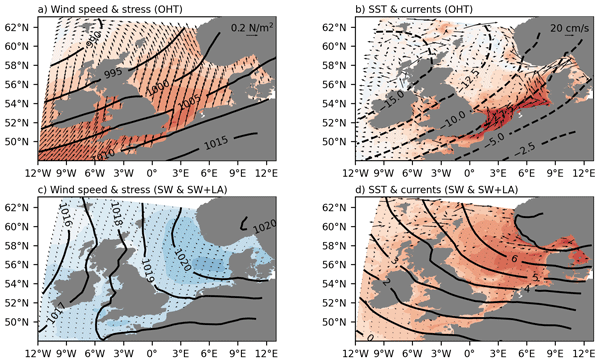
Furthermore, we find that the evolution of the surface temperature in the German Bight is largely determined by local atmospheric conditions rather than remote variability in the Atlantic. Although the inflow of warm water through the English Channel is important, it is the atmosphere that controls its volume transport and temperature. Whether the atmospheric conditions themselves are linked to remote variability in the Atlantic Ocean remains to be studied.
-
Notice on discussion status
The requested preprint has a corresponding peer-reviewed final revised paper. You are encouraged to refer to the final revised version.
-
Preprint
(8127 KB)
-
The requested preprint has a corresponding peer-reviewed final revised paper. You are encouraged to refer to the final revised version.
- Preprint
(8127 KB) - Metadata XML
- BibTeX
- EndNote
- Final revised paper


Journal article(s) based on this preprint
Interactive discussion
Status: closed
-
RC1: 'Comment on egusphere-2026-1239', Anonymous Referee #1, 16 Apr 2026
-
AC1: 'Reply on RC1', Tobias Schulzki, 01 Jun 2026
The comment was uploaded in the form of a supplement: https://egusphere.copernicus.org/preprints/2026/egusphere-2026-1239/egusphere-2026-1239-AC1-supplement.pdf
-
AC1: 'Reply on RC1', Tobias Schulzki, 01 Jun 2026
-
RC2: 'Comment on egusphere-2026-1239', Segolene Berthou, 27 Apr 2026
Review of the manuscript entitled
"The past evolution of marine heatwaves and their drivers in the southern North Sea”
By Tobias Schulzki et al.
This study presents the past evolution of marine heatwaves in the North Sea, and in particular the German bight. It first compares different observation-based gridded products and different model-based simulations, including regional and global reanalyses. The different products show reasonable agreements, though the reanalyses and satellite-driven are more in line with each-other. All datasets show a significant warming trend everywhere in the North Sea, and a trend towards an increase frequency of marine heatwaves, most of them are significant. The trends disappear with detrending, and natural variability acted to reduce slightly the variability in the last decade. The study then picks one model, for which the authors have access to full output and can re-run, although not the best amongst the other datasets, still represents MHW and trends relatively correctly. With this (global) model, they take a look at the different drivers of MHWs. They conclude that MHWs in the German Bight require several conditions to happen: 1. Some pre-conditioning in the previous season, and 2.a. Atmospheric drivers in the summer acting to enhance solar radiation and reduce latent heat cooling, or 2.b. oceanic advection driven by atmospheric low-pressure systems in winter months. They also examine the atmospheric conditions for advective MHW to happen. Finally, they show that anomalies in the North Atlantic don’t advect into the North Sea, and therefore anomalies in the southern North Sea are mainly linked with atmospheric conditions. They also show that longer term variability of temperature in the German Bight is a subtle equilibrium between surface heat fluxes and ocean advection.
The article shows new insights into the drivers and tendencies of MHWs in the North Sea, and in particular highlights new process-understanding of cold-season MHWs in the southern North Sea, which are linked with advection of warmer water from the English Channel into the North Sea, which, when the background anomalies are already high, can lead to MHW triggering. They also show that weather-regimes alone are a necessary but not sufficient condition to develop marine heatwaves.
I enjoyed reading this article and I gained new insight into these processes influencing different timescales of surface temperature variability in the North Sea. The article is very long, but it is well separated into sizeable chunks to read. The methods are robust and statistical methods are well used to assess significance. The figures are of excellent quality.
I have a few comments which I would like the authors to address before I recommend the manuscript for publication:
- MHW intensity – you take the maximum MHW intensity in your article, showing no significant trend. However, maximum MHW intensity i would the conclusion still be true with mean MHW intensity?
- Your result that OIS has a larger SST trend than OIS or any other dataset in the North Sea is important, in particular as it’s the dataset used in Mahamed et al. 2025 – please highlight it in the conclusion.
- Please do a general re-read, as there are a few typos here and there, I highlight a few below in the minor comments
- Regarding MHW drivers (Figure 4): I’m surprised LW cooling suppression (e.g. by low-level cloud) doesn’t come up as a driver in the autumn/winter – can the authors comment on this? (LW+SE+LA only significant in one case in the detrended baseline)
- I understand that the authors use a common period to compare all the datasets, but their conclusions Line 739 may not hold if taking the full 1982-2025 dataset – please comment on this – does the trend emerge in OST when the full available period taken?
- On the variability on seasonal timescales (6.1), I am surprised by the major influence of Ti on mean season temperature anomaly in MJJJ found in Figure 8, but this does not translate into presence of at least 1 MHW/Ti conditional probability in Fig. 7d, despite a strong MHW/mean seasonal temperature conditional probability. Can the authors explore this further?
- I would invite the authors to be clearer in section titles and in figure captions about which graph relates to the whole of the North Sea, and which to the German Bight only. I kept being confused between the two regions. I think only section 4 and figure 1-3 relates to the whole North Sea, but the rest of the article is just for the German Bight, please make it clearer
- Regarding MHW drivers, the fact that you are detrending or not seems to have a large impact on results, in particular the detrending brings new MHWs in the 1980s associated with heat advection. Your event set shown in Figure 4 c and f seems to be almost entirely different for every year depending on detrending or not, and seems to have more MHWs in the detrended baseline than the fixed one. This makes me think that you removed an all-year trend, rather than a month-by-month or season-by-season trend. The trend is usually larger in summer than winter, so if you removed a yearly-averaged trend, then more winter events will emerge in the past by construction, but this is incorrect (Smith et al. 2025).
Minor comments:
- European Northwest Shelf -> Northwest European shelf
- Abstract: line 12: replace “Instead” by “In this region,”
- Line 39: Hu et al. 2021 can be complemented by Okajima et al. (2025), who showed wet bulb globe temperature enhanced by a MHW in Japan, leading to human discomfort.
- Lines 111-115: please add that VIKING is a NEMO-based ocean configuration
- Line 158: It it based -> it is based
- Please check GLORYS12 reference: should be Lellouche et al (first names/last names mixed up in the reference)
- Figure 1: please use the same y-axis scale between 1a and 1b.
- Lines 380-381: the overestimation of MHW days by models & reanalyses: this may be linked with the satellite datasets having no diurnal cycle, and instead representing a night-time, foundation SST (Good et al. 2020) – please comment on this in the article.
- Line 404: define Southern Bight
- Line 404: and frequency, have increased -> and frequency have increased,
- Line 440: less -> fewer
- Figure 2: the dots overimposed on the temperature trend maps make the colour scale hard to read – I suggest to use fewer colour levels (e.g. 0, 0.1, 0.2, 0.3, 0.4), so that it’s easier to read the figure
- Line 44: less -> fewer
- Line 445: the difference between minimum and maximum -> missing which quantity you are talking about: SST?
- Paragraph Line 460: is the decrease trend in standard deviation statistically significant? It looks more like interannual variability
- Line 544: These results
- Line 540: strong input of heat at the ocean surface -> please rephrase, as LA-driven MHWs are rather a lack of cooling rather than a warming (so there is no “input of heat”)
- Line 569: Northeast of Scotland -> look Northwest of Scotland to me (upper left boundary of the map)
- Line 637: various different weather patterns -> various weather patterns
- Lines 650: 1988/89 -> 87/88 if I interpret the figure correctly
- Line 651: 1987 -> 1988
- Figure A2: c, f and i have a negative depth scale – please correct to be consistent with other panels
References:
Okajima, S., Kosaka, Y., Miyasaka, T., & Ito, R. (2025). Unprecedented marine heatwave significantly exacerbated the record-breaking 2023 East Asian summer heatwave. AGU Advances, 6, e2025AV001673. https://doi.org/10.1029/2025AV001673
Smith, K. E., sen Gupta, A., Amaya, D., Benthuysen, J. A., Burrows, M. T., Capotondi, A., Filbee-Dexter, K., Frölicher, T. L., Hobday, A. J., Holbrook, N. J., Malan, N., Moore, P. J., Oliver, E. C. J., Richaud, B., Salcedo-Castro, J., Smale, D. A., Thomsen, M., & Wernberg, T. (2025). Baseline matters: Challenges and implications of different marine heatwave baselines. Progress in Oceanography, 231, 103404. https://doi.org/https://doi.org/10.1016/j.pocean.2024.103404
Citation: https://doi.org/10.5194/egusphere-2026-1239-RC2 -
AC2: 'Reply on RC2', Tobias Schulzki, 01 Jun 2026
The comment was uploaded in the form of a supplement: https://egusphere.copernicus.org/preprints/2026/egusphere-2026-1239/egusphere-2026-1239-AC2-supplement.pdf
Peer review completion


Interactive discussion
Status: closed
-
RC1: 'Comment on egusphere-2026-1239', Anonymous Referee #1, 16 Apr 2026
This paper uses a wealth of data sources, principally models and re-analyses, to consider the relative influence of atmospheric and oceanic drivers on the generation of marine heatwaves (MHW) in the North Sea, specifically in the German Bight. They report that, save for in winter, weather patterns and climate indices (e.g. the NAO) in a given season cannot alone explain the incidence of MHW: the effects of ocean pre-conditioning must also be taken into account. They also report that ocean-atmosphere heat fluxes tend to dampen the influence of heat transport anomalies, lessening the frequency with which heat transport alone generates MHW, at least in their study region.
This is a nice paper that contains some interesting results that I think will be of interest to the community. I particularly think that the consideration of both vertical (atmospheric) and horizontal (oceanic) heat fluxes is timely. I have only a few fairly minor comments, so I recommend publication after minor revisions. Please accept my apologies for the delay in submitting this review.
COMMENTS
Introduction. It would be nice to have a few sentences justifying the choice of study region. Why was the German Bight chosen as the focus of this study? Why is it important? And a bit of background about the region’s oceanography would be good too – for instance, annual cycle of stratification, circulation patterns etc.
Line 129. Is there likely to be an impact of not including tidal forcing? This is presumably a region with relatively strong tidal currents? Apologies if I’ve missed something, but a word or two on this would be welcome.
Line 148. “Dynamically” implies a temporal change, but do you mean a spatial change in this context?
Also line 148. Taking the sub-surface temperature as the surface temperature: how does this fit with the finding of Berthou et al (2024) that heatwaves peak in a thin surface layer, and anomalies are much smaller below this? Is the depth of your uppermost interpolated value still within this surface layer?
Line 176. The model might not include the effects of tidal forcing directly, but presumably the observations that are fed into GLORYS12 will include the effects of tidal forcing?
Line 283. Apologies if I’ve missed something here, but will the degree of surface heat lost to deeper model levels be at least partly determined by the degree of turbulent mixing in the model? Which will be influenced by tides – or the lack thereof? That is, will not including tides in products/models such as VIKING20X reduce the amount of vertical heat transport?
Figure 2. I know this is a common way of plotting things, so I don’t want to insist – but I do think it makes it harder to interpret these sorts of plots when the bits that are significant are stippled out, rather than the bits that aren’t.
Line 484. In what direction are the latent heat anomalies? I’d state here for clarity.
Line 735. This sentence doesn’t make a lot of sense to me: there was a warming trend that was followed by a warming trend? I’d re-phrase for clarity.
Line 805. Temperature is an integrated quantity – do you mean spatially or temporally? (Or both?!) From later context, I assume you mean temporally, but I’d state it here explicitly.
Citation: https://doi.org/10.5194/egusphere-2026-1239-RC1 -
AC1: 'Reply on RC1', Tobias Schulzki, 01 Jun 2026
The comment was uploaded in the form of a supplement: https://egusphere.copernicus.org/preprints/2026/egusphere-2026-1239/egusphere-2026-1239-AC1-supplement.pdf
-
AC1: 'Reply on RC1', Tobias Schulzki, 01 Jun 2026
-
RC2: 'Comment on egusphere-2026-1239', Segolene Berthou, 27 Apr 2026
Review of the manuscript entitled
"The past evolution of marine heatwaves and their drivers in the southern North Sea”
By Tobias Schulzki et al.
This study presents the past evolution of marine heatwaves in the North Sea, and in particular the German bight. It first compares different observation-based gridded products and different model-based simulations, including regional and global reanalyses. The different products show reasonable agreements, though the reanalyses and satellite-driven are more in line with each-other. All datasets show a significant warming trend everywhere in the North Sea, and a trend towards an increase frequency of marine heatwaves, most of them are significant. The trends disappear with detrending, and natural variability acted to reduce slightly the variability in the last decade. The study then picks one model, for which the authors have access to full output and can re-run, although not the best amongst the other datasets, still represents MHW and trends relatively correctly. With this (global) model, they take a look at the different drivers of MHWs. They conclude that MHWs in the German Bight require several conditions to happen: 1. Some pre-conditioning in the previous season, and 2.a. Atmospheric drivers in the summer acting to enhance solar radiation and reduce latent heat cooling, or 2.b. oceanic advection driven by atmospheric low-pressure systems in winter months. They also examine the atmospheric conditions for advective MHW to happen. Finally, they show that anomalies in the North Atlantic don’t advect into the North Sea, and therefore anomalies in the southern North Sea are mainly linked with atmospheric conditions. They also show that longer term variability of temperature in the German Bight is a subtle equilibrium between surface heat fluxes and ocean advection.
The article shows new insights into the drivers and tendencies of MHWs in the North Sea, and in particular highlights new process-understanding of cold-season MHWs in the southern North Sea, which are linked with advection of warmer water from the English Channel into the North Sea, which, when the background anomalies are already high, can lead to MHW triggering. They also show that weather-regimes alone are a necessary but not sufficient condition to develop marine heatwaves.
I enjoyed reading this article and I gained new insight into these processes influencing different timescales of surface temperature variability in the North Sea. The article is very long, but it is well separated into sizeable chunks to read. The methods are robust and statistical methods are well used to assess significance. The figures are of excellent quality.
I have a few comments which I would like the authors to address before I recommend the manuscript for publication:
- MHW intensity – you take the maximum MHW intensity in your article, showing no significant trend. However, maximum MHW intensity i would the conclusion still be true with mean MHW intensity?
- Your result that OIS has a larger SST trend than OIS or any other dataset in the North Sea is important, in particular as it’s the dataset used in Mahamed et al. 2025 – please highlight it in the conclusion.
- Please do a general re-read, as there are a few typos here and there, I highlight a few below in the minor comments
- Regarding MHW drivers (Figure 4): I’m surprised LW cooling suppression (e.g. by low-level cloud) doesn’t come up as a driver in the autumn/winter – can the authors comment on this? (LW+SE+LA only significant in one case in the detrended baseline)
- I understand that the authors use a common period to compare all the datasets, but their conclusions Line 739 may not hold if taking the full 1982-2025 dataset – please comment on this – does the trend emerge in OST when the full available period taken?
- On the variability on seasonal timescales (6.1), I am surprised by the major influence of Ti on mean season temperature anomaly in MJJJ found in Figure 8, but this does not translate into presence of at least 1 MHW/Ti conditional probability in Fig. 7d, despite a strong MHW/mean seasonal temperature conditional probability. Can the authors explore this further?
- I would invite the authors to be clearer in section titles and in figure captions about which graph relates to the whole of the North Sea, and which to the German Bight only. I kept being confused between the two regions. I think only section 4 and figure 1-3 relates to the whole North Sea, but the rest of the article is just for the German Bight, please make it clearer
- Regarding MHW drivers, the fact that you are detrending or not seems to have a large impact on results, in particular the detrending brings new MHWs in the 1980s associated with heat advection. Your event set shown in Figure 4 c and f seems to be almost entirely different for every year depending on detrending or not, and seems to have more MHWs in the detrended baseline than the fixed one. This makes me think that you removed an all-year trend, rather than a month-by-month or season-by-season trend. The trend is usually larger in summer than winter, so if you removed a yearly-averaged trend, then more winter events will emerge in the past by construction, but this is incorrect (Smith et al. 2025).
Minor comments:
- European Northwest Shelf -> Northwest European shelf
- Abstract: line 12: replace “Instead” by “In this region,”
- Line 39: Hu et al. 2021 can be complemented by Okajima et al. (2025), who showed wet bulb globe temperature enhanced by a MHW in Japan, leading to human discomfort.
- Lines 111-115: please add that VIKING is a NEMO-based ocean configuration
- Line 158: It it based -> it is based
- Please check GLORYS12 reference: should be Lellouche et al (first names/last names mixed up in the reference)
- Figure 1: please use the same y-axis scale between 1a and 1b.
- Lines 380-381: the overestimation of MHW days by models & reanalyses: this may be linked with the satellite datasets having no diurnal cycle, and instead representing a night-time, foundation SST (Good et al. 2020) – please comment on this in the article.
- Line 404: define Southern Bight
- Line 404: and frequency, have increased -> and frequency have increased,
- Line 440: less -> fewer
- Figure 2: the dots overimposed on the temperature trend maps make the colour scale hard to read – I suggest to use fewer colour levels (e.g. 0, 0.1, 0.2, 0.3, 0.4), so that it’s easier to read the figure
- Line 44: less -> fewer
- Line 445: the difference between minimum and maximum -> missing which quantity you are talking about: SST?
- Paragraph Line 460: is the decrease trend in standard deviation statistically significant? It looks more like interannual variability
- Line 544: These results
- Line 540: strong input of heat at the ocean surface -> please rephrase, as LA-driven MHWs are rather a lack of cooling rather than a warming (so there is no “input of heat”)
- Line 569: Northeast of Scotland -> look Northwest of Scotland to me (upper left boundary of the map)
- Line 637: various different weather patterns -> various weather patterns
- Lines 650: 1988/89 -> 87/88 if I interpret the figure correctly
- Line 651: 1987 -> 1988
- Figure A2: c, f and i have a negative depth scale – please correct to be consistent with other panels
References:
Okajima, S., Kosaka, Y., Miyasaka, T., & Ito, R. (2025). Unprecedented marine heatwave significantly exacerbated the record-breaking 2023 East Asian summer heatwave. AGU Advances, 6, e2025AV001673. https://doi.org/10.1029/2025AV001673
Smith, K. E., sen Gupta, A., Amaya, D., Benthuysen, J. A., Burrows, M. T., Capotondi, A., Filbee-Dexter, K., Frölicher, T. L., Hobday, A. J., Holbrook, N. J., Malan, N., Moore, P. J., Oliver, E. C. J., Richaud, B., Salcedo-Castro, J., Smale, D. A., Thomsen, M., & Wernberg, T. (2025). Baseline matters: Challenges and implications of different marine heatwave baselines. Progress in Oceanography, 231, 103404. https://doi.org/https://doi.org/10.1016/j.pocean.2024.103404
Citation: https://doi.org/10.5194/egusphere-2026-1239-RC2 -
AC2: 'Reply on RC2', Tobias Schulzki, 01 Jun 2026
The comment was uploaded in the form of a supplement: https://egusphere.copernicus.org/preprints/2026/egusphere-2026-1239/egusphere-2026-1239-AC2-supplement.pdf
Peer review completion
Journal article(s) based on this preprint
Data sets
High-resolution hindcast simulation of the North Sea in a global ocean - sea-ice model Tobias Schulzki et al. https://hdl.handle.net/20.500.12085/f2d595cc-10c7-11f1-a464-005056a30ade
The past evolution of marine heatwaves and their drivers in the southern North Sea Tobias Schulzki et al. https://hdl.handle.net/20.500.12085/6dd5ffce-10c7-11f1-a1b6-005056a30ade
Viewed
| HTML | XML | Total | BibTeX | EndNote | |
|---|---|---|---|---|---|
| 747 | 357 | 85 | 1,189 | 63 | 87 |
- HTML: 747
- PDF: 357
- XML: 85
- Total: 1,189
- BibTeX: 63
- EndNote: 87
Viewed (geographical distribution)
| Country | # | Views | % |
|---|
| Total: | 0 |
| HTML: | 0 |
| PDF: | 0 |
| XML: | 0 |
- 1

Franziska U. Schwarzkopf
Arne Biastoch
The requested preprint has a corresponding peer-reviewed final revised paper. You are encouraged to refer to the final revised version.
- Preprint
(8127 KB) - Metadata XML
This paper uses a wealth of data sources, principally models and re-analyses, to consider the relative influence of atmospheric and oceanic drivers on the generation of marine heatwaves (MHW) in the North Sea, specifically in the German Bight. They report that, save for in winter, weather patterns and climate indices (e.g. the NAO) in a given season cannot alone explain the incidence of MHW: the effects of ocean pre-conditioning must also be taken into account. They also report that ocean-atmosphere heat fluxes tend to dampen the influence of heat transport anomalies, lessening the frequency with which heat transport alone generates MHW, at least in their study region.
This is a nice paper that contains some interesting results that I think will be of interest to the community. I particularly think that the consideration of both vertical (atmospheric) and horizontal (oceanic) heat fluxes is timely. I have only a few fairly minor comments, so I recommend publication after minor revisions. Please accept my apologies for the delay in submitting this review.
COMMENTS
Introduction. It would be nice to have a few sentences justifying the choice of study region. Why was the German Bight chosen as the focus of this study? Why is it important? And a bit of background about the region’s oceanography would be good too – for instance, annual cycle of stratification, circulation patterns etc.
Line 129. Is there likely to be an impact of not including tidal forcing? This is presumably a region with relatively strong tidal currents? Apologies if I’ve missed something, but a word or two on this would be welcome.
Line 148. “Dynamically” implies a temporal change, but do you mean a spatial change in this context?
Also line 148. Taking the sub-surface temperature as the surface temperature: how does this fit with the finding of Berthou et al (2024) that heatwaves peak in a thin surface layer, and anomalies are much smaller below this? Is the depth of your uppermost interpolated value still within this surface layer?
Line 176. The model might not include the effects of tidal forcing directly, but presumably the observations that are fed into GLORYS12 will include the effects of tidal forcing?
Line 283. Apologies if I’ve missed something here, but will the degree of surface heat lost to deeper model levels be at least partly determined by the degree of turbulent mixing in the model? Which will be influenced by tides – or the lack thereof? That is, will not including tides in products/models such as VIKING20X reduce the amount of vertical heat transport?
Figure 2. I know this is a common way of plotting things, so I don’t want to insist – but I do think it makes it harder to interpret these sorts of plots when the bits that are significant are stippled out, rather than the bits that aren’t.
Line 484. In what direction are the latent heat anomalies? I’d state here for clarity.
Line 735. This sentence doesn’t make a lot of sense to me: there was a warming trend that was followed by a warming trend? I’d re-phrase for clarity.
Line 805. Temperature is an integrated quantity – do you mean spatially or temporally? (Or both?!) From later context, I assume you mean temporally, but I’d state it here explicitly.