
the Creative Commons Attribution 4.0 License.
the Creative Commons Attribution 4.0 License.
 | 18 Mar 2026
Organic vapors from Savannah and European Boreal fire emissions: Insights from photochemical and dark aging experiments in a smog chamber
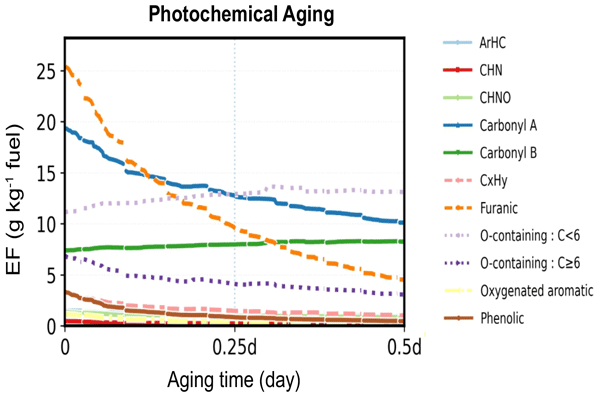
Abstract. Biomass burning (BB) emits large amounts of pollutants in the particle and gas phases, with significant implications for air quality, human health and climate. Here, we investigate the emission of organic vapors from controlled burns of relatively understudied biomass fuels: woody plants and grasses from African savannah and European boreal forest surface using a high-resolution proton transfer reaction-mass spectrometer. To understand the effect of different oxidation regimes, organic vapors were aged in a 29 m3 Teflon chamber, where photochemical and dark aging were simulated. The average total primary emission factors (EFs) for organic vapors varied considerably with fuel type, ranging from 69 to 161 g kg-1. Photochemical aging led to substantial depletion of furanics, phenolics and oxygenated aromatics, accompanied by enhancements of carbonyl B compounds and O-containing compounds C<6 across experiments. In contrast, dark aging under low-NOx conditions produced minimal compositional changes. Hierarchical clustering of relative composition showed clear regime dependence, with regime-associated differences accounting for 73 % of the variance in group-level composition. Toluene and furan showed a strong negative correlation with secondary oxygenated volatile organic compounds (OVOCs), including anhydrides and small acids, consistent with their role as precursors. After 0.5 equivalent day of photochemical aging, organic vapors shifted to higher O/C (>0.70) and an increased fraction of CxHyOz (z≥3). These results highlight the integral role of OH·-driven photo-oxidation in governing the atmospheric evolution and composition of BB organic vapors and underscore the need for secondary organic aerosols (SOA) models to include non-traditional precursors.
-
Notice on discussion status
The requested preprint has a corresponding peer-reviewed final revised paper. You are encouraged to refer to the final revised version.
-
Preprint
(2093 KB)
-
Supplement
(3638 KB)
-
The requested preprint has a corresponding peer-reviewed final revised paper. You are encouraged to refer to the final revised version.
- Preprint
(2093 KB) - Metadata XML
-
Supplement
(3638 KB) - BibTeX
- EndNote
- Final revised paper


Journal article(s) based on this preprint
Interactive discussion
Status: closed
-
RC1: 'Comment on egusphere-2026-1231', Anonymous Referee #1, 24 Apr 2026
- AC1: 'Reply on RC1', Hendryk Czech, 05 Aug 2026
-
RC2: 'Comment on egusphere-2026-1231', Anonymous Referee #2, 25 Jun 2026
- AC2: 'Reply on RC2', Hendryk Czech, 05 Aug 2026
Peer review completion


Interactive discussion
Status: closed
-
RC1: 'Comment on egusphere-2026-1231', Anonymous Referee #1, 24 Apr 2026
General comments:
This manuscript presents a characterization of gas-phase emissions from laboratory biomass burning experiments. In particular, the gas-phase analysis is of high quality and constitutes a clear strength of the study. However, important sections lack sufficient detail, such as methodological explanations and the interpretation of results. The absence of reported concentration values is a significant limitation that makes the overall manuscript difficult to follow. There are also concerns regarding the methodology. The approach of calculating emission factors and interpreting them through aging is not appropriate as presented. While the treatment of primary emissions appears appropriate, the way that aging-related processes are presented in the paper requires reconsideration. In particular, primary and secondary contributions should be distinguished, and the methodology used to separate these components must be explicitly described. The terminology “emission factors” should then be revised at the aging processes. Additionally, there are multiple parts where the writing lacks clarity, and the intended meaning is not immediately understandable. Considering these concerns, I recommend major revisions before the manuscript can be considered for publication.
Specific comments:
- The authors should provide a more detailed description of a representative experiment. Additionally, the presentation of the results requires improvement. Currently, results are expressed only in terms of equivalent time, which makes it difficult to assess the actual duration of experiments within the chamber. The time series of at least one experiment should be showed.
- Lines 146-148: The instrumentation is described in previous work, however, the manuscript would benefit from the inclusion of a general schematic illustrating the experimental setup. In particular, the configuration of the “open-stack setup” is not clearly explained. The reference to Christian et al. (2003) is not sufficient in this regard, as it does not provide a schematic either.
- Lines 162-163: Specific information is missing, such as: the injected mass concentration, the dilution ratio, the size distribution of the injected particles, the mass concentration after the oxidation.
- The paper provides a strong analysis of the gas phase, however, it would benefit from including some basic information on the particle phase. In particular, the OA mass before and after oxidation should be reported, as it is currently unclear whether additional mass was produced during these experiments. Also, it would be useful to include BC concentrations. Finally, the manuscript would benefit from a metric or indicator demonstrating that consistent burning conditions were maintained across all experiments.
- Line 165: The authors could add an explanation for their choice to add O3 into the photochemistry experiments in addition to H2O2.
- Lines 166-167: The manuscript could be benefited by a small discussion of the reason why different quantities of O3 were injected for night vs day experiments. Also, the O3 concentrations could be added for every experiment.
- Lines 179-182: It is not clear why this averaging happened.
- Lines 250-253: The reason for performing an outlier analysis is not clear. This type of analysis may be useful for field measurements, but its use in controlled laboratory experiments needs to be better explained. The authors should clarify why outliers would be expected in this case and which were the ones that were identified.
- Lines 259-263: The authors should clarify why certain carbonyl compounds increase while others decrease. It would be helpful to identify any common characteristics within each group (e.g., molecular weight, carbon number, or chemical structure) and to discuss whether a systematic pattern can be observed.
- The use of the term “emission factors” in the context of aged or secondary products is not appropriate and may be misleading. I recommend that the authors both clarify their methodology for distinguishing primary and secondary processes and revise the terminology accordingly.
- Section 3.2: The manuscript could be benefited by adding how much the OH was in each experiment.
- It is unclear whether blank experiments were performed to assess the background contributions of each gas species after aging.
- Lines 453-458: Have the authors checked the volatility of the fresh vs aged gases? Wall losses can reduce the gas phase but not as significantly as the particle phase (for Teflon chambers), so it could not be the main reductor. How much time did each experiment last?
- Lines 470-479: The introduction of O₃ in the OH experiments complicate the attribution of observed reactivity. It is not clear why the authors chose to study mixed chemistry. In addition, key information is missing: OH and O₃ concentrations for each experiment are not reported, which limits the ability to interpret the relative oxidation processes and access the reactivity.
- The manuscript would benefit from reporting the concentrations of key species such as carbon monoxide (CO) and carbon dioxide (CO₂) for each experiment. In addition, the presence and levels of levoglucosan should be specified.
- Figure 3 is difficult to follow in its current form
- Line 572: “29-35% in savannah grass » it seems like a range when it should show as from x to y%. Also, I have some concerns about how this part is presented. First, the increases are not so big (in figure 5, the image does not change much between the different cases). Secondly, how much is the uncertainty of those percentages? And thirdly, I would like to see the differences in absolute concentrations rather than only in percentages.
- Boreal forests are located in Scandinavia. So, the argument in the introduction linking climate change impacts on boreal forests is not particularly strong. For instance, regions such as the Mediterranean are expected to be more significantly affected by climate change. A brief revision in this presentation statement would strengthen the introduction section.
- Lines 461-466: The manuscript would benefit from reporting the concentration of NO2 in this study, as together with O3 they can create NO3 that can be a significant oxidant for dark chemistry.
Technical comments:
- Add a small explanation of what MCE is
- Line 65: Please rephrase. Either/or
- Line 67: Please add a reference. Are these in the emission inventories high?
- Line 69: Part the explanation is because in US there are a lot of boreal forests, while in Europe not so much. The surface area of these forests in the 2 continents is very different.
- Lines 70-71: Please add all the processes. Heterogeneous reactions and dilution are part of the story but so is evaporation and gas-phase oxidation. I can see that these are mentioned later in line 76, so maybe this part could be changed to be more easily followed.
- Lines 79-81: Part of this is that in the atmosphere these transformations happen fast so bbOA is part of the SOA
- Lines 147-148: Please rephrase for clarity
- Lines 148-149: Please explain why different diameters were used for the different fuels
- Line 150: Parenthesis opens and never closes
- Line 157: Please explain why different RH was used. Could the differences in RH affect the chemical results?
- Line 171: Please add reference for the average OH.
- Line 238: “flue-gas” seems to be a typo here
- Line 238: “as per” Please rephrase for clarity
- Line 244-246: Please add a better explanation. It is not mentioned what is “i” and what is “j”.
- Line 248: Please add how Fc was calculated
- Line 261: “Compounds with ≥80% experiments showing a negative slope” please rephrase for clarity
- Line 303: What do the authors mean by glowing-phase?
- Line 319: IQR acronym name. Please name all the acronyms the first time you use them
- Figure 1: Please add percentages to pie charts. Also write in the figure caption that different axes are used in EF. Also, were these gases measured with the PTRMS? If yes, how were the hydrocarbons measured?
- Figure 2 is not helpful. Maybe one diagram per fuel type and the rest to the SI.
- Lines 370-372: 3 or 2 pathways? Seems like 2 are explained.
- Line 414: please remove “by”
- Line 438: “R ranges” maybe R2?
- Figure 4: Please add percentages to the pie chart
- Line 570: “>3” change to (z>3)
- Line 571: parenthesis open is in subscript
- Line 577: Please add what is DBE
- Figure 5: x,y, etc. Please make them subscripts.
- Line 621: please rephrase for clarity
- Lines 653-657: how much are the SOA yields of these compounds?
Citation: https://doi.org/10.5194/egusphere-2026-1231-RC1 - AC1: 'Reply on RC1', Hendryk Czech, 05 Aug 2026
-
RC2: 'Comment on egusphere-2026-1231', Anonymous Referee #2, 25 Jun 2026
- AC2: 'Reply on RC2', Hendryk Czech, 05 Aug 2026
Peer review completion
Journal article(s) based on this preprint
Viewed
| HTML | XML | Total | Supplement | BibTeX | EndNote | |
|---|---|---|---|---|---|---|
| 873 | 331 | 99 | 1,303 | 173 | 90 | 99 |
- HTML: 873
- PDF: 331
- XML: 99
- Total: 1,303
- Supplement: 173
- BibTeX: 90
- EndNote: 99
Viewed (geographical distribution)
| Country | # | Views | % |
|---|
| Total: | 0 |
| HTML: | 0 |
| PDF: | 0 |
| XML: | 0 |
- 1
Deeksha Shukla
Lejish Vettikkat
Mika Ihalainen
Markus Somero
Hendryk Czech

Siegfried Schobesberger
Angela Buchholz
Iida Pullinen
Kerneels Jaars
Kajar Köster
Pasi Yli-Pirilä
Stefan Siebert
Pieter van Zyl
Annele Virtanen
Ville Vakkari
Olli Sippula
Ralf Zimmermann
The requested preprint has a corresponding peer-reviewed final revised paper. You are encouraged to refer to the final revised version.
- Preprint
(2093 KB) - Metadata XML
-
Supplement
(3638 KB) - BibTeX
- EndNote
- Final revised paper
General comments:
This manuscript presents a characterization of gas-phase emissions from laboratory biomass burning experiments. In particular, the gas-phase analysis is of high quality and constitutes a clear strength of the study. However, important sections lack sufficient detail, such as methodological explanations and the interpretation of results. The absence of reported concentration values is a significant limitation that makes the overall manuscript difficult to follow. There are also concerns regarding the methodology. The approach of calculating emission factors and interpreting them through aging is not appropriate as presented. While the treatment of primary emissions appears appropriate, the way that aging-related processes are presented in the paper requires reconsideration. In particular, primary and secondary contributions should be distinguished, and the methodology used to separate these components must be explicitly described. The terminology “emission factors” should then be revised at the aging processes. Additionally, there are multiple parts where the writing lacks clarity, and the intended meaning is not immediately understandable. Considering these concerns, I recommend major revisions before the manuscript can be considered for publication.
Specific comments:
Technical comments: