
the Creative Commons Attribution 4.0 License.
the Creative Commons Attribution 4.0 License.
 | 17 Mar 2026
Further constraining the role of in-atmosphere production on the global HFC-23 budget
Abstract. A large discrepancy of at least 10 Gg yr-1 exists between reported emissions of the potent greenhouse gas HFC-23 (CHF3, trifluoromethane) and emissions derived from atmospheric measurements. In-atmosphere production of HFC-23 from the breakdown of fluorinated source gases such as hydrofluorocarbons and hydrofluoroolefins contributes to this gap, but the magnitude of this source is weakly constrained. This uncertainty is due, in part, to limited experimental measurements of the photolysis quantum yield of trifluoroacetaldehyde (CF3CHO), a key degradation product which forms HFC-23 via photolysis. The parameters governing CF3CHO deposition are also poorly understood. Previous work reported an upper limit of the contribution of the in-atmosphere source to the global HFC-23 burden. Here, we use a 3D chemistry and transport model to further constrain this contribution, using recent estimates of source gas emissions, kinetic rate constants, photolysis rates and deposition parameters, as well as considering the uncertainties in these values. We find that in-atmosphere production of HFC-23 is in the range 0.013–0.035 Gg yr−1, significantly lower than previous estimates. This accounts for <0.5 % of the discrepancy between reported emissions and those derived from atmospheric observations, suggesting that this source makes a negligible contribution to the overall HFC-23 budget. As part of this work, we also calculate indirect global warming potentials for the HFC-23 source gases HFO-1234ze(E), HFO-1336mzz(Z) and HCFO-1233zd(E) and find that their impact on climate is up to ten times higher than previously reported.
-
Notice on discussion status
The requested preprint has a corresponding peer-reviewed final revised paper. You are encouraged to refer to the final revised version.
-
Preprint
(1252 KB)
-
Supplement
(540 KB)
-
The requested preprint has a corresponding peer-reviewed final revised paper. You are encouraged to refer to the final revised version.
- Preprint
(1252 KB) - Metadata XML
-
Supplement
(540 KB) - BibTeX
- EndNote
- Final revised paper


Journal article(s) based on this preprint
Interactive discussion
Status: closed
- RC1: 'Comment on egusphere-2026-1230', Anonymous Referee #1, 06 May 2026
-
RC2: 'Comment on egusphere-2026-1230', Anonymous Referee #2, 22 May 2026
The study by Adam et al. investigates the role of in-atmosphere production on the global HFC-23 budget. They use a 3D chemistry-climate model and perform several sensitivity simulations. The main question they want to answer is if in-atmosphere production can explain the gap between reported and measured emissions. They find that the in-atmosphere production only contributes to a minor part and that the reason for this gap are still unclear. Using a box model the authors additionally investigate the global warming potential and find that some HFOs have a larger impact on climate than previously thought.
The study seems to be quite sound, however lacks a clear description of e.g. the models used and the simulations performed. The topic itself also is not well explained. For example for what are HFCs used and why is the investigation of their budget important? As I remember these are the replacements species for the CFCs. What has been established by the Montreal Protocol and its subsequent amendments? The whole topic/problem of using these species needs to be better explained so that this study is also understandable for non-experts.
The same holds for sources and sinks of the HFOs. Since the focus of this study is on the budget of HFC-23, in the manuscript a clear description of the sources and sinks should be provided. While the sources are quite extensively discussed, the sinks are hardly mentioned and solely indirectly covered the sensitivity tests.
Generally, my feeling is that there is a misbalance in writing. The manuscript goes into too much detail where it is not needed, however barely scratches on the surface where more details are needed.
Specific comments:
P1, L1-15: The abstract should be written in a more concise way and omit insignificant details as e.g. the specific uncertainties in the measurements and the HFC-23 source gases that contribute to climate change. On the other hand what has been done in this study, which model has been used could be explained in more detail. The model name and that also sensitivity studies have been performed should be clearly mentioned.P1-4: General comment on the Introduction: too long and should be shortened and only focus on what information is really needed for understanding this study. Also the structure should be adjusted. I would suggest to start with what are HFCs, what are they used for, why is it important to understand emissions and the global budget, what are the open questions and what is done in your study and how does it contribute to answering the open questions?
P2, L30-38: Move this paragraph further up. It should be mentioned that HFCs are the replacement for the CFCs.
P2, L39ff: How are these estimates derived and how are the CFCs measured. What are the uncertainties?
P2, L40ff: The sentence is not clear. Please check if something is missing here and correct accordingly.
P3, L62: This needs to be elaborated more. Which modelling studies on HFC-23 exists and which models were used. Is your statement that so far no CTMs have been used really correct?
P3, L64: What measurements exactly were made when and where? This also should be elaborated a bit more.
P3, L80: It would be much more helpful if the previous studies would be explicitly discussed. Split up the references and explicitly discuss what e.g. has Van Hoomissen et al. (2025) done or Nielsen et al. (2025) or Perez-Pena et al. (2025) have done in their studies.
P2-3, until L80: The Introduction should be thoroughly revised. There are too many unnecessary details given and the rather necessary information/details are omitted.
P4, L94: So far only the sources have been discussed, bot not the sinks.P4, L94: General comment on the introduction would be to shorten, restructure and provide only the necessary information (what are HFCs, what are they used for, sources and sinks, previous studies) and more details on that.
P4, L97ff: More information on the model (technical details and set-up) should be given. What time period has been modelled and which resolution has been used. Have global simulations or regional been performed? For what kind of studies is the model generally used, what is known about the general quality and reliability of the model simulation?
P4, L113ff: Usually the greek letter tau is used for the lifetime. I would introduce this letter and then add “tau =“ to the lifetimes instead of just writing solely the lifetimes or “tropospheric lifetime =“
P5, L123-124: Too many repetitions of mentioning Table 1.
P5, Table 1 and text: What is the meaning of the source gas suffixes mzz, zd etc:?
P6, L147: Which previous work? The work by Vollmer et al. (2025)? If yes, this should be stated more clearly.
P6, 155: What sensitivity studies have been performed? Is here the reference to the section where these are described missing?
P7, L172: Add a greek lambda before the wavelength, so that it reads lambda = ….. nm.
P7, L185: Also here a reference to Sect. 2.4 where the sensitivity studies are described is missing.
P8, L210: Add here the numbers for the lowest and highest levels.
P9, L217: More details and the dry and wet deposition processes should be given. On what exactly deposits the HFCs?
P9, L232: Reference to Sect. 2.4 is missing. Better would be if you would provide all details on the sensitivity study in Sect. 2.4 and not spread out throughout the manuscript.
P10, L266: This table is important and should appear in the main text and not in the supplement. As the other referee mentioned the supplementary material would be worth to be added to the main manuscript. I totally agree.
P11, L282: More details on the box model used and simulations done should be added.
P11, L300: Are you considering here the global HFC production?
P14 and 15, Sect. 3.2.2. and 3.2.3: A reference to the table where the sensitivity runs are listed is missing in these sections.
P16, L428: Add reference? Or are these lifetimes also found in Liang et al. (2022)?
P17, L433: GWP calculations done with the box model? Id yes, clearly mention this. What set-up was used? Provide more details and what exactly is meant with 10-, 100- and 500-year time horizons. Over 10, 100 and 500 times or in 10, 100 and 500 years?
P17, Table 5 caption: What is the difference between direct and indirect global warming potentials? This should be clearly described in the text.
P17, L440: “are discussed in the next section” correct? Obsolete?
P18, L474: What is meant with F-gas?
Technical corrections:
P2, L37: was -> isP3, L70: parametrise -> parameterise
P3, L76: Publication year of the Van Hoomissen et al. reference is missing.
P4, L97: Is STOCHEM-CRI an abbreviation? If yes, the meaning of the abbreviation should be introduced.
P6, L150: emissions inventories -> emission inventories or better emission inventory. Aren’t you using only one inventory?
P6, L153: emissions estimates -> emission estimates
P7, L183: Figure S1 -> Fig. S1
P8, L202: add “by” so that it reads “by Burkholder et al. (2019)”.
P8, L205 and 206: Omit “Supplementary” and change “Figure S1” to “Fig.. S1”.
P8, L209: Add “at wavelengths” after “occurs”.
P8, Table 3 caption: pressures -> pressure levels?
P9, L216-217: Repetition of “considered in the model” in the sentence.
P10, L266: Omit “Supplementary”.
P11, L285: Sentence “was a uniform 0.4 ppt” not clear. Please check and correct.
P11, L306: Remove parentheses around the Van Hoomissen et al. reference and incorporate the reference into the text -> by Van Hoomissen et al. (2025)
P12, Figure 1 caption: section 2.4 -> Sect. 2.4
P13, Figure 2 caption: in solid bars -> as solid bars
P13, L325 and 326: emissions scenarios -> emission scenarios
P13, L330: Figure 2 -> Fig. 2
P14, L385: Figure 1 -> Fig. 1
P14, L360: section 2.2 -> Sect. 2.2
P16, L426: Remove parentheses around reference of Liang et al. and write “in Liang et al. (2022)”.
P16, L429: of the literature -> to the literature
P18, L458: emissions gap -> emission gap
Citation: https://doi.org/10.5194/egusphere-2026-1230-RC2 -
AC1: 'Comment on egusphere-2026-1230', Ben Adam, 01 Jul 2026
Response to reviewers on
“Further constraining the role of in-atmosphere production on the global HFC-23 budget”
Ben Adam, Rayne Holland, Daniel Van Hoomissen, James B. Burkholder, Anwar Khan, Paul Griffiths, Jens Mühle, Dudley Shallcross and Matt Rigby
1st July 2026
We thank the reviewers for taking the time to return thorough and insightful reviews. We have addressed each of the comments in turn, indicated where changes were made, and responded to each as follows. Sections of the revised text are coloured in blue and begin with a line reference (to the revised manuscript) in bold. This comment in its entirety is also attached as a PDF supplement.
Reviewer 1
The manuscript, 'Further Constraining the Role of In-Atmosphere Production on the Global HFC-23 Budget', by Adam and co-authors, presents the findings of an atmospheric modelling study that investigated the potential production of HFC-23 (a highly potent greenhouse gas) from precursor gases within the atmosphere. The study uses a state-of-the-art atmospheric chemistry model updated for HFC and HFO chemistry, making use of updated photolysis data for the critical intermediate trifluoroacetaldehyde. A series of sensitivity simulations were performed to propagate the uncertainties associated with several significant atmospheric processes. The study is well designed and the manuscript is well written, with the results communicated clearly. Furthermore, the results are highly relevant as they rule out significant atmospheric production of HFC-23. This suggests that direct emissions (currently unreported/unknown) must be responsible for the growth of HFC-23 in the atmosphere. I would highly recommend publication of the manuscript once some minor points have been addressed/clarified.
P5, L126: Please distinguish the references for observations and global emission estimates. AGAGE provides observations; Western et al. provides global emission estimates based on these observations. A simple 'and .., respectively.' should do it.
We have distinguished the references as suggested for clarity.
L123-126: For the four long-lived source gases (HFC-143a, HFC-236fa, HFC-245fa and HFC-365mfc), baseline mole fractions are taken from the Advanced Global Atmospheric Gases Experiment (AGAGE) network (Prinn et al., 2018, 2023). In the model runs, we initialise hemispheric average mole fractions for 2023 and prescribe global emissions for that same year from Western et al. (2025), as shown in Table 2.
P5, L138: When reading through this and the following paragraph, I stumbled several times over the assumptions made. Here: why GDP scaling, when we know that transitions are different in different world regions. Later on, the assumption is questioned and a link is made to the sensitivity runs that explore the importance of the spatial distribution of emissions. I think this section would be easier to follow if it is made clear from the beginning that HFO emission totals and distributions are not well known and therefore different sensitivity tests were carried out. Already mention why spatial distribution is more important for HFOs than for HFCs (currently stated in L250 and following). This can be followed by the current description of the base case emissions and finally the mention of alternatives emission distributions. Essentially, this suggests putting the last paragraph in the section forward.
We welcome the reviewer’s suggestions on restructuring this section. The shortcomings of our method for estimating and distributing HFO emissions are now outlined at the outset, followed by a re-ordered and restructured description. We cite an example of GDP being used to estimate HFC consumption in the literature but note that this doesn’t factor in the varying rates of transition from HFC to HFO. We then reiterate that our broad sensitivity tests still capture what is likely to be the full range of potential emissions and so the study still returns a reasonable in-atmosphere HFC-23 estimate. The revised text reads:
L131-165: “The shorter lifetimes of the HFOs make them unsuitable for top-down emissions estimation with a global box model (e.g. Western et al., 2025), and no global bottom-up inventory of HFO emissions is available, either. Therefore, we make several approximations in estimating the magnitude and spatial distribution of HFO emissions and carry out a wide range of sensitivity tests (detailed in Sect. 2.4) to explore the sensitivity of our results to these assumptions. Firstly, we assume that the adoption and emission of HFOs is correlated with GDP globally. Although it ignores the differing rates of transition from HFCs to HFOs in different regions, we use GDP as a proxy for emissions as it has been used previously to estimate demand for HFCs globally (Velders et al., 2009). Previous work (Vollmer et al., 2025) suggests this correlation is unlikely to hold globally, since phase-out of HFCs in favour of HFOs seems to be slower in areas such as East Asia than in Europe, where regulation of fluorinated species has accelerated this transition. However, in the absence of other suitable proxies, we take published HFO emissions for Europe (Vollmer et al., 2025) and scale them up using national GDP totals to give global estimates. Emissions of HFO-1234ze(E) and HCFO-1233zd(E) were 0.96 Gg yr−1 and 1.0 Gg yr−1, respectively, in 2023 for Northwest Europe, a region defined as Ireland, the United Kingdom, France, Germany, Luxembourg, the Netherlands and Belgium. These countries accounted for approximately 12.5% of the global GDP for that year (World Bank Group, 2025). Therefore, we scale these emissions up by a factor of 8 and use global emissions of 7.7 Gg yr−1 and 8.0 Gg yr−1 for these two species, respectively, in the STOCHEM-CRI model. Despite concerns about overestimating emissions via this method, our estimates are approximately 50% lower than those made by Killen et al. (2026), who estimated global HFO-1234ze(E) emissions at 15 Gg yr−1.
For HFO-1336mzz(Z), no recent emissions estimates are available. However, Rust et al. (2023) estimated Swiss emissions of HFO-1336mzz(Z) at 5 Mg yr−1 in 2019-2020. Swiss emissions of the other two HFOs considered in this model were also estimated for 2019-2020 at 34 Mg yr−1 (HFO-1234ze(E)) and 7.3 Mg yr−1 (HCFO-1233zd(E)) (Rust et al., 2022). Using a tracer ratio method and scaling up to global emissions, this suggests that HFO-1336mzz(Z) emissions are between 1.2 Gg yr−1 and 5.4 Gg yr−1, depending on which HFO is used as a tracer. Here, we take a mean of these values and estimate global HFO-1336mzz(Z) emissions at 3.3 Gg yr−1. We note that the use of the other HFOs as tracers for HFO-1336mzz(Z) emissions may not be reasonable, as evidenced by the large disparity in emissions when selecting alternative tracers. Nonetheless, in the absence of complete emission inventories derived from atmospheric measurements, we believe the wide range of sensitivity test conducted here (see Sect. 2.4) produce a sound order-of-magnitude estimate for global HFO emissions, sufficient to estimate the in-atmosphere production of HFC-23. We also note that the amount of HFC-23 produced by the in-atmosphere breakdown of HFOs is likely to be linear in the global emissions of each species, so if improved emission estimates were to become available, our totals could be scaled. We explore the extent to which this is true, as well as the effect of varying emissions totals, in the sensitivity analysis.
The spatial distribution of the HFO emissions is also poorly constrained. In the absence of gridded emissions estimates, the emissions are distributed according to the method used by Holland et al. (2021) and McGillen et al. (2023). This takes the spatial distribution for HFC-134a emissions in the EDGAR database and replaces the emissions inventory from China using gridded estimates from Su et al. (2015). The impact of changing these spatial distributions and therefore releasing the HFOs into regions of varying O3 and OH concentrations, is investigated through a set of sensitivity tests outlined in Sect. 2.4. These tests also probe the validity of scaling up emissions by GDP.”
Table 2: Are these the lifetimes calculated from the base simulation or literature values? Please clarify.
We have clarified that these lifetimes are literature values and added the relevant references to the table.
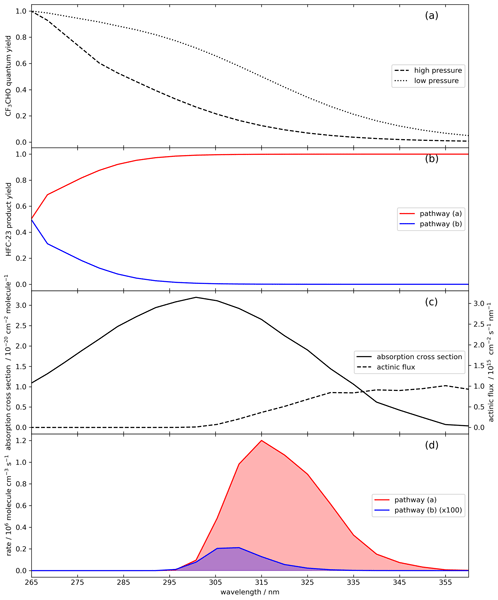
Section 2.3.1: Since this section takes up quite some space and is the basis for the re-evaluation of reaction pathways, I would suggest to also include Figure S1 in the main text. The overall length of the manuscript is rather short and there seems to be no need to hide the Figure (and also the SI tables) in a supplement. Alternatively, the section and figures could be moved into an appendix.
We have moved this plot to the main text as per the reviewer’s suggestion, now as Figure 1.
Equation 2 and Figure S1: Equation 2 for the product yield does not fit to the values displayed in Figure S1b. S1b shows PY=1 for lambda<266, the equation suggests 0.5. Please clarify.
Thank you. The correct version is the equation, and it was this version implemented in the model. The error in the plot has been rectified in the updated manuscript.
P8 L196: How is the actinic flux calculated in STOCHEM? The wavelength dependency of the actinic flux will obviously impact the relative importance of pathway a vs b.
Spherically integrated actinic fluxes in STOCHEM are calculated over 106 wavelength intervals within the range 200 to 660 nm for a given air parcel, using a variant of a one-dimensional two-stream model. We have added to the text and included a reference for clarity.
L206-207: “Details on the photolysis scheme of the model, including the calculation of actinic flux, can be found in Winiberg et al. (2018).”
P9, L222: The upper end of deposition rates seems to be rather extreme. Not even very water-soluble compounds like HNO3 have such high deposition velocities, especially not over the ocean or bare soils. I understand that extremes should be explored but at the same time these should be within physical bounds.
We appreciate that the proposed upper limit is extreme, however we believe using a ‘theoretical’ upper limit of loss by deposition works to demonstrate the full range of influence that uncertainty in the parameter can reasonably have on the atmospheric fate of CF3CHO. As there has been some debate on this in the literature, and on the role of wet deposition more generally, we feel its appropriate to explore an extreme range to start to constrain the maximum and minimum influence. We have also clarified this in the main text:
L243-245: “Extension of the range of deposition parameters to ’extreme’ upper limits intends to test the entire theoretical range of deposition behaviour. In doing so, our ensembles capture the full range of influence that uncertainty in these parameters can have on the atmospheric fate of CF3CHO and, therefore, improves the constraint on these highly uncertain processes”.
P10, L 246: Assuming that the transition to HFOs is progressing fastest in Europe and, hence, the base case already represents an upper-limit emission scenario: how realistic is the evaluated emission range 0.33 - 3 times the base case?
While we agree that our ‘best estimate’ base case is likely to be on the higher end of plausible emissions scenarios, it remains our best estimate at this time (and indeed is substantially lower than another recently published emissions estimate (Killen et al., 2026)).
We also note that by reporting the full range of our ensembles rather than an average, we demonstrate that even our ‘extreme’ scenarios have minimal bearing on our overall conclusion that in-atmosphere production is unlikely to be the cause of the top-down, bottom-up emission estimate gap.
Section 3: When discussing the results, it should be clarified if the ensemble mean/median or the base case are considered to give the most realistic results. A statement on how much the two differ may be helpful as well. Since some of the sensitivity runs are leaning towards extreme parameter tests, it is not obvious that the ensemble mean is an unbiased, best estimate.
We agree that a median would be a better indicator of an average than a mean. In most cases, we report a range, but in the single case that we report an average, we have updated the text to report a median.
L361-362: “The median is used here to avoid introducing bias from the simulations testing extreme parametrisations.”
P13, L323: What is the uncertainty estimate on the global HFC emissions from Western et al. (2026)? Assuming linearity this could be propagated to evaluate its influence in comparison to the HFO emission and other sensitivity runs. However, I agree that it will most likely be smaller than for the HFO emission sensitivity, which covered a broad range.
The reported uncertainty (1σ) in the global HFC emissions ranges between ± 6% (for HFC-143a) and ± 30% (for HFC-245fa). However, the production of HFC-23 in the atmosphere is driven not by the emissions of these long-lived gases but by their background mole fraction in the atmosphere, which will be only weakly impacted by small changes in emissions in a given year. Therefore, this is not considered in the sensitivity tests. We have now outlined this in the text.
L128-130: “While these emissions estimates have uncertainties of up to 30% (1σ), the reaction to form CF3CHO (and subsequently HFC-23) is predominantly driven not by emissions but by the background mole fraction, which is better-constrained (typically on the order of a few percent; see Western et al. (2025)). We therefore do not consider the uncertainties in HFC emissions in this analysis.”
P13/14: For understanding the comparison with the Van Hoomissen et al. (2025) results it would be helpful to repeat the kind of model that was used in their study.
We have added to the text to contextualise our comparison with the previous study.
L354-358: “The relative ordering of the contributions within the HFC species is consistent with results in Van Hoomissen et al. (2025), which used globally averaged abundances of source gases and oxidants, as well as fixed estimates of the CF3CHO partial lifetime with respect to its loss processes, to estimate a conservative upper limit on HFC-23 production. In that study, the contribution from HFOs dominated (80%) the total HFC-23 production. This is a similar contribution to our ‘Em_Hi’ scenario, in which HFOs contribute 71% of HFC-23 production.”
P14, L353: While global total HFC-23 production is similar in these runs with different spatial distribution of HFO emissions: Do the runs lead to considerable regional differences in HFC-23 production and, hence, mole fraction differences? Would these differences be sufficiently large to compare simulated versus observed HFC-23 latitudinal gradients?
We have added a plot to show the spatial variation of HFC-23 production and mole fraction across the sensitivity tests in the Supplement (Figure S1), and refer to it in the main text:
L388-389: “The impact of these different emissions scenarios on the spatial distribution of HFC-23 production is shown in Supplementary Fig. 1.”
Section 3.4: Are the cited literature values based on global model simulations as well or simply on kinetic data and average OH assumptions? Please clarify if the Liang et al. (2022) citation also valid for the HFO-1336mzz(Z) and HCFO-1233zd(E) lifetimes.
Lifetimes are those that are reported in the WMO 2022 Ozone Assessment. The reference covers all the HFOs and we have made this clearer in the text.
L458: “reported in the WMO Ozone Assessment 2022”
Reviewer 2
The study by Adam et al. investigates the role of in-atmosphere production on the global HFC-23 budget. They use a 3D chemistry-climate model and perform several sensitivity simulations. The main question they want to answer is if in-atmosphere production can explain the gap between reported and measured emissions. They find that the in-atmosphere production only contributes to a minor part and that the reason for this gap are still unclear. Using a box model the authors additionally investigate the global warming potential and find that some HFOs have a larger impact on climate than previously thought.
The study seems to be quite sound, however lacks a clear description of e.g. the models used and the simulations performed. The topic itself also is not well explained. For example for what are HFCs used and why is the investigation of their budget important? As I remember these are the replacements species for the CFCs. What has been established by the Montreal Protocol and its subsequent amendments? The whole topic/problem of using these species needs to be better explained so that this study is also understandable for non-experts.
The same holds for sources and sinks of the HFOs. Since the focus of this study is on the budget of HFC-23, in the manuscript a clear description of the sources and sinks should be provided. While the sources are quite extensively discussed, the sinks are hardly mentioned and solely indirectly covered the sensitivity tests.
Generally, my feeling is that there is a misbalance in writing. The manuscript goes into too much detail where it is not needed, however barely scratches on the surface where more details are needed.
We thank the reviewer for their thorough review of our manuscript and have addressed the points their comments on the introduction and background material in our response to their specific comments below.
Specific comments:
P1, L1-15: The abstract should be written in a more concise way and omit insignificant details as e.g. the specific uncertainties in the measurements and the HFC-23 source gases that contribute to climate change. On the other hand what has been done in this study, which model has been used could be explained in more detail. The model name and that also sensitivity studies have been performed should be clearly mentioned.We have included the model's name in the abstract and improved the link between the uncertainty in the parameters and the reported range of simulated in-atmosphere HFC-23 production.
L7-12: “Previous work reported an upper limit of the contribution of the in-atmosphere source to the global HFC-23 burden. Here, we use a 3D chemistry and transport model, STOCHEM-CRI, to further constrain this contribution, using recent estimates of source gas emissions, kinetic rate constants, photolysis rates and deposition parameters. Furthermore, we perform an ensemble of simulations to account for the uncertainties in these values. We find that in-atmosphere production of HFC-23 is in the range 0.013 - 0.035 Gg yr-1, substantially lower than previous estimates.”
P1-4: General comment on the Introduction: too long and should be shortened and only focus on what information is really needed for understanding this study. Also the structure should be adjusted. I would suggest to start with what are HFCs, what are they used for, why is it important to understand emissions and the global budget, what are the open questions and what is done in your study and how does it contribute to answering the open questions?
We have made significant changes to the introduction to reduce its length and better highlight the relevance of this study. As HFC-23 is the focus of this study, we prefer to start our introduction by introducing it rather than the precursors we consider.
L21-24: “The Kigali Amendment requires Parties to destroy emissions of HFC-23 ‘to the extent practicable' when it is generated during production of other hydrofluorocarbons (HFCs) and hydrochlorofluorocarbons (HCFCs). The dominant source of HFC-23 in the atmosphere is believed to be its emission as a by-product during HCFC-22 (CHClF2, chlorodifluoromethane) production from chloroform (CHCl3).”
P2, L30-38: Move this paragraph further up. It should be mentioned that HFCs are the replacement for the CFCs.
We believe that our re-organisation of our introduction has satisfied this comment:
L44-46: “HFOs are fourth-generation refrigerants and foam-blowing agents, slated to replace HFCs (which in turn replaced chlorofluorocarbons, CFCs) due to their reduced impact on stratospheric ozone and climate".
P2, L39ff: How are these estimates derived and how are the CFCs measured. What are the uncertainties?
We have restructured the sentence to clarify how the estimates are derived and the provided references have more information on the measurement techniques and associated uncertainties.
L35-36: “In the last decade, global ‘top-down' emission estimates, derived using atmospheric measurements, have consistently exceeded reported emissions by over 10 Gg yr-1.”
P2, L40ff: The sentence is not clear. Please check if something is missing here and correct accordingly.
We have added the word ‘estimates’ and added a direct comparison between derived emission estimates and those that were reported to demonstrate the 10 Gg/yr discrepancy.
L35-38: “In the last decade, global ‘top-down’ emission estimates, derived using atmospheric measurements, have consistently exceeded reported emissions by over 10 Gg yr−1. For example, ‘top-down’ emission estimates averaged over 15 Gg yr−1 in the period 2018 - 2023, while in that same period reported emissions, which assumed that national abatement policies were effectively implemented, were only 2 - 3 Gg yr−1 (Adam et al., 2024).”
P3, L62: This needs to be elaborated more. Which modelling studies on HFC-23 exists and which models were used. Is your statement that so far no CTMs have been used really correct?
This was true at the time of writing though during the open review process a further study has been published that also uses a CTM. As a result, we have directly referenced and described this study in this section.
L72-77: “In addition, one recent modelling study explored the atmospheric fate and environmental impacts of one specific source gas, HFO-1234ze(E), and estimated very small in-atmosphere HFC-23 production using an alternative atmospheric chemistry and transport model (Killen et al., 2026). However, that study considered only one source gas for HFC-23, and so could only report a partial estimate for in-atmosphere production. In addition, given that no experimental data has been published to better constrain the physical properties of CF3CHO in the atmosphere, a range of modelling approaches are required to explore the uncertainties in these parameters.”
P3, L64: What measurements exactly were made when and where? This also should be elaborated a bit more.
We have elaborated that the ‘measurements’ were, more specifically, detection and quantification of HFC-23 production via ozonolysis of some HFOs and HCFOs. The references given provide extra detail.
L56-58: “Secondly, direct formation of HFC-23 has been detected and quantified during the reactions of HFO-1234ze(E) (Garavagno et al., 2025), HFO-1336mzz(Z) (McGillen et al., 2023) and HCFO-1233zd(E) (Nielsen et al., 2025b) with ozone (O3).”
P3, L80: It would be much more helpful if the previous studies would be explicitly discussed. Split up the references and explicitly discuss what e.g. has Van Hoomissen et al. (2025) done or Nielsen et al. (2025) or Perez-Pena et al. (2025) have done in their studies.
We have clarified in the text specifically what the discussion in the literature related to. As we only mention this to establish that there is uncertainty in these processes, which we then explore in our ensemble of simulations, we feel this is sufficient for our introduction.
L70-72: “Since the publication of Van Hoomissen et al. (2025), there has been further discussion of the physical properties of CF3CHO and its fate in the troposphere, particularly in relation to the balance of heterogeneous loss processes against photolysis (Nielsen et al., 2025a; Pérez-Peña et al., 2025)”
P2-3, until L80: The Introduction should be thoroughly revised. There are too many unnecessary details given and the rather necessary information/details are omitted.
We have thoroughly revised the introduction and taken on board all of the reviewer’s comments and suggestions. We feel that the result is a more concise and clearer introduction with the necessary level of detail and thank the reviewer for their feedback, but we did not want to leave out details that we think are important for other readers.
P4, L94: So far only the sources have been discussed, bot not the sinks.The long lifetime (228 years) of HFC-23 relative to the one-year analysis period in this study means that its loss is negligible and not discussed in depth. We have added text to the box model method to clarify why we consider loss here and not in the 1-year production run.
L302-305: “Although the loss of HFC-23 in the STOCHEM-CRI model is negligible due to its long lifetime relative to the one-year simulations, the reaction with OH was also incorporated into the kinetic scheme here, tuned such that HFC-23 had a tropospheric lifetime of 243 years (ignoring stratospheric loss) (Burkholder et al., 2022).”
P4, L94: General comment on the introduction would be to shorten, restructure and provide only the necessary information (what are HFCs, what are they used for, sources and sinks, previous studies) and more details on that.
This comment has been addressed during revisions in response to the previous comments.
P4, L97ff: More information on the model (technical details and set-up) should be given. What time period has been modelled and which resolution has been used. Have global simulations or regional been performed? For what kind of studies is the model generally used, what is known about the general quality and reliability of the model simulation?
We have added the simulation length and further clarified that we conducted global simulations. The resolution is given in line L129, other studies in which the model was used are referenced in lines 99-101 and further information can be found in these references.
L100-101: “In this investigation, we simulated a full year of HFC-23 in-atmosphere production following an initial spin-up simulation which was used to initialise the atmospheric conditions and then discarded.”
P4, L113ff: Usually the greek letter tau is used for the lifetime. I would introduce this letter and then add “tau =“ to the lifetimes instead of just writing solely the lifetimes or “tropospheric lifetime =“
We have incorporated this suggestion into the manuscript.
L111-114: “Of these, HFC-143a (CF3CH3, tropospheric lifetime τtrop = 57.2 years), HFC-236fa (CF3CH2CF3, τtrop = 253 years), HFC-245fa (CF3CH2CHF2, τtrop = 8.1 years) and HFC-365mfc (CF3CH2CF2CH3, τtrop = 9.3 years) have been measured in the global atmosphere (Prinn et al., 2023, 2018; Burkholder et al., 2022; Liang et al., 2022)”
P5, L123-124: Too many repetitions of mentioning Table 1.
We have removed unnecessary references to Table 1.
L117-124: “The rate coefficients and yields of the reactions of these HFCs with OH are taken from the NASA/JPL recommended values (Burkholder et al., 2019). In addition, three unsaturated fluorinated gases with measured atmospheric abundances have also been shown to react with OH to produce CF3CHO (Burkholder et al., 2019). These species are HFO-1234ze(E) (trans-CF3CH=CHF, τtrop = 19 days), HFO-1336mzz(Z) (cis-CF3CH=CHCF3, τtrop = 27 days) and HCFO-1233zd(E) (trans-CF3CH=CHCl, τtrop = 41.9 days). These three species also react with O3 to produce HFC-23 directly. All rate coefficients and yields for included reactions are shown in Table 1.”
P5, Table 1 and text: What is the meaning of the source gas suffixes mzz, zd etc:?
These are the commonly used chemical names of these gases. They describe the chemical structure of these longer chained complex molecules, see e.g., https://www.fluorocarbons.org/naming-and-numbering/.
P6, L147: Which previous work? The work by Vollmer et al. (2025)? If yes, this should be stated more clearly.
We have moved the citation for clarity.
L137-139: “Previous work (Vollmer et al., 2025) suggests this correlation is unlikely to hold globally, since phase-out of HFCs in favour of HFOs seems to be slower in areas such as East Asia than in Europe, where regulation of fluorinated species has accelerated this transition”
P6, 155: What sensitivity studies have been performed? Is here the reference to the section where these are described missing?
We have added a reference to Section 2.4 where the sensitivity studies are described.
L132-134: “Therefore, we make several approximations in estimating the magnitude and spatial distribution of HFO emissions and carry out a wide range of tests (detailed in Sect. 2.4) to explore the sensitivity of our results to these assumptions.”
L153-156: “Nonetheless, in the absence of complete emission inventories derived from atmospheric measurements, we believe the wide range of sensitivity test conducted here (see Sect. 2.4) produce a sound order-of-magnitude estimate for global HFO emissions, sufficient to estimate the in-atmosphere production of HFC-23”
P7, L172: Add a greek lambda before the wavelength, so that it reads lambda = ….. nm.
We have added the lambda to each reaction path.
P7, L185: Also here a reference to Sect. 2.4 where the sensitivity studies are described is missing.
We have added the reference to Sect. 2.4.
L193-194: “To investigate the sensitivity of the modelled HFC-23 production to uncertainties in the photolysis parametrisations, we carried out two further model runs, `Phot_Hi' and `Phot_Low', in addition to the base case (see Section 2.4).”
P8, L210: Add here the numbers for the lowest and highest levels.
We have added the lowest and highest-pressure levels in STOCHEM-CRI to this sentence for completeness.
L220-221: “The three photolysis scenarios are summarised in Table 3, alongside typical CF3CHO photolysis lifetimes calculated at the highest (912-1013 hPa) and lowest (100-201 hPa) pressure levels in STOCHEM-CRI.”
P9, L217: More details and the dry and wet deposition processes should be given. On what exactly deposits the HFCs?
The physical loss processes apply only to CF3CHO. The HFCs and HFOs are not considered to see significant loss by deposition due to their low solubilities and therefore these have not been included in the model.
P9, L232: Reference to Sect. 2.4 is missing. Better would be if you would provide all details on the sensitivity study in Sect. 2.4 and not spread out throughout the manuscript.
We agree that a centralised table where all the sensitivity simulation details are included is helpful to the reader (see later responses, where table has been moved from supp to main text). We have also added reference to Section 2.4 here.
L240-242: “Given the spread of these estimates, any value chosen for the DSC and CSC is subject to large uncertainty, and so we explore the impact of varying this parameter between 1.0 cm-1 and 10.0 cm-1 in the sensitivity analysis (see Sect. 2.4).”
P10, L266: This table is important and should appear in the main text and not in the supplement. As the other referee mentioned the supplementary material would be worth to be added to the main manuscript. I totally agree.
We have added this table to the main text (Table 4).
P11, L282: More details on the box model used and simulations done should be added.
We have added further text to this section to provide details on the box model. In addition, the code for the box model has been made publicly available.
L296-297: “This model tracks the concentrations of the relevant gas species over time according to a simple kinetic scheme, but is otherwise static with respect to atmospheric conditions.”
P11, L300: Are you considering here the global HFC production?
Yes, we have added the word ‘global’ to clarify this.
L312-314: “Here, we report global in-atmosphere HFC-23 production from each of the model runs, assess how varying the parameters in STOCHEM-CRI impacts these values, and finally, calculate indirect global warming potentials for each of the source gas species due to their breakdown to HFC-23.”
P14 and 15, Sect. 3.2.2. and 3.2.3: A reference to the table where the sensitivity runs are listed is missing in these sections.
The requested references to the table have been added.
P16, L428: Add reference? Or are these lifetimes also found in Liang et al. (2022)?
The reference has been added again for clarity.
P17, L433: GWP calculations done with the box model? Id yes, clearly mention this. What set-up was used? Provide more details and what exactly is meant with 10-, 100- and 500-year time horizons. Over 10, 100 and 500 times or in 10, 100 and 500 years?
We have edited the text for clarity:
L464-465: “For the eight source gases investigated here, their indirect global warming potential due to their breakdown to HFC-23 is calculated over 20-, 100- and 500-year time horizons using the box model described in Sect. 2.5.”
P17, Table 5 caption: What is the difference between direct and indirect global warming potentials? This should be clearly described in the text.
The caption has been edited to refer to the relevant section in the text.
P17, L440: “are discussed in the next section” correct? Obsolete?
We have removed the obsolete sentence.
P18, L474: What is meant with F-gas?
We have added the definition to main text.
L505: “For example, European fluorinated gas (F-gas) regulations”
Technical corrections:
All technical corrections have been amended unless otherwise responded to.
P2, L37: was -> isP3, L70: parametrise -> parameterise
P3, L76: Publication year of the Van Hoomissen et al. reference is missing.
P4, L97: Is STOCHEM-CRI an abbreviation? If yes, the meaning of the abbreviation should be introduced.
P6, L150: emissions inventories -> emission inventories or better emission inventory. Aren’t you using only one inventory?
P6, L153: emissions estimates -> emission estimates
P7, L183: Figure S1 -> Fig. S1
P8, L202: add “by” so that it reads “by Burkholder et al. (2019)”.
P8, L205 and 206: Omit “Supplementary” and change “Figure S1” to “Fig.. S1”.
P8, L209: Add “at wavelengths” after “occurs”.
P8, Table 3 caption: pressures -> pressure levels?
P9, L216-217: Repetition of “considered in the model” in the sentence.
P10, L266: Omit “Supplementary”.
P11, L285: Sentence “was a uniform 0.4 ppt” not clear. Please check and correct.
P11, L306: Remove parentheses around the Van Hoomissen et al. reference and incorporate the reference into the text -> by Van Hoomissen et al. (2025)
P12, Figure 1 caption: section 2.4 -> Sect. 2.4
P13, Figure 2 caption: in solid bars -> as solid bars
P13, L325 and 326: emissions scenarios -> emission scenarios
P13, L330: Figure 2 -> Fig. 2
P14, L385: Figure 1 -> Fig. 1
P14, L360: section 2.2 -> Sect. 2.2
P16, L426: Remove parentheses around reference of Liang et al. and write “in Liang et al. (2022)”.
P16, L429: of the literature -> to the literature
We believe ‘within 12% of the literature value’ is correct and so this change has not been made.
P18, L458: emissions gap -> emission gap
Peer review completion


Interactive discussion
Status: closed
-
RC1: 'Comment on egusphere-2026-1230', Anonymous Referee #1, 06 May 2026
The manuscript, 'Further Constraining the Role of In-Atmosphere Production on the Global HFC-23 Budget', by Adam and co-authors, presents the findings of an atmospheric modelling study that investigated the potential production of HFC-23 (a highly potent greenhouse gas) from precursor gases within the atmosphere. The study uses a state-of-the-art atmospheric chemistry model updated for HFC and HFO chemistry, making use of updated photolysis data for the critical intermediate trifluoroacetaldehyde. A series of sensitivity simulations were performed to propagate the uncertainties associated with several significant atmospheric processes. The study is well designed and the manuscript is well written, with the results communicated clearly. Furthermore, the results are highly relevant as they rule out significant atmospheric production of HFC-23. This suggests that direct emissions (currently unreported/unknown) must be responsible for the growth of HFC-23 in the atmosphere. I would highly recommend publication of the manuscript once some minor points have been addressed/clarified.
P5, L126: Please distinguish the references for observations and global emission estimates. AGAGE provides observations; Western et al. provides global emission estimates based on these observations. A simple 'and .., respectively.' should do it.
P5, L138: When reading through this and the following paragraph, I stumbled several times over the assumptions made. Here: why GDP scaling, when we know that transitions are different in different world regions. Later on, the assumption is questioned and a link is made to the sensitivity runs that explore the importance of the spatial distribution of emissions. I think this section would be easier to follow if it is made clear from the beginning that HFO emission totals and distributions are not well known and therefore different sensitivity tests were carried out. Already mention why spatial distribution is more important for HFOs than for HFCs (currently stated in L250 and following). This can be followed by the current description of the base case emissions and finally the mention of alternatives emission distributions. Essentially, this suggests putting the last paragraph in the section forward.
Table 2: Are these the lifetimes calculated from the base simulation or literature values? Please clarify.
Section 2.3.1: Since this section takes up quite some space and is the basis for the re-evaluation of reaction pathways, I would suggest to also include Figure S1 in the main text. The overall length of the manuscript is rather short and there seems to be no need to hide the Figure (and also the SI tables) in a supplement. Alternatively, the section and figures could be moved into an appendix.
Equation 2 and Figure S1: Equation 2 for the product yield does not fit to the values displayed in Figure S1b. S1b shows PY=1 for lambda<266, the equation suggests 0.5. Please clarify.
P8 L196: How is the actinic flux calculated in STOCHEM? The wavelength dependency of the actinic flux will obviously impact the relative importance of pathway a vs b.
P8, L196: How is the actinic flux calculated in STOCHEM? The wavelength dependency of the actinic flux will obviously impact the relative importance of pathway a vs b.
P9, L222: The upper end of deposition rates seems to be rather extreme. Not even very water-soluble compounds like HNO3 have such high deposition velocities, especially not over the ocean or bare soils. I understand that extremes should be explored but at the same time these should be within physical bounds.
P10, L 246: Assuming that the transition to HFOs is progressing fastest in Europe and, hence, the base case already represents an upper-limit emission scenario: how realistic is the evaluated emission range 0.33 - 3 times the base case?
Section 3: When discussing the results, it should be clarified if the ensemble mean/median or the base case are considered to give the most realistic results. A statement on how much the two differ may be helpful as well. Since some of the sensitivity runs are leaning towards extreme parameter tests, it is not obvious that the ensemble mean is an unbiased, best estimate.
P13, L323: What is the uncertainty estimate on the global HFC emissions from Western et al. (2026)? Assuming linearity this could be propagated to evaluate its influence in comparison to the HFO emission and other sensitivity runs. However, I agree that it will most likely be smaller than for the HFO emission sensitivity, which covered a broad range.
P13/14: For understanding the comparison with the Van Hoomissen et al. (2025) results it would be helpful to repeat the kind of model that was used in their study.
P14, L353: While global total HFC-23 production is similar in these runs with different spatial distribution of HFO emissions: Do the runs lead to considerable regional differences in HFC-23 production and, hence, mole fraction differences? Would these differences be sufficiently large to compare simulated versus observed HFC-23 latitudinal gradients?
Section 3.4: Are the cited literature values based on global model simulations as well or simply on kinetic data and average OH assumptions? Please clarify if the Liang et al. (2022) citation also valid for the HFO-1336mzz(Z) and HCFO-1233zd(E) lifetimes.
Citation: https://doi.org/10.5194/egusphere-2026-1230-RC1 -
RC2: 'Comment on egusphere-2026-1230', Anonymous Referee #2, 22 May 2026
The study by Adam et al. investigates the role of in-atmosphere production on the global HFC-23 budget. They use a 3D chemistry-climate model and perform several sensitivity simulations. The main question they want to answer is if in-atmosphere production can explain the gap between reported and measured emissions. They find that the in-atmosphere production only contributes to a minor part and that the reason for this gap are still unclear. Using a box model the authors additionally investigate the global warming potential and find that some HFOs have a larger impact on climate than previously thought.
The study seems to be quite sound, however lacks a clear description of e.g. the models used and the simulations performed. The topic itself also is not well explained. For example for what are HFCs used and why is the investigation of their budget important? As I remember these are the replacements species for the CFCs. What has been established by the Montreal Protocol and its subsequent amendments? The whole topic/problem of using these species needs to be better explained so that this study is also understandable for non-experts.
The same holds for sources and sinks of the HFOs. Since the focus of this study is on the budget of HFC-23, in the manuscript a clear description of the sources and sinks should be provided. While the sources are quite extensively discussed, the sinks are hardly mentioned and solely indirectly covered the sensitivity tests.
Generally, my feeling is that there is a misbalance in writing. The manuscript goes into too much detail where it is not needed, however barely scratches on the surface where more details are needed.
Specific comments:
P1, L1-15: The abstract should be written in a more concise way and omit insignificant details as e.g. the specific uncertainties in the measurements and the HFC-23 source gases that contribute to climate change. On the other hand what has been done in this study, which model has been used could be explained in more detail. The model name and that also sensitivity studies have been performed should be clearly mentioned.P1-4: General comment on the Introduction: too long and should be shortened and only focus on what information is really needed for understanding this study. Also the structure should be adjusted. I would suggest to start with what are HFCs, what are they used for, why is it important to understand emissions and the global budget, what are the open questions and what is done in your study and how does it contribute to answering the open questions?
P2, L30-38: Move this paragraph further up. It should be mentioned that HFCs are the replacement for the CFCs.
P2, L39ff: How are these estimates derived and how are the CFCs measured. What are the uncertainties?
P2, L40ff: The sentence is not clear. Please check if something is missing here and correct accordingly.
P3, L62: This needs to be elaborated more. Which modelling studies on HFC-23 exists and which models were used. Is your statement that so far no CTMs have been used really correct?
P3, L64: What measurements exactly were made when and where? This also should be elaborated a bit more.
P3, L80: It would be much more helpful if the previous studies would be explicitly discussed. Split up the references and explicitly discuss what e.g. has Van Hoomissen et al. (2025) done or Nielsen et al. (2025) or Perez-Pena et al. (2025) have done in their studies.
P2-3, until L80: The Introduction should be thoroughly revised. There are too many unnecessary details given and the rather necessary information/details are omitted.
P4, L94: So far only the sources have been discussed, bot not the sinks.P4, L94: General comment on the introduction would be to shorten, restructure and provide only the necessary information (what are HFCs, what are they used for, sources and sinks, previous studies) and more details on that.
P4, L97ff: More information on the model (technical details and set-up) should be given. What time period has been modelled and which resolution has been used. Have global simulations or regional been performed? For what kind of studies is the model generally used, what is known about the general quality and reliability of the model simulation?
P4, L113ff: Usually the greek letter tau is used for the lifetime. I would introduce this letter and then add “tau =“ to the lifetimes instead of just writing solely the lifetimes or “tropospheric lifetime =“
P5, L123-124: Too many repetitions of mentioning Table 1.
P5, Table 1 and text: What is the meaning of the source gas suffixes mzz, zd etc:?
P6, L147: Which previous work? The work by Vollmer et al. (2025)? If yes, this should be stated more clearly.
P6, 155: What sensitivity studies have been performed? Is here the reference to the section where these are described missing?
P7, L172: Add a greek lambda before the wavelength, so that it reads lambda = ….. nm.
P7, L185: Also here a reference to Sect. 2.4 where the sensitivity studies are described is missing.
P8, L210: Add here the numbers for the lowest and highest levels.
P9, L217: More details and the dry and wet deposition processes should be given. On what exactly deposits the HFCs?
P9, L232: Reference to Sect. 2.4 is missing. Better would be if you would provide all details on the sensitivity study in Sect. 2.4 and not spread out throughout the manuscript.
P10, L266: This table is important and should appear in the main text and not in the supplement. As the other referee mentioned the supplementary material would be worth to be added to the main manuscript. I totally agree.
P11, L282: More details on the box model used and simulations done should be added.
P11, L300: Are you considering here the global HFC production?
P14 and 15, Sect. 3.2.2. and 3.2.3: A reference to the table where the sensitivity runs are listed is missing in these sections.
P16, L428: Add reference? Or are these lifetimes also found in Liang et al. (2022)?
P17, L433: GWP calculations done with the box model? Id yes, clearly mention this. What set-up was used? Provide more details and what exactly is meant with 10-, 100- and 500-year time horizons. Over 10, 100 and 500 times or in 10, 100 and 500 years?
P17, Table 5 caption: What is the difference between direct and indirect global warming potentials? This should be clearly described in the text.
P17, L440: “are discussed in the next section” correct? Obsolete?
P18, L474: What is meant with F-gas?
Technical corrections:
P2, L37: was -> isP3, L70: parametrise -> parameterise
P3, L76: Publication year of the Van Hoomissen et al. reference is missing.
P4, L97: Is STOCHEM-CRI an abbreviation? If yes, the meaning of the abbreviation should be introduced.
P6, L150: emissions inventories -> emission inventories or better emission inventory. Aren’t you using only one inventory?
P6, L153: emissions estimates -> emission estimates
P7, L183: Figure S1 -> Fig. S1
P8, L202: add “by” so that it reads “by Burkholder et al. (2019)”.
P8, L205 and 206: Omit “Supplementary” and change “Figure S1” to “Fig.. S1”.
P8, L209: Add “at wavelengths” after “occurs”.
P8, Table 3 caption: pressures -> pressure levels?
P9, L216-217: Repetition of “considered in the model” in the sentence.
P10, L266: Omit “Supplementary”.
P11, L285: Sentence “was a uniform 0.4 ppt” not clear. Please check and correct.
P11, L306: Remove parentheses around the Van Hoomissen et al. reference and incorporate the reference into the text -> by Van Hoomissen et al. (2025)
P12, Figure 1 caption: section 2.4 -> Sect. 2.4
P13, Figure 2 caption: in solid bars -> as solid bars
P13, L325 and 326: emissions scenarios -> emission scenarios
P13, L330: Figure 2 -> Fig. 2
P14, L385: Figure 1 -> Fig. 1
P14, L360: section 2.2 -> Sect. 2.2
P16, L426: Remove parentheses around reference of Liang et al. and write “in Liang et al. (2022)”.
P16, L429: of the literature -> to the literature
P18, L458: emissions gap -> emission gap
Citation: https://doi.org/10.5194/egusphere-2026-1230-RC2 -
AC1: 'Comment on egusphere-2026-1230', Ben Adam, 01 Jul 2026
Response to reviewers on
“Further constraining the role of in-atmosphere production on the global HFC-23 budget”
Ben Adam, Rayne Holland, Daniel Van Hoomissen, James B. Burkholder, Anwar Khan, Paul Griffiths, Jens Mühle, Dudley Shallcross and Matt Rigby
1st July 2026
We thank the reviewers for taking the time to return thorough and insightful reviews. We have addressed each of the comments in turn, indicated where changes were made, and responded to each as follows. Sections of the revised text are coloured in blue and begin with a line reference (to the revised manuscript) in bold. This comment in its entirety is also attached as a PDF supplement.
Reviewer 1
The manuscript, 'Further Constraining the Role of In-Atmosphere Production on the Global HFC-23 Budget', by Adam and co-authors, presents the findings of an atmospheric modelling study that investigated the potential production of HFC-23 (a highly potent greenhouse gas) from precursor gases within the atmosphere. The study uses a state-of-the-art atmospheric chemistry model updated for HFC and HFO chemistry, making use of updated photolysis data for the critical intermediate trifluoroacetaldehyde. A series of sensitivity simulations were performed to propagate the uncertainties associated with several significant atmospheric processes. The study is well designed and the manuscript is well written, with the results communicated clearly. Furthermore, the results are highly relevant as they rule out significant atmospheric production of HFC-23. This suggests that direct emissions (currently unreported/unknown) must be responsible for the growth of HFC-23 in the atmosphere. I would highly recommend publication of the manuscript once some minor points have been addressed/clarified.
P5, L126: Please distinguish the references for observations and global emission estimates. AGAGE provides observations; Western et al. provides global emission estimates based on these observations. A simple 'and .., respectively.' should do it.
We have distinguished the references as suggested for clarity.
L123-126: For the four long-lived source gases (HFC-143a, HFC-236fa, HFC-245fa and HFC-365mfc), baseline mole fractions are taken from the Advanced Global Atmospheric Gases Experiment (AGAGE) network (Prinn et al., 2018, 2023). In the model runs, we initialise hemispheric average mole fractions for 2023 and prescribe global emissions for that same year from Western et al. (2025), as shown in Table 2.
P5, L138: When reading through this and the following paragraph, I stumbled several times over the assumptions made. Here: why GDP scaling, when we know that transitions are different in different world regions. Later on, the assumption is questioned and a link is made to the sensitivity runs that explore the importance of the spatial distribution of emissions. I think this section would be easier to follow if it is made clear from the beginning that HFO emission totals and distributions are not well known and therefore different sensitivity tests were carried out. Already mention why spatial distribution is more important for HFOs than for HFCs (currently stated in L250 and following). This can be followed by the current description of the base case emissions and finally the mention of alternatives emission distributions. Essentially, this suggests putting the last paragraph in the section forward.
We welcome the reviewer’s suggestions on restructuring this section. The shortcomings of our method for estimating and distributing HFO emissions are now outlined at the outset, followed by a re-ordered and restructured description. We cite an example of GDP being used to estimate HFC consumption in the literature but note that this doesn’t factor in the varying rates of transition from HFC to HFO. We then reiterate that our broad sensitivity tests still capture what is likely to be the full range of potential emissions and so the study still returns a reasonable in-atmosphere HFC-23 estimate. The revised text reads:
L131-165: “The shorter lifetimes of the HFOs make them unsuitable for top-down emissions estimation with a global box model (e.g. Western et al., 2025), and no global bottom-up inventory of HFO emissions is available, either. Therefore, we make several approximations in estimating the magnitude and spatial distribution of HFO emissions and carry out a wide range of sensitivity tests (detailed in Sect. 2.4) to explore the sensitivity of our results to these assumptions. Firstly, we assume that the adoption and emission of HFOs is correlated with GDP globally. Although it ignores the differing rates of transition from HFCs to HFOs in different regions, we use GDP as a proxy for emissions as it has been used previously to estimate demand for HFCs globally (Velders et al., 2009). Previous work (Vollmer et al., 2025) suggests this correlation is unlikely to hold globally, since phase-out of HFCs in favour of HFOs seems to be slower in areas such as East Asia than in Europe, where regulation of fluorinated species has accelerated this transition. However, in the absence of other suitable proxies, we take published HFO emissions for Europe (Vollmer et al., 2025) and scale them up using national GDP totals to give global estimates. Emissions of HFO-1234ze(E) and HCFO-1233zd(E) were 0.96 Gg yr−1 and 1.0 Gg yr−1, respectively, in 2023 for Northwest Europe, a region defined as Ireland, the United Kingdom, France, Germany, Luxembourg, the Netherlands and Belgium. These countries accounted for approximately 12.5% of the global GDP for that year (World Bank Group, 2025). Therefore, we scale these emissions up by a factor of 8 and use global emissions of 7.7 Gg yr−1 and 8.0 Gg yr−1 for these two species, respectively, in the STOCHEM-CRI model. Despite concerns about overestimating emissions via this method, our estimates are approximately 50% lower than those made by Killen et al. (2026), who estimated global HFO-1234ze(E) emissions at 15 Gg yr−1.
For HFO-1336mzz(Z), no recent emissions estimates are available. However, Rust et al. (2023) estimated Swiss emissions of HFO-1336mzz(Z) at 5 Mg yr−1 in 2019-2020. Swiss emissions of the other two HFOs considered in this model were also estimated for 2019-2020 at 34 Mg yr−1 (HFO-1234ze(E)) and 7.3 Mg yr−1 (HCFO-1233zd(E)) (Rust et al., 2022). Using a tracer ratio method and scaling up to global emissions, this suggests that HFO-1336mzz(Z) emissions are between 1.2 Gg yr−1 and 5.4 Gg yr−1, depending on which HFO is used as a tracer. Here, we take a mean of these values and estimate global HFO-1336mzz(Z) emissions at 3.3 Gg yr−1. We note that the use of the other HFOs as tracers for HFO-1336mzz(Z) emissions may not be reasonable, as evidenced by the large disparity in emissions when selecting alternative tracers. Nonetheless, in the absence of complete emission inventories derived from atmospheric measurements, we believe the wide range of sensitivity test conducted here (see Sect. 2.4) produce a sound order-of-magnitude estimate for global HFO emissions, sufficient to estimate the in-atmosphere production of HFC-23. We also note that the amount of HFC-23 produced by the in-atmosphere breakdown of HFOs is likely to be linear in the global emissions of each species, so if improved emission estimates were to become available, our totals could be scaled. We explore the extent to which this is true, as well as the effect of varying emissions totals, in the sensitivity analysis.
The spatial distribution of the HFO emissions is also poorly constrained. In the absence of gridded emissions estimates, the emissions are distributed according to the method used by Holland et al. (2021) and McGillen et al. (2023). This takes the spatial distribution for HFC-134a emissions in the EDGAR database and replaces the emissions inventory from China using gridded estimates from Su et al. (2015). The impact of changing these spatial distributions and therefore releasing the HFOs into regions of varying O3 and OH concentrations, is investigated through a set of sensitivity tests outlined in Sect. 2.4. These tests also probe the validity of scaling up emissions by GDP.”
Table 2: Are these the lifetimes calculated from the base simulation or literature values? Please clarify.
We have clarified that these lifetimes are literature values and added the relevant references to the table.
Section 2.3.1: Since this section takes up quite some space and is the basis for the re-evaluation of reaction pathways, I would suggest to also include Figure S1 in the main text. The overall length of the manuscript is rather short and there seems to be no need to hide the Figure (and also the SI tables) in a supplement. Alternatively, the section and figures could be moved into an appendix.
We have moved this plot to the main text as per the reviewer’s suggestion, now as Figure 1.
Equation 2 and Figure S1: Equation 2 for the product yield does not fit to the values displayed in Figure S1b. S1b shows PY=1 for lambda<266, the equation suggests 0.5. Please clarify.
Thank you. The correct version is the equation, and it was this version implemented in the model. The error in the plot has been rectified in the updated manuscript.
P8 L196: How is the actinic flux calculated in STOCHEM? The wavelength dependency of the actinic flux will obviously impact the relative importance of pathway a vs b.
Spherically integrated actinic fluxes in STOCHEM are calculated over 106 wavelength intervals within the range 200 to 660 nm for a given air parcel, using a variant of a one-dimensional two-stream model. We have added to the text and included a reference for clarity.
L206-207: “Details on the photolysis scheme of the model, including the calculation of actinic flux, can be found in Winiberg et al. (2018).”
P9, L222: The upper end of deposition rates seems to be rather extreme. Not even very water-soluble compounds like HNO3 have such high deposition velocities, especially not over the ocean or bare soils. I understand that extremes should be explored but at the same time these should be within physical bounds.
We appreciate that the proposed upper limit is extreme, however we believe using a ‘theoretical’ upper limit of loss by deposition works to demonstrate the full range of influence that uncertainty in the parameter can reasonably have on the atmospheric fate of CF3CHO. As there has been some debate on this in the literature, and on the role of wet deposition more generally, we feel its appropriate to explore an extreme range to start to constrain the maximum and minimum influence. We have also clarified this in the main text:
L243-245: “Extension of the range of deposition parameters to ’extreme’ upper limits intends to test the entire theoretical range of deposition behaviour. In doing so, our ensembles capture the full range of influence that uncertainty in these parameters can have on the atmospheric fate of CF3CHO and, therefore, improves the constraint on these highly uncertain processes”.
P10, L 246: Assuming that the transition to HFOs is progressing fastest in Europe and, hence, the base case already represents an upper-limit emission scenario: how realistic is the evaluated emission range 0.33 - 3 times the base case?
While we agree that our ‘best estimate’ base case is likely to be on the higher end of plausible emissions scenarios, it remains our best estimate at this time (and indeed is substantially lower than another recently published emissions estimate (Killen et al., 2026)).
We also note that by reporting the full range of our ensembles rather than an average, we demonstrate that even our ‘extreme’ scenarios have minimal bearing on our overall conclusion that in-atmosphere production is unlikely to be the cause of the top-down, bottom-up emission estimate gap.
Section 3: When discussing the results, it should be clarified if the ensemble mean/median or the base case are considered to give the most realistic results. A statement on how much the two differ may be helpful as well. Since some of the sensitivity runs are leaning towards extreme parameter tests, it is not obvious that the ensemble mean is an unbiased, best estimate.
We agree that a median would be a better indicator of an average than a mean. In most cases, we report a range, but in the single case that we report an average, we have updated the text to report a median.
L361-362: “The median is used here to avoid introducing bias from the simulations testing extreme parametrisations.”
P13, L323: What is the uncertainty estimate on the global HFC emissions from Western et al. (2026)? Assuming linearity this could be propagated to evaluate its influence in comparison to the HFO emission and other sensitivity runs. However, I agree that it will most likely be smaller than for the HFO emission sensitivity, which covered a broad range.
The reported uncertainty (1σ) in the global HFC emissions ranges between ± 6% (for HFC-143a) and ± 30% (for HFC-245fa). However, the production of HFC-23 in the atmosphere is driven not by the emissions of these long-lived gases but by their background mole fraction in the atmosphere, which will be only weakly impacted by small changes in emissions in a given year. Therefore, this is not considered in the sensitivity tests. We have now outlined this in the text.
L128-130: “While these emissions estimates have uncertainties of up to 30% (1σ), the reaction to form CF3CHO (and subsequently HFC-23) is predominantly driven not by emissions but by the background mole fraction, which is better-constrained (typically on the order of a few percent; see Western et al. (2025)). We therefore do not consider the uncertainties in HFC emissions in this analysis.”
P13/14: For understanding the comparison with the Van Hoomissen et al. (2025) results it would be helpful to repeat the kind of model that was used in their study.
We have added to the text to contextualise our comparison with the previous study.
L354-358: “The relative ordering of the contributions within the HFC species is consistent with results in Van Hoomissen et al. (2025), which used globally averaged abundances of source gases and oxidants, as well as fixed estimates of the CF3CHO partial lifetime with respect to its loss processes, to estimate a conservative upper limit on HFC-23 production. In that study, the contribution from HFOs dominated (80%) the total HFC-23 production. This is a similar contribution to our ‘Em_Hi’ scenario, in which HFOs contribute 71% of HFC-23 production.”
P14, L353: While global total HFC-23 production is similar in these runs with different spatial distribution of HFO emissions: Do the runs lead to considerable regional differences in HFC-23 production and, hence, mole fraction differences? Would these differences be sufficiently large to compare simulated versus observed HFC-23 latitudinal gradients?
We have added a plot to show the spatial variation of HFC-23 production and mole fraction across the sensitivity tests in the Supplement (Figure S1), and refer to it in the main text:
L388-389: “The impact of these different emissions scenarios on the spatial distribution of HFC-23 production is shown in Supplementary Fig. 1.”
Section 3.4: Are the cited literature values based on global model simulations as well or simply on kinetic data and average OH assumptions? Please clarify if the Liang et al. (2022) citation also valid for the HFO-1336mzz(Z) and HCFO-1233zd(E) lifetimes.
Lifetimes are those that are reported in the WMO 2022 Ozone Assessment. The reference covers all the HFOs and we have made this clearer in the text.
L458: “reported in the WMO Ozone Assessment 2022”
Reviewer 2
The study by Adam et al. investigates the role of in-atmosphere production on the global HFC-23 budget. They use a 3D chemistry-climate model and perform several sensitivity simulations. The main question they want to answer is if in-atmosphere production can explain the gap between reported and measured emissions. They find that the in-atmosphere production only contributes to a minor part and that the reason for this gap are still unclear. Using a box model the authors additionally investigate the global warming potential and find that some HFOs have a larger impact on climate than previously thought.
The study seems to be quite sound, however lacks a clear description of e.g. the models used and the simulations performed. The topic itself also is not well explained. For example for what are HFCs used and why is the investigation of their budget important? As I remember these are the replacements species for the CFCs. What has been established by the Montreal Protocol and its subsequent amendments? The whole topic/problem of using these species needs to be better explained so that this study is also understandable for non-experts.
The same holds for sources and sinks of the HFOs. Since the focus of this study is on the budget of HFC-23, in the manuscript a clear description of the sources and sinks should be provided. While the sources are quite extensively discussed, the sinks are hardly mentioned and solely indirectly covered the sensitivity tests.
Generally, my feeling is that there is a misbalance in writing. The manuscript goes into too much detail where it is not needed, however barely scratches on the surface where more details are needed.
We thank the reviewer for their thorough review of our manuscript and have addressed the points their comments on the introduction and background material in our response to their specific comments below.
Specific comments:
P1, L1-15: The abstract should be written in a more concise way and omit insignificant details as e.g. the specific uncertainties in the measurements and the HFC-23 source gases that contribute to climate change. On the other hand what has been done in this study, which model has been used could be explained in more detail. The model name and that also sensitivity studies have been performed should be clearly mentioned.We have included the model's name in the abstract and improved the link between the uncertainty in the parameters and the reported range of simulated in-atmosphere HFC-23 production.
L7-12: “Previous work reported an upper limit of the contribution of the in-atmosphere source to the global HFC-23 burden. Here, we use a 3D chemistry and transport model, STOCHEM-CRI, to further constrain this contribution, using recent estimates of source gas emissions, kinetic rate constants, photolysis rates and deposition parameters. Furthermore, we perform an ensemble of simulations to account for the uncertainties in these values. We find that in-atmosphere production of HFC-23 is in the range 0.013 - 0.035 Gg yr-1, substantially lower than previous estimates.”
P1-4: General comment on the Introduction: too long and should be shortened and only focus on what information is really needed for understanding this study. Also the structure should be adjusted. I would suggest to start with what are HFCs, what are they used for, why is it important to understand emissions and the global budget, what are the open questions and what is done in your study and how does it contribute to answering the open questions?
We have made significant changes to the introduction to reduce its length and better highlight the relevance of this study. As HFC-23 is the focus of this study, we prefer to start our introduction by introducing it rather than the precursors we consider.
L21-24: “The Kigali Amendment requires Parties to destroy emissions of HFC-23 ‘to the extent practicable' when it is generated during production of other hydrofluorocarbons (HFCs) and hydrochlorofluorocarbons (HCFCs). The dominant source of HFC-23 in the atmosphere is believed to be its emission as a by-product during HCFC-22 (CHClF2, chlorodifluoromethane) production from chloroform (CHCl3).”
P2, L30-38: Move this paragraph further up. It should be mentioned that HFCs are the replacement for the CFCs.
We believe that our re-organisation of our introduction has satisfied this comment:
L44-46: “HFOs are fourth-generation refrigerants and foam-blowing agents, slated to replace HFCs (which in turn replaced chlorofluorocarbons, CFCs) due to their reduced impact on stratospheric ozone and climate".
P2, L39ff: How are these estimates derived and how are the CFCs measured. What are the uncertainties?
We have restructured the sentence to clarify how the estimates are derived and the provided references have more information on the measurement techniques and associated uncertainties.
L35-36: “In the last decade, global ‘top-down' emission estimates, derived using atmospheric measurements, have consistently exceeded reported emissions by over 10 Gg yr-1.”
P2, L40ff: The sentence is not clear. Please check if something is missing here and correct accordingly.
We have added the word ‘estimates’ and added a direct comparison between derived emission estimates and those that were reported to demonstrate the 10 Gg/yr discrepancy.
L35-38: “In the last decade, global ‘top-down’ emission estimates, derived using atmospheric measurements, have consistently exceeded reported emissions by over 10 Gg yr−1. For example, ‘top-down’ emission estimates averaged over 15 Gg yr−1 in the period 2018 - 2023, while in that same period reported emissions, which assumed that national abatement policies were effectively implemented, were only 2 - 3 Gg yr−1 (Adam et al., 2024).”
P3, L62: This needs to be elaborated more. Which modelling studies on HFC-23 exists and which models were used. Is your statement that so far no CTMs have been used really correct?
This was true at the time of writing though during the open review process a further study has been published that also uses a CTM. As a result, we have directly referenced and described this study in this section.
L72-77: “In addition, one recent modelling study explored the atmospheric fate and environmental impacts of one specific source gas, HFO-1234ze(E), and estimated very small in-atmosphere HFC-23 production using an alternative atmospheric chemistry and transport model (Killen et al., 2026). However, that study considered only one source gas for HFC-23, and so could only report a partial estimate for in-atmosphere production. In addition, given that no experimental data has been published to better constrain the physical properties of CF3CHO in the atmosphere, a range of modelling approaches are required to explore the uncertainties in these parameters.”
P3, L64: What measurements exactly were made when and where? This also should be elaborated a bit more.
We have elaborated that the ‘measurements’ were, more specifically, detection and quantification of HFC-23 production via ozonolysis of some HFOs and HCFOs. The references given provide extra detail.
L56-58: “Secondly, direct formation of HFC-23 has been detected and quantified during the reactions of HFO-1234ze(E) (Garavagno et al., 2025), HFO-1336mzz(Z) (McGillen et al., 2023) and HCFO-1233zd(E) (Nielsen et al., 2025b) with ozone (O3).”
P3, L80: It would be much more helpful if the previous studies would be explicitly discussed. Split up the references and explicitly discuss what e.g. has Van Hoomissen et al. (2025) done or Nielsen et al. (2025) or Perez-Pena et al. (2025) have done in their studies.
We have clarified in the text specifically what the discussion in the literature related to. As we only mention this to establish that there is uncertainty in these processes, which we then explore in our ensemble of simulations, we feel this is sufficient for our introduction.
L70-72: “Since the publication of Van Hoomissen et al. (2025), there has been further discussion of the physical properties of CF3CHO and its fate in the troposphere, particularly in relation to the balance of heterogeneous loss processes against photolysis (Nielsen et al., 2025a; Pérez-Peña et al., 2025)”
P2-3, until L80: The Introduction should be thoroughly revised. There are too many unnecessary details given and the rather necessary information/details are omitted.
We have thoroughly revised the introduction and taken on board all of the reviewer’s comments and suggestions. We feel that the result is a more concise and clearer introduction with the necessary level of detail and thank the reviewer for their feedback, but we did not want to leave out details that we think are important for other readers.
P4, L94: So far only the sources have been discussed, bot not the sinks.The long lifetime (228 years) of HFC-23 relative to the one-year analysis period in this study means that its loss is negligible and not discussed in depth. We have added text to the box model method to clarify why we consider loss here and not in the 1-year production run.
L302-305: “Although the loss of HFC-23 in the STOCHEM-CRI model is negligible due to its long lifetime relative to the one-year simulations, the reaction with OH was also incorporated into the kinetic scheme here, tuned such that HFC-23 had a tropospheric lifetime of 243 years (ignoring stratospheric loss) (Burkholder et al., 2022).”
P4, L94: General comment on the introduction would be to shorten, restructure and provide only the necessary information (what are HFCs, what are they used for, sources and sinks, previous studies) and more details on that.
This comment has been addressed during revisions in response to the previous comments.
P4, L97ff: More information on the model (technical details and set-up) should be given. What time period has been modelled and which resolution has been used. Have global simulations or regional been performed? For what kind of studies is the model generally used, what is known about the general quality and reliability of the model simulation?
We have added the simulation length and further clarified that we conducted global simulations. The resolution is given in line L129, other studies in which the model was used are referenced in lines 99-101 and further information can be found in these references.
L100-101: “In this investigation, we simulated a full year of HFC-23 in-atmosphere production following an initial spin-up simulation which was used to initialise the atmospheric conditions and then discarded.”
P4, L113ff: Usually the greek letter tau is used for the lifetime. I would introduce this letter and then add “tau =“ to the lifetimes instead of just writing solely the lifetimes or “tropospheric lifetime =“
We have incorporated this suggestion into the manuscript.
L111-114: “Of these, HFC-143a (CF3CH3, tropospheric lifetime τtrop = 57.2 years), HFC-236fa (CF3CH2CF3, τtrop = 253 years), HFC-245fa (CF3CH2CHF2, τtrop = 8.1 years) and HFC-365mfc (CF3CH2CF2CH3, τtrop = 9.3 years) have been measured in the global atmosphere (Prinn et al., 2023, 2018; Burkholder et al., 2022; Liang et al., 2022)”
P5, L123-124: Too many repetitions of mentioning Table 1.
We have removed unnecessary references to Table 1.
L117-124: “The rate coefficients and yields of the reactions of these HFCs with OH are taken from the NASA/JPL recommended values (Burkholder et al., 2019). In addition, three unsaturated fluorinated gases with measured atmospheric abundances have also been shown to react with OH to produce CF3CHO (Burkholder et al., 2019). These species are HFO-1234ze(E) (trans-CF3CH=CHF, τtrop = 19 days), HFO-1336mzz(Z) (cis-CF3CH=CHCF3, τtrop = 27 days) and HCFO-1233zd(E) (trans-CF3CH=CHCl, τtrop = 41.9 days). These three species also react with O3 to produce HFC-23 directly. All rate coefficients and yields for included reactions are shown in Table 1.”
P5, Table 1 and text: What is the meaning of the source gas suffixes mzz, zd etc:?
These are the commonly used chemical names of these gases. They describe the chemical structure of these longer chained complex molecules, see e.g., https://www.fluorocarbons.org/naming-and-numbering/.
P6, L147: Which previous work? The work by Vollmer et al. (2025)? If yes, this should be stated more clearly.
We have moved the citation for clarity.
L137-139: “Previous work (Vollmer et al., 2025) suggests this correlation is unlikely to hold globally, since phase-out of HFCs in favour of HFOs seems to be slower in areas such as East Asia than in Europe, where regulation of fluorinated species has accelerated this transition”
P6, 155: What sensitivity studies have been performed? Is here the reference to the section where these are described missing?
We have added a reference to Section 2.4 where the sensitivity studies are described.
L132-134: “Therefore, we make several approximations in estimating the magnitude and spatial distribution of HFO emissions and carry out a wide range of tests (detailed in Sect. 2.4) to explore the sensitivity of our results to these assumptions.”
L153-156: “Nonetheless, in the absence of complete emission inventories derived from atmospheric measurements, we believe the wide range of sensitivity test conducted here (see Sect. 2.4) produce a sound order-of-magnitude estimate for global HFO emissions, sufficient to estimate the in-atmosphere production of HFC-23”
P7, L172: Add a greek lambda before the wavelength, so that it reads lambda = ….. nm.
We have added the lambda to each reaction path.
P7, L185: Also here a reference to Sect. 2.4 where the sensitivity studies are described is missing.
We have added the reference to Sect. 2.4.
L193-194: “To investigate the sensitivity of the modelled HFC-23 production to uncertainties in the photolysis parametrisations, we carried out two further model runs, `Phot_Hi' and `Phot_Low', in addition to the base case (see Section 2.4).”
P8, L210: Add here the numbers for the lowest and highest levels.
We have added the lowest and highest-pressure levels in STOCHEM-CRI to this sentence for completeness.
L220-221: “The three photolysis scenarios are summarised in Table 3, alongside typical CF3CHO photolysis lifetimes calculated at the highest (912-1013 hPa) and lowest (100-201 hPa) pressure levels in STOCHEM-CRI.”
P9, L217: More details and the dry and wet deposition processes should be given. On what exactly deposits the HFCs?
The physical loss processes apply only to CF3CHO. The HFCs and HFOs are not considered to see significant loss by deposition due to their low solubilities and therefore these have not been included in the model.
P9, L232: Reference to Sect. 2.4 is missing. Better would be if you would provide all details on the sensitivity study in Sect. 2.4 and not spread out throughout the manuscript.
We agree that a centralised table where all the sensitivity simulation details are included is helpful to the reader (see later responses, where table has been moved from supp to main text). We have also added reference to Section 2.4 here.
L240-242: “Given the spread of these estimates, any value chosen for the DSC and CSC is subject to large uncertainty, and so we explore the impact of varying this parameter between 1.0 cm-1 and 10.0 cm-1 in the sensitivity analysis (see Sect. 2.4).”
P10, L266: This table is important and should appear in the main text and not in the supplement. As the other referee mentioned the supplementary material would be worth to be added to the main manuscript. I totally agree.
We have added this table to the main text (Table 4).
P11, L282: More details on the box model used and simulations done should be added.
We have added further text to this section to provide details on the box model. In addition, the code for the box model has been made publicly available.
L296-297: “This model tracks the concentrations of the relevant gas species over time according to a simple kinetic scheme, but is otherwise static with respect to atmospheric conditions.”
P11, L300: Are you considering here the global HFC production?
Yes, we have added the word ‘global’ to clarify this.
L312-314: “Here, we report global in-atmosphere HFC-23 production from each of the model runs, assess how varying the parameters in STOCHEM-CRI impacts these values, and finally, calculate indirect global warming potentials for each of the source gas species due to their breakdown to HFC-23.”
P14 and 15, Sect. 3.2.2. and 3.2.3: A reference to the table where the sensitivity runs are listed is missing in these sections.
The requested references to the table have been added.
P16, L428: Add reference? Or are these lifetimes also found in Liang et al. (2022)?
The reference has been added again for clarity.
P17, L433: GWP calculations done with the box model? Id yes, clearly mention this. What set-up was used? Provide more details and what exactly is meant with 10-, 100- and 500-year time horizons. Over 10, 100 and 500 times or in 10, 100 and 500 years?
We have edited the text for clarity:
L464-465: “For the eight source gases investigated here, their indirect global warming potential due to their breakdown to HFC-23 is calculated over 20-, 100- and 500-year time horizons using the box model described in Sect. 2.5.”
P17, Table 5 caption: What is the difference between direct and indirect global warming potentials? This should be clearly described in the text.
The caption has been edited to refer to the relevant section in the text.
P17, L440: “are discussed in the next section” correct? Obsolete?
We have removed the obsolete sentence.
P18, L474: What is meant with F-gas?
We have added the definition to main text.
L505: “For example, European fluorinated gas (F-gas) regulations”
Technical corrections:
All technical corrections have been amended unless otherwise responded to.
P2, L37: was -> isP3, L70: parametrise -> parameterise
P3, L76: Publication year of the Van Hoomissen et al. reference is missing.
P4, L97: Is STOCHEM-CRI an abbreviation? If yes, the meaning of the abbreviation should be introduced.
P6, L150: emissions inventories -> emission inventories or better emission inventory. Aren’t you using only one inventory?
P6, L153: emissions estimates -> emission estimates
P7, L183: Figure S1 -> Fig. S1
P8, L202: add “by” so that it reads “by Burkholder et al. (2019)”.
P8, L205 and 206: Omit “Supplementary” and change “Figure S1” to “Fig.. S1”.
P8, L209: Add “at wavelengths” after “occurs”.
P8, Table 3 caption: pressures -> pressure levels?
P9, L216-217: Repetition of “considered in the model” in the sentence.
P10, L266: Omit “Supplementary”.
P11, L285: Sentence “was a uniform 0.4 ppt” not clear. Please check and correct.
P11, L306: Remove parentheses around the Van Hoomissen et al. reference and incorporate the reference into the text -> by Van Hoomissen et al. (2025)
P12, Figure 1 caption: section 2.4 -> Sect. 2.4
P13, Figure 2 caption: in solid bars -> as solid bars
P13, L325 and 326: emissions scenarios -> emission scenarios
P13, L330: Figure 2 -> Fig. 2
P14, L385: Figure 1 -> Fig. 1
P14, L360: section 2.2 -> Sect. 2.2
P16, L426: Remove parentheses around reference of Liang et al. and write “in Liang et al. (2022)”.
P16, L429: of the literature -> to the literature
We believe ‘within 12% of the literature value’ is correct and so this change has not been made.
P18, L458: emissions gap -> emission gap
Peer review completion
Journal article(s) based on this preprint
Viewed
| HTML | XML | Total | Supplement | BibTeX | EndNote | |
|---|---|---|---|---|---|---|
| 838 | 425 | 103 | 1,366 | 166 | 97 | 105 |
- HTML: 838
- PDF: 425
- XML: 103
- Total: 1,366
- Supplement: 166
- BibTeX: 97
- EndNote: 105
Viewed (geographical distribution)
| Country | # | Views | % |
|---|
| Total: | 0 |
| HTML: | 0 |
| PDF: | 0 |
| XML: | 0 |
- 1
Cited



Rayne Holland
Daniel Van Hoomissen
James B. Burkholder
Anwar Khan
Paul Griffiths
Jens Mühle
Dudley Shallcross
Matt Rigby
The requested preprint has a corresponding peer-reviewed final revised paper. You are encouraged to refer to the final revised version.
- Preprint
(1252 KB) - Metadata XML
-
Supplement
(540 KB) - BibTeX
- EndNote
- Final revised paper
The manuscript, 'Further Constraining the Role of In-Atmosphere Production on the Global HFC-23 Budget', by Adam and co-authors, presents the findings of an atmospheric modelling study that investigated the potential production of HFC-23 (a highly potent greenhouse gas) from precursor gases within the atmosphere. The study uses a state-of-the-art atmospheric chemistry model updated for HFC and HFO chemistry, making use of updated photolysis data for the critical intermediate trifluoroacetaldehyde. A series of sensitivity simulations were performed to propagate the uncertainties associated with several significant atmospheric processes. The study is well designed and the manuscript is well written, with the results communicated clearly. Furthermore, the results are highly relevant as they rule out significant atmospheric production of HFC-23. This suggests that direct emissions (currently unreported/unknown) must be responsible for the growth of HFC-23 in the atmosphere. I would highly recommend publication of the manuscript once some minor points have been addressed/clarified.
P5, L126: Please distinguish the references for observations and global emission estimates. AGAGE provides observations; Western et al. provides global emission estimates based on these observations. A simple 'and .., respectively.' should do it.
P5, L138: When reading through this and the following paragraph, I stumbled several times over the assumptions made. Here: why GDP scaling, when we know that transitions are different in different world regions. Later on, the assumption is questioned and a link is made to the sensitivity runs that explore the importance of the spatial distribution of emissions. I think this section would be easier to follow if it is made clear from the beginning that HFO emission totals and distributions are not well known and therefore different sensitivity tests were carried out. Already mention why spatial distribution is more important for HFOs than for HFCs (currently stated in L250 and following). This can be followed by the current description of the base case emissions and finally the mention of alternatives emission distributions. Essentially, this suggests putting the last paragraph in the section forward.
Table 2: Are these the lifetimes calculated from the base simulation or literature values? Please clarify.
Section 2.3.1: Since this section takes up quite some space and is the basis for the re-evaluation of reaction pathways, I would suggest to also include Figure S1 in the main text. The overall length of the manuscript is rather short and there seems to be no need to hide the Figure (and also the SI tables) in a supplement. Alternatively, the section and figures could be moved into an appendix.
Equation 2 and Figure S1: Equation 2 for the product yield does not fit to the values displayed in Figure S1b. S1b shows PY=1 for lambda<266, the equation suggests 0.5. Please clarify.
P8 L196: How is the actinic flux calculated in STOCHEM? The wavelength dependency of the actinic flux will obviously impact the relative importance of pathway a vs b.
P8, L196: How is the actinic flux calculated in STOCHEM? The wavelength dependency of the actinic flux will obviously impact the relative importance of pathway a vs b.
P9, L222: The upper end of deposition rates seems to be rather extreme. Not even very water-soluble compounds like HNO3 have such high deposition velocities, especially not over the ocean or bare soils. I understand that extremes should be explored but at the same time these should be within physical bounds.
P10, L 246: Assuming that the transition to HFOs is progressing fastest in Europe and, hence, the base case already represents an upper-limit emission scenario: how realistic is the evaluated emission range 0.33 - 3 times the base case?
Section 3: When discussing the results, it should be clarified if the ensemble mean/median or the base case are considered to give the most realistic results. A statement on how much the two differ may be helpful as well. Since some of the sensitivity runs are leaning towards extreme parameter tests, it is not obvious that the ensemble mean is an unbiased, best estimate.
P13, L323: What is the uncertainty estimate on the global HFC emissions from Western et al. (2026)? Assuming linearity this could be propagated to evaluate its influence in comparison to the HFO emission and other sensitivity runs. However, I agree that it will most likely be smaller than for the HFO emission sensitivity, which covered a broad range.
P13/14: For understanding the comparison with the Van Hoomissen et al. (2025) results it would be helpful to repeat the kind of model that was used in their study.
P14, L353: While global total HFC-23 production is similar in these runs with different spatial distribution of HFO emissions: Do the runs lead to considerable regional differences in HFC-23 production and, hence, mole fraction differences? Would these differences be sufficiently large to compare simulated versus observed HFC-23 latitudinal gradients?
Section 3.4: Are the cited literature values based on global model simulations as well or simply on kinetic data and average OH assumptions? Please clarify if the Liang et al. (2022) citation also valid for the HFO-1336mzz(Z) and HCFO-1233zd(E) lifetimes.