
the Creative Commons Attribution 4.0 License.
the Creative Commons Attribution 4.0 License.
 | 13 Mar 2026
Long-term patterns of peat accumulation and organic matter decomposition in Costa Rican peatlands
Abstract. Tropical peatlands, compared to their boreal counterparts, are vastly understudied despite these ecosystems acting as a significant terrestrial carbon sink, sequestering 100–300 gigatons of carbon. In particular, the low number of field-based studies from Latin America and the Caribbean limits our knowledge of these important wetland ecosystems: across the tropical Panamerican region, peatland location, soil characteristics, inception ages, and carbon accumulation histories remain largely unknown. These datasets are needed to inform a mechanistic understanding of why peat develops in certain areas but not in others, both in terms of peat initiation conditions as well as the factors that enable peat to subsist over centuries and millennia. Here we present extensive, high-resolution laboratory datasets from 11 peat cores from four peatland types from Costa Rica (high-elevation, riverine, coastal palm swamp, and mangrove). A multi-proxy paleoecological approach was employed to shed light on the successional pathways and past conditions that have allowed for these peatlands to form, as well as to provide a first estimate of their carbon stock. The core characterization includes radiocarbon dating, loss-on-ignition, carbon and nitrogen content, and plant macrofossils. Fourier transform infrared spectroscopy (FTIR) was also used to assess changes in organic matter quality across sites and over time, ultimately to clarify the role of recalcitrant material in tropical peat accumulation. Overall, this research provides a basis for understanding long-term carbon accumulation within Caribbean tropical peatlands and is critical to advancing knowledge of the structure of tropical peatland systems.
-
Notice on discussion status
The requested preprint has a corresponding peer-reviewed final revised paper. You are encouraged to refer to the final revised version.
-
Preprint
(3365 KB)
-
The requested preprint has a corresponding peer-reviewed final revised paper. You are encouraged to refer to the final revised version.
- Preprint
(3365 KB) - Metadata XML
- BibTeX
- EndNote
- Final revised paper


Journal article(s) based on this preprint
Interactive discussion
Status: closed
-
RC1: 'Comment on egusphere-2026-1209', Anonymous Referee #1, 20 Apr 2026
-
AC1: 'Reply on RC1', Julie Loisel, 12 Jun 2026
The comment was uploaded in the form of a supplement: https://egusphere.copernicus.org/preprints/2026/egusphere-2026-1209/egusphere-2026-1209-AC1-supplement.pdf
-
AC1: 'Reply on RC1', Julie Loisel, 12 Jun 2026
-
RC2: 'Comment on egusphere-2026-1209', Anonymous Referee #2, 09 May 2026
This paper describes 11 cores from four peatland types in Costa Rica (montane, alluvial,
coastal palm swamp, and mangrove). The authors applied radiocarbon dating to construct
an age-depth curve (BACON), loss-on-ignition, carbon and nitrogen content, and
macrofossils as well as FTIR (Fourier-transform infrared spectroscopy). FTIR is
increasingly used to evaluate dominant types of macromolecules in peat (cellulose-like
vs lignin-like) as part of a way of assessing either inherent recalcitrance or degree of
decomposition. The study provides correlation diagrams for mangrove, riverine and one
of the bog sites. Basal radiocarbon dates ranged from about 11,000 to about 500
calibrated years before present, with oldest basal dates in the montane peatlands and
the most recent inception date in the coast palm swamp near Limon (Caribbean coast).The descriptive work here has unambiguous and lasting value and the manuscript therefore
makes a worthy contribution to the literature. As the authors state, the peatlands of
Central America remain poorly known so this information is fundamentally valuable. I do
not see any critical flaws. The manuscript is currently somewhat difficult to read,
partly because it does not quite follow the standard division into methods vs results
and does not articulate an alternate structure. The sequencing is often surprising and
makes the information hard to absorb and retain. My feeling is that the manuscript
could be greatly improved by establishing a clear, possibly different, structure; and
that the resulting text could and should also be significantly shortened. The text in
most of the figures also needs to be larger to be easily legible at printed size. I
have therefore recommended major revisions, although this would require no new analysis
or reinterpretation. The bulk of my review is focused on helping to prepare the
manuscript for publication.General comments
1. The text through the Introduction is good. I finished the Introduction excited to
read the rest of the paper.
2. The Introduction and Discussion are well grounded in the literature, notwithstanding
some suggestions in the detailed comments below.
3. The Introduction seems to half-commit to a hypothesis-testing framing regarding
preservation of tropical peat. I think it would be better to abandon this because the
hypothesis cannot really be tested with the data collected, which are anyway
valuable.
4. I suggest shortening the Methods and moving most of what is currently presented as
site description to the Results, leaving in the Methods only the general approach to
identifying and characterizing sites, and the technical methods (coring, FTIR, etc.).
5. The site descriptions would be easier to absorb if they were more structured. The
observations are good but characteristics that are compared across sites would be
better presented in a table, so that the description of each site in the text
contains only essential qualitative information.
6. Description of sites in section 2.2 is valuable but comes off as meandering and it is
not clear what material is important or why. It also seems a mix of methods and
results (but this depends partly on the positioning of the paper; I think actually
these sections are part of the novelty and contribution?). Restructure this to make
its purpose clear. Putting 2.3 before 2.2 might help?
7. Motivation for methods generally unclear; why do the ANCOVA? Papers in top journals
can provide useful examples; it is often useful to structure sections of the Methods
like this: "To quantify / evaluate / assess X, we measured Y".
8. The Results are essentially descriptive but not strongly propelled by a clear
narrative motivation.
9. Interpretation is sprinkled into the Results in places; distinguish these clearly. I
would reduce the number of adjectives in the results ("expected", "incongruent", ...)
unless a point can be made that any reasonable person would find these results
expected or incongruous, in which case it should be made clear why.
10. Interpretation: what explanations can the authors suggest for the transition to
mangrove at RM?
11. I feel that the Discussion and Conclusions could be more
concise and should be shortened significantly.Specific comments
1. P1, "ultimately to clarify the role of recalcitrant material in tropical peat
accumulation.": If the results have in fact clarified the role of recalcitrant
material, consider replacing this statement with what was learned? Otherwise,
consider removing it?
2. P1, "and is critical to advancing knowledge of the structure of tropical peatland
systems": Consider removing this statement? The abstract is just as strong without
it, and It is not obvious how it is justified by the findings of the study.
3. P2, "largest tropical peatland complexes in the world": Does the Gumbricht et al map
suggest this? It clearly suggests a very large total peatland area in the
neotropics, but does it suggest exceptionally large individual peatland complexes
(rivaling those in the Congo)?
4. P2, "beyond Changuinola, there is little knowledge on where peat is found, how deep,
old, and carbon-rich it might be, and what factors control long-term peat
accumulation processes": Is this a fair statement in view of the following
references? Already cited: Hastie, A., Honorio Coronado, E. N., Reyna, J., Mitchard,
E. T. A., Åkesson, C. M., Baker, T. R., Cole, L. E. S., Oroche, César. J. C., Dargie,
G., Dávila, N., De Grandi, E. C., Del Águila, J., Del Castillo Torres, D., De La Cruz
Paiva, R., Draper, F. C., Flores, G., Grández, J., Hergoualc’h, K., Householder,
J. E., et al. (2022). Risks to carbon storage from land-use change revealed by peat
thickness maps of Peru. Nature Geoscience, 15(5),
369–374. https://doi.org/10.1038/s41561-022-00923-4 Draper, F. C., Roucoux, K. H.,
Lawson, I. T., Mitchard, E. T. A., Honorio Coronado, E. N., Lähteenoja, O., Torres
Montenegro, L., Valderrama Sandoval, E., Zaráte, R., & Baker, T. R. (2014). The
distribution and amount of carbon in the largest peatland complex in
Amazonia. Environmental Research Letters,
9(12), 124017. https://doi.org/10.1088/1748-9326/9/12/124017 Lawson et al. 2026 Not
cited: Kelly, T. J., Lawson, I. T., Roucoux, K. H., Baker, T. R., & Honorio Coronado,
E. N. (2020). Patterns and drivers of development in a west Amazonian peatland during
the late Holocene. Quaternary Science Reviews,
230, 106168. https://doi.org/10.1016/j.quascirev.2020.106168 Kelly, T. J., Lawson,
I. T., Roucoux, K. H., Baker, T. R., Jones, T. D., & Sanderson, N. K. (2017). The
vegetation history of an Amazonian domed peatland. Palaeogeography,
Palaeoclimatology, Palaeoecology, 468,
129–141. https://doi.org/10.1016/j.palaeo.2016.11.039
5. P2, "(Rabel and Loisel, 2024": It is not clear without referring to Rabel and Loisel
(2024) and Rabel et al (2025) how the work in those studies relates to the work here.
7. P3, "the findings of this study shed light on biogeochemical processes that underpin
the formation, development, and resilience of tropical peatland ecosystems, thus
providing knowledge to scientists, landowners, managers, and policymakers.": I would
put something concrete here, or cut it.
8. P3, "For instance, the accumulation of recalcitrant compounds": There isn't enough
context here for a reader to understand these statements or evaluate the results. Is
more given in the discussion? Is it necessary to include this section at all? Would
it make more sense to explore these questions in another paper that works with a
larger dataset?
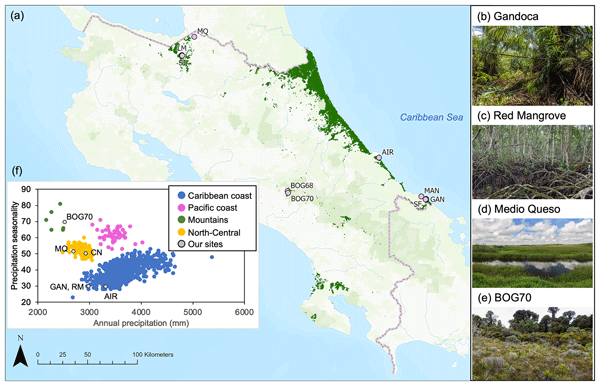
9. P4, ", (g) g , ( ) Photo credits: Hannah Mitchell and Patrick Campbell.": The
pictures are great. It is helpful to have something or someone for scale if possible
but appreciate that such photos may not be available.
10. P4, "The country-wide Costa Rica map,": Would it be possible to also show the peat
distribution as far as it is currently known (basis for the inset) in the map? I
think readers may expect this.
11. P4, "Inset map": The text in the inset will be too small to read comfortably at
print size for many readers. Usually 6 pt, or at the very smallest, 5 pt is about as
small as one can go and still reach most people.
12. P5, "the Atlantic Ocean": the Caribbean Sea, no?
13. P5, "a few meters away": This surprised me! What keeps this small stream in its
channel? Are there large mineral-soil levees on either side of the stream?
14. P5, "Table 1": This table looks like results; see general comments.
15. P6, "50 cm long,": The chamber is 50 cm long, but I think this description might
confuse some people who are not familiar with the device (how can one core to 2 m
with a 50 cm corer?). Rephrase?
16. P8, "in some cases, such as for mangrove roots, the distinction was safe to make":
How should we interpret the results? Should we consider samples specified as
containing root material as definitely containing roots, and others as possibly
containing roots, or?
17. P9, "distance": Bray-Curtis dissimilarity, technically not a distance (not a
distance metric) in that it does not satisfy the triangle inequality (with three
samples A, B, and C, the dissimilarity between A and B may be greater than the
dissimilarity between A and B plus the dissimilarity between B and C).
18. P10, "Figure 2.": Text is again very small.
19. P11, "We offer an explanation of this incongruent result in sect. 3.1.3 and 3.2.1.":
Good
20. P13, "Repeated flooding may have increased clay content, confounding the
carbohydrate signal, thereby also explaining why our high carbohydrate abundances
are synchronous with high bulk density values, which is also a phenomenon that we
observed at our mangrove site": Interpretation; try to reserve for Discussion to the
extent possible.
21. P13, "the record may have been altered,": What is meant by "the record may have been
altered"? Is it hypothesized that the core was affected by some secondary processes?
22. P15, "Age-depth g g p i i model,": Comment briefly in the caption on the error
envelope near the top of the core, or refer to a specific section in the text?
23. P16, "Figure 6": Series labels are obscure; expand in legend or in caption?
24. P20, "base level,": Define
25. P20, "pre-colombian": pre-Colombian
26. P21, "perpendicular to the ocean.": perpendicular to the shore?
27. P22, "%C is about half the OM content, similar as the relationship found in the
northern peatland database for non-Sphagnum peat (0.514; Loisel et al. 2014),
supporting the idea that OM content and %C are closely related in peatlands across
biomes": It would be good to make a comparison to other tropical peats as well. See,
for example, Warren, M. W., Kauffman, J. B., Murdiyarso, D., Anshari, G.,
Hergoualc’h, K., Kurnianto, S., Purbopuspito, J., Gusmayanti, E., Afifudin, M.,
Rahajoe, J., Alhamd, L., Limin, S., & Iswandi, A. (2012). A cost-efficient method to
assess carbon stocks in tropical peat soil. Biogeosciences, 9(11),
4477–4485. https://doi.org/10.5194/bg-9-4477-2012
28. P24, "60% more dense than their northern counterparts": Compare also to bulk density
from other tropical peatlands. See, for example, Shimada, S., Takahashi, H.,
Haraguchi, A., & Kaneko, M. (2001). The carbon content characteristics of tropical
peats in Central Kalimantan, Indonesia: Estimating their spatial variability in
density. Biogeochemistry, 53(3),
249–267. https://doi.org/10.1023/a:1010618807469. Consider distinguishing Sphagnum
peats from woody peats in the comparison.
29. P27, "A key finding is that bulk density values tend to be greater in tropical
lowland peatlands than what is typically reported for extra-tropical peatlands":
This statement is too broad as a finding from a study of Costa Rican peatlands.
30. P28, "spectra": spectrum
31. P37, "The data will be made publicly available through Zenodo upon publication of
this study.": Normally data are made available to reviewers at the review
stage. This is not always an issue but in this case the figures are quite difficult
to read.Citation: https://doi.org/10.5194/egusphere-2026-1209-RC2 -
AC2: 'Reply on RC2', Julie Loisel, 12 Jun 2026
The comment was uploaded in the form of a supplement: https://egusphere.copernicus.org/preprints/2026/egusphere-2026-1209/egusphere-2026-1209-AC2-supplement.pdf
-
AC2: 'Reply on RC2', Julie Loisel, 12 Jun 2026
Peer review completion


Post-review adjustments


Interactive discussion
Status: closed
-
RC1: 'Comment on egusphere-2026-1209', Anonymous Referee #1, 20 Apr 2026
Review of Mitchell et al.
Mitchell et al. reports an impressive dataset of Costa Rican peatlands geochemical analysis enabling a carbon store estimation, successional and peat accumulation histories, while attempting to establish links between peatland types, accumulation and organic matter quality. Given the dearth of field-based peat studies in the Central Americas, this study lays important groundwork relevant for a range of scientists and policy makers to understand the value of tropical peatlands in Costa Rica.
The introduction is very well written, outlaying current paradigms and challenges of tropical peat biogeochemistry and carbon stores, peatland extent and uncertainties on their inceptions. Especially the regional importance is well highlighted. The methods could benefit from some clarification (Major comment 3). The results and discussion could benefit from restructuring, the authors spend a lot of the manuscript describing results and could benefit from reducing this (Major comment 1&2) and spending this on placing their results in wider literature (expand discussion). That being said, the manuscript presents some impressive results which should be highlighted better in the text. To move towards a better understanding of tropical peatland dynamics and extant globally, papers like Mitchell et al. are exactly what our field requires. I strongly recommend publication, pending appropriate modifications. This is thorough and impressive work that makes several important contributions to the discipline and will serve as a foundation for understanding carbon sequestration and transformation in tropical peatlands
Major comments
1. Figures and redundancy
Almost all figures (excluding Fig. 11) are too low resolution for readers and contain too small text features (axis labels, legends etc.). Furthermore, many figures convey several iterations of the same data (see minor comments on figures) which is unnecessary and inflates the number of figures and panels to the detriment of the reader and dilutes the impact of the data. The same applies to the main text, the authors present different versions of the same data, which should be presented in a single succinct section, see minor comments. I would encourage the authors to convey their story in less figures and strategically choose and incorporate data to highlight. Currently the text and figures do not easily link. The minor comments on the figures and text suggest several alternations that could aid the reader.
2. Structuring of results and discussion
Currently, the manuscript contains discussion in the results and results in the discussion (see minor comments for specifics). When splitting actual results and discussion, I would argue that that balance is off. The majority of the manuscript is outlining results (sometimes redundantly), and the manuscript could reach higher impact if focusing more on the wider context of tropical peatlands, drawing from other studies and bringing the story back to some of the larger themes outlined in the introduction.
3. Clarification on FTIR-processing methodology
Does the author utilize the R-script published in Hodgkins et al. (2018) or is it a custom iteration? Are the dotted lines in Fig. A1 the peak heights as included in the study? If so, this would be a different interpretation than the approach presented in Hodgkins et al. (2018) as it is not baseline corrected per included peak height. I question this approach, especially for the aliphatics. In Figure A1, you can see the that the aliphatic peaks are situated on a larger peak of
unidentified absorbance. Therefore, the signal of this broader peak would be added to the interpreted signal of the aliphatics. The advice in Hodgkins et al. (2018) is to use the baseline-corrected peak heights normalized to spectral area, so I wonder why the authors have chosen a different approach. Does the relative abundance refer to the peak height post-correction? Overall, I would advise to expand the method paragraph on FTIR to aid reproducibility and publishing the custom R-script with the paper. It is difficult for me to assess which processing the authors have actually conducted. I would also advise to employ the R-script from Hodgkins et al. (2018), since the study publishes a transfer function that allows for %carbohydrates and %Klason lignin determination. This would help contextualize the results as currently any change seems relative and cannot be easily compared to the wider literature. I am aware such transfer function for the aliphatics and acids does not exists, therefore the current approach is (besides the uncertainties surrounding base-line correction) acceptable. Furthermore, the manuscript often highlights the role of silicate mineral interference to overinflate the proportion of carbohydrates in FTIR. This is a known effect and flagged in Hodgkins et al. (2018) and the pipeline includes a test (norm.silicate780) to assess whether or not data points need to be discarded due to silicate mineral interference. Perhaps it is possible for the authors to engage a similar method? To construct a threshold after which we should not overinterpret the carbohydrate signal. The relative abundance concept is also not entirely clear to me. Would the overinflation of carbohydrates indirectly cause a decrease in aromatics due to a normalization step before? If this is the case, any datapoint with enough evidence for silicate interference should be presented separately.
4. Silicate interference on FTIR results
The influence of silicate mineral interference in the carbohydrate peak in the FTIR is a reoccurring theme throughout the paper, discussed in at least four separate paragraphs. I would encourage the authors to deal with this earlier, dedicating a section fully on this phenomenon. Especially, because it is such an important theme, perhaps it is more accurate to detach “carbohydrate” from the 1050 cm-1 peak height and refer to the FTIR signal as the 1050 cm-1 band instead and add the interpretational link to carbohydrates where it is appropriate. (I would suggest to alter this in all figures as well). If the silicate interference (through relative abundance calculations) also affects the other FTIR signal (which I cannot currently decipher based on the methods) I would advise to use the wave lengths instead of the interpretation throughout the manuscript as well. The paper could benefit especially from a dedicated section to convince me that the authors are not solely interpreting silicate minerals proportions instead of the actual peat organic matter. Could this interference be deconvolved semi-quantitively? Although this has not been attempted before (as far as I know) and papers usually disqualify samples. However, the latter approach would be a shame for such an amazing dataset.
Given these comments, I think that minor revisions would result in a fine manuscript of value to the community. However, I have suggested major revisions, as these (especially a stronger treatment of the FTIR data and greater discussion relative to the results) could yield a truly foundational paper.Minor comments text:
Line 9: sentence does not flow, perhaps remove “these ecosystems”
Line 10/277/279/283/347/351: number ranges work better with an en-dash: “100–300 gigatons”
Line 11/12: Split the sentence (remove : , replace by full stop), ensure the list does not include “Panamerican region”
Line 22: replace “of” with “on”
Line 28: “multifold and” is redundant
Line 29: Replace “/” with “and”
Line 30/31/32: Is there basis to assume that Panamerican tropical peat is essentially different? Could the author clarify and reference why estimating carbon density on extra-tropical region is problematic. Same is true for the next sentence. Why would Southeast Asian peatlands have essentially different carbon densities? To a certain extent we always extrapolate data for carbon estimations, why would geographic region matter more than, for example, vegetation type?
Line 36: Any references for this paradigm? I suppose that “tropical” depends on your definition. Lowland (climatically) tropical, yes, but high-elevation tropical, perhaps not so much. Perhaps the author can define/clarify its meaning for tropical earlier, especially given that the study includes some high-elevation sites.
Line 38: replace “special” with “specific”
Line 43: Please reference mechanism (2) as well
Line 44: Please clarify the wording; are stems, branches, wood not composed of recalcitrant compounds? Perhaps “woody tissues” or “lignin-rich tissues” can replace this summation. I would also clarify that this is relatively recalcitrant to tissues associated with northern peat accumulation.
Line 47: Are there any other studies that have implied this as well?
Line 49-62: The purpose of this paragraph seems to be to cement the lack of field-based carbon storage dynamic peat studies in Central America. Perhaps introducing a world map insert into figure 1 might be more powerful displaying the coverage of field studies? Perhaps then the paragraph can be consolidated more effectively.
Line 64/69: spell out “nine”
Line 66: remove “, if any”
Line 68: The line “We also discuss the differences that were found across our sites” is repetition of the earlier defined goal of “temporal differences” and therefore redundant.
Line 70: “can be used” seems cryptic, will the author do it? Perhaps remove?
Line 71-73: switch to active voice for consistency with the previous sentences.
Line 74-76: These hypotheses feel arbitrary, given that no hypotheses are presented for any other objectives. If included, the literature can be used to back up the hypotheses as both have been observed before.
Line 75-76: Are roots associated with a high carbohydrate relative abundance? As far as I understand, aerobic degradation is fairly ambivalent to aromatic/carbohydrate proportions, therefore bypassed roots should have similar carbohydrate-aromatic ratios to extensively
aerobically degraded peat litter, however roots are often “woody tissue” and may have higher recalcitrance?
Line 82: As peatlands cover 3% of the worlds surface; Wouldn’t that make Costa Rica a “peat-average” country?
Line 82: remove “With that said, “
Line 89: Could the author clarify if these peat types are representative for Costa Rica’s peatland cover
Line 102: Please include the acronyms in the photo panel description too
Line 106-107: Perhaps it is helpful to introduce the “full core”/”bottom core” concept here already, since it is included in the table
Table 1: Perhaps including temperature range and precipitation is more informative than elevation given the scope? Could the authors reorder the table to the site description order?
Line 112/123/134/153: Full stop after (n=x). i.e. “(4) Montane peatbogs (n=2). These sites…”
Line 112: Be consistent with using either “these” or “those” describing field sites
Line 119: “The” instead of “Those”
Line 120: Could the authors briefly describe the relevant information that these studies contain? Equivalent to Lines 131-132
Line 123: replace “Mangroves” with “Mangrove”
Line 123: Please approximate the distance (e.g. ~5m)
Line 164: The information in section 2.3 might be presented better first (as section 2.1)?
Line 184: Please introduce the acronym LOI earlier in the manuscript
Line 198-199: Perhaps this statement is better suited in the results?
Line 263: Is this abovementioned mineral interval the peat basement? Could the author clarify which mineral interval? I do not observe it in Fig. 2, so I assume it is omitted from the graph?
Line 263-266: Since these are relative abundances, what kind of variations are low and which ones are high? Could the author clarify what variations are significant? Furthermore, the trends in %Carbon in Fig. 2 seem to correlate well with both Carbohydrate and Aromatic, where a low %Carbon corresponds to a high proportion of Carbohydrates and Aromatics being a perfect anti-correlation to that. Especially in the 15-35 interval the %OM, %C, carb and aro show the same signal. I wonder if this could also be mineral interference as the author invokes in later sites, especially since the %C is rather low, likely the rest of the material would contain some silicates.
Line 275: This sentence is redundant, perhaps integrate the next 2 sentences. Also, this seems like a point for in the discussion instead?
Line 280-285: Could the authors explain why the model discarded that reversal instead of the date at 45cm? Perhaps the authors could reword this section as currently the wording anthropomorphises the model and treats it as a black box (e.g. “deemed too young”)
Line 289: em dash instead of hyphen to separate the sentence
Line 297-300: These lines are better suited in the discussion of 3.2.1, where the authors could draw from all the sites, making the signposting here redundant
Line 313: The age model in figure 4 seems continuous with radiocarbon points in the indicated hiatus (Fig. 4A)? Could the author clarify?
Line 317-323: Could the author perhaps restructure or swap out the interpretation with RM to introduce this earlier in the manuscript? However, the split peaks indicates that the silicate signal is equivalent to the carbohydrate peak, which it does not have to be to significantly alter the carbohydrate height due to the width of the peak. Could that the same mechanism drive most FTIR trends in RM and GAN as well, regardless of the bulk density trends?
Line 327: Could the author add a reference that establishes a link between aliphatics and herbaceous peat?
Line 343: “shortest but longest” is confusing. Could the authors either remove the lead-in or specify their meaning e.g. “spatially shortest but temporally longest”.
Line 343-344: Could the authors specify what observations lead to the interpretation of “appears to have started as a herbaceous-dominated peatland”. This sentence could benefit from restructuring as the current 4 sub-sentences are not linked coherently.
Line 348-349: Could the authors specify at what depth (“top of profile”)?
Line 349: remove “in fact”
Line 349: Could the authors explain the two outliers in OM% at ~18 and ~75cm? (Fig. 5h). They do not seem represented in any other parameter.
Line 352-353: Could the authors reference and provide context for the link between aliphatics and herbaceous peat?
Line 354: Could the authors briefly explain what chemical/spectral reason is behind this feature?
Line 367-368: While I am not certain what transformations the authors applied to the spectral data, I wonder if the normalization step essentially makes carbohydrates and aromatics into a ratio of each other, therefore these correlations are autogenic.
Line 369-370: Is this correlation positive or negative? I wonder if it is actually the dearth of silicates that drives this correlation.
Line 372-374: This interpretation is likely, however, the inverse relationship can also indicate the proportion of silicate minerals increasing instead. It would be excellent if the authors could present a signal independent of the proportion of the 1050cm-1 peak heights.
Line 376-377: Could the author speculate why? This is a rather common trend that would be expected here as well. Is it the modern vegetation/recent vegetation shifts? Are we missing the top interval in the cores where the majority of this increase in recalcitrance is expected? (especially since tropical peat degradation is likely stronger and quicker)
Line 387-388: Could the authors refer to papers that state these mineral FTIR wavelenghts?
Line 388-390: Do the authors have any indication about the flooding frequency or sediment load of the floodings? The %OM still suggests rather minor flooding/sediment loads otherwise the peatland would not incept?
Line 382-392: This section seems to be a repeat of Line 317-323 with added markers for mineral interference and discussion. Could the author restructure the manuscript to deal with the silicate mineral effect in one sharply written section and contextualize the interpretation? Perhaps prior to the site-specific interpretation. (as section 3.1 instead). This would enable the reader to understand the nuanced FTIR signals earlier
Line 397-398: This lead-in seems not to link to the rest of the paragraph? Perhaps the author can justify their use of ordination to disentangle inter site variability.
Line 402-403: Is this information not found in Fig. 8? If this figure is more key that figure 8, perhaps these figures can swap?
Line 409: Could the authors do a statistical test to prove this?
Line 411-414: See comment for Line 382-392; it would be beneficial to condense all the lines of evidence for silicate mineral interference in one section.
Line 418: Does the combination of peat type and site not encompass the whole dataset? It is difficult to attribute these properties to peat type and site if those overlap significantly. There could be many covariance with uncharacterized parameters. Perhaps the authors could just highlight this.
Line 420-423: Could the author show the statistical tests for these?
Line 441: “tend to cluster” can the author show this statistically?
Line 440-446: This section contains results and should be moved to the results
Line 447: “, a common theme …” to “which is a common theme”
Line 448: I would argue that elevation cannot be a driver of peatland inception (peat is ambivalent to vertical location), it is the climatic conditions associated with elevation that are the main drivers. Same goes for coastal sites, but that has a different driver.
Line 452: Could the author clarify what “base level” entails?
Line 453-454: Does the author have any references to back up this hypothetical chain of events?
Line 457: “it seems [sites] lay within a lowland area that used to be flooded” Could the author ensure and remove the doubt from the sentence?
Line 458: Does the author mean Fig. 1?
Line 470-497: This section contained new data and contains no citations at all. I would urge the authors to either move this to the results and place these results in relevant literature.
Line 470-483: Should be presented in the results, perhaps a section dedicated to the bottom cores would be valuable?
Line 487: “that is an order …” replace by “which is an order …”
Line 485-490: This information was presented in the results and is repetition here. If the authors want to reinforce the uniqueness of the fast and slow accumulations, perhaps drawing from wider literature might make a stronger argument.
Line 490-497: Every sentence is this section would benefit from relevant citations. I question most statements made in this paragraph. Perhaps the author could present a structured approach to the factors that offset the balance of accumulation and degradation with citations
Line 494: Remove: “with all that said”
Line 498-512: Move to the results. I encourage the authors to condense all similar statistical tests in one comprehensive section in the results.
Line 507: Could the authors not conduct these tests in a smaller subset?
Line 510: Could the authors further investigate this relationship, as the slope is the same, but the intercept might not be. Why does this relationship does not hold in Sphagnum peat?
Table 3: This table is redundant with the box plots presented in Fig. 10. I would encourage the authors to omit this table or move to SI
Line 521-522: Could the author cite a study where this data is “directly usabl[e]” as an example?
Line 524-525: Does the author have suggestions why the Costa Rican bryophyte peat has a lower %OM?
Line 525-538: In this section, the authors compare every parameter to northern peats. I would encourage the authors to include the northern data in Fig. 12 and not highlight every difference or commonality, instead find 2-4 common themes to highlight, discuss, and place in wider literature context.
Line 544: I would argue that the approach in this study is “simple” as well given the uncertainties in peatland depths or spatial transferability of the parameters. Perhaps more powerful would be to highlight strengths of this study’s carbon store estimations.
Line 558-559: Since this study does currently contain the best available carbon estimations, I would encourage the authors to contextualize the carbon store (compare to other estimations) and provide a probabilistic range to their estimation as well. These could be helpful to stir further research and to engage to a wider (policy-focussed) audience. Overall, this section could be expanded for higher impact.
Line 571: Does the author mean figure 1?
Line 573: I would encourage the author to incorporate this caveat earlier and end the paragraph on a positive note.
Line 576: Remove “The montane peatland presented a different story”
Line 583: Based on the size and extent of the peatland, I would not presume to pick up any palynological changes in a regional lake. What would the authors most likely speculation be? Could it be an autogenic development? (i.e. fen-bog transition).
Line 591: Remove “The effect of peat type on the nature of the peat carbon compounds is worth discussing”
Line 593: Could the author clarify the challenge? FTIR generally functions under any level of humification
Line 595-596: Or the silicate minerals overprinted the carbohydrates, which pushed down the relative abundances of the aromatics and aliphatics. Recalcitrance is also not solely controlling organic matter accumulation, I would argue.
Line 598: Remove “The anticipated effect of depth (and age) on the carbon compounds was not straightforward”
Line 604-606: As the manuscript currently stands, I would argue this is the main factor controlling all FTIR-based signals, not the peat OM.
Line 608-615: Do the authors have any data-driven insights into this mechanism? If not, I would encourage the authors to omit this paragraph.
Line 617: The authors referred to some peat sediment studies in the methods before. Is the word “systematic” the key word in this sentence?
Line 618-619: I did not extract the gravitas of this finding out of the main text, perhaps the authors could highlight this unique feature to aid readers.
Line 620: The word “mineralized” is confusing with the silicate mineral interference and OM remineralization discussed previous.
Line 622: This was discussed but not proven with data. Could the vegetation input be recalcitrant instead?
Line 623-624: The author earlier referred to this as a given fact (no citations), and here discussed as a major result. Perhaps I have missed the discussion about this?
Line 624-627: Could the author indicate the inception age range? (e.g. 500-10000 yrs or 102-104 yrs)
Line 628: Why does humification lead to linear models? Was this discussed previously?
Line 629-630: See previous comment, could the author strengthen this speculation with references earlier in the discussion?
Minor comments figures:
Figure 1: Panel E is currently illegible. I suggest the author also label the included sites in panel E (MAN, BOG etc). Does this climate envelope also suggest there is a detailed probabilistic map for Costa Rica? Perhaps that would make for a better base for panel A? I suggest the author labels panels f, g, h, and i to include the acronym of the peatland as well. I would also suggest to remove the insert maps, as they currently do not convey extra information and perhaps include a global map to cement the dearth of field-based peat studies in the region. I also suggest the author to color-code each dot representing an included peat core by the four assigned peatland types in all panels? The additional suggestion would be to highlight the four sites that will feature with detailed geochemical characterization (e.g. bigger dots, thicker outline).
Figure 2, 3, 4, and 5: Could the author condense the panels in the figures to aid the visual appeal and avoid overcrowding? For example in Fig. 2; b,c,d have similar x-axis and can be color coded and integrated, same applies for the FTIR results (l,m,n). The figures could benefit from
added grouping aids i.e. subtitle for l,m,n,o indicating they are from FTIR analysis, I,j,k from elemental analysis, b,c,d from macrofossil etc. These visual aids can enhance the readers ability to quickly interpret these complicated figures. Especially since every figure features a different selection of panels (i.e. figure 3 having mineral %). Alternatively, the authors could choose to intergrate several sites in a single panel, which would aid visual comparison. It is difficult for the reader to grasp the differences between sites because the data is split in several complicated figures. For the age model specifically, it would enhance the readers ability to compare the sites by plotting the 4 age models in the same plot.
Fig 6: This is an excellent figure, which enables direct comparison of the FTIR results between the sites. Could the authors clarify that the figure shows interpretated FTIR signals? i.e. change axis labels to “carbohydates from FTIR 1050 cm-1” or something similar. The authors could simplify figures 2,3,4, and 5 as the same data is now presented twice (Fig. 6b, excluding acids). Style suggestions: Could the authors assign a panel letter (a,b,c) to each individual plot? (i.e. 6a aromatics vs carbs, 6b aliphatics vs carbs etc.). Could the authors make the text and datapoints larger? It currently difficult to read. Could the authors enlarge the legend and add the full name of the site and peatland type as well.
Fig 7. This figure is crucial for interpretation but would benefit from some visual enhancements. Could the author attach a higher resolution version and max out the signal on the Y-axis (no unit presented anyway, no need to)? Could the author integrate this with Fig. A1a, adding the bands for the compounds, perhaps even annotating the discussed mineral-related signals (kaolinite bands etc.)? The author could also add a shading band to indicate the entire range of spectra detected in each peatland so the reader does not necessarily has to look at Fig A2,A3, A4 and A5. While I personally like figures A1-A5, I would argue that they are redundant if the author publishes their raw spectra in the SI and enhances Figure 7 as suggested. The figure caption could also be expanded to explain e.g. the missing Y-axis labels and other important details.
Fig. 8: I would advise the authors to condense their figures. Panel a,b and c display the same information with 1 variable swapped out. It would enhance the understanding of the reader by omitting either depth or age (depending on which the story requires) and choosing perhaps inline labelling to convey this information. I.e. shape = Peat Type, colour = Core, label = Depth (cm). This would enable the plot to be larger and the text as well. Furthermore, please add a legend if the authors wants to minimize the text on the vectors (e.g. cn, should be described as C/N, aliph as FTIR-based aliphatics, no idea what n represents?, etc.). If keeping panel c, please add a unit to Age. Could the authors make the text and datapoints larger? It currently difficult to read. Could the authors enlarge the legend and add the full name of the site and peatland type as well. Then again, I would encourage the authors to condense the PCoA information in 1 panel.
Fig. 9: Given that all information of panel A is in panel B, I would suggest removing panel A. Could the authors add the site acronyms in panel B (labelled datapoints) and expand the legend. Could the authors also incorporate uncertainty (error bars) in the age dimension? Also, could the authors move the X-axis up to Age = 0 and condense the X-axis (range 0-250 cm).
Fig. 10: Overall, I encourage the authors to omit this figure. If keeping: the histograms bins obscure the data. I would urge the authors to remove the histograms, present the box plots and remove the scatter plots as well. The scatter plots are redundant with the information presented in Fig 2, 3, 4, and 5. (although perhaps, with added lines, this figure could replace Fig. 2,3,4, and
5). Could the authors enlarge the legend and add the full name of the site and peatland type as well. Perhaps the authors could enlarge the x-axis label significantly to aid the reader.
Fig 11: Excellent readability and the only graph for which the resolution is sufficient. Could the author present a transfer function, RMSE, r, n and specify the regression approach in the caption?
Figure A1: Add references for the association of wavelength to compounds-
AC1: 'Reply on RC1', Julie Loisel, 12 Jun 2026
The comment was uploaded in the form of a supplement: https://egusphere.copernicus.org/preprints/2026/egusphere-2026-1209/egusphere-2026-1209-AC1-supplement.pdf
-
AC1: 'Reply on RC1', Julie Loisel, 12 Jun 2026
-
RC2: 'Comment on egusphere-2026-1209', Anonymous Referee #2, 09 May 2026
This paper describes 11 cores from four peatland types in Costa Rica (montane, alluvial,
coastal palm swamp, and mangrove). The authors applied radiocarbon dating to construct
an age-depth curve (BACON), loss-on-ignition, carbon and nitrogen content, and
macrofossils as well as FTIR (Fourier-transform infrared spectroscopy). FTIR is
increasingly used to evaluate dominant types of macromolecules in peat (cellulose-like
vs lignin-like) as part of a way of assessing either inherent recalcitrance or degree of
decomposition. The study provides correlation diagrams for mangrove, riverine and one
of the bog sites. Basal radiocarbon dates ranged from about 11,000 to about 500
calibrated years before present, with oldest basal dates in the montane peatlands and
the most recent inception date in the coast palm swamp near Limon (Caribbean coast).The descriptive work here has unambiguous and lasting value and the manuscript therefore
makes a worthy contribution to the literature. As the authors state, the peatlands of
Central America remain poorly known so this information is fundamentally valuable. I do
not see any critical flaws. The manuscript is currently somewhat difficult to read,
partly because it does not quite follow the standard division into methods vs results
and does not articulate an alternate structure. The sequencing is often surprising and
makes the information hard to absorb and retain. My feeling is that the manuscript
could be greatly improved by establishing a clear, possibly different, structure; and
that the resulting text could and should also be significantly shortened. The text in
most of the figures also needs to be larger to be easily legible at printed size. I
have therefore recommended major revisions, although this would require no new analysis
or reinterpretation. The bulk of my review is focused on helping to prepare the
manuscript for publication.General comments
1. The text through the Introduction is good. I finished the Introduction excited to
read the rest of the paper.
2. The Introduction and Discussion are well grounded in the literature, notwithstanding
some suggestions in the detailed comments below.
3. The Introduction seems to half-commit to a hypothesis-testing framing regarding
preservation of tropical peat. I think it would be better to abandon this because the
hypothesis cannot really be tested with the data collected, which are anyway
valuable.
4. I suggest shortening the Methods and moving most of what is currently presented as
site description to the Results, leaving in the Methods only the general approach to
identifying and characterizing sites, and the technical methods (coring, FTIR, etc.).
5. The site descriptions would be easier to absorb if they were more structured. The
observations are good but characteristics that are compared across sites would be
better presented in a table, so that the description of each site in the text
contains only essential qualitative information.
6. Description of sites in section 2.2 is valuable but comes off as meandering and it is
not clear what material is important or why. It also seems a mix of methods and
results (but this depends partly on the positioning of the paper; I think actually
these sections are part of the novelty and contribution?). Restructure this to make
its purpose clear. Putting 2.3 before 2.2 might help?
7. Motivation for methods generally unclear; why do the ANCOVA? Papers in top journals
can provide useful examples; it is often useful to structure sections of the Methods
like this: "To quantify / evaluate / assess X, we measured Y".
8. The Results are essentially descriptive but not strongly propelled by a clear
narrative motivation.
9. Interpretation is sprinkled into the Results in places; distinguish these clearly. I
would reduce the number of adjectives in the results ("expected", "incongruent", ...)
unless a point can be made that any reasonable person would find these results
expected or incongruous, in which case it should be made clear why.
10. Interpretation: what explanations can the authors suggest for the transition to
mangrove at RM?
11. I feel that the Discussion and Conclusions could be more
concise and should be shortened significantly.Specific comments
1. P1, "ultimately to clarify the role of recalcitrant material in tropical peat
accumulation.": If the results have in fact clarified the role of recalcitrant
material, consider replacing this statement with what was learned? Otherwise,
consider removing it?
2. P1, "and is critical to advancing knowledge of the structure of tropical peatland
systems": Consider removing this statement? The abstract is just as strong without
it, and It is not obvious how it is justified by the findings of the study.
3. P2, "largest tropical peatland complexes in the world": Does the Gumbricht et al map
suggest this? It clearly suggests a very large total peatland area in the
neotropics, but does it suggest exceptionally large individual peatland complexes
(rivaling those in the Congo)?
4. P2, "beyond Changuinola, there is little knowledge on where peat is found, how deep,
old, and carbon-rich it might be, and what factors control long-term peat
accumulation processes": Is this a fair statement in view of the following
references? Already cited: Hastie, A., Honorio Coronado, E. N., Reyna, J., Mitchard,
E. T. A., Åkesson, C. M., Baker, T. R., Cole, L. E. S., Oroche, César. J. C., Dargie,
G., Dávila, N., De Grandi, E. C., Del Águila, J., Del Castillo Torres, D., De La Cruz
Paiva, R., Draper, F. C., Flores, G., Grández, J., Hergoualc’h, K., Householder,
J. E., et al. (2022). Risks to carbon storage from land-use change revealed by peat
thickness maps of Peru. Nature Geoscience, 15(5),
369–374. https://doi.org/10.1038/s41561-022-00923-4 Draper, F. C., Roucoux, K. H.,
Lawson, I. T., Mitchard, E. T. A., Honorio Coronado, E. N., Lähteenoja, O., Torres
Montenegro, L., Valderrama Sandoval, E., Zaráte, R., & Baker, T. R. (2014). The
distribution and amount of carbon in the largest peatland complex in
Amazonia. Environmental Research Letters,
9(12), 124017. https://doi.org/10.1088/1748-9326/9/12/124017 Lawson et al. 2026 Not
cited: Kelly, T. J., Lawson, I. T., Roucoux, K. H., Baker, T. R., & Honorio Coronado,
E. N. (2020). Patterns and drivers of development in a west Amazonian peatland during
the late Holocene. Quaternary Science Reviews,
230, 106168. https://doi.org/10.1016/j.quascirev.2020.106168 Kelly, T. J., Lawson,
I. T., Roucoux, K. H., Baker, T. R., Jones, T. D., & Sanderson, N. K. (2017). The
vegetation history of an Amazonian domed peatland. Palaeogeography,
Palaeoclimatology, Palaeoecology, 468,
129–141. https://doi.org/10.1016/j.palaeo.2016.11.039
5. P2, "(Rabel and Loisel, 2024": It is not clear without referring to Rabel and Loisel
(2024) and Rabel et al (2025) how the work in those studies relates to the work here.
7. P3, "the findings of this study shed light on biogeochemical processes that underpin
the formation, development, and resilience of tropical peatland ecosystems, thus
providing knowledge to scientists, landowners, managers, and policymakers.": I would
put something concrete here, or cut it.
8. P3, "For instance, the accumulation of recalcitrant compounds": There isn't enough
context here for a reader to understand these statements or evaluate the results. Is
more given in the discussion? Is it necessary to include this section at all? Would
it make more sense to explore these questions in another paper that works with a
larger dataset?
9. P4, ", (g) g , ( ) Photo credits: Hannah Mitchell and Patrick Campbell.": The
pictures are great. It is helpful to have something or someone for scale if possible
but appreciate that such photos may not be available.
10. P4, "The country-wide Costa Rica map,": Would it be possible to also show the peat
distribution as far as it is currently known (basis for the inset) in the map? I
think readers may expect this.
11. P4, "Inset map": The text in the inset will be too small to read comfortably at
print size for many readers. Usually 6 pt, or at the very smallest, 5 pt is about as
small as one can go and still reach most people.
12. P5, "the Atlantic Ocean": the Caribbean Sea, no?
13. P5, "a few meters away": This surprised me! What keeps this small stream in its
channel? Are there large mineral-soil levees on either side of the stream?
14. P5, "Table 1": This table looks like results; see general comments.
15. P6, "50 cm long,": The chamber is 50 cm long, but I think this description might
confuse some people who are not familiar with the device (how can one core to 2 m
with a 50 cm corer?). Rephrase?
16. P8, "in some cases, such as for mangrove roots, the distinction was safe to make":
How should we interpret the results? Should we consider samples specified as
containing root material as definitely containing roots, and others as possibly
containing roots, or?
17. P9, "distance": Bray-Curtis dissimilarity, technically not a distance (not a
distance metric) in that it does not satisfy the triangle inequality (with three
samples A, B, and C, the dissimilarity between A and B may be greater than the
dissimilarity between A and B plus the dissimilarity between B and C).
18. P10, "Figure 2.": Text is again very small.
19. P11, "We offer an explanation of this incongruent result in sect. 3.1.3 and 3.2.1.":
Good
20. P13, "Repeated flooding may have increased clay content, confounding the
carbohydrate signal, thereby also explaining why our high carbohydrate abundances
are synchronous with high bulk density values, which is also a phenomenon that we
observed at our mangrove site": Interpretation; try to reserve for Discussion to the
extent possible.
21. P13, "the record may have been altered,": What is meant by "the record may have been
altered"? Is it hypothesized that the core was affected by some secondary processes?
22. P15, "Age-depth g g p i i model,": Comment briefly in the caption on the error
envelope near the top of the core, or refer to a specific section in the text?
23. P16, "Figure 6": Series labels are obscure; expand in legend or in caption?
24. P20, "base level,": Define
25. P20, "pre-colombian": pre-Colombian
26. P21, "perpendicular to the ocean.": perpendicular to the shore?
27. P22, "%C is about half the OM content, similar as the relationship found in the
northern peatland database for non-Sphagnum peat (0.514; Loisel et al. 2014),
supporting the idea that OM content and %C are closely related in peatlands across
biomes": It would be good to make a comparison to other tropical peats as well. See,
for example, Warren, M. W., Kauffman, J. B., Murdiyarso, D., Anshari, G.,
Hergoualc’h, K., Kurnianto, S., Purbopuspito, J., Gusmayanti, E., Afifudin, M.,
Rahajoe, J., Alhamd, L., Limin, S., & Iswandi, A. (2012). A cost-efficient method to
assess carbon stocks in tropical peat soil. Biogeosciences, 9(11),
4477–4485. https://doi.org/10.5194/bg-9-4477-2012
28. P24, "60% more dense than their northern counterparts": Compare also to bulk density
from other tropical peatlands. See, for example, Shimada, S., Takahashi, H.,
Haraguchi, A., & Kaneko, M. (2001). The carbon content characteristics of tropical
peats in Central Kalimantan, Indonesia: Estimating their spatial variability in
density. Biogeochemistry, 53(3),
249–267. https://doi.org/10.1023/a:1010618807469. Consider distinguishing Sphagnum
peats from woody peats in the comparison.
29. P27, "A key finding is that bulk density values tend to be greater in tropical
lowland peatlands than what is typically reported for extra-tropical peatlands":
This statement is too broad as a finding from a study of Costa Rican peatlands.
30. P28, "spectra": spectrum
31. P37, "The data will be made publicly available through Zenodo upon publication of
this study.": Normally data are made available to reviewers at the review
stage. This is not always an issue but in this case the figures are quite difficult
to read.Citation: https://doi.org/10.5194/egusphere-2026-1209-RC2 -
AC2: 'Reply on RC2', Julie Loisel, 12 Jun 2026
The comment was uploaded in the form of a supplement: https://egusphere.copernicus.org/preprints/2026/egusphere-2026-1209/egusphere-2026-1209-AC2-supplement.pdf
-
AC2: 'Reply on RC2', Julie Loisel, 12 Jun 2026
Peer review completion
Post-review adjustments
Journal article(s) based on this preprint
Viewed
| HTML | XML | Total | BibTeX | EndNote | |
|---|---|---|---|---|---|
| 777 | 454 | 61 | 1,292 | 53 | 83 |
- HTML: 777
- PDF: 454
- XML: 61
- Total: 1,292
- BibTeX: 53
- EndNote: 83
Viewed (geographical distribution)
| Country | # | Views | % |
|---|
| Total: | 0 |
| HTML: | 0 |
| PDF: | 0 |
| XML: | 0 |
- 1
Hannah Mitchell
Jacklyn Rivera Wong
Alessandra C. Leri
Mia Allison
The requested preprint has a corresponding peer-reviewed final revised paper. You are encouraged to refer to the final revised version.
- Preprint
(3365 KB) - Metadata XML
Review of Mitchell et al.
Mitchell et al. reports an impressive dataset of Costa Rican peatlands geochemical analysis enabling a carbon store estimation, successional and peat accumulation histories, while attempting to establish links between peatland types, accumulation and organic matter quality. Given the dearth of field-based peat studies in the Central Americas, this study lays important groundwork relevant for a range of scientists and policy makers to understand the value of tropical peatlands in Costa Rica.
The introduction is very well written, outlaying current paradigms and challenges of tropical peat biogeochemistry and carbon stores, peatland extent and uncertainties on their inceptions. Especially the regional importance is well highlighted. The methods could benefit from some clarification (Major comment 3). The results and discussion could benefit from restructuring, the authors spend a lot of the manuscript describing results and could benefit from reducing this (Major comment 1&2) and spending this on placing their results in wider literature (expand discussion). That being said, the manuscript presents some impressive results which should be highlighted better in the text. To move towards a better understanding of tropical peatland dynamics and extant globally, papers like Mitchell et al. are exactly what our field requires. I strongly recommend publication, pending appropriate modifications. This is thorough and impressive work that makes several important contributions to the discipline and will serve as a foundation for understanding carbon sequestration and transformation in tropical peatlands
Major comments
1. Figures and redundancy
Almost all figures (excluding Fig. 11) are too low resolution for readers and contain too small text features (axis labels, legends etc.). Furthermore, many figures convey several iterations of the same data (see minor comments on figures) which is unnecessary and inflates the number of figures and panels to the detriment of the reader and dilutes the impact of the data. The same applies to the main text, the authors present different versions of the same data, which should be presented in a single succinct section, see minor comments. I would encourage the authors to convey their story in less figures and strategically choose and incorporate data to highlight. Currently the text and figures do not easily link. The minor comments on the figures and text suggest several alternations that could aid the reader.
2. Structuring of results and discussion
Currently, the manuscript contains discussion in the results and results in the discussion (see minor comments for specifics). When splitting actual results and discussion, I would argue that that balance is off. The majority of the manuscript is outlining results (sometimes redundantly), and the manuscript could reach higher impact if focusing more on the wider context of tropical peatlands, drawing from other studies and bringing the story back to some of the larger themes outlined in the introduction.
3. Clarification on FTIR-processing methodology
Does the author utilize the R-script published in Hodgkins et al. (2018) or is it a custom iteration? Are the dotted lines in Fig. A1 the peak heights as included in the study? If so, this would be a different interpretation than the approach presented in Hodgkins et al. (2018) as it is not baseline corrected per included peak height. I question this approach, especially for the aliphatics. In Figure A1, you can see the that the aliphatic peaks are situated on a larger peak of
unidentified absorbance. Therefore, the signal of this broader peak would be added to the interpreted signal of the aliphatics. The advice in Hodgkins et al. (2018) is to use the baseline-corrected peak heights normalized to spectral area, so I wonder why the authors have chosen a different approach. Does the relative abundance refer to the peak height post-correction? Overall, I would advise to expand the method paragraph on FTIR to aid reproducibility and publishing the custom R-script with the paper. It is difficult for me to assess which processing the authors have actually conducted. I would also advise to employ the R-script from Hodgkins et al. (2018), since the study publishes a transfer function that allows for %carbohydrates and %Klason lignin determination. This would help contextualize the results as currently any change seems relative and cannot be easily compared to the wider literature. I am aware such transfer function for the aliphatics and acids does not exists, therefore the current approach is (besides the uncertainties surrounding base-line correction) acceptable. Furthermore, the manuscript often highlights the role of silicate mineral interference to overinflate the proportion of carbohydrates in FTIR. This is a known effect and flagged in Hodgkins et al. (2018) and the pipeline includes a test (norm.silicate780) to assess whether or not data points need to be discarded due to silicate mineral interference. Perhaps it is possible for the authors to engage a similar method? To construct a threshold after which we should not overinterpret the carbohydrate signal. The relative abundance concept is also not entirely clear to me. Would the overinflation of carbohydrates indirectly cause a decrease in aromatics due to a normalization step before? If this is the case, any datapoint with enough evidence for silicate interference should be presented separately.
4. Silicate interference on FTIR results
The influence of silicate mineral interference in the carbohydrate peak in the FTIR is a reoccurring theme throughout the paper, discussed in at least four separate paragraphs. I would encourage the authors to deal with this earlier, dedicating a section fully on this phenomenon. Especially, because it is such an important theme, perhaps it is more accurate to detach “carbohydrate” from the 1050 cm-1 peak height and refer to the FTIR signal as the 1050 cm-1 band instead and add the interpretational link to carbohydrates where it is appropriate. (I would suggest to alter this in all figures as well). If the silicate interference (through relative abundance calculations) also affects the other FTIR signal (which I cannot currently decipher based on the methods) I would advise to use the wave lengths instead of the interpretation throughout the manuscript as well. The paper could benefit especially from a dedicated section to convince me that the authors are not solely interpreting silicate minerals proportions instead of the actual peat organic matter. Could this interference be deconvolved semi-quantitively? Although this has not been attempted before (as far as I know) and papers usually disqualify samples. However, the latter approach would be a shame for such an amazing dataset.
Given these comments, I think that minor revisions would result in a fine manuscript of value to the community. However, I have suggested major revisions, as these (especially a stronger treatment of the FTIR data and greater discussion relative to the results) could yield a truly foundational paper.
Minor comments text:
Line 9: sentence does not flow, perhaps remove “these ecosystems”
Line 10/277/279/283/347/351: number ranges work better with an en-dash: “100–300 gigatons”
Line 11/12: Split the sentence (remove : , replace by full stop), ensure the list does not include “Panamerican region”
Line 22: replace “of” with “on”
Line 28: “multifold and” is redundant
Line 29: Replace “/” with “and”
Line 30/31/32: Is there basis to assume that Panamerican tropical peat is essentially different? Could the author clarify and reference why estimating carbon density on extra-tropical region is problematic. Same is true for the next sentence. Why would Southeast Asian peatlands have essentially different carbon densities? To a certain extent we always extrapolate data for carbon estimations, why would geographic region matter more than, for example, vegetation type?
Line 36: Any references for this paradigm? I suppose that “tropical” depends on your definition. Lowland (climatically) tropical, yes, but high-elevation tropical, perhaps not so much. Perhaps the author can define/clarify its meaning for tropical earlier, especially given that the study includes some high-elevation sites.
Line 38: replace “special” with “specific”
Line 43: Please reference mechanism (2) as well
Line 44: Please clarify the wording; are stems, branches, wood not composed of recalcitrant compounds? Perhaps “woody tissues” or “lignin-rich tissues” can replace this summation. I would also clarify that this is relatively recalcitrant to tissues associated with northern peat accumulation.
Line 47: Are there any other studies that have implied this as well?
Line 49-62: The purpose of this paragraph seems to be to cement the lack of field-based carbon storage dynamic peat studies in Central America. Perhaps introducing a world map insert into figure 1 might be more powerful displaying the coverage of field studies? Perhaps then the paragraph can be consolidated more effectively.
Line 64/69: spell out “nine”
Line 66: remove “, if any”
Line 68: The line “We also discuss the differences that were found across our sites” is repetition of the earlier defined goal of “temporal differences” and therefore redundant.
Line 70: “can be used” seems cryptic, will the author do it? Perhaps remove?
Line 71-73: switch to active voice for consistency with the previous sentences.
Line 74-76: These hypotheses feel arbitrary, given that no hypotheses are presented for any other objectives. If included, the literature can be used to back up the hypotheses as both have been observed before.
Line 75-76: Are roots associated with a high carbohydrate relative abundance? As far as I understand, aerobic degradation is fairly ambivalent to aromatic/carbohydrate proportions, therefore bypassed roots should have similar carbohydrate-aromatic ratios to extensively
aerobically degraded peat litter, however roots are often “woody tissue” and may have higher recalcitrance?
Line 82: As peatlands cover 3% of the worlds surface; Wouldn’t that make Costa Rica a “peat-average” country?
Line 82: remove “With that said, “
Line 89: Could the author clarify if these peat types are representative for Costa Rica’s peatland cover
Line 102: Please include the acronyms in the photo panel description too
Line 106-107: Perhaps it is helpful to introduce the “full core”/”bottom core” concept here already, since it is included in the table
Table 1: Perhaps including temperature range and precipitation is more informative than elevation given the scope? Could the authors reorder the table to the site description order?
Line 112/123/134/153: Full stop after (n=x). i.e. “(4) Montane peatbogs (n=2). These sites…”
Line 112: Be consistent with using either “these” or “those” describing field sites
Line 119: “The” instead of “Those”
Line 120: Could the authors briefly describe the relevant information that these studies contain? Equivalent to Lines 131-132
Line 123: replace “Mangroves” with “Mangrove”
Line 123: Please approximate the distance (e.g. ~5m)
Line 164: The information in section 2.3 might be presented better first (as section 2.1)?
Line 184: Please introduce the acronym LOI earlier in the manuscript
Line 198-199: Perhaps this statement is better suited in the results?
Line 263: Is this abovementioned mineral interval the peat basement? Could the author clarify which mineral interval? I do not observe it in Fig. 2, so I assume it is omitted from the graph?
Line 263-266: Since these are relative abundances, what kind of variations are low and which ones are high? Could the author clarify what variations are significant? Furthermore, the trends in %Carbon in Fig. 2 seem to correlate well with both Carbohydrate and Aromatic, where a low %Carbon corresponds to a high proportion of Carbohydrates and Aromatics being a perfect anti-correlation to that. Especially in the 15-35 interval the %OM, %C, carb and aro show the same signal. I wonder if this could also be mineral interference as the author invokes in later sites, especially since the %C is rather low, likely the rest of the material would contain some silicates.
Line 275: This sentence is redundant, perhaps integrate the next 2 sentences. Also, this seems like a point for in the discussion instead?
Line 280-285: Could the authors explain why the model discarded that reversal instead of the date at 45cm? Perhaps the authors could reword this section as currently the wording anthropomorphises the model and treats it as a black box (e.g. “deemed too young”)
Line 289: em dash instead of hyphen to separate the sentence
Line 297-300: These lines are better suited in the discussion of 3.2.1, where the authors could draw from all the sites, making the signposting here redundant
Line 313: The age model in figure 4 seems continuous with radiocarbon points in the indicated hiatus (Fig. 4A)? Could the author clarify?
Line 317-323: Could the author perhaps restructure or swap out the interpretation with RM to introduce this earlier in the manuscript? However, the split peaks indicates that the silicate signal is equivalent to the carbohydrate peak, which it does not have to be to significantly alter the carbohydrate height due to the width of the peak. Could that the same mechanism drive most FTIR trends in RM and GAN as well, regardless of the bulk density trends?
Line 327: Could the author add a reference that establishes a link between aliphatics and herbaceous peat?
Line 343: “shortest but longest” is confusing. Could the authors either remove the lead-in or specify their meaning e.g. “spatially shortest but temporally longest”.
Line 343-344: Could the authors specify what observations lead to the interpretation of “appears to have started as a herbaceous-dominated peatland”. This sentence could benefit from restructuring as the current 4 sub-sentences are not linked coherently.
Line 348-349: Could the authors specify at what depth (“top of profile”)?
Line 349: remove “in fact”
Line 349: Could the authors explain the two outliers in OM% at ~18 and ~75cm? (Fig. 5h). They do not seem represented in any other parameter.
Line 352-353: Could the authors reference and provide context for the link between aliphatics and herbaceous peat?
Line 354: Could the authors briefly explain what chemical/spectral reason is behind this feature?
Line 367-368: While I am not certain what transformations the authors applied to the spectral data, I wonder if the normalization step essentially makes carbohydrates and aromatics into a ratio of each other, therefore these correlations are autogenic.
Line 369-370: Is this correlation positive or negative? I wonder if it is actually the dearth of silicates that drives this correlation.
Line 372-374: This interpretation is likely, however, the inverse relationship can also indicate the proportion of silicate minerals increasing instead. It would be excellent if the authors could present a signal independent of the proportion of the 1050cm-1 peak heights.
Line 376-377: Could the author speculate why? This is a rather common trend that would be expected here as well. Is it the modern vegetation/recent vegetation shifts? Are we missing the top interval in the cores where the majority of this increase in recalcitrance is expected? (especially since tropical peat degradation is likely stronger and quicker)
Line 387-388: Could the authors refer to papers that state these mineral FTIR wavelenghts?
Line 388-390: Do the authors have any indication about the flooding frequency or sediment load of the floodings? The %OM still suggests rather minor flooding/sediment loads otherwise the peatland would not incept?
Line 382-392: This section seems to be a repeat of Line 317-323 with added markers for mineral interference and discussion. Could the author restructure the manuscript to deal with the silicate mineral effect in one sharply written section and contextualize the interpretation? Perhaps prior to the site-specific interpretation. (as section 3.1 instead). This would enable the reader to understand the nuanced FTIR signals earlier
Line 397-398: This lead-in seems not to link to the rest of the paragraph? Perhaps the author can justify their use of ordination to disentangle inter site variability.
Line 402-403: Is this information not found in Fig. 8? If this figure is more key that figure 8, perhaps these figures can swap?
Line 409: Could the authors do a statistical test to prove this?
Line 411-414: See comment for Line 382-392; it would be beneficial to condense all the lines of evidence for silicate mineral interference in one section.
Line 418: Does the combination of peat type and site not encompass the whole dataset? It is difficult to attribute these properties to peat type and site if those overlap significantly. There could be many covariance with uncharacterized parameters. Perhaps the authors could just highlight this.
Line 420-423: Could the author show the statistical tests for these?
Line 441: “tend to cluster” can the author show this statistically?
Line 440-446: This section contains results and should be moved to the results
Line 447: “, a common theme …” to “which is a common theme”
Line 448: I would argue that elevation cannot be a driver of peatland inception (peat is ambivalent to vertical location), it is the climatic conditions associated with elevation that are the main drivers. Same goes for coastal sites, but that has a different driver.
Line 452: Could the author clarify what “base level” entails?
Line 453-454: Does the author have any references to back up this hypothetical chain of events?
Line 457: “it seems [sites] lay within a lowland area that used to be flooded” Could the author ensure and remove the doubt from the sentence?
Line 458: Does the author mean Fig. 1?
Line 470-497: This section contained new data and contains no citations at all. I would urge the authors to either move this to the results and place these results in relevant literature.
Line 470-483: Should be presented in the results, perhaps a section dedicated to the bottom cores would be valuable?
Line 487: “that is an order …” replace by “which is an order …”
Line 485-490: This information was presented in the results and is repetition here. If the authors want to reinforce the uniqueness of the fast and slow accumulations, perhaps drawing from wider literature might make a stronger argument.
Line 490-497: Every sentence is this section would benefit from relevant citations. I question most statements made in this paragraph. Perhaps the author could present a structured approach to the factors that offset the balance of accumulation and degradation with citations
Line 494: Remove: “with all that said”
Line 498-512: Move to the results. I encourage the authors to condense all similar statistical tests in one comprehensive section in the results.
Line 507: Could the authors not conduct these tests in a smaller subset?
Line 510: Could the authors further investigate this relationship, as the slope is the same, but the intercept might not be. Why does this relationship does not hold in Sphagnum peat?
Table 3: This table is redundant with the box plots presented in Fig. 10. I would encourage the authors to omit this table or move to SI
Line 521-522: Could the author cite a study where this data is “directly usabl[e]” as an example?
Line 524-525: Does the author have suggestions why the Costa Rican bryophyte peat has a lower %OM?
Line 525-538: In this section, the authors compare every parameter to northern peats. I would encourage the authors to include the northern data in Fig. 12 and not highlight every difference or commonality, instead find 2-4 common themes to highlight, discuss, and place in wider literature context.
Line 544: I would argue that the approach in this study is “simple” as well given the uncertainties in peatland depths or spatial transferability of the parameters. Perhaps more powerful would be to highlight strengths of this study’s carbon store estimations.
Line 558-559: Since this study does currently contain the best available carbon estimations, I would encourage the authors to contextualize the carbon store (compare to other estimations) and provide a probabilistic range to their estimation as well. These could be helpful to stir further research and to engage to a wider (policy-focussed) audience. Overall, this section could be expanded for higher impact.
Line 571: Does the author mean figure 1?
Line 573: I would encourage the author to incorporate this caveat earlier and end the paragraph on a positive note.
Line 576: Remove “The montane peatland presented a different story”
Line 583: Based on the size and extent of the peatland, I would not presume to pick up any palynological changes in a regional lake. What would the authors most likely speculation be? Could it be an autogenic development? (i.e. fen-bog transition).
Line 591: Remove “The effect of peat type on the nature of the peat carbon compounds is worth discussing”
Line 593: Could the author clarify the challenge? FTIR generally functions under any level of humification
Line 595-596: Or the silicate minerals overprinted the carbohydrates, which pushed down the relative abundances of the aromatics and aliphatics. Recalcitrance is also not solely controlling organic matter accumulation, I would argue.
Line 598: Remove “The anticipated effect of depth (and age) on the carbon compounds was not straightforward”
Line 604-606: As the manuscript currently stands, I would argue this is the main factor controlling all FTIR-based signals, not the peat OM.
Line 608-615: Do the authors have any data-driven insights into this mechanism? If not, I would encourage the authors to omit this paragraph.
Line 617: The authors referred to some peat sediment studies in the methods before. Is the word “systematic” the key word in this sentence?
Line 618-619: I did not extract the gravitas of this finding out of the main text, perhaps the authors could highlight this unique feature to aid readers.
Line 620: The word “mineralized” is confusing with the silicate mineral interference and OM remineralization discussed previous.
Line 622: This was discussed but not proven with data. Could the vegetation input be recalcitrant instead?
Line 623-624: The author earlier referred to this as a given fact (no citations), and here discussed as a major result. Perhaps I have missed the discussion about this?
Line 624-627: Could the author indicate the inception age range? (e.g. 500-10000 yrs or 102-104 yrs)
Line 628: Why does humification lead to linear models? Was this discussed previously?
Line 629-630: See previous comment, could the author strengthen this speculation with references earlier in the discussion?
Minor comments figures:
Figure 1: Panel E is currently illegible. I suggest the author also label the included sites in panel E (MAN, BOG etc). Does this climate envelope also suggest there is a detailed probabilistic map for Costa Rica? Perhaps that would make for a better base for panel A? I suggest the author labels panels f, g, h, and i to include the acronym of the peatland as well. I would also suggest to remove the insert maps, as they currently do not convey extra information and perhaps include a global map to cement the dearth of field-based peat studies in the region. I also suggest the author to color-code each dot representing an included peat core by the four assigned peatland types in all panels? The additional suggestion would be to highlight the four sites that will feature with detailed geochemical characterization (e.g. bigger dots, thicker outline).
Figure 2, 3, 4, and 5: Could the author condense the panels in the figures to aid the visual appeal and avoid overcrowding? For example in Fig. 2; b,c,d have similar x-axis and can be color coded and integrated, same applies for the FTIR results (l,m,n). The figures could benefit from
added grouping aids i.e. subtitle for l,m,n,o indicating they are from FTIR analysis, I,j,k from elemental analysis, b,c,d from macrofossil etc. These visual aids can enhance the readers ability to quickly interpret these complicated figures. Especially since every figure features a different selection of panels (i.e. figure 3 having mineral %). Alternatively, the authors could choose to intergrate several sites in a single panel, which would aid visual comparison. It is difficult for the reader to grasp the differences between sites because the data is split in several complicated figures. For the age model specifically, it would enhance the readers ability to compare the sites by plotting the 4 age models in the same plot.
Fig 6: This is an excellent figure, which enables direct comparison of the FTIR results between the sites. Could the authors clarify that the figure shows interpretated FTIR signals? i.e. change axis labels to “carbohydates from FTIR 1050 cm-1” or something similar. The authors could simplify figures 2,3,4, and 5 as the same data is now presented twice (Fig. 6b, excluding acids). Style suggestions: Could the authors assign a panel letter (a,b,c) to each individual plot? (i.e. 6a aromatics vs carbs, 6b aliphatics vs carbs etc.). Could the authors make the text and datapoints larger? It currently difficult to read. Could the authors enlarge the legend and add the full name of the site and peatland type as well.
Fig 7. This figure is crucial for interpretation but would benefit from some visual enhancements. Could the author attach a higher resolution version and max out the signal on the Y-axis (no unit presented anyway, no need to)? Could the author integrate this with Fig. A1a, adding the bands for the compounds, perhaps even annotating the discussed mineral-related signals (kaolinite bands etc.)? The author could also add a shading band to indicate the entire range of spectra detected in each peatland so the reader does not necessarily has to look at Fig A2,A3, A4 and A5. While I personally like figures A1-A5, I would argue that they are redundant if the author publishes their raw spectra in the SI and enhances Figure 7 as suggested. The figure caption could also be expanded to explain e.g. the missing Y-axis labels and other important details.
Fig. 8: I would advise the authors to condense their figures. Panel a,b and c display the same information with 1 variable swapped out. It would enhance the understanding of the reader by omitting either depth or age (depending on which the story requires) and choosing perhaps inline labelling to convey this information. I.e. shape = Peat Type, colour = Core, label = Depth (cm). This would enable the plot to be larger and the text as well. Furthermore, please add a legend if the authors wants to minimize the text on the vectors (e.g. cn, should be described as C/N, aliph as FTIR-based aliphatics, no idea what n represents?, etc.). If keeping panel c, please add a unit to Age. Could the authors make the text and datapoints larger? It currently difficult to read. Could the authors enlarge the legend and add the full name of the site and peatland type as well. Then again, I would encourage the authors to condense the PCoA information in 1 panel.
Fig. 9: Given that all information of panel A is in panel B, I would suggest removing panel A. Could the authors add the site acronyms in panel B (labelled datapoints) and expand the legend. Could the authors also incorporate uncertainty (error bars) in the age dimension? Also, could the authors move the X-axis up to Age = 0 and condense the X-axis (range 0-250 cm).
Fig. 10: Overall, I encourage the authors to omit this figure. If keeping: the histograms bins obscure the data. I would urge the authors to remove the histograms, present the box plots and remove the scatter plots as well. The scatter plots are redundant with the information presented in Fig 2, 3, 4, and 5. (although perhaps, with added lines, this figure could replace Fig. 2,3,4, and
5). Could the authors enlarge the legend and add the full name of the site and peatland type as well. Perhaps the authors could enlarge the x-axis label significantly to aid the reader.
Fig 11: Excellent readability and the only graph for which the resolution is sufficient. Could the author present a transfer function, RMSE, r, n and specify the regression approach in the caption?
Figure A1: Add references for the association of wavelength to compounds