
the Creative Commons Attribution 4.0 License.
the Creative Commons Attribution 4.0 License.
 | 11 Mar 2026
Reconstructed VOC emissions reveal hidden ozone precursors: Overlooked roles of primary OVOCs and unmeasured species
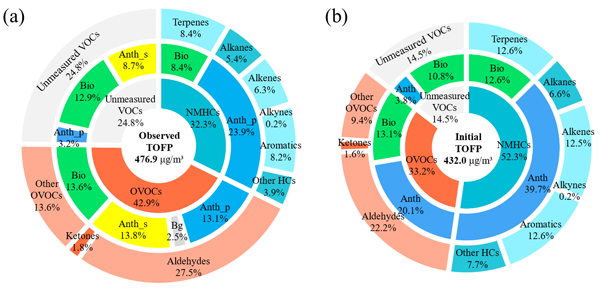
Abstract. Ambient volatile organic compounds (VOCs), including non-methane hydrocarbons (NMHCs) and oxygenated VOCs (OVOCs), are critical precursors of tropospheric ozone (O3). However, conventional estimates of ozone formation potential (OFP) derived from observed VOC concentrations may introduce substantial biases, as they neglect the photochemical degradation of primary VOCs and the concurrent generation of secondary OVOCs during atmospheric transport. This study quantified the sources of ambient OVOCs at a suburban site in Shanghai, China during summer 2020 to reconstruct their initial emission concentrations. Together with the reconstructed initial concentrations of NMHCs, we estimated the OFP of freshly emitted VOCs. In addition, the sources and OFP of unmeasured VOCs were inferred by concurrent measurements of missing OH reactivity. Our results demonstrate that photochemical reactions substantially altered the composition and source characteristics of VOCs, leading to pronounced discrepancies in OFP estimation between observed and reconstructed initial concentrations. Specifically, OFP contributions from reconstructed NMHCs (52.3 %) were underestimated by 31.7 % when derived from observed concentrations for this site, whereas those from reconstructed OVOCs (33.2 %) were overestimated by 42.6 %. Reconstructed VOC emissions indicated that anthropogenic sources dominated total emissions (71.5 %), whereas OVOCs constituted a substantial fraction of total VOC emissions (40.8 %). Unmeasured VOCs, primarily of biogenic origin, contributed an additional 12.6 %. Collectively, OVOCs and unmeasured species exhibited OFP comparable to NMHCs, underscoring their critical role in O3 production and the necessity of incorporating these species into the design of comprehensive and effective O3 control strategies.
-
Notice on discussion status
The requested preprint has a corresponding peer-reviewed final revised paper. You are encouraged to refer to the final revised version.
-
Preprint
(1077 KB)
-
Supplement
(1709 KB)
-
The requested preprint has a corresponding peer-reviewed final revised paper. You are encouraged to refer to the final revised version.
- Preprint
(1077 KB) - Metadata XML
-
Supplement
(1709 KB) - BibTeX
- EndNote
- Final revised paper


Journal article(s) based on this preprint
Interactive discussion
Status: closed
-
RC1: 'Comment on egusphere-2026-1204', Anonymous Referee #1, 04 Apr 2026
- AC1: 'Reply on RC1', Lin Wang, 09 Jun 2026
-
RC2: 'Comment on egusphere-2026-1204', Anonymous Referee #2, 23 Apr 2026
The work presented by Yin et al., highlights the importance of chemical aging from primary emissions and the inconsistency of neglecting this in measurement based ozone formation potential studies and associated impacts on air quality management policies. By tracing the atmospheric composition back to primary emission mixtures that are aged chemically, they are able to associate the ozone formation potential to primary emitted compounds and asses their integrated impact on atmospheric chemistry.
Results are obtained from a limited dataset obtained during summer in a suburban region. While this limits the overall implications and may introduce a bias in their interpretation, the authors do acknowledge this in their last section. I hope to see similar evaluations at different locations and seasons to see how results compare to the assessment made in the current publication.
The work is presented clearly and I appreciated the high quality of writing. However, one major concern about the data availability and some minor remarks should be resolved before I can recommend publication.
Major concern:
According to the ACP data policy authors are required to provide a statement on how their underlying research data can be accessed. The data deposited in the doi reflect data shown in the figures from the paper and are not sufficient for reproducing the analysis. Please make the calculated concentrations from the measurement campaign available either here or through a separate paper submitted to ESSD in accordance to the ACP data policy suggestion.
Minor comments:
- L 48-50; Traditional source apportionment methods like PMF do resolve secondary sources, though limitedly. E.g., source factors identified by PMF that are the dominant source of MVK/MACR are usually identified as a "secondary biogenic factor". The high simplification being that chemical ageing of primary emissions is assumed to be a linear combination of the primary and the secondary factor which does not allow for differences in chemical lifetime of primary compounds. Your analysis has the edge because it explicitly traces back the secondary source factors to the origins. Please be more precise in your discussion.
- L 199-203; Please make a clearer separation between your results (identification of an anthropogenic source) , and discussion (which anthropogenic activities emit these compounds). As I understood the analysis, you cannot resolve sector based sources which is inconsistent with the formulation of most notably L 199-200.
Technical comments:
- L 35; grammatical error, remove "the" before "smog chambers"
- L 113; Please remain consistent in naming between the formula and the explanation (i.e., choose between NMHC or VOC here).
Citation: https://doi.org/10.5194/egusphere-2026-1204-RC2 - AC2: 'Reply on RC2', Lin Wang, 09 Jun 2026
-
RC3: 'Comment on egusphere-2026-1204', Anonymous Referee #3, 27 Apr 2026
General comments
This paper presented the comprehensive analysis of measured VOC concentrations and missing OH reactivity at a suburban site in Shanghai, China. Source apportionment was performed via the photochemical age-based parametrisation method allowing the attribution of OVOCs to primary and secondary anthropogenic sources, biogenic sources, and regional background. Eventually, the ozone formation potential was determined with the MIR method. To assess the impact of chemical aging during transport of the eventually measured air mass on the VOC distribution and the ozone formation potential, primary VOC and OVOC concentrations were estimated using the observed VOC concentrations and the OH exposure, derived from a species ratio method.
This paper focuses on the comparison between observed VOCs and estimated primarily emitted VOCs and the implication on the OFP. Even though differences are somehow expected, the quantitative comparison gives an idea about the magnitude and the VOCs, either measured or reconstructed, contributing most to the OFP.
Overall, this paper highlights the importance of reconstructing VOC and OVOC emissions in the OFP analysis, which is commonly performed with observed VOC concentrations. Even though previous studies already investigated the impact of the reconstruction on the OFP, I believe that this study would be complementing if the comparison between the different studies is properly discussed. Therefore, I recommend this paper for publication after major changes have been done.
Major comments
- In general, I am missing more details about trace gas concentrations and meteorological parameters (temperature, relative humidity) measured during the campaign which would help the reader to understand the chemical conditions onsite. There is no information about the level of ozone and nitrogen oxides as well of the measured total OH reactivity. The measured total OH reactivity is not discussed at all in the paper. Even though the missing OH reactivity is obviously derived from the comparison of the total OH reactivity with the OH reactivity calculated from the VOC measurements, there is no comparison shown and no absolute numbers given. Furthermore, since the OH exposure determines the reconstruction, it is important to show this as well. How long is actually the estimated transport time of the air mass which plays into the OH exposure and thus into the reconstruction?
- The quantitative comparison of the results with previous studies (e.g. Zheng and Xie (2025)) should be included in the paper. How do the results about the OFP and the top drivers compare? How does the measured total OH reactivity compare with other studies focusing on ozone pollution in China?
- At the end, it was mentioned that the results help understanding previous discrepancies between field observations, emission inventories, and source measurements. How much do the findings solve these discrepancies? In addition, the authors state that the emission control strategies focus too much on a limited set of NMHCs such as PAMS. How much do PAMS contribute to the total OFP? In other words, how much is the OFP underestimated by only considering PAMS?
Technical corrections
- In general, values have too many decimals which is not necessary.
- There are often articles missing. Here are few examples: (a) Line 14,19,21: the ozone formation potential, (b) line 17: an OFP
- There are references missing:
- Line 86: Fuchs et al. (2017) (https://doi.org/10.5194/amt-10-4023-2017) should be cited here as it compares different kOH measurements including CRM.
- Line 92: Give a reference for PAPM
- Since different techniques are applied, it is important to make sure to be precise in the wording. There are different situations where it is unclear for the reader what is meant.
- Line 93: It sounds like the PAPM neglects the photolysis of OVOCs. However, in line 52 it is mentioned that the photolysis of OVOCs is also considered by the PAPM.
- Line 94: I would add the corresponding emission rates, like “anthropogenic primary emissions (ER_OVOC), …” This will help the reader to understand what is shown in the plots later.
- Lines 106,107: It is not clear to me how these two sentences connect. Currently, it reads like a least-squares fit was done because the OH radicals are dominating the VOC oxidation. However, I guess the authors intended to say that only this specific time window is considered because OH radicals dominate the VOC oxidation then.
- Line 107: I would add the fit parameters here to make it as clear as possible.
- Lines 113-115: How are the sources of NMHCs derived?
- Line 139,140: What is used for the correlation? The different emission rates?
- Line 147,148: Why is it here the “jth source at the observation site” and before only “jth source”? I recommend to be consistent, in this specific case with regard to lines 113-115, 120,149.
- Line 150: It is not clear to me what you mean by “equivalent concentrations of measured VOCs”. You do measure concentrations, so this wording is confusing.
- Line 152: How were the unmeasured VOCs associated with secondary formation determined?
- Line 155: Isn’t Eq. (7) the same as Eq. (2)? In line 151 it is mentioned that the unmeasured VOCs are similarly treated as the measured ones.
- Line 177: “fitted results”. For the understanding, I would add here a reference to the corresponding equation and section. Same for the caption of Figure 1.
- Line 22,24: Since this is the abstract it is not clear yet what the authors mean by “reconstructed NMHCs/OVOCs”. To clarify this, I would rather write “reconstructed primarily emitted NMHCs/OVOCs”
- Line 35: I do not think that it is relevant here whether the VOCs were added in smog chambers or came from numerical simulations. I would cancel this as it confuses the reader.
- Line 87: “…, respectively” can be cancelled as it does not apply.
- Line 89: What is “zero gas”? Is it pure synthetic air or is it compressed air? I would be more specific here.
- There are some sentences with a wrong syntax or grammer:
- Line 99: “their precursors to relative C2H2” should be “their precursors relative to C2H2”
- Line 103: “ratio of OVOCs to isoprene from biogenic emissions” should be “ratio of OVOCs from biogenic emissions relative to isoprene”
- Line 193: “high contributions to MVK” should be “high contributions of MVK”
- Line 110: I believe the nitrate radical has not been introduced yet.
- Line 129: I would add the scientific meaning of a, b, and c.
- Line 130: “Cbackground is interception” seems to be lost.
- Line 131: The unit of a,b,c should be ppb/s
- Line 132,133: “derive” seems to be the wrong verb here. I would rather use “originate”.
- Line 165: Why were these 130 OVOCs without MIR values excluded from the OFP analysis and not treated as unmeasured OVOCs?
- Line 171: “kOH” was not introduced yet. Since kOH is typically an abbreviation for the OH reactivity, which was also measured, I would not give this abbreviation to an OH reaction rate constant. In general, there is not a consistent notation of reaction rate constants and VOC species. In Eqs. (1), (2), (7), the OH reaction rate of a VOC species I is called ki. In Eq. (4), the VOC species is called Xi and the corresponding OH rate coefficient k(Xi+OH)
- Line 297, 298: I do not understand where these numbers are coming from. It is not consistent with Fig. 3.
- Line 322: I would make clear that it refers here to the reconstructed VOCs and the corresponding OFP.
- Line 327 (Figure 4): It should be added that it is the contribution to the TOFP. Are only anthropogenic primary emissions shown? This is unclear.
- Line 328: The OFP should be added.
- Line 350: The number (14.5%) should be checked. According to Fig. 2b it should rather be 12.6%.
Citation: https://doi.org/10.5194/egusphere-2026-1204-RC3 - AC3: 'Reply on RC3', Lin Wang, 09 Jun 2026
Peer review completion


Interactive discussion
Status: closed
-
RC1: 'Comment on egusphere-2026-1204', Anonymous Referee #1, 04 Apr 2026
Summary
In this study, the authors reconstruct VOC emissions at a suburban site in Shanghai and estimate ozone formation potential based on reconstructed results. The topic is within the scope of ACP. However, in my point of view, this study does not provide sufficient novel insights into VOC emissions for promoting the understanding of ozone pollution in China. The overall framework remains largely an extension of conventional OFP calculations based on MIR by Carter et al, while the observations are limited by discontinuous sampling and a single-site dataset.Major comments:
1) The most significant concern is that this work relies on MIR-based OFP estimation derived from Carter et al, which remains a highly simplified reactivity metric rather than a process-resolving representation of ozone production. In recent years, many studies in China have already highlighted the limitations of conventional MIR/OFP approaches and have proposed more localized or observation-constrained methods to diagnose ozone precursor importance under region-specific chemical regimes. Although the authors attempt to reconstruct initial VOC concentrations and correct biases arising from photochemical aging, the analysis still builds on a simple OFP framework rather than a more rigorous assessment.
2) Another major concern is the very short sampling period and the quality of the VOC observations. As shown in Figure 1, VOC observations contain substantial missing periods, especially during the first three weeks of August, where only intermittent measurements are available and the time series is highly discontinuous. I have serious concerns regarding the quality of the dataset and the robustness of the source apportionment as well as reconstruction results. When the observational basis is fragmented to this extent, it becomes difficult to support strong quantitative statements regarding the relative contributions of OVOCs, NMHCs, and unmeasured species to ozone precursor budgets.
3) Another key issue is that the importance of OVOCs in Chinese urban and suburban atmospheres, including their sources, formation pathways, and contribution to ozone chemistry, has already been extensively investigated in previous studies, including many conducted in the Pearl River Delta, Yangtze River Delta, and other heavily polluted regions of China. Compared with prior studies, this analysis is based on a single suburban site with limited available data points. The authors rely on only approximately three weeks of available VOC observations for their analysis. It remains unclear whether the key conclusion regarding the contribution of directly emitted OVOCs would be changed if the sampling period were extended to a full season or even an annual scale.
4) In the Atmospheric implications section, the authors suggest that this work supports a shift toward reactivity-based VOC management. However, a critical issue is overlooked: how important are these OVOCs for ozone pollution? In other words, what is their contribution to ozone levels in Shanghai under ambient conditions? This is a central question that the study should address. A more rigorous analysis, such as using an MCM-based box model, is essentially needed to quantify and elucidate the contribution of OVOCs to ozone formation.5) In terms of the comprehensiveness of the data and the scientific insights presented in the manuscript, I think this paper does not qualify as a research article in its current form in ACP.
Citation: https://doi.org/10.5194/egusphere-2026-1204-RC1 - AC1: 'Reply on RC1', Lin Wang, 09 Jun 2026
-
RC2: 'Comment on egusphere-2026-1204', Anonymous Referee #2, 23 Apr 2026
The work presented by Yin et al., highlights the importance of chemical aging from primary emissions and the inconsistency of neglecting this in measurement based ozone formation potential studies and associated impacts on air quality management policies. By tracing the atmospheric composition back to primary emission mixtures that are aged chemically, they are able to associate the ozone formation potential to primary emitted compounds and asses their integrated impact on atmospheric chemistry.
Results are obtained from a limited dataset obtained during summer in a suburban region. While this limits the overall implications and may introduce a bias in their interpretation, the authors do acknowledge this in their last section. I hope to see similar evaluations at different locations and seasons to see how results compare to the assessment made in the current publication.
The work is presented clearly and I appreciated the high quality of writing. However, one major concern about the data availability and some minor remarks should be resolved before I can recommend publication.
Major concern:
According to the ACP data policy authors are required to provide a statement on how their underlying research data can be accessed. The data deposited in the doi reflect data shown in the figures from the paper and are not sufficient for reproducing the analysis. Please make the calculated concentrations from the measurement campaign available either here or through a separate paper submitted to ESSD in accordance to the ACP data policy suggestion.
Minor comments:
- L 48-50; Traditional source apportionment methods like PMF do resolve secondary sources, though limitedly. E.g., source factors identified by PMF that are the dominant source of MVK/MACR are usually identified as a "secondary biogenic factor". The high simplification being that chemical ageing of primary emissions is assumed to be a linear combination of the primary and the secondary factor which does not allow for differences in chemical lifetime of primary compounds. Your analysis has the edge because it explicitly traces back the secondary source factors to the origins. Please be more precise in your discussion.
- L 199-203; Please make a clearer separation between your results (identification of an anthropogenic source) , and discussion (which anthropogenic activities emit these compounds). As I understood the analysis, you cannot resolve sector based sources which is inconsistent with the formulation of most notably L 199-200.
Technical comments:
- L 35; grammatical error, remove "the" before "smog chambers"
- L 113; Please remain consistent in naming between the formula and the explanation (i.e., choose between NMHC or VOC here).
Citation: https://doi.org/10.5194/egusphere-2026-1204-RC2 - AC2: 'Reply on RC2', Lin Wang, 09 Jun 2026
-
RC3: 'Comment on egusphere-2026-1204', Anonymous Referee #3, 27 Apr 2026
General comments
This paper presented the comprehensive analysis of measured VOC concentrations and missing OH reactivity at a suburban site in Shanghai, China. Source apportionment was performed via the photochemical age-based parametrisation method allowing the attribution of OVOCs to primary and secondary anthropogenic sources, biogenic sources, and regional background. Eventually, the ozone formation potential was determined with the MIR method. To assess the impact of chemical aging during transport of the eventually measured air mass on the VOC distribution and the ozone formation potential, primary VOC and OVOC concentrations were estimated using the observed VOC concentrations and the OH exposure, derived from a species ratio method.
This paper focuses on the comparison between observed VOCs and estimated primarily emitted VOCs and the implication on the OFP. Even though differences are somehow expected, the quantitative comparison gives an idea about the magnitude and the VOCs, either measured or reconstructed, contributing most to the OFP.
Overall, this paper highlights the importance of reconstructing VOC and OVOC emissions in the OFP analysis, which is commonly performed with observed VOC concentrations. Even though previous studies already investigated the impact of the reconstruction on the OFP, I believe that this study would be complementing if the comparison between the different studies is properly discussed. Therefore, I recommend this paper for publication after major changes have been done.
Major comments
- In general, I am missing more details about trace gas concentrations and meteorological parameters (temperature, relative humidity) measured during the campaign which would help the reader to understand the chemical conditions onsite. There is no information about the level of ozone and nitrogen oxides as well of the measured total OH reactivity. The measured total OH reactivity is not discussed at all in the paper. Even though the missing OH reactivity is obviously derived from the comparison of the total OH reactivity with the OH reactivity calculated from the VOC measurements, there is no comparison shown and no absolute numbers given. Furthermore, since the OH exposure determines the reconstruction, it is important to show this as well. How long is actually the estimated transport time of the air mass which plays into the OH exposure and thus into the reconstruction?
- The quantitative comparison of the results with previous studies (e.g. Zheng and Xie (2025)) should be included in the paper. How do the results about the OFP and the top drivers compare? How does the measured total OH reactivity compare with other studies focusing on ozone pollution in China?
- At the end, it was mentioned that the results help understanding previous discrepancies between field observations, emission inventories, and source measurements. How much do the findings solve these discrepancies? In addition, the authors state that the emission control strategies focus too much on a limited set of NMHCs such as PAMS. How much do PAMS contribute to the total OFP? In other words, how much is the OFP underestimated by only considering PAMS?
Technical corrections
- In general, values have too many decimals which is not necessary.
- There are often articles missing. Here are few examples: (a) Line 14,19,21: the ozone formation potential, (b) line 17: an OFP
- There are references missing:
- Line 86: Fuchs et al. (2017) (https://doi.org/10.5194/amt-10-4023-2017) should be cited here as it compares different kOH measurements including CRM.
- Line 92: Give a reference for PAPM
- Since different techniques are applied, it is important to make sure to be precise in the wording. There are different situations where it is unclear for the reader what is meant.
- Line 93: It sounds like the PAPM neglects the photolysis of OVOCs. However, in line 52 it is mentioned that the photolysis of OVOCs is also considered by the PAPM.
- Line 94: I would add the corresponding emission rates, like “anthropogenic primary emissions (ER_OVOC), …” This will help the reader to understand what is shown in the plots later.
- Lines 106,107: It is not clear to me how these two sentences connect. Currently, it reads like a least-squares fit was done because the OH radicals are dominating the VOC oxidation. However, I guess the authors intended to say that only this specific time window is considered because OH radicals dominate the VOC oxidation then.
- Line 107: I would add the fit parameters here to make it as clear as possible.
- Lines 113-115: How are the sources of NMHCs derived?
- Line 139,140: What is used for the correlation? The different emission rates?
- Line 147,148: Why is it here the “jth source at the observation site” and before only “jth source”? I recommend to be consistent, in this specific case with regard to lines 113-115, 120,149.
- Line 150: It is not clear to me what you mean by “equivalent concentrations of measured VOCs”. You do measure concentrations, so this wording is confusing.
- Line 152: How were the unmeasured VOCs associated with secondary formation determined?
- Line 155: Isn’t Eq. (7) the same as Eq. (2)? In line 151 it is mentioned that the unmeasured VOCs are similarly treated as the measured ones.
- Line 177: “fitted results”. For the understanding, I would add here a reference to the corresponding equation and section. Same for the caption of Figure 1.
- Line 22,24: Since this is the abstract it is not clear yet what the authors mean by “reconstructed NMHCs/OVOCs”. To clarify this, I would rather write “reconstructed primarily emitted NMHCs/OVOCs”
- Line 35: I do not think that it is relevant here whether the VOCs were added in smog chambers or came from numerical simulations. I would cancel this as it confuses the reader.
- Line 87: “…, respectively” can be cancelled as it does not apply.
- Line 89: What is “zero gas”? Is it pure synthetic air or is it compressed air? I would be more specific here.
- There are some sentences with a wrong syntax or grammer:
- Line 99: “their precursors to relative C2H2” should be “their precursors relative to C2H2”
- Line 103: “ratio of OVOCs to isoprene from biogenic emissions” should be “ratio of OVOCs from biogenic emissions relative to isoprene”
- Line 193: “high contributions to MVK” should be “high contributions of MVK”
- Line 110: I believe the nitrate radical has not been introduced yet.
- Line 129: I would add the scientific meaning of a, b, and c.
- Line 130: “Cbackground is interception” seems to be lost.
- Line 131: The unit of a,b,c should be ppb/s
- Line 132,133: “derive” seems to be the wrong verb here. I would rather use “originate”.
- Line 165: Why were these 130 OVOCs without MIR values excluded from the OFP analysis and not treated as unmeasured OVOCs?
- Line 171: “kOH” was not introduced yet. Since kOH is typically an abbreviation for the OH reactivity, which was also measured, I would not give this abbreviation to an OH reaction rate constant. In general, there is not a consistent notation of reaction rate constants and VOC species. In Eqs. (1), (2), (7), the OH reaction rate of a VOC species I is called ki. In Eq. (4), the VOC species is called Xi and the corresponding OH rate coefficient k(Xi+OH)
- Line 297, 298: I do not understand where these numbers are coming from. It is not consistent with Fig. 3.
- Line 322: I would make clear that it refers here to the reconstructed VOCs and the corresponding OFP.
- Line 327 (Figure 4): It should be added that it is the contribution to the TOFP. Are only anthropogenic primary emissions shown? This is unclear.
- Line 328: The OFP should be added.
- Line 350: The number (14.5%) should be checked. According to Fig. 2b it should rather be 12.6%.
Citation: https://doi.org/10.5194/egusphere-2026-1204-RC3 - AC3: 'Reply on RC3', Lin Wang, 09 Jun 2026
Peer review completion
Journal article(s) based on this preprint
Viewed
| HTML | XML | Total | Supplement | BibTeX | EndNote | |
|---|---|---|---|---|---|---|
| 923 | 404 | 107 | 1,434 | 198 | 87 | 118 |
- HTML: 923
- PDF: 404
- XML: 107
- Total: 1,434
- Supplement: 198
- BibTeX: 87
- EndNote: 118
Viewed (geographical distribution)
| Country | # | Views | % |
|---|
| Total: | 0 |
| HTML: | 0 |
| PDF: | 0 |
| XML: | 0 |
- 1
Sijia Yin
Gan Yang
Chuang Li
Qingyan Fu
Juntao Huo
Yuruo Fu
Rengqi Yan

The requested preprint has a corresponding peer-reviewed final revised paper. You are encouraged to refer to the final revised version.
- Preprint
(1077 KB) - Metadata XML
-
Supplement
(1709 KB) - BibTeX
- EndNote
- Final revised paper
Summary
In this study, the authors reconstruct VOC emissions at a suburban site in Shanghai and estimate ozone formation potential based on reconstructed results. The topic is within the scope of ACP. However, in my point of view, this study does not provide sufficient novel insights into VOC emissions for promoting the understanding of ozone pollution in China. The overall framework remains largely an extension of conventional OFP calculations based on MIR by Carter et al, while the observations are limited by discontinuous sampling and a single-site dataset.
Major comments:
1) The most significant concern is that this work relies on MIR-based OFP estimation derived from Carter et al, which remains a highly simplified reactivity metric rather than a process-resolving representation of ozone production. In recent years, many studies in China have already highlighted the limitations of conventional MIR/OFP approaches and have proposed more localized or observation-constrained methods to diagnose ozone precursor importance under region-specific chemical regimes. Although the authors attempt to reconstruct initial VOC concentrations and correct biases arising from photochemical aging, the analysis still builds on a simple OFP framework rather than a more rigorous assessment.
2) Another major concern is the very short sampling period and the quality of the VOC observations. As shown in Figure 1, VOC observations contain substantial missing periods, especially during the first three weeks of August, where only intermittent measurements are available and the time series is highly discontinuous. I have serious concerns regarding the quality of the dataset and the robustness of the source apportionment as well as reconstruction results. When the observational basis is fragmented to this extent, it becomes difficult to support strong quantitative statements regarding the relative contributions of OVOCs, NMHCs, and unmeasured species to ozone precursor budgets.
3) Another key issue is that the importance of OVOCs in Chinese urban and suburban atmospheres, including their sources, formation pathways, and contribution to ozone chemistry, has already been extensively investigated in previous studies, including many conducted in the Pearl River Delta, Yangtze River Delta, and other heavily polluted regions of China. Compared with prior studies, this analysis is based on a single suburban site with limited available data points. The authors rely on only approximately three weeks of available VOC observations for their analysis. It remains unclear whether the key conclusion regarding the contribution of directly emitted OVOCs would be changed if the sampling period were extended to a full season or even an annual scale.
4) In the Atmospheric implications section, the authors suggest that this work supports a shift toward reactivity-based VOC management. However, a critical issue is overlooked: how important are these OVOCs for ozone pollution? In other words, what is their contribution to ozone levels in Shanghai under ambient conditions? This is a central question that the study should address. A more rigorous analysis, such as using an MCM-based box model, is essentially needed to quantify and elucidate the contribution of OVOCs to ozone formation.
5) In terms of the comprehensiveness of the data and the scientific insights presented in the manuscript, I think this paper does not qualify as a research article in its current form in ACP.