
the Creative Commons Attribution 4.0 License.
the Creative Commons Attribution 4.0 License.
 | 09 Mar 2026
Climatology and trends of extreme precipitation in France: evaluation of an explicit-convection regional climate model
Abstract. Climate change is intensifying the global water cycle, with extreme precipitation events increasing in frequency and intensity at the global scale. While trends in daily precipitation extremes are well-documented, sub-daily extremes—critical for flash flood risk—remain poorly characterized, due to limited long-term sub-daily observations. Convection-permitting models explicitly resolve deep convection and therefore offer the potential for a substantially improved representation of convective processes and short-duration precipitation extremes. This study evaluates the ability of the convection-permitting regional climate model AROME (2.5 km resolution, 1959–2022), forced by ERA5 reanalysis, to reproduce precipitation extremes and their trends, at daily and hourly scales, using a dense network of Météo-France stations.
Using extreme value theory (GEV modeling), we analyze trends in 10-year return levels for both daily (1959–2022) and hourly (1990–2022) extremes. At the daily scale, AROME reproduces observed positive trends in southeastern France, consistent with previous studies. Hourly trends are more heterogeneous and less robust, with high spatial variability and low model-observation correlation. Overall, the results highlight the added value of the explicit-convection model for extreme precipitation studies while underscoring its limitations for convective extremes.
-
Notice on discussion status
The requested preprint has a corresponding peer-reviewed final revised paper. You are encouraged to refer to the final revised version.
-
Preprint
(31923 KB)
-
The requested preprint has a corresponding peer-reviewed final revised paper. You are encouraged to refer to the final revised version.
- Preprint
(31923 KB) - Metadata XML
- BibTeX
- EndNote
- Final revised paper


Journal article(s) based on this preprint
Interactive discussion
Status: closed
-
RC1: 'Comment on egusphere-2026-1202', Anonymous Referee #1, 19 Apr 2026
- AC1: 'Reply on RC1', J. Blanchet, 02 Jun 2026
-
RC2: 'Comment on egusphere-2026-1202', Anonymous Referee #2, 06 May 2026
Review Climatology and trends of extreme precipitation in France: evaluation of an explicit-convection regional climate model
The manuscript presents results from AROME simulations and observations over France on extreme precipitation on daily and hourly time scales. Extreme precipitation trends are analyzed with 10-year return values for both hourly and daily extremes. The results are clearly presented and well described and appear suitable for publication; however, several concerns should be addressed prior to acceptance.
General
There is a 10-tear return period chosen for both daily and hourly data, even though 10-year return period for hourly is much more extreme compared to daily given the amount of hourly data in a 10-year period compared to daily. Has a lower return value been tested? Given the noily result, and the shorter period of data a better justification for the high return period for hourly data should be given, and it is of interest to show a lower return period.
Introduction: First paragraph introduces a lot of different processes that are not necessarily connected. For instance, global warming leads to an increase in surface temperature, but it’s the temperature increase in the atmosphere that increases the water holding capabilities, and the energy balance is also between the top of atmosphere and surface (and everything in between). A lot of the statements in Introduction need a reference for instance line 47-50 and should include more research articles in addition on the IPCC 2021 report.
Figure 2 and Figure 3: How much of the temperature trend could be caused by aerosol changes due to anthropogenic pollution? How is aerosol treated in AROME? The results in these plots indicate that there is an increase in temperature after the peak pollution in the 1980s and that the trend in 10-year return level is increasing after this peak. Even though aerosols are not included or kept constant in AROME, this should be stated and included in the discussion and limitations.
For the maps with stations, setting non-significant trends to zeros makes it difficult to differentiate with stations that have close to zero or zero significant trends and stations with strong trends that are non-significant. The authors should consider not showing the stations at all or choosing another marker. The size of the marker also seems to vary with the trend, which can make it look like the stations with strong trends are more numerous than they are.
Minor
Why choose the hydrological year? The study itself does not take into account snowpack, and in addition the convective extreme precipitation can come in summer that in this study is over the start of the hydrological year (JAS, where summer usually is considered as JJA). This should be justified more.
It can be confusing in the text with GEV models and Arome model, could consider naming one different.
To little font in Figure 8
Citation: https://doi.org/10.5194/egusphere-2026-1202-RC2 - AC2: 'Reply on RC2', J. Blanchet, 02 Jun 2026
Peer review completion


Interactive discussion
Status: closed
-
RC1: 'Comment on egusphere-2026-1202', Anonymous Referee #1, 19 Apr 2026
This study presents the evaluation of precipitation extremes in France for a 63-year run of the AROME ERA-driven convection-permitting climate model (CPM). In particular, the focus is on daily and hourly 10-yr return levels, both on their climatology and temporal trend. As a benchmark, daily and hourly rain gauge observations are used (minimum 50 year and 25 years record length, respectively).
These objectives are of interest in the hydrological community, given the increasing use of these type of climate models and the need of robust evaluation for extremes. This is still limited, particularly for the observed trend because the lack of longer than 10-20 year simulations. The paper is thus relevant for HESS journal, but I suggest moderate revision. In particular, it could benefit from improved/highlighted information about relative biases (now it’s more focused on correlation metrics), and some updates to figures.
Main comments:
Line 88-89 (but also linked with lines 323-324 in the discussion). Considering that you are not looking at very rare extremes (10-yr return level), I suggest to look also at trend in Annual Maxima, that is not affected by uncertainty in fitting a 3-parameters distribution like GEV, in order to compare/confirm your patterns.
Line 162: I have a few concerns about the non-stationary models. Hourly data mostly starts in 1990. Thus, the M* models are applied just to the daily case, right? Do you really need 6 non-stationary models? In how many cases the M* models resulted better than the M ones?
Line 178: not clear to me why you use the 2-step procedure, why not simply choosing the model with the smallest p-value?
Line 199. I suggest to illustrate in the method section which evaluation metrics you used (e.g. ME, r) and for which variables other than 10-yr RL (e.g. frequency of wet days)
Lines 216-225. I strongly suggest to add information on relative biases (also, in figures 4 and 5), because N mm/year could be small or big difference depending on the baseline!
Lines 230. This seems mostly referring to spatial correlation; but also bias should be mentioned (e.g., underestimation at 1h)
Figure 4 . I suggest to substitute 3rd row or add a 4th row with relative biases. For all figures with maps: Use same size for dots (now, the highest values have both darker color and bigger size, hiding other; I think color is enough); maybe find a darker color for the 0 bias (not much visible as it is now).
Figure 5. I suggest a second panel summarizing %biases for the 4 variables.
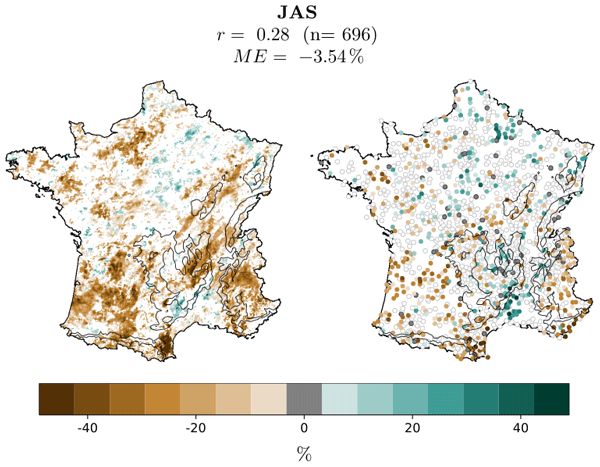
Lines 274-285 and figure 8, and figure 9. I found this text a too qualitative, and all those maps in figure 8 not much relevant and their metrics not easily readable. My suggestion is to move this figure in supplementary, and to update figure 9 to give more complete summary information about monthly performance (not just r): trend from stations and model, bias, correlation for both daily and hourly extremes (example or organization below, or any other combination allowing to show all those metrics). It could support what you then mention at line 377 in the discussion.
DAILY
HOURLY
Trend stations and arome
Trend stations and arome
Relative bias
Relative bias
Correlation
Correlation
Line 298. Link this to your results. Should we expect even higher underestimation at hourly scale by the model, if undercatch errors for stations will be corrected? What do you mean with “heterogeneity”?
Line 305-308. I think SMEV approach should also be mentioned (Marra et al. 2020 10.1029/2020gl090209) which has been also applied in both stationary mode for evaluation of short-run CPMs (Correa-Sanchez et al., 2025 https://doi.org/10.1016/j.jhydrol.2025.133324) and non-stationary mode on 90-yr CPM (Lompi et al., 2025 https://doi.org/10.1016/j.advwatres.2025.105071)
Minor comments:
Line 11 (and 395). “added value” … with respect to what?
Line 19. What does it mean “under calm conditions”?
Line 54. “sensitivities”: maybe more clearly “temperature-scaling rate”
Line 57. “hourly extremes”: what kind? Annual Maxima, percentiles, return levels?
Line 70. “over long period”: this is not generally true for CPM. This is way your study is valuable.
Line 121. 50km? you mentioned 25-31 km at line 79
Lines 126-128. I wonder if this should be placed in the discussion (and a smaller figure, considering the simplicity of its information)
Line 133: Evaluation is made per year and season … and month.
Figure 3. Mention that is an example of M3* model with positive trend. Consider if moving to supplementary (I don't find it so relevant).
Line 253. “moderately” capture… in some seasons (highest r=0.4).
Lines 261-264. You mention twice “no trend” for seasons where about 1/3 of stations show significant trend! I guess you intended something like “no clear spatial pattern” or similar. I suggest to clarify/correct
Line 273. -84.7% in figure 7
Line 291. Also July and October null/very small
Line 345. Where? Same regions where you find underestimation?
Line 366. Is this really an issue at daily scale? How? I think it could lower the absolute values, not clearly the temporal trend. (same consideration for line 382-383)
- AC1: 'Reply on RC1', J. Blanchet, 02 Jun 2026
-
RC2: 'Comment on egusphere-2026-1202', Anonymous Referee #2, 06 May 2026
Review Climatology and trends of extreme precipitation in France: evaluation of an explicit-convection regional climate model
The manuscript presents results from AROME simulations and observations over France on extreme precipitation on daily and hourly time scales. Extreme precipitation trends are analyzed with 10-year return values for both hourly and daily extremes. The results are clearly presented and well described and appear suitable for publication; however, several concerns should be addressed prior to acceptance.
General
There is a 10-tear return period chosen for both daily and hourly data, even though 10-year return period for hourly is much more extreme compared to daily given the amount of hourly data in a 10-year period compared to daily. Has a lower return value been tested? Given the noily result, and the shorter period of data a better justification for the high return period for hourly data should be given, and it is of interest to show a lower return period.
Introduction: First paragraph introduces a lot of different processes that are not necessarily connected. For instance, global warming leads to an increase in surface temperature, but it’s the temperature increase in the atmosphere that increases the water holding capabilities, and the energy balance is also between the top of atmosphere and surface (and everything in between). A lot of the statements in Introduction need a reference for instance line 47-50 and should include more research articles in addition on the IPCC 2021 report.
Figure 2 and Figure 3: How much of the temperature trend could be caused by aerosol changes due to anthropogenic pollution? How is aerosol treated in AROME? The results in these plots indicate that there is an increase in temperature after the peak pollution in the 1980s and that the trend in 10-year return level is increasing after this peak. Even though aerosols are not included or kept constant in AROME, this should be stated and included in the discussion and limitations.
For the maps with stations, setting non-significant trends to zeros makes it difficult to differentiate with stations that have close to zero or zero significant trends and stations with strong trends that are non-significant. The authors should consider not showing the stations at all or choosing another marker. The size of the marker also seems to vary with the trend, which can make it look like the stations with strong trends are more numerous than they are.
Minor
Why choose the hydrological year? The study itself does not take into account snowpack, and in addition the convective extreme precipitation can come in summer that in this study is over the start of the hydrological year (JAS, where summer usually is considered as JJA). This should be justified more.
It can be confusing in the text with GEV models and Arome model, could consider naming one different.
To little font in Figure 8
Citation: https://doi.org/10.5194/egusphere-2026-1202-RC2 - AC2: 'Reply on RC2', J. Blanchet, 02 Jun 2026
Peer review completion
Journal article(s) based on this preprint
Viewed
| HTML | XML | Total | BibTeX | EndNote | |
|---|---|---|---|---|---|
| 928 | 1,015 | 87 | 2,030 | 107 | 119 |
- HTML: 928
- PDF: 1,015
- XML: 87
- Total: 2,030
- BibTeX: 107
- EndNote: 119
Viewed (geographical distribution)
| Country | # | Views | % |
|---|
| Total: | 0 |
| HTML: | 0 |
| PDF: | 0 |
| XML: | 0 |
- 1
Nicolas Decoopman
Juliette Blanchet

Antoine Blanc
Cécile Caillaud
The requested preprint has a corresponding peer-reviewed final revised paper. You are encouraged to refer to the final revised version.
- Preprint
(31923 KB) - Metadata XML
This study presents the evaluation of precipitation extremes in France for a 63-year run of the AROME ERA-driven convection-permitting climate model (CPM). In particular, the focus is on daily and hourly 10-yr return levels, both on their climatology and temporal trend. As a benchmark, daily and hourly rain gauge observations are used (minimum 50 year and 25 years record length, respectively).
These objectives are of interest in the hydrological community, given the increasing use of these type of climate models and the need of robust evaluation for extremes. This is still limited, particularly for the observed trend because the lack of longer than 10-20 year simulations. The paper is thus relevant for HESS journal, but I suggest moderate revision. In particular, it could benefit from improved/highlighted information about relative biases (now it’s more focused on correlation metrics), and some updates to figures.
Main comments:
Line 88-89 (but also linked with lines 323-324 in the discussion). Considering that you are not looking at very rare extremes (10-yr return level), I suggest to look also at trend in Annual Maxima, that is not affected by uncertainty in fitting a 3-parameters distribution like GEV, in order to compare/confirm your patterns.
Line 162: I have a few concerns about the non-stationary models. Hourly data mostly starts in 1990. Thus, the M* models are applied just to the daily case, right? Do you really need 6 non-stationary models? In how many cases the M* models resulted better than the M ones?
Line 178: not clear to me why you use the 2-step procedure, why not simply choosing the model with the smallest p-value?
Line 199. I suggest to illustrate in the method section which evaluation metrics you used (e.g. ME, r) and for which variables other than 10-yr RL (e.g. frequency of wet days)
Lines 216-225. I strongly suggest to add information on relative biases (also, in figures 4 and 5), because N mm/year could be small or big difference depending on the baseline!
Lines 230. This seems mostly referring to spatial correlation; but also bias should be mentioned (e.g., underestimation at 1h)
Figure 4 . I suggest to substitute 3rd row or add a 4th row with relative biases. For all figures with maps: Use same size for dots (now, the highest values have both darker color and bigger size, hiding other; I think color is enough); maybe find a darker color for the 0 bias (not much visible as it is now).
Figure 5. I suggest a second panel summarizing %biases for the 4 variables.
Lines 274-285 and figure 8, and figure 9. I found this text a too qualitative, and all those maps in figure 8 not much relevant and their metrics not easily readable. My suggestion is to move this figure in supplementary, and to update figure 9 to give more complete summary information about monthly performance (not just r): trend from stations and model, bias, correlation for both daily and hourly extremes (example or organization below, or any other combination allowing to show all those metrics). It could support what you then mention at line 377 in the discussion.
DAILY
HOURLY
Trend stations and arome
Trend stations and arome
Relative bias
Relative bias
Correlation
Correlation
Line 298. Link this to your results. Should we expect even higher underestimation at hourly scale by the model, if undercatch errors for stations will be corrected? What do you mean with “heterogeneity”?
Line 305-308. I think SMEV approach should also be mentioned (Marra et al. 2020 10.1029/2020gl090209) which has been also applied in both stationary mode for evaluation of short-run CPMs (Correa-Sanchez et al., 2025 https://doi.org/10.1016/j.jhydrol.2025.133324) and non-stationary mode on 90-yr CPM (Lompi et al., 2025 https://doi.org/10.1016/j.advwatres.2025.105071)
Minor comments:
Line 11 (and 395). “added value” … with respect to what?
Line 19. What does it mean “under calm conditions”?
Line 54. “sensitivities”: maybe more clearly “temperature-scaling rate”
Line 57. “hourly extremes”: what kind? Annual Maxima, percentiles, return levels?
Line 70. “over long period”: this is not generally true for CPM. This is way your study is valuable.
Line 121. 50km? you mentioned 25-31 km at line 79
Lines 126-128. I wonder if this should be placed in the discussion (and a smaller figure, considering the simplicity of its information)
Line 133: Evaluation is made per year and season … and month.
Figure 3. Mention that is an example of M3* model with positive trend. Consider if moving to supplementary (I don't find it so relevant).
Line 253. “moderately” capture… in some seasons (highest r=0.4).
Lines 261-264. You mention twice “no trend” for seasons where about 1/3 of stations show significant trend! I guess you intended something like “no clear spatial pattern” or similar. I suggest to clarify/correct
Line 273. -84.7% in figure 7
Line 291. Also July and October null/very small
Line 345. Where? Same regions where you find underestimation?
Line 366. Is this really an issue at daily scale? How? I think it could lower the absolute values, not clearly the temporal trend. (same consideration for line 382-383)