
the Creative Commons Attribution 4.0 License.
the Creative Commons Attribution 4.0 License.
 | 20 Mar 2026
Attribution of The Record Breaking 2025 European Fire Season to Climate Change
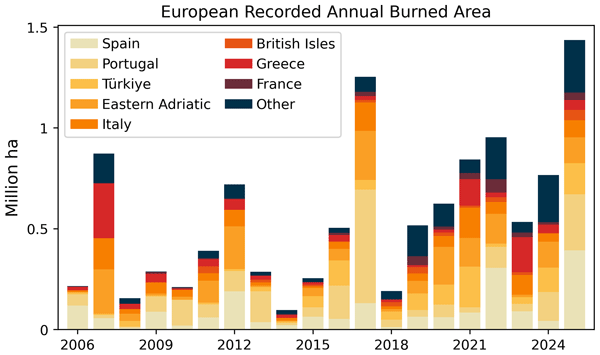
Abstract. The 2025 European fire season was historically extreme, with record-breaking burned area exceeding 1,400,000 ha, and multiple regionally unprecedented wildfires. Emerging fire regimes and extreme wildfire behaviour in Europe pose increasing adaptation challenges. Extreme event attribution of a recent fire season, combined with analysis of changes in vegetation and land use, provides insight into the effect of climate and environmental change on high impact events. We analyse five regions that experienced particularly extreme wildfire activity in 2025 (northwestern Iberia, northern and western Britain, Occitania, the eastern Adriatic/Ionian, and northern and western Türkiye) capturing a diverse range of driving weather conditions and fire regimes. Strong trends towards drier summer summers and extreme weekly vapour pressure deficit (VPD) were found, with summer drought emergent from natural variability in most southern European regions, and VPD extreme emergent in reanalysis data for all regions. Changes in VPD are the main reason why combined hot, dry, and windy conditions have become more frequent than expected from natural variability. This emergence is seen in both reanalysis data and climate models for the Iberian, Adriatic/Ionian and Turkish regions. In contrast, in the British and Occitanian regions, models do not show observed trends.
Competing interests: At least one of the (co-)authors is a member of the editorial board of Natural Hazards and Earth System Sciences.
Publisher's note: Copernicus Publications remains neutral with regard to jurisdictional claims made in the text, published maps, institutional affiliations, or any other geographical representation in this paper. While Copernicus Publications makes every effort to include appropriate place names, the final responsibility lies with the authors. Views expressed in the text are those of the authors and do not necessarily reflect the views of the publisher.-
Notice on discussion status
The requested preprint has a corresponding peer-reviewed final revised paper. You are encouraged to refer to the final revised version.
-
Preprint
(6773 KB)
-
Supplement
(3837 KB)
-
The requested preprint has a corresponding peer-reviewed final revised paper. You are encouraged to refer to the final revised version.
- Preprint
(6773 KB) - Metadata XML
-
Supplement
(3837 KB) - BibTeX
- EndNote
- Final revised paper


Journal article(s) based on this preprint
Interactive discussion
Status: closed
-
RC1: 'Comment on egusphere-2026-1193', Anonymous Referee #1, 20 May 2026
- AC1: 'Reply on RC1', Theodore Keeping, 26 Jun 2026
-
RC2: 'Comment on egusphere-2026-1193', Anonymous Referee #2, 25 May 2026
The manuscript addresses an important and timely topic and provides a broad regional analysis of the 2025 European wildfire season. The combination of fire-weather attribution, vegetation trends, and land-use change is valuable. However, some sections would benefit from clearer wording, reduced repetition, and smoother explanation of the research gap and methodological logic. In several places, the text is scientifically meaningful but syntactically heavy, which may reduce readability for a broad NHESS audience. I consider the manuscript suitable for publication after revision.
Line 25 / Abstract
The phrase “drier summer summers” appears to contain a repetition/typo. Please revise.
Introduction / early framing
Some sentences in the introduction are very long and contain several ideas at once. Consider splitting them to improve readability, especially where fire weather attribution, vegetation trends, and land-use analysis are introduced together.
Line 36
Remove extra space after “was “.
Line 42
Maybe better not to start the sentence with 2025; for example, “The European wildfire season also recorded...”
Line 44
This sentence provides useful impact context, but smoke is not a central component of the study. Consider shortening it or linking it more clearly to the motivation for studying extreme wildfire seasons.
Line 51–54
This sentence is conceptually important but difficult to follow. Consider simplifying the structure after “allows” and clarifying that the study assesses how changing wildfire drivers contribute to the severity of extreme wildfire seasons.
Lines 117, 188, 218, 222, and 238–246
Several regional background statements would benefit from stronger citation support.
Line 190
The phrase “low, highly connected vegetation” may be vague for some readers. Consider revising to “short, continuous vegetation” or “connected surface fuels” to clarify that “low” refers to vegetation height, not low fuel amount.
Line 255
Please remove the repetition of “detailed” and make the research-gap explanation smoother. The contrast between the relatively strong understanding of recent regional wildfire drivers and the limited understanding of longer-term fire-regime changes due to the short satellite-based record is important, but it could be expressed more clearly.
Methods section
The methodological framework is strong, but some readers may benefit from a clearer explanation of why specific variables were selected, especially HDWI, VPD, seasonal effective precipitation, LAI, and managed land fraction. A short linking paragraph could help connect these variables to the conceptual wildfire-driver framework.
Discussion
The discussion is rich and well connected to the results, but some claims could be made more cautious where the evidence is indirect, especially when interpreting LAI and land-use change as proxies for fuel load, fuel continuity, or abandonment effects.
Conclusion
The conclusion effectively summarizes the main regional contrasts, but it is quite dense. Consider shortening some sentences and emphasizing the main contribution more clearly: climate change has increased key fire-weather hazards, while vegetation and land-use changes modulate regional wildfire potential.
Citation: https://doi.org/10.5194/egusphere-2026-1193-RC2 - AC2: 'Reply on RC2', Theodore Keeping, 26 Jun 2026
Peer review completion


Interactive discussion
Status: closed
-
RC1: 'Comment on egusphere-2026-1193', Anonymous Referee #1, 20 May 2026
This is a well-written and timely contribution that will have significant impact on the wildfire research and management community. The multi-region approach is interesting and commendable, and the combination of attribution methodology with vegetation and land-use analysis provides a genuinely comprehensive picture of the 2025 European fire season. The writing is generally clear and technically rigorous, though at times sentences become complex enough to obscure the intended meaning for a first-time reader. The figure captions, while necessarily detailed for a paper of this scope, tend toward verbosity and contain some internal redundancy that could be reduced. A few methodological clarifications are needed — most notably regarding the use of the term "anomaly" in figures where ratios rather than differences appear to be plotted. Once these are addressed, the paper will be in excellent shape for publication. See the supplement for the suggested revisions.
- AC1: 'Reply on RC1', Theodore Keeping, 26 Jun 2026
-
RC2: 'Comment on egusphere-2026-1193', Anonymous Referee #2, 25 May 2026
The manuscript addresses an important and timely topic and provides a broad regional analysis of the 2025 European wildfire season. The combination of fire-weather attribution, vegetation trends, and land-use change is valuable. However, some sections would benefit from clearer wording, reduced repetition, and smoother explanation of the research gap and methodological logic. In several places, the text is scientifically meaningful but syntactically heavy, which may reduce readability for a broad NHESS audience. I consider the manuscript suitable for publication after revision.
Line 25 / Abstract
The phrase “drier summer summers” appears to contain a repetition/typo. Please revise.
Introduction / early framing
Some sentences in the introduction are very long and contain several ideas at once. Consider splitting them to improve readability, especially where fire weather attribution, vegetation trends, and land-use analysis are introduced together.
Line 36
Remove extra space after “was “.
Line 42
Maybe better not to start the sentence with 2025; for example, “The European wildfire season also recorded...”
Line 44
This sentence provides useful impact context, but smoke is not a central component of the study. Consider shortening it or linking it more clearly to the motivation for studying extreme wildfire seasons.
Line 51–54
This sentence is conceptually important but difficult to follow. Consider simplifying the structure after “allows” and clarifying that the study assesses how changing wildfire drivers contribute to the severity of extreme wildfire seasons.
Lines 117, 188, 218, 222, and 238–246
Several regional background statements would benefit from stronger citation support.
Line 190
The phrase “low, highly connected vegetation” may be vague for some readers. Consider revising to “short, continuous vegetation” or “connected surface fuels” to clarify that “low” refers to vegetation height, not low fuel amount.
Line 255
Please remove the repetition of “detailed” and make the research-gap explanation smoother. The contrast between the relatively strong understanding of recent regional wildfire drivers and the limited understanding of longer-term fire-regime changes due to the short satellite-based record is important, but it could be expressed more clearly.
Methods section
The methodological framework is strong, but some readers may benefit from a clearer explanation of why specific variables were selected, especially HDWI, VPD, seasonal effective precipitation, LAI, and managed land fraction. A short linking paragraph could help connect these variables to the conceptual wildfire-driver framework.
Discussion
The discussion is rich and well connected to the results, but some claims could be made more cautious where the evidence is indirect, especially when interpreting LAI and land-use change as proxies for fuel load, fuel continuity, or abandonment effects.
Conclusion
The conclusion effectively summarizes the main regional contrasts, but it is quite dense. Consider shortening some sentences and emphasizing the main contribution more clearly: climate change has increased key fire-weather hazards, while vegetation and land-use changes modulate regional wildfire potential.
Citation: https://doi.org/10.5194/egusphere-2026-1193-RC2 - AC2: 'Reply on RC2', Theodore Keeping, 26 Jun 2026
Peer review completion
Journal article(s) based on this preprint
Data sets
Attribution of The Record Breaking 2025 European Fire Season to Climate Change Theodore R. Keeping https://doi.org/10.5281/zenodo.18839224
Model code and software
rwwa Clair Barnes https://github.com/WorldWeatherAttribution/rwwa/blob/main/DESCRIPTION
Interactive computing environment
Attribution of The Record Breaking 2025 European Fire Season to Climate Change Theodore R. Keeping https://doi.org/10.5281/zenodo.18839224
Viewed
| HTML | XML | Total | Supplement | BibTeX | EndNote | |
|---|---|---|---|---|---|---|
| 1,660 | 1,111 | 86 | 2,857 | 187 | 93 | 94 |
- HTML: 1,660
- PDF: 1,111
- XML: 86
- Total: 2,857
- Supplement: 187
- BibTeX: 93
- EndNote: 94
Viewed (geographical distribution)
| Country | # | Views | % |
|---|
| Total: | 0 |
| HTML: | 0 |
| PDF: | 0 |
| XML: | 0 |
- 1
Cited


2 citations as recorded by crossref.
- Protected and non-protected areas burned at a similar fire severity within the 2025 megafires in Spain N. Quintero et al. https://doi.org/10.1186/s42408-026-00512-5
- Transient and asymptotic distributions of vegetation under recurrent stochastic fires F. Rodríguez et al. https://doi.org/10.1007/s40314-026-03793-3
Theodore R. Keeping

Mariam Zachariah
Olivia Haas
Μanolis Grillakis
Clair Barnes
Gareth D. Clay
Bikem Ekberzade
Orjeta Jaupaj
Andreia F. S. Ribeiro
Ricardo M. Trigo
Apostolos Voulgarakis
Friederike E. L. Otto
The requested preprint has a corresponding peer-reviewed final revised paper. You are encouraged to refer to the final revised version.
- Preprint
(6773 KB) - Metadata XML
-
Supplement
(3837 KB) - BibTeX
- EndNote
- Final revised paper
This is a well-written and timely contribution that will have significant impact on the wildfire research and management community. The multi-region approach is interesting and commendable, and the combination of attribution methodology with vegetation and land-use analysis provides a genuinely comprehensive picture of the 2025 European fire season. The writing is generally clear and technically rigorous, though at times sentences become complex enough to obscure the intended meaning for a first-time reader. The figure captions, while necessarily detailed for a paper of this scope, tend toward verbosity and contain some internal redundancy that could be reduced. A few methodological clarifications are needed — most notably regarding the use of the term "anomaly" in figures where ratios rather than differences appear to be plotted. Once these are addressed, the paper will be in excellent shape for publication. See the supplement for the suggested revisions.