
the Creative Commons Attribution 4.0 License.
the Creative Commons Attribution 4.0 License.
 | 07 Apr 2026
El Niño meets elevated Tibetan Plateau snow cover: Independent and synergistic effects on the winter PM2.5 dipole pattern in China
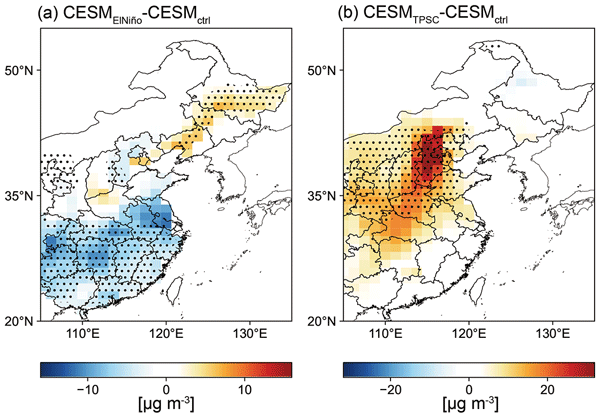
Abstract. Snow cover over the Tibetan Plateau (TP) plays a vital role in shaping regional and large-scale atmospheric circulation through snow-albedo feedbacks. However, its influence on fine particulate matter (PM2.5) pollution in China remains unclear. This study reveals that winter PM2.5 variability in China is controlled by both anthropogenic emissions and large-scale atmospheric circulation. Large-scale circulation creates a north-south dipole pattern over eastern China, which is mainly contributed by El Niño and snow cover over the northern TP. Observational data and model simulations confirm that El Niño mainly impacts PM2.5 in southern China by enhancing moisture transport and wet scavenging, while increased snow cover over the northern TP independently promotes accumulation and hygroscopic growth of aerosols in northern China. Moreover, El Niño and TP snow cover interact synergistically, particularly during their positive phases, intensifying circulation anomalies linked to the PM2.5 dipole. These findings emphasize the importance of cryospheric and oceanic variability in influencing winter air quality and offer valuable insights for improving seasonal prediction of air pollution in China.
-
Notice on discussion status
The requested preprint has a corresponding peer-reviewed final revised paper. You are encouraged to refer to the final revised version.
-
Preprint
(9128 KB)
-
The requested preprint has a corresponding peer-reviewed final revised paper. You are encouraged to refer to the final revised version.
- Preprint
(9128 KB) - Metadata XML
- BibTeX
- EndNote
- Final revised paper


Journal article(s) based on this preprint
Interactive discussion
Status: closed
-
RC1: 'Comment on egusphere-2026-1177', Anonymous Referee #1, 20 Apr 2026
- AC1: 'Reply on RC1', Xiaorui Zhang, 26 May 2026
-
RC2: 'Comment on egusphere-2026-1177', Anonymous Referee #2, 22 Apr 2026
This manuscript investigates the influence of El Niño and Tibetan Plateau snow cover on the winter PM2.5 dipole pattern over China, using EOF analysis, statistical diagnostics, and CESM sensitivity experiments. The study links large-scale climate variability with regional air pollution and identifies a north-south dipole structure associated with atmospheric circulation changes. Overall, the manuscript is well organized, and the topic is quite interesting. However, several key issues related to experimental design, physical interpretation, and methodological consistency need to be addressed to improve the robustness and credibility of the conclusions.
Major Comments:
- The CESM sensitivity experiments are conducted for only a single winter period, which raises concerns about the robustness. Given the strong interannual variability of atmospheric circulation, it is recommended to include multi-year trials to enhance the reliability of the simulation results.
- The second EOF mode (PC2), although central to the manuscript, explains a relatively limited fraction of variance and its physical interpretation is not sufficiently clarified. It remains unclear whether PC2 represents a dynamically independent mode or a statistical pattern resulting from multiple overlapping processes.
- The treatment of Tibetan Plateau snow cover raises concerns. The selected region is relatively limited and characterized by generally shallow and sparse snow cover, which may weaken its physical representativeness. In such regions, variations in snow cover fraction alone may not be sufficient to induce strong surface energy perturbations or atmospheric responses, and this issue is not sufficiently discussed. In addition, it should be noted that the temporal variability of snow cover differs markedly across different regions of the Tibetan Plateau. In contrast, previous studies suggest that snow anomalies over the whole Tibetan Plateau are more likely to generate large-scale circulation responses affecting eastern China. Therefore, the current regional definition may not fully capture the relevant physical processes.
- The snow forcing experiment is highly idealized. Using a fixed high albedo (0.8) to represent enhanced snow cover deviates from realistic conditions, especially in regions where snow is typically thin. This setting may overestimate the snow-albedo effect and lacks representation of realistic snow processes and land-atmosphere interactions. The implications of this simplification should be more clearly discussed.
Minor Comments:
- The manuscript does not clearly distinguish between snow albedo and surface albedo over snow-covered areas. These represent different physical quantities, and clearer definitions would improve the interpretation of radiative processes.
- The unit in Figure 6a is unclear.
- Figure 7 is incorrectly referred to as Figure 6 in the text and should be corrected.
Citation: https://doi.org/10.5194/egusphere-2026-1177-RC2 - AC2: 'Reply on RC2', Xiaorui Zhang, 26 May 2026
Peer review completion


Interactive discussion
Status: closed
-
RC1: 'Comment on egusphere-2026-1177', Anonymous Referee #1, 20 Apr 2026
This manuscript investigates the independent and synergistic effects of ENSO and Tibetan Plateau snow cover on winter PM2.5 variability over China. The topic is interesting and potentially important for understanding interactions between climate and air quality.
Major comments:
- In CESM, the enhanced snow cover scenario over the Tibetan Plateau is simulated by prescribing a fixed albedo (0.8). Is this setup overly idealized, potentially exaggerating the snow effect? Why not use a more realistic snow cover anomaly as the forcing?
- The CESM simulation covers only one winter (November 2010 to February of the following year). Although this year is characterized by neutral ENSO and a TPSC event, is this single‑winter simulation sufficiently representative? Without a multi‑member ensemble or multi‑year integrations, how can we be sure that the simulated response is not dominated by internal variability? The authors should justify why such a short simulation period is adequate.
- The credibility of the simulated PM2.5 concentrations in CESM has been mentioned in the manuscript, with the authors noting that “model outputs were interpreted in terms of the direction of PM2.5 changes rather than their absolute magnitudes.” However, given the large uncertainties in absolute concentrations, it remains debatable whether relying solely on the direction of change is sufficient to interpret the underlying physical mechanisms, especially for key processes such as wet scavenging and hygroscopic growth, whose model representation strongly influences the results. Since the current study is based solely on a single model without independent validation, have the authors evaluated the model's performance in simulating the relevant aerosol processes?
- The authors attribute EOF1 to emission changes, but the physical attribution of EOF2 still requires further robustness testing. Since PM2.5 concentrations are the combined result of emissions and meteorological conditions, and emission control policies vary significantly across different regions of China, demonstrating that PC1 correlates with national total emissions is insufficient to rule out the potential influence of the spatial variability of emissions on the EOF2 structure. Could the residual emission variability affect the dipole pattern?
- The study uses partial correlation to isolate the effect of Tibetan Plateau snow cover. However, ENSO and Tibetan Plateau snow cover may not be independent of each other. As noted in the manuscript, “winter El Niño has positive impacts on TP snow by increasing storm activity and resultant snowfall, which reinforce snow-albedo feedbacks and strengthen the associated circulation response.” In the presence of potential multicollinearity, the results of partial correlation analysis may not be sufficiently robust. The authors should further clarify the correlations among the variables and their impact on the results.
Minor comments:
- In the third paragraph of Section 3.3, the figure number is incorrectly cited.
- The model simulation part lacks significance testing; for example, the changes in the horizontal distribution of near-surface PM2.5 concentrations in Figure 5 have not been subjected to significance testing.
- The naming conventions such as “Niño 1+2+\TPSC+” in Figure 8 are somewhat confusing. It is recommended to unify them into more intuitive expressions (e.g., “Only Niño 1+2+”).
- Although the manuscript discusses the physical mechanisms by which ENSO and Tibetan Plateau snow cover affect PM2.5, the comparison with existing studies remains somewhat insufficient. It is recommended to strengthen the connections with previous work in the discussion section to better highlight the incremental contributions of this study.
Citation: https://doi.org/10.5194/egusphere-2026-1177-RC1 - AC1: 'Reply on RC1', Xiaorui Zhang, 26 May 2026
-
RC2: 'Comment on egusphere-2026-1177', Anonymous Referee #2, 22 Apr 2026
This manuscript investigates the influence of El Niño and Tibetan Plateau snow cover on the winter PM2.5 dipole pattern over China, using EOF analysis, statistical diagnostics, and CESM sensitivity experiments. The study links large-scale climate variability with regional air pollution and identifies a north-south dipole structure associated with atmospheric circulation changes. Overall, the manuscript is well organized, and the topic is quite interesting. However, several key issues related to experimental design, physical interpretation, and methodological consistency need to be addressed to improve the robustness and credibility of the conclusions.
Major Comments:
- The CESM sensitivity experiments are conducted for only a single winter period, which raises concerns about the robustness. Given the strong interannual variability of atmospheric circulation, it is recommended to include multi-year trials to enhance the reliability of the simulation results.
- The second EOF mode (PC2), although central to the manuscript, explains a relatively limited fraction of variance and its physical interpretation is not sufficiently clarified. It remains unclear whether PC2 represents a dynamically independent mode or a statistical pattern resulting from multiple overlapping processes.
- The treatment of Tibetan Plateau snow cover raises concerns. The selected region is relatively limited and characterized by generally shallow and sparse snow cover, which may weaken its physical representativeness. In such regions, variations in snow cover fraction alone may not be sufficient to induce strong surface energy perturbations or atmospheric responses, and this issue is not sufficiently discussed. In addition, it should be noted that the temporal variability of snow cover differs markedly across different regions of the Tibetan Plateau. In contrast, previous studies suggest that snow anomalies over the whole Tibetan Plateau are more likely to generate large-scale circulation responses affecting eastern China. Therefore, the current regional definition may not fully capture the relevant physical processes.
- The snow forcing experiment is highly idealized. Using a fixed high albedo (0.8) to represent enhanced snow cover deviates from realistic conditions, especially in regions where snow is typically thin. This setting may overestimate the snow-albedo effect and lacks representation of realistic snow processes and land-atmosphere interactions. The implications of this simplification should be more clearly discussed.
Minor Comments:
- The manuscript does not clearly distinguish between snow albedo and surface albedo over snow-covered areas. These represent different physical quantities, and clearer definitions would improve the interpretation of radiative processes.
- The unit in Figure 6a is unclear.
- Figure 7 is incorrectly referred to as Figure 6 in the text and should be corrected.
Citation: https://doi.org/10.5194/egusphere-2026-1177-RC2 - AC2: 'Reply on RC2', Xiaorui Zhang, 26 May 2026
Peer review completion
Journal article(s) based on this preprint
Viewed
| HTML | XML | Total | BibTeX | EndNote | |
|---|---|---|---|---|---|
| 514 | 227 | 51 | 792 | 34 | 29 |
- HTML: 514
- PDF: 227
- XML: 51
- Total: 792
- BibTeX: 34
- EndNote: 29
Viewed (geographical distribution)
| Country | # | Views | % |
|---|
| Total: | 0 |
| HTML: | 0 |
| PDF: | 0 |
| XML: | 0 |
- 1
Xiaorui Zhang
Yuyang Han
Siyu Chen
Xiadong An
Chen Sheng
Wansuo Duan
Qinglong You
Xingyue Hao
Ziqi Qiu
Zhihan Zhang
Zicheng Zhuang

The requested preprint has a corresponding peer-reviewed final revised paper. You are encouraged to refer to the final revised version.
- Preprint
(9128 KB) - Metadata XML
This manuscript investigates the independent and synergistic effects of ENSO and Tibetan Plateau snow cover on winter PM2.5 variability over China. The topic is interesting and potentially important for understanding interactions between climate and air quality.
Major comments:
Minor comments: