
the Creative Commons Attribution 4.0 License.
the Creative Commons Attribution 4.0 License.
 | 18 Mar 2026
RHITA: a web tool for real-time detection of extreme weather events
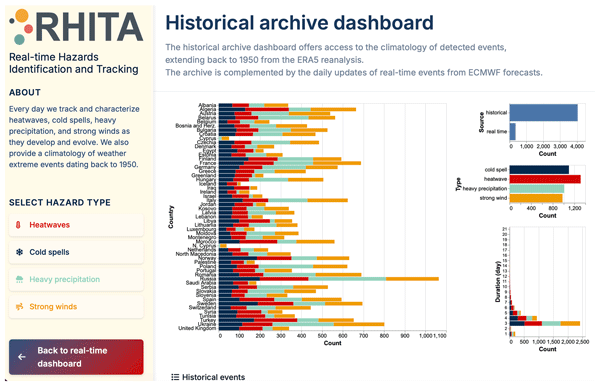
Abstract. Extreme weather hazards are increasing and stakeholders need rapid, transparent information during unfolding events. We present RHITA (Real-time Hazard Identification and Tracking Algorithm), an open-source framework and web tool for near real-time detection and tracking of weather-related hazards over Europe. RHITA identifies grid cells exceeding local quantile thresholds, groups them into spatial clusters, and links clusters through time to reconstruct three-dimensional events in longitude, latitude, and time. For each event, RHITA provides intensity, extent and duration metrics and estimates rarity through return periods derived from a long historical record. RHITA is operated with ECMWF open forecasts for daily monitoring and ERA5 reanalysis for a consistent historical archive from 1950 to 2024. We target four hazards: heatwaves, cold spells, heavy precipitation and strong winds. Key spatial and temporal parameters are optimized against EM-DAT disaster records (2000 to 2023). Applying RHITA to ERA5 yields a European climatology of hazard events and reveals robust increases in heatwave frequency, intensity and affected area, a decline in cold spell frequency, and more heterogeneous signals for heavy precipitation and strong winds at the continental scale. RHITA provides open access data and an interactive interface to support rapid hazard characterization, event contextualization and downstream risk analysis.
-
Notice on discussion status
The requested preprint has a corresponding peer-reviewed final revised paper. You are encouraged to refer to the final revised version.
-
Preprint
(1938 KB)
-
Supplement
(2285 KB)
-
The requested preprint has a corresponding peer-reviewed final revised paper. You are encouraged to refer to the final revised version.
- Preprint
(1938 KB) - Metadata XML
-
Supplement
(2285 KB) - BibTeX
- EndNote
- Final revised paper


Journal article(s) based on this preprint
Interactive discussion
Status: closed
-
RC1: 'Comment on egusphere-2026-1175', Anonymous Referee #1, 08 Apr 2026
-
AC1: 'Reply on RC1', Davide Faranda, 22 May 2026
Response to Reviewer #1
General comments
Comment: The study does not consider droughts, which are a major category of natural disasters and are included in the EM-DAT database. The authors should either provide a clear justification for excluding droughts, or discuss the feasibility and limitations of incorporating drought detection within the RHITA framework.
Response: We thank the reviewer for raising this important point. In the revised manuscript, we will clarify more explicitly why droughts are not included in the present implementation of RHITA. The current framework was primarily designed for hazards characterized by relatively rapid spatio temporal evolution and detectable from daily meteorological fields. Droughts differ substantially from the hazards considered here because they involve longer temporal scales, cumulative hydrological processes, and memory effects related to soil moisture and evapotranspiration. Their identification often relies on dedicated indices such as SPI, SPEI, or soil moisture anomalies, rather than direct threshold exceedances on daily atmospheric variables. We will therefore add text in the Introduction and Discussion sections explaining that the exclusion of droughts does not reflect a lack of relevance, but rather a deliberate methodological choice aimed at maintaining a coherent hazard definition within the present framework. We will also clarify that RHITA could in principle be extended to drought related applications, although such an implementation would require methodological adaptations beyond the scope of the current work.
Comment: The Discussion section would benefit from a dedicated paragraph addressing uncertainties associated with ERA5 reanalysis and ECMWF forecasts, EM-DAT data biases, parameter selection in the algorithm. Additionally, the potential impact of these uncertainties on the results and conclusions should be explicitly discussed.
Response: We agree with the reviewer and will expand the Discussion section accordingly. In the revised manuscript, we will discuss more explicitly several sources of uncertainty associated with the framework.
First, we will clarify the limitations associated with ERA5 and ECMWF products, particularly the implications of the 0.25° spatial resolution for representing localized and short lived convective phenomena. We will also discuss the possible influence of uncertainties in reanalysis and forecast products on the estimated intensity and spatial extent of detected events. Second, we will strengthen the discussion regarding EM-DAT. We will emphasize more clearly that EM-DAT is a socially filtered disaster archive, affected by reporting heterogeneities, country dependent practices, and varying levels of exposure and vulnerability. We will stress that RHITA is calibrated against reported disasters rather than against a purely physical catalogue of meteorological extremes. Third, we will clarify that the definition of an event necessarily depends on methodological choices regarding thresholds, spatial clustering, and temporal linking. We will explicitly acknowledge that the resulting climatology partly reflects these algorithmic design choices. Finally, we will discuss more explicitly how these limitations influence the interpretation of continental scale trends and hazard statistics.
Comment: Please clarify whether any preprocessing steps were applied to ECMWF forecasts and ERA5 data.
Response: We will clarify this point in Section 2. The revised manuscript will explicitly state how daily variables are constructed from the ECMWF operational forecasts, including the computation of daily mean temperature from the 3 hourly fields and daily maximum wind speed from the wind components. We will also clarify that ERA5 daily aggregates are retrieved directly using CDSupdate, a Python package that automates the process of retrieving, processing, and managing climate data from the Climate Data Store (CDS) API (available here https://pypi.org/project/CDSupdate/). No additional statistical bias correction or preprocessing is applied prior to the RHITA detection procedure.
Comment: The current evaluation relies primarily on sensitivity. Including additional performance metrics such as precision and F1 score would provide a more balanced and comprehensive assessment of the algorithm’s performance.
Response: We appreciate this suggestion and will clarify the rationale behind our evaluation strategy. In the revised manuscript, we will explain more explicitly why sensitivity was prioritized in the optimization framework. Since RHITA aims to identify physically extreme events, many detected events may not appear in EM-DAT because they did not generate sufficiently documented societal impacts. As a consequence, false positives relative to EM-DAT do not necessarily correspond to incorrect detections from a meteorological perspective. To avoid overinterpreting EM-DAT as a complete physical catalogue of extremes, we chose to focus primarily on sensitivity and on minimizing event fragmentation and merging. We will discuss this limitation more explicitly in the manuscript and clarify the implications for the interpretation of validation metrics.
Comment: Lines 22 to 24. Please add the appropriate references to support the statements made in this section.
Response: Additional references will be included in the revised manuscript to support these statements.
Comment: Line 66. It is recommended to include the date of data access/download for all datasets to ensure reproducibility and traceability.
Response: We agree and will revise the manuscript accordingly. Access dates will be added systematically for all datasets.
Comment: Line 110. Consider including a sensitivity analysis to evaluate how the results vary with different threshold choices. This would strengthen confidence in the robustness of the methodology.
Response: We thank the reviewer for this suggestion. Rather than introducing substantial additional analyses, we will clarify the rationale behind the chosen thresholds and expand the discussion regarding their influence on the detected climatology. In particular, we will state more explicitly that the identified events and associated trends are partly dependent on the selected thresholds and tracking parameters. We will also emphasize that the objective of RHITA is not to provide a unique definition of extremes, but rather a transparent and reproducible framework whose parameters can be adapted depending on the intended application.
Comment: Line 120. The use of fixed quantile thresholds should be further justified.
Response: We will expand the justification for the use of the 0.99 and 0.01 quantiles in Section 3. The revised text will explain more clearly that these thresholds were selected as a compromise between identifying sufficiently rare meteorological anomalies while still retaining events whose societal relevance may arise from their duration or spatial extent rather than only from peak intensity. We will also add references to previous studies using comparable percentile based approaches for the identification of climate extremes. Finally, we will clarify that local quantile thresholds allow adaptation to strong climatological contrasts across Europe.
Citation: https://doi.org/10.5194/egusphere-2026-1175-AC1
-
AC1: 'Reply on RC1', Davide Faranda, 22 May 2026
-
RC2: 'Comment on egusphere-2026-1175', Milad Basirifard, 12 Apr 2026
A key strength of the manuscript is the development of an open and operational multi-hazard framework. However, I have concerns regarding the robustness of the event climatology, given the sensitivity of the algorithm to thresholding and tracking parameters, the reliance on EM-DAT for calibration despite known reporting inhomogeneities, and the comparatively weak validation results for certain hazards, especially cold spells. Additional sensitivity analyses and clearer discussion of these limitations would strengthen the manuscript.
- RHITA decides what an “event” is using chosen thresholds for extremeness, spatial grouping, minimum area, and temporal linking. Those choices are sensible, but they are still subjective and they strongly affect what gets counted as one event versus many. So the results are not purely “found” in the data; they are partly built by the algorithm design.
- EM-DAT records disasters with societal impacts, but it has reporting gaps, inconsistencies, and country-level aggregation. The authors acknowledge this directly. That means RHITA is being tuned against a socially filtered disaster archive, not a perfect physical catalogue of meteorological extremes.
- Validation sensitivity for cold spells is much lower than for heatwaves or heavy precipitation. That is a real weakness, not a minor caveat. The authors explain it as a mismatch between their symmetric physical threshold and EM-DAT’s broader reporting of cold events, but the practical outcome is still poorer detection for that hazard.
- For strong winds, they reuse the heavy-precipitation parameter set because EM-DAT does not cleanly isolate wind-only disasters, and they do not report sensitivity metrics for wind. So one hazard class in the system is less well validated than the others.
- The 0.25° data are good for broad, persistent systems, but not ideal for short-lived, localized, convective extremes. So RHITA is likely better at continent-scale heatwaves and large storms than at intense local downpours or small-scale severe weather.
- The tool says how extreme the weather is, but not how exposed or vulnerable the affected population is. That means it cannot by itself explain disaster severity, even though users may be tempted to interpret it that way.
- Some of the Europe-wide trend analyses may conceal important regional or seasonal differences, particularly for precipitation and wind, where the reported signals are more heterogeneous.
- Its big contribution is building an operational framework and web tool. That is useful, but it means the scientific novelty is more methodological than conceptual. It does not revolutionize understanding of extremes; it operationalizes known ideas in a unified system.
Citation: https://doi.org/10.5194/egusphere-2026-1175-RC2 -
AC2: 'Reply on RC2', Davide Faranda, 22 May 2026
Response to Reviewer #2
We thank the reviewer for the detailed and balanced assessment of the manuscript. We appreciate the recognition of RHITA as an operational and open multi hazard framework. We also agree that several methodological limitations deserve clearer discussion and contextualization. The revised manuscript will be modified extensively in this direction.
Comment: RHITA decides what an “event” is using chosen thresholds for extremeness, spatial grouping, minimum area, and temporal linking. Those choices are sensible, but they are still subjective and they strongly affect what gets counted as one event versus many.
Response: We fully agree and will revise the manuscript to make this point more explicit. Event based climatologies inevitably depend on methodological definitions, particularly regarding thresholds and spatio-temporal aggregation criteria. Indeed, the revised text will explain more clearly that these thresholds were selected as a compromise between identifying sufficiently rare meteorological anomalies while still retaining events whose societal relevance may arise from their duration or spatial extent rather than only from peak intensity, which is the final scope of the RHITA webtool. In the revised version, we will state more clearly that RHITA algortihm provides a transparent and reproducible operational definition of hazards rather than an objective or unique definition of extreme events. We will also emphasize that the framework was intentionally designed to remain flexible and adaptable to different applications and hazard types, beyond the merely scope of out webtool.
Comment: EM-DAT records disasters with societal impacts, but it has reporting gaps, inconsistencies, and country level aggregation.
Response: We agree and will strengthen this discussion throughout the manuscript. We will emphasize more explicitly that EM-DAT reflects reported disasters conditioned by societal exposure, vulnerability, and reporting practices. The revised text will also clarify that RHITA is calibrated against this impact oriented database because the purpose of the optimization is to identify physically extreme hazard configurations associated with major societal events. We will additionally explain more clearly why false positives relative to EM-DAT were not penalized during optimization.
Comment: Validation sensitivity for cold spells is much lower than for heatwaves or heavy precipitation.
Response: We agree that this is an important limitation and will revise the discussion accordingly. In the original manuscript, we already proposed that the discrepancy may partly reflect the broader inclusion of moderate winter events in EM-DAT compared to the physically symmetric thresholds adopted in RHITA. In the revised manuscript, we will make this point more explicit and discuss more carefully the implications for the interpretation of cold spell statistics. We will also clarify that the symmetric threshold choice was retained intentionally to preserve a homogeneous physical definition of temperature extremes.
Comment: For strong winds, they reuse the heavy precipitation parameter set because EM-DAT does not cleanly isolate wind only disasters.
Response: We agree and will expand the discussion of this limitation. The revised manuscript will state more explicitly that the validation of wind events remains less robust because EM-DAT does not provide a clean separation between wind driven and precipitation driven storm disasters. We will clarify that the adopted parameter choice should therefore be interpreted as a pragmatic approximation rather than as a hazard specific calibration.
Comment: The 0.25° data are good for broad, persistent systems, but not ideal for short lived localized convective extremes.
Response: We agree and will reinforce this point in both the Discussion and Conclusions sections. The revised manuscript will explicitly state that RHITA is expected to perform better for synoptic and large-scale hazards such as heatwaves or extended storm systems than for localized convective extremes and short duration severe weather events.
Comment: The tool says how extreme the weather is, but not how exposed or vulnerable the affected population is.
Response: We thank the reviewer for highlighting this important distinction. In the revised manuscript, we will strengthen the wording, clarifying that RHITA only characterizes the hazard component of disasters. We will emphasize more consistently that disaster severity depends on the interaction between hazard, exposure, and vulnerability, and that RHITA does not aim to quantify impacts directly.
Comment: Some of the Europe wide trend analyses may conceal important regional or seasonal differences.
Response: We agree and will clarify this point further in the revised Discussion section. We will stress more explicitly that continental-scale aggregation can mask important regional and seasonal heterogeneity, particularly for precipitation and wind related hazards. The absence of robust European scale trends should therefore not be interpreted as evidence of the absence of regional changes.
Comment: Its big contribution is building an operational framework and web tool. The novelty is more methodological than conceptual.
Response: We agree with this assessment and will revise the Introduction and Conclusions accordingly. The revised manuscript will position RHITA more clearly as an operational and methodological contribution aimed at unifying hazard detection, tracking, climatological analysis, and near real time visualization within a common open framework.
Citation: https://doi.org/10.5194/egusphere-2026-1175-AC2
Peer review completion


Interactive discussion
Status: closed
-
RC1: 'Comment on egusphere-2026-1175', Anonymous Referee #1, 08 Apr 2026
Reviewer’s comments:
Recommendation: Subject to minor revision. If revised paper is resubmitted, it needs to be reconsidered and re-reviewed.
Comments: on egusphere-2026-1175: RHITA: a web tool for real-time detection of extreme weather events.
The manuscript entitled “RHITA: a web tool for real-time detection of extreme weather events” presents an open-source framework for near real-time detection and tracking of weather-related hazards across Europe using ECMWF forecasts and ERA5 reanalysis data (1950–2024). The study focuses on four hazard types: heatwaves, cold spells, heavy precipitation, and strong winds. The work addresses an important and timely topic, particularly in the context of climate change and the growing need for operational, user-friendly tools to support hazard monitoring and risk assessment. The integration of real-time capability with a historical climatology is a clear strength, and the web-based interface enhances accessibility and usability.
However, several methodological and conceptual aspects require clarification and strengthening before the manuscript can be considered for publication. It would be suitable for publication after addressing minor revisions. The following are some suggestions for improvement:
While making the revision, please highlight the corrections added to the manuscript, so it will be easier to track the changes.
General comments:
- The study does not consider droughts, which are a major category of natural disasters and are included in the EM-DAT database. The authors should either: provide a clear justification for excluding droughts, or discuss the feasibility and limitations of incorporating drought detection within the RHITA framework.
- The Discussion section would benefit from a dedicated paragraph addressing uncertainties associated with: ERA5 reanalysis and ECMWF forecasts, EM-DAT data biases, parameter selection in the algorithm. Additionally, the potential impact of these uncertainties on the results and conclusions should be explicitly discussed.
- Please clarify whether any preprocessing steps were applied to ECMWF forecasts and ERA5 data.
- The current evaluation relies primarily on sensitivity. Including additional performance metrics such as precision and F1-score would provide a more balanced and comprehensive assessment of the algorithm’s performance.
Specific comments:
- Lines 22-24 : Please add the appropriate references to support the statements made in this section.
- Line 66: It is recommended to include the date of data access/download for all datasets to ensure reproducibility and traceability.
- Line 110 : Consider including a sensitivity analysis to evaluate how the results vary with different threshold choices. This would strengthen confidence in the robustness of the methodology.
- Line 120 : The use of fixed quantile thresholds (e.g., 0.99 and 0.01) should be further justified. Please: provide references to previous studies that have used similar thresholds, and/or explain the rationale behind selecting these specific values.
-
AC1: 'Reply on RC1', Davide Faranda, 22 May 2026
Response to Reviewer #1
General comments
Comment: The study does not consider droughts, which are a major category of natural disasters and are included in the EM-DAT database. The authors should either provide a clear justification for excluding droughts, or discuss the feasibility and limitations of incorporating drought detection within the RHITA framework.
Response: We thank the reviewer for raising this important point. In the revised manuscript, we will clarify more explicitly why droughts are not included in the present implementation of RHITA. The current framework was primarily designed for hazards characterized by relatively rapid spatio temporal evolution and detectable from daily meteorological fields. Droughts differ substantially from the hazards considered here because they involve longer temporal scales, cumulative hydrological processes, and memory effects related to soil moisture and evapotranspiration. Their identification often relies on dedicated indices such as SPI, SPEI, or soil moisture anomalies, rather than direct threshold exceedances on daily atmospheric variables. We will therefore add text in the Introduction and Discussion sections explaining that the exclusion of droughts does not reflect a lack of relevance, but rather a deliberate methodological choice aimed at maintaining a coherent hazard definition within the present framework. We will also clarify that RHITA could in principle be extended to drought related applications, although such an implementation would require methodological adaptations beyond the scope of the current work.
Comment: The Discussion section would benefit from a dedicated paragraph addressing uncertainties associated with ERA5 reanalysis and ECMWF forecasts, EM-DAT data biases, parameter selection in the algorithm. Additionally, the potential impact of these uncertainties on the results and conclusions should be explicitly discussed.
Response: We agree with the reviewer and will expand the Discussion section accordingly. In the revised manuscript, we will discuss more explicitly several sources of uncertainty associated with the framework.
First, we will clarify the limitations associated with ERA5 and ECMWF products, particularly the implications of the 0.25° spatial resolution for representing localized and short lived convective phenomena. We will also discuss the possible influence of uncertainties in reanalysis and forecast products on the estimated intensity and spatial extent of detected events. Second, we will strengthen the discussion regarding EM-DAT. We will emphasize more clearly that EM-DAT is a socially filtered disaster archive, affected by reporting heterogeneities, country dependent practices, and varying levels of exposure and vulnerability. We will stress that RHITA is calibrated against reported disasters rather than against a purely physical catalogue of meteorological extremes. Third, we will clarify that the definition of an event necessarily depends on methodological choices regarding thresholds, spatial clustering, and temporal linking. We will explicitly acknowledge that the resulting climatology partly reflects these algorithmic design choices. Finally, we will discuss more explicitly how these limitations influence the interpretation of continental scale trends and hazard statistics.
Comment: Please clarify whether any preprocessing steps were applied to ECMWF forecasts and ERA5 data.
Response: We will clarify this point in Section 2. The revised manuscript will explicitly state how daily variables are constructed from the ECMWF operational forecasts, including the computation of daily mean temperature from the 3 hourly fields and daily maximum wind speed from the wind components. We will also clarify that ERA5 daily aggregates are retrieved directly using CDSupdate, a Python package that automates the process of retrieving, processing, and managing climate data from the Climate Data Store (CDS) API (available here https://pypi.org/project/CDSupdate/). No additional statistical bias correction or preprocessing is applied prior to the RHITA detection procedure.
Comment: The current evaluation relies primarily on sensitivity. Including additional performance metrics such as precision and F1 score would provide a more balanced and comprehensive assessment of the algorithm’s performance.
Response: We appreciate this suggestion and will clarify the rationale behind our evaluation strategy. In the revised manuscript, we will explain more explicitly why sensitivity was prioritized in the optimization framework. Since RHITA aims to identify physically extreme events, many detected events may not appear in EM-DAT because they did not generate sufficiently documented societal impacts. As a consequence, false positives relative to EM-DAT do not necessarily correspond to incorrect detections from a meteorological perspective. To avoid overinterpreting EM-DAT as a complete physical catalogue of extremes, we chose to focus primarily on sensitivity and on minimizing event fragmentation and merging. We will discuss this limitation more explicitly in the manuscript and clarify the implications for the interpretation of validation metrics.
Comment: Lines 22 to 24. Please add the appropriate references to support the statements made in this section.
Response: Additional references will be included in the revised manuscript to support these statements.
Comment: Line 66. It is recommended to include the date of data access/download for all datasets to ensure reproducibility and traceability.
Response: We agree and will revise the manuscript accordingly. Access dates will be added systematically for all datasets.
Comment: Line 110. Consider including a sensitivity analysis to evaluate how the results vary with different threshold choices. This would strengthen confidence in the robustness of the methodology.
Response: We thank the reviewer for this suggestion. Rather than introducing substantial additional analyses, we will clarify the rationale behind the chosen thresholds and expand the discussion regarding their influence on the detected climatology. In particular, we will state more explicitly that the identified events and associated trends are partly dependent on the selected thresholds and tracking parameters. We will also emphasize that the objective of RHITA is not to provide a unique definition of extremes, but rather a transparent and reproducible framework whose parameters can be adapted depending on the intended application.
Comment: Line 120. The use of fixed quantile thresholds should be further justified.
Response: We will expand the justification for the use of the 0.99 and 0.01 quantiles in Section 3. The revised text will explain more clearly that these thresholds were selected as a compromise between identifying sufficiently rare meteorological anomalies while still retaining events whose societal relevance may arise from their duration or spatial extent rather than only from peak intensity. We will also add references to previous studies using comparable percentile based approaches for the identification of climate extremes. Finally, we will clarify that local quantile thresholds allow adaptation to strong climatological contrasts across Europe.
Citation: https://doi.org/10.5194/egusphere-2026-1175-AC1
-
RC2: 'Comment on egusphere-2026-1175', Milad Basirifard, 12 Apr 2026
A key strength of the manuscript is the development of an open and operational multi-hazard framework. However, I have concerns regarding the robustness of the event climatology, given the sensitivity of the algorithm to thresholding and tracking parameters, the reliance on EM-DAT for calibration despite known reporting inhomogeneities, and the comparatively weak validation results for certain hazards, especially cold spells. Additional sensitivity analyses and clearer discussion of these limitations would strengthen the manuscript.
- RHITA decides what an “event” is using chosen thresholds for extremeness, spatial grouping, minimum area, and temporal linking. Those choices are sensible, but they are still subjective and they strongly affect what gets counted as one event versus many. So the results are not purely “found” in the data; they are partly built by the algorithm design.
- EM-DAT records disasters with societal impacts, but it has reporting gaps, inconsistencies, and country-level aggregation. The authors acknowledge this directly. That means RHITA is being tuned against a socially filtered disaster archive, not a perfect physical catalogue of meteorological extremes.
- Validation sensitivity for cold spells is much lower than for heatwaves or heavy precipitation. That is a real weakness, not a minor caveat. The authors explain it as a mismatch between their symmetric physical threshold and EM-DAT’s broader reporting of cold events, but the practical outcome is still poorer detection for that hazard.
- For strong winds, they reuse the heavy-precipitation parameter set because EM-DAT does not cleanly isolate wind-only disasters, and they do not report sensitivity metrics for wind. So one hazard class in the system is less well validated than the others.
- The 0.25° data are good for broad, persistent systems, but not ideal for short-lived, localized, convective extremes. So RHITA is likely better at continent-scale heatwaves and large storms than at intense local downpours or small-scale severe weather.
- The tool says how extreme the weather is, but not how exposed or vulnerable the affected population is. That means it cannot by itself explain disaster severity, even though users may be tempted to interpret it that way.
- Some of the Europe-wide trend analyses may conceal important regional or seasonal differences, particularly for precipitation and wind, where the reported signals are more heterogeneous.
- Its big contribution is building an operational framework and web tool. That is useful, but it means the scientific novelty is more methodological than conceptual. It does not revolutionize understanding of extremes; it operationalizes known ideas in a unified system.
Citation: https://doi.org/10.5194/egusphere-2026-1175-RC2 -
AC2: 'Reply on RC2', Davide Faranda, 22 May 2026
Response to Reviewer #2
We thank the reviewer for the detailed and balanced assessment of the manuscript. We appreciate the recognition of RHITA as an operational and open multi hazard framework. We also agree that several methodological limitations deserve clearer discussion and contextualization. The revised manuscript will be modified extensively in this direction.
Comment: RHITA decides what an “event” is using chosen thresholds for extremeness, spatial grouping, minimum area, and temporal linking. Those choices are sensible, but they are still subjective and they strongly affect what gets counted as one event versus many.
Response: We fully agree and will revise the manuscript to make this point more explicit. Event based climatologies inevitably depend on methodological definitions, particularly regarding thresholds and spatio-temporal aggregation criteria. Indeed, the revised text will explain more clearly that these thresholds were selected as a compromise between identifying sufficiently rare meteorological anomalies while still retaining events whose societal relevance may arise from their duration or spatial extent rather than only from peak intensity, which is the final scope of the RHITA webtool. In the revised version, we will state more clearly that RHITA algortihm provides a transparent and reproducible operational definition of hazards rather than an objective or unique definition of extreme events. We will also emphasize that the framework was intentionally designed to remain flexible and adaptable to different applications and hazard types, beyond the merely scope of out webtool.
Comment: EM-DAT records disasters with societal impacts, but it has reporting gaps, inconsistencies, and country level aggregation.
Response: We agree and will strengthen this discussion throughout the manuscript. We will emphasize more explicitly that EM-DAT reflects reported disasters conditioned by societal exposure, vulnerability, and reporting practices. The revised text will also clarify that RHITA is calibrated against this impact oriented database because the purpose of the optimization is to identify physically extreme hazard configurations associated with major societal events. We will additionally explain more clearly why false positives relative to EM-DAT were not penalized during optimization.
Comment: Validation sensitivity for cold spells is much lower than for heatwaves or heavy precipitation.
Response: We agree that this is an important limitation and will revise the discussion accordingly. In the original manuscript, we already proposed that the discrepancy may partly reflect the broader inclusion of moderate winter events in EM-DAT compared to the physically symmetric thresholds adopted in RHITA. In the revised manuscript, we will make this point more explicit and discuss more carefully the implications for the interpretation of cold spell statistics. We will also clarify that the symmetric threshold choice was retained intentionally to preserve a homogeneous physical definition of temperature extremes.
Comment: For strong winds, they reuse the heavy precipitation parameter set because EM-DAT does not cleanly isolate wind only disasters.
Response: We agree and will expand the discussion of this limitation. The revised manuscript will state more explicitly that the validation of wind events remains less robust because EM-DAT does not provide a clean separation between wind driven and precipitation driven storm disasters. We will clarify that the adopted parameter choice should therefore be interpreted as a pragmatic approximation rather than as a hazard specific calibration.
Comment: The 0.25° data are good for broad, persistent systems, but not ideal for short lived localized convective extremes.
Response: We agree and will reinforce this point in both the Discussion and Conclusions sections. The revised manuscript will explicitly state that RHITA is expected to perform better for synoptic and large-scale hazards such as heatwaves or extended storm systems than for localized convective extremes and short duration severe weather events.
Comment: The tool says how extreme the weather is, but not how exposed or vulnerable the affected population is.
Response: We thank the reviewer for highlighting this important distinction. In the revised manuscript, we will strengthen the wording, clarifying that RHITA only characterizes the hazard component of disasters. We will emphasize more consistently that disaster severity depends on the interaction between hazard, exposure, and vulnerability, and that RHITA does not aim to quantify impacts directly.
Comment: Some of the Europe wide trend analyses may conceal important regional or seasonal differences.
Response: We agree and will clarify this point further in the revised Discussion section. We will stress more explicitly that continental-scale aggregation can mask important regional and seasonal heterogeneity, particularly for precipitation and wind related hazards. The absence of robust European scale trends should therefore not be interpreted as evidence of the absence of regional changes.
Comment: Its big contribution is building an operational framework and web tool. The novelty is more methodological than conceptual.
Response: We agree with this assessment and will revise the Introduction and Conclusions accordingly. The revised manuscript will position RHITA more clearly as an operational and methodological contribution aimed at unifying hazard detection, tracking, climatological analysis, and near real time visualization within a common open framework.
Citation: https://doi.org/10.5194/egusphere-2026-1175-AC2
Peer review completion
Journal article(s) based on this preprint
Viewed
| HTML | XML | Total | Supplement | BibTeX | EndNote | |
|---|---|---|---|---|---|---|
| 979 | 500 | 85 | 1,564 | 148 | 82 | 87 |
- HTML: 979
- PDF: 500
- XML: 85
- Total: 1,564
- Supplement: 148
- BibTeX: 82
- EndNote: 87
Viewed (geographical distribution)
| Country | # | Views | % |
|---|
| Total: | 0 |
| HTML: | 0 |
| PDF: | 0 |
| XML: | 0 |
- 1
Greta Cazzaniga
Anastasia Akakpo-Numado
Patrick Brockmann
Adrien Burq
Mathieu Vrac
Davide Faranda

The requested preprint has a corresponding peer-reviewed final revised paper. You are encouraged to refer to the final revised version.
- Preprint
(1938 KB) - Metadata XML
-
Supplement
(2285 KB) - BibTeX
- EndNote
- Final revised paper
Reviewer’s comments:
Recommendation: Subject to minor revision. If revised paper is resubmitted, it needs to be reconsidered and re-reviewed.
Comments: on egusphere-2026-1175: RHITA: a web tool for real-time detection of extreme weather events.
The manuscript entitled “RHITA: a web tool for real-time detection of extreme weather events” presents an open-source framework for near real-time detection and tracking of weather-related hazards across Europe using ECMWF forecasts and ERA5 reanalysis data (1950–2024). The study focuses on four hazard types: heatwaves, cold spells, heavy precipitation, and strong winds. The work addresses an important and timely topic, particularly in the context of climate change and the growing need for operational, user-friendly tools to support hazard monitoring and risk assessment. The integration of real-time capability with a historical climatology is a clear strength, and the web-based interface enhances accessibility and usability.
However, several methodological and conceptual aspects require clarification and strengthening before the manuscript can be considered for publication. It would be suitable for publication after addressing minor revisions. The following are some suggestions for improvement:
While making the revision, please highlight the corrections added to the manuscript, so it will be easier to track the changes.
General comments:
Specific comments: