
the Creative Commons Attribution 4.0 License.
the Creative Commons Attribution 4.0 License.
 | 25 Mar 2026
Derecho-favoring atmospheric environments in Finland: characteristics, identification criteria, and increasing frequency
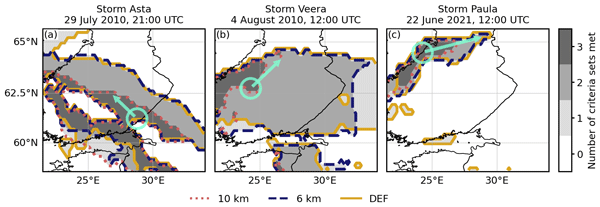
Abstract. In this study, we investigate the atmospheric environments during eight summertime derechos and two derecho-type events in Finland, as well as trends in frequency of such environments during 1940–2022, using ERA5 reanalysis. We find that derechos in Finland tend to occur near the right entrance region of an upper-level jet streak, where deep-layer vertical wind shear is moderate, and deep-layer flow with a southerly component advects warm, moist air into the area. In all 10 studied cases, equivalent potential temperature at 850 hPa exceeds 325 K along the trajectory of the system. We define three sets of criteria to capture atmospheric environments favoring derecho formation in Finland. Two of the criteria sets are largely based on literature, whereas the third one is more adapted to the atmospheric conditions observed along the trajectories of derechos in Finland. The criteria sets consist particularly of kinematic parameters, including deep-layer (0–6 km and 0–10 km) vertical wind shear and 6–10 km layer mean wind speed, but also contain thermodynamic variables, including convective available potential energy (CAPE) and equivalent potential temperature at 850 hPa. For each criteria set, we require that threshold values for combinations of these parameters are satisfied at the same grid point and over a sufficiently large grid area to classify the day as favorable for derecho formation. By applying the criteria sets, we discover that derecho-favoring environments in Finland have become more frequent, particularly during the era of accelerated global warming (1980–2022). This finding suggests that derechos are likely to become more common in the future, at least in Finland.
-
Notice on discussion status
The requested preprint has a corresponding peer-reviewed final revised paper. You are encouraged to refer to the final revised version.
-
Preprint
(4766 KB)
-
Supplement
(11993 KB)
-
The requested preprint has a corresponding peer-reviewed final revised paper. You are encouraged to refer to the final revised version.
- Preprint
(4766 KB) - Metadata XML
-
Supplement
(11993 KB) - BibTeX
- EndNote
- Final revised paper


Journal article(s) based on this preprint
Interactive discussion
Status: closed
- RC1: 'Comment on egusphere-2026-1174', Anonymous Referee #1, 15 Apr 2026
- RC2: 'Comment on egusphere-2026-1174', Anonymous Referee #2, 23 Apr 2026
- AC1: 'Comment on egusphere-2026-1174', Oskari Rantala, 21 Jun 2026
Peer review completion


Interactive discussion
Status: closed
-
RC1: 'Comment on egusphere-2026-1174', Anonymous Referee #1, 15 Apr 2026
Review Decision:
The authors have submitted a manuscript documenting 10 derechos and/or derecho like events across Finland, noting the ambient conditions that accompanied the MCSs that produced these wind swaths. The authors then combined the most favorable parameters often associated with these derecho events to create a parameter space, which diagnosed derecho favoring environments. From here, the authors identified the number of days that these conditions were observed over a period of just over 80 years to determine if there was an increasing trend in the number of derecho favoring days, and if this increasing trend could be attributed to climate change. I think the author’s methodologies for identifying derechos, and derecho environments or parameters were largely adequate for this study. It is also highly applaudable that the authors openly acknowledged the weaknesses and caveats within this study, which I believe is important for transparency in science. This manuscript was written relatively concisely, neatly, and with excellent structure and grammar. I think this study may be an excellent contribution to understanding derechos and their environments over Finland, and more broadly, over Europe. However, I think there is considerable overreach in the conclusion that derechos are becoming more frequent in the region due to climate change based on the evidence provided. The sample size of derechos in this study is quite limited, which may explain the sensitivities noted when deriving derecho favoring parameters. The high degree of variance in the number of days such conditions were observed on a yearly basis also introduced quite a bit of “noise” in the data trends. While taking 7-year averages helped smooth the noise in the data to a degree, this benefit was countered by the short time period sampled, which seems rather low for climatological standards. Going back 80 years may not be enough to know for sure if global warming is making derecho environments more frequent, or if the overall number of days per year favoring derecho development may oscillate over a longer period of time (i.e. a century or more). As such, my strongest recommendation with this manuscript would be to tone down the overly confident nature of the language associating perceived increasing number of derecho favoring days with climate change. This is discussed in more detail in Major Concern #1: I also provide some recommendations in Major Concern #2 to better understand derecho favoring conditions by way of an index, as opposed to overlapping conditions meeting rigid thresholds, which might make the identification of derecho favoring environments easier. Lastly, I provide several minor comments to consider under Grammar, Writing, and Clarification.Major Concern #1:
Given the overly strong language associating increased derecho-favoring conditions with climate change, I strongly recommend adjusting this language throughout the manuscript. I recommend adjustments in the following locations:
Manuscript title: I recommend changing "increasing frequency" with "frequency trends". This manuscript did look at these trends, so saying "frequency trends" is accurate. While you technically did note an increase in frequency of favorable derecho conditions, there was a lot of noise given high yearly variability in a short sampling period, with the conditions being derived from a small sample size, so it is not entirely clear if we can confidently say that derecho/derecho conditions are truly increasing.
Line 12: Change "we discover" to "it appears"
Line 14: Change "This finding suggests that derechos are likely to" to "As such, it is plausible that derechos may".
Line 472: Replace "the results are still remarkable" with "the results still hold scientific merit".
Line 478: Remove "strongly".
Line 483-484: Replace "occurrence" with "the recurrence" and "looks continuously more likely" to "appears possible". Again, I recommend toning the language down given this shorter (40-year) sampling period and other caveats discussed in this review.
Line 487-488: Please delete this last sentence. All your reasoning from lines 488-498 is solid, including the possibility of a weakening jet stream diminishing future derecho potential (which may or may not counter a wavier upper-air pattern). As such, the increase in derecho favorability does remain more uncertain, so I am not sure one can say that we "expect" more favorable derecho days in the future. Rather, the evidence provided in this article is adequate to at least justify posing the question of whether derechos will or will not become more frequent in a warmer climate. As you correctly concluded, more research is needed to figure out if we really should expect more/worse derechos in the future with a warmed climate.
Lines 539-541: As mentioned in the next sentence, more research is needed to know for sure if derechos will truly become more frequent/worse in a changing climate. As such, this sentence needs to be written less definitively. I recommend replacing this sentence with something like: "Nevertheless, despite the caveats noted in the present study, the increasing trend of days with greater theta-e, amid favorable shear in warm season troughing patterns, justifies us asking whether such conditions may make derechos more frequent across Finland or even all of Europe in a warmed climate."Major Concern #2:
Lines 345-346: It is hard to develop parameter space criteria for severe local storms given the strong non-linearities associated with the convective evolution and the ambient environment. Looking at the ambient environment alone, supportive CAPE/shear parameter spaces may vary greatly, which is why overlapping independent criteria, especially with rigid thresholds (as you do with upper winds, shear, or theta-e) will present so many exceptions to the rule, or intuitive expectations.
Past studies have created indices that factor in the ranges that parameter spaces may occupy to account for the multi-dimensional space that severe hazards may occur in, which is also conveniently condensed to a singular 2-D variable (i.e. the supercell composite parameter, significant tornado parameter, and derecho composite parameter used in operational meteorology). Have you considered using the derecho composite parameter (adjusted to a lower threshold given overall weaker CAPE values) to compare against your proposed criteria to see if that is a better fit? Better yet, could you create a new index based on the parameters you have deemed most important for derechos over Finland? I would imagine that an index will give you more flexibility than when trying to overlap criteria meeting rigid cut-off values. Furthermore, you could end up with cleaner results, perhaps without pronounced spatial displacements.Grammar, Writing, and Clarification:
Line 20: Please change to say all "atmospheric" natural disasters.
Line 35: Delete the word "obviously".
Lines 43-45: While getting a derecho series in Finland may be remarkable, getting such events in series is a known recurrence, especially in the U.S. As such, I recommend adding a statement here that derechos are known to occur in series, and I would recommend citing Ashley et al. (2005, 2007)
Lines 140-145: The last sentence reads in this paragraph like 1940-1980 was barely used, yet it is references later in the manuscript and furthermore, is contrasted with the 1980-2022 period to argue greater derecho favorability with greater planetary warming. As such, I recommend removing the wording that 1980-2022 was a “main focus”.
Line 155 and elsewhere where relevant: I recommend replacing the word "situation" with something like "pattern" when describing synoptic setups.
Line 157: This sentence contains the same type of material as in the caption. I recommend deleting it.
Line 174 and wherever applicable in the manuscript: Several studies have noted that warm-season derecho events sometimes occurred with upper troughs (i.e. warm-season trough events). It seems that most warm season European derechos were documented with this upper-air pattern. You also mentioned at the end of this study that it was important to understand future derecho trends because a warming planet might lead to a weaker jet stream but wavier (more amplified) upper-air pattern, hence more chances to produce a derecho. While you imply that derechos occur with this upper-air pattern at the end of this paragraph, I think it would be more concise and straightforward if you mention upfront that many European derechos are associated with the warm season troughing pattern, and thus have a strong meridional component of forward motion (as noted in Gatzen 2004, Lopez 2007, Hamid 2012, Celiński-Mysław and Matuszko 2014; Taszarek et al. 2019; Gatzen et al. 2020; Surowiecki and Taszarek 2020; Chernokulsky et al. 2022).
Line 184: You already mention the surface high over Russia in the previous paragraph. To avoid redundancy and promote conciseness, I recommend merging information in this paragraph with the previous one.
Lines 188-189: Add a comma before “which”, and add "a" before “characteristic”.
Lines 197-198: I could be wrong, but could the maximum in the jet region behind the MCS be some form of convective feedback in the ERA5 data?
Lines 224-225: Could CAPE values be lower over Europe compared to the U.S. because Europe does not have the elevated mixed layer (EML) that the U.S. has? If so, it might be worth noting here.
Lines 230-233: Please be careful when making CAPE comparisons across studies varying samples over both warm and cool seasons. You are focusing on warm-season cases, whereas Gatzen et al. (2020) included cool season events, which may have featured more high shear/low CAPE events. As such, it is not surprising to see CAPE values in this discussion vary from 500-3000 J/kg. While the 500 J/kg is a median for Gatzen et al. (2020) and 3000 J/kg was the maximum for one case in Lopez (2007), the difference in these values varies by almost an order of magnitude, which is not a very useful comparison. I recommend focusing the CAPE discussion on warm-season derechos over Europe.
Lines 233-239: As recently noted, CAPE is overall weaker for European derecho chases than the U.S., possibly due to the lack of an EML. As such, is it fair to say that where lapse rates might be lacking, strong warm-air advection might be key to supporting such events? If so, that is where the 850 hPa theta-e plays a role. I think many readers who are familiar with derechos and severe convective storms may come to that conclusion. 850 hPa theta-e seems to be a main contributor to buoyancy for derechos over Finland, as implied later in the manuscript, but I think this should be made clear up front around this part of the manuscript.
Line 234: Delete "level"
Line 248: I guess that Verneri was one of the storms that followed more of an upper ridging environment or zonal upper-air regime as opposed to warm-season troughing noted with many other warm-season European derechos? I think it is important to note, since the sample size of this study is so small, which makes these exceptions to the rule more important.
Lines 276-277: Please clarify why upper-level winds tend to be weaker over Finland compared to European countries to the south?
Lines 368-369: This is another opportunity to mention that derechos may occur in series Specifically, Ashley et al. (2007) noted that derechos can occur in both a direct and indirect series. A direct series is when a severe wind producing MCS leaves behind a boundary, which can be a source of lift for new convection, which in turn can produce a derecho. An indirect series is when you have multiple impulses independently triggering new MCSs which produce derechos. Given the remarkable period of 2010 in Finland, it might be worth it to briefly mention if these derechos developed in a direct or indirect series. This would be especially enlightening if these were warm season troughing events, since it is not clear how often a derecho series occurs with warm-season troughing upper-air patterns.
Lines 374-383: This makes the point of why an index like the derecho composite parameter (or custom-derived parameter) might be more useful than trying to match the time duration that multiple different parameters intersect.
Lines 397-403: This is where deriving a set of favorable derecho conditions from an outlier period (i.e. Summer 2010) has drawbacks. It seems that DEF may be too strict of criteria because it is largely based on 2010 performance (i.e. nearly half of your derechos by which you justify these criteria all come from this one derecho series). You discuss the drawbacks of a small sample size later in the manuscript, as well as the impact this has on criteria selection, but such drawbacks should be stated up front at this point in the manuscript.
Table 3: Your results would be more visually distinguishable if you either split this table into two tables (one for the 1940-2022 period and the other for 1980-2022), or parse this table to split the two time periods.
Lines 445-451: It does appear that N increases for nearly all the applied derecho environment criteria from 1980-2022. However, looking at 1940-1980, it almost appears that there is a very slight decreasing trend. A couple of questions arise from this. As mentioned earlier in this review, can the frequency of these derecho conditions oscillate on multi-decade time scales (so 80 years might not be long enough of a sampling to make climatological distinctions)? Second, changes in data assimilation over the last several decades in ERA5 be influencing these results? If so, how much? We know that satellite data were assimilated into ERA5 by 1980, but were there other changes/additions in data sources from 1940-2022? If there are others, they could be heavily influencing these results, so they should be pointed out here.
Line 450: Is the CAPE higher because 850 hPa theta-e is higher? It seems that way, and if this is really the case, that should be mentioned here.
Lines 500-505: I encourage the authors to review and perhaps discuss/cite the Kaminski et al. (2024) manuscript, which basically did a large-scale climate-based simulation of convective activity in a future warmed climate, finding that derechos become more frequent and potentially more severe in this modeled framework. It may be argued that many more large-scale studies like Kaminski et al. (2024), but with different methodologies, would all have to be performed and come to a consensus to produce a convincing link between worsening derechos and climate change.References:
Ashley, W. S., T. L. Mote, and M. L. Bentley, 2005: On the episodic nature of derecho-producing convective systems in the United States. Int. J. Climatol., 25, 1915–1932, https://doi.org/10.1002/joc.1229.
Ashley, W. S., T. L. Mote, and M. L. Bentley, 2007: An extensive episode of derecho-producing convective systems in the United States during May–June 1998: A multi-scale analysis and review. Meteor. Appl., 14, 227–244, https://doi.org/10.1002/met.23.
Kaminski, K., W. S. Ashley, A. M. Haberlie, and V. A. Gensini, 2024: Future derecho potential in the United States. J. Climate, 38, 3–26, https://doi.org/10.1175/JCLI-D-23-0633.1.
Surowiecki, A., and M. Taszarek, 2020: A 10-year radar-based climatology of mesoscale convective system archetypes and derechos in Poland. Mon. Wea. Rev., 148, 3471–3488, https://doi.org/10.1175/MWR-D-19-0412.1.
Citation: https://doi.org/10.5194/egusphere-2026-1174-RC1 - RC2: 'Comment on egusphere-2026-1174', Anonymous Referee #2, 23 Apr 2026
- AC1: 'Comment on egusphere-2026-1174', Oskari Rantala, 21 Jun 2026
Peer review completion
Journal article(s) based on this preprint
Viewed
| HTML | XML | Total | Supplement | BibTeX | EndNote | |
|---|---|---|---|---|---|---|
| 589 | 289 | 65 | 943 | 605 | 52 | 62 |
- HTML: 589
- PDF: 289
- XML: 65
- Total: 943
- Supplement: 605
- BibTeX: 52
- EndNote: 62
Viewed (geographical distribution)
| Country | # | Views | % |
|---|
| Total: | 0 |
| HTML: | 0 |
| PDF: | 0 |
| XML: | 0 |
- 1
Oskari Rantala

Jouni Räisänen
Jenni Rauhala
Marja Bister
The requested preprint has a corresponding peer-reviewed final revised paper. You are encouraged to refer to the final revised version.
- Preprint
(4766 KB) - Metadata XML
-
Supplement
(11993 KB) - BibTeX
- EndNote
- Final revised paper
Review Decision:
The authors have submitted a manuscript documenting 10 derechos and/or derecho like events across Finland, noting the ambient conditions that accompanied the MCSs that produced these wind swaths. The authors then combined the most favorable parameters often associated with these derecho events to create a parameter space, which diagnosed derecho favoring environments. From here, the authors identified the number of days that these conditions were observed over a period of just over 80 years to determine if there was an increasing trend in the number of derecho favoring days, and if this increasing trend could be attributed to climate change. I think the author’s methodologies for identifying derechos, and derecho environments or parameters were largely adequate for this study. It is also highly applaudable that the authors openly acknowledged the weaknesses and caveats within this study, which I believe is important for transparency in science. This manuscript was written relatively concisely, neatly, and with excellent structure and grammar. I think this study may be an excellent contribution to understanding derechos and their environments over Finland, and more broadly, over Europe. However, I think there is considerable overreach in the conclusion that derechos are becoming more frequent in the region due to climate change based on the evidence provided. The sample size of derechos in this study is quite limited, which may explain the sensitivities noted when deriving derecho favoring parameters. The high degree of variance in the number of days such conditions were observed on a yearly basis also introduced quite a bit of “noise” in the data trends. While taking 7-year averages helped smooth the noise in the data to a degree, this benefit was countered by the short time period sampled, which seems rather low for climatological standards. Going back 80 years may not be enough to know for sure if global warming is making derecho environments more frequent, or if the overall number of days per year favoring derecho development may oscillate over a longer period of time (i.e. a century or more). As such, my strongest recommendation with this manuscript would be to tone down the overly confident nature of the language associating perceived increasing number of derecho favoring days with climate change. This is discussed in more detail in Major Concern #1: I also provide some recommendations in Major Concern #2 to better understand derecho favoring conditions by way of an index, as opposed to overlapping conditions meeting rigid thresholds, which might make the identification of derecho favoring environments easier. Lastly, I provide several minor comments to consider under Grammar, Writing, and Clarification.
Major Concern #1:
Given the overly strong language associating increased derecho-favoring conditions with climate change, I strongly recommend adjusting this language throughout the manuscript. I recommend adjustments in the following locations:
Manuscript title: I recommend changing "increasing frequency" with "frequency trends". This manuscript did look at these trends, so saying "frequency trends" is accurate. While you technically did note an increase in frequency of favorable derecho conditions, there was a lot of noise given high yearly variability in a short sampling period, with the conditions being derived from a small sample size, so it is not entirely clear if we can confidently say that derecho/derecho conditions are truly increasing.
Line 12: Change "we discover" to "it appears"
Line 14: Change "This finding suggests that derechos are likely to" to "As such, it is plausible that derechos may".
Line 472: Replace "the results are still remarkable" with "the results still hold scientific merit".
Line 478: Remove "strongly".
Line 483-484: Replace "occurrence" with "the recurrence" and "looks continuously more likely" to "appears possible". Again, I recommend toning the language down given this shorter (40-year) sampling period and other caveats discussed in this review.
Line 487-488: Please delete this last sentence. All your reasoning from lines 488-498 is solid, including the possibility of a weakening jet stream diminishing future derecho potential (which may or may not counter a wavier upper-air pattern). As such, the increase in derecho favorability does remain more uncertain, so I am not sure one can say that we "expect" more favorable derecho days in the future. Rather, the evidence provided in this article is adequate to at least justify posing the question of whether derechos will or will not become more frequent in a warmer climate. As you correctly concluded, more research is needed to figure out if we really should expect more/worse derechos in the future with a warmed climate.
Lines 539-541: As mentioned in the next sentence, more research is needed to know for sure if derechos will truly become more frequent/worse in a changing climate. As such, this sentence needs to be written less definitively. I recommend replacing this sentence with something like: "Nevertheless, despite the caveats noted in the present study, the increasing trend of days with greater theta-e, amid favorable shear in warm season troughing patterns, justifies us asking whether such conditions may make derechos more frequent across Finland or even all of Europe in a warmed climate."
Major Concern #2:
Lines 345-346: It is hard to develop parameter space criteria for severe local storms given the strong non-linearities associated with the convective evolution and the ambient environment. Looking at the ambient environment alone, supportive CAPE/shear parameter spaces may vary greatly, which is why overlapping independent criteria, especially with rigid thresholds (as you do with upper winds, shear, or theta-e) will present so many exceptions to the rule, or intuitive expectations.
Past studies have created indices that factor in the ranges that parameter spaces may occupy to account for the multi-dimensional space that severe hazards may occur in, which is also conveniently condensed to a singular 2-D variable (i.e. the supercell composite parameter, significant tornado parameter, and derecho composite parameter used in operational meteorology). Have you considered using the derecho composite parameter (adjusted to a lower threshold given overall weaker CAPE values) to compare against your proposed criteria to see if that is a better fit? Better yet, could you create a new index based on the parameters you have deemed most important for derechos over Finland? I would imagine that an index will give you more flexibility than when trying to overlap criteria meeting rigid cut-off values. Furthermore, you could end up with cleaner results, perhaps without pronounced spatial displacements.
Grammar, Writing, and Clarification:
Line 20: Please change to say all "atmospheric" natural disasters.
Line 35: Delete the word "obviously".
Lines 43-45: While getting a derecho series in Finland may be remarkable, getting such events in series is a known recurrence, especially in the U.S. As such, I recommend adding a statement here that derechos are known to occur in series, and I would recommend citing Ashley et al. (2005, 2007)
Lines 140-145: The last sentence reads in this paragraph like 1940-1980 was barely used, yet it is references later in the manuscript and furthermore, is contrasted with the 1980-2022 period to argue greater derecho favorability with greater planetary warming. As such, I recommend removing the wording that 1980-2022 was a “main focus”.
Line 155 and elsewhere where relevant: I recommend replacing the word "situation" with something like "pattern" when describing synoptic setups.
Line 157: This sentence contains the same type of material as in the caption. I recommend deleting it.
Line 174 and wherever applicable in the manuscript: Several studies have noted that warm-season derecho events sometimes occurred with upper troughs (i.e. warm-season trough events). It seems that most warm season European derechos were documented with this upper-air pattern. You also mentioned at the end of this study that it was important to understand future derecho trends because a warming planet might lead to a weaker jet stream but wavier (more amplified) upper-air pattern, hence more chances to produce a derecho. While you imply that derechos occur with this upper-air pattern at the end of this paragraph, I think it would be more concise and straightforward if you mention upfront that many European derechos are associated with the warm season troughing pattern, and thus have a strong meridional component of forward motion (as noted in Gatzen 2004, Lopez 2007, Hamid 2012, Celiński-Mysław and Matuszko 2014; Taszarek et al. 2019; Gatzen et al. 2020; Surowiecki and Taszarek 2020; Chernokulsky et al. 2022).
Line 184: You already mention the surface high over Russia in the previous paragraph. To avoid redundancy and promote conciseness, I recommend merging information in this paragraph with the previous one.
Lines 188-189: Add a comma before “which”, and add "a" before “characteristic”.
Lines 197-198: I could be wrong, but could the maximum in the jet region behind the MCS be some form of convective feedback in the ERA5 data?
Lines 224-225: Could CAPE values be lower over Europe compared to the U.S. because Europe does not have the elevated mixed layer (EML) that the U.S. has? If so, it might be worth noting here.
Lines 230-233: Please be careful when making CAPE comparisons across studies varying samples over both warm and cool seasons. You are focusing on warm-season cases, whereas Gatzen et al. (2020) included cool season events, which may have featured more high shear/low CAPE events. As such, it is not surprising to see CAPE values in this discussion vary from 500-3000 J/kg. While the 500 J/kg is a median for Gatzen et al. (2020) and 3000 J/kg was the maximum for one case in Lopez (2007), the difference in these values varies by almost an order of magnitude, which is not a very useful comparison. I recommend focusing the CAPE discussion on warm-season derechos over Europe.
Lines 233-239: As recently noted, CAPE is overall weaker for European derecho chases than the U.S., possibly due to the lack of an EML. As such, is it fair to say that where lapse rates might be lacking, strong warm-air advection might be key to supporting such events? If so, that is where the 850 hPa theta-e plays a role. I think many readers who are familiar with derechos and severe convective storms may come to that conclusion. 850 hPa theta-e seems to be a main contributor to buoyancy for derechos over Finland, as implied later in the manuscript, but I think this should be made clear up front around this part of the manuscript.
Line 234: Delete "level"
Line 248: I guess that Verneri was one of the storms that followed more of an upper ridging environment or zonal upper-air regime as opposed to warm-season troughing noted with many other warm-season European derechos? I think it is important to note, since the sample size of this study is so small, which makes these exceptions to the rule more important.
Lines 276-277: Please clarify why upper-level winds tend to be weaker over Finland compared to European countries to the south?
Lines 368-369: This is another opportunity to mention that derechos may occur in series Specifically, Ashley et al. (2007) noted that derechos can occur in both a direct and indirect series. A direct series is when a severe wind producing MCS leaves behind a boundary, which can be a source of lift for new convection, which in turn can produce a derecho. An indirect series is when you have multiple impulses independently triggering new MCSs which produce derechos. Given the remarkable period of 2010 in Finland, it might be worth it to briefly mention if these derechos developed in a direct or indirect series. This would be especially enlightening if these were warm season troughing events, since it is not clear how often a derecho series occurs with warm-season troughing upper-air patterns.
Lines 374-383: This makes the point of why an index like the derecho composite parameter (or custom-derived parameter) might be more useful than trying to match the time duration that multiple different parameters intersect.
Lines 397-403: This is where deriving a set of favorable derecho conditions from an outlier period (i.e. Summer 2010) has drawbacks. It seems that DEF may be too strict of criteria because it is largely based on 2010 performance (i.e. nearly half of your derechos by which you justify these criteria all come from this one derecho series). You discuss the drawbacks of a small sample size later in the manuscript, as well as the impact this has on criteria selection, but such drawbacks should be stated up front at this point in the manuscript.
Table 3: Your results would be more visually distinguishable if you either split this table into two tables (one for the 1940-2022 period and the other for 1980-2022), or parse this table to split the two time periods.
Lines 445-451: It does appear that N increases for nearly all the applied derecho environment criteria from 1980-2022. However, looking at 1940-1980, it almost appears that there is a very slight decreasing trend. A couple of questions arise from this. As mentioned earlier in this review, can the frequency of these derecho conditions oscillate on multi-decade time scales (so 80 years might not be long enough of a sampling to make climatological distinctions)? Second, changes in data assimilation over the last several decades in ERA5 be influencing these results? If so, how much? We know that satellite data were assimilated into ERA5 by 1980, but were there other changes/additions in data sources from 1940-2022? If there are others, they could be heavily influencing these results, so they should be pointed out here.
Line 450: Is the CAPE higher because 850 hPa theta-e is higher? It seems that way, and if this is really the case, that should be mentioned here.
Lines 500-505: I encourage the authors to review and perhaps discuss/cite the Kaminski et al. (2024) manuscript, which basically did a large-scale climate-based simulation of convective activity in a future warmed climate, finding that derechos become more frequent and potentially more severe in this modeled framework. It may be argued that many more large-scale studies like Kaminski et al. (2024), but with different methodologies, would all have to be performed and come to a consensus to produce a convincing link between worsening derechos and climate change.
References:
Ashley, W. S., T. L. Mote, and M. L. Bentley, 2005: On the episodic nature of derecho-producing convective systems in the United States. Int. J. Climatol., 25, 1915–1932, https://doi.org/10.1002/joc.1229.
Ashley, W. S., T. L. Mote, and M. L. Bentley, 2007: An extensive episode of derecho-producing convective systems in the United States during May–June 1998: A multi-scale analysis and review. Meteor. Appl., 14, 227–244, https://doi.org/10.1002/met.23.
Kaminski, K., W. S. Ashley, A. M. Haberlie, and V. A. Gensini, 2024: Future derecho potential in the United States. J. Climate, 38, 3–26, https://doi.org/10.1175/JCLI-D-23-0633.1.
Surowiecki, A., and M. Taszarek, 2020: A 10-year radar-based climatology of mesoscale convective system archetypes and derechos in Poland. Mon. Wea. Rev., 148, 3471–3488, https://doi.org/10.1175/MWR-D-19-0412.1.