
the Creative Commons Attribution 4.0 License.
the Creative Commons Attribution 4.0 License.
 | 23 Mar 2026
Origin of Low Ozone above Western North America: An Investigation of Sources and Trends
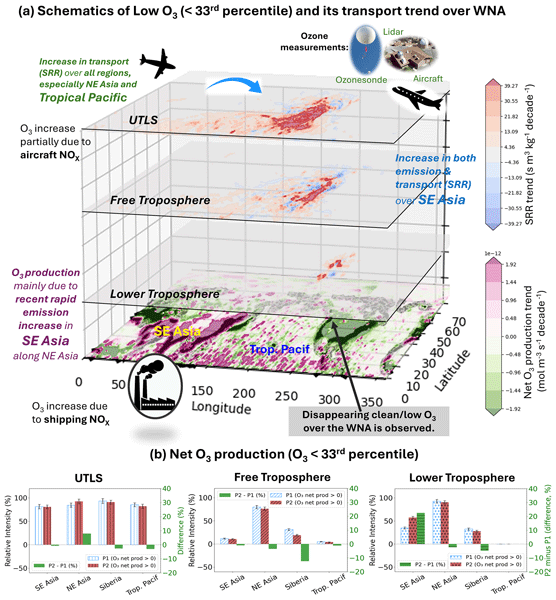
Abstract. While free-tropospheric ozone (O3) over western North America (WNA) has increased since the mid-1990s, research has primarily focused on the mean. We investigate the lower tail (O3 < 33rd percentile) to characterize the evolving remote background state. Because these air masses are minimally affected by episodic extremes, they offer a clearer window into long-term shifts in background O3, transport, and photochemistry. Using FLEXPART-ERA5 source–receptor relationships (SRRs) from 1994 to 2021, we analyze the transport history of air masses reaching WNA (25–55° N, 130–90° W). Despite no robust SRR trends within the lower and mid-troposphere (0-8 km), changing emission patterns suggest an intensifying remote influence. Specifically, WNA's surface NOX emissions have decreased while lower-tail O3 continues to rise, aligning with increasing surface emissions from Southeast Asia and intensified shipping. In contrast, UTLS (8–13 km) SRRs show a clear increase, indicating growing influence from high-altitude sources, including enhanced transport from Southeast Asia and the tropical Pacific, and rising global aircraft emissions. GMI chemical simulations corroborate these findings, revealing that net O3 production over Southeast Asia increased by 157 % in the lower troposphere and 7 % in the free troposphere between 2007 and 2019. The rise in WNA's low O3 percentiles is driven by the combined influence of intensified transport from Southeast Asia and the tropical Pacific, along with increasing global aircraft and shipping emissions. Ultimately, these trends reflect both the rapid growth of Southeast Asia emissions and shifting trans-Pacific transport.
-
Notice on discussion status
The requested preprint has a corresponding peer-reviewed final revised paper. You are encouraged to refer to the final revised version.
-
Preprint
(2950 KB)
-
Supplement
(2756 KB)
-
The requested preprint has a corresponding peer-reviewed final revised paper. You are encouraged to refer to the final revised version.
- Preprint
(2950 KB) - Metadata XML
-
Supplement
(2756 KB) - BibTeX
- EndNote
- Final revised paper


Journal article(s) based on this preprint
Interactive discussion
Status: closed
-
CC1: 'community comment on Ryoo et al. 2026', Tabish Ansari, 24 Apr 2026
(This is a community comment, not a review.)
I enjoyed reading this manuscript by Ryoo et al. Here, they have derived source-receptor relationships using the FLEXPART-ERA5 model and have shown how the most influential source regions change across different percentiles of the ozone distribution in the Western North America. They identify a large influence of South Asia, Southern East Asia, and Southeast Asia in contributing to low ozone percentiles over the Western North America. I would like to point out that these results are in agreement with our recently published findings in ACP (Ansari et al, 2025) where we used explicit NOx and VOC emissions tagging and showed an increasing influence of foreign anthropogenic NOx and to a lesser extent global shipping NOx (see Figures 10, S8, and S10) over NW US, SW US, and Western Canada regions between 2000-2018. The findings become clearer when you focus on the winter months in those figures, which correspond to the low-percentile values analysed here. We have also shown, in Figure 17, that the increasing trend in wintertime and springtime ozone over western US is mainly due to increasing transport of foreign-NOx-produced O3 and not so much due to the reduced wintertime titration due to declining local NOx. Again, these findings are consistent with the results shown in this study.
Another recent study (Li et al., 2023) which used the same explicit dual-tagging technique found increasing contributions of Asian NOx emissions to Western US ozone, particularly in wintertime (see Figure 7 third row, left panel) over the 1995-2019 period.It would be good to include findings from these studies in the introduction and/or discussion sections to make the study more up-to-date with recent work in the field.
Also, what the authors refer to as "Southeast Asia" here is quite different from the conventional definition of Southeast Asia. This can cause some confusion in the minds of readers-in-a-hurry who only read the abstract or try to cite the study without actually looking at the figures. The dominant source region identified here is in fact (Southern East Asia + South Asia + Southeast Asia).
I wish the authors the best with the rest of the review process.Tabish Ansari
References of papers mentioned:Li, P., Yang, Y., Wang, H., Li, S., Li, K., Wang, P., Li, B., and Liao, H.: Source attribution of near-surface ozone trends in the United States during 1995–2019, Atmos. Chem. Phys., 23, 5403–5417, https://doi.org/10.5194/acp-23-5403-2023, 2023.
Ansari, T., Nalam, A., Lupaşcu, A., Hinz, C., Grasse, S., and Butler, T.: Explaining trends and changing seasonal cycles of surface ozone in North America and Europe over the 2000–2018 period: a global modelling study with NOx and VOC tagging, Atmos. Chem. Phys., 25, 16833–16876, https://doi.org/10.5194/acp-25-16833-2025, 2025.
Citation: https://doi.org/10.5194/egusphere-2026-1157-CC1 - AC3: 'Reply on CC1', Ju-Mee Ryoo, 02 Aug 2026
-
RC1: 'Comment on egusphere-2026-1157', Anonymous Referee #1, 08 Jun 2026
Review of Ryoo et al. (2026) “Origin of Low Ozone above Western North America: An
Investigation of Sources and Trends”
Summary:
The authors use observations, model simulations, and reanalyses to diagnose increasing low-end (< 33rd percentile) ozone amounts over Western North America (WNA) from 1994-2021, even though regional emissions over WNA have decreased. Source Receptor Relationships (SRR) derived from FLEXPART and ERA5 backwards trajectories indicate a strong influence of the tropical Pacific and SE Asia for WNA lower-tropospheric low ozone amounts. Trends in SRR were fairly weak except for the UTLS which demonstrates a growing impact of aircraft emissions and lightning NOx on “background” ozone increases over WNA. Furthermore, large positive trends in ozone production from the GMI model simulation over SE Asia are identified as contributing to low ozone amount increases over WNA. The authors are able to leverage their datasets and analyses to describe both dynamical/transport and chemical changes and their effects on WNA ozone amounts.
General Comments and Recommendation:
This is a well-motivated and executed analysis, the writing quality is excellent, and this will end up being one of the shortest reviews I have ever submitted. I recommend publication after just a few technical items and suggestions listed below.
Line-by-line/Technical Comments:
- Figure 1c: The two different vertical axes are confusing so I suggest just using one
- Line 98: Delete “particle dispersion model”
- Check the reference list. I found at least one in the text that does not appear in the references
- All relevant figures: I suggest instead using dots to denote p-values above05, so you are not obscuring the values for your high confidence results
- Line 460: Did I miss something or am I correct that MLS data do not appear anywhere in this paper?
Citation: https://doi.org/10.5194/egusphere-2026-1157-RC1 - AC1: 'Reply on RC1', Ju-Mee Ryoo, 02 Aug 2026
-
RC2: 'Comment on egusphere-2026-1157', Juseon Bak, 09 Jun 2026
The authors present an interesting and comprehensive analysis of sources and trends over western North America using a combination of source-receptor relationships, emissions information, and chemical model simulations. The manuscript addresses an important scientific question and provides valuable insights into the processes influencing ozone over the region. Overall, the study is well organized, clearly written, and fits well within the scope of ACP.
The comments below are intended primarily to improve the clarity of the interpretation and presentation.
Figure 2.
- For clarity, I suggest showing the same regional boxes in all panels. In addition, the figure could be improved to better highlight the spatial characteristics of the SRR fields. The map panels are highly compressed and important features are difficult to discern. I suggest increasing the map size and adding latitude/longitude grid lines or labeled latitude ticks. In addition, the PDFs occupy a substantial fraction of the figure and may be more effectively presented in a separate figure. This would allow the spatial patterns and source-region contrasts to be displayed more clearly.
- The term “latitudinal PDF” need to be revised. The presented PDFs appear to represent the distribution of SRR values for different source regions, rather than those as a function of latitude. Although the selected regions occupy different latitude bands, the PDFs are calculated over predefined geographic boxes with noticeably different longitudinal extents.
- The statement "aligned specifically with the southern regions of East Asia and the tropical Pacific f 2a; SRR is higher in the red and gray boxed regions " does not appear to be fully supported by Fig. 2a. In particular, the PDF peaks for SE Asia are not clearly distinguishable from those of NE Asia or Siberia. While the Tropical Pacific exhibits a broader SRR distribution peaking at the highest SRR value, the SE Asia PDF does not obviously show either a uniquely high peak or a broader spread compared to the other source regions.
- The statement “Conversely, elevated O₃ concentrations are primarily associated with air masses transiting through NE Asia” appears stronger than what is supported by Fig. 2c. Although the NE Asia PDF exhibits a relatively higher peak, the difference does not appear sufficiently large. In addition, the Tropical Pacific shows a broad SRR distribution with a pronounced long tail, but SRR maps also do not clearly indicate a dominant contribution from any single source region. More generally, the contrast between Figs. 2a and 2c seems to reflect differences between maritime transport pathways and continental source influences. The relationship between lower-tropospheric O₃ over WNA and Asian continental source regions is certainly important. However, it may be difficult to directly infer this linkage from the backward trajectory results shown in Fig. 2. the Tropical/North Pacific region appears to be more directly connected to WNA than the Asian continent itself. Therefore, it may be more appropriate to first identify the Pacific regions that exert the strongest influence on WNA O₃ and then investigate the upstream source regions contributing to those Pacific air masses. Such an approach may provide a more robust framework for assessing the influence of Asian outflow on WNA ozone (0-3 km).
- The seasonal results presented in Fig. S4 appear to contain additional information. It would be useful to briefly summarize the major seasonal differences in the main manuscript,
Figure 3
The discussion of the increasing trend in the 8–13 km layer is interesting and well-motivated. Given that this layer overlaps with the UTLS region, it may also be worthwhile to briefly mention the potential role of stratosphere-to-troposphere exchange (STE), even if a detailed assessment is beyond the scope of the present study.
Data availability
The OMI total ozone data including discussion of data quality are available 460 from https://ozoneaq.gsfc.nasa.gov/.
I believe the dataset referenced here is Ziemke's tropospheric ozone product rather than total ozone. Since this satellite dataset is not directly used, I do not think it is necessary to provide the data source here.
Citation: https://doi.org/10.5194/egusphere-2026-1157-RC2 - AC2: 'Reply on RC2', Ju-Mee Ryoo, 02 Aug 2026
-
AC4: 'Comment on egusphere-2026-1157', Ju-Mee Ryoo, 02 Aug 2026
Dear Editor,
Thank you for the opportunity to review and revise our manuscript titled “Origin of Low Ozone above Western North America: An Investigation of Sources and Trends”.
We have thoroughly addressed all comments from both the reviewers and the community. We have updated the figures and explanations to improve the clarity of the paper. In the response letter, we have provided point-by-point responses to all reviewers and community comments.
Thank you again for considering our manuscript for publication in ACP. We look forward to submitting our revised manuscript for the further review.
Sincerely,
Ju-Mee Ryoo, Laura T. Iraci, Yu Yan Cui, Owen R. Cooper, Matthew S. Johnson, Kai-Lan Chang, Emma Yates, Valerie Thouret, Hanna Clark, Philippe Nedelec, Bastien SauvageCitation: https://doi.org/10.5194/egusphere-2026-1157-AC4
Peer review completion


Interactive discussion
Status: closed
-
CC1: 'community comment on Ryoo et al. 2026', Tabish Ansari, 24 Apr 2026
(This is a community comment, not a review.)
I enjoyed reading this manuscript by Ryoo et al. Here, they have derived source-receptor relationships using the FLEXPART-ERA5 model and have shown how the most influential source regions change across different percentiles of the ozone distribution in the Western North America. They identify a large influence of South Asia, Southern East Asia, and Southeast Asia in contributing to low ozone percentiles over the Western North America. I would like to point out that these results are in agreement with our recently published findings in ACP (Ansari et al, 2025) where we used explicit NOx and VOC emissions tagging and showed an increasing influence of foreign anthropogenic NOx and to a lesser extent global shipping NOx (see Figures 10, S8, and S10) over NW US, SW US, and Western Canada regions between 2000-2018. The findings become clearer when you focus on the winter months in those figures, which correspond to the low-percentile values analysed here. We have also shown, in Figure 17, that the increasing trend in wintertime and springtime ozone over western US is mainly due to increasing transport of foreign-NOx-produced O3 and not so much due to the reduced wintertime titration due to declining local NOx. Again, these findings are consistent with the results shown in this study.
Another recent study (Li et al., 2023) which used the same explicit dual-tagging technique found increasing contributions of Asian NOx emissions to Western US ozone, particularly in wintertime (see Figure 7 third row, left panel) over the 1995-2019 period.It would be good to include findings from these studies in the introduction and/or discussion sections to make the study more up-to-date with recent work in the field.
Also, what the authors refer to as "Southeast Asia" here is quite different from the conventional definition of Southeast Asia. This can cause some confusion in the minds of readers-in-a-hurry who only read the abstract or try to cite the study without actually looking at the figures. The dominant source region identified here is in fact (Southern East Asia + South Asia + Southeast Asia).
I wish the authors the best with the rest of the review process.Tabish Ansari
References of papers mentioned:Li, P., Yang, Y., Wang, H., Li, S., Li, K., Wang, P., Li, B., and Liao, H.: Source attribution of near-surface ozone trends in the United States during 1995–2019, Atmos. Chem. Phys., 23, 5403–5417, https://doi.org/10.5194/acp-23-5403-2023, 2023.
Ansari, T., Nalam, A., Lupaşcu, A., Hinz, C., Grasse, S., and Butler, T.: Explaining trends and changing seasonal cycles of surface ozone in North America and Europe over the 2000–2018 period: a global modelling study with NOx and VOC tagging, Atmos. Chem. Phys., 25, 16833–16876, https://doi.org/10.5194/acp-25-16833-2025, 2025.
Citation: https://doi.org/10.5194/egusphere-2026-1157-CC1 - AC3: 'Reply on CC1', Ju-Mee Ryoo, 02 Aug 2026
-
RC1: 'Comment on egusphere-2026-1157', Anonymous Referee #1, 08 Jun 2026
Review of Ryoo et al. (2026) “Origin of Low Ozone above Western North America: An
Investigation of Sources and Trends”
Summary:
The authors use observations, model simulations, and reanalyses to diagnose increasing low-end (< 33rd percentile) ozone amounts over Western North America (WNA) from 1994-2021, even though regional emissions over WNA have decreased. Source Receptor Relationships (SRR) derived from FLEXPART and ERA5 backwards trajectories indicate a strong influence of the tropical Pacific and SE Asia for WNA lower-tropospheric low ozone amounts. Trends in SRR were fairly weak except for the UTLS which demonstrates a growing impact of aircraft emissions and lightning NOx on “background” ozone increases over WNA. Furthermore, large positive trends in ozone production from the GMI model simulation over SE Asia are identified as contributing to low ozone amount increases over WNA. The authors are able to leverage their datasets and analyses to describe both dynamical/transport and chemical changes and their effects on WNA ozone amounts.
General Comments and Recommendation:
This is a well-motivated and executed analysis, the writing quality is excellent, and this will end up being one of the shortest reviews I have ever submitted. I recommend publication after just a few technical items and suggestions listed below.
Line-by-line/Technical Comments:
- Figure 1c: The two different vertical axes are confusing so I suggest just using one
- Line 98: Delete “particle dispersion model”
- Check the reference list. I found at least one in the text that does not appear in the references
- All relevant figures: I suggest instead using dots to denote p-values above05, so you are not obscuring the values for your high confidence results
- Line 460: Did I miss something or am I correct that MLS data do not appear anywhere in this paper?
Citation: https://doi.org/10.5194/egusphere-2026-1157-RC1 - AC1: 'Reply on RC1', Ju-Mee Ryoo, 02 Aug 2026
-
RC2: 'Comment on egusphere-2026-1157', Juseon Bak, 09 Jun 2026
The authors present an interesting and comprehensive analysis of sources and trends over western North America using a combination of source-receptor relationships, emissions information, and chemical model simulations. The manuscript addresses an important scientific question and provides valuable insights into the processes influencing ozone over the region. Overall, the study is well organized, clearly written, and fits well within the scope of ACP.
The comments below are intended primarily to improve the clarity of the interpretation and presentation.
Figure 2.
- For clarity, I suggest showing the same regional boxes in all panels. In addition, the figure could be improved to better highlight the spatial characteristics of the SRR fields. The map panels are highly compressed and important features are difficult to discern. I suggest increasing the map size and adding latitude/longitude grid lines or labeled latitude ticks. In addition, the PDFs occupy a substantial fraction of the figure and may be more effectively presented in a separate figure. This would allow the spatial patterns and source-region contrasts to be displayed more clearly.
- The term “latitudinal PDF” need to be revised. The presented PDFs appear to represent the distribution of SRR values for different source regions, rather than those as a function of latitude. Although the selected regions occupy different latitude bands, the PDFs are calculated over predefined geographic boxes with noticeably different longitudinal extents.
- The statement "aligned specifically with the southern regions of East Asia and the tropical Pacific f 2a; SRR is higher in the red and gray boxed regions " does not appear to be fully supported by Fig. 2a. In particular, the PDF peaks for SE Asia are not clearly distinguishable from those of NE Asia or Siberia. While the Tropical Pacific exhibits a broader SRR distribution peaking at the highest SRR value, the SE Asia PDF does not obviously show either a uniquely high peak or a broader spread compared to the other source regions.
- The statement “Conversely, elevated O₃ concentrations are primarily associated with air masses transiting through NE Asia” appears stronger than what is supported by Fig. 2c. Although the NE Asia PDF exhibits a relatively higher peak, the difference does not appear sufficiently large. In addition, the Tropical Pacific shows a broad SRR distribution with a pronounced long tail, but SRR maps also do not clearly indicate a dominant contribution from any single source region. More generally, the contrast between Figs. 2a and 2c seems to reflect differences between maritime transport pathways and continental source influences. The relationship between lower-tropospheric O₃ over WNA and Asian continental source regions is certainly important. However, it may be difficult to directly infer this linkage from the backward trajectory results shown in Fig. 2. the Tropical/North Pacific region appears to be more directly connected to WNA than the Asian continent itself. Therefore, it may be more appropriate to first identify the Pacific regions that exert the strongest influence on WNA O₃ and then investigate the upstream source regions contributing to those Pacific air masses. Such an approach may provide a more robust framework for assessing the influence of Asian outflow on WNA ozone (0-3 km).
- The seasonal results presented in Fig. S4 appear to contain additional information. It would be useful to briefly summarize the major seasonal differences in the main manuscript,
Figure 3
The discussion of the increasing trend in the 8–13 km layer is interesting and well-motivated. Given that this layer overlaps with the UTLS region, it may also be worthwhile to briefly mention the potential role of stratosphere-to-troposphere exchange (STE), even if a detailed assessment is beyond the scope of the present study.
Data availability
The OMI total ozone data including discussion of data quality are available 460 from https://ozoneaq.gsfc.nasa.gov/.
I believe the dataset referenced here is Ziemke's tropospheric ozone product rather than total ozone. Since this satellite dataset is not directly used, I do not think it is necessary to provide the data source here.
Citation: https://doi.org/10.5194/egusphere-2026-1157-RC2 - AC2: 'Reply on RC2', Ju-Mee Ryoo, 02 Aug 2026
-
AC4: 'Comment on egusphere-2026-1157', Ju-Mee Ryoo, 02 Aug 2026
Dear Editor,
Thank you for the opportunity to review and revise our manuscript titled “Origin of Low Ozone above Western North America: An Investigation of Sources and Trends”.
We have thoroughly addressed all comments from both the reviewers and the community. We have updated the figures and explanations to improve the clarity of the paper. In the response letter, we have provided point-by-point responses to all reviewers and community comments.
Thank you again for considering our manuscript for publication in ACP. We look forward to submitting our revised manuscript for the further review.
Sincerely,
Ju-Mee Ryoo, Laura T. Iraci, Yu Yan Cui, Owen R. Cooper, Matthew S. Johnson, Kai-Lan Chang, Emma Yates, Valerie Thouret, Hanna Clark, Philippe Nedelec, Bastien SauvageCitation: https://doi.org/10.5194/egusphere-2026-1157-AC4
Peer review completion
Journal article(s) based on this preprint
Viewed
| HTML | XML | Total | Supplement | BibTeX | EndNote | |
|---|---|---|---|---|---|---|
| 851 | 335 | 113 | 1,299 | 129 | 93 | 103 |
- HTML: 851
- PDF: 335
- XML: 113
- Total: 1,299
- Supplement: 129
- BibTeX: 93
- EndNote: 103
Viewed (geographical distribution)
| Country | # | Views | % |
|---|
| Total: | 0 |
| HTML: | 0 |
| PDF: | 0 |
| XML: | 0 |
- 1
Ju-Mee Ryoo

Laura T. Iraci
Yu Yan Cui
Owen R. Cooper
Matthew S. Johnson
Kai-Lan Chang
Emma L. Yates
Valerie Thouret
Hanna Clark
Philippe Nedelec
Bastien Sauvage
The requested preprint has a corresponding peer-reviewed final revised paper. You are encouraged to refer to the final revised version.
- Preprint
(2950 KB) - Metadata XML
-
Supplement
(2756 KB) - BibTeX
- EndNote
- Final revised paper