
the Creative Commons Attribution 4.0 License.
the Creative Commons Attribution 4.0 License.
 | 13 Apr 2026
ShyBFM v1.0: unstructured grid advection-diffusion-reaction modelling for coastal biogeochemical processes
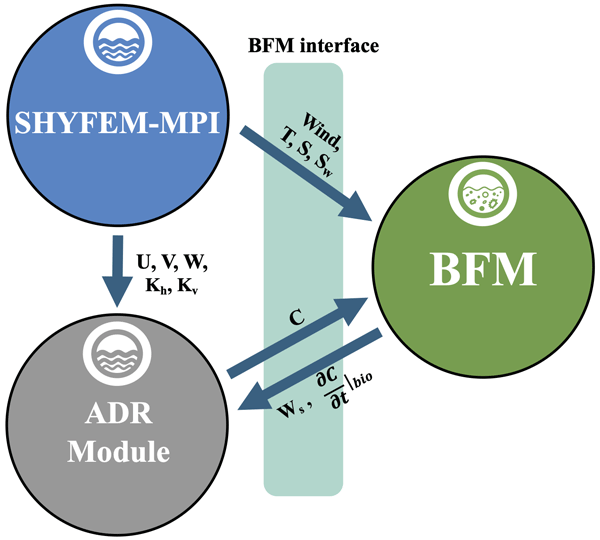
Abstract. This study presents ShyBFM, a high-resolution coupled physical–biogeochemical modelling system based on an unstructured grid. The physical component is the parallel computing finite element, ocean circulation model SHYFEM-MPI, while the marine ecosystem is described through the Biogeochemical Flux Model (BFM) which resolves the coupled pelagic and benthic lower trophic level interactions. The unstructured grid framework enables an accurate representation of complex coastal geometries while maintaining the influence of larger-scale dynamics through open boundary conditions. The numerical implementation of the model coupling is described, including the treatment of lateral and surface boundary conditions, and its application is illustrated through a reference case study. Model validation is performed for a coastal region of the northern Adriatic Sea (Mediterranean Sea), nested within an existing large-scale coupled physical–biogeochemical model that provides initial and lateral boundary conditions and serves as a calibration and validation benchmark. Simulated biogeochemical tracers from both the large-scale model and ShyBFM are compared against observational climatology. Results indicate that ShyBFM successfully reproduces the seasonal variability of key biogeochemical variables, exhibiting enhanced temporal variability and improved skill scores relative to the coarser-resolution model, although some limitations remain to be addressed. ShyBFM constitutes a robust and flexible tool for investigating interactions between physical dynamics and biogeochemical processes in coastal environments, which are strongly constrained by geomorphology, bathymetry, and riverine inputs. As such, ShyBFM is particularly well suited for applications supporting coastal management and environmental assessment.
-
Notice on discussion status
The requested preprint has a corresponding peer-reviewed final revised paper. You are encouraged to refer to the final revised version.
-
Preprint
(7222 KB)
-
Supplement
(2384 KB)
-
The requested preprint has a corresponding peer-reviewed final revised paper. You are encouraged to refer to the final revised version.
- Preprint
(7222 KB) - Metadata XML
-
Supplement
(2384 KB) - BibTeX
- EndNote
- Final revised paper


Journal article(s) based on this preprint
Interactive discussion
Status: closed
-
CEC1: 'Comment on egusphere-2026-1119 - No compliance with the policy of the journal', Juan Antonio Añel, 26 May 2026
-
AC1: 'Reply on CEC1', Jacopo Alessandri, 28 May 2026
Dear Juan,
Thank you for pointing out this issue.
We have updated the Zenodo repository to comply with the journal requirements. The BFM code used in this work is now added to the repository:
Link: https://zenodo.org/records/20415331
DOI: 10.5281/zenodo.20415331
We will also update the “Code and Data Availability” section and the bibliography accordingly in the revised manuscript when requested by the Topical Editor.
Best regards,
Jacopo AlessandriCitation: https://doi.org/10.5194/egusphere-2026-1119-AC1
-
AC1: 'Reply on CEC1', Jacopo Alessandri, 28 May 2026
-
RC1: 'Comment on egusphere-2026-1119', J.,. Palmieri, 30 May 2026
In this study, Jacopo Alessandri et al use the biogeochemical model BFM coupled to the ocean circulation model SHYFEM-MPI in an regional-unstructured-grid configuration of the North-West Adriatic, with a resolution that goes from 2km down to 300m on the coast, and compare it to their usual NEMO-BFM version (2km resolution).
Although the study is well done and shows that SHY-BFM has an improved biogeochemistry, lots of questions remain open, that prevent to really understand why it's better, and i think a major revision might be needed to fill all the gaps.
General comments.
- My general feeling about the study is that, we miss a whole part of the study. Biogeochemistry is a slave of the physics, and we can't understand why BFM acts differently in SHY-BFM without a minimum evaluation of both SHY-BFM and NEMO-BFM physics. In particular things that will explain the differences we see: circulation changes, mixing, T-S maps...
- Also we need some more information about NEMO-BFM. We have lots of details for the SHY-BFM configuration (which is good), but not much about the NEMO-BFM ER configuration it is compared to. We need to know what the differences are between both configurations, as some will explain the biogeochemical changes. In particular, are both configurations run with the same time step ? If everything is the same but SHY-BFM, please mention it in the simulation set-up. This has to be clear for the reader.
- Finally, as you say in the text, the domain is very open, and hence strongly controlled by the boundary conditions. It would be interesting to know the boundary condition biases if there are any, as they explain some of the biases on the edge of the domain.Specific comments (written while reading).
- Introduction
- Line 79 : "And it is open-source". Looks like a late addition. It can be included in a better way to the sentence.
- In most of the paper, there are mentions of "The BFM" or "The SHYBFM". If it is "the BFM model" or "module" Or something else, the "the" is OK, but it is not needed of it is just BFM.
- Line 81: "verified with the comparison with" - you can change to "compared to".- The coupled physics-biogeochemistry system
- Line 108-109: I thought BFM's benthic model was more complex than a "fixed quotes". That's surprising, and it will have consequences on the model results in the ER domain.
- Physical and BGC model component.
- Are your configurations adapted for shelf specific dynamics, are tides or tide induced mixing included for example?
- Table 2 : It would be good to add information about the forcing in the table, like resolution, frequency, etc, lame for the river runoff/load. I know it is in the text, but it would help the reader.- Simulation set-up
- Don't you have Iron, DIC, DOM, Alkalinity from the rivers ? Or they are not considered important because of the open domain ?
- What are the initial conditions ? you say it in the abstract, but not here. Is the parent model (that provides Init and boundary conditions optimised for the region ?)
- Model Calibration.
Just to be clear, you've used NEMO-BFM on ER coastal region. what is in there ? what's the grid, domain, time-step ? what are the differences with shy-BFM ? We need some information about this NEMO-BFM run on ER domain.- Model evaluation.
- Are both Shy-BFM and NEMO-BFM using the new parameters ?
- Fig 3. numbers are too little. we can't see them without zooming in.
- Here again, i think we miss important information.
Before evaluating the biogeochemical response to this new unstructured-grid. we have to know about the dynamics, and its answer to SHY-BFM. The BGC changes will mostly be in response to changes in the dynamics. And to (better) understand what's happening, we need to know them.
- Also, the domain is very open. it must be very Boundary conditions dependant. So, although you show Shy-BFM improves the BGC in the overall domain, it would be good to have an idea of how controlled by the boundary conditions your run is. for example, the North of the domain must mainly be controlled by the BC. Those BC are from another NEMO-BFM run, how different are they from the climatology ?
- Suggestion: it could be good to add the Boundary Conditions (or the parent model results) around the model results in Fig 3 and 4. Highlighting the ER region, but so that we know that the high DIN at the north of the domain are (or not) from the BC.
- line 330: good oxygen at the surface: this has to be, as it's in equilibrium with the atmosphere. It would be worrying if not.
- Fig 7. : Shy-BFM looks better, with more variability. I would suggest to improve the shaded colours transparency, or the shaded colours themselves. we don't see the green shade when bellow the orange one.- Discussion :
- Line 431 : you talk about ISM, while i always heard of the importance of CDOM in coastal regions. I see a Paper by Alvarez et al., 2023, modelling CDOM with a 1D version of BFM. does your version of BFM include the impact of CDOM on light absorption ?
- What is the computational cost of SHY-BFM compare the NEMO-BFM ?- After reading questions :
I am sorry but reading your paper rises lots of questions. You might want to include some of your answers in the paper. It would be good if you do, i understand if you don't :
- Why this approach rather than working on other mechanisms that would (also) improve the model in a shelf region (and probably be less computationally expensive), like improving the benthic model ? or changing the vertical coordinates ?
- Any plans for further improvements ? Any idea how to improve the river nutrient inputs ? any data from land/river models ?
- The atmospheric forcing at 6km (which is already great) sounds like a limitation when running with 300m resolution at the coast. Is there a way (that's probably a whole project) to downscale those around the coast to a finer resolution ?
- Zenodo - Please, give a minimum instruction on how to run Shy-BFM. Giving the code is nice, but please, explain how to use it.Citation: https://doi.org/10.5194/egusphere-2026-1119-RC1 - AC2: 'Reply on RC1', Jacopo Alessandri, 18 Jul 2026
-
RC2: 'Comment on egusphere-2026-1119', Anonymous Referee #2, 11 Jun 2026
General Comments
This manuscript presents a new high-resolution physical-biogeochemical modeling system that is produced by coupling existing physical (SHYFEM-MPI) and biogeochemical (BFM) models that have previously been used separately in other contexts. The physical model's unstructured grid provides flexibility in balancing computational demands with resolution of complex coastal features, while the fairly complex biogeochemical model, with ?? tracers, includes many components of the biogeochemical dynamics. The model is implemented for a small regional domain in the northern Adriatic Sea. Model skill is evaluated in comparison to an observational climatology and an existing coarser resolution NEMO-based model with the same BFM biogeochemical component (although differently tuned parameter settings). While the differences in tuning are clearly justified by the differing dominant ecosystem types of the parent and child domains, the combination of physical and biogeochemical model differences between the parent and child models preclude attribution of differences in skill to one factor or the other. However, the results demonstrate the significant potential of the unstructured grid approach in the context of representation of coastal biogeochemistry. The skill assessment highlights the need for further development in order to accurately capture spatial features present in the observational climatology. Yet, the model successfully captures the timing of bloom events. The manuscript is interesting and generally provides a level of detail sufficient to understand the model's implementation. However, revision and clarification in some areas (outlined below) would be beneficial.Specific Comments
A settling velocity is included in equation 1a but not in section 2.1, except in equation 5. I find the apparent switching between considering and ignoring tracer sinking velocities confusing and suggest adding additional clarifying information or perhaps correction. I would have expected, for example, that a no-flux surface boundary condition might reflect a balance between sinking, vertical turbulent diffusion, and possibly motion of the free surface, and that the bottom boundary condition for sedimented organic matter would reflect the sinking flux (eg eqs 98-99 here: https://getm.eu/files/GETM/doc/html/node78.html).
The spatial patterns in nutrients look quite different between SB and the observational climatology. Is this reflected in the temperature and salinity as well? It could be informative to also present the same figures for temperature and salinity. Are riverine nutrient inputs near the center of the domain's coastline underestimated?
Table SI1: This table could be more informative if the original parameter values in the parent domain were also specified.
line 397 suggests that the upwind horizontal advection scheme may not be optimal, but does not say why (although numerical diffusion is mentioned at line 464). Is there evidence of numerical diffusion in the results? How would it lead to a positive chl bias at the Po River mouth?
Technical Corrections
line 77: I think this is the first time "ADR" is used- please define it (advection-diffusion-reaction, I assume)
line 108: The word "quotes" does not make sense. Do you mean fractions perhaps?
line 135: "The carbon, nitrogen, and silicon cycles are solved independently across their inorganic form and the organic content within each FG." I am not sure what this sentence means- I find the structure ambiguous.
line 165: what does "synthetically" mean here?
line 330: Table 3 shows a slightly higher IQR for SB compared to NBCitation: https://doi.org/10.5194/egusphere-2026-1119-RC2 - AC3: 'Reply on RC2', Jacopo Alessandri, 18 Jul 2026
Peer review completion


Interactive discussion
Status: closed
-
CEC1: 'Comment on egusphere-2026-1119 - No compliance with the policy of the journal', Juan Antonio Añel, 26 May 2026
Dear authors,
Unfortunately, after checking your manuscript, it has come to our attention that it does not comply with our "Code and Data Policy".
https://www.geoscientific-model-development.net/policies/code_and_data_policy.html
In the Code and Data Availability section of your manuscript you do not provide a repository for the BMF code. We can not accept this. The BMF code is distributed under the GPLv3 license, and therefore you can share and redistribute it with the only limitation of doing it under the same license. Therefore, you must store the BMF code in one of the repositories acceptable according to our policy, and reply to this comment with the link and permanent handler for it (e.g. DOI). Later, if the Topical Editor decides to continue with the review or publication process of your manuscript and you are requested to upload a new version of it, then The 'Code and Data Availability’ section of your manuscript must also be modified to cite the new repository locations, and corresponding references added to the bibliography.
I must note that if you do not fix this problem, we cannot continue with the peer-review process or accept your manuscript for publication in GMD.
Juan A. Añel
Geosci. Model Dev. Executive EditorCitation: https://doi.org/10.5194/egusphere-2026-1119-CEC1 -
AC1: 'Reply on CEC1', Jacopo Alessandri, 28 May 2026
Dear Juan,
Thank you for pointing out this issue.
We have updated the Zenodo repository to comply with the journal requirements. The BFM code used in this work is now added to the repository:
Link: https://zenodo.org/records/20415331
DOI: 10.5281/zenodo.20415331
We will also update the “Code and Data Availability” section and the bibliography accordingly in the revised manuscript when requested by the Topical Editor.
Best regards,
Jacopo AlessandriCitation: https://doi.org/10.5194/egusphere-2026-1119-AC1
-
AC1: 'Reply on CEC1', Jacopo Alessandri, 28 May 2026
-
RC1: 'Comment on egusphere-2026-1119', J.,. Palmieri, 30 May 2026
In this study, Jacopo Alessandri et al use the biogeochemical model BFM coupled to the ocean circulation model SHYFEM-MPI in an regional-unstructured-grid configuration of the North-West Adriatic, with a resolution that goes from 2km down to 300m on the coast, and compare it to their usual NEMO-BFM version (2km resolution).
Although the study is well done and shows that SHY-BFM has an improved biogeochemistry, lots of questions remain open, that prevent to really understand why it's better, and i think a major revision might be needed to fill all the gaps.
General comments.
- My general feeling about the study is that, we miss a whole part of the study. Biogeochemistry is a slave of the physics, and we can't understand why BFM acts differently in SHY-BFM without a minimum evaluation of both SHY-BFM and NEMO-BFM physics. In particular things that will explain the differences we see: circulation changes, mixing, T-S maps...
- Also we need some more information about NEMO-BFM. We have lots of details for the SHY-BFM configuration (which is good), but not much about the NEMO-BFM ER configuration it is compared to. We need to know what the differences are between both configurations, as some will explain the biogeochemical changes. In particular, are both configurations run with the same time step ? If everything is the same but SHY-BFM, please mention it in the simulation set-up. This has to be clear for the reader.
- Finally, as you say in the text, the domain is very open, and hence strongly controlled by the boundary conditions. It would be interesting to know the boundary condition biases if there are any, as they explain some of the biases on the edge of the domain.Specific comments (written while reading).
- Introduction
- Line 79 : "And it is open-source". Looks like a late addition. It can be included in a better way to the sentence.
- In most of the paper, there are mentions of "The BFM" or "The SHYBFM". If it is "the BFM model" or "module" Or something else, the "the" is OK, but it is not needed of it is just BFM.
- Line 81: "verified with the comparison with" - you can change to "compared to".- The coupled physics-biogeochemistry system
- Line 108-109: I thought BFM's benthic model was more complex than a "fixed quotes". That's surprising, and it will have consequences on the model results in the ER domain.
- Physical and BGC model component.
- Are your configurations adapted for shelf specific dynamics, are tides or tide induced mixing included for example?
- Table 2 : It would be good to add information about the forcing in the table, like resolution, frequency, etc, lame for the river runoff/load. I know it is in the text, but it would help the reader.- Simulation set-up
- Don't you have Iron, DIC, DOM, Alkalinity from the rivers ? Or they are not considered important because of the open domain ?
- What are the initial conditions ? you say it in the abstract, but not here. Is the parent model (that provides Init and boundary conditions optimised for the region ?)
- Model Calibration.
Just to be clear, you've used NEMO-BFM on ER coastal region. what is in there ? what's the grid, domain, time-step ? what are the differences with shy-BFM ? We need some information about this NEMO-BFM run on ER domain.- Model evaluation.
- Are both Shy-BFM and NEMO-BFM using the new parameters ?
- Fig 3. numbers are too little. we can't see them without zooming in.
- Here again, i think we miss important information.
Before evaluating the biogeochemical response to this new unstructured-grid. we have to know about the dynamics, and its answer to SHY-BFM. The BGC changes will mostly be in response to changes in the dynamics. And to (better) understand what's happening, we need to know them.
- Also, the domain is very open. it must be very Boundary conditions dependant. So, although you show Shy-BFM improves the BGC in the overall domain, it would be good to have an idea of how controlled by the boundary conditions your run is. for example, the North of the domain must mainly be controlled by the BC. Those BC are from another NEMO-BFM run, how different are they from the climatology ?
- Suggestion: it could be good to add the Boundary Conditions (or the parent model results) around the model results in Fig 3 and 4. Highlighting the ER region, but so that we know that the high DIN at the north of the domain are (or not) from the BC.
- line 330: good oxygen at the surface: this has to be, as it's in equilibrium with the atmosphere. It would be worrying if not.
- Fig 7. : Shy-BFM looks better, with more variability. I would suggest to improve the shaded colours transparency, or the shaded colours themselves. we don't see the green shade when bellow the orange one.- Discussion :
- Line 431 : you talk about ISM, while i always heard of the importance of CDOM in coastal regions. I see a Paper by Alvarez et al., 2023, modelling CDOM with a 1D version of BFM. does your version of BFM include the impact of CDOM on light absorption ?
- What is the computational cost of SHY-BFM compare the NEMO-BFM ?- After reading questions :
I am sorry but reading your paper rises lots of questions. You might want to include some of your answers in the paper. It would be good if you do, i understand if you don't :
- Why this approach rather than working on other mechanisms that would (also) improve the model in a shelf region (and probably be less computationally expensive), like improving the benthic model ? or changing the vertical coordinates ?
- Any plans for further improvements ? Any idea how to improve the river nutrient inputs ? any data from land/river models ?
- The atmospheric forcing at 6km (which is already great) sounds like a limitation when running with 300m resolution at the coast. Is there a way (that's probably a whole project) to downscale those around the coast to a finer resolution ?
- Zenodo - Please, give a minimum instruction on how to run Shy-BFM. Giving the code is nice, but please, explain how to use it.Citation: https://doi.org/10.5194/egusphere-2026-1119-RC1 - AC2: 'Reply on RC1', Jacopo Alessandri, 18 Jul 2026
-
RC2: 'Comment on egusphere-2026-1119', Anonymous Referee #2, 11 Jun 2026
General Comments
This manuscript presents a new high-resolution physical-biogeochemical modeling system that is produced by coupling existing physical (SHYFEM-MPI) and biogeochemical (BFM) models that have previously been used separately in other contexts. The physical model's unstructured grid provides flexibility in balancing computational demands with resolution of complex coastal features, while the fairly complex biogeochemical model, with ?? tracers, includes many components of the biogeochemical dynamics. The model is implemented for a small regional domain in the northern Adriatic Sea. Model skill is evaluated in comparison to an observational climatology and an existing coarser resolution NEMO-based model with the same BFM biogeochemical component (although differently tuned parameter settings). While the differences in tuning are clearly justified by the differing dominant ecosystem types of the parent and child domains, the combination of physical and biogeochemical model differences between the parent and child models preclude attribution of differences in skill to one factor or the other. However, the results demonstrate the significant potential of the unstructured grid approach in the context of representation of coastal biogeochemistry. The skill assessment highlights the need for further development in order to accurately capture spatial features present in the observational climatology. Yet, the model successfully captures the timing of bloom events. The manuscript is interesting and generally provides a level of detail sufficient to understand the model's implementation. However, revision and clarification in some areas (outlined below) would be beneficial.Specific Comments
A settling velocity is included in equation 1a but not in section 2.1, except in equation 5. I find the apparent switching between considering and ignoring tracer sinking velocities confusing and suggest adding additional clarifying information or perhaps correction. I would have expected, for example, that a no-flux surface boundary condition might reflect a balance between sinking, vertical turbulent diffusion, and possibly motion of the free surface, and that the bottom boundary condition for sedimented organic matter would reflect the sinking flux (eg eqs 98-99 here: https://getm.eu/files/GETM/doc/html/node78.html).
The spatial patterns in nutrients look quite different between SB and the observational climatology. Is this reflected in the temperature and salinity as well? It could be informative to also present the same figures for temperature and salinity. Are riverine nutrient inputs near the center of the domain's coastline underestimated?
Table SI1: This table could be more informative if the original parameter values in the parent domain were also specified.
line 397 suggests that the upwind horizontal advection scheme may not be optimal, but does not say why (although numerical diffusion is mentioned at line 464). Is there evidence of numerical diffusion in the results? How would it lead to a positive chl bias at the Po River mouth?
Technical Corrections
line 77: I think this is the first time "ADR" is used- please define it (advection-diffusion-reaction, I assume)
line 108: The word "quotes" does not make sense. Do you mean fractions perhaps?
line 135: "The carbon, nitrogen, and silicon cycles are solved independently across their inorganic form and the organic content within each FG." I am not sure what this sentence means- I find the structure ambiguous.
line 165: what does "synthetically" mean here?
line 330: Table 3 shows a slightly higher IQR for SB compared to NBCitation: https://doi.org/10.5194/egusphere-2026-1119-RC2 - AC3: 'Reply on RC2', Jacopo Alessandri, 18 Jul 2026
Peer review completion
Journal article(s) based on this preprint
Viewed
| HTML | XML | Total | Supplement | BibTeX | EndNote | |
|---|---|---|---|---|---|---|
| 413 | 227 | 48 | 688 | 73 | 51 | 48 |
- HTML: 413
- PDF: 227
- XML: 48
- Total: 688
- Supplement: 73
- BibTeX: 51
- EndNote: 48
Viewed (geographical distribution)
| Country | # | Views | % |
|---|
| Total: | 0 |
| HTML: | 0 |
| PDF: | 0 |
| XML: | 0 |
- 1
Jacopo Alessandri

Giulia Bonino
Tomas Lovato
Momme Butenschön
Lorenzo Mentaschi
Giorgia Verri
Ivan Federico
Nadia Pinardi
The requested preprint has a corresponding peer-reviewed final revised paper. You are encouraged to refer to the final revised version.
- Preprint
(7222 KB) - Metadata XML
-
Supplement
(2384 KB) - BibTeX
- EndNote
- Final revised paper
Dear authors,
Unfortunately, after checking your manuscript, it has come to our attention that it does not comply with our "Code and Data Policy".
https://www.geoscientific-model-development.net/policies/code_and_data_policy.html
In the Code and Data Availability section of your manuscript you do not provide a repository for the BMF code. We can not accept this. The BMF code is distributed under the GPLv3 license, and therefore you can share and redistribute it with the only limitation of doing it under the same license. Therefore, you must store the BMF code in one of the repositories acceptable according to our policy, and reply to this comment with the link and permanent handler for it (e.g. DOI). Later, if the Topical Editor decides to continue with the review or publication process of your manuscript and you are requested to upload a new version of it, then The 'Code and Data Availability’ section of your manuscript must also be modified to cite the new repository locations, and corresponding references added to the bibliography.
I must note that if you do not fix this problem, we cannot continue with the peer-review process or accept your manuscript for publication in GMD.
Juan A. Añel
Geosci. Model Dev. Executive Editor