
the Creative Commons Attribution 4.0 License.
the Creative Commons Attribution 4.0 License.
 | 17 Mar 2026
Non-Maxwellian electron distributions in the D region during artificial heating (Paper I): Model development and electron temperature
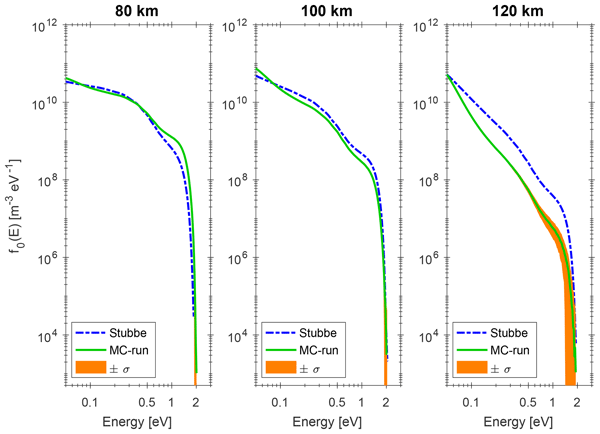
Abstract. The phase space density in the weakly ionized D region is calculated by numerically solving the Boltzmann equation and through a Monte Carlo simulation for high power, high frequency radio wave heating under the assumption that the electron collision frequency is much larger than the gyro-frequency. The effects of elastic and inelastic collisions, such as vibrational, rotational and electronic excitation, are taken into account using the best available cross sections. The solutions demonstrate that the distribution function deviates significantly from a Maxwellian distribution, and that even though a temperature can be defined from the second moment of the distribution, it is not sufficient to specify the distribution functions.
-
Notice on discussion status
The requested preprint has a corresponding peer-reviewed final revised paper. You are encouraged to refer to the final revised version.
-
Preprint
(2754 KB)
-
The requested preprint has a corresponding peer-reviewed final revised paper. You are encouraged to refer to the final revised version.
- Preprint
(2754 KB) - Metadata XML
- BibTeX
- EndNote
- Final revised paper


Journal article(s) based on this preprint
Interactive discussion
Status: closed
-
RC1: 'Comment on egusphere-2026-1117', Anonymous Referee #1, 04 May 2026
-
RC2: 'Reply on RC1', Anonymous Referee #2, 13 May 2026
This is an interesting paper with clear presentation and discussion. I recommend it for publication. There are a couple of typo errors that have already been pointed out by another reviewer.
Citation: https://doi.org/10.5194/egusphere-2026-1117-RC2 -
AC2: 'Reply on RC2', Margaretha Myrvang, 15 May 2026
We would to thank the referee for their kind and helpful comments, and we will make the corrections pointed out by referee #1.
Citation: https://doi.org/10.5194/egusphere-2026-1117-AC2
-
AC2: 'Reply on RC2', Margaretha Myrvang, 15 May 2026
-
AC1: 'Reply on RC1', Margaretha Myrvang, 15 May 2026
We would like to thank the referee for their kind feedback and helpful comments. We will correct the typo errors pointed out.
Regarding the comment on line 185:
To compute the electric field amplitudes at height z, we use a simplified version of equation 16 from Shoucri and Morales 1984, given by:
$|E(z)|= 0.25*(beta*W*G)^{1/2}/D$
where beta is the absorption at low altitude, assuming no loss in the D region so that beta = 1, W is the average radiated power, G is the gain of the antenna, and D is the altitude from the ground. Here (W*G) is the ERP, the effective radiated power. In principle, the actual electric field will depend on the electron density at altitudes below, which controls how much of the Poynting flux is absorbed. For this paper, we rather choose some representative, but somewhat realistic, electric field amplitude to be able to compare the shape of the phase space density for the Monte Carlo simulation and the solution based on Boltzmann equation, and in order to compare the response at different altitudes, we do not take into account the absorption below.References:
Shoucri, M. M. and Morales, G. J.: Ohmic Heating of the Polar F Region by HF Pulses, Journal of geophysical research, 89, 2907–2917, 1984.Citation: https://doi.org/10.5194/egusphere-2026-1117-AC1
-
RC2: 'Reply on RC1', Anonymous Referee #2, 13 May 2026
Peer review completion


Interactive discussion
Status: closed
-
RC1: 'Comment on egusphere-2026-1117', Anonymous Referee #1, 04 May 2026
This manuscript shows that HF pumping with high-power radio waves in the D-region ionosphere can result in a non-Maxwellian electron energy distribution, thereby refuting a commonly held assumption. The manuscript is well-written and clear. I recommend publication subject to one minor revision and a few trivial edits.
L185: It is not clear how the authors obtained the electric field amplitudes given. This should be briefly explained.
L197: "is lower" should be "being lower".
L202: "due ti the " should be "due to the".
L221: "collision" should be plural.
L228: "becomes" should be singular.
Citation: https://doi.org/10.5194/egusphere-2026-1117-RC1 -
RC2: 'Reply on RC1', Anonymous Referee #2, 13 May 2026
This is an interesting paper with clear presentation and discussion. I recommend it for publication. There are a couple of typo errors that have already been pointed out by another reviewer.
Citation: https://doi.org/10.5194/egusphere-2026-1117-RC2 -
AC2: 'Reply on RC2', Margaretha Myrvang, 15 May 2026
We would to thank the referee for their kind and helpful comments, and we will make the corrections pointed out by referee #1.
Citation: https://doi.org/10.5194/egusphere-2026-1117-AC2
-
AC2: 'Reply on RC2', Margaretha Myrvang, 15 May 2026
-
AC1: 'Reply on RC1', Margaretha Myrvang, 15 May 2026
We would like to thank the referee for their kind feedback and helpful comments. We will correct the typo errors pointed out.
Regarding the comment on line 185:
To compute the electric field amplitudes at height z, we use a simplified version of equation 16 from Shoucri and Morales 1984, given by:
$|E(z)|= 0.25*(beta*W*G)^{1/2}/D$
where beta is the absorption at low altitude, assuming no loss in the D region so that beta = 1, W is the average radiated power, G is the gain of the antenna, and D is the altitude from the ground. Here (W*G) is the ERP, the effective radiated power. In principle, the actual electric field will depend on the electron density at altitudes below, which controls how much of the Poynting flux is absorbed. For this paper, we rather choose some representative, but somewhat realistic, electric field amplitude to be able to compare the shape of the phase space density for the Monte Carlo simulation and the solution based on Boltzmann equation, and in order to compare the response at different altitudes, we do not take into account the absorption below.References:
Shoucri, M. M. and Morales, G. J.: Ohmic Heating of the Polar F Region by HF Pulses, Journal of geophysical research, 89, 2907–2917, 1984.Citation: https://doi.org/10.5194/egusphere-2026-1117-AC1
-
RC2: 'Reply on RC1', Anonymous Referee #2, 13 May 2026
Peer review completion
Journal article(s) based on this preprint
Viewed
| HTML | XML | Total | BibTeX | EndNote | |
|---|---|---|---|---|---|
| 603 | 227 | 75 | 905 | 66 | 79 |
- HTML: 603
- PDF: 227
- XML: 75
- Total: 905
- BibTeX: 66
- EndNote: 79
Viewed (geographical distribution)
| Country | # | Views | % |
|---|
| Total: | 0 |
| HTML: | 0 |
| PDF: | 0 |
| XML: | 0 |
- 1
Margaretha Myrvang

Björn Gustavsson
The requested preprint has a corresponding peer-reviewed final revised paper. You are encouraged to refer to the final revised version.
- Preprint
(2754 KB) - Metadata XML
This manuscript shows that HF pumping with high-power radio waves in the D-region ionosphere can result in a non-Maxwellian electron energy distribution, thereby refuting a commonly held assumption. The manuscript is well-written and clear. I recommend publication subject to one minor revision and a few trivial edits.
L185: It is not clear how the authors obtained the electric field amplitudes given. This should be briefly explained.
L197: "is lower" should be "being lower".
L202: "due ti the " should be "due to the".
L221: "collision" should be plural.
L228: "becomes" should be singular.