
the Creative Commons Attribution 4.0 License.
the Creative Commons Attribution 4.0 License.
 | 11 May 2026
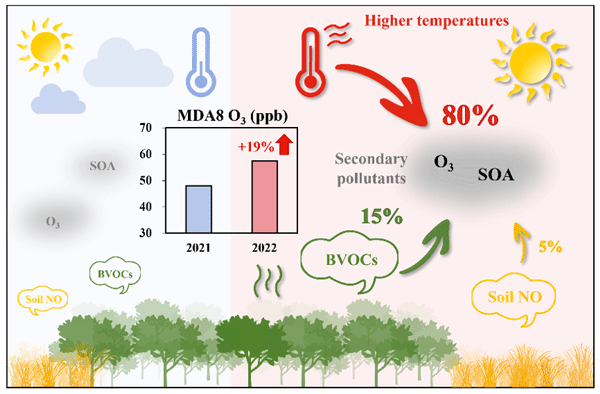
Direct thermal enhancement dominates over emission-mediated pathways in heatwave-induced O3 and SOA increases across China
Abstract. Heatwaves are major drivers of ozone (O3) and secondary organic aerosol (SOA) pollution. High temperatures directly accelerate photochemical reaction rates and concurrently enhance emissions of biogenic volatile organic compounds (BVOCs) and soil nitric oxide (SNO). However, the individual contributions of these direct and emission-mediated pathways to pollution formation remain poorly constrained. This study explicitly quantifies the distinct roles of these two pathways during heatwave events in China. Results show that high temperatures drive over 80 % of the O3 and SOA increases nationally, primarily through favorable weather conditions and enhanced atmospheric oxidation capacity. The O3-temperature dependence is strongest in the Yangtze River Delta (0.66 ppb °C-1) and Pearl River Delta (0.95 ppb °C-1). Furthermore, high-temperature-induced BVOC emissions significantly exacerbate O3 in VOC-limited regions like the North China Plain. These findings underscore the importance of climate mitigation by illustrating its critical role in alleviating temperature-driven secondary pollution.
-
Notice on discussion status
The requested preprint has a corresponding peer-reviewed final revised paper. You are encouraged to refer to the final revised version.
-
Preprint
(1401 KB)
-
Supplement
(1015 KB)
-
The requested preprint has a corresponding peer-reviewed final revised paper. You are encouraged to refer to the final revised version.
- Preprint
(1401 KB) - Metadata XML
-
Supplement
(1015 KB) - BibTeX
- EndNote
- Final revised paper


Journal article(s) based on this preprint
Interactive discussion
Status: closed
-
RC1: 'Comment on egusphere-2026-1101', Anonymous Referee #1, 12 May 2026
-
AC2: 'Reply on RC1', Peng Wang, 13 Jun 2026
Reviewer 1
The manuscript addresses an important and timely question: how heatwaves enhance O3 and SOA through direct meteorological effects and emission-mediated pathways. The topic fits well within the journal scope. The WRF-CMAQ sensitivity design is generally appropriate, and the main conclusion that direct high-temperature meteorological effects dominate the national O3/SOA increases is interesting and policy relevant. The regional finding that BVOC-related effects are particularly important for O3 in the VOC-limited North China Plain is also valuable. I recommend publication after minor revisions.
Response: We sincerely thank the reviewer for the positive evaluation and constructive feedback. We have carefully considered all comments and revised the manuscript to clarify our attribution methods, acknowledge observational and methodological limitations, and improve figure readability. Detailed point-by-point responses and corresponding manuscript modifications are provided below.
- The attribution method should be explained more clearly. The authors state that nonlinear interactions lead to a residual term and that percentage contributions are normalized against the sum of absolute changes from separated scenarios. This treatment may influence the reported “over 80%” meteorological contribution, so a clearer explanation or sensitivity discussion is needed. See p. 4, lines 101–105, and p. 1, lines 18–21.
Response: We thank the reviewer for this comment. In the CMAQ model, secondary pollution formation is highly nonlinear. When high temperatures and elevated biogenic emissions occur simultaneously in the BASE22 scenario, they create synergistic chemical interactions. Consequently, the sum of the absolute concentration changes from the three isolated sensitivity scenarios (MET22, BVOC22, SNO22) does not exactly equal the total interannual difference. This mathematical gap is the residual term, which represents the overlapping synergistic effects and typically accounts for a minor fraction of 3%-5%.
To accurately evaluate the relative weight of each pathway within a closed 100% framework, we normalized the individual contributions against the sum of their absolute changes. This specific treatment ensures that the overlapping synergistic residual is distributed proportionally among the drivers rather than arbitrarily assigned to one. Figure 3 in the manuscript confirms that the unnormalized increments driven by meteorology (the MET scenario) are inherently and vastly larger than those from isolated emission variations (the BVOC and SNO scenarios) across most regions. We have updated section 2.3 to include this explanation and revised the abstract to state that the over 80% contribution is a normalized value.
Changes in manuscript (lines 18-19): “Results show that high temperatures drive over 80% (normalized) of the O3 and SOA increases nationally, primarily through favorable weather conditions and enhanced atmospheric oxidation capacity.”
(lines 104-110): “Due to the nonlinearity of secondary pollution formation, summing these isolated contributions leaves a residual term when compared to the total difference, which typically accounts for 3% to 5% of the total change across most regions in this study. This term reflects the overlapping synergistic interactions between the high temperatures and elevated emissions concurrently present in the BASE22 scenario. To accurately clarify the calculation sequence, we first determined the raw contribution of each sensitivity case by dividing its isolated concentration change by the total interannual difference. To eliminate the arithmetic overlap from the residual and establish a closed framework, these individual raw percentages were then normalized against the sum of their absolute values, ensuring the final adjusted contributions of all drivers sum to 100%.”
- The use of summer 2021 as the baseline for the 2022 heatwave should be discussed as a limitation. Interannual differences may reflect not only heatwave effects, but also circulation variability, emissions, and boundary conditions. A short discussion, or comparison with a multi-year baseline if available, would strengthen the attribution. See p. 4, lines 90–99.
Response: We thank the reviewer for this constructive suggestion. The summer of 2021 was selected as the baseline for two major reasons. First, anthropogenic emissions in China were highly comparable and remained stable between 2021 and 2022 due to continuous emission control policies, which minimizes the interference of emission fluctuations in our attribution system. Second, although 2021 experienced notable warmth, the 2022 heatwave was an unprecedented, record-breaking extreme event across China (Wang et al., 2024; Sun et al., 2022). Compared to the extraordinary severity of 2022, the meteorological conditions in 2021 provide a relatively moderate control case to isolate the impacts of this rare extreme heatwave. We recognize that using a single year baseline includes interannual weather variability, and we have added a brief discussion in section 4 to state this limitation.
Changes in manuscript (lines 316-322): “While scenario analysis successfully isolates the key drivers of the 2022 anomaly, using the summer of 2021 as the sole baseline cannot completely separate the heatwave from background interannual weather variability. Nevertheless, this selection is justified by the highly comparable anthropogenic emissions between 2021 and 2022 resulting from continuous national emission control policies, which minimizes the interference of emission fluctuations. Furthermore, although 2021 also experienced high temperatures, the 2022 heatwave remains an unprecedented extreme event across China. The atmospheric conditions in 2021 therefore provide a relatively moderate control case to highlight the impacts of this rare extremity. Future studies should use a multi-year baseline to better separate localized extreme impacts from background climate variability.”
- The uncertainty in MEGAN-based BVOC and SNO emissions should be discussed more explicitly, since these emissions are central to the indirect pathway analysis. This is especially important for regional conclusions regarding NCP BVOC sensitivity and SNO effects. See p. 3, lines 75–82, and p. 5, lines 106–120.
Response: We thank the reviewer for this constructive comment. Previous studies show that while MEGAN generally overestimates regional BVOC emissions, it frequently underestimates them in urban areas due to coarse vegetation data that fail to capture high-emitting urban greening (Zhang et al., 2025). Besides, MEGAN typically underestimates SNO emissions because it oversimplifies agricultural fertilizer inputs (Oikawa et al., 2015; Huang et al., 2023). Considering the geographical landscape of the NCP, which features dense urban clusters intertwined with agricultural lands, it is plausible that both urban BVOC and agricultural SNO emissions during the heatwave were higher than simulated. We have expanded section 3.5 to suggest that, indirect pathways in the NCP likely play a larger role than our estimates.
Changes in manuscript (234-238): “These estimated impacts of biogenic emissions in the NCP likely represent a conservative estimate. Specifically, coarse vegetation data and simplified fertilizer parameterizations lead the MEGAN model to underestimate urban BVOCs and SNO emissions, respectively (Zhang et al., 2025) (Oikawa et al., 2015; Huang et al., 2023). As the NCP features dense urban clusters interspersed with intensive agricultural lands, the actual emissions of both precursors and their subsequent contributions to secondary pollution during the heatwave are expected to exceed the current simulations.”
- The model evaluation is acceptable, but the SOA-related conclusions would benefit from clearer validation or caveats. The current evaluation focuses mainly on meteorology, O3, PM5, and NO2, while direct observational constraints on SOA are not clearly shown. Please clarify whether OA/SOA observations are available, or explicitly state this limitation. See p. 5–6, lines 121–135.
Response: We thank the reviewer for this constructive suggestion regarding SOA validation. The evaluation is restricted to criteria pollutants because a systematic and continuous nationwide monitoring network for OA or SOA components is currently unavailable in China. Consequently, direct observational constraints on the simulated SOA concentrations are unfeasible for this study. As suggested, we have explicitly acknowledged this observational limitation and the associated uncertainties of SOA simulations in the revised manuscript.
Changes in manuscript (lines 140-144): “However, a direct evaluation of SOA is currently unfeasible due to the absence of a nationwide monitoring network in China. Furthermore, previous studies reported that air quality models generally underestimate SOA concentrations because of missing precursor emissions, such as semivolatile/intermediate VOCs, and unrepresented multigenerational oxidation pathways(Zhao et al., 2022; Li et al., 2026). Consequently, the actual amplification of SOA caused by high temperatures is likely more severe than the model estimates.”
- The nighttime O3 mechanism is interesting but could be clarified. The explanation involving NO3 chemistry, reduced NO titration, and boundary-layer stability should better distinguish chemical effects from vertical mixing or transport effects. Additional diagnostics such as nighttime PBL height, NOx, NO3, or vertical diffusion changes would be helpful if available. See p. 10–11, lines 220–225.
Response: We sincerely appreciate this constructive feedback. We have added a new figure (see Fig.1 in the PDF) showing the diurnal variations of PBL height, NO3 radical, and NOx to illustrate the O3 diurnal changes. Figure 1 shows a nocturnal decrease in PBL height, which confirms that vertical mixing is suppressed and traps pollutants near the surface. Within this stable layer, chemical processes determine the O3 trends. Figure 4b in the manuscript shows that weather driven biogenic emissions (BVOC22 case) cause a net reduction in nighttime NO3 radical concentrations, which indicates the chemical consumption of NO3 radicals by BVOCs. This process changes the nocturnal nitrogen cycle and reduces NO for O3 titration. Therefore, as shown by the positive biogenic contribution in Figure 4a, the reduced titration preserves residual O3 and leads to its nighttime accumulation.
Changes in manuscript (lines 228-234): “Moreover, the impact of the BVOC22 on NCP O3 exhibits a diurnal reversal, from negative in the daytime to positive at night (Fig. 4). During the day, an increase in BVOCs enhanced the oxidation of NO to NO2, and further facilitated the formation of O3. However, the concurrently increased NO from NO2 photolysis also intensifies the O3 loss via titration (O3 + NO). When the titration process became slightly dominant, this could lead to a net negative daytime contribution to O3. Conversely, at night, the suppressed PBL height limits vertical mixing and traps pollutants (Fig. S6). Within this stable layer, increased BVOCs promoted NO3 radical chemistry, which is verified by the net decrease of nighttime NO3 concentrations (Fig. 4b). This process consumed NO and thus reduced the nocturnal O3 titration, facilitating residual O3 accumulation.”
- Some figures contain dense information and relatively small labels. Improving figure readability and keeping scenario names consistent would make the manuscript easier to follow, especially for Figs. 3–6.
Response: We thank the reviewer for the suggestions on figure quality. Figures 3-6 have been updated to increase the font sizes of all necessary labels, legends, and axis titles. We have also verified that the scenario abbreviations (B for BASE, M for MET, V for BVOC, and N for SNO) are used consistently across all panels, labels, and captions.
Overall, this is a useful and timely study. After addressing the above minor issues, the manuscript should be suitable for publication.
Response: We sincerely thank the reviewer for the positive overall evaluation and the highly constructive feedback. We have carefully addressed all the raised issues in the revised manuscript, which we believe has significantly improved the quality of our study.
References
Huang, L., Fang, J., Liao, J., Yarwood, G., Chen, H., Wang, Y., and Li, L.: Insights into soil NO emissions and the contribution to surface ozone formation in China, Atmos. Chem. Phys., 23, 14919-14932, 10.5194/acp-23-14919-2023, 2023.
Li, Y., Qin, M., Hu, W., Zhao, B., Li, Y., Pye, H. O. T., Li, J., Zeng, L., Guo, S., Hu, M., and Hu, J.: Evaluating simulations of organic aerosol volatility and degree of oxygenation in eastern China, Atmos. Chem. Phys., 26, 1001-1020, 10.5194/acp-26-1001-2026, 2026.
Oikawa, P. Y., Ge, C., Wang, J., Eberwein, J. R., Liang, L. L., Allsman, L. A., Grantz, D. A., and Jenerette, G. D.: Unusually high soil nitrogen oxide emissions influence air quality in a high-temperature agricultural region, Nature Communications, 6, 8753, 10.1038/ncomms9753, 2015.
Sun, Y., Chao, Q.-C., Zhou, B.-T., and Zhou, T.-J.: Explaining China's climate in 2021, Advances in Climate Change Research, 13, 769-771, https://doi.org/10.1016/j.accre.2022.12.001, 2022.
Wang, D., Sun, Y., Hu, T., and Yin, H.: The 2022 Record-Breaking Heat Event over the Middle and Lower Reaches of the Yangtze River: The Role of Anthropogenic Forcing and Atmospheric Circulation, Bulletin of the American Meteorological Society, 105, E200-E205, https://doi.org/10.1175/BAMS-D-23-0152.1, 2024.
Zhang, Y., Ran, H., Guenther, A., Zhang, Q., George, C., Mellouki, W., Sheng, G., Peng, P. a., and Wang, X.: Improved modelling of biogenic emissions in human-disturbed forest edges and urban areas, Nature Communications, 16, 8064, 10.1038/s41467-025-63437-8, 2025.
Zhao, J., Lv, Z., Qi, L., Zhao, B., Deng, F., Chang, X., Wang, X., Luo, Z., Zhang, Z., Xu, H., Ying, Q., Wang, S., He, K., and Liu, H.: Comprehensive Assessment for the Impacts of S/IVOC Emissions from Mobile Sources on SOA Formation in China, Environmental Science & Technology, 56, 16695-16706, 10.1021/acs.est.2c07265, 2022.
-
AC2: 'Reply on RC1', Peng Wang, 13 Jun 2026
-
RC2: 'Comment on egusphere-2026-1101', Anonymous Referee #2, 23 May 2026
This manuscript presents a well-designed modeling study on the drivers of O3 and SOA increases during heatwaves in China. The experimental design is appropriate, and the findings regarding the dominant role of direct temperature effects and the heightened VOC sensitivity in the North China Plain are valuable for understanding climate air quality interactions. The paper is generally well written and organized. However, several minor issues remain that should be addressed before publication. Overall, the manuscript is suitable for acceptance by ACP after minor revision.
- In the BVOC22 sensitivity simulation, the authors state that isoprene, terpenes, and sesquiterpenes are selected as the dominant BVOC species. Please provide the relative emission proportions of these three groups under the baseline (2021) and heatwave (2022) conditions. This information would help readers assess which biogenic precursors are most responsible for the observed O₃ and SOA changes.
- Section 3.6 reports that the PRD region has the highest O₃ temperature sensitivity, yet Figure 1 shows that summer temperatures in the PRD slightly decreased from 2021 to 2022. Please clarify how a sensitivity slope can be derived under a net cooling condition. Is the sensitivity estimate driven by spatial variability rather than interannual temperature change? A brief explanation would help readers interpret this result correctly.
- Section 3.4 reports that the direct meteorological contribution (MET22) to O3 in the North China Plain is more pronounced at night than during the day, attributed to temperature inversion trapping surface O3. However, nocturnal O3 is typically depleted by NO titration. Please explain why the trapped O3 is not rapidly titrated by NO under the stagnant, high-pressure conditions described.
- In Figure 2 caption, the difference term is written as “BASE22-BASE2”. It should be “BASE22-BASE21”. Please add the missing digit “1”.
- Section 3.4 defines daytime as 8:00 to 20:00 and nighttime as 20:00 to 8:00. Please clarify whether these times refer to local standard time or Beijing Time (UTC+8). Additionally, please confirm whether the model simulations accounted for time zone differences across the study domain (e.g., western China versus eastern China) when aggregating diurnal patterns.
Citation: https://doi.org/10.5194/egusphere-2026-1101-RC2 -
AC1: 'Reply on RC2', Peng Wang, 13 Jun 2026
This manuscript presents a well-designed modeling study on the drivers of O3 and SOA increases during heatwaves in China. The experimental design is appropriate, and the findings regarding the dominant role of direct temperature effects and the heightened VOC sensitivity in the North China Plain are valuable for understanding climate air quality interactions. The paper is generally well written and organized. However, several minor issues remain that should be addressed before publication. Overall, the manuscript is suitable for acceptance by ACP after minor revision.
Response: We sincerely thank the reviewer for the positive evaluation of our work. We have carefully addressed all of your comments and incorporated the suggested changes into the revised manuscript. Detailed point-by-point responses are provided below.
- In the BVOC22 sensitivity simulation, the authors state that isoprene, terpenes, and sesquiterpenes are selected as the dominant BVOC species. Please provide the relative emission proportions of these three groups under the baseline (2021) and heatwave (2022) conditions. This information would help readers assess which biogenic precursors are most responsible for the observed O3 and SOA changes.
Response: We thank the reviewer for this insightful suggestion. Based on the model outputs, the relative emission proportions of BVOCs remained highly consistent between the 2021 baseline and the 2022 heatwave conditions (see Fig. 2 in the PDF file). Under the 2021 conditions, isoprene, terpenes, and sesquiterpenes accounted for approximately 81.8%, 15.5%, and 2.6% of the total emissions, respectively. Under the 2022 conditions, these proportions shifted only slightly to 82.8%, 14.7%, and 2.5%. This indicates that while the absolute emission amounts increased during the heatwave, the primary precursor composition driving the O3 and SOA changes remained stable. We have revised section 2.3 to help readers better assess the biogenic precursors.
Changes in manuscript (lines 81-83): “Based on the MEGAN estimates, the relative proportions of isoprene, terpenes, and sesquiterpenes are highly consistent between the 2021 baseline and 2022 heatwave conditions (Fig. S1). They account for 81.8%, 15.5%, and 2.6% of the total BVOC emissions in 2021, and 82.8%, 14.7%, and 2.5% in 2022, respectively.”
- Section 3.6 reports that the PRD region has the highest O3 temperature sensitivity, yet Figure 1 shows that summer temperatures in the PRD slightly decreased from 2021 to 2022. Please clarify how a sensitivity slope can be derived under a net cooling condition. Is the sensitivity estimate driven by spatial variability rather than interannual temperature change? A brief explanation would help readers interpret this result correctly.
Response: According to our methodology, the sensitivity in our study is defined as the linear regression slope calculated across all grid cells within a region, which represents spatial variability rather than an interannual trend. Therefore, although the regional average temperature in the PRD slightly decreased in 2022, the spatial linear regression across the individual PRD grids still yields a highly positive sensitivity slope.
Changes in manuscript (lines 259-261): “As defined in section 2.4, this positive slope represents the spatial linear regression across PRD grids rather than interannual temperature changes. This spatial variability heightens local risks and necessitates targeted mitigation.”
- Section 3.4 reports that the direct meteorological contribution (MET22) to O3in the North China Plain is more pronounced at night than during the day, attributed to temperature inversion trapping surface O3. However, nocturnal O3 is typically depleted by NO titration. Please explain why the trapped O3 is not rapidly titrated by NO under the stagnant, high-pressure conditions described.
Response: We thank the reviewer for this question. The trapped O3 is not rapidly titrated by NO because the lowered PBL height restricts the vertical diffusion of O3 and precursors. Within the PBL, these precursors accelerate NO3 radical chemistry. This pathway consumes NO, which competes with direct O3 titration (O3 + NO) and facilitates O3 to accumulate. We have revised section 3.4 to clarify this mechanism.
Changes in manuscript (lines 228-234): “Moreover, the impact of the BVOC22 on NCP O3 exhibits a diurnal reversal, from negative in the daytime to positive at night (Fig. 4). During the day, an increase in BVOCs enhanced the oxidation of NO to NO2, and further facilitated the formation of O3. However, the concurrently increased NO from NO2 photolysis also intensifies the O3 loss via titration (O3 + NO). When the titration process became slightly dominant, this could lead to a net negative daytime contribution to O3. Conversely, at night, the suppressed PBL height limits vertical mixing and traps pollutants (Fig. S6). Within this stable layer, increased BVOCs promoted NO3 radical chemistry, which is verified by the net decrease of nighttime NO3 concentrations (Fig. 4b). This process consumed NO and thus reduced the nocturnal O3 titration, facilitating residual O3 accumulation.”
- In Figure 2 caption, the difference term is written as “BASE22-BASE2”. It should be “BASE22-BASE21”. Please add the missing digit “1”.
Response: We thank the reviewer for pointing out this typographical error. We have corrected the text in the Figure 2 caption.
Changes in manuscript (lines 172-173): “Figure 2. (a) The differences in simulated BVOC emission rates between BASE22 and BASE21 (BASE22–BASE21, units: mole s-1.”
- Section 3.4 defines daytime as 8:00 to 20:00 and nighttime as 20:00 to 8:00. Please clarify whether these times refer to local standard time or Beijing Time (UTC+8). Additionally, please confirm whether the model simulations accounted for time zone differences across the study domain (e.g., western China versus eastern China) when aggregating diurnal patterns.
Response: We thank the reviewer for this question. The daytime and nighttime definitions refer to Beijing Time (UTC +8). The model uses the longitude of each grid cell to calculate local solar radiation and photochemistry. For regional aggregation, we used Beijing Time as the unified standard. Since the four selected urban clusters are located in eastern and central China, they geographically align with the Beijing Time zone, minimizing solar time discrepancies. We have explicitly specified this in the Figure 4 caption.
Changes in manuscript (lines 215): “Daytime is defined as 8:00 to 20:00 and nighttime as 20:00 to 8:00 Beijing Time.”
Peer review completion


Interactive discussion
Status: closed
-
RC1: 'Comment on egusphere-2026-1101', Anonymous Referee #1, 12 May 2026
The manuscript addresses an important and timely question: how heatwaves enhance O3 and SOA through direct meteorological effects and emission-mediated pathways. The topic fits well within the journal scope. The WRF-CMAQ sensitivity design is generally appropriate, and the main conclusion that direct high-temperature meteorological effects dominate the national O3/SOA increases is interesting and policy relevant. The regional finding that BVOC-related effects are particularly important for O3 in the VOC-limited North China Plain is also valuable. I recommend publication after minor revisions.
- The attribution method should be explained more clearly. The authors state that nonlinear interactions lead to a residual term and that percentage contributions are normalized against the sum of absolute changes from separated scenarios. This treatment may influence the reported “over 80%” meteorological contribution, so a clearer explanation or sensitivity discussion is needed. See p. 4, lines 101–105, and p. 1, lines 18–21.
- The use of summer 2021 as the baseline for the 2022 heatwave should be discussed as a limitation. Interannual differences may reflect not only heatwave effects, but also circulation variability, emissions, and boundary conditions. A short discussion, or comparison with a multi-year baseline if available, would strengthen the attribution. See p. 4, lines 90–99.
- The uncertainty in MEGAN-based BVOC and SNO emissions should be discussed more explicitly, since these emissions are central to the indirect pathway analysis. This is especially important for regional conclusions regarding NCP BVOC sensitivity and SNO effects. See p. 3, lines 75–82, and p. 5, lines 106–120.
- The model evaluation is acceptable, but the SOA-related conclusions would benefit from clearer validation or caveats. The current evaluation focuses mainly on meteorology, O3, PM2.5, and NO2, while direct observational constraints on SOA are not clearly shown. Please clarify whether OA/SOA observations are available, or explicitly state this limitation. See p. 5–6, lines 121–135.
- The nighttime O3 mechanism is interesting but could be clarified. The explanation involving NO3 chemistry, reduced NO titration, and boundary-layer stability should better distinguish chemical effects from vertical mixing or transport effects. Additional diagnostics such as nighttime PBL height, NOx, NO3, or vertical diffusion changes would be helpful if available. See p. 10–11, lines 220–225.
- Some figures contain dense information and relatively small labels. Improving figure readability and keeping scenario names consistent would make the manuscript easier to follow, especially for Figs. 3–6.
Overall, this is a useful and timely study. After addressing the above minor issues, the manuscript should be suitable for publication.
Citation: https://doi.org/10.5194/egusphere-2026-1101-RC1 -
AC2: 'Reply on RC1', Peng Wang, 13 Jun 2026
Reviewer 1
The manuscript addresses an important and timely question: how heatwaves enhance O3 and SOA through direct meteorological effects and emission-mediated pathways. The topic fits well within the journal scope. The WRF-CMAQ sensitivity design is generally appropriate, and the main conclusion that direct high-temperature meteorological effects dominate the national O3/SOA increases is interesting and policy relevant. The regional finding that BVOC-related effects are particularly important for O3 in the VOC-limited North China Plain is also valuable. I recommend publication after minor revisions.
Response: We sincerely thank the reviewer for the positive evaluation and constructive feedback. We have carefully considered all comments and revised the manuscript to clarify our attribution methods, acknowledge observational and methodological limitations, and improve figure readability. Detailed point-by-point responses and corresponding manuscript modifications are provided below.
- The attribution method should be explained more clearly. The authors state that nonlinear interactions lead to a residual term and that percentage contributions are normalized against the sum of absolute changes from separated scenarios. This treatment may influence the reported “over 80%” meteorological contribution, so a clearer explanation or sensitivity discussion is needed. See p. 4, lines 101–105, and p. 1, lines 18–21.
Response: We thank the reviewer for this comment. In the CMAQ model, secondary pollution formation is highly nonlinear. When high temperatures and elevated biogenic emissions occur simultaneously in the BASE22 scenario, they create synergistic chemical interactions. Consequently, the sum of the absolute concentration changes from the three isolated sensitivity scenarios (MET22, BVOC22, SNO22) does not exactly equal the total interannual difference. This mathematical gap is the residual term, which represents the overlapping synergistic effects and typically accounts for a minor fraction of 3%-5%.
To accurately evaluate the relative weight of each pathway within a closed 100% framework, we normalized the individual contributions against the sum of their absolute changes. This specific treatment ensures that the overlapping synergistic residual is distributed proportionally among the drivers rather than arbitrarily assigned to one. Figure 3 in the manuscript confirms that the unnormalized increments driven by meteorology (the MET scenario) are inherently and vastly larger than those from isolated emission variations (the BVOC and SNO scenarios) across most regions. We have updated section 2.3 to include this explanation and revised the abstract to state that the over 80% contribution is a normalized value.
Changes in manuscript (lines 18-19): “Results show that high temperatures drive over 80% (normalized) of the O3 and SOA increases nationally, primarily through favorable weather conditions and enhanced atmospheric oxidation capacity.”
(lines 104-110): “Due to the nonlinearity of secondary pollution formation, summing these isolated contributions leaves a residual term when compared to the total difference, which typically accounts for 3% to 5% of the total change across most regions in this study. This term reflects the overlapping synergistic interactions between the high temperatures and elevated emissions concurrently present in the BASE22 scenario. To accurately clarify the calculation sequence, we first determined the raw contribution of each sensitivity case by dividing its isolated concentration change by the total interannual difference. To eliminate the arithmetic overlap from the residual and establish a closed framework, these individual raw percentages were then normalized against the sum of their absolute values, ensuring the final adjusted contributions of all drivers sum to 100%.”
- The use of summer 2021 as the baseline for the 2022 heatwave should be discussed as a limitation. Interannual differences may reflect not only heatwave effects, but also circulation variability, emissions, and boundary conditions. A short discussion, or comparison with a multi-year baseline if available, would strengthen the attribution. See p. 4, lines 90–99.
Response: We thank the reviewer for this constructive suggestion. The summer of 2021 was selected as the baseline for two major reasons. First, anthropogenic emissions in China were highly comparable and remained stable between 2021 and 2022 due to continuous emission control policies, which minimizes the interference of emission fluctuations in our attribution system. Second, although 2021 experienced notable warmth, the 2022 heatwave was an unprecedented, record-breaking extreme event across China (Wang et al., 2024; Sun et al., 2022). Compared to the extraordinary severity of 2022, the meteorological conditions in 2021 provide a relatively moderate control case to isolate the impacts of this rare extreme heatwave. We recognize that using a single year baseline includes interannual weather variability, and we have added a brief discussion in section 4 to state this limitation.
Changes in manuscript (lines 316-322): “While scenario analysis successfully isolates the key drivers of the 2022 anomaly, using the summer of 2021 as the sole baseline cannot completely separate the heatwave from background interannual weather variability. Nevertheless, this selection is justified by the highly comparable anthropogenic emissions between 2021 and 2022 resulting from continuous national emission control policies, which minimizes the interference of emission fluctuations. Furthermore, although 2021 also experienced high temperatures, the 2022 heatwave remains an unprecedented extreme event across China. The atmospheric conditions in 2021 therefore provide a relatively moderate control case to highlight the impacts of this rare extremity. Future studies should use a multi-year baseline to better separate localized extreme impacts from background climate variability.”
- The uncertainty in MEGAN-based BVOC and SNO emissions should be discussed more explicitly, since these emissions are central to the indirect pathway analysis. This is especially important for regional conclusions regarding NCP BVOC sensitivity and SNO effects. See p. 3, lines 75–82, and p. 5, lines 106–120.
Response: We thank the reviewer for this constructive comment. Previous studies show that while MEGAN generally overestimates regional BVOC emissions, it frequently underestimates them in urban areas due to coarse vegetation data that fail to capture high-emitting urban greening (Zhang et al., 2025). Besides, MEGAN typically underestimates SNO emissions because it oversimplifies agricultural fertilizer inputs (Oikawa et al., 2015; Huang et al., 2023). Considering the geographical landscape of the NCP, which features dense urban clusters intertwined with agricultural lands, it is plausible that both urban BVOC and agricultural SNO emissions during the heatwave were higher than simulated. We have expanded section 3.5 to suggest that, indirect pathways in the NCP likely play a larger role than our estimates.
Changes in manuscript (234-238): “These estimated impacts of biogenic emissions in the NCP likely represent a conservative estimate. Specifically, coarse vegetation data and simplified fertilizer parameterizations lead the MEGAN model to underestimate urban BVOCs and SNO emissions, respectively (Zhang et al., 2025) (Oikawa et al., 2015; Huang et al., 2023). As the NCP features dense urban clusters interspersed with intensive agricultural lands, the actual emissions of both precursors and their subsequent contributions to secondary pollution during the heatwave are expected to exceed the current simulations.”
- The model evaluation is acceptable, but the SOA-related conclusions would benefit from clearer validation or caveats. The current evaluation focuses mainly on meteorology, O3, PM5, and NO2, while direct observational constraints on SOA are not clearly shown. Please clarify whether OA/SOA observations are available, or explicitly state this limitation. See p. 5–6, lines 121–135.
Response: We thank the reviewer for this constructive suggestion regarding SOA validation. The evaluation is restricted to criteria pollutants because a systematic and continuous nationwide monitoring network for OA or SOA components is currently unavailable in China. Consequently, direct observational constraints on the simulated SOA concentrations are unfeasible for this study. As suggested, we have explicitly acknowledged this observational limitation and the associated uncertainties of SOA simulations in the revised manuscript.
Changes in manuscript (lines 140-144): “However, a direct evaluation of SOA is currently unfeasible due to the absence of a nationwide monitoring network in China. Furthermore, previous studies reported that air quality models generally underestimate SOA concentrations because of missing precursor emissions, such as semivolatile/intermediate VOCs, and unrepresented multigenerational oxidation pathways(Zhao et al., 2022; Li et al., 2026). Consequently, the actual amplification of SOA caused by high temperatures is likely more severe than the model estimates.”
- The nighttime O3 mechanism is interesting but could be clarified. The explanation involving NO3 chemistry, reduced NO titration, and boundary-layer stability should better distinguish chemical effects from vertical mixing or transport effects. Additional diagnostics such as nighttime PBL height, NOx, NO3, or vertical diffusion changes would be helpful if available. See p. 10–11, lines 220–225.
Response: We sincerely appreciate this constructive feedback. We have added a new figure (see Fig.1 in the PDF) showing the diurnal variations of PBL height, NO3 radical, and NOx to illustrate the O3 diurnal changes. Figure 1 shows a nocturnal decrease in PBL height, which confirms that vertical mixing is suppressed and traps pollutants near the surface. Within this stable layer, chemical processes determine the O3 trends. Figure 4b in the manuscript shows that weather driven biogenic emissions (BVOC22 case) cause a net reduction in nighttime NO3 radical concentrations, which indicates the chemical consumption of NO3 radicals by BVOCs. This process changes the nocturnal nitrogen cycle and reduces NO for O3 titration. Therefore, as shown by the positive biogenic contribution in Figure 4a, the reduced titration preserves residual O3 and leads to its nighttime accumulation.
Changes in manuscript (lines 228-234): “Moreover, the impact of the BVOC22 on NCP O3 exhibits a diurnal reversal, from negative in the daytime to positive at night (Fig. 4). During the day, an increase in BVOCs enhanced the oxidation of NO to NO2, and further facilitated the formation of O3. However, the concurrently increased NO from NO2 photolysis also intensifies the O3 loss via titration (O3 + NO). When the titration process became slightly dominant, this could lead to a net negative daytime contribution to O3. Conversely, at night, the suppressed PBL height limits vertical mixing and traps pollutants (Fig. S6). Within this stable layer, increased BVOCs promoted NO3 radical chemistry, which is verified by the net decrease of nighttime NO3 concentrations (Fig. 4b). This process consumed NO and thus reduced the nocturnal O3 titration, facilitating residual O3 accumulation.”
- Some figures contain dense information and relatively small labels. Improving figure readability and keeping scenario names consistent would make the manuscript easier to follow, especially for Figs. 3–6.
Response: We thank the reviewer for the suggestions on figure quality. Figures 3-6 have been updated to increase the font sizes of all necessary labels, legends, and axis titles. We have also verified that the scenario abbreviations (B for BASE, M for MET, V for BVOC, and N for SNO) are used consistently across all panels, labels, and captions.
Overall, this is a useful and timely study. After addressing the above minor issues, the manuscript should be suitable for publication.
Response: We sincerely thank the reviewer for the positive overall evaluation and the highly constructive feedback. We have carefully addressed all the raised issues in the revised manuscript, which we believe has significantly improved the quality of our study.
References
Huang, L., Fang, J., Liao, J., Yarwood, G., Chen, H., Wang, Y., and Li, L.: Insights into soil NO emissions and the contribution to surface ozone formation in China, Atmos. Chem. Phys., 23, 14919-14932, 10.5194/acp-23-14919-2023, 2023.
Li, Y., Qin, M., Hu, W., Zhao, B., Li, Y., Pye, H. O. T., Li, J., Zeng, L., Guo, S., Hu, M., and Hu, J.: Evaluating simulations of organic aerosol volatility and degree of oxygenation in eastern China, Atmos. Chem. Phys., 26, 1001-1020, 10.5194/acp-26-1001-2026, 2026.
Oikawa, P. Y., Ge, C., Wang, J., Eberwein, J. R., Liang, L. L., Allsman, L. A., Grantz, D. A., and Jenerette, G. D.: Unusually high soil nitrogen oxide emissions influence air quality in a high-temperature agricultural region, Nature Communications, 6, 8753, 10.1038/ncomms9753, 2015.
Sun, Y., Chao, Q.-C., Zhou, B.-T., and Zhou, T.-J.: Explaining China's climate in 2021, Advances in Climate Change Research, 13, 769-771, https://doi.org/10.1016/j.accre.2022.12.001, 2022.
Wang, D., Sun, Y., Hu, T., and Yin, H.: The 2022 Record-Breaking Heat Event over the Middle and Lower Reaches of the Yangtze River: The Role of Anthropogenic Forcing and Atmospheric Circulation, Bulletin of the American Meteorological Society, 105, E200-E205, https://doi.org/10.1175/BAMS-D-23-0152.1, 2024.
Zhang, Y., Ran, H., Guenther, A., Zhang, Q., George, C., Mellouki, W., Sheng, G., Peng, P. a., and Wang, X.: Improved modelling of biogenic emissions in human-disturbed forest edges and urban areas, Nature Communications, 16, 8064, 10.1038/s41467-025-63437-8, 2025.
Zhao, J., Lv, Z., Qi, L., Zhao, B., Deng, F., Chang, X., Wang, X., Luo, Z., Zhang, Z., Xu, H., Ying, Q., Wang, S., He, K., and Liu, H.: Comprehensive Assessment for the Impacts of S/IVOC Emissions from Mobile Sources on SOA Formation in China, Environmental Science & Technology, 56, 16695-16706, 10.1021/acs.est.2c07265, 2022.
-
RC2: 'Comment on egusphere-2026-1101', Anonymous Referee #2, 23 May 2026
This manuscript presents a well-designed modeling study on the drivers of O3 and SOA increases during heatwaves in China. The experimental design is appropriate, and the findings regarding the dominant role of direct temperature effects and the heightened VOC sensitivity in the North China Plain are valuable for understanding climate air quality interactions. The paper is generally well written and organized. However, several minor issues remain that should be addressed before publication. Overall, the manuscript is suitable for acceptance by ACP after minor revision.
- In the BVOC22 sensitivity simulation, the authors state that isoprene, terpenes, and sesquiterpenes are selected as the dominant BVOC species. Please provide the relative emission proportions of these three groups under the baseline (2021) and heatwave (2022) conditions. This information would help readers assess which biogenic precursors are most responsible for the observed O₃ and SOA changes.
- Section 3.6 reports that the PRD region has the highest O₃ temperature sensitivity, yet Figure 1 shows that summer temperatures in the PRD slightly decreased from 2021 to 2022. Please clarify how a sensitivity slope can be derived under a net cooling condition. Is the sensitivity estimate driven by spatial variability rather than interannual temperature change? A brief explanation would help readers interpret this result correctly.
- Section 3.4 reports that the direct meteorological contribution (MET22) to O3 in the North China Plain is more pronounced at night than during the day, attributed to temperature inversion trapping surface O3. However, nocturnal O3 is typically depleted by NO titration. Please explain why the trapped O3 is not rapidly titrated by NO under the stagnant, high-pressure conditions described.
- In Figure 2 caption, the difference term is written as “BASE22-BASE2”. It should be “BASE22-BASE21”. Please add the missing digit “1”.
- Section 3.4 defines daytime as 8:00 to 20:00 and nighttime as 20:00 to 8:00. Please clarify whether these times refer to local standard time or Beijing Time (UTC+8). Additionally, please confirm whether the model simulations accounted for time zone differences across the study domain (e.g., western China versus eastern China) when aggregating diurnal patterns.
Citation: https://doi.org/10.5194/egusphere-2026-1101-RC2 -
AC1: 'Reply on RC2', Peng Wang, 13 Jun 2026
This manuscript presents a well-designed modeling study on the drivers of O3 and SOA increases during heatwaves in China. The experimental design is appropriate, and the findings regarding the dominant role of direct temperature effects and the heightened VOC sensitivity in the North China Plain are valuable for understanding climate air quality interactions. The paper is generally well written and organized. However, several minor issues remain that should be addressed before publication. Overall, the manuscript is suitable for acceptance by ACP after minor revision.
Response: We sincerely thank the reviewer for the positive evaluation of our work. We have carefully addressed all of your comments and incorporated the suggested changes into the revised manuscript. Detailed point-by-point responses are provided below.
- In the BVOC22 sensitivity simulation, the authors state that isoprene, terpenes, and sesquiterpenes are selected as the dominant BVOC species. Please provide the relative emission proportions of these three groups under the baseline (2021) and heatwave (2022) conditions. This information would help readers assess which biogenic precursors are most responsible for the observed O3 and SOA changes.
Response: We thank the reviewer for this insightful suggestion. Based on the model outputs, the relative emission proportions of BVOCs remained highly consistent between the 2021 baseline and the 2022 heatwave conditions (see Fig. 2 in the PDF file). Under the 2021 conditions, isoprene, terpenes, and sesquiterpenes accounted for approximately 81.8%, 15.5%, and 2.6% of the total emissions, respectively. Under the 2022 conditions, these proportions shifted only slightly to 82.8%, 14.7%, and 2.5%. This indicates that while the absolute emission amounts increased during the heatwave, the primary precursor composition driving the O3 and SOA changes remained stable. We have revised section 2.3 to help readers better assess the biogenic precursors.
Changes in manuscript (lines 81-83): “Based on the MEGAN estimates, the relative proportions of isoprene, terpenes, and sesquiterpenes are highly consistent between the 2021 baseline and 2022 heatwave conditions (Fig. S1). They account for 81.8%, 15.5%, and 2.6% of the total BVOC emissions in 2021, and 82.8%, 14.7%, and 2.5% in 2022, respectively.”
- Section 3.6 reports that the PRD region has the highest O3 temperature sensitivity, yet Figure 1 shows that summer temperatures in the PRD slightly decreased from 2021 to 2022. Please clarify how a sensitivity slope can be derived under a net cooling condition. Is the sensitivity estimate driven by spatial variability rather than interannual temperature change? A brief explanation would help readers interpret this result correctly.
Response: According to our methodology, the sensitivity in our study is defined as the linear regression slope calculated across all grid cells within a region, which represents spatial variability rather than an interannual trend. Therefore, although the regional average temperature in the PRD slightly decreased in 2022, the spatial linear regression across the individual PRD grids still yields a highly positive sensitivity slope.
Changes in manuscript (lines 259-261): “As defined in section 2.4, this positive slope represents the spatial linear regression across PRD grids rather than interannual temperature changes. This spatial variability heightens local risks and necessitates targeted mitigation.”
- Section 3.4 reports that the direct meteorological contribution (MET22) to O3in the North China Plain is more pronounced at night than during the day, attributed to temperature inversion trapping surface O3. However, nocturnal O3 is typically depleted by NO titration. Please explain why the trapped O3 is not rapidly titrated by NO under the stagnant, high-pressure conditions described.
Response: We thank the reviewer for this question. The trapped O3 is not rapidly titrated by NO because the lowered PBL height restricts the vertical diffusion of O3 and precursors. Within the PBL, these precursors accelerate NO3 radical chemistry. This pathway consumes NO, which competes with direct O3 titration (O3 + NO) and facilitates O3 to accumulate. We have revised section 3.4 to clarify this mechanism.
Changes in manuscript (lines 228-234): “Moreover, the impact of the BVOC22 on NCP O3 exhibits a diurnal reversal, from negative in the daytime to positive at night (Fig. 4). During the day, an increase in BVOCs enhanced the oxidation of NO to NO2, and further facilitated the formation of O3. However, the concurrently increased NO from NO2 photolysis also intensifies the O3 loss via titration (O3 + NO). When the titration process became slightly dominant, this could lead to a net negative daytime contribution to O3. Conversely, at night, the suppressed PBL height limits vertical mixing and traps pollutants (Fig. S6). Within this stable layer, increased BVOCs promoted NO3 radical chemistry, which is verified by the net decrease of nighttime NO3 concentrations (Fig. 4b). This process consumed NO and thus reduced the nocturnal O3 titration, facilitating residual O3 accumulation.”
- In Figure 2 caption, the difference term is written as “BASE22-BASE2”. It should be “BASE22-BASE21”. Please add the missing digit “1”.
Response: We thank the reviewer for pointing out this typographical error. We have corrected the text in the Figure 2 caption.
Changes in manuscript (lines 172-173): “Figure 2. (a) The differences in simulated BVOC emission rates between BASE22 and BASE21 (BASE22–BASE21, units: mole s-1.”
- Section 3.4 defines daytime as 8:00 to 20:00 and nighttime as 20:00 to 8:00. Please clarify whether these times refer to local standard time or Beijing Time (UTC+8). Additionally, please confirm whether the model simulations accounted for time zone differences across the study domain (e.g., western China versus eastern China) when aggregating diurnal patterns.
Response: We thank the reviewer for this question. The daytime and nighttime definitions refer to Beijing Time (UTC +8). The model uses the longitude of each grid cell to calculate local solar radiation and photochemistry. For regional aggregation, we used Beijing Time as the unified standard. Since the four selected urban clusters are located in eastern and central China, they geographically align with the Beijing Time zone, minimizing solar time discrepancies. We have explicitly specified this in the Figure 4 caption.
Changes in manuscript (lines 215): “Daytime is defined as 8:00 to 20:00 and nighttime as 20:00 to 8:00 Beijing Time.”
Peer review completion
Journal article(s) based on this preprint
Viewed
| HTML | XML | Total | Supplement | BibTeX | EndNote | |
|---|---|---|---|---|---|---|
| 470 | 110 | 56 | 636 | 70 | 43 | 41 |
- HTML: 470
- PDF: 110
- XML: 56
- Total: 636
- Supplement: 70
- BibTeX: 43
- EndNote: 41
Viewed (geographical distribution)
| Country | # | Views | % |
|---|
| Total: | 0 |
| HTML: | 0 |
| PDF: | 0 |
| XML: | 0 |
- 1

Wenxuan Yu
Zhaolei Zhang
Jianyan Lu
Shenxin Li
The requested preprint has a corresponding peer-reviewed final revised paper. You are encouraged to refer to the final revised version.
- Preprint
(1401 KB) - Metadata XML
-
Supplement
(1015 KB) - BibTeX
- EndNote
- Final revised paper
The manuscript addresses an important and timely question: how heatwaves enhance O3 and SOA through direct meteorological effects and emission-mediated pathways. The topic fits well within the journal scope. The WRF-CMAQ sensitivity design is generally appropriate, and the main conclusion that direct high-temperature meteorological effects dominate the national O3/SOA increases is interesting and policy relevant. The regional finding that BVOC-related effects are particularly important for O3 in the VOC-limited North China Plain is also valuable. I recommend publication after minor revisions.
Overall, this is a useful and timely study. After addressing the above minor issues, the manuscript should be suitable for publication.