
the Creative Commons Attribution 4.0 License.
the Creative Commons Attribution 4.0 License.
 | 01 Apr 2026
Exploring the Hydrogen Abstraction Pathway in HOM Formation from α-pinene Photooxidation Systems under Varying NO Conditions
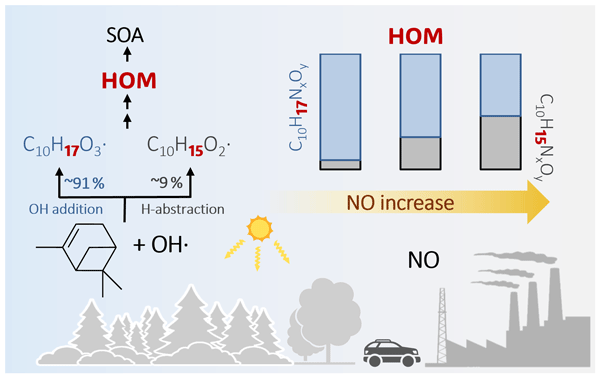
Abstract. Highly oxygenated organic molecules (HOM) are formed via autoxidation during ∙OH initiated oxidation of α-pinene. We investigated the importance of ∙OH addition and hydrogen (H)-abstraction in HOM formation from α-pinene photooxidation under varying NO concentrations. HOM-RO2∙ and subsequent termination products were detected by chemical ionization mass spectrometry. In the absence of NO, C10H17Ox∙ peroxy radicals and related products dominated the HOM spectrum, contributing >70 %. In contrast, the presence of NO induced substantial changes in HOM products, particularly the rapid formation of C10H15Ox∙-related HOM, such as C10H15NO8. This indicates an enhanced contribution from the H-abstraction pathway. The ratio of C10H15NOx to C10H17NOx also increased significantly from 0.34 to 0.84 as the initial loss rate of RO2∙ via reaction with NO rose from 0.18 s-1 to 1.7 s-1. Under high NO conditions (7.4 ppbv), major C10H15Ox∙-related closed-shell HOM (C10H14Ox and C10H15NOx) contributed ~30 % to the total HOM. Fuzzy c‑means clustering identified C10H15Ox∙-related HOM, thought to be second generation products via pinonaldehyde formation, as the cluster with the fastest formation rate, consistent with first-generation products. Subsequent pinonaldehyde oxidation experiments under comparable conditions showed significantly different product distributions. Formation of C10H15Ox∙-related HOM in α‑pinene experiments was more than two times higher than in the pinonaldehyde experiments despite the pinonaldehyde turnover being more than ten times lower. This study highlights the significance of the H-abstraction pathway for ∙OH initiated α-pinene photooxidation in the presence of NO, exploring detailed product distributions formed via this pathway.
Competing interests: At least one of the (co-)authors is a member of the editorial board of Atmospheric Chemistry and Physics. The peer-review process was guided by an independent editor, and the authors also have no other competing interests to declare.
Publisher's note: Copernicus Publications remains neutral with regard to jurisdictional claims made in the text, published maps, institutional affiliations, or any other geographical representation in this paper. While Copernicus Publications makes every effort to include appropriate place names, the final responsibility lies with the authors. Views expressed in the text are those of the authors and do not necessarily reflect the views of the publisher.-
Notice on discussion status
The requested preprint has a corresponding peer-reviewed final revised paper. You are encouraged to refer to the final revised version.
-
Preprint
(1243 KB)
-
Supplement
(1164 KB)
-
The requested preprint has a corresponding peer-reviewed final revised paper. You are encouraged to refer to the final revised version.
- Preprint
(1243 KB) - Metadata XML
-
Supplement
(1164 KB) - BibTeX
- EndNote
- Final revised paper


Journal article(s) based on this preprint
Interactive discussion
Status: closed
-
RC1: 'Comment on egusphere-2026-1083', Anonymous Referee #1, 27 Apr 2026
- AC1: 'Reply on RC1', Soeren Zorn, 25 Jun 2026
-
CC1: 'Comment on egusphere-2026-1083', Shunyu Yao, 27 Apr 2026
Major Comment:
- Scientific Significance
I want to raise some concerns regarding the key finding presented in this manuscript, as one major part of the result overlaps significantly with a 2022 Science paper. (Shen et al., 2022) In the previous publication, the effect of NO has already been discussed, and mechanisms have been thoroughly evaluated. This manuscript does show innovation through the no NO condition, which was not present in previous research, and the addition of pinonaldehyde control, which offered a concrete conclusion to the formation pathway. However, the overlap in key conclusions with prior work is substantial. I will list some overlapping parts in conclusion from both the manuscript and publication.
2022 Paper: “the formation rate of C10H15OX•-related HOM is mainly affected by the NO concentration.” “In this study, RO• are mainly formed by the alkoxy step (RO2• + NO ➔ RO• + NO2), whose reaction rate depends on the current NO concentration, while the ring opening is especially fast with a typical rate >106 s−1. As a consequence, the formation rate of C10H15OX-related HOM is mainly affected by the NO concentration.”
Manuscript conclusion: “C10H15Ox∙-related HOM exhibits a strong dependence on NO levels and can only be formed in significant amounts in the presence of NO.”
2022 Paper: “time series of C10H17OX•-related HOM are similar at low and high NO.”
Manuscript result: “The C10H17O7∙ peroxy radicals exhibit a rapid formation rate and a high molar yield in α-pinene photooxidation, and the formation is not strongly dependent on NO concentration.”
2022 Paper also made a time-based analysis to assess whether pinonaldehyde oxidation will result in C10H15OX formation and ruled out such possibility as pinonaldehyde takes longer to form than H-abstraction product. The manuscript used a similar approach by cluster definition and had the same conclusion.
Pinonaldehyde oxidation control was a novel approach which was not present in the 2022 paper. This control allows readers to directly compare yield of HOM produced from pinonaldehyde oxidation and H-abstraction, in which case H-abstraction had much better yield. This combined with cluster time difference provides stronger evidence of why C10H15Ox does not originate from pinonaldehyde oxidation. There are other novel approaches in this manuscript, such as using both amine-CIMS and nitrate-CIMS to capture a broader range of products, including less-oxygenated species.
The conclusion also addresses one important finding, stating that the contribution of the H-abstraction related products observed in this study is 70 % lower than that reported in the 2022 paper. Authors contributed this difference to inlet, stating that multi-scheme ionization inlet was used for this study, while the 2022 paper used Eisele type inlet. The lower value reported in this manuscript could be an interesting path to pursue, but no direct explanation was given.
The scientific significance would benefit from clearer positioning relative to prior work, particularly the 2022 study. The study applies largely novel experimental approaches to a system whose core conclusions are broadly consistent with prior literature. The scope of detection was widened, and additional control experiments have been done to enhance conclusions. I believe it’s an excellent addition to this field of study, but the conclusion does seem to repeat the older paper.
- Scientific Quality
The overall scientific quality is solid, as the hypothesis-experiment-interpretation logic does not show many shortcomings. There are two major comments I have.
Comment 1: Four-membered ring breakage with OH addition was mentioned in line 292, and the manuscript claimed the C10H17O7 unresponsiveness to NO change was due to this mechanism. There was no clear mechanism relationship explained in this manuscript and the paper referenced. A possible mechanistic interpretation is that the reaction rate of ring opening is fast with auto oxidation. This was partially mentioned in Lee et al., 2023., as the author stated the ring opening oxidation is a fast unimolecular reaction. This, however, is implicit, and the mechanistic linkage should be more explicitly developed within the manuscript.
Comment 2: The lack of explanation introduced another question. Both OH addition and H-abstraction followed by oxidation would form alkyl peroxy radical. However NO seems to only affect the formation of C10H15Ox, the product from H-abstraction. The author used unimolecular reaction rate as explanation, but it does not fully answer why the formation of alkyloxy radicals is selective through mechanistic interpretation. The referenced paper does show explicitly ring opening steps and reaction rate reported. I believe it would be more helpful to include such data in this manuscript.
Referring to the 2022 science publication, there were three types of ring opening structures with the same molecular composition (C10H15O3). I think the author should give more explanation on that park as well.
- Presentation Quality
The presentation quality of this manuscript is decent, with good paragraph structures, informative figures and mostly clear logical reasoning. I think figures can be improved with following comments:
Fig 1 should adopt structure-based illustrations to visualize free radical position and ring opening step.
Explanation between result and interpretation was compressed and information lacking. There are many cases where the author offered little to none detailed logic to obtain conclusions. This was briefly mentioned in the scientific quality part, but lack of explanation also hinders readers’ interpretation of results.
Many terms are overly abbreviated, which creates confusion. For example, reaction conditions can have a full name instead of labeled as AN or PN. Reactions can also be written out instead of assigned identifiers in the very beginning of the manuscript.
Minor comments:
In Line 230, “with low NO (Anslow), and with high NO (Anlo).” Second Anlo should be ANhigh.
In line 199, define ncps.
Line 369 “need longest time be formed.” Consider rephrasing into longest formation time.
Hyphenation inconsistency, as an example both low-NO and low NO appeared.
Citation: https://doi.org/10.5194/egusphere-2026-1083-CC1 - AC3: 'Reply on CC1', Soeren Zorn, 25 Jun 2026
- Scientific Significance
-
RC2: 'Comment on egusphere-2026-1083', Anonymous Referee #2, 05 May 2026
Summary
This study explores HOM formation via the H-abstraction pathway of alpha-pinene OH-oxidation by conducting photo-oxidation experiments of alpha-pinene and pinonaldehyde in the SAPHIR-STAR chamber at varying NO levels using H2O2 as an oxidant precursor. This work is novel as it explores another possible source for H-abstraction HOM-RO2 and subsequent products (i.e. pinonaldehyde OH-oxidation). Using two types of chemical ionization techniques and fuzzy c-means clustering, this study finds that fractional contribution of H-abstraction HOM-RO2 and subsequent termination products to total HOM increased with increasing NO.
It’s my determination that this work is both within the scope of this journal and the results from these experiments can prove beneficial to the field. However, I have some concerns about the analysis of the data, and I believe some deeper analysis could increase the novelty of the work. Therefore, I recommend reconsidering this manuscript after major revisions.
Major comments
1. Regarding the experimental setup, a focus is placed on the no NO case having no NO. However, is there no NO or is the level of NO below the limit of detection of your instrument? No LOD is given, and, as shown in the Shen 2022 paper, an off-gassing of HONO from chamber walls could delay a NO reaction with the initial H-abstraction RO2 (C10H15O2) resulting in a delay of isomerization and subsequent HOM-RO2 formation. I have a similar comment with the O3 measurement. What is the LOD and what is the O3 production during the “early reaction stage” (this can be estimated with some 0D box modeling, see below)?
2. The authors discussion identifying the “early reaction stage” is unclear to me since the reasoning is not quantitative. This could be limiting their analysis by comparing across the experiments at different extents of reaction. Because they measure many key compounds that affect RO2 and VOC fate, such as NO, HO2, OH, and O3, I recommend some RO2 parameterization and reaction modeling be included in this study to enhance their discussion of RO2 fate and FCM analysis by quantifying the “early reaction stage”.
A more robust decision could be made by choosing the OH exposure (or reaction time), at which the authors identify a range for “early reaction stage” via some 0D box modeling to quantify pinonaldehyde loss with respect to alpha-pinene loss and relative alpha-pinene loss with respect to O3 oxidation compared to OH oxidation By doing so, the authors will make the discussion in section 3 and statements such as in line 333 (“C10H15O3•, which cannot arise from ozonolysis of α-pinene since O3 formation is negligible in the early reaction stages”) more convincing.
Finally, because all relevant species are directly measured and calibrated, more quantitative parameters of the RO2 fate could be calculated instead of just estimating the ratio of RO2 reactivity towards NO or HO2.
3. I find discussion used to prove the C10H14Ox compounds come from alpha-pinene H-abstraction instead of pinonaldehyde OH addition unclear. The main issue I have is with the paragraph starting on line 405. First, it is unclear what exactly is being plotted in Figure 4b: the integrated ncps over the course of the experiments or the signal of each species recorded at a similar time. Either way, there is limited discussion on whether [OH]ss or VOC reactivity drives the difference in turnover between alpha-pinene and pinonaldehyde. The loss of closed shell species to OH oxidation could muddle the conclusions here and is not discussed at all. That being said, I think the evidence presented in the paragraph starting at line 429 is the most convincing and robust and should be highlighted more in this discussion and throughout the paper.
Minor comments
Throughout the figures (Fig 2a, Fig 4a), the NO measurements look stepwise. What was the frequency of data acquisition? Were these points interpolated?
Line 58: It is unclear what is meant by “the latter,” as the comparison in the previous paragraph was OH-addition vs OH-abstraction, but C10H17O3• don’t form via OH-abstraction.
Line 70: Vereecken et al. (2007) has only a limited discussion of the H-abstraction pathway of alpha-pinene oxidation and only specifically comments on later generation fragmentation products of the H-abstraction pathway in the atmosphere vs the chamber (see figures 3+4).
Line 181: Grammatical error.
Line 232: “Under no-NO” is formatted awkwardly surrounding the table.
Lines 243-249: There is a paragraph break contains multiple ideas. It’s a bit hard to follow clearly.
Line 309: “formula” instead of “formular”
Line 344: Are the KMD plots showing the integrated contribution over the course of the total “early reaction stage” or is it at the top limit?
Line 484: Why would the use of a different type of inlet effect the measurement sensitivity of just one class of HOM? Is there evidence to back up this hypothesis? The experimental conditions and chamber were different between the authors experiments and the Shen et al 2022 experiments. Could that be a reason differences are observed?
Citation: https://doi.org/10.5194/egusphere-2026-1083-RC2 - AC2: 'Reply on RC2', Soeren Zorn, 25 Jun 2026
Peer review completion


Interactive discussion
Status: closed
-
RC1: 'Comment on egusphere-2026-1083', Anonymous Referee #1, 27 Apr 2026
This manuscript examines the role of the OH-initiated H-abstraction pathway in HOM formation from α-pinene photooxidation across a systematic NO range using the SAPHIR-STAR chamber with complementary nitrate-CIMS and propylamine-CIMS. Fuzzy c-means (FCM) clustering is applied to discriminate product families by their temporal formation behavior, and parallel pinonaldehyde photooxidation experiments under matched OH/NO conditions are used to test whether secondary pinonaldehyde oxidation can account for the observed C10H15Ox-related HOM. The study makes a valuable contribution to an unresolved question in monoterpene oxidation chemistry: whether H-abstraction is a negligible curiosity or a substantive contributor to HOM and SOA under NO-rich conditions. The work extends Shen et al. (2022, Sci. Adv.) in three important ways: (i) by systematically varying NO rather than fixing it, (ii) by including a propylamine-CIMS to capture less-oxygenated products (O < 7), and (iii) by providing a direct pinonaldehyde control experiment. The experimental design is sound, the radical budget is well-constrained through a dedicated HO2 calibration via isoprene/MCM modelling, and the conclusions are generally defensible. However, a few comments should be addressed before publication.
Major Comments
- Vereecken et al. (2007) suggested that the cleanest diagnostic of H-abstraction is the detection of C10H15Ox species with fewer than five oxygen atoms, since these cannot plausibly arise from OH-addition autoxidation chains. The authors' amine-CIMS data show exactly this: C10H15NO4 is a major peak in ANhigh but is absent from PNhigh. Mechanistically, this implies a C10H15O3 peroxy radical precursor, which is the H-abstraction product from α-pinene, and it cannot arise from pinonaldehyde because pinonaldehyde H-abstraction produces C10H15O4 as the nascent RO2. This is the single most compelling piece of evidence in the manuscript and deserves to be highlighted in the abstract, elevated in Section 3.1, and emphasized in the conclusions. At present it is introduced late in Section 3.2 and treated as one observation among many.
- The authors exclude ozonolysis and pinonaldehyde oxidation (via the FCM timing and the PNhigh control). However, a mechanistic alternative receives little attention: alkoxy radicals derived from C10H17Ox + NO can undergo H-shifts, β-scissions, or HO2 loss steps that might produce 15-H skeletons. This is particularly relevant for the ~75% of four-membered-ring-retained C10H17O3 isomers whose fate under high NO is not extensively discussed here. The authors should (i) explicitly consider whether alkoxy-mediated conversion of C10H17Ox into C10H15Ox products can be quantitatively excluded and (ii) provide an estimate of the contribution this pathway could make given the measured alkoxy branching. The text on lines 262–268 acknowledges alkoxy propagation in the C10H17Ox family but does not connect it to the possibility of subsequent C10H15Ox formation.
- The current argument in Section 3.2 compares summed signals and distributions qualitatively between ANhigh and PNhigh. The authors are suggested to scale the PNhigh yields (per unit pinonaldehyde turnover) by the actual pinonaldehyde concentration and turnover in the ANhigh experiment. Whatever remains must be attributed to primary H-abstraction (or to another non-pinonaldehyde pathway). This arithmetic would transform a qualitative argument into a quantitative upper-bound statement and should be included. Relatedly, the amine-CIMS ratio for C10H15NOx between ANhigh and PNhigh (0.56×) is currently glossed over; because it is less than unity, it seemingly argues for a meaningful pinonaldehyde contribution to the less-oxygenated component, and this deserves an explicit inclusion.
- The inference of generation order from cluster peak times (160, 210, 290, 850 s for clusters 1–4) is central to the argument that C10H15NO7/NO8 are first-generation products and that pinonaldehyde (in cluster 3) cannot be their precursor. Several uncertainties are not addressed: (1) The four-cluster solution was selected from SSE, distortion, and silhouette curves (Figure S5), but robustness of the cluster-1 membership of C10H15NO7/NO9 under 3- and 5-cluster solutions should be tested. (2) Early-peaking behavior does not strictly imply first-generation status; species formed rapidly from short-lived precursors can also peak early. (3) The FCM run of 50 initializations per cluster number presumably yields a distribution of cluster assignments; the authors should report how stable cluster-1 membership is across these initializations.
- The H-abstraction contribution reported here (~30% of HOM under ANhigh) is described as "70% lower than" Shen et al. The proposed explanation (Eisele inlet vs. MION inlet detection efficiency for less-oxygenated C10H17Ox-related HOM) is highly speculative. The two studies also differ in chamber, residence time, NO range, VOC concentration, and OH source. A more detailed discussion would be helpful.
- HO2 varies by a factor of ~3 across conditions. Because HO₂· is a competing sink for both C10H17Ox and C10H15Ox and because the C10H16Ox family assignment explicitly invokes C10H15Ox + HO2, the varying HO2 should be more prominently incorporated into the interpretation of C10H15Ox-related HOM yields. It would be useful to present yields normalized by the relevant rate-weighted sink flux rather than by raw VOC turnover.
- The extrapolation to Hyytiälä and to megacity conditions should be more carefully framed. Hyytiälä daytime NO is typically well below 0.5 ppbv, whereas the dominant H-abstraction signal here is observed at 7.4 ppbv. A quantitative statement of how the H-abstraction HOM fraction scales between the lab ranges explored and atmospherically relevant NO levels would be valuable and would temper the implied relevance to low-NO boreal conditions.
Citation: https://doi.org/10.5194/egusphere-2026-1083-RC1 - AC1: 'Reply on RC1', Soeren Zorn, 25 Jun 2026
-
CC1: 'Comment on egusphere-2026-1083', Shunyu Yao, 27 Apr 2026
Major Comment:
- Scientific Significance
I want to raise some concerns regarding the key finding presented in this manuscript, as one major part of the result overlaps significantly with a 2022 Science paper. (Shen et al., 2022) In the previous publication, the effect of NO has already been discussed, and mechanisms have been thoroughly evaluated. This manuscript does show innovation through the no NO condition, which was not present in previous research, and the addition of pinonaldehyde control, which offered a concrete conclusion to the formation pathway. However, the overlap in key conclusions with prior work is substantial. I will list some overlapping parts in conclusion from both the manuscript and publication.
2022 Paper: “the formation rate of C10H15OX•-related HOM is mainly affected by the NO concentration.” “In this study, RO• are mainly formed by the alkoxy step (RO2• + NO ➔ RO• + NO2), whose reaction rate depends on the current NO concentration, while the ring opening is especially fast with a typical rate >106 s−1. As a consequence, the formation rate of C10H15OX-related HOM is mainly affected by the NO concentration.”
Manuscript conclusion: “C10H15Ox∙-related HOM exhibits a strong dependence on NO levels and can only be formed in significant amounts in the presence of NO.”
2022 Paper: “time series of C10H17OX•-related HOM are similar at low and high NO.”
Manuscript result: “The C10H17O7∙ peroxy radicals exhibit a rapid formation rate and a high molar yield in α-pinene photooxidation, and the formation is not strongly dependent on NO concentration.”
2022 Paper also made a time-based analysis to assess whether pinonaldehyde oxidation will result in C10H15OX formation and ruled out such possibility as pinonaldehyde takes longer to form than H-abstraction product. The manuscript used a similar approach by cluster definition and had the same conclusion.
Pinonaldehyde oxidation control was a novel approach which was not present in the 2022 paper. This control allows readers to directly compare yield of HOM produced from pinonaldehyde oxidation and H-abstraction, in which case H-abstraction had much better yield. This combined with cluster time difference provides stronger evidence of why C10H15Ox does not originate from pinonaldehyde oxidation. There are other novel approaches in this manuscript, such as using both amine-CIMS and nitrate-CIMS to capture a broader range of products, including less-oxygenated species.
The conclusion also addresses one important finding, stating that the contribution of the H-abstraction related products observed in this study is 70 % lower than that reported in the 2022 paper. Authors contributed this difference to inlet, stating that multi-scheme ionization inlet was used for this study, while the 2022 paper used Eisele type inlet. The lower value reported in this manuscript could be an interesting path to pursue, but no direct explanation was given.
The scientific significance would benefit from clearer positioning relative to prior work, particularly the 2022 study. The study applies largely novel experimental approaches to a system whose core conclusions are broadly consistent with prior literature. The scope of detection was widened, and additional control experiments have been done to enhance conclusions. I believe it’s an excellent addition to this field of study, but the conclusion does seem to repeat the older paper.
- Scientific Quality
The overall scientific quality is solid, as the hypothesis-experiment-interpretation logic does not show many shortcomings. There are two major comments I have.
Comment 1: Four-membered ring breakage with OH addition was mentioned in line 292, and the manuscript claimed the C10H17O7 unresponsiveness to NO change was due to this mechanism. There was no clear mechanism relationship explained in this manuscript and the paper referenced. A possible mechanistic interpretation is that the reaction rate of ring opening is fast with auto oxidation. This was partially mentioned in Lee et al., 2023., as the author stated the ring opening oxidation is a fast unimolecular reaction. This, however, is implicit, and the mechanistic linkage should be more explicitly developed within the manuscript.
Comment 2: The lack of explanation introduced another question. Both OH addition and H-abstraction followed by oxidation would form alkyl peroxy radical. However NO seems to only affect the formation of C10H15Ox, the product from H-abstraction. The author used unimolecular reaction rate as explanation, but it does not fully answer why the formation of alkyloxy radicals is selective through mechanistic interpretation. The referenced paper does show explicitly ring opening steps and reaction rate reported. I believe it would be more helpful to include such data in this manuscript.
Referring to the 2022 science publication, there were three types of ring opening structures with the same molecular composition (C10H15O3). I think the author should give more explanation on that park as well.
- Presentation Quality
The presentation quality of this manuscript is decent, with good paragraph structures, informative figures and mostly clear logical reasoning. I think figures can be improved with following comments:
Fig 1 should adopt structure-based illustrations to visualize free radical position and ring opening step.
Explanation between result and interpretation was compressed and information lacking. There are many cases where the author offered little to none detailed logic to obtain conclusions. This was briefly mentioned in the scientific quality part, but lack of explanation also hinders readers’ interpretation of results.
Many terms are overly abbreviated, which creates confusion. For example, reaction conditions can have a full name instead of labeled as AN or PN. Reactions can also be written out instead of assigned identifiers in the very beginning of the manuscript.
Minor comments:
In Line 230, “with low NO (Anslow), and with high NO (Anlo).” Second Anlo should be ANhigh.
In line 199, define ncps.
Line 369 “need longest time be formed.” Consider rephrasing into longest formation time.
Hyphenation inconsistency, as an example both low-NO and low NO appeared.
Citation: https://doi.org/10.5194/egusphere-2026-1083-CC1 - AC3: 'Reply on CC1', Soeren Zorn, 25 Jun 2026
- Scientific Significance
-
RC2: 'Comment on egusphere-2026-1083', Anonymous Referee #2, 05 May 2026
Summary
This study explores HOM formation via the H-abstraction pathway of alpha-pinene OH-oxidation by conducting photo-oxidation experiments of alpha-pinene and pinonaldehyde in the SAPHIR-STAR chamber at varying NO levels using H2O2 as an oxidant precursor. This work is novel as it explores another possible source for H-abstraction HOM-RO2 and subsequent products (i.e. pinonaldehyde OH-oxidation). Using two types of chemical ionization techniques and fuzzy c-means clustering, this study finds that fractional contribution of H-abstraction HOM-RO2 and subsequent termination products to total HOM increased with increasing NO.
It’s my determination that this work is both within the scope of this journal and the results from these experiments can prove beneficial to the field. However, I have some concerns about the analysis of the data, and I believe some deeper analysis could increase the novelty of the work. Therefore, I recommend reconsidering this manuscript after major revisions.
Major comments
1. Regarding the experimental setup, a focus is placed on the no NO case having no NO. However, is there no NO or is the level of NO below the limit of detection of your instrument? No LOD is given, and, as shown in the Shen 2022 paper, an off-gassing of HONO from chamber walls could delay a NO reaction with the initial H-abstraction RO2 (C10H15O2) resulting in a delay of isomerization and subsequent HOM-RO2 formation. I have a similar comment with the O3 measurement. What is the LOD and what is the O3 production during the “early reaction stage” (this can be estimated with some 0D box modeling, see below)?
2. The authors discussion identifying the “early reaction stage” is unclear to me since the reasoning is not quantitative. This could be limiting their analysis by comparing across the experiments at different extents of reaction. Because they measure many key compounds that affect RO2 and VOC fate, such as NO, HO2, OH, and O3, I recommend some RO2 parameterization and reaction modeling be included in this study to enhance their discussion of RO2 fate and FCM analysis by quantifying the “early reaction stage”.
A more robust decision could be made by choosing the OH exposure (or reaction time), at which the authors identify a range for “early reaction stage” via some 0D box modeling to quantify pinonaldehyde loss with respect to alpha-pinene loss and relative alpha-pinene loss with respect to O3 oxidation compared to OH oxidation By doing so, the authors will make the discussion in section 3 and statements such as in line 333 (“C10H15O3•, which cannot arise from ozonolysis of α-pinene since O3 formation is negligible in the early reaction stages”) more convincing.
Finally, because all relevant species are directly measured and calibrated, more quantitative parameters of the RO2 fate could be calculated instead of just estimating the ratio of RO2 reactivity towards NO or HO2.
3. I find discussion used to prove the C10H14Ox compounds come from alpha-pinene H-abstraction instead of pinonaldehyde OH addition unclear. The main issue I have is with the paragraph starting on line 405. First, it is unclear what exactly is being plotted in Figure 4b: the integrated ncps over the course of the experiments or the signal of each species recorded at a similar time. Either way, there is limited discussion on whether [OH]ss or VOC reactivity drives the difference in turnover between alpha-pinene and pinonaldehyde. The loss of closed shell species to OH oxidation could muddle the conclusions here and is not discussed at all. That being said, I think the evidence presented in the paragraph starting at line 429 is the most convincing and robust and should be highlighted more in this discussion and throughout the paper.
Minor comments
Throughout the figures (Fig 2a, Fig 4a), the NO measurements look stepwise. What was the frequency of data acquisition? Were these points interpolated?
Line 58: It is unclear what is meant by “the latter,” as the comparison in the previous paragraph was OH-addition vs OH-abstraction, but C10H17O3• don’t form via OH-abstraction.
Line 70: Vereecken et al. (2007) has only a limited discussion of the H-abstraction pathway of alpha-pinene oxidation and only specifically comments on later generation fragmentation products of the H-abstraction pathway in the atmosphere vs the chamber (see figures 3+4).
Line 181: Grammatical error.
Line 232: “Under no-NO” is formatted awkwardly surrounding the table.
Lines 243-249: There is a paragraph break contains multiple ideas. It’s a bit hard to follow clearly.
Line 309: “formula” instead of “formular”
Line 344: Are the KMD plots showing the integrated contribution over the course of the total “early reaction stage” or is it at the top limit?
Line 484: Why would the use of a different type of inlet effect the measurement sensitivity of just one class of HOM? Is there evidence to back up this hypothesis? The experimental conditions and chamber were different between the authors experiments and the Shen et al 2022 experiments. Could that be a reason differences are observed?
Citation: https://doi.org/10.5194/egusphere-2026-1083-RC2 - AC2: 'Reply on RC2', Soeren Zorn, 25 Jun 2026
Peer review completion
Journal article(s) based on this preprint
Viewed
| HTML | XML | Total | Supplement | BibTeX | EndNote | |
|---|---|---|---|---|---|---|
| 629 | 267 | 65 | 961 | 106 | 52 | 56 |
- HTML: 629
- PDF: 267
- XML: 65
- Total: 961
- Supplement: 106
- BibTeX: 52
- EndNote: 56
Viewed (geographical distribution)
| Country | # | Views | % |
|---|
| Total: | 0 |
| HTML: | 0 |
| PDF: | 0 |
| XML: | 0 |
- 1
Hongru Shen

Sungah Kang
Rongrong Wu
Yarê Baker
Quanfu He
Annika Zanders
Mathias Bachner
Douglas R. Worsnop
Thorsten Hohaus
Thomas F. Mentel
The requested preprint has a corresponding peer-reviewed final revised paper. You are encouraged to refer to the final revised version.
- Preprint
(1243 KB) - Metadata XML
-
Supplement
(1164 KB) - BibTeX
- EndNote
- Final revised paper
This manuscript examines the role of the OH-initiated H-abstraction pathway in HOM formation from α-pinene photooxidation across a systematic NO range using the SAPHIR-STAR chamber with complementary nitrate-CIMS and propylamine-CIMS. Fuzzy c-means (FCM) clustering is applied to discriminate product families by their temporal formation behavior, and parallel pinonaldehyde photooxidation experiments under matched OH/NO conditions are used to test whether secondary pinonaldehyde oxidation can account for the observed C10H15Ox-related HOM. The study makes a valuable contribution to an unresolved question in monoterpene oxidation chemistry: whether H-abstraction is a negligible curiosity or a substantive contributor to HOM and SOA under NO-rich conditions. The work extends Shen et al. (2022, Sci. Adv.) in three important ways: (i) by systematically varying NO rather than fixing it, (ii) by including a propylamine-CIMS to capture less-oxygenated products (O < 7), and (iii) by providing a direct pinonaldehyde control experiment. The experimental design is sound, the radical budget is well-constrained through a dedicated HO2 calibration via isoprene/MCM modelling, and the conclusions are generally defensible. However, a few comments should be addressed before publication.
Major Comments