
the Creative Commons Attribution 4.0 License.
the Creative Commons Attribution 4.0 License.
 | 23 Mar 2026
Brief communication: Temperature-driven shrinkage of a disappearing Himalayan glacier
Abstract. Using drone and GNSS surveys, we updated the geodetic mass balance of Glacier AX010. This glacier has the longest observational record in the Nepal Himalayas, showing accelerating mass loss rates of –1.3 m w.e. a–1 over the last 15 years (2008–2023). We reconstructed 80 years of annual mass balance using a mass-balance model forced by calibrated reanalysis data. While rising temperatures drive shrinkage, changes in precipitation have neither accelerated nor mitigated mass loss. The glacier began losing mass in the early 1970s, accelerated in the early 2000s, and is projected to disappear within one to two decades.
-
Notice on discussion status
The requested preprint has a corresponding peer-reviewed final revised paper. You are encouraged to refer to the final revised version.
-
Preprint
(5042 KB)
-
Supplement
(24614 KB)
-
The requested preprint has a corresponding peer-reviewed final revised paper. You are encouraged to refer to the final revised version.
- Preprint
(5042 KB) - Metadata XML
-
Supplement
(24614 KB) - BibTeX
- EndNote
- Final revised paper


Journal article(s) based on this preprint
Interactive discussion
Status: closed
-
RC1: 'Comment on egusphere-2026-1078', Anonymous Referee #1, 13 May 2026
In this study, Koji Fujita and Rijan B. Kayastha reconstruct the evolution of AX000 and AX010, two small glaciers of the Nepal Himalaya. This contribution is of great importance given that AX010 is among the first Himalayan glaciers that were observed with modern methods in the late 1970s. This brief communication is a concise article that efficiently convey the main message about the importance of temperature in driving the mass loss of AX000 and AX010. The figures are of very high quality and the text is very clear. I recommend to publish the paper after some minor revisions.
General comments:
- In some places, I think that the authors could better acknowledge the glaciology research conducted in the region. This is detailed below.
- It is difficult to keep track of all the geodetic mass balances. Especially, some results originate from previous studies and are not easily available (Fujita and Nuimura, 2011; Nuimura et al., 2012). I suggest to add a dedicated section in the data and method about these previous estimates, and to distribute these data together with the 2008 and 2023 elevation data.
- The approach to take ERA5 temperature from pressure level instead of surface data of the grid point is relevant (L99-101). The drawback of this method is that the surface variables are then likely not physically consistent. This is probably the case for the relative humidity at least. Then the debiasing of ERA5 variables based on Trakarding AWS injects another level of inconsistency, because variables are debiased one by one (L146-148). I don’t see any way around, but the authors should at least acknowledge this issue.
- Most numbers come with too many digits in the text and tables (e.g. L128 the error should be 0.04 m w.e. a-1); please check carefully everywhere
- Some references to small glaciers could be added (Huss and Fischer, 2016; Parkes and Marzeion, 2018). I understand that this contribution is a “Brief communication” with associated space constraints, so my request is only optional.
Specific comments:
L1-2: “longest” should be change to “oldest” as observations are not continuous for AX010
L2: “accelerating” is not matching the number provided in the sentence, which is the mass loss rate for the latest period. I suggest removing “accelerating” or otherwise calculate the acceleration in m w.e. a-1/decade.
L12: I can’t find the mention of a “tipping point” in Beniston et al. (2018). Consider rephrasing or citing another reference.
L18-20: this sentence is ambiguous, as it is not clear if it refers to the number of series or to the mass balance trends. Consider rephrasing.
L52: provide the duration of the GNSS record
L67: why is the density assumption different from the most commonly used (Huss, 2013)?
L75-77: I did not find a direct comparison of the ice radar measurements with the bed reconstructions. It would be good the add the three ice radar points on the closest cross section on figure S11
L82: how is the albedo evolving in the model?
L96: missing details about the 1978 hypsometry (and associated DEM of the glacier surface)
L114-115: I did not understand whether there would be one or multiple values for r_P at the first reading, because I was not expecting r_P to change through time. I suggest to formulate the method more explicitly, and write that you calculate five different r_P (Table S4)
L120-125: I find the uncertainties on the GNSS-UAV DEM difference a bit optimistic, especially given that there is a systematic offset between the GNSS and UAV for both study sites (fig. 1b).
L120-135: I am missing the actual values of the geodetic mass balance in the text and/or in a table in the main article. I would suggest swapping table 1 and table S4/S6.
L129: what are the “sparse survey points”?
L136: references about local meteorological measurements and comparison with ERA5 could be relevant here (Khadka et al., 2022; Matthews et al., 2020)
183-184: a reference to Florentine et al. (2023) could be relevant here
L205-209: the authors could update the references cited here because a lot of work has been produced on the this topic in the recent years (Jouberton et al., 2022)
L217-219: compare with the results of (Khadka et al., 2024)
L243: “longest” -> “oldest”
L253-254: it would be clearer to write the name of Trambau Glacier explicitely
Fig. S6b -> relative humidity should be corrected for the pressure difference, no?
References cited in this review
Beniston, M., Farinotti, D., Stoffel, M., Andreassen, L. M., Coppola, E., Eckert, N., Fantini, A., Giacona, F., Hauck, C., Huss, M., Huwald, H., Lehning, M., López-Moreno, J.-I., Magnusson, J., Marty, C., Morán-Tejéda, E., Morin, S., Naaim, M., Provenzale, A., Rabatel, A., Six, D., Stötter, J., Strasser, U., Terzago, S., and Vincent, C.: The European mountain cryosphere: a review of its current state, trends, and future challenges, The Cryosphere, 12, 759–794, https://doi.org/10.5194/tc-12-759-2018, 2018.
Florentine, C., Sass, L., McNeil, C., Baker, E., and O’Neel, S.: How to handle glacier area change in geodetic mass balance, Journal of Glaciology, 69, 2169–2175, https://doi.org/10.1017/jog.2023.86, 2023.
Fujita, K. and Nuimura, T.: Spatially heterogeneous wastage of Himalayan glaciers, Proceedings of the National Academy of Sciences, 108, 14011–14014, https://doi.org/10.1073/pnas.1106242108, 2011.
Huss, M.: Density assumptions for converting geodetic glacier volume change to mass change, The Cryosphere, 7, 877–887, https://doi.org/10.5194/tc-7-877-2013, 2013.
Huss, M. and Fischer, M.: Sensitivity of Very Small Glaciers in the Swiss Alps to Future Climate Change, Frontiers in Earth Science, 4, 34, https://doi.org/10.3389/feart.2016.00034, 2016.
Jouberton, A., Shaw, T. E., Miles, E., McCarthy, M., Fugger, S., Ren, S., Dehecq, A., Yang, W., and Pellicciotti, F.: Warming-induced monsoon precipitation phase change intensifies glacier mass loss in the southeastern Tibetan Plateau, Proceedings of the National Academy of Sciences, 119, e2109796119, https://doi.org/10.1073/pnas.2109796119, 2022.
Khadka, A., Wagnon, P., Brun, F., Shrestha, D., Lejeune, Y., and Arnaud, Y.: Evaluation of ERA5-Land and HARv2 Reanalysis Data at High Elevation in the Upper Dudh Koshi Basin (Everest Region, Nepal), Journal of Applied Meteorology and Climatology, 61, 931–954, https://doi.org/10.1175/JAMC-D-21-0091.1, 2022.
Khadka, A., Brun, F., Wagnon, P., Shrestha, D., and Sherpa, T. C.: Surface energy and mass balance of Mera Glacier (Nepal, Central Himalaya) and their sensitivity to temperature and precipitation, Journal of Glaciology, 1–22, https://doi.org/10.1017/jog.2024.42, 2024.
Matthews, T., Perry, L. B., Koch, I., Aryal, D., Khadka, A., Shrestha, D., Abernathy, K., Elmore, A. C., Seimon, A., Tait, A., Elvin, S., Tuladhar, S., Baidya, S. K., Potocki, M., Birkel, S. D., Kang, S., Sherpa, T. C., Gajurel, A., and Mayewski, P. A.: Going to Extremes: Installing the World’s Highest Weather Stations on Mount Everest, Bulletin of the American Meteorological Society, 101, E1870–E1890, https://doi.org/10.1175/BAMS-D-19-0198.1, 2020.
Nuimura, T., Fujita, K., Yamaguchi, S., and Sharma, R. R.: Elevation changes of glaciers revealed by multitemporal digital elevation models calibrated by GPS survey in the Khumbu region, Nepal Himalaya, 1992-2008, Journal of Glaciology, 58, 648–656, https://doi.org/10.3189/2012JoG11J061, 2012.
Parkes, D. and Marzeion, B.: Twentieth-century contribution to sea-level rise from uncharted glaciers, Nature, 563, 551–554, https://doi.org/10.1038/s41586-018-0687-9, 2018.
Citation: https://doi.org/10.5194/egusphere-2026-1078-RC1 - AC1: 'Reply on RC1', Koji Fujita, 15 Jun 2026
-
RC2: 'Comment on egusphere-2026-1078', Anonymous Referee #2, 20 May 2026
The manuscript used a set of recent and past data consisting of ice thickness observation, GNSS points, drone photogrammetry survey, and other datasets to update the mass balance record of two small glaciers in the Nepal Himalaya. Based on these observations, in combination with ERA5 reanalysis and nearby meteorological observations, the authors simulate the mass balance for a long period from 1940-2023 using their established glacier mass balance model. The main aim of the manuscript is to estimate and update the long-term mass balance record, understand how climate change has influenced glacier loss over the past decades, and how the glaciers will evolve in future decades. They conclude that both glaciers are losing mass at higher rates, particularly after the 1970s and in recent years, and that the glaciers may lose their remaining ice volume by 2050. The results support these conclusions.
Overall, the manuscript is well written, with good and informative figures and tables (including those in the supplementary material). Method-wise, the work employed all established methods with uncertainly/calibration analysis for reliability. I do not have any major concern about the method or content of the manuscript, except several minor issues regarding text phrasing, citation, etc., which I have highlighted below.
Introduction
The authors very nicely framed the introduction section touching almost every aspect that the title expresses, except for the role of climate change or warming in glacier shrinkage. In the second paragraph, the authors briefly review the existing records and understanding of glacier shrinkage of the Himalayan region and also particularly for the Nepal area, where the current work is conducted. In my understanding, at the end of this para, a brief sentence of how climate has altered the mass loss / shrinkage of these glaciers over the past decades, would make the paragraph/part complete, considering that ‘climate change/warming’ is the main reason of glacier shrinkage in the region, which the authors have also highlighted in their title.
Line 27: Please add ‘records’ (or similar word) after ‘mass balance’ as ‘..update the mass balance of an iconic glacier..’ sounds a bit incomplete.
Line 28-29: This sentence contains ‘mas balance’ word three times; the authors might want to take care of this in a different way.
Line 45-46: Abbreviation of DEM is already done before in Line 23-24.
I would also expand GNSS term somewhere it appears first.
Line 65-66: This sentence is almost the same as it is in Line 47-48. Can be merged or removed from one place.
Line 67-69: here, at the end of this sentence, I would cite a couple of studies who used similar methods for uncertainty analysis as error estimation is an important part of the mass balance calculation, so that readers can relate better or for their future reference. Within the authors existing reference list, Maurer et al., 2019; Shean et al., 2020 are also good examples of such studies.
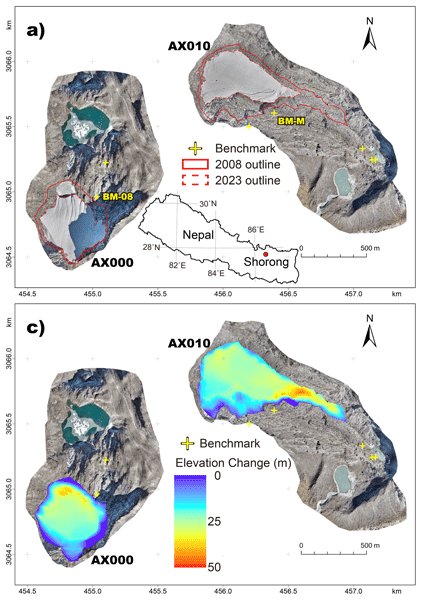
Line 130-131: Please cite the figure number (Fig. 1d) at the end of this sentence for reference. Also, instead of ‘show glacier changes...’, I would write it as ‘show mass loss/balance changes...’. In my understanding, mass balance/loss is more appropriate here compared to ‘glacier change’.
Line 161: The authors may want to use ‘glacier-wide’ instead of glacier-scale.
Line 193-195: I do not see any figure or table reference to see the PDD changes. Table S8? Please add a figure/table reference at the end of the sentence.
Line 238: Isn't here the ice thickness unit should be in just meter, not in m w.e.?
Figure 1: Inside texts are very small to read, maybe increase the font size or the figure sizes. In B panel, legend markers are also very small to read. I do not see any elevation information of the glaciers here, which would have been helpful to identify the ablation/accumulation areas of the glaciers, thus, better interpreting the spatial mass loss patterns. Maybe adding elevation contours would be helpful. This came to my mind when I was wondering about the small size of the glaciers, if they have any distinguishable ablation or accumulation zones.
Citation: https://doi.org/10.5194/egusphere-2026-1078-RC2 - AC2: 'Reply on RC2', Koji Fujita, 15 Jun 2026
Peer review completion


Interactive discussion
Status: closed
-
RC1: 'Comment on egusphere-2026-1078', Anonymous Referee #1, 13 May 2026
In this study, Koji Fujita and Rijan B. Kayastha reconstruct the evolution of AX000 and AX010, two small glaciers of the Nepal Himalaya. This contribution is of great importance given that AX010 is among the first Himalayan glaciers that were observed with modern methods in the late 1970s. This brief communication is a concise article that efficiently convey the main message about the importance of temperature in driving the mass loss of AX000 and AX010. The figures are of very high quality and the text is very clear. I recommend to publish the paper after some minor revisions.
General comments:
- In some places, I think that the authors could better acknowledge the glaciology research conducted in the region. This is detailed below.
- It is difficult to keep track of all the geodetic mass balances. Especially, some results originate from previous studies and are not easily available (Fujita and Nuimura, 2011; Nuimura et al., 2012). I suggest to add a dedicated section in the data and method about these previous estimates, and to distribute these data together with the 2008 and 2023 elevation data.
- The approach to take ERA5 temperature from pressure level instead of surface data of the grid point is relevant (L99-101). The drawback of this method is that the surface variables are then likely not physically consistent. This is probably the case for the relative humidity at least. Then the debiasing of ERA5 variables based on Trakarding AWS injects another level of inconsistency, because variables are debiased one by one (L146-148). I don’t see any way around, but the authors should at least acknowledge this issue.
- Most numbers come with too many digits in the text and tables (e.g. L128 the error should be 0.04 m w.e. a-1); please check carefully everywhere
- Some references to small glaciers could be added (Huss and Fischer, 2016; Parkes and Marzeion, 2018). I understand that this contribution is a “Brief communication” with associated space constraints, so my request is only optional.
Specific comments:
L1-2: “longest” should be change to “oldest” as observations are not continuous for AX010
L2: “accelerating” is not matching the number provided in the sentence, which is the mass loss rate for the latest period. I suggest removing “accelerating” or otherwise calculate the acceleration in m w.e. a-1/decade.
L12: I can’t find the mention of a “tipping point” in Beniston et al. (2018). Consider rephrasing or citing another reference.
L18-20: this sentence is ambiguous, as it is not clear if it refers to the number of series or to the mass balance trends. Consider rephrasing.
L52: provide the duration of the GNSS record
L67: why is the density assumption different from the most commonly used (Huss, 2013)?
L75-77: I did not find a direct comparison of the ice radar measurements with the bed reconstructions. It would be good the add the three ice radar points on the closest cross section on figure S11
L82: how is the albedo evolving in the model?
L96: missing details about the 1978 hypsometry (and associated DEM of the glacier surface)
L114-115: I did not understand whether there would be one or multiple values for r_P at the first reading, because I was not expecting r_P to change through time. I suggest to formulate the method more explicitly, and write that you calculate five different r_P (Table S4)
L120-125: I find the uncertainties on the GNSS-UAV DEM difference a bit optimistic, especially given that there is a systematic offset between the GNSS and UAV for both study sites (fig. 1b).
L120-135: I am missing the actual values of the geodetic mass balance in the text and/or in a table in the main article. I would suggest swapping table 1 and table S4/S6.
L129: what are the “sparse survey points”?
L136: references about local meteorological measurements and comparison with ERA5 could be relevant here (Khadka et al., 2022; Matthews et al., 2020)
183-184: a reference to Florentine et al. (2023) could be relevant here
L205-209: the authors could update the references cited here because a lot of work has been produced on the this topic in the recent years (Jouberton et al., 2022)
L217-219: compare with the results of (Khadka et al., 2024)
L243: “longest” -> “oldest”
L253-254: it would be clearer to write the name of Trambau Glacier explicitely
Fig. S6b -> relative humidity should be corrected for the pressure difference, no?
References cited in this review
Beniston, M., Farinotti, D., Stoffel, M., Andreassen, L. M., Coppola, E., Eckert, N., Fantini, A., Giacona, F., Hauck, C., Huss, M., Huwald, H., Lehning, M., López-Moreno, J.-I., Magnusson, J., Marty, C., Morán-Tejéda, E., Morin, S., Naaim, M., Provenzale, A., Rabatel, A., Six, D., Stötter, J., Strasser, U., Terzago, S., and Vincent, C.: The European mountain cryosphere: a review of its current state, trends, and future challenges, The Cryosphere, 12, 759–794, https://doi.org/10.5194/tc-12-759-2018, 2018.
Florentine, C., Sass, L., McNeil, C., Baker, E., and O’Neel, S.: How to handle glacier area change in geodetic mass balance, Journal of Glaciology, 69, 2169–2175, https://doi.org/10.1017/jog.2023.86, 2023.
Fujita, K. and Nuimura, T.: Spatially heterogeneous wastage of Himalayan glaciers, Proceedings of the National Academy of Sciences, 108, 14011–14014, https://doi.org/10.1073/pnas.1106242108, 2011.
Huss, M.: Density assumptions for converting geodetic glacier volume change to mass change, The Cryosphere, 7, 877–887, https://doi.org/10.5194/tc-7-877-2013, 2013.
Huss, M. and Fischer, M.: Sensitivity of Very Small Glaciers in the Swiss Alps to Future Climate Change, Frontiers in Earth Science, 4, 34, https://doi.org/10.3389/feart.2016.00034, 2016.
Jouberton, A., Shaw, T. E., Miles, E., McCarthy, M., Fugger, S., Ren, S., Dehecq, A., Yang, W., and Pellicciotti, F.: Warming-induced monsoon precipitation phase change intensifies glacier mass loss in the southeastern Tibetan Plateau, Proceedings of the National Academy of Sciences, 119, e2109796119, https://doi.org/10.1073/pnas.2109796119, 2022.
Khadka, A., Wagnon, P., Brun, F., Shrestha, D., Lejeune, Y., and Arnaud, Y.: Evaluation of ERA5-Land and HARv2 Reanalysis Data at High Elevation in the Upper Dudh Koshi Basin (Everest Region, Nepal), Journal of Applied Meteorology and Climatology, 61, 931–954, https://doi.org/10.1175/JAMC-D-21-0091.1, 2022.
Khadka, A., Brun, F., Wagnon, P., Shrestha, D., and Sherpa, T. C.: Surface energy and mass balance of Mera Glacier (Nepal, Central Himalaya) and their sensitivity to temperature and precipitation, Journal of Glaciology, 1–22, https://doi.org/10.1017/jog.2024.42, 2024.
Matthews, T., Perry, L. B., Koch, I., Aryal, D., Khadka, A., Shrestha, D., Abernathy, K., Elmore, A. C., Seimon, A., Tait, A., Elvin, S., Tuladhar, S., Baidya, S. K., Potocki, M., Birkel, S. D., Kang, S., Sherpa, T. C., Gajurel, A., and Mayewski, P. A.: Going to Extremes: Installing the World’s Highest Weather Stations on Mount Everest, Bulletin of the American Meteorological Society, 101, E1870–E1890, https://doi.org/10.1175/BAMS-D-19-0198.1, 2020.
Nuimura, T., Fujita, K., Yamaguchi, S., and Sharma, R. R.: Elevation changes of glaciers revealed by multitemporal digital elevation models calibrated by GPS survey in the Khumbu region, Nepal Himalaya, 1992-2008, Journal of Glaciology, 58, 648–656, https://doi.org/10.3189/2012JoG11J061, 2012.
Parkes, D. and Marzeion, B.: Twentieth-century contribution to sea-level rise from uncharted glaciers, Nature, 563, 551–554, https://doi.org/10.1038/s41586-018-0687-9, 2018.
Citation: https://doi.org/10.5194/egusphere-2026-1078-RC1 - AC1: 'Reply on RC1', Koji Fujita, 15 Jun 2026
-
RC2: 'Comment on egusphere-2026-1078', Anonymous Referee #2, 20 May 2026
The manuscript used a set of recent and past data consisting of ice thickness observation, GNSS points, drone photogrammetry survey, and other datasets to update the mass balance record of two small glaciers in the Nepal Himalaya. Based on these observations, in combination with ERA5 reanalysis and nearby meteorological observations, the authors simulate the mass balance for a long period from 1940-2023 using their established glacier mass balance model. The main aim of the manuscript is to estimate and update the long-term mass balance record, understand how climate change has influenced glacier loss over the past decades, and how the glaciers will evolve in future decades. They conclude that both glaciers are losing mass at higher rates, particularly after the 1970s and in recent years, and that the glaciers may lose their remaining ice volume by 2050. The results support these conclusions.
Overall, the manuscript is well written, with good and informative figures and tables (including those in the supplementary material). Method-wise, the work employed all established methods with uncertainly/calibration analysis for reliability. I do not have any major concern about the method or content of the manuscript, except several minor issues regarding text phrasing, citation, etc., which I have highlighted below.
Introduction
The authors very nicely framed the introduction section touching almost every aspect that the title expresses, except for the role of climate change or warming in glacier shrinkage. In the second paragraph, the authors briefly review the existing records and understanding of glacier shrinkage of the Himalayan region and also particularly for the Nepal area, where the current work is conducted. In my understanding, at the end of this para, a brief sentence of how climate has altered the mass loss / shrinkage of these glaciers over the past decades, would make the paragraph/part complete, considering that ‘climate change/warming’ is the main reason of glacier shrinkage in the region, which the authors have also highlighted in their title.
Line 27: Please add ‘records’ (or similar word) after ‘mass balance’ as ‘..update the mass balance of an iconic glacier..’ sounds a bit incomplete.
Line 28-29: This sentence contains ‘mas balance’ word three times; the authors might want to take care of this in a different way.
Line 45-46: Abbreviation of DEM is already done before in Line 23-24.
I would also expand GNSS term somewhere it appears first.
Line 65-66: This sentence is almost the same as it is in Line 47-48. Can be merged or removed from one place.
Line 67-69: here, at the end of this sentence, I would cite a couple of studies who used similar methods for uncertainty analysis as error estimation is an important part of the mass balance calculation, so that readers can relate better or for their future reference. Within the authors existing reference list, Maurer et al., 2019; Shean et al., 2020 are also good examples of such studies.
Line 130-131: Please cite the figure number (Fig. 1d) at the end of this sentence for reference. Also, instead of ‘show glacier changes...’, I would write it as ‘show mass loss/balance changes...’. In my understanding, mass balance/loss is more appropriate here compared to ‘glacier change’.
Line 161: The authors may want to use ‘glacier-wide’ instead of glacier-scale.
Line 193-195: I do not see any figure or table reference to see the PDD changes. Table S8? Please add a figure/table reference at the end of the sentence.
Line 238: Isn't here the ice thickness unit should be in just meter, not in m w.e.?
Figure 1: Inside texts are very small to read, maybe increase the font size or the figure sizes. In B panel, legend markers are also very small to read. I do not see any elevation information of the glaciers here, which would have been helpful to identify the ablation/accumulation areas of the glaciers, thus, better interpreting the spatial mass loss patterns. Maybe adding elevation contours would be helpful. This came to my mind when I was wondering about the small size of the glaciers, if they have any distinguishable ablation or accumulation zones.
Citation: https://doi.org/10.5194/egusphere-2026-1078-RC2 - AC2: 'Reply on RC2', Koji Fujita, 15 Jun 2026
Peer review completion
Journal article(s) based on this preprint
Viewed
| HTML | XML | Total | Supplement | BibTeX | EndNote | |
|---|---|---|---|---|---|---|
| 822 | 406 | 63 | 1,291 | 694 | 57 | 71 |
- HTML: 822
- PDF: 406
- XML: 63
- Total: 1,291
- Supplement: 694
- BibTeX: 57
- EndNote: 71
Viewed (geographical distribution)
| Country | # | Views | % |
|---|
| Total: | 0 |
| HTML: | 0 |
| PDF: | 0 |
| XML: | 0 |
- 1

Rijan B. Kayastha
The requested preprint has a corresponding peer-reviewed final revised paper. You are encouraged to refer to the final revised version.
- Preprint
(5042 KB) - Metadata XML
-
Supplement
(24614 KB) - BibTeX
- EndNote
- Final revised paper