
the Creative Commons Attribution 4.0 License.
the Creative Commons Attribution 4.0 License.
 | 06 Mar 2026
Introducing shrubs enhances the representation of high-latitude vegetation and carbon cycling in the ORCHIDEE land surface model
Abstract. Arctic-Boreal terrestrial ecosystems are rapidly changing under amplified high-latitude warming, including widespread expansion of shrubs, with consequences for regional carbon and energy balances. Yet, high-latitude vegetation diversity and vegetation-climate interactions remain under-represented in many global land surface models. In ORCHIDEE, the land surface component of the IPSL Earth system model, high-latitude vegetation is represented primarily as boreal trees or grasslands, omitting explicit shrubs. Here, we implement three high-latitude shrub plant functional types (PFTs) (tall deciduous, low deciduous, and evergreen dwarf shrubs) in ORCHIDEE (revision 9269). Following literature recommendations, this classification combines phenology and stature to capture key functional contrasts while keeping the number of new PFTs limited. The implementation builds on ORCHIDEE's existing woody vegetation scheme by recalibrating a targeted set of parameters controlling allometry, carbon allocation, recruitment, mortality and phenology. Parameter values are constrained using synthesised pan-Arctic observations to obtain regionally representative shrub traits. Shrub spatial distributions are prescribed with updated PFT maps that combine ESA CCI products with Arctic and regional shrub mapping information. The resulting shrub PFTs reproduce observed ranges of shrub size and biomass allocation across the Arctic–Boreal domain. Introducing shrubs reduces simulated total aboveground biomass in the Arctic-Boreal region from 54 to 46.7 P g C (-13.5 %) and mean annual gross primary productivity from 498 to 481 g C m−2 yr−1 (-3.4 %) over the simulated period 1992-2020, with a stronger reduction in the tundra region (4.6 to 3 P g C (-34.8 %); and 334 to 289 g C m−2 yr−1 (-13.5 %)), increasing agreement with benchmarking datasets. A key strength of our implementation is its simplicity, as it builds on ORCHIDEE's existing woody vegetation framework. In addition, the use of synthesised pan-Arctic observations provides regionally representative observational constraints, making the methodological choices transferable beyond ORCHIDEE. Overall, this work provides a data-constrained shrub representation in ORCHIDEE with minimal added process complexity and establishes a foundation for future development of shrub-climate interactions and dynamic shrubification processes.
-
Notice on discussion status
The requested preprint has a corresponding peer-reviewed final revised paper. You are encouraged to refer to the final revised version.
-
Preprint
(6144 KB)
-
The requested preprint has a corresponding peer-reviewed final revised paper. You are encouraged to refer to the final revised version.
- Preprint
(6144 KB) - Metadata XML
- BibTeX
- EndNote
- Final revised paper


Journal article(s) based on this preprint
Interactive discussion
Status: closed
-
RC1: 'Comment on egusphere-2026-1071', Anonymous Referee #1, 18 Mar 2026
-
AC1: 'Reply on RC1', Anna Kirchner, 07 May 2026
We sincerely thank the reviewer for their careful reading and constructive comments. The suggestions have been very helpful and have led to substantial improvements to the manuscript. All comments are addressed in detail in the attached document.
-
AC1: 'Reply on RC1', Anna Kirchner, 07 May 2026
-
RC2: 'Comment on egusphere-2026-1071', Wu Sun, 21 Apr 2026
The manuscript by Kirchner et al. implemented a parsimonious, fine-grained classification of shrub plant functional types (PFT) for the global Arctic–boreal region in the land surface model ORCHIDEE, meticulously identified and calibrated relevant parameters, and evaluated model simulations of biomass density and carbon fluxes against benchmark data products. The shrub PFT implementation is nicely done and well documented. In my opinion, two highlights of the work include: a parsimonious classification of shrub PFTs to capture the main variability of functional diversity among dominant Arctic–boreal shrub species while not overcomplicating it, and the systematic approach toward parameter selection and parameter optimization using ORCHIDAS, which puts the work on a rigorous footing. The manuscript is overall well written, although some clarifications would be helpful. My comments are mostly minor, listed as follows:
- A limitation of this work is that the partition from the total shrub coverage into the three shrub PFTs (tall deciduous, short deciduous, and short evergreen) is simplistic, with latitude as the only factor determining shrub PFT fractions. Empirical knowledge tells us that there is a strong west–east gradient in the northern limit of treelines over North America: the same latitude in southern Alaska where boreal forest dominates would be tundra around the Hudson Bay. There is also an east–west gradient in shrub coverage going from Finland to Norway. Potential misclassification caused by the latitude-only shrub distribution (Eqs. 5 and 7) may need to be discussed in comparison with the original CAVM and Macander et al. (2017) maps. In addition, the empirical representation of shrub PFT fractions seems ill-suited for CMIP-style future projections where PFT fractions are forced by evolving climate.
- This study claims to have obtained “regionally representative shrub traits.” If this means in a narrow sense that simulated aboveground biomass and GPP align well with pan-Arctic/boreal data products, then yes. But this claim is tenuous if it refers to parameter optimization, given that “sensitivity tests and optimisation were performed ... primarily using the grid cell around Toolik Lake, Alaska” (L176–177) and that the GPP targets are based on data from only three eddy covariance sites (Table 2). Further clarifications on regional representativeness are needed. Besides, it’s unclear which target variables from Toolik Lake are used for the optimization.
- L57–62: It’s worth discussing in which aspects this shrub PFT implementation differs from Druel et al. (2017) and why the implementation presented in this study makes better sense.
- L85: “adapted to harsh high-latitude conditions” - This statement only refers to Arctic/boreal shrubs because shrublands are common in mediterranean, xeric, and alpine ecosystems.
- L99–104: Are there evergreen tall shrubs in the Arctic?
- Table 2: Is there a scientific reason to use different partitioning methods for different sites? How does the discrepancy between daytime and nighttime partitioning affect the calibration? Also, I have the same question as Reviewer #1 - Why did the authors select only three sites? There are more AmeriFlux and ICOS shrub sites in the high latitude (for example, US-EML).
- L252: What are the target variables in Y? Please spell them out. Also, better use an upright capital “T” to indicate matrix transpose in Eq. (4).
- L264: “boreal tree PFTs (80%) and boreal grass (20%)” - This feels ambiguous to me. Does this mean that a high-latitude grid cell would have 80% fractional coverage of boreal tree PFTs, and 20% fractional coverage of boreal grass? Or does it mean that among all high-latitude grid cells, 80% of them are assigned boreal tree PFTs?
- Fig. 3: Is there a similar comparison for belowground biomass, or any related measurable belowground traits?
- Fig. 4: This is a central figure that requires some clarifications. First, do we expect these sites to host only one shrub PFT? It is unclear what this comparison aims to achieve. It is true that if we restrict the grid cell to only one PFT, then PFT 18 is the obvious winner. But is reality a mixture of multiple shrub PFTs? It seems a fair comparison can only be made between observations and PFT-aggregated grid-cell-scale carbon flux estimates. Second, why does PFT 18 (evergreen dwarf shrubs) show a more gradual spring onset than do PFTs 16 (tall deciduous shrubs) and 17 (low deciduous shrubs)? In addition, consider changing “FLUXNET” to “observations” in figure annotations to avoid potential confusion (FLUXNET usually indicates the global network of flux towers).
- L329: What does the recruitment beta mean?
- L362–363: Does ORCHIDEE ramp up Vcmax gradually after leaf onset or use a fixed Vcmax value throughout the growing season?
- L389: What does “forest-prescribed tundra” mean in this context?
- L445: “more exhaustive and complete” - This seems pretty subjective. I would say that the classification is more fine-grained, for sure.
- L504–506: It is also worth noting that the shrub–snow albedo feedback goes the other way: more shrub coverage prompts earlier snow melt and amplifies warming, because protruding shrub branches are darker than snow. See, for example: Domine et al. (2025) JGR-Biogeosciences, https://doi.org/10.1029/2024JG008593; Belke-Brea et al. (2020) J Climate, https://doi.org/10.1175/JCLI-D-19-0318.1.
Citation: https://doi.org/10.5194/egusphere-2026-1071-RC2 - AC2: 'Reply on RC2', Anna Kirchner, 07 May 2026
-
RC3: 'Comment on egusphere-2026-1071', Anonymous Referee #3, 21 Apr 2026
The manuscript by Kirchner et al. substantially improves the representation of tundra vegetation in a LSM by introducing three plant functional types describing Arctic-Boreal shrubs. They define shrub PFT parameters using literature estimates that are then constrained by calibrating ORCHIDEE model outputs of vegetation structure against pan-Arctic observational datasets. This is timely and important work given the current need to understand feedbacks between climate and vegetation change at high-latitudes, in particular the consequences of shrub expansion. The paper is well written and results are generally presented clearly. However, elaborating on several of the methodological choices could help readers better understand how transferable this PFT parameterization is beyond ORCHIDEE and how scalable this approach is as Arctic-Boreal datasets continue to improve in spatial resolution and coverage. Some comments are provided below to this end.
- L70. Including a brief framework overview of the carbon cycle processes relevant to shrubs in ORCHIDEE (e.g. expanding on the description in L155 (perhaps nearer the beginning of the methods, such as here) could help orient the reader to methodological choices further on.
- L170: A more detailed discussion on how targeted parameters (Table 3 and Table 4) were chosen, and in particular which were kept the same across trees-to-shrubs and across new shrub PFT’s, could be helpful. Some relevant traits seemed missing: for example, Vcmax varies across evergreen and deciduous species, but seems to be the same (across trees and shrubs) for all PFT’s? Leaf nitrogen and leaf carbon construction costs would also vary, which could be taken into account by the “NUE_OPT” parameter, but without more elaboration on what is going on in the model, it is somewhat unclear how these parameter changes would translate (particularly beyond the ORCHIDEE-specific framework).
- L175: Even after reading the appendix, I remained unclear about this process. How sensitive were the PFT model parameter calibrations to the choice of grid cell for optimization? Was a certain distribution of each shrub PFT assigned to this cell during the calibrations based on vegetation maps of the region? Or was the whole cell separately assigned to each PFT to run the calibrations? While shrubs are prevalent in the Toolik area, a large majority of the area is dominated by mixed or non-shrub vegetation cover. Comparing how well observational targets identified in Section 2.1.2 match the substantial amount of vegetation biomass (e.g. shrub biomass maps, such as Greaves et al. 2018, https://doi.org/10.1016/j.rse.2016.07.026) seems perhaps relevant. Perhaps more relevant to the method, how much did the optimization procedure change the manual estimates of parameters and in which directions?
- L205: What is the relationship between PFT height and stand height? Was stand height (or some combination of pipe_tune2) used to constrain the height targets in Table 1?
- L244: Is NUE the only aspect in which nitrogen dynamics interface with shrub PFT traits? In general, how ecosystem impacts of shrubs beyond their contribution to GPP is not particularly clear -- are these ecosystem-feedback processes implemented in the model and carried over from grass or tree PFT's or not yet implemented? For example, are shrubs altering albedo like trees (PFT5), modifying litter inputs, altering soil temperature and moisture, or nitrogen availability? Parameterizing PFT's based on mainly GPP and standing biomass alone is a worthy task within itself, but it would still be useful to clarify which shrub-feedback process are and are not included.
- Table 3: Should there be a column for each shrub PFT? Combining with some higher-level info from Table 4 seems nice here.
- Table 4: A column w/more general names (or translations to related metrics) could help increase reach of results. For example, if possible to translate outputs from the pipe-allometry sub-model back into the power-law allometric parameters typically used for Arctic shrubs (e.g. as in Berner et al. 2015), this would be of general interest. While parameters like "alpha_self_thinning" are specific to ORCHIDEE model infrastructure, model outputs such as maximum stand density seem more relevant (and transferable) to report even if not the exact parameters tuned.
- L315: Newer high-resolution map estimates of tundra plant biomass, divided into woody and non-woody, now exist for the tundra region (e.g. https://arcticdata.io/catalog/view/doi:10.18739/A2NS0M06B). It could be useful to check whether fractional cover assigned to shrub PFT’s match these products at least for 2020 to test/justify the latitude-based approach.
- Figure 4. The choice of these three shrub sites is somewhat unclear, particularly given they demonstrate pretty same patterns. Incorporating data from other sites, including EC sites that have known distributions of vegetation (that could be mapped to PFT 7-18, e.g. such as vegetation maps and fluxes from Ludwig et al. 2024, https://bg.copernicus.org/articles/21/1301/2024/bg-21-1301-2024.html), seems potentially more useful than three shrub sites.
Citation: https://doi.org/10.5194/egusphere-2026-1071-RC3 - AC3: 'Reply on RC3', Anna Kirchner, 07 May 2026
Peer review completion


Interactive discussion
Status: closed
-
RC1: 'Comment on egusphere-2026-1071', Anonymous Referee #1, 18 Mar 2026
The manuscript "Introducing shrubs enhances the representation of high-latitude vegetation and carbon cycling in the ORCHIDEE land surface model" refined PFTs for shrublands and improved a LSM using updated PFT maps for the Arctic region. The study also investigated the influence of shrub PFT incorporation on estimates of biomass and carbon fluxes and used ground-truth data for model evaluation. In general, this manuscript is well written and follows a clear logical flow. The improved PFT methodology can benefit the broader modeling community and should be relevant to the general audience of Biogeosciences. I have a few minor suggestions that may help the authors further improve the manuscript:
L147. Three is a relatively small number, given that more sites could be categorized as shrublands according to the IGBP classification. Please provide more detail on why other sites were excluded based on specific criteria.
L155. Given the importance of the ORCHIDEE model for this study, consider adding a diagram and/or additional description of the model (perhaps in Appendix if space is limited) for a broader audience. This would help readers understand how this model compares with other LSMs and to what extent the findings can inform other modeling efforts.
L177. Provide more detail about the specific grid cell, including its resolution and representativeness, and explain why a single cell is sufficient for sensitivity tests and optimization.
L318-322. The writing in this paragraph is somewhat unclear. Please clarify how the three datasets were selected and what distinct aspects they represent, such as ground-truth data versus data-fusion products. In the later discussion section, the comparison with these datasets could also mention a bit more on uncertainty from the observations/ products.
L336 and L345: Elaborate more on why the simulated range is much smaller than the observed range (Figure 3) and discuss the implications.
Figure 4: It appears that the uncertainty range is truncated for GPP and NEE in some cases.
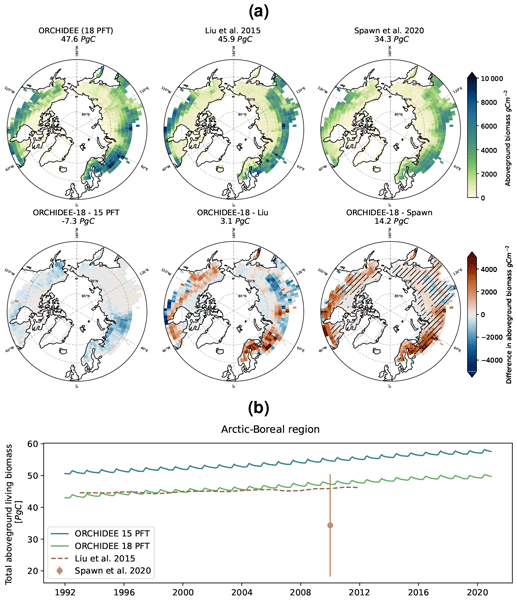
L405-406: Explain why the modeled trends show a clear increase over time for biomass (Figure 6) and GPP (Figure 7), whereas this pattern is much less evident in the datasets used for comparison.
Table 6. Consider adding a column that specifies the thresholds or definitions associated with these shrub classes, since these definitions can differ substantially across ESMs.
Citation: https://doi.org/10.5194/egusphere-2026-1071-RC1 -
AC1: 'Reply on RC1', Anna Kirchner, 07 May 2026
We sincerely thank the reviewer for their careful reading and constructive comments. The suggestions have been very helpful and have led to substantial improvements to the manuscript. All comments are addressed in detail in the attached document.
-
AC1: 'Reply on RC1', Anna Kirchner, 07 May 2026
-
RC2: 'Comment on egusphere-2026-1071', Wu Sun, 21 Apr 2026
The manuscript by Kirchner et al. implemented a parsimonious, fine-grained classification of shrub plant functional types (PFT) for the global Arctic–boreal region in the land surface model ORCHIDEE, meticulously identified and calibrated relevant parameters, and evaluated model simulations of biomass density and carbon fluxes against benchmark data products. The shrub PFT implementation is nicely done and well documented. In my opinion, two highlights of the work include: a parsimonious classification of shrub PFTs to capture the main variability of functional diversity among dominant Arctic–boreal shrub species while not overcomplicating it, and the systematic approach toward parameter selection and parameter optimization using ORCHIDAS, which puts the work on a rigorous footing. The manuscript is overall well written, although some clarifications would be helpful. My comments are mostly minor, listed as follows:
- A limitation of this work is that the partition from the total shrub coverage into the three shrub PFTs (tall deciduous, short deciduous, and short evergreen) is simplistic, with latitude as the only factor determining shrub PFT fractions. Empirical knowledge tells us that there is a strong west–east gradient in the northern limit of treelines over North America: the same latitude in southern Alaska where boreal forest dominates would be tundra around the Hudson Bay. There is also an east–west gradient in shrub coverage going from Finland to Norway. Potential misclassification caused by the latitude-only shrub distribution (Eqs. 5 and 7) may need to be discussed in comparison with the original CAVM and Macander et al. (2017) maps. In addition, the empirical representation of shrub PFT fractions seems ill-suited for CMIP-style future projections where PFT fractions are forced by evolving climate.
- This study claims to have obtained “regionally representative shrub traits.” If this means in a narrow sense that simulated aboveground biomass and GPP align well with pan-Arctic/boreal data products, then yes. But this claim is tenuous if it refers to parameter optimization, given that “sensitivity tests and optimisation were performed ... primarily using the grid cell around Toolik Lake, Alaska” (L176–177) and that the GPP targets are based on data from only three eddy covariance sites (Table 2). Further clarifications on regional representativeness are needed. Besides, it’s unclear which target variables from Toolik Lake are used for the optimization.
- L57–62: It’s worth discussing in which aspects this shrub PFT implementation differs from Druel et al. (2017) and why the implementation presented in this study makes better sense.
- L85: “adapted to harsh high-latitude conditions” - This statement only refers to Arctic/boreal shrubs because shrublands are common in mediterranean, xeric, and alpine ecosystems.
- L99–104: Are there evergreen tall shrubs in the Arctic?
- Table 2: Is there a scientific reason to use different partitioning methods for different sites? How does the discrepancy between daytime and nighttime partitioning affect the calibration? Also, I have the same question as Reviewer #1 - Why did the authors select only three sites? There are more AmeriFlux and ICOS shrub sites in the high latitude (for example, US-EML).
- L252: What are the target variables in Y? Please spell them out. Also, better use an upright capital “T” to indicate matrix transpose in Eq. (4).
- L264: “boreal tree PFTs (80%) and boreal grass (20%)” - This feels ambiguous to me. Does this mean that a high-latitude grid cell would have 80% fractional coverage of boreal tree PFTs, and 20% fractional coverage of boreal grass? Or does it mean that among all high-latitude grid cells, 80% of them are assigned boreal tree PFTs?
- Fig. 3: Is there a similar comparison for belowground biomass, or any related measurable belowground traits?
- Fig. 4: This is a central figure that requires some clarifications. First, do we expect these sites to host only one shrub PFT? It is unclear what this comparison aims to achieve. It is true that if we restrict the grid cell to only one PFT, then PFT 18 is the obvious winner. But is reality a mixture of multiple shrub PFTs? It seems a fair comparison can only be made between observations and PFT-aggregated grid-cell-scale carbon flux estimates. Second, why does PFT 18 (evergreen dwarf shrubs) show a more gradual spring onset than do PFTs 16 (tall deciduous shrubs) and 17 (low deciduous shrubs)? In addition, consider changing “FLUXNET” to “observations” in figure annotations to avoid potential confusion (FLUXNET usually indicates the global network of flux towers).
- L329: What does the recruitment beta mean?
- L362–363: Does ORCHIDEE ramp up Vcmax gradually after leaf onset or use a fixed Vcmax value throughout the growing season?
- L389: What does “forest-prescribed tundra” mean in this context?
- L445: “more exhaustive and complete” - This seems pretty subjective. I would say that the classification is more fine-grained, for sure.
- L504–506: It is also worth noting that the shrub–snow albedo feedback goes the other way: more shrub coverage prompts earlier snow melt and amplifies warming, because protruding shrub branches are darker than snow. See, for example: Domine et al. (2025) JGR-Biogeosciences, https://doi.org/10.1029/2024JG008593; Belke-Brea et al. (2020) J Climate, https://doi.org/10.1175/JCLI-D-19-0318.1.
Citation: https://doi.org/10.5194/egusphere-2026-1071-RC2 - AC2: 'Reply on RC2', Anna Kirchner, 07 May 2026
-
RC3: 'Comment on egusphere-2026-1071', Anonymous Referee #3, 21 Apr 2026
The manuscript by Kirchner et al. substantially improves the representation of tundra vegetation in a LSM by introducing three plant functional types describing Arctic-Boreal shrubs. They define shrub PFT parameters using literature estimates that are then constrained by calibrating ORCHIDEE model outputs of vegetation structure against pan-Arctic observational datasets. This is timely and important work given the current need to understand feedbacks between climate and vegetation change at high-latitudes, in particular the consequences of shrub expansion. The paper is well written and results are generally presented clearly. However, elaborating on several of the methodological choices could help readers better understand how transferable this PFT parameterization is beyond ORCHIDEE and how scalable this approach is as Arctic-Boreal datasets continue to improve in spatial resolution and coverage. Some comments are provided below to this end.
- L70. Including a brief framework overview of the carbon cycle processes relevant to shrubs in ORCHIDEE (e.g. expanding on the description in L155 (perhaps nearer the beginning of the methods, such as here) could help orient the reader to methodological choices further on.
- L170: A more detailed discussion on how targeted parameters (Table 3 and Table 4) were chosen, and in particular which were kept the same across trees-to-shrubs and across new shrub PFT’s, could be helpful. Some relevant traits seemed missing: for example, Vcmax varies across evergreen and deciduous species, but seems to be the same (across trees and shrubs) for all PFT’s? Leaf nitrogen and leaf carbon construction costs would also vary, which could be taken into account by the “NUE_OPT” parameter, but without more elaboration on what is going on in the model, it is somewhat unclear how these parameter changes would translate (particularly beyond the ORCHIDEE-specific framework).
- L175: Even after reading the appendix, I remained unclear about this process. How sensitive were the PFT model parameter calibrations to the choice of grid cell for optimization? Was a certain distribution of each shrub PFT assigned to this cell during the calibrations based on vegetation maps of the region? Or was the whole cell separately assigned to each PFT to run the calibrations? While shrubs are prevalent in the Toolik area, a large majority of the area is dominated by mixed or non-shrub vegetation cover. Comparing how well observational targets identified in Section 2.1.2 match the substantial amount of vegetation biomass (e.g. shrub biomass maps, such as Greaves et al. 2018, https://doi.org/10.1016/j.rse.2016.07.026) seems perhaps relevant. Perhaps more relevant to the method, how much did the optimization procedure change the manual estimates of parameters and in which directions?
- L205: What is the relationship between PFT height and stand height? Was stand height (or some combination of pipe_tune2) used to constrain the height targets in Table 1?
- L244: Is NUE the only aspect in which nitrogen dynamics interface with shrub PFT traits? In general, how ecosystem impacts of shrubs beyond their contribution to GPP is not particularly clear -- are these ecosystem-feedback processes implemented in the model and carried over from grass or tree PFT's or not yet implemented? For example, are shrubs altering albedo like trees (PFT5), modifying litter inputs, altering soil temperature and moisture, or nitrogen availability? Parameterizing PFT's based on mainly GPP and standing biomass alone is a worthy task within itself, but it would still be useful to clarify which shrub-feedback process are and are not included.
- Table 3: Should there be a column for each shrub PFT? Combining with some higher-level info from Table 4 seems nice here.
- Table 4: A column w/more general names (or translations to related metrics) could help increase reach of results. For example, if possible to translate outputs from the pipe-allometry sub-model back into the power-law allometric parameters typically used for Arctic shrubs (e.g. as in Berner et al. 2015), this would be of general interest. While parameters like "alpha_self_thinning" are specific to ORCHIDEE model infrastructure, model outputs such as maximum stand density seem more relevant (and transferable) to report even if not the exact parameters tuned.
- L315: Newer high-resolution map estimates of tundra plant biomass, divided into woody and non-woody, now exist for the tundra region (e.g. https://arcticdata.io/catalog/view/doi:10.18739/A2NS0M06B). It could be useful to check whether fractional cover assigned to shrub PFT’s match these products at least for 2020 to test/justify the latitude-based approach.
- Figure 4. The choice of these three shrub sites is somewhat unclear, particularly given they demonstrate pretty same patterns. Incorporating data from other sites, including EC sites that have known distributions of vegetation (that could be mapped to PFT 7-18, e.g. such as vegetation maps and fluxes from Ludwig et al. 2024, https://bg.copernicus.org/articles/21/1301/2024/bg-21-1301-2024.html), seems potentially more useful than three shrub sites.
Citation: https://doi.org/10.5194/egusphere-2026-1071-RC3 - AC3: 'Reply on RC3', Anna Kirchner, 07 May 2026
Peer review completion
Journal article(s) based on this preprint
Viewed
| HTML | XML | Total | BibTeX | EndNote | |
|---|---|---|---|---|---|
| 979 | 499 | 106 | 1,584 | 92 | 137 |
- HTML: 979
- PDF: 499
- XML: 106
- Total: 1,584
- BibTeX: 92
- EndNote: 137
Viewed (geographical distribution)
| Country | # | Views | % |
|---|
| Total: | 0 |
| HTML: | 0 |
| PDF: | 0 |
| XML: | 0 |
- 1

Efrén López-Blanco
Vladislav Bastrikov
Sebastiaan Luyssaert
Philippe Peylin
The requested preprint has a corresponding peer-reviewed final revised paper. You are encouraged to refer to the final revised version.
- Preprint
(6144 KB) - Metadata XML
The manuscript "Introducing shrubs enhances the representation of high-latitude vegetation and carbon cycling in the ORCHIDEE land surface model" refined PFTs for shrublands and improved a LSM using updated PFT maps for the Arctic region. The study also investigated the influence of shrub PFT incorporation on estimates of biomass and carbon fluxes and used ground-truth data for model evaluation. In general, this manuscript is well written and follows a clear logical flow. The improved PFT methodology can benefit the broader modeling community and should be relevant to the general audience of Biogeosciences. I have a few minor suggestions that may help the authors further improve the manuscript:
L147. Three is a relatively small number, given that more sites could be categorized as shrublands according to the IGBP classification. Please provide more detail on why other sites were excluded based on specific criteria.
L155. Given the importance of the ORCHIDEE model for this study, consider adding a diagram and/or additional description of the model (perhaps in Appendix if space is limited) for a broader audience. This would help readers understand how this model compares with other LSMs and to what extent the findings can inform other modeling efforts.
L177. Provide more detail about the specific grid cell, including its resolution and representativeness, and explain why a single cell is sufficient for sensitivity tests and optimization.
L318-322. The writing in this paragraph is somewhat unclear. Please clarify how the three datasets were selected and what distinct aspects they represent, such as ground-truth data versus data-fusion products. In the later discussion section, the comparison with these datasets could also mention a bit more on uncertainty from the observations/ products.
L336 and L345: Elaborate more on why the simulated range is much smaller than the observed range (Figure 3) and discuss the implications.
Figure 4: It appears that the uncertainty range is truncated for GPP and NEE in some cases.
L405-406: Explain why the modeled trends show a clear increase over time for biomass (Figure 6) and GPP (Figure 7), whereas this pattern is much less evident in the datasets used for comparison.
Table 6. Consider adding a column that specifies the thresholds or definitions associated with these shrub classes, since these definitions can differ substantially across ESMs.