
the Creative Commons Attribution 4.0 License.
the Creative Commons Attribution 4.0 License.
 | 27 Feb 2026
Contribution of free tropospheric aerosols to Arctic low-level cloud droplets formation and longwave radiative forcing
Abstract. Aerosol-cloud-radiation interactions are a major source of uncertainty in the Arctic climate, particularly for low-level clouds (LLC) that dominate cloud cover. This study presents in situ measurements of aerosols and cloud droplets collected with a tethered-balloon between May 16 and June 10, 2023, during the Atmospheric Rivers and the onseT of sea ice MELT campaign above sea ice in the Fram Strait. The objective was to quantify the contributions of boundary-layer and free-tropospheric sources to the cloud condensation nuclei (CCN) budget of LLCs. Above- and below-cloud observations of five LLCs showed enhanced aerosol concentrations above cloud top in four cases.
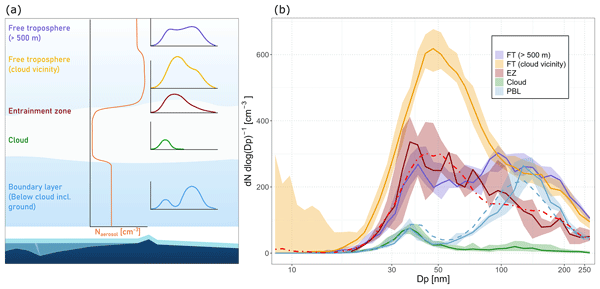
The analysis of a case study, in which the cloud was coupled to the surface, revealed a complex layered structure of aerosol properties, including multiple distinct size distributions. Aerosol concentrations above the cloud were up to four times higher than below, and measurements at the cloud-top interface indicated mixing between in-cloud and free-tropospheric air masses. Simulations of cloud droplet concentrations based on measured particle size distributions showed that including aerosols from above cloud, rather than only below, was required to achieve closure with observations. Our highly detailed observations around the cloud allowed us to demonstrate the significance of free-tropospheric CCN sources, which influence Arctic cloud microphysical and radiative properties. Not accounting for free tropospheric CCN would have resulted in a low bias in the longwave radiative forcing of 1.3 W m-2. These findings highlight the need for systematic vertical aerosol observations and improved model representation of elevated aerosol layers.
Competing interests: At least one of the (co-)authors is a member of the editorial board of Atmospheric Chemistry and Physics. The peer-review process was guided by an independent editor, and the authors also have no other competing interests to declare.
Publisher's note: Copernicus Publications remains neutral with regard to jurisdictional claims made in the text, published maps, institutional affiliations, or any other geographical representation in this paper. While Copernicus Publications makes every effort to include appropriate place names, the final responsibility lies with the authors. Views expressed in the text are those of the authors and do not necessarily reflect the views of the publisher.-
Notice on discussion status
The requested preprint has a corresponding peer-reviewed final revised paper. You are encouraged to refer to the final revised version.
-
Preprint
(3626 KB)
-
Supplement
(1456 KB)
-
The requested preprint has a corresponding peer-reviewed final revised paper. You are encouraged to refer to the final revised version.
- Preprint
(3626 KB) - Metadata XML
-
Supplement
(1456 KB) - BibTeX
- EndNote
- Final revised paper


Journal article(s) based on this preprint
Interactive discussion
Status: closed
-
RC1: 'Comment on egusphere-2026-1068', Christian Pilz, 20 Mar 2026
- AC1: 'Reply on RC1', Roman Pohorsky, 23 Jun 2026
-
RC2: 'Comment on egusphere-2026-1068', Anonymous Referee #2, 24 Mar 2026
Review of “Contribution of free tropospheric aerosols to Arctic low-level cloud droplets formation and longwave radiative forcing” by R. Pohorsky et al.
This is a nice analysis of data from the recent ARTofMELT campaign to probe the importance of enhanced aerosol concentrations above cloud tops. The data analysis and the methodology is generally good, but I am struggling to make sense of the results and hopefully the authors can provide some clarification.
Major Comments:
- It is absolutely reasonable to think that the entrainment zone aerosol particles are contributing to the in-cloud droplet concentration. However, there is one aspect that I can’t understand. The droplet concentration is well-mixed through the cloudy layer suggesting that particles activated at cloud top quickly become dispersed through the cloud. Wouldn’t it follow that ALL particles, including the unactivated Aitken mode particles, would also become well-mixed throughout the cloudy and sub-cloud layers? And if that were true, shouldn’t the sub-cloud aerosol population be sufficient to explain the droplet concentration? This statement should apply to the accumulation mode particles too since the cloud and sub-cloud layers are coupled. In other words, if you dried out the cloud droplets and counted accumulation mode particles, shouldn’t it roughly match the sub-cloud population? But with the current explanation, I don’t think this would be true. With the given explanation there would be a substantially higher number of accumulation particles in the cloud layer than in the sub-cloud layer even though the Aitken populations in these two layers match. I can’t understand why one aerosol mode should match and the other mode shouldn’t.
- I am confused by the droplet concentrations, and perhaps this confusion is related to my first comment. In Lines 192-193, the authors state that cloud droplets are those particles detected by the LOAC that are larger than 3 microns and classified as droplets. However, if Figure 7, size bins are shown for drop sizes of 0.9-1.1 microns and 1.1-3 microns. Are the concentrations of these smallest particles included in the total droplet concentration? I think the answer is “yes” but it is hard to tell given the log-scale used in Figure 7. Is this then why the droplet concentration is higher than the sub-cloud accumulation mode concentration? Perhaps the authors are including counts of hydrated but unactivated Aitken particles with sizes of 0.9-3 microns. Please check.
- It’s not clear to me why the authors did not repeat the analysis for the other three cases identified. It seems that doing so could strengthen the conclusions if they are similar.
Minor Comments:
- Lines 437-438: I don’t understand why increasing concentrations above cloud top should help to explain the decreasing concentrations at the surface.
- Consider showing the Aitken mode concentration profile in Figure 7 especially since particles larger than 52nm contribute to the droplet population and you discuss the Aitken mode in more detail later.
- Consider also citing Sterzinger and Igel 2024: https://acp.copernicus.org/articles/24/3529/2024/
Citation: https://doi.org/10.5194/egusphere-2026-1068-RC2 - AC2: 'Reply on RC2', Roman Pohorsky, 23 Jun 2026
Peer review completion


Interactive discussion
Status: closed
-
RC1: 'Comment on egusphere-2026-1068', Christian Pilz, 20 Mar 2026
The study by Pohorsky et al. provides valuable new insights into aerosol-cloud-radiation interactions in the Arctic, based on tethered balloon measurements above the sea ice. Profile observations of meteorological parameters, as well as aerosol and cloud properties, were effectively combined with cloud remote sensing and modeling to investigate the impact of free-tropospheric aerosols on low-level cloud properties. The authors showed that cloud droplet numbers could not be explained solely by boundary-layer aerosol concentrations but required the inclusion of the entrainment of cloud condensation nuclei (CCN) at cloud top. Radiative transfer modelling resulted in an enhancement of the cloud’s longwave warming by 1.3 W m-2 by the entrained particles. This effect is of the same order as previously reported effects of anthropogenic pollution on Arctic clouds and might be even more pronounced under conditions with fewer aerosols. Although the study is based on a single case, it provides an important piece in assessing the CCN budget of Arctic low-level clouds and their radiative effects. Moreover, tethered-balloon observations over Arctic sea ice are sparse due to the inherent difficulties of conducting them. The paper is of high scientific quality, is well-structured, and reads well. I recommend accepting the paper with minor revisions.
One major topic that needs to be treated in more detail is the cloud droplet measurements and their use in the models. The study would be significantly strengthened if the LOAC cloud droplet size distributions were used to derive the LWC and effective radius reff, rather than remote-sensing products. Or at least should be compared with remote sensing, as the droplet number concentration profiles in Fig. 7 indicate a smaller reff at the bottom of the cloud than in the upper part. It would also be beneficial to add the cloud droplet number distribution as an average over the cloud layer, or, better yet, as a vertical contour plot, rather than droplet number concentration per-bin profiles. The droplet number concentration of the LOAC should be validated in greater detail in the main part of the paper, since this is the core part of the study that connects different observations to the models, e.g., by performing a linear regression against the fog monitor. In section 2.2, it is stated that Nd is derived from droplets larger than 3 µm, which is inconsistent with Fig. 7 where smaller sizes are included. On what size range are the reported Nd of 130 cm-3 in the case study based on?
One aspect that puzzles me is why the case study is based only on one of the six available profiles on 7 June? Including the other profiles would significantly strengthen the study by enhancing the statistics or providing more insights into the variations between the profiles. Judging from Fig. 7, it seems that the aerosol particle number size distribution of the entrainment zone is only based on a single mSEMS scan at ~400 m height. This provides rather weak statistics, given the counting statistics of small charged particles at low aerosol concentrations and an mSEMS scan time of 160 s during an ascending balloon flight in a dynamic environment.
Detailed comments:
Figure 1: Nice figure, but also slightly complex with the particle sources in the free troposphere (long-range, NPF) not mentioned in the introduction so far. Better focus on the core points of the study in the figure, or give background on the particle sources in the intro, including references.
Sec 2.1: What was the average climb rate of the balloon and the resulting vertical resolution of the mSEMS?
L 157–161: This could be moved to the supplementary material, as the STAP and filter samples were not used in the paper.
Supp. Fig S1: Typo in caption, d) N8-280
L. 186 -191: The POPS correction scheme seems inaccurate. It seems more reasonable to correct the POPS diameter rather than the particle number to match the DMPS. The particle numbers of the POPS are probably correct, but they are counted at a different size due to the deviation of the optical diameter from the mobility diameter. This would also affect the lower detection limit of the POPS.
Fig. S3: What are the lower Y-Axis labels on the heat maps, droplet size?
L 233: Unintroduced abbreviation SLP
Fig S4: Typo in caption: 186 and 3370 nm
Sec. 2.6: The droplet activation scheme seems to be derived for liquid stratus clouds. Is it applicable to mixed-phase clouds, as in your case study?
L 382-383: The number ~150 cm-3 is inconsistent with ~450 cm-3 on 10 June, as seen in Fig. 4. The statement “ – too small to activate in this case” without the supporting PNSD seems difficult to comprehend.
Fig 4: Please provide further info on how the mSEMS and POPS were merged in terms of bin limits and different time resolutions of each instrument to derive profiles of N8-3370.
Fig 5: Typo in caption: 1000 km radius should be 100 km, as in the text?
L 436-438: sentence reads a bit difficult. How is the increasing concentration above the cloud linked to decreasing concentrations at the surface?
L 466 – 469: This conclusion may be better placed later in the text, since the aerosol PNSD was not introduced yet.
Fig 8: Please add the DMPS size distribution for the PBL to the plot, or add a comparison of the mSEMS with the DMPS to the supplementary.
L547 – 551: Does the calculated number of CCN above the Hoppel minimum from the DMPS match the measured number from the CCN counter, when it is derived by an interpolation between the two nearest SS levels, similar to the procedure for deriving kappa?
L627 – 628: There seems to be a typo in “3 times more droplets”, as your range of Nd from 68 to 122 cm-3 is more or less similar to the study.
Citation: https://doi.org/10.5194/egusphere-2026-1068-RC1 - AC1: 'Reply on RC1', Roman Pohorsky, 23 Jun 2026
-
RC2: 'Comment on egusphere-2026-1068', Anonymous Referee #2, 24 Mar 2026
Review of “Contribution of free tropospheric aerosols to Arctic low-level cloud droplets formation and longwave radiative forcing” by R. Pohorsky et al.
This is a nice analysis of data from the recent ARTofMELT campaign to probe the importance of enhanced aerosol concentrations above cloud tops. The data analysis and the methodology is generally good, but I am struggling to make sense of the results and hopefully the authors can provide some clarification.
Major Comments:
- It is absolutely reasonable to think that the entrainment zone aerosol particles are contributing to the in-cloud droplet concentration. However, there is one aspect that I can’t understand. The droplet concentration is well-mixed through the cloudy layer suggesting that particles activated at cloud top quickly become dispersed through the cloud. Wouldn’t it follow that ALL particles, including the unactivated Aitken mode particles, would also become well-mixed throughout the cloudy and sub-cloud layers? And if that were true, shouldn’t the sub-cloud aerosol population be sufficient to explain the droplet concentration? This statement should apply to the accumulation mode particles too since the cloud and sub-cloud layers are coupled. In other words, if you dried out the cloud droplets and counted accumulation mode particles, shouldn’t it roughly match the sub-cloud population? But with the current explanation, I don’t think this would be true. With the given explanation there would be a substantially higher number of accumulation particles in the cloud layer than in the sub-cloud layer even though the Aitken populations in these two layers match. I can’t understand why one aerosol mode should match and the other mode shouldn’t.
- I am confused by the droplet concentrations, and perhaps this confusion is related to my first comment. In Lines 192-193, the authors state that cloud droplets are those particles detected by the LOAC that are larger than 3 microns and classified as droplets. However, if Figure 7, size bins are shown for drop sizes of 0.9-1.1 microns and 1.1-3 microns. Are the concentrations of these smallest particles included in the total droplet concentration? I think the answer is “yes” but it is hard to tell given the log-scale used in Figure 7. Is this then why the droplet concentration is higher than the sub-cloud accumulation mode concentration? Perhaps the authors are including counts of hydrated but unactivated Aitken particles with sizes of 0.9-3 microns. Please check.
- It’s not clear to me why the authors did not repeat the analysis for the other three cases identified. It seems that doing so could strengthen the conclusions if they are similar.
Minor Comments:
- Lines 437-438: I don’t understand why increasing concentrations above cloud top should help to explain the decreasing concentrations at the surface.
- Consider showing the Aitken mode concentration profile in Figure 7 especially since particles larger than 52nm contribute to the droplet population and you discuss the Aitken mode in more detail later.
- Consider also citing Sterzinger and Igel 2024: https://acp.copernicus.org/articles/24/3529/2024/
Citation: https://doi.org/10.5194/egusphere-2026-1068-RC2 - AC2: 'Reply on RC2', Roman Pohorsky, 23 Jun 2026
Peer review completion
Journal article(s) based on this preprint
Viewed
| HTML | XML | Total | Supplement | BibTeX | EndNote | |
|---|---|---|---|---|---|---|
| 1,416 | 600 | 120 | 2,136 | 273 | 123 | 180 |
- HTML: 1,416
- PDF: 600
- XML: 120
- Total: 2,136
- Supplement: 273
- BibTeX: 123
- EndNote: 180
Viewed (geographical distribution)
| Country | # | Views | % |
|---|
| Total: | 0 |
| HTML: | 0 |
| PDF: | 0 |
| XML: | 0 |
- 1

Heather Guy
Ian M. Brooks
Lea Haberstock
Nicolas Fauré
Paul Zieger
Julia Kojoj
Sonja Murto
Radiance Calmer
Benjamin Heutte
Michael Lonardi
Erik S. Thomson
Michael Tjernström
Jessie Creamean
Athanasios Nenes
The requested preprint has a corresponding peer-reviewed final revised paper. You are encouraged to refer to the final revised version.
- Preprint
(3626 KB) - Metadata XML
-
Supplement
(1456 KB) - BibTeX
- EndNote
- Final revised paper
The study by Pohorsky et al. provides valuable new insights into aerosol-cloud-radiation interactions in the Arctic, based on tethered balloon measurements above the sea ice. Profile observations of meteorological parameters, as well as aerosol and cloud properties, were effectively combined with cloud remote sensing and modeling to investigate the impact of free-tropospheric aerosols on low-level cloud properties. The authors showed that cloud droplet numbers could not be explained solely by boundary-layer aerosol concentrations but required the inclusion of the entrainment of cloud condensation nuclei (CCN) at cloud top. Radiative transfer modelling resulted in an enhancement of the cloud’s longwave warming by 1.3 W m-2 by the entrained particles. This effect is of the same order as previously reported effects of anthropogenic pollution on Arctic clouds and might be even more pronounced under conditions with fewer aerosols. Although the study is based on a single case, it provides an important piece in assessing the CCN budget of Arctic low-level clouds and their radiative effects. Moreover, tethered-balloon observations over Arctic sea ice are sparse due to the inherent difficulties of conducting them. The paper is of high scientific quality, is well-structured, and reads well. I recommend accepting the paper with minor revisions.
One major topic that needs to be treated in more detail is the cloud droplet measurements and their use in the models. The study would be significantly strengthened if the LOAC cloud droplet size distributions were used to derive the LWC and effective radius reff, rather than remote-sensing products. Or at least should be compared with remote sensing, as the droplet number concentration profiles in Fig. 7 indicate a smaller reff at the bottom of the cloud than in the upper part. It would also be beneficial to add the cloud droplet number distribution as an average over the cloud layer, or, better yet, as a vertical contour plot, rather than droplet number concentration per-bin profiles. The droplet number concentration of the LOAC should be validated in greater detail in the main part of the paper, since this is the core part of the study that connects different observations to the models, e.g., by performing a linear regression against the fog monitor. In section 2.2, it is stated that Nd is derived from droplets larger than 3 µm, which is inconsistent with Fig. 7 where smaller sizes are included. On what size range are the reported Nd of 130 cm-3 in the case study based on?
One aspect that puzzles me is why the case study is based only on one of the six available profiles on 7 June? Including the other profiles would significantly strengthen the study by enhancing the statistics or providing more insights into the variations between the profiles. Judging from Fig. 7, it seems that the aerosol particle number size distribution of the entrainment zone is only based on a single mSEMS scan at ~400 m height. This provides rather weak statistics, given the counting statistics of small charged particles at low aerosol concentrations and an mSEMS scan time of 160 s during an ascending balloon flight in a dynamic environment.
Detailed comments:
Figure 1: Nice figure, but also slightly complex with the particle sources in the free troposphere (long-range, NPF) not mentioned in the introduction so far. Better focus on the core points of the study in the figure, or give background on the particle sources in the intro, including references.
Sec 2.1: What was the average climb rate of the balloon and the resulting vertical resolution of the mSEMS?
L 157–161: This could be moved to the supplementary material, as the STAP and filter samples were not used in the paper.
Supp. Fig S1: Typo in caption, d) N8-280
L. 186 -191: The POPS correction scheme seems inaccurate. It seems more reasonable to correct the POPS diameter rather than the particle number to match the DMPS. The particle numbers of the POPS are probably correct, but they are counted at a different size due to the deviation of the optical diameter from the mobility diameter. This would also affect the lower detection limit of the POPS.
Fig. S3: What are the lower Y-Axis labels on the heat maps, droplet size?
L 233: Unintroduced abbreviation SLP
Fig S4: Typo in caption: 186 and 3370 nm
Sec. 2.6: The droplet activation scheme seems to be derived for liquid stratus clouds. Is it applicable to mixed-phase clouds, as in your case study?
L 382-383: The number ~150 cm-3 is inconsistent with ~450 cm-3 on 10 June, as seen in Fig. 4. The statement “ – too small to activate in this case” without the supporting PNSD seems difficult to comprehend.
Fig 4: Please provide further info on how the mSEMS and POPS were merged in terms of bin limits and different time resolutions of each instrument to derive profiles of N8-3370.
Fig 5: Typo in caption: 1000 km radius should be 100 km, as in the text?
L 436-438: sentence reads a bit difficult. How is the increasing concentration above the cloud linked to decreasing concentrations at the surface?
L 466 – 469: This conclusion may be better placed later in the text, since the aerosol PNSD was not introduced yet.
Fig 8: Please add the DMPS size distribution for the PBL to the plot, or add a comparison of the mSEMS with the DMPS to the supplementary.
L547 – 551: Does the calculated number of CCN above the Hoppel minimum from the DMPS match the measured number from the CCN counter, when it is derived by an interpolation between the two nearest SS levels, similar to the procedure for deriving kappa?
L627 – 628: There seems to be a typo in “3 times more droplets”, as your range of Nd from 68 to 122 cm-3 is more or less similar to the study.