
the Creative Commons Attribution 4.0 License.
the Creative Commons Attribution 4.0 License.
 | 09 Mar 2026
Long-term Study of Gravity Wave Potential Energy and OH Airglow Emissions from 22 years of TIMED/SABER Observations
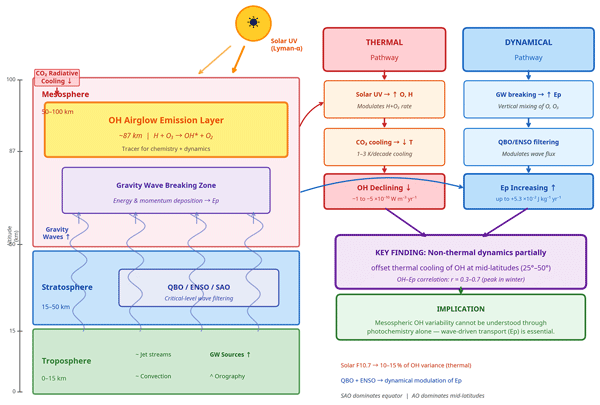
Abstract. Using 22 years (2002–2023) of TIMED/SABER satellite observations, we investigate the long-term coupling between mesospheric hydroxyl (OH) airglow and gravity wave potential energy (Ep). Continuous wavelet transform analysis extracts gravity wave signatures from temperature perturbations, and multiple linear regression decomposes the observed variability into contributions from solar activity, geomagnetic activity, the Quasi-Biennial Oscillation (QBO), and the El Niño–Southern Oscillation (ENSO). Three major findings emerge. First, OH emissions and gravity wave Ep are positively coupled, with statistically significant (p < 0.05) correlation coefficients of 0.3–0.7 that peak during winter at mid-latitudes. Second, long-term trends reveal contrasting latitudinal patterns: OH trends are negative at mid-latitudes in both hemispheres (−1 to −5 × 10⁻¹⁰ W m-3 yr-1), consistent with mesospheric cooling, whereas Ep trends are positive at mid-latitudes (up to 5.3 × 10⁻² J kg-1 yr-1), exceeding current model predictions. Both quantities show weaker trends near the equator. Third, a novel decomposition methodology separates temperature-driven chemical responses from non-thermal dynamical effects, revealing that solar forcing operates primarily through thermal mechanisms and accounts for 10–15 % of OH variance, while QBO and ENSO influence mesospheric chemistry through dynamical pathways. ENSO drives negative OH responses yet enhances Ep, and QBO responses exhibit equatorial–midlatitude dipole patterns. Semi-annual oscillations dominate equatorial variability, while annual oscillations prevail at Southern Hemisphere mid-latitudes.
-
Notice on discussion status
The requested preprint has a corresponding peer-reviewed final revised paper. You are encouraged to refer to the final revised version.
-
Preprint
(19985 KB)
-
The requested preprint has a corresponding peer-reviewed final revised paper. You are encouraged to refer to the final revised version.
- Preprint
(19985 KB) - Metadata XML
- BibTeX
- EndNote
- Final revised paper


Journal article(s) based on this preprint
Interactive discussion
Status: closed
-
RC1: 'Comment on egusphere-2026-1038', Anonymous Referee #1, 20 Mar 2026
-
AC1: 'Reply on RC1', Toyese Tunde Ayorinde, 31 Mar 2026
Response to Reviewer Comments
Long-term Study of Gravity Wave Potential Energy and OH Airglow Emissions from 22 years of TIMED/SABER ObservationsWe thank the reviewer for the careful reading of our manuscript and for the constructive comments. Below, we address each comment individually.
Reviewer 1
Reviewer Comment: The authors provide a solid study of correlations between gravity wave potential energy and airglow parameters using 22 years of SABER data. They also analyze trends and separate responses to different forcing factors. I found the article very interesting and suitable for publication after some minor revisions (see specific comments below). My main concern here is the 22 years of the SABER dataset, especially for analyzing solar activity impact. This limitation should be clarified in the article.
Author Response: We thank the reviewer for the positive assessment and the important point regarding the dataset time span. We have added a paragraph in Section 3.3 (Latitudinal Profiles of Trends and Solar Responses) explicitly acknowledging this limitation. The added text is shown below.
Comment 1 (Lines 257-258)
Reviewer Comment: Could it also be due to differences in the gravity wave environment?
Author Response: We agree with the reviewer that differences in the gravity wave environment between the two hemispheres could contribute to the observed hemispheric asymmetry in Ep seasonal cycles. We have added the following sentence to the discussion of hemispheric Ep differences in Section 3.2:Correction in manuscript: "Additionally, differences in the gravity wave environment between the two hemispheres, including the distribution of topographic features, jet stream characteristics, and convective activity. This may contribute to the observed hemispheric asymmetry in Ep (Ern et al., 2018; Geller et al., 2013)."
Comment 2 (Lines 300-301)
Reviewer Comment: The authors should briefly comment on the time span (22 years), which is generally too short to perform trend analysis. For solar activity impact, it should be pointed out that the solar cycles covered here had very different magnitudes, especially cycles 23 and 24.
Author Response: We fully agree with this important point. We have added a paragraph at the beginning of Section 3.3 (Latitudinal Profiles of Trends and Solar Responses) that explicitly acknowledges the limitation of the 22 years for trend analysis and notes the different magnitudes of solar cycles 23 and 24 :
Correction in manuscript: "We note that a 22 -year time span, while among the longest continuous satellite records available for mesospheric studies, covers only approximately two solar cycles and is generally considered short for robust trend analysis. Moreover, the solar cycles covered here (cycles 23 and 24 ) had markedly different magnitudes, with cycle 24 being considerably weaker than cycle 23, which may affect the separation of solar-driven variability from long-term trends in the MLR analysis (Laštovička, 2017). These limitations should be kept in mind when interpreting the trend and solar response results presented below."
Comment 3 (Line 336)
Reviewer Comment: Not sure if "dipole" is a relevant term here. I assume the authors mean opposite responses at the equator and at mid-latitudes.
Author Response: We agree that "dipole" is not the most appropriate term in this context. We have replaced all instances of "dipole" with clearer language describing the opposite responses between the equator and mid-latitudes. The corrections were made in the abstract, Section 3.4, and Section 4 (Discussion):
Correction in manuscript:
- Abstract: "...and QBO responses exhibit opposite patterns between the equator and mid-latitudes." (previously: "equatorial-midlatitude dipole patterns")
- Section 3.4: "The OH response to the QBO ...shows opposite responses between the equator and midlatitudes." (previously: "shows a dipole between the equator and midlatitudes")
- Section 4: "The QBO response ...shows opposite OH responses at the equator and at mid-latitudes, with QBO30 producing ..." (previously: "shows an equatorial midlatitude dipole")
Comment 4 (Line 392 and further in the text)
Reviewer Comment: Probably the authors mean 85-90 km, not degrees.
Author Response: We thank the reviewer for catching this typographical error. Indeed, the altitudes should be expressed in km, not in degrees. The ang command was incorrectly applied to altitude values in Section 3.6. We have corrected all instances where altitude values were erroneously formatted with the degree symbol:Correction in manuscript: All altitude references in Section 3.6 have been corrected from " " to " ", " " to " ", and similar corrections for 90 km throughout the paragraph.
Citation: https://doi.org/10.5194/egusphere-2026-1038-AC1 -
RC3: 'Reply on AC1', Anonymous Referee #1, 15 Apr 2026
The authors addressed my comments and made appropriate changes in the text. From my side, there are no further comments. I think the article is suitable for publication in its present form.
Citation: https://doi.org/10.5194/egusphere-2026-1038-RC3
-
AC1: 'Reply on RC1', Toyese Tunde Ayorinde, 31 Mar 2026
-
RC2: 'Comment on egusphere-2026-1038', Anonymous Referee #2, 15 Apr 2026
Review comments on Ayoride et al. (2026)
This paper analyzes 22 years of SABER satellite observations to derive long-term trends in OH airglow emission and gravity wave activity in the upper mesosphere. Although the data analysis itself appears careful, I found the motivation and physical interpretation insufficiently developed. In its current form, the manuscript does not clearly explain the scientific purpose of the study or the physical mechanisms underlying the reported relationships. As a result, I am left with the impression that the paper mainly presents correlations, without adequately demonstrating their physical significance.I am also concerned that some of the cited references may not fully support the statements for which they are used. I therefore encourage major revisions before possible resubmission, including substantial reconstruction of the discussion and a more careful examination of the previous literature. I strongly recommend that the co-authors double-check the references one by one. I reviewed several references that I found questionable, although I did not have time to verify all of them. Since my assessment may be stricter than that of other reviewers, I leave the final decision to the editor.
Major comments
1.Physical meaning of the correlation between OH emission and gravity wave activity
The authors state that OH emission and gravity wave activity are positively correlated (e.g., line 6), but I am not convinced that this relationship is physically meaningful rather than spurious. Because the possibility of a spurious correlation cannot be ruled out perfectly, the manuscript should provide either additional dynamical evidence or a much more thorough discussion based on physical theory.At present, the manuscript does not explain the background of the coupling between gravity waves and the mean OH emission. Therefore, it is unclear why this topic was selected and how physically meaningful the reported results are. I suspect that there may be no direct physical coupling between the two quantities; instead, temperature or atmospheric stability may control both their magnitudes and their emission altitudes. In that case, the reported correlation would be spurious and of limited physical significance.
2. Interpretation of Ep trends and the role of OH layer altitude variations
The authors state that the Ep trends (gravity wave potential energy per unit mass) are larger than current model predictions (e.g., line 8). However, I question this conclusion because the manuscript does not appear to consider variations in the altitude of the OH emission layer. Since Ep increases exponentially with altitude, an upward shift of the OH layer can produce an apparent increase in Ep even without a real increase in gravity wave activity. In that case, Ep evaluated at the OH layer is not a robust index of gravity wave activity. If the authors wish to isolate gravity wave activity itself, they should consider using gravity wave potential energy per unit volum.Because the altitude variations appear to be overlooked, I am concerned that the results may be inconsistent with previous studies such as Liu et al. (2017). To my knowledge, gravity wave activity in winter mid- and high latitudes is typically stronger than at low latitudes in the middle atmosphere because of the strong stratospheric jet. Figure 1 of Liu et al. (2017), based on 14 years of data from 50 to 100 km, shows this clearly. In contrast, I do not see corresponding peaks near 50°N/S in Figure 11 of Ayoride et al. (2026).
It should also be noted that Liu et al. (2017) analyzed the same SABER data set over 14 years and discussed relationships among gravity wave activity, solar activity, and the QBO, yet the present manuscript only cites that study without explaining how the current results differ from it. I strongly recommend that the authors explain clearly how their findings differ from those of Liu et al. (2017), why the conclusions are different, and what new advance this study makes relative to previous work.
3. Statistical interpretation of the results
I strongly suggest that the authors discuss the results consistently according to their stated statistical criterion. Although the analysis is statistical in nature, the interpretation is not always statistically consistent.For example, at line 303 the authors state that “the annual trends show negative values at mid-latitudes in both hemispheres and weaker trends in tropical regions.” However, based on Figure 4, these trends are not statistically significant under the criterion adopted in the manuscript, so the appropriate conclusion should be “no significant trend.” I suspect that a negative trend at 50°N/S might emerge under a one-sigma criterion, but this study uses a 95% confidence interval so that they should state “no significant trend”. In the other latitude bands, I do not think the current statements are robust, even if they change the criterion by one sigma.
If the authors adopt the 95% confidence interval as their statistical criterion, they should avoid drawing substantive conclusions from results outside that interval. Otherwise, readers cannot judge how reliable the reported trends actually are.
4. Discussion of Brewer–Dobson circulation and OH emission
The manuscript sometimes discusses a relationship between OH emission and the Brewer–Dobson circulation, but I do not understand the mechanism. If the authors are referring to the deep branch of the Brewer–Dobson circulation, that branch extends only to around the stratopause. Although it may indirectly influence mesospheric composition or dynamics, the manuscript does not explain such pathways.How exactly is the OH emission trend connected to the Brewer–Dobson circulation? Have previous studies proposed such a connection? If stratospheric conditions influence OH emission, then why does the manuscript not discuss the possible role of stratospheric jet activity? How was that possibility ruled out?
In addition, the manuscript discusses cooling effects, but not the accompanying decrease in atmospheric density or the associated downward displacement of the atmosphere. Kogure et al. (2026) showed that such downward motion can shift the mesospheric ozone layer downward. Although I am not an expert on OH airglow, I suspect that changes in density and vertical displacement may also affect OH emission intensity and emission altitude, perhaps more strongly than the circulation effect emphasized in the manuscript.
5. Statement about short-vertical-wavelength convective waves in the tropics
In lines 492–495, the authors state: “Conversely, the weaker equatorial correlations (~0.3) are consistent with the dominance of shorter vertical wavelength convectively generated waves in the tropics, whose phase structure can produce cancellation across the ~8 km-thick OH layer (Vargas et al., 2007; Fritts and Alexander, 2003).”I checked Vargas et al. (2007), but I could not find this statement there. To the best of my recollection, Fritts and Alexander (2003) discuss convectively generated gravity waves, but do not state that shorter vertical wavelength waves are dominant in the tropics.
Many studies have shown that convection can generate high-phase-speed gravity waves, which tend to have relatively large vertical wavelengths, while convection more generally produces a broad gravity wave spectrum. Therefore, if the authors wish to argue for the dominance of short-vertical-wavelength convectively generated waves in the tropics, they should cite an appropriate reference that explicitly supports this claim.
I am very sorry to say it, but I feel that the authors cite inaccurate references to avoid the detailed and concrete discussion several times.Minor comments
Lines 50–53: The authors cite only their own papers, but the effect of tropospheric weather on stratospheric gravity wave activity has been discussed for more than three decades. In addition, the cited studies focus only on South America, whereas the present manuscript considers latitudes between 50°S and 50°N. The authors should also note that mesospheric gravity wave activity is not always directly tied to tropospheric forcing, because gravity waves can propagate long horizontal distances and are filtered in the stratosphere and mesosphere by the QBO, SAO, polar night jet, summer mesospheric jet, and other processes. Please discuss these other controlling factors.
Line 55: Although gravity waves certainly modulate OH emission intensity, I doubt that they directly affect the mean OH emission intensity. The cited references likely describe wave-induced fluctuations in OH emission, not direct control of the mean intensity. Gravity waves may affect the variance of OH emission, but not necessarily its mean value. Please clarify the potential mechanism and cite appropriate references. If the comparison is actually between Ep and the variance of OH intensity, please explain how that variance was derived.
Lines 57–61: Please explain the physical mechanisms linking gravity waves and the OH layer to the QBO, ENSO, and solar activity. The manuscript seems to treat these three factors as the primary drivers of interannual variability, but this is not sufficiently explained. Why were these three processes selected? Why is the cooling effect on the OH layer, introduced earlier in the manuscript, not considered further? If previous studies such as Liu et al. (2017) provide correlations or physical explanations, please cite them explicitly.
Line 95: SABER errors increase with altitude. Did the authors examine whether the retrieval errors themselves show trends over time? Were the trends in intensity and temperature correlated with changes in the retrieval uncertainty? Although I am not an instrument specialist, long-term changes in error characteristics or sensitivity should at least be considered, especially because the manuscript also discusses low-significance results. Statistically significant trends are more likely to be robust, but weaker results require more caution.
Line 133: Please briefly explain the method. At a minimum, the manuscript should specify the horizontal wavenumbers removed and the type of filter applied. I also note that the original method cites many earlier studies; even if the present implementation differs somewhat, the previous work should still be properly acknowledged. In addition, I found a possible error in Ayorinde et al. (2024): Eq. (4) appears to be missing a factor of 0.25. Note that ; see Eq. (5) of Kogure et al. (2017). If Eq. (4) in Ayorinde et al. (2024) was actually used in the analysis, the resulting values may have been overestimated by a factor of four.
Line 160: I understand why the authors excluded those data, but such exclusions also distort the sampling distribution. The manuscript should state how much data was excluded by each criterion. In addition, can sometimes exceed in the MLT. I am also not convinced that 1000 J kg-1 is an appropriate threshold. This value likely corresponds to a temperature amplitude of ~15 K, and gravity-wave fluctuations often exceed that magnitude. Overall, the authors should explain more clearly how these thresholds were selected and why they are physically appropriate. Personally, I would prefer screening based on instrument uncertainty.
Line 205: This statement is inaccurate. Polynomial terms are not generally orthogonal to one another. I assume the authors mean that the terms are less strongly correlated, but the current procedure does not automatically guarantee low correlation or prevent multicollinearity. Please explain more clearly why the procedure is expected to reduce multicollinearity.
Line 225: I suspect that QBO50 and QBO30 are highly correlated. Please check for multicollinearity.
Line 232: I reviewed Lean (2018), but I could not find support for the statement that including both linear and quadratic terms accounts for potential nonlinear responses. Please verify this citation.
Line 267: Remove “austral.”
Line 268: To my knowledge, Ep values are generally larger in the Southern Hemisphere during winter (e.g., Liu et al., 2017; Geller et al., 2013). If Ep values are compared in the same month, background winds in the middle atmosphere control them more strongly than source activity does. This is one reason conventional gravity wave parameterizations tend to emphasize propagation effects rather than detailed source variability. I am not certain which factor is dominant here, but the stronger stratospheric jet is a plausible contributor. Please discuss why your result differs from previous studies.
Line 285: I suspect that these Ep variations are mainly caused by variations in the altitude of the OH emission layer.
Line 479: Please explain how Brewer–Dobson circulation is expected to influence the upper mesosphere.
Line 500: I am not aware of established evidence that solar activity directly affects the polar vortex. Ern et al. (2017), Liu et al. (2017), and Lieberman et al. (2013) do not appear to support that statement. Please cite a more appropriate reference. In addition, even if the polar vortex has some solar dependence, tropospheric forcing is likely much stronger. The manuscript should also explain why the filtering of gravity waves is attributed specifically to planetary waves rather than to background winds or tides.
Line 510: Please verify whether the cited references actually state that El Niño–related changes in Brewer–Dobson circulation reduce the transport of atomic hydrogen.
Line 517: Please verify whether the cited references actually state that mesospheric cooling causes an upward displacement of the OH layer. If so, the physical mechanism should be briefly explained. My understanding is that chemical and plasma constituents tend to shift downward because of CO2 cooling, so this point seems inconsistent with that picture.
Line 525: I suspect that the strong trend is only apparent and is mainly caused by altitude variations.
Line 546: I do not understand how the predominantly non-thermal character is consistent with the proposed mechanism. In addition, the semiannual oscillation may also affect gravity wave activity, and its influence should be separated from that of the QBO.
Line 565: The current results do not appear to support this statement, because some of the relevant statistical results are not significant.
Please add confidence intervals of correlation coefficients.
Citation: https://doi.org/10.5194/egusphere-2026-1038-RC2


Interactive discussion
Status: closed
-
RC1: 'Comment on egusphere-2026-1038', Anonymous Referee #1, 20 Mar 2026
The authors provide a solid study of correlations between gravity wave potential energy and airglow parameters using 22 years of SABER data. They also analyze trends and separate responses to different forcing factors. I found the article very interesting and suitable for publication after some minor revisions (see specific comments below). My main concern here is the 22-year time span of the SABER dataset, especially for analyzing solar activity impact. This limitation should be clarified in the article.
257-258: Could it be also due to differences in gravity wave environment?
300-301: The authors should briefly comment on the time span (22 years), which is generally too short to perform trend analysis. For solar activity impact, it should be pointed out that the solar cycles covered here had very different magnitudes, especially cycles 23 and 24.
336: Not sure if “dipole” is a relevant term here. I assume the authors mean opposite OH responses at the equator and at mid-latitudes.
392 and further in the text: Probably the authors mean 85-90 km, not degrees.
Citation: https://doi.org/10.5194/egusphere-2026-1038-RC1 -
AC1: 'Reply on RC1', Toyese Tunde Ayorinde, 31 Mar 2026
Response to Reviewer Comments
Long-term Study of Gravity Wave Potential Energy and OH Airglow Emissions from 22 years of TIMED/SABER ObservationsWe thank the reviewer for the careful reading of our manuscript and for the constructive comments. Below, we address each comment individually.
Reviewer 1
Reviewer Comment: The authors provide a solid study of correlations between gravity wave potential energy and airglow parameters using 22 years of SABER data. They also analyze trends and separate responses to different forcing factors. I found the article very interesting and suitable for publication after some minor revisions (see specific comments below). My main concern here is the 22 years of the SABER dataset, especially for analyzing solar activity impact. This limitation should be clarified in the article.
Author Response: We thank the reviewer for the positive assessment and the important point regarding the dataset time span. We have added a paragraph in Section 3.3 (Latitudinal Profiles of Trends and Solar Responses) explicitly acknowledging this limitation. The added text is shown below.
Comment 1 (Lines 257-258)
Reviewer Comment: Could it also be due to differences in the gravity wave environment?
Author Response: We agree with the reviewer that differences in the gravity wave environment between the two hemispheres could contribute to the observed hemispheric asymmetry in Ep seasonal cycles. We have added the following sentence to the discussion of hemispheric Ep differences in Section 3.2:Correction in manuscript: "Additionally, differences in the gravity wave environment between the two hemispheres, including the distribution of topographic features, jet stream characteristics, and convective activity. This may contribute to the observed hemispheric asymmetry in Ep (Ern et al., 2018; Geller et al., 2013)."
Comment 2 (Lines 300-301)
Reviewer Comment: The authors should briefly comment on the time span (22 years), which is generally too short to perform trend analysis. For solar activity impact, it should be pointed out that the solar cycles covered here had very different magnitudes, especially cycles 23 and 24.
Author Response: We fully agree with this important point. We have added a paragraph at the beginning of Section 3.3 (Latitudinal Profiles of Trends and Solar Responses) that explicitly acknowledges the limitation of the 22 years for trend analysis and notes the different magnitudes of solar cycles 23 and 24 :
Correction in manuscript: "We note that a 22 -year time span, while among the longest continuous satellite records available for mesospheric studies, covers only approximately two solar cycles and is generally considered short for robust trend analysis. Moreover, the solar cycles covered here (cycles 23 and 24 ) had markedly different magnitudes, with cycle 24 being considerably weaker than cycle 23, which may affect the separation of solar-driven variability from long-term trends in the MLR analysis (Laštovička, 2017). These limitations should be kept in mind when interpreting the trend and solar response results presented below."
Comment 3 (Line 336)
Reviewer Comment: Not sure if "dipole" is a relevant term here. I assume the authors mean opposite responses at the equator and at mid-latitudes.
Author Response: We agree that "dipole" is not the most appropriate term in this context. We have replaced all instances of "dipole" with clearer language describing the opposite responses between the equator and mid-latitudes. The corrections were made in the abstract, Section 3.4, and Section 4 (Discussion):
Correction in manuscript:
- Abstract: "...and QBO responses exhibit opposite patterns between the equator and mid-latitudes." (previously: "equatorial-midlatitude dipole patterns")
- Section 3.4: "The OH response to the QBO ...shows opposite responses between the equator and midlatitudes." (previously: "shows a dipole between the equator and midlatitudes")
- Section 4: "The QBO response ...shows opposite OH responses at the equator and at mid-latitudes, with QBO30 producing ..." (previously: "shows an equatorial midlatitude dipole")
Comment 4 (Line 392 and further in the text)
Reviewer Comment: Probably the authors mean 85-90 km, not degrees.
Author Response: We thank the reviewer for catching this typographical error. Indeed, the altitudes should be expressed in km, not in degrees. The ang command was incorrectly applied to altitude values in Section 3.6. We have corrected all instances where altitude values were erroneously formatted with the degree symbol:Correction in manuscript: All altitude references in Section 3.6 have been corrected from " " to " ", " " to " ", and similar corrections for 90 km throughout the paragraph.
Citation: https://doi.org/10.5194/egusphere-2026-1038-AC1 -
RC3: 'Reply on AC1', Anonymous Referee #1, 15 Apr 2026
The authors addressed my comments and made appropriate changes in the text. From my side, there are no further comments. I think the article is suitable for publication in its present form.
Citation: https://doi.org/10.5194/egusphere-2026-1038-RC3
-
AC1: 'Reply on RC1', Toyese Tunde Ayorinde, 31 Mar 2026
-
RC2: 'Comment on egusphere-2026-1038', Anonymous Referee #2, 15 Apr 2026
Review comments on Ayoride et al. (2026)
This paper analyzes 22 years of SABER satellite observations to derive long-term trends in OH airglow emission and gravity wave activity in the upper mesosphere. Although the data analysis itself appears careful, I found the motivation and physical interpretation insufficiently developed. In its current form, the manuscript does not clearly explain the scientific purpose of the study or the physical mechanisms underlying the reported relationships. As a result, I am left with the impression that the paper mainly presents correlations, without adequately demonstrating their physical significance.I am also concerned that some of the cited references may not fully support the statements for which they are used. I therefore encourage major revisions before possible resubmission, including substantial reconstruction of the discussion and a more careful examination of the previous literature. I strongly recommend that the co-authors double-check the references one by one. I reviewed several references that I found questionable, although I did not have time to verify all of them. Since my assessment may be stricter than that of other reviewers, I leave the final decision to the editor.
Major comments
1.Physical meaning of the correlation between OH emission and gravity wave activity
The authors state that OH emission and gravity wave activity are positively correlated (e.g., line 6), but I am not convinced that this relationship is physically meaningful rather than spurious. Because the possibility of a spurious correlation cannot be ruled out perfectly, the manuscript should provide either additional dynamical evidence or a much more thorough discussion based on physical theory.At present, the manuscript does not explain the background of the coupling between gravity waves and the mean OH emission. Therefore, it is unclear why this topic was selected and how physically meaningful the reported results are. I suspect that there may be no direct physical coupling between the two quantities; instead, temperature or atmospheric stability may control both their magnitudes and their emission altitudes. In that case, the reported correlation would be spurious and of limited physical significance.
2. Interpretation of Ep trends and the role of OH layer altitude variations
The authors state that the Ep trends (gravity wave potential energy per unit mass) are larger than current model predictions (e.g., line 8). However, I question this conclusion because the manuscript does not appear to consider variations in the altitude of the OH emission layer. Since Ep increases exponentially with altitude, an upward shift of the OH layer can produce an apparent increase in Ep even without a real increase in gravity wave activity. In that case, Ep evaluated at the OH layer is not a robust index of gravity wave activity. If the authors wish to isolate gravity wave activity itself, they should consider using gravity wave potential energy per unit volum.Because the altitude variations appear to be overlooked, I am concerned that the results may be inconsistent with previous studies such as Liu et al. (2017). To my knowledge, gravity wave activity in winter mid- and high latitudes is typically stronger than at low latitudes in the middle atmosphere because of the strong stratospheric jet. Figure 1 of Liu et al. (2017), based on 14 years of data from 50 to 100 km, shows this clearly. In contrast, I do not see corresponding peaks near 50°N/S in Figure 11 of Ayoride et al. (2026).
It should also be noted that Liu et al. (2017) analyzed the same SABER data set over 14 years and discussed relationships among gravity wave activity, solar activity, and the QBO, yet the present manuscript only cites that study without explaining how the current results differ from it. I strongly recommend that the authors explain clearly how their findings differ from those of Liu et al. (2017), why the conclusions are different, and what new advance this study makes relative to previous work.
3. Statistical interpretation of the results
I strongly suggest that the authors discuss the results consistently according to their stated statistical criterion. Although the analysis is statistical in nature, the interpretation is not always statistically consistent.For example, at line 303 the authors state that “the annual trends show negative values at mid-latitudes in both hemispheres and weaker trends in tropical regions.” However, based on Figure 4, these trends are not statistically significant under the criterion adopted in the manuscript, so the appropriate conclusion should be “no significant trend.” I suspect that a negative trend at 50°N/S might emerge under a one-sigma criterion, but this study uses a 95% confidence interval so that they should state “no significant trend”. In the other latitude bands, I do not think the current statements are robust, even if they change the criterion by one sigma.
If the authors adopt the 95% confidence interval as their statistical criterion, they should avoid drawing substantive conclusions from results outside that interval. Otherwise, readers cannot judge how reliable the reported trends actually are.
4. Discussion of Brewer–Dobson circulation and OH emission
The manuscript sometimes discusses a relationship between OH emission and the Brewer–Dobson circulation, but I do not understand the mechanism. If the authors are referring to the deep branch of the Brewer–Dobson circulation, that branch extends only to around the stratopause. Although it may indirectly influence mesospheric composition or dynamics, the manuscript does not explain such pathways.How exactly is the OH emission trend connected to the Brewer–Dobson circulation? Have previous studies proposed such a connection? If stratospheric conditions influence OH emission, then why does the manuscript not discuss the possible role of stratospheric jet activity? How was that possibility ruled out?
In addition, the manuscript discusses cooling effects, but not the accompanying decrease in atmospheric density or the associated downward displacement of the atmosphere. Kogure et al. (2026) showed that such downward motion can shift the mesospheric ozone layer downward. Although I am not an expert on OH airglow, I suspect that changes in density and vertical displacement may also affect OH emission intensity and emission altitude, perhaps more strongly than the circulation effect emphasized in the manuscript.
5. Statement about short-vertical-wavelength convective waves in the tropics
In lines 492–495, the authors state: “Conversely, the weaker equatorial correlations (~0.3) are consistent with the dominance of shorter vertical wavelength convectively generated waves in the tropics, whose phase structure can produce cancellation across the ~8 km-thick OH layer (Vargas et al., 2007; Fritts and Alexander, 2003).”I checked Vargas et al. (2007), but I could not find this statement there. To the best of my recollection, Fritts and Alexander (2003) discuss convectively generated gravity waves, but do not state that shorter vertical wavelength waves are dominant in the tropics.
Many studies have shown that convection can generate high-phase-speed gravity waves, which tend to have relatively large vertical wavelengths, while convection more generally produces a broad gravity wave spectrum. Therefore, if the authors wish to argue for the dominance of short-vertical-wavelength convectively generated waves in the tropics, they should cite an appropriate reference that explicitly supports this claim.
I am very sorry to say it, but I feel that the authors cite inaccurate references to avoid the detailed and concrete discussion several times.Minor comments
Lines 50–53: The authors cite only their own papers, but the effect of tropospheric weather on stratospheric gravity wave activity has been discussed for more than three decades. In addition, the cited studies focus only on South America, whereas the present manuscript considers latitudes between 50°S and 50°N. The authors should also note that mesospheric gravity wave activity is not always directly tied to tropospheric forcing, because gravity waves can propagate long horizontal distances and are filtered in the stratosphere and mesosphere by the QBO, SAO, polar night jet, summer mesospheric jet, and other processes. Please discuss these other controlling factors.
Line 55: Although gravity waves certainly modulate OH emission intensity, I doubt that they directly affect the mean OH emission intensity. The cited references likely describe wave-induced fluctuations in OH emission, not direct control of the mean intensity. Gravity waves may affect the variance of OH emission, but not necessarily its mean value. Please clarify the potential mechanism and cite appropriate references. If the comparison is actually between Ep and the variance of OH intensity, please explain how that variance was derived.
Lines 57–61: Please explain the physical mechanisms linking gravity waves and the OH layer to the QBO, ENSO, and solar activity. The manuscript seems to treat these three factors as the primary drivers of interannual variability, but this is not sufficiently explained. Why were these three processes selected? Why is the cooling effect on the OH layer, introduced earlier in the manuscript, not considered further? If previous studies such as Liu et al. (2017) provide correlations or physical explanations, please cite them explicitly.
Line 95: SABER errors increase with altitude. Did the authors examine whether the retrieval errors themselves show trends over time? Were the trends in intensity and temperature correlated with changes in the retrieval uncertainty? Although I am not an instrument specialist, long-term changes in error characteristics or sensitivity should at least be considered, especially because the manuscript also discusses low-significance results. Statistically significant trends are more likely to be robust, but weaker results require more caution.
Line 133: Please briefly explain the method. At a minimum, the manuscript should specify the horizontal wavenumbers removed and the type of filter applied. I also note that the original method cites many earlier studies; even if the present implementation differs somewhat, the previous work should still be properly acknowledged. In addition, I found a possible error in Ayorinde et al. (2024): Eq. (4) appears to be missing a factor of 0.25. Note that ; see Eq. (5) of Kogure et al. (2017). If Eq. (4) in Ayorinde et al. (2024) was actually used in the analysis, the resulting values may have been overestimated by a factor of four.
Line 160: I understand why the authors excluded those data, but such exclusions also distort the sampling distribution. The manuscript should state how much data was excluded by each criterion. In addition, can sometimes exceed in the MLT. I am also not convinced that 1000 J kg-1 is an appropriate threshold. This value likely corresponds to a temperature amplitude of ~15 K, and gravity-wave fluctuations often exceed that magnitude. Overall, the authors should explain more clearly how these thresholds were selected and why they are physically appropriate. Personally, I would prefer screening based on instrument uncertainty.
Line 205: This statement is inaccurate. Polynomial terms are not generally orthogonal to one another. I assume the authors mean that the terms are less strongly correlated, but the current procedure does not automatically guarantee low correlation or prevent multicollinearity. Please explain more clearly why the procedure is expected to reduce multicollinearity.
Line 225: I suspect that QBO50 and QBO30 are highly correlated. Please check for multicollinearity.
Line 232: I reviewed Lean (2018), but I could not find support for the statement that including both linear and quadratic terms accounts for potential nonlinear responses. Please verify this citation.
Line 267: Remove “austral.”
Line 268: To my knowledge, Ep values are generally larger in the Southern Hemisphere during winter (e.g., Liu et al., 2017; Geller et al., 2013). If Ep values are compared in the same month, background winds in the middle atmosphere control them more strongly than source activity does. This is one reason conventional gravity wave parameterizations tend to emphasize propagation effects rather than detailed source variability. I am not certain which factor is dominant here, but the stronger stratospheric jet is a plausible contributor. Please discuss why your result differs from previous studies.
Line 285: I suspect that these Ep variations are mainly caused by variations in the altitude of the OH emission layer.
Line 479: Please explain how Brewer–Dobson circulation is expected to influence the upper mesosphere.
Line 500: I am not aware of established evidence that solar activity directly affects the polar vortex. Ern et al. (2017), Liu et al. (2017), and Lieberman et al. (2013) do not appear to support that statement. Please cite a more appropriate reference. In addition, even if the polar vortex has some solar dependence, tropospheric forcing is likely much stronger. The manuscript should also explain why the filtering of gravity waves is attributed specifically to planetary waves rather than to background winds or tides.
Line 510: Please verify whether the cited references actually state that El Niño–related changes in Brewer–Dobson circulation reduce the transport of atomic hydrogen.
Line 517: Please verify whether the cited references actually state that mesospheric cooling causes an upward displacement of the OH layer. If so, the physical mechanism should be briefly explained. My understanding is that chemical and plasma constituents tend to shift downward because of CO2 cooling, so this point seems inconsistent with that picture.
Line 525: I suspect that the strong trend is only apparent and is mainly caused by altitude variations.
Line 546: I do not understand how the predominantly non-thermal character is consistent with the proposed mechanism. In addition, the semiannual oscillation may also affect gravity wave activity, and its influence should be separated from that of the QBO.
Line 565: The current results do not appear to support this statement, because some of the relevant statistical results are not significant.
Please add confidence intervals of correlation coefficients.
Citation: https://doi.org/10.5194/egusphere-2026-1038-RC2
Peer review completion


Journal article(s) based on this preprint
Viewed
| HTML | XML | Total | BibTeX | EndNote | |
|---|---|---|---|---|---|
| 695 | 364 | 91 | 1,150 | 95 | 109 |
- HTML: 695
- PDF: 364
- XML: 91
- Total: 1,150
- BibTeX: 95
- EndNote: 109
Viewed (geographical distribution)
| Country | # | Views | % |
|---|
| Total: | 0 |
| HTML: | 0 |
| PDF: | 0 |
| XML: | 0 |
- 1
Toyese Tunde Ayorinde
Cristiano Max Wrasse
Luiz Fillip Rodrigues Vital
Anderson Vestena Bilibio
Gabriel Augusto Giongo
Hisao Takahashi
Cosme Alexandre Oliveira Barros Figueiredo
The requested preprint has a corresponding peer-reviewed final revised paper. You are encouraged to refer to the final revised version.
- Preprint
(19985 KB) - Metadata XML
The authors provide a solid study of correlations between gravity wave potential energy and airglow parameters using 22 years of SABER data. They also analyze trends and separate responses to different forcing factors. I found the article very interesting and suitable for publication after some minor revisions (see specific comments below). My main concern here is the 22-year time span of the SABER dataset, especially for analyzing solar activity impact. This limitation should be clarified in the article.
257-258: Could it be also due to differences in gravity wave environment?
300-301: The authors should briefly comment on the time span (22 years), which is generally too short to perform trend analysis. For solar activity impact, it should be pointed out that the solar cycles covered here had very different magnitudes, especially cycles 23 and 24.
336: Not sure if “dipole” is a relevant term here. I assume the authors mean opposite OH responses at the equator and at mid-latitudes.
392 and further in the text: Probably the authors mean 85-90 km, not degrees.