
the Creative Commons Attribution 4.0 License.
the Creative Commons Attribution 4.0 License.
 | 05 Mar 2026
Juice/SWI during the Lunar-Earth-Gravity-Assist (LEGA). I. General overview
Abstract. The Jupiter Icy moons Explorer (Juice) was the first spacecraft ever that performed a combined gravity assist using 20 both the Moon and Earth in succession. The double flyby required highly precise navigation to succeed. The LEGA allowed Juice to make a shortcut through the inner solar system on its way to Jupiter, using less fuel than would have been otherwise required. On August 19, 2024, Juice had its closest approach to the Moon. This first part of the manoeuvre accelerated the spacecraft by approximately 0.9 km/s relative to the Sun. On August 20, 2024, the spacecraft swung past Earth. This second part of the manoeuvre reduced the spacecraft's speed by 4.8 km/s relative to the Sun. This was a unique opportunity for its payloads to observe the Moon and Earth from a close distance as both calibration and science targets. The Submillimetre Wave Instrument (SWI), a dual channel heterodyne spectrometer observed both targets in two far-infrared bands around 500 and 250 μm wavelength in order to characterize and calibrate the overall performance of the instrument, including its receiver frontend, spectrometer backend and telescope mechanisms. In addition, the commanding pipeline and operations processes of the instrument were also tested close to its full range of flexibility using the relevant pipelines. In this paper we provide a contextual description of physical and functional characteristics of SWI, its operational principles and in-flight calibration activities during LEGA.
-
Notice on discussion status
The requested preprint has a corresponding peer-reviewed final revised paper. You are encouraged to refer to the final revised version.
-
Preprint
(921 KB)
-
The requested preprint has a corresponding peer-reviewed final revised paper. You are encouraged to refer to the final revised version.
- Preprint
(921 KB) - Metadata XML
- BibTeX
- EndNote
- Final revised paper


Journal article(s) based on this preprint
Interactive discussion
Status: closed
-
RC1: 'Comment on egusphere-2026-1011', Anonymous Referee #1, 30 Mar 2026
-
RC2: 'RC2', Anonymous Referee #2, 13 Apr 2026
The authors give a brief description of Juice/SWI and the main findings from LEGA. Hence the manuscript does not contain any scientific results about the Earth or the Moon, but rather an in-flight characterization of the instrument. This information is essential for answering the question, whether the scientific program can be executed as planned upon arrival at the Jupiter system.
Two major defects of SWI were identified that jeopardize its ability to meet the requirements:
- The flux calibration mechanism can carry out only 5% of the planned number of calibration cycles.
- The Ultra Stable Oscillator changes its frequency, when the Frequency Distribution Module changes its temperature.
These problems, however, are discussed in greater detail in other contributions to the same, special issue.
I suggest the following, technical corrections.
- Line 60: There is no Hartogh et al. 2026 in the list of references, only a 2026a. On the other hand, there is no 2026b among the references, either.
- Line 73: Delete "a".
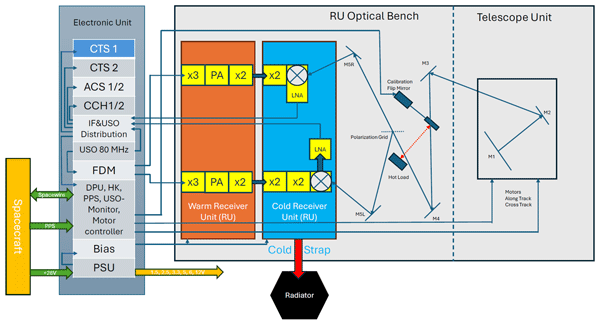
- Line 92: There is no "M5R" in the Figure, only "M5L" and "M5T".
- References: Replace "??, ??" with "this issue".
- I support the last comment by anonymous referee #1 - the answer to his question interests me as well.
Citation: https://doi.org/10.5194/egusphere-2026-1011-RC2 -
RC3: 'Reply on RC2', Anonymous Referee #1, 13 Apr 2026
I agree with all comments of the rewiever 2
Indeed, we don't have a plan for all the articles./ chapters . This section (I) covers a General Overview ; I assumed that the details would be developed in other chapters/ articles.
Citation: https://doi.org/10.5194/egusphere-2026-1011-RC3 -
AC3: 'Reply on RC3', Paul Hartogh, 06 May 2026
correct.
Citation: https://doi.org/10.5194/egusphere-2026-1011-AC3
-
AC3: 'Reply on RC3', Paul Hartogh, 06 May 2026
-
AC2: 'Reply on RC2', Paul Hartogh, 06 May 2026
We would like to thank referee 2 for the fruitful and constructive comments. See our reply below:
The authors give a brief description of Juice/SWI and the main findings from LEGA. Hence the manuscript does not contain any scientific results about the Earth or the Moon, but rather an in-flight characterization of the instrument. This information is essential for answering the question, whether the scientific program can be executed as planned upon arrival at the Jupiter system.
Two major defects of SWI were identified that jeopardize its ability to meet the requirements:
The flux calibration mechanism can carry out only 5% of the planned number of calibration cycles.
The Ultra Stable Oscillator changes its frequency, when the Frequency Distribution Module changes its temperature.
These problems, however, are discussed in greater detail in other contributions to the same, special issue.
I suggest the following, technical corrections.
Line 60: There is no Hartogh et al. 2026 in the list of references, only a 2026a. On the other hand, there is no 2026b among the references, either.
corrected.
Line 73: Delete "a".
done
Line 92: There is no "M5R" in the Figure, only "M5L" and "M5T".
M5T in the figure was corrected by M5R
References: Replace "??, ??" with "this issue".
Replaced by “This issue”
I support the last comment by anonymous referee #1 - the answer to his question interests me as well.
See answer to referee #1
Citation: https://doi.org/10.5194/egusphere-2026-1011-AC2
-
AC1: 'Reply on RC1', Paul Hartogh, 06 May 2026
We thank referee 1 for the constructive and fruitful comments. Please see our replies below:
Very nice instrument; excellent, complete and clear paper ! just minors suggestions to the authors :
line 65 :: "the multiplying circuit is also called frequency mixer" : why mixer ? would-I suggest "Source" ??,
This is an interesting question and it took some investigation to figure out the origin of the component description/designation as mixer or frequency mixer. The heterodyne system was proposed for the first time by Reginald Fessenden in 1901. During that time receiver technology was just at its beginning and new developments were published in general as patents. In 1917 and 1918 two patents on the heterodyne principle including practical implementations were published by Lucien Levy and Edwin Howard Armstrong respectively. The latter had a number of additional patents on heterodyne receivers and their application. In a patent of the year 1920 he introduced the word mixer for the multiplying circuit. Since then, it became the standard designation for this component. We can only guess why Armstrong called it mixer: two different frequencies are applied to a non-linear circuit (e.g. a solid-state diode or in case of Armstrong a vacuum tube). Its IV-curve can be approximated by a power series. Taking its quadratic term and applying the antenna (radio frequency) signal and the sinusoidal local oscillator signal to the circuit will produce sum- and difference frequencies. This process was defined as mixing.
line 68 : to explain the acronyme FDM ?
The acronym FDM is already explained in line 67.
line 72 : this warm LO part , could we use "warm" LO or ambiant temperature LO ?
Good point: we call it “warm” LO-part in the instrument-specific description, but we will clarify what it means and add the typical operational temperature range in space.
line 100 : is-it a offset telescope ? to mention it ?
Indeed, it is an off-axis Cassegrain telescope. Thanks for the reminder. We will add it to the paper.
line 118 : relate t particular calibration.. : I suppose it is : relate to particular...
Thank you for pointing to this typo. We will replace “t” by “to the”.
line 121 : FIR signals , could w say FIR/submm signals ?
Yes, will be added.
line 140 : the satellite contractor : must we use : the spacecraft....?
We will replace “satellite” by “spacecraft”
line 153 : to explain the acronyme NECP ?
We will explain the acronym NECP (Near Earth Commissioning Phase) in the paper.
line 197 + : here is a measured diagram ? would it be interesting to put it in the place ?
The beam widths for the two frequency bands were not directly measured for 600 and 1200 GHz, but for some frequencies above and below, Therefore we do not have a plot for 600 and 1200 GHz. The values in the text were just derived from the measurements of other frequencies. We plan to publish a separate paper on the near-field campaign in the near future.
line 244 : please indicates Observatoire de Paris , LERMA -site de Paris (now called LIRA)
Will be included.
Nb : just a question , line 205 : using the Sun ...would it be possible to make a deconvolution ?
Yes, in principle a deconvolution or retrieval approach could be applied based on data derived by scanning over the extended solar disk (extended in the sense that the apparent diameter of the sun is as large or larger than the SWI beam). The main information would be gained here by scanning over the edge of the sun and therefore the scan resolution should be high enough while scanning over the edges.
However the SWI receiver-spectrometer system is not designed for this application. The SWI signal path is designed in a way to provide an optimal linearity and dynamic range for signals below the hot load temperature (~240 K). Scanning over the extended sun with > 6000 K brightness in the SWI bands will add a very strong noise signal to the receiver noise temperatures of about 1500 K and 3000K respectively and increase the IF output signal by 7 respectively 4 dB. These high levels will not only drive the spectrometers into saturation, deteriorating total power calibration of the instrument, but may even destroy components in the backend due to the high radio frequency power level.
Citation: https://doi.org/10.5194/egusphere-2026-1011-AC1
-
RC2: 'RC2', Anonymous Referee #2, 13 Apr 2026
Peer review completion


Interactive discussion
Status: closed
-
RC1: 'Comment on egusphere-2026-1011', Anonymous Referee #1, 30 Mar 2026
Very nice instrument; excellent, complete and clear paper ! just minors suggestions to the authors :
line 65 :: "the multiplying circuit is also called frequency mixer" : why mixer ? would-I suggest "Source" ??,
line 68 : to explain the acronyme FDM ?
line 72 : this warm LO part , could we use "warm" LO or ambiant temperature LO ?
line 100 : is-it a offset telescope ? to mention it ?
line 118 : relate t particular calibration.. : I suppose it is : relate to particular...
line 121 : FIR signals , could w say FIR/submm signals ?
line 140 : the satellite contractor : must we use : the spacecraft....?
line 153 : to explain the acronyme NECP ?
line 197 + : here is a measured diagram ? would it be interesting to put it in the place ?
line 244 : please indicates Observatoire de Paris , LERMA -site de Paris (now called LIRA)
Nb : just a question , line 205 : using the Sun ...would it be possible to make a deconvolution ?
Citation: https://doi.org/10.5194/egusphere-2026-1011-RC1 -
RC2: 'RC2', Anonymous Referee #2, 13 Apr 2026
The authors give a brief description of Juice/SWI and the main findings from LEGA. Hence the manuscript does not contain any scientific results about the Earth or the Moon, but rather an in-flight characterization of the instrument. This information is essential for answering the question, whether the scientific program can be executed as planned upon arrival at the Jupiter system.
Two major defects of SWI were identified that jeopardize its ability to meet the requirements:
- The flux calibration mechanism can carry out only 5% of the planned number of calibration cycles.
- The Ultra Stable Oscillator changes its frequency, when the Frequency Distribution Module changes its temperature.
These problems, however, are discussed in greater detail in other contributions to the same, special issue.
I suggest the following, technical corrections.
- Line 60: There is no Hartogh et al. 2026 in the list of references, only a 2026a. On the other hand, there is no 2026b among the references, either.
- Line 73: Delete "a".
- Line 92: There is no "M5R" in the Figure, only "M5L" and "M5T".
- References: Replace "??, ??" with "this issue".
- I support the last comment by anonymous referee #1 - the answer to his question interests me as well.
Citation: https://doi.org/10.5194/egusphere-2026-1011-RC2 -
RC3: 'Reply on RC2', Anonymous Referee #1, 13 Apr 2026
I agree with all comments of the rewiever 2
Indeed, we don't have a plan for all the articles./ chapters . This section (I) covers a General Overview ; I assumed that the details would be developed in other chapters/ articles.
Citation: https://doi.org/10.5194/egusphere-2026-1011-RC3 -
AC3: 'Reply on RC3', Paul Hartogh, 06 May 2026
correct.
Citation: https://doi.org/10.5194/egusphere-2026-1011-AC3
-
AC3: 'Reply on RC3', Paul Hartogh, 06 May 2026
-
AC2: 'Reply on RC2', Paul Hartogh, 06 May 2026
We would like to thank referee 2 for the fruitful and constructive comments. See our reply below:
The authors give a brief description of Juice/SWI and the main findings from LEGA. Hence the manuscript does not contain any scientific results about the Earth or the Moon, but rather an in-flight characterization of the instrument. This information is essential for answering the question, whether the scientific program can be executed as planned upon arrival at the Jupiter system.
Two major defects of SWI were identified that jeopardize its ability to meet the requirements:
The flux calibration mechanism can carry out only 5% of the planned number of calibration cycles.
The Ultra Stable Oscillator changes its frequency, when the Frequency Distribution Module changes its temperature.
These problems, however, are discussed in greater detail in other contributions to the same, special issue.
I suggest the following, technical corrections.
Line 60: There is no Hartogh et al. 2026 in the list of references, only a 2026a. On the other hand, there is no 2026b among the references, either.
corrected.
Line 73: Delete "a".
done
Line 92: There is no "M5R" in the Figure, only "M5L" and "M5T".
M5T in the figure was corrected by M5R
References: Replace "??, ??" with "this issue".
Replaced by “This issue”
I support the last comment by anonymous referee #1 - the answer to his question interests me as well.
See answer to referee #1
Citation: https://doi.org/10.5194/egusphere-2026-1011-AC2
-
AC1: 'Reply on RC1', Paul Hartogh, 06 May 2026
We thank referee 1 for the constructive and fruitful comments. Please see our replies below:
Very nice instrument; excellent, complete and clear paper ! just minors suggestions to the authors :
line 65 :: "the multiplying circuit is also called frequency mixer" : why mixer ? would-I suggest "Source" ??,
This is an interesting question and it took some investigation to figure out the origin of the component description/designation as mixer or frequency mixer. The heterodyne system was proposed for the first time by Reginald Fessenden in 1901. During that time receiver technology was just at its beginning and new developments were published in general as patents. In 1917 and 1918 two patents on the heterodyne principle including practical implementations were published by Lucien Levy and Edwin Howard Armstrong respectively. The latter had a number of additional patents on heterodyne receivers and their application. In a patent of the year 1920 he introduced the word mixer for the multiplying circuit. Since then, it became the standard designation for this component. We can only guess why Armstrong called it mixer: two different frequencies are applied to a non-linear circuit (e.g. a solid-state diode or in case of Armstrong a vacuum tube). Its IV-curve can be approximated by a power series. Taking its quadratic term and applying the antenna (radio frequency) signal and the sinusoidal local oscillator signal to the circuit will produce sum- and difference frequencies. This process was defined as mixing.
line 68 : to explain the acronyme FDM ?
The acronym FDM is already explained in line 67.
line 72 : this warm LO part , could we use "warm" LO or ambiant temperature LO ?
Good point: we call it “warm” LO-part in the instrument-specific description, but we will clarify what it means and add the typical operational temperature range in space.
line 100 : is-it a offset telescope ? to mention it ?
Indeed, it is an off-axis Cassegrain telescope. Thanks for the reminder. We will add it to the paper.
line 118 : relate t particular calibration.. : I suppose it is : relate to particular...
Thank you for pointing to this typo. We will replace “t” by “to the”.
line 121 : FIR signals , could w say FIR/submm signals ?
Yes, will be added.
line 140 : the satellite contractor : must we use : the spacecraft....?
We will replace “satellite” by “spacecraft”
line 153 : to explain the acronyme NECP ?
We will explain the acronym NECP (Near Earth Commissioning Phase) in the paper.
line 197 + : here is a measured diagram ? would it be interesting to put it in the place ?
The beam widths for the two frequency bands were not directly measured for 600 and 1200 GHz, but for some frequencies above and below, Therefore we do not have a plot for 600 and 1200 GHz. The values in the text were just derived from the measurements of other frequencies. We plan to publish a separate paper on the near-field campaign in the near future.
line 244 : please indicates Observatoire de Paris , LERMA -site de Paris (now called LIRA)
Will be included.
Nb : just a question , line 205 : using the Sun ...would it be possible to make a deconvolution ?
Yes, in principle a deconvolution or retrieval approach could be applied based on data derived by scanning over the extended solar disk (extended in the sense that the apparent diameter of the sun is as large or larger than the SWI beam). The main information would be gained here by scanning over the edge of the sun and therefore the scan resolution should be high enough while scanning over the edges.
However the SWI receiver-spectrometer system is not designed for this application. The SWI signal path is designed in a way to provide an optimal linearity and dynamic range for signals below the hot load temperature (~240 K). Scanning over the extended sun with > 6000 K brightness in the SWI bands will add a very strong noise signal to the receiver noise temperatures of about 1500 K and 3000K respectively and increase the IF output signal by 7 respectively 4 dB. These high levels will not only drive the spectrometers into saturation, deteriorating total power calibration of the instrument, but may even destroy components in the backend due to the high radio frequency power level.
Citation: https://doi.org/10.5194/egusphere-2026-1011-AC1
-
RC2: 'RC2', Anonymous Referee #2, 13 Apr 2026
Peer review completion
Journal article(s) based on this preprint
Viewed
| HTML | XML | Total | BibTeX | EndNote | |
|---|---|---|---|---|---|
| 912 | 560 | 115 | 1,587 | 98 | 113 |
- HTML: 912
- PDF: 560
- XML: 115
- Total: 1,587
- BibTeX: 98
- EndNote: 113
Viewed (geographical distribution)
| Country | # | Views | % |
|---|
| Total: | 0 |
| HTML: | 0 |
| PDF: | 0 |
| XML: | 0 |
- 1
Cited


1 citations as recorded by crossref.

Ladislav Rezac
Thibault Cavalié
Christopher Jarchow
Raphael Moreno
Ali Schulz-Ravanbakhsh
Alberto Carrasco Gallardo
Borys Dabrowski
Samuel Goodyear
Miriam Rengel
Fabrice Herpin
Yasuko Kasai
Mikko Kotiranta
Emmanuel Lellouch
Axel Murk
Michael Olberg
Slawomira Szutowicz
Eva Wirström
The requested preprint has a corresponding peer-reviewed final revised paper. You are encouraged to refer to the final revised version.
- Preprint
(921 KB) - Metadata XML
Very nice instrument; excellent, complete and clear paper ! just minors suggestions to the authors :
line 65 :: "the multiplying circuit is also called frequency mixer" : why mixer ? would-I suggest "Source" ??,
line 68 : to explain the acronyme FDM ?
line 72 : this warm LO part , could we use "warm" LO or ambiant temperature LO ?
line 100 : is-it a offset telescope ? to mention it ?
line 118 : relate t particular calibration.. : I suppose it is : relate to particular...
line 121 : FIR signals , could w say FIR/submm signals ?
line 140 : the satellite contractor : must we use : the spacecraft....?
line 153 : to explain the acronyme NECP ?
line 197 + : here is a measured diagram ? would it be interesting to put it in the place ?
line 244 : please indicates Observatoire de Paris , LERMA -site de Paris (now called LIRA)
Nb : just a question , line 205 : using the Sun ...would it be possible to make a deconvolution ?