
the Creative Commons Attribution 4.0 License.
the Creative Commons Attribution 4.0 License.
 | 11 Mar 2026
Exploring divergent long-term stratospheric aerosol injection scenarios with the G2-SAI and ARISE-hybrid experiments
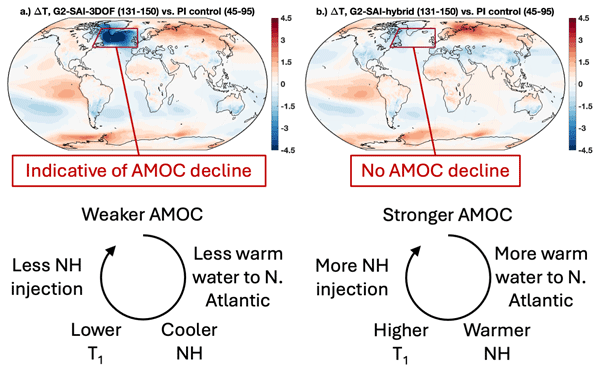
Abstract. Stratospheric aerosol injection (SAI) simulations are often short relative to climatic timescales and conducted against a background that evolves due to changes in anthropogenic greenhouse gas emissions and other forcings. This can cause challenges in assessing certain impacts of the intervention, especially for aspects of the climate that respond slowly to such changes. The early Geoengineering Model Intercomparison Project (GeoMIP) G2 experiment prescribes solar dimming to offset 1%CO2 forcing in a preindustrial control background. Here we propose a new G2-SAI experiment, in which SAI is applied in the same scenario, to isolate SAI climate responses from transient changes other than CO2. Using the Community Earth System Model (CESM2), we present three 150-year "G2-SAI" simulations which use contemporary SAI strategies: two use the commonly-used "three degree-of-freedom" ("3DOF") strategy, in which independent injections at 30° N, 15° N, 15° S, and 30° S are used to manage global mean temperature (T0) and large-scale meridional temperature gradients (T1, T2). Our third G2-SAI simulation uses a "1DOF" strategy that injects at 30°N and 30°S to manage global mean temperature only. Our two 3DOF simulations both maintain the same temperature targets; however, one simulation, which injects mostly at 15° S, slows but does not prevent the decline of the Atlantic Meridional Overturning Circulation (AMOC) compared to the baseline simulation, while the other, which injects mostly at 30° N and 30° S, stops the decline of AMOC entirely, similarly to the 1DOF simulation. These results demonstrate that multiple distinct Earth system states can satisfy the same temperature targets, challenging the assumption of linearity commonly used in strategy design. In addition, the results highlight that long simulations are required to identify some of the long-term impacts of SAI, such as AMOC changes. Using this knowledge, we revisit the ARISE-SAI-1.5 experiment and modify the injection strategy without changing the temperature targets, producing an "ARISE-hybrid" ensemble. We demonstrate that this results in some significant differences in the climate response to SAI, with implications for the perceived effects of the intervention.
-
Notice on discussion status
The requested preprint has a corresponding peer-reviewed final revised paper. You are encouraged to refer to the final revised version.
-
Preprint
(4924 KB)
-
Supplement
(437 KB)
-
The requested preprint has a corresponding peer-reviewed final revised paper. You are encouraged to refer to the final revised version.
- Preprint
(4924 KB) - Metadata XML
-
Supplement
(437 KB) - BibTeX
- EndNote
- Final revised paper


Journal article(s) based on this preprint
Interactive discussion
Status: closed
-
RC1: 'Comment on egusphere-2026-1004', Anonymous Referee #1, 15 Apr 2026
- AC1: 'Reply on RC1', Walker Lee, 06 Jun 2026
-
RC2: 'Comment on egusphere-2026-1004', Anonymous Referee #2, 26 Apr 2026
In the work, Lee et al. propose an updated version of the earlier iteration of the GeoMIP G2 experiment which originally involved a “time dependent insolation decrease to offset the radiative flux perturbations from a scenarios in which CO2 concentrations increase by 1% per year from pre-industrial levels” [Kravitz et al. 2013]. Authors use this background emissions scenario to test three unique SAI injection strategies:
- Injection at 30N, 15N, 15S and 30S to manage global average surface temperature large scale meridional temperature gradients
- Injection at 30N and 30S to manage global mean surface temperature
Authors find that while all scenarios meet the same surface temperature objective …achieving this state with injection dominated at 15S fails to slow the decline of the AMOC; ultimately challenging the idea of linearity used in contemporary strategy design. These findings are used to revisit the ARISE-SAI-1.5 simulations.
In general, I find this work an important addition to the literature by providing evidence to support the need to better understand potential non linearities in the climate response under the same surface temperature response. Ultimately, I think this work will provide motivation to the SRM community to invest in further mechanistic and process levels studies to improve assessment of why such non-linearities exist. Additionally, assessment of the AMOC response to SAI with a higher control on background CO2 emissions represents a timely investigation given recent literature to suggest the first observed decline in AMOC strength; making such simulations important to the global tipping points discussion. One major comment to the authors is consideration of splitting out the discussion of the revision of the ARISE-SAI-1.5 into a separate work and expanding the AMOC related findings from the G2 simulations, more robustly building out this section. The presentation of the G2 simulations alone is well founded and generates a substantial amount of results that constitute a clear addition to the literature as a stand-alone study. The introduction of the ARISE SAI revisit makes sense but it does make more work for the reader and I worry it could reduce visibility of your already very interesting and important findings from the novel G2 work. I leave this choice up to the authors. Below I discuss several additional minor comments.
Minor Comments:
Line 135: It remains somewhat unclear what the G2-SAI-hybrid setup refers to. It is clear from the current text that it is one of two 3-DOF scenarios which seeks to maintain targets T0, T1, T2, but it is unclear what differentiates it from the G2-SAI-3DOF scenario when first introduced. I would suggest the authors add a bit more text to make this more clear. This comment extends to the abstract, where I would suggest making more clear the differences between the two 3DOF simulations. As it reads now I initially thought one 3DOF simulation sought to control for T0 and the other sought to control T1, T2. This can be made more clear. One might consider moving information from line 170 “the term hybrid is chosen to reflect the combined aspects of both the 3DOF and 1DOF strategies,” higher in the text when the G2-SAI-hybrid is introduced.
Table 1: in the same way, I would recommend an additional column in Table 1 to help the reader understand the differences between G2-SAI-3DOF and G2-SAI-hybrid, which otherwise look identical from the table as is.
Line 185/Figure 2b: Changes in the slope of plots of Tg-SO2 per year vs. deg. C cooling are estimated to say that for G2-SAI the injections cool less efficiently above 10 Tg/year. I wonder if authors could provide some measure of or correction to the interannual variability in the cooling efficiency in the context of these estimated slopes? In addition to a lessoning of the efficiency, is there also greater year to year variability in the later years of the simulation? If so why might this be?
Figure 4 : I might try to make the panels under “Stratospheric 550 nam per Tg SO2 / yr” and “Residual d near -surface T” slightly larger. This figure was an extremely useful visual representation of the inter-scenario differences and would merit taking up more room on the page. For ease of reading I would also suggest thickening the lines and moving the legend which covers both sub sections to the bottom to be a bit clearer.
Section 3.2 : authors may consider creating separate sections for AMOC response and the surface temperature/precipitation response. I would recommend showing the reader the surface temperature/precipitation plots before an in depth discussion of the AMOC response which then helps to explain why the G2 – 3DOF scenarios differ in responsive injection latitudes as a function of temperature itself. I realize section 3.1 was results of the G2 SAI scenarios, but I would consider breaking out the section discussing AMOC separately as it is discussed in comparison with the other pre-existing simulations. I acknowledge one relies on the other – the northern hemisphere temperature changes are dependent on the decline of the AMOC. It may be useful to tie these sections together by providing overlapping time vs. metric plots of norther hemisphere T change vs. some metric of the AMOC – as a visualization of this relationship.
Line 264: might be more specific and say “warming patterns across the two background ghg scenarios” … this section is good but was just a lot to digest as the reader keeping track of all the simulations so wherever possible being super specific is helpful – (which in general I think the authors have achieved).
Figure 6-7: For visual clarity for these large multi -panel plots, authors might consider making clear rows for the different simulations (eg moving the labels G2-SAI-1DOF) to the far left highlighting that all members of that row are the same simulation. The repetition of labels and colorbars makes the reader have to parse if there are differences in every single map. Reducing visual noise here could really help simplify for the viewer.
295-300: It would be really clarifying to include in the supplementary material a plot of latitude (x axis) vs. d-precip (yaxis) for each scenario. This helps to easily summarize the descriptions and similarities discussed in this section which otherwise do take quite a bit of time to get to. I think this would help the important results of your work sink in for folks a bit more.
Citation: https://doi.org/10.5194/egusphere-2026-1004-RC2 - AC1: 'Reply on RC1', Walker Lee, 06 Jun 2026
Peer review completion


Interactive discussion
Status: closed
-
RC1: 'Comment on egusphere-2026-1004', Anonymous Referee #1, 15 Apr 2026
This manuscript introduces a new set of long term experiments, G2-SAI, to better isolate and understand the impacts of stratospheric aerosol injection (SAI), and propose them as new GeoMIP experiments. Using CESM2, the authors show that the commonly used feedback algorithm, when adjusted, can result in the scenario meeting the same temperature targets using different injection location magnitudes. These different injections can produce fundamentally different climate states, especially through their influence on the AMOC, whilst still achieving the same temperature targets. The study highlights the importance of longer simulations to capture slower climate feedbacks, and shows that small changes in the feedback algorithm can change the resulting climate impacts.
This paper is very well written and formulated. The revision of the ARISE simulations are particularly interesting. I recommend it for publication and have only a few comments below.
General comments
Section 2.2: Please could you clarify the algorithm used for G2-SAI-hybrid. You discuss in this section that l0 determines the injection for 15°N+15°S and its l1 and l2 which determine how much is injected in 30°N+30°S, how does the hybrid scenario determine injection at 30°N+30°S if l1 and l2 are turned off? It might be worth expanding on your explanation of this scenario in this section. It was not immediately clear that the three temperature targets were still being used when you discuss turning off the feedforward terms.
Section 3.2:
I really like how you have displayed the figures as “per degree of warming” but I think the way you have done this could be better explained in the opening paragraph. I think you get to some of that in the figure caption but this section would benefit from further explanation in the main text as to how you calculate the “per unit warming”. Personally, the addition of the global mean temperature increase values in the figure caption helped me understand what you had done, so perhaps adding that to the main text would help. Lines 259-261 discussing the average of the maps added confusion for me personally, so might benefit from further explanation.
Regarding the precipitation changes, I agree that a detailed investigation would be beyond the scope of the study. But it might be worth mentioning again that for the G2-SAI simulations you are only looking at one ensemble member and precipitation is highly variable and would benefit from multiple ensemble members to determine any specific impacts.
Specific comments
Line 149: remove “above”
Lines 150-152: “Feedback gains, which adjust the injection rates each year based on the error (the difference between the actual and desired model behavior) over the course of the simulation.”
Figure 1: It might be worth adjusting the width of the ensemble mean lines, it looks quite messy with the variation, in particular the black lines. This is an aesthetic judgement which the authors should feel free to ignore.
Line 196: 4f not 4f-g
Lines 200-201: “AOD distributions in years 16-35 of injection likewise have similar shapes.” Please add a reference to 4g here.
Lines 225-228: Figure references should be 5 not 4.
Line 229: Figure reference should be 4 not 3.
Line 272: Should that read “compare Figs 5a and 8d”?
Citation: https://doi.org/10.5194/egusphere-2026-1004-RC1 - AC1: 'Reply on RC1', Walker Lee, 06 Jun 2026
-
RC2: 'Comment on egusphere-2026-1004', Anonymous Referee #2, 26 Apr 2026
In the work, Lee et al. propose an updated version of the earlier iteration of the GeoMIP G2 experiment which originally involved a “time dependent insolation decrease to offset the radiative flux perturbations from a scenarios in which CO2 concentrations increase by 1% per year from pre-industrial levels” [Kravitz et al. 2013]. Authors use this background emissions scenario to test three unique SAI injection strategies:
- Injection at 30N, 15N, 15S and 30S to manage global average surface temperature large scale meridional temperature gradients
- Injection at 30N and 30S to manage global mean surface temperature
Authors find that while all scenarios meet the same surface temperature objective …achieving this state with injection dominated at 15S fails to slow the decline of the AMOC; ultimately challenging the idea of linearity used in contemporary strategy design. These findings are used to revisit the ARISE-SAI-1.5 simulations.
In general, I find this work an important addition to the literature by providing evidence to support the need to better understand potential non linearities in the climate response under the same surface temperature response. Ultimately, I think this work will provide motivation to the SRM community to invest in further mechanistic and process levels studies to improve assessment of why such non-linearities exist. Additionally, assessment of the AMOC response to SAI with a higher control on background CO2 emissions represents a timely investigation given recent literature to suggest the first observed decline in AMOC strength; making such simulations important to the global tipping points discussion. One major comment to the authors is consideration of splitting out the discussion of the revision of the ARISE-SAI-1.5 into a separate work and expanding the AMOC related findings from the G2 simulations, more robustly building out this section. The presentation of the G2 simulations alone is well founded and generates a substantial amount of results that constitute a clear addition to the literature as a stand-alone study. The introduction of the ARISE SAI revisit makes sense but it does make more work for the reader and I worry it could reduce visibility of your already very interesting and important findings from the novel G2 work. I leave this choice up to the authors. Below I discuss several additional minor comments.
Minor Comments:
Line 135: It remains somewhat unclear what the G2-SAI-hybrid setup refers to. It is clear from the current text that it is one of two 3-DOF scenarios which seeks to maintain targets T0, T1, T2, but it is unclear what differentiates it from the G2-SAI-3DOF scenario when first introduced. I would suggest the authors add a bit more text to make this more clear. This comment extends to the abstract, where I would suggest making more clear the differences between the two 3DOF simulations. As it reads now I initially thought one 3DOF simulation sought to control for T0 and the other sought to control T1, T2. This can be made more clear. One might consider moving information from line 170 “the term hybrid is chosen to reflect the combined aspects of both the 3DOF and 1DOF strategies,” higher in the text when the G2-SAI-hybrid is introduced.
Table 1: in the same way, I would recommend an additional column in Table 1 to help the reader understand the differences between G2-SAI-3DOF and G2-SAI-hybrid, which otherwise look identical from the table as is.
Line 185/Figure 2b: Changes in the slope of plots of Tg-SO2 per year vs. deg. C cooling are estimated to say that for G2-SAI the injections cool less efficiently above 10 Tg/year. I wonder if authors could provide some measure of or correction to the interannual variability in the cooling efficiency in the context of these estimated slopes? In addition to a lessoning of the efficiency, is there also greater year to year variability in the later years of the simulation? If so why might this be?
Figure 4 : I might try to make the panels under “Stratospheric 550 nam per Tg SO2 / yr” and “Residual d near -surface T” slightly larger. This figure was an extremely useful visual representation of the inter-scenario differences and would merit taking up more room on the page. For ease of reading I would also suggest thickening the lines and moving the legend which covers both sub sections to the bottom to be a bit clearer.
Section 3.2 : authors may consider creating separate sections for AMOC response and the surface temperature/precipitation response. I would recommend showing the reader the surface temperature/precipitation plots before an in depth discussion of the AMOC response which then helps to explain why the G2 – 3DOF scenarios differ in responsive injection latitudes as a function of temperature itself. I realize section 3.1 was results of the G2 SAI scenarios, but I would consider breaking out the section discussing AMOC separately as it is discussed in comparison with the other pre-existing simulations. I acknowledge one relies on the other – the northern hemisphere temperature changes are dependent on the decline of the AMOC. It may be useful to tie these sections together by providing overlapping time vs. metric plots of norther hemisphere T change vs. some metric of the AMOC – as a visualization of this relationship.
Line 264: might be more specific and say “warming patterns across the two background ghg scenarios” … this section is good but was just a lot to digest as the reader keeping track of all the simulations so wherever possible being super specific is helpful – (which in general I think the authors have achieved).
Figure 6-7: For visual clarity for these large multi -panel plots, authors might consider making clear rows for the different simulations (eg moving the labels G2-SAI-1DOF) to the far left highlighting that all members of that row are the same simulation. The repetition of labels and colorbars makes the reader have to parse if there are differences in every single map. Reducing visual noise here could really help simplify for the viewer.
295-300: It would be really clarifying to include in the supplementary material a plot of latitude (x axis) vs. d-precip (yaxis) for each scenario. This helps to easily summarize the descriptions and similarities discussed in this section which otherwise do take quite a bit of time to get to. I think this would help the important results of your work sink in for folks a bit more.
Citation: https://doi.org/10.5194/egusphere-2026-1004-RC2 - AC1: 'Reply on RC1', Walker Lee, 06 Jun 2026
Peer review completion
Journal article(s) based on this preprint
Viewed
| HTML | XML | Total | Supplement | BibTeX | EndNote | |
|---|---|---|---|---|---|---|
| 1,407 | 691 | 100 | 2,198 | 146 | 100 | 96 |
- HTML: 1,407
- PDF: 691
- XML: 100
- Total: 2,198
- Supplement: 146
- BibTeX: 100
- EndNote: 96
Viewed (geographical distribution)
| Country | # | Views | % |
|---|
| Total: | 0 |
| HTML: | 0 |
| PDF: | 0 |
| XML: | 0 |
- 1

Simone Tilmes
Ewa M. Bednarz
The requested preprint has a corresponding peer-reviewed final revised paper. You are encouraged to refer to the final revised version.
- Preprint
(4924 KB) - Metadata XML
-
Supplement
(437 KB) - BibTeX
- EndNote
- Final revised paper
This manuscript introduces a new set of long term experiments, G2-SAI, to better isolate and understand the impacts of stratospheric aerosol injection (SAI), and propose them as new GeoMIP experiments. Using CESM2, the authors show that the commonly used feedback algorithm, when adjusted, can result in the scenario meeting the same temperature targets using different injection location magnitudes. These different injections can produce fundamentally different climate states, especially through their influence on the AMOC, whilst still achieving the same temperature targets. The study highlights the importance of longer simulations to capture slower climate feedbacks, and shows that small changes in the feedback algorithm can change the resulting climate impacts.
This paper is very well written and formulated. The revision of the ARISE simulations are particularly interesting. I recommend it for publication and have only a few comments below.
General comments
Section 2.2: Please could you clarify the algorithm used for G2-SAI-hybrid. You discuss in this section that l0 determines the injection for 15°N+15°S and its l1 and l2 which determine how much is injected in 30°N+30°S, how does the hybrid scenario determine injection at 30°N+30°S if l1 and l2 are turned off? It might be worth expanding on your explanation of this scenario in this section. It was not immediately clear that the three temperature targets were still being used when you discuss turning off the feedforward terms.
Section 3.2:
I really like how you have displayed the figures as “per degree of warming” but I think the way you have done this could be better explained in the opening paragraph. I think you get to some of that in the figure caption but this section would benefit from further explanation in the main text as to how you calculate the “per unit warming”. Personally, the addition of the global mean temperature increase values in the figure caption helped me understand what you had done, so perhaps adding that to the main text would help. Lines 259-261 discussing the average of the maps added confusion for me personally, so might benefit from further explanation.
Regarding the precipitation changes, I agree that a detailed investigation would be beyond the scope of the study. But it might be worth mentioning again that for the G2-SAI simulations you are only looking at one ensemble member and precipitation is highly variable and would benefit from multiple ensemble members to determine any specific impacts.
Specific comments
Line 149: remove “above”
Lines 150-152: “Feedback gains, which adjust the injection rates each year based on the error (the difference between the actual and desired model behavior) over the course of the simulation.”
Figure 1: It might be worth adjusting the width of the ensemble mean lines, it looks quite messy with the variation, in particular the black lines. This is an aesthetic judgement which the authors should feel free to ignore.
Line 196: 4f not 4f-g
Lines 200-201: “AOD distributions in years 16-35 of injection likewise have similar shapes.” Please add a reference to 4g here.
Lines 225-228: Figure references should be 5 not 4.
Line 229: Figure reference should be 4 not 3.
Line 272: Should that read “compare Figs 5a and 8d”?