
the Creative Commons Attribution 4.0 License.
the Creative Commons Attribution 4.0 License.
 | 08 Jan 2026
Contrasting different noise models for representing westerly wind bursts in a recharge oscillator model of ENSO
Abstract. Westerly wind bursts (WWBs) have long been known to have a major impact on the development of El Niño events. In particular, they amplify these events, with stronger events associated with a higher number of WWBs. We further find indications that WWBs lead to a more monotonically increasing evolution of warming events. We consider here a noise-driven recharge oscillator model of ENSO. Commonly, WWBs are represented by a state-dependent Gaussian noise which naturally reproduces the amplification of warm events. However, we show that many properties of WWBs and their effects on sea surface temperature (SST) are not well captured by such Gaussian noise. Instead, we show that conditional additive and multiplicative (CAM) noise presents a promising alternative. In addition to recovering the sporadic nature of WWBs, CAM noise leads to an asymmetry between El Niño and La Niña events without the need for deterministic nonlinearities. Furthermore, CAM noise generates a more monotonic increase of extreme warming events with a higher frequency of WWBs accompanying the largest events. This suggests that extreme warm events are better modelled by CAM noise. To cover the full spectrum of warm events we propose a conditional noise model in which the wind stress is modelled by additive Gaussian noise for sufficiently small SSTs and by additive CAM noise once the SST exceeds a certain threshold. We show that this conditional noise model captures the observed properties of WWBs reasonably well.
-
Notice on discussion status
The requested preprint has a corresponding peer-reviewed final revised paper. You are encouraged to refer to the final revised version.
-
Preprint
(0 KB)
-
The requested preprint has a corresponding peer-reviewed final revised paper. You are encouraged to refer to the final revised version.


Journal article(s) based on this preprint
Interactive discussion
Status: closed
- RC1: 'Comment on egusphere-2025-6535', Anonymous Referee #1, 16 Feb 2026
-
RC2: 'Comment on egusphere-2025-6535', Anonymous Referee #2, 28 Apr 2026
This manuscript investigates the representation of Westerly Wind Bursts (WWBs) in a Recharge Oscillator (RO) model of ENSO by comparing three stochastic forcing schemes: a multiplicative OU process, additive CAM noise, and a state-dependent Conditional (CON) noise model. The authors propose that the non-Gaussian nature of CAM/CON noise better captures the "monotonicity" and WWB frequency observed in extreme El Niño events. While the topic is of great interest to the climate dynamics community, there are several critical issues regarding the clarity of the motivation, the consistency of the statistical evidence, and the lack of direct comparison with observational data.
Major Comments:
- The Introduction is currently somewhat unclear. (1) The authors need to explain the limitations of the classical multiplicative Gaussian-noise approach more explicitly. For example, is the main motivation that an OU process cannot adequately represent the highly nonlinear and intermittent nature of westerly wind bursts (WWBs)? (2) The transition from CAM noise to the proposed CON model feels a bit abrupt. The authors state that CAM noise is “more appropriate” for warm environments, but this claim would benefit from clearer literature support. The manuscript needs to better discuss the limitations of using either a purely OU/Gaussian noise model or a multiplicative CAM-noise model. For instance, is the CON model introduced because CAM noise alone produces unrealistic La Niña behavior or cold-phase statistics? Without showing where the simpler OU-only or CAM-only approaches fail, the propose for the CON model may appear somewhat ad hoc, mainly introduced to fit the NINO3 PDF rather than as a physically motivated improvement. I suggest that the authors clarify this logic in the Introduction and, if possible, include a brief comparison showing the limitations of the OU-only and/or CAM-only approaches. Since the authors argue that WWBs resemble CAM noise, it would also be helpful to clarify whether this type of noise has been applied to ENSO models in previous studies, and to strengthen the physical or literature-based justification for using CAM/CON noise in the RO model instead of more traditional noise schemes.
- For Figures 4 to 6, the Results section lacks clarity regarding the advantages of the proposed models. In Figure 4, the traditional OU process (4a) appears to have a smaller variance, and its simulated mean (black dot) is closer to the observations (red dot) than the CON model (4c). In Figure 6, based on the PDF results, the OU process seems more consistent with observations, as the simulated curve stays mostly within the 5-95% confidence interval (blue and beige bars) if I understand correctly. Conversely, CAM and CON models show significant deviations at the peak of the PDF. The authors claim on page 6 that "... all three noise models are capable of reproducing the global statistics reasonably well," but this is a qualitative statement. I suggest using a quantitative metric (e.g., Kolmogorov-Smirnov test or RMSE) between observations and models to justify this claim. If the OU model provides a better statistical fit, the authors should explicitly discuss the trade-off between "statistical fit" and "dynamical realism."
- A recurring issue is the absence of direct observational benchmarks in the dynamical analysis in Figures 5, 7, & 9. Figure 5: The simulated SST time series is shown in isolation. Without a side-by-side comparison with the observed NINO3 time series, it is impossible to evaluate if the "morphology" or "intermittency" has been improved. Figure 7: I think this is one of the most interesting results of the paper, yet it lacks an observational equivalent. The authors should calculate the number of strong WWBs preceding historical El Niño events and include this as a reference histogram. Figure 9: The monotonicity measure μ is an innovative diagnostic. However, to validate its utility, the authors need to calculate μ from the observed NINO3 index (e.g., for the 22 events mentioned) and mark these values on the plots. This would provide a definitive test of whether CAM/CON noise truly captures the "fingerprint" of real-world events better than the OU process.
Minor Comments:
- Figure 6 caption: The caption mentions a "green line," but I only see blue bars and red/black curves. I assume "green" refers to the "blue"? Please ensure the colors in the caption match the figure. Additionally, please define exactly what the red line represents in all subplots of the figure.
- Missing Line Numbers: The manuscript lacks line numbers. Please include them in the revised version.
- Parameter Sensitivity: The parameters in Table I appear highly tuned for each model. Please discuss whether the improved monotonicity in the CON model is a robust feature of CAM noise or sensitive to specific parameter selections.
Citation: https://doi.org/10.5194/egusphere-2025-6535-RC2 -
AC1: 'Comment on egusphere-2025-6535', Georg Gottwald, 25 Jun 2026
The comment was uploaded in the form of a supplement: https://egusphere.copernicus.org/preprints/2026/egusphere-2025-6535/egusphere-2025-6535-AC1-supplement.pdf


Interactive discussion
Status: closed
-
RC1: 'Comment on egusphere-2025-6535', Anonymous Referee #1, 16 Feb 2026
This manuscript describes the role of various noise approximations to the role of Westerly Wind bursts (WWBs) on the development of large amplitude El Nino events. The finding that conditional additive and multiplicative (CAM) noise is a reasonable approximation to intermittent WWBs with impacts on asymmetries between El Nino and La Nina events is perhaps not unsurprising given the literature on applications of noise in linear inverse models (LIMs). However the demonstration within a simplified framework of the recharge oscillator model is somewhat novel. In general, this work is well described, clear and accessible to a wide audience. It is entirely appropriate for NPG.
Given the effort to produce the conditional noise model (CON) I am somewhat confused that this is not at all mentioned in the abstract nor why the paper only has a focus on large amplitude El Nino and not on the ability to reproduce the observed La Nina amplitudes.
Specific comments:
Paragraph 1; Line 1: Reference [1] is to an ECMWF tech. report from 1997. I suggest replacing this with a more up to date reference that takes into account the most recent decades.
Paragraph 2; Line 1: What is the "inferred measure of the time-integrated wind stress associated with WWBs"? Is it simply wind stress anomalies? Please explicitly state what is calculated in Figure 1. Also why use CESM rather than a reanalysis e.g. ERA5. I would further suggest combining the observed time integrated wind stress due to WWBs with the observed NINO3 index and demonstrate i.e. quantify the relationship.
Page 2: regarding Gaussian multiplicative noise on East Pacific SST, please provide references to the "... emerging consensus in the ENSO literature".
Page 3: Last sentence before section"Noise Models": missing section number. i.e., "in section ? we will discuss ..."
Sentence following Equation 8: \nu_{2} is undefined.
Page 6: Combine Fig3 with new Fig1 observed WWBs.
Fig 4: Please quantify the differences between observed and estimated variance and skewness. By eye, it appears that OU is a better fit than either CAM or CON.
Fig5: I do not see the relevance of these timeseries segments. Please provide a quantitative measure or drop the figure.
Fig8: Please provide a table with the dates of the chosen events. Further, it is quite obvious that many of these events are not monotonically increasing until at least t=-6 months. Choosing only the 4 most extreme cases does not strengthen the argument when all chosen cases are exceeding the threshold.
Citation: https://doi.org/10.5194/egusphere-2025-6535-RC1 -
RC2: 'Comment on egusphere-2025-6535', Anonymous Referee #2, 28 Apr 2026
This manuscript investigates the representation of Westerly Wind Bursts (WWBs) in a Recharge Oscillator (RO) model of ENSO by comparing three stochastic forcing schemes: a multiplicative OU process, additive CAM noise, and a state-dependent Conditional (CON) noise model. The authors propose that the non-Gaussian nature of CAM/CON noise better captures the "monotonicity" and WWB frequency observed in extreme El Niño events. While the topic is of great interest to the climate dynamics community, there are several critical issues regarding the clarity of the motivation, the consistency of the statistical evidence, and the lack of direct comparison with observational data.
Major Comments:
- The Introduction is currently somewhat unclear. (1) The authors need to explain the limitations of the classical multiplicative Gaussian-noise approach more explicitly. For example, is the main motivation that an OU process cannot adequately represent the highly nonlinear and intermittent nature of westerly wind bursts (WWBs)? (2) The transition from CAM noise to the proposed CON model feels a bit abrupt. The authors state that CAM noise is “more appropriate” for warm environments, but this claim would benefit from clearer literature support. The manuscript needs to better discuss the limitations of using either a purely OU/Gaussian noise model or a multiplicative CAM-noise model. For instance, is the CON model introduced because CAM noise alone produces unrealistic La Niña behavior or cold-phase statistics? Without showing where the simpler OU-only or CAM-only approaches fail, the propose for the CON model may appear somewhat ad hoc, mainly introduced to fit the NINO3 PDF rather than as a physically motivated improvement. I suggest that the authors clarify this logic in the Introduction and, if possible, include a brief comparison showing the limitations of the OU-only and/or CAM-only approaches. Since the authors argue that WWBs resemble CAM noise, it would also be helpful to clarify whether this type of noise has been applied to ENSO models in previous studies, and to strengthen the physical or literature-based justification for using CAM/CON noise in the RO model instead of more traditional noise schemes.
- For Figures 4 to 6, the Results section lacks clarity regarding the advantages of the proposed models. In Figure 4, the traditional OU process (4a) appears to have a smaller variance, and its simulated mean (black dot) is closer to the observations (red dot) than the CON model (4c). In Figure 6, based on the PDF results, the OU process seems more consistent with observations, as the simulated curve stays mostly within the 5-95% confidence interval (blue and beige bars) if I understand correctly. Conversely, CAM and CON models show significant deviations at the peak of the PDF. The authors claim on page 6 that "... all three noise models are capable of reproducing the global statistics reasonably well," but this is a qualitative statement. I suggest using a quantitative metric (e.g., Kolmogorov-Smirnov test or RMSE) between observations and models to justify this claim. If the OU model provides a better statistical fit, the authors should explicitly discuss the trade-off between "statistical fit" and "dynamical realism."
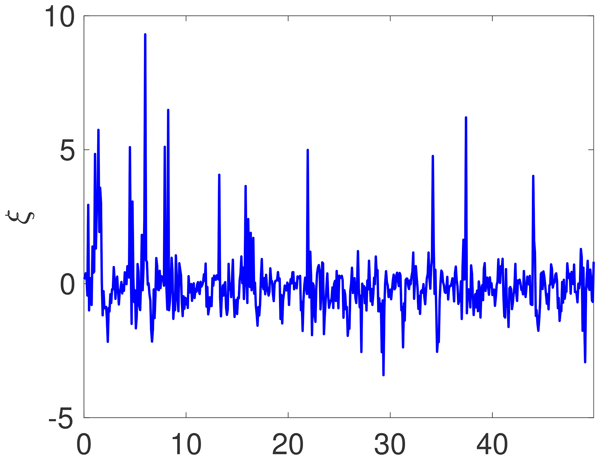
- A recurring issue is the absence of direct observational benchmarks in the dynamical analysis in Figures 5, 7, & 9. Figure 5: The simulated SST time series is shown in isolation. Without a side-by-side comparison with the observed NINO3 time series, it is impossible to evaluate if the "morphology" or "intermittency" has been improved. Figure 7: I think this is one of the most interesting results of the paper, yet it lacks an observational equivalent. The authors should calculate the number of strong WWBs preceding historical El Niño events and include this as a reference histogram. Figure 9: The monotonicity measure μ is an innovative diagnostic. However, to validate its utility, the authors need to calculate μ from the observed NINO3 index (e.g., for the 22 events mentioned) and mark these values on the plots. This would provide a definitive test of whether CAM/CON noise truly captures the "fingerprint" of real-world events better than the OU process.
Minor Comments:
- Figure 6 caption: The caption mentions a "green line," but I only see blue bars and red/black curves. I assume "green" refers to the "blue"? Please ensure the colors in the caption match the figure. Additionally, please define exactly what the red line represents in all subplots of the figure.
- Missing Line Numbers: The manuscript lacks line numbers. Please include them in the revised version.
- Parameter Sensitivity: The parameters in Table I appear highly tuned for each model. Please discuss whether the improved monotonicity in the CON model is a robust feature of CAM noise or sensitive to specific parameter selections.
Citation: https://doi.org/10.5194/egusphere-2025-6535-RC2 -
AC1: 'Comment on egusphere-2025-6535', Georg Gottwald, 25 Jun 2026
The comment was uploaded in the form of a supplement: https://egusphere.copernicus.org/preprints/2026/egusphere-2025-6535/egusphere-2025-6535-AC1-supplement.pdf
Peer review completion


Journal article(s) based on this preprint
Viewed
Since the preprint corresponding to this journal article was posted outside of Copernicus Publications, the preprint-related metrics are limited to HTML views.
| HTML | XML | Total | BibTeX | EndNote | |
|---|---|---|---|---|---|
| 910 | 0 | 6 | 916 | 0 | 0 |
- HTML: 910
- PDF: 0
- XML: 6
- Total: 916
- BibTeX: 0
- EndNote: 0
Viewed (geographical distribution)
Since the preprint corresponding to this journal article was posted outside of Copernicus Publications, the preprint-related metrics are limited to HTML views.
| Country | # | Views | % |
|---|
| Total: | 0 |
| HTML: | 0 |
| PDF: | 0 |
| XML: | 0 |
- 1
Georg A. Gottwald
Eli Tziperman
Alexey Fedorov
The requested preprint has a corresponding peer-reviewed final revised paper. You are encouraged to refer to the final revised version.
This manuscript describes the role of various noise approximations to the role of Westerly Wind bursts (WWBs) on the development of large amplitude El Nino events. The finding that conditional additive and multiplicative (CAM) noise is a reasonable approximation to intermittent WWBs with impacts on asymmetries between El Nino and La Nina events is perhaps not unsurprising given the literature on applications of noise in linear inverse models (LIMs). However the demonstration within a simplified framework of the recharge oscillator model is somewhat novel. In general, this work is well described, clear and accessible to a wide audience. It is entirely appropriate for NPG.
Given the effort to produce the conditional noise model (CON) I am somewhat confused that this is not at all mentioned in the abstract nor why the paper only has a focus on large amplitude El Nino and not on the ability to reproduce the observed La Nina amplitudes.
Specific comments:
Paragraph 1; Line 1: Reference [1] is to an ECMWF tech. report from 1997. I suggest replacing this with a more up to date reference that takes into account the most recent decades.
Paragraph 2; Line 1: What is the "inferred measure of the time-integrated wind stress associated with WWBs"? Is it simply wind stress anomalies? Please explicitly state what is calculated in Figure 1. Also why use CESM rather than a reanalysis e.g. ERA5. I would further suggest combining the observed time integrated wind stress due to WWBs with the observed NINO3 index and demonstrate i.e. quantify the relationship.
Page 2: regarding Gaussian multiplicative noise on East Pacific SST, please provide references to the "... emerging consensus in the ENSO literature".
Page 3: Last sentence before section"Noise Models": missing section number. i.e., "in section ? we will discuss ..."
Sentence following Equation 8: \nu_{2} is undefined.
Page 6: Combine Fig3 with new Fig1 observed WWBs.
Fig 4: Please quantify the differences between observed and estimated variance and skewness. By eye, it appears that OU is a better fit than either CAM or CON.
Fig5: I do not see the relevance of these timeseries segments. Please provide a quantitative measure or drop the figure.
Fig8: Please provide a table with the dates of the chosen events. Further, it is quite obvious that many of these events are not monotonically increasing until at least t=-6 months. Choosing only the 4 most extreme cases does not strengthen the argument when all chosen cases are exceeding the threshold.