
the Creative Commons Attribution 4.0 License.
the Creative Commons Attribution 4.0 License.
 | 12 Feb 2026
An advanced modelling study on the role of dimethyl sulfide in new particle formation in the pristine marine boundary layer
Abstract. New particle formation (NPF) enhances the concentration of cloud condensation nuclei (CCN) over the oceans, thereby affecting the radiative balance and, consequently, Earth’s climate. The literature suggest that marine NPF predominantly occurs in the free troposphere, as the extensive surface area of sea spray aerosols and limited precursor gases suppress NPF in the marine boundary layer (MBL). However, such interpretations do not fully account for the observations on nucleation and Aitken-mode particles within the MBL. Here, we demonstrate how natural emissions of dimethyl sulfide (DMS) and NH3 can drive H2SO4–NH3-derived NPF in the MBL during cloud-free conditions following precipitation events. The newly formed particles manage to grow into the upper Aitken and accumulation mode size range within 3–4 days, with the potential to act as CCN. Through extensive sensitivity runs, we show that DMS-derived NPF and growth exhibits a non-linear response to variations in air temperature and wind speed, whereas their response to changes in sea surface temperature, precipitation rate, and DMS surface ocean concentration remains approximately linear. Sporadic cloud cover is shown to suppress NPF. Finally, we report new rate coefficients and reaction pathways for the OH-initiated oxidation of methane sulphinic acid (MSIA) and assess key uncertainties in the DMS oxidation mechanism, illustrating their impact on the formation and growth of DMS-derived aerosol particles in the MBL.
-
Notice on discussion status
The requested preprint has a corresponding peer-reviewed final revised paper. You are encouraged to refer to the final revised version.
-
Preprint
(822 KB)
-
Supplement
(22341 KB)
-
The requested preprint has a corresponding peer-reviewed final revised paper. You are encouraged to refer to the final revised version.
- Preprint
(822 KB) - Metadata XML
-
Supplement
(22341 KB) - BibTeX
- EndNote
- Final revised paper


Journal article(s) based on this preprint
Interactive discussion
Status: closed
-
RC1: 'Comment on egusphere-2025-6524', Anonymous Referee #1, 18 Mar 2026
- AC1: 'Reply on RC1', Robin Wollesen de Jonge, 29 May 2026
-
RC2: 'Comment on egusphere-2025-6524', Anonymous Referee #2, 10 Apr 2026
This manuscript presents a detailed box modeling study of dimethylsulfide (DMS) oxidation in the box model ADCHAM, which resolves gas-phase and multiphase chemistry in aerosol and cloud water. The study presents an extensive array of sensitivity simulations beyond a base case that is meant to represent NPF observations made from aircraft over the Eastern North Atlantic. The authors implement detailed DMS oxidation chemistry in both gas and liquid phases, and find that with moderate sea-air exchange of NH3(g), DMS emitted from the surface ocean is sufficient to drive nucleation and particle growth following precipitation. This result is significant because, as the authors describe, the prevailing view is that the condensation sink in the marine boundary layer is too high for new particle formation and growth to occur. This work is suitable for publication in Atmospheric Chemistry and Physics, once the following largely minor comments are addressed.
General Comments:(1) Further evidence and context is required to establish the range of surface ocean NHx concentrations applied in this study, as these choices appear critical for the modelled nucleation and growth by DMS-derived sulfuric acid. L216-218 describes justification for the chosen low, moderate, and high NHx concentrations, but no citations are given. Section 3.2.6 does not describe whether the chosen NHx(aq) concentrations and flux parameterization produce reasonable NH3(g) concentrations relative to what has been observed in the marine boundary layer. The low value of 0.1 mmol/m3 appears somewhat high; for example, approximately half of surface ocean samples from Wentworth 2016 contained NHx < 0.02 mmol/m3. Further on the flux parameterization, it is not immediately clear how this was parameterized: NH3(g) fluxes arise through bidirectional exchange, and so depend on the balance between NH3(g) and NHx(aq) concentrations, see Wentworth et al., 2016.
(2) The discussion of controls on surface ocean DMS concentration is somewhat cursory and should be improved. See specific comments below.
(3) The authors may consider adjusting the article's title to better reflect the major findings of the work, rather than what was done.
(4) The manuscript contains a number of typos (e.g., 'to' instead of 'too'; 'continues' instead of 'continued'; 'summery' instead of 'summary'; 'bellow' instead of 'below').
Specific Comments:
L12-14: Please adjust the description of the new rate coefficients for MSIA gas-phase reactions to better reflect what was done and what was found (i.e., as written, it is unclear
L20-22: While these statements are true, the authors neglect to include a number of high-latitude shipborne and aircraft studies that also show this. For example: https://doi.org/10.5194/acp-17-13119-2017; https://doi.org/10.1002/2017GL075671; https://doi.org/10.5194/acp-17-5515-2017; https://doi.org/10.5194/acp-16-7663-2016; https://doi.org/10.1038/s41467-020-18551-0; https://doi.org/10.1038/s41561-021-00751-y
L31 (and elsewhere): The authors refer to the major DMS source as phytoplankton, which is a true but incomplete description of DMS production in the surface ocean. A number of reviews exist that describe the role of bacteria in converting DMSP to DMS (and methanethiol, MeSH, which is not mentioned in this manuscript), and the authors should provide a more accurate description in their introduction and elsewhere.
L40: Include Veres et al., 2020?
L75-77: What is meant by "decrease in the aerosol particle deliquescence"? A decrease in particle water content with a change in humidity? Or a change in particle composition that leads to a change in the particle deliquescence point?
L82: "bellow cloud-scattering of particles" is below-cloud scavenging meant here?
L84: How does this dry deposition parameterization compare to more recent parameterizations, such as Emerson et al., 2020 (https://doi.org/10.1073/pnas.2014761117)? Does this have significant impact on the results of this work?
L94-96: It may be useful to lead with this justification. This reader persistently wondered how this simulation scheme was decided upon, until the end of the description.
L111: Sea-ice melt or break-up?
Figure 1: It appears visually in Figure 1 that DMS+BrO is an H-abstraction pathway. Suggest to revise the figure to separate the addition and abstraction pathways more clearly.
Section 2.2 (Table S1 & S2): Table S1 & S2 should show units of all rate coefficients used
L142-145 (Table S2): Why do the authors implement on the reaction of MSIA + O3 and not MSI- + O3? Is the pH of cloud droplets and aerosol always below the pKa of MSIA in the model?
L155-156: This is an indirect estimation of the rate coefficient. Why aren't the authors using the temperature dependent measurement of Assaf 2023 https://doi.org/10.1021/acs.jpca.2c09095, which suggests a somewhat lower value at room temperature?
L167-171: Do the authors use the rate coefficients calculated by Chen et al., 2023? https://doi.org/10.1021/acs.est.3c07120
L177-181: The MSIA+OH addition pathway is also proposed by Chen et al., 2023 (https://doi.org/10.1021/acs.est.3c07120) as a source of MSA. Also, why do the authors computations provide a quite different result than Lv 2019 that suggests this reaction proceeds to H2SO3 and CH3 radical?
L186: It is known whether this isomerization actually occurs? Current literature seems to assume this is the case.
L192: Not only NO, but also HO2 or RO2 (See Chen et al., 2023) Do the authors use the equilibrium constant for CH3SO2 + O2 from Chen et al., 2023? In Table S1, the reaction of CH3SO2 (+O2) --> CH3SO2O2 is attributed to MCM.
Figure 2: Consider showing the concentration of DMSO and NH3 in this figure.
L280-281: Does the model capture the aerosol pH effects on this partitioning? e.g., https://www.nature.com/articles/s43247-025-03041-2
L316-317: How does this depend on pH? Do the authors assume that the reaction always proceeds through MSIA+O3 (rather than MSI- + O3)? L320: What is the pH of these particles?
L324: Does the model not capture aerosol liquid water reactions of S(IV), or is the pH and liquid water content simply not sufficient for rapid conversion? What might be the effect enhanced reaction rates due to ionic strength in aerosol (eg. https://pubs.acs.org/doi/10.1021/acs.est.3c00212; https://doi.org/10.1021/acs.est.0c06496)?
L357-358: At what NOx concentrations?
L454-455: What is the particulate methansulfonate/methansulfonic acid lifetime against OH oxidation in the model?
L511-513: This doesn't seem correct? The Henry's Law constant will decrease with increasing temperature, but this would not change the concentration gradient at some given C_w and C_a? Perhaps this statement can be clarified.
L542-543: This statement needs to be clarified and referenced. While high latitude oceans are often regions of elevated DMS production compared to the global average, this is not necessarily because of nutrients, but rather because of biological species distribution (e.g., prevalence of strong DMS producers in polar regions). Polar regions often have nutrient limitation, which varies depending on region and season.
L546: Similar to the above comment, this is an overly simplified statement. DMS does not scale simply with total biomass abundance, but is more related to the abundance of DMS producing algal functional groups (see e.g. https://link.springer.com/article/10.1007/s10533-007-9091-5), as well as mixed layer depth (see e.g. https://doi.org/10.1038/46516 and https://doi.org/10.1029/2001GB001829)
L554: What is "natural nutrient availability"?
Citation: https://doi.org/10.5194/egusphere-2025-6524-RC2 - AC2: 'Reply on RC2', Robin Wollesen de Jonge, 29 May 2026
Peer review completion


Interactive discussion
Status: closed
-
RC1: 'Comment on egusphere-2025-6524', Anonymous Referee #1, 18 Mar 2026
The present work provides a comprehensive and systematic analysis of how DMS-derived new particle formation (NPF) and subsequent growth respond to varying meteorological conditions within the marine boundary layer. The results clearly demonstrate that DMS-derived NPF and growth occur only under a limited set of conditions, specifically, cloud-free periods following moderate to heavy precipitation, despite a wide range of meteorological and environmental parameters. In addition, the study identifies priority areas for future research on gas-phase DMS oxidation chemistry, based on detailed quantum chemical calculations and sensitivity analyses. This represents an important step toward addressing the role of DMS in clouds and climate.
I recommend publication after the authors address the minor concerns outlined below.
General comments:
Throughout Section 3.2: My primary concern is the lack of model evaluation against field observations. For example, the modeled DMS concentrations, ranging from 200 ppt (Line 448) to 2 ppb (Line 559), are substantially higher than typical observed values, which are mostly below 300 ppt and rarely exceed 500 ppt in the summertime Southern Ocean (e.g., Figure 8 of Kang et al., 2025). Similarly, the modeled SO2 concentrations (100–500 ppt; Lines 386–387) are considerably higher than observations, which are generally below 50 ppt (Figure S3 of Kang et al., 2025). I recognize that this is a modeling study aimed at qualitatively demonstrating how DMS-derived NPF responds to different environmental conditions. However, these large discrepancies between model results and observations raise concerns about the reliability of the conclusions. I suggest that the authors discuss the possible reasons for the overestimation of atmospheric sulfur species and assess its potential impact on their conclusions.
Section 3.2.1 and 3.2.4, and Figure 3: Is it correct that the SST sensitivity tests were conducted with a fixed air temperature of 283 K? It is somewhat difficult to envision scenarios in which air temperature and sea surface temperature vary independently, although I appreciate the value of isolating the sensitivity to individual parameters. If feasible, I suggest performing additional sensitivity tests in which both air temperature and SST are varied simultaneously by the same amount. Would their effects on PN concentrations offset each other, or does one parameter exert a stronger control on PN concentrations?
Line 148-161 and Line 379-391: The rapid cloud uptake of HPMTF (Novak et al., 2021) is not considered in this model. Given the importance of this process in suppressing gas-phase SO₂ formation, I recommend that the authors conduct an additional sensitivity test including this process to ensure that it does not affect their conclusions. References such as Fung et al. (2022) and Tashmim et al. (2024) may be useful for constraining the rate constants. Alternatively, the authors should justify why this process is not included.
Line 763-766 (and 20-26): This recommendation for future work would benefit from rephrasing in light of both the results of the present study and existing observational evidence. As summarized in Kerminen et al. (2018) (their Section 3.2.4) and Zheng et al. (2021), the prevailing view that “NPF is rare in the marine boundary layer” is based on the limited number of observed NPF events relative to the substantial body of field observations across various regions and seasons, particularly at the surface level. The present study, which shows that DMS-derived NPF occurs only under a limited set of conditions, is consistent with these observational findings from a theoretical perspective. I am not convinced that simply deploying long-term, station-based observations would be sufficient to demonstrate the influence of MBL NPF on CCN concentrations. A more critical question is where within the MBL such conditions are met. At a minimum, new observational efforts should target locations with favorable conditions (e.g., frequent cloud-free periods) and be combined with detailed air-mass history analyses to determine whether such events occur near the surface or aloft.
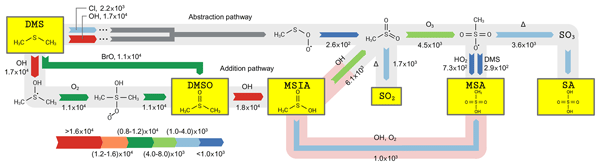
Figure 1: The placement of the DMS + BrO pathway is potentially misleading. In the current scheme, this pathway appears to be categorized under the abstraction pathway, which is not consistent with chemical terminology. In an abstraction pathway, oxidants remove an H atom from a methyl group of DMS, whereas in an addition pathway, oxidants form a bond with the central sulfur atom of DMS in the initial reaction step. Please see Barnes et al. (2006, their Section 2.3.8) for a detailed discussion of this mechanism. The initial product of the DMS + BrO reaction is generally assumed to be the (CH3)2S–OBr adduct. In addition, the DMS + Cl reaction can proceed via both abstraction and addition pathways (see also Barnes et al., 2006, Section 2.3.2). These pathways are treated separately in the present model (Nr G4 and G5 in Table S1). Please check whether the flux value reported for DMS + Cl in Figure 1 (2.2 × 10³) corresponds solely to the abstraction pathway.
Technical comments:
Line 48, 327 and more: “metrological” may be a typo of “meteorological”. Please check throughout the manuscript.
Line 268, 352, 356, and more: “continues” may be a typo of “continued” or “continuous”. Please check throughout the manuscript.
Line 464: “As a results, …” -> “As a result, …”
Line 759: “formation SA” -> “formation of SA”
Line 763: Delete one “to” from “the scientific community to to provide…”.
References:
Barnes, Ian, Jens Hjorth, and Nikos Mihalopoulos. (2006) “Dimethyl Sulfide and Dimethyl Sulfoxide and Their Oxidation in the Atmosphere.” Chemical Reviews 106 (3): 940–75. https://doi.org/10.1021/cr020529+.
Fung, Ka Ming, Colette L. Heald, Jesse H. Kroll, et al. (2022) “Exploring Dimethyl Sulfide (DMS) Oxidation and Implications for Global Aerosol Radiative Forcing.” Atmospheric Chemistry and Physics 22 (2): 1549–73. https://doi.org/10.5194/acp-22-1549-2022.
Kang, Litai, Roger Marchand, Po-Lun Ma, et al. (2025) “Impacts of DMS Emissions and Chemistry on E3SMv2 Simulated Cloud Droplet Numbers and Aerosol Concentrations Over the Southern Ocean.” Journal of Advances in Modeling Earth Systems 17 (5): e2024MS004683. https://doi.org/10.1029/2024MS004683.
Kerminen, Veli-Matti, Xuemeng Chen, Ville Vakkari, Tuukka Petäjä, Markku Kulmala, and Federico Bianchi. (2018) “Atmospheric New Particle Formation and Growth: Review of Field Observations.” Environmental Research Letters 13 (10): 103003. https://doi.org/10.1088/1748-9326/aadf3c.
Novak, Gordon A., Charles H. Fite, Christopher D. Holmes, et al. (2021) “Rapid Cloud Removal of Dimethyl Sulfide Oxidation Products Limits SO2 and Cloud Condensation Nuclei Production in the Marine Atmosphere.” Proceedings of the National Academy of Sciences 118 (42): e2110472118. https://doi.org/10.1073/pnas.2110472118.
Tashmim, Linia, William C. Porter, Qianjie Chen, et al. (2024) “Contribution of Expanded Marine Sulfur Chemistry to the Seasonal Variability of Dimethyl Sulfide Oxidation Products and Size-Resolved Sulfate Aerosol.” Atmospheric Chemistry and Physics 24 (6): 3379–403. https://doi.org/10.5194/acp-24-3379-2024.
Zheng, Guangjie, Yang Wang, Robert Wood, et al. (2021) “New Particle Formation in the Remote Marine Boundary Layer.” Nature Communications 12 (1): 527. https://doi.org/10.1038/s41467-020-20773-1.
Citation: https://doi.org/10.5194/egusphere-2025-6524-RC1 - AC1: 'Reply on RC1', Robin Wollesen de Jonge, 29 May 2026
-
RC2: 'Comment on egusphere-2025-6524', Anonymous Referee #2, 10 Apr 2026
This manuscript presents a detailed box modeling study of dimethylsulfide (DMS) oxidation in the box model ADCHAM, which resolves gas-phase and multiphase chemistry in aerosol and cloud water. The study presents an extensive array of sensitivity simulations beyond a base case that is meant to represent NPF observations made from aircraft over the Eastern North Atlantic. The authors implement detailed DMS oxidation chemistry in both gas and liquid phases, and find that with moderate sea-air exchange of NH3(g), DMS emitted from the surface ocean is sufficient to drive nucleation and particle growth following precipitation. This result is significant because, as the authors describe, the prevailing view is that the condensation sink in the marine boundary layer is too high for new particle formation and growth to occur. This work is suitable for publication in Atmospheric Chemistry and Physics, once the following largely minor comments are addressed.
General Comments:(1) Further evidence and context is required to establish the range of surface ocean NHx concentrations applied in this study, as these choices appear critical for the modelled nucleation and growth by DMS-derived sulfuric acid. L216-218 describes justification for the chosen low, moderate, and high NHx concentrations, but no citations are given. Section 3.2.6 does not describe whether the chosen NHx(aq) concentrations and flux parameterization produce reasonable NH3(g) concentrations relative to what has been observed in the marine boundary layer. The low value of 0.1 mmol/m3 appears somewhat high; for example, approximately half of surface ocean samples from Wentworth 2016 contained NHx < 0.02 mmol/m3. Further on the flux parameterization, it is not immediately clear how this was parameterized: NH3(g) fluxes arise through bidirectional exchange, and so depend on the balance between NH3(g) and NHx(aq) concentrations, see Wentworth et al., 2016.
(2) The discussion of controls on surface ocean DMS concentration is somewhat cursory and should be improved. See specific comments below.
(3) The authors may consider adjusting the article's title to better reflect the major findings of the work, rather than what was done.
(4) The manuscript contains a number of typos (e.g., 'to' instead of 'too'; 'continues' instead of 'continued'; 'summery' instead of 'summary'; 'bellow' instead of 'below').
Specific Comments:
L12-14: Please adjust the description of the new rate coefficients for MSIA gas-phase reactions to better reflect what was done and what was found (i.e., as written, it is unclear
L20-22: While these statements are true, the authors neglect to include a number of high-latitude shipborne and aircraft studies that also show this. For example: https://doi.org/10.5194/acp-17-13119-2017; https://doi.org/10.1002/2017GL075671; https://doi.org/10.5194/acp-17-5515-2017; https://doi.org/10.5194/acp-16-7663-2016; https://doi.org/10.1038/s41467-020-18551-0; https://doi.org/10.1038/s41561-021-00751-y
L31 (and elsewhere): The authors refer to the major DMS source as phytoplankton, which is a true but incomplete description of DMS production in the surface ocean. A number of reviews exist that describe the role of bacteria in converting DMSP to DMS (and methanethiol, MeSH, which is not mentioned in this manuscript), and the authors should provide a more accurate description in their introduction and elsewhere.
L40: Include Veres et al., 2020?
L75-77: What is meant by "decrease in the aerosol particle deliquescence"? A decrease in particle water content with a change in humidity? Or a change in particle composition that leads to a change in the particle deliquescence point?
L82: "bellow cloud-scattering of particles" is below-cloud scavenging meant here?
L84: How does this dry deposition parameterization compare to more recent parameterizations, such as Emerson et al., 2020 (https://doi.org/10.1073/pnas.2014761117)? Does this have significant impact on the results of this work?
L94-96: It may be useful to lead with this justification. This reader persistently wondered how this simulation scheme was decided upon, until the end of the description.
L111: Sea-ice melt or break-up?
Figure 1: It appears visually in Figure 1 that DMS+BrO is an H-abstraction pathway. Suggest to revise the figure to separate the addition and abstraction pathways more clearly.
Section 2.2 (Table S1 & S2): Table S1 & S2 should show units of all rate coefficients used
L142-145 (Table S2): Why do the authors implement on the reaction of MSIA + O3 and not MSI- + O3? Is the pH of cloud droplets and aerosol always below the pKa of MSIA in the model?
L155-156: This is an indirect estimation of the rate coefficient. Why aren't the authors using the temperature dependent measurement of Assaf 2023 https://doi.org/10.1021/acs.jpca.2c09095, which suggests a somewhat lower value at room temperature?
L167-171: Do the authors use the rate coefficients calculated by Chen et al., 2023? https://doi.org/10.1021/acs.est.3c07120
L177-181: The MSIA+OH addition pathway is also proposed by Chen et al., 2023 (https://doi.org/10.1021/acs.est.3c07120) as a source of MSA. Also, why do the authors computations provide a quite different result than Lv 2019 that suggests this reaction proceeds to H2SO3 and CH3 radical?
L186: It is known whether this isomerization actually occurs? Current literature seems to assume this is the case.
L192: Not only NO, but also HO2 or RO2 (See Chen et al., 2023) Do the authors use the equilibrium constant for CH3SO2 + O2 from Chen et al., 2023? In Table S1, the reaction of CH3SO2 (+O2) --> CH3SO2O2 is attributed to MCM.
Figure 2: Consider showing the concentration of DMSO and NH3 in this figure.
L280-281: Does the model capture the aerosol pH effects on this partitioning? e.g., https://www.nature.com/articles/s43247-025-03041-2
L316-317: How does this depend on pH? Do the authors assume that the reaction always proceeds through MSIA+O3 (rather than MSI- + O3)? L320: What is the pH of these particles?
L324: Does the model not capture aerosol liquid water reactions of S(IV), or is the pH and liquid water content simply not sufficient for rapid conversion? What might be the effect enhanced reaction rates due to ionic strength in aerosol (eg. https://pubs.acs.org/doi/10.1021/acs.est.3c00212; https://doi.org/10.1021/acs.est.0c06496)?
L357-358: At what NOx concentrations?
L454-455: What is the particulate methansulfonate/methansulfonic acid lifetime against OH oxidation in the model?
L511-513: This doesn't seem correct? The Henry's Law constant will decrease with increasing temperature, but this would not change the concentration gradient at some given C_w and C_a? Perhaps this statement can be clarified.
L542-543: This statement needs to be clarified and referenced. While high latitude oceans are often regions of elevated DMS production compared to the global average, this is not necessarily because of nutrients, but rather because of biological species distribution (e.g., prevalence of strong DMS producers in polar regions). Polar regions often have nutrient limitation, which varies depending on region and season.
L546: Similar to the above comment, this is an overly simplified statement. DMS does not scale simply with total biomass abundance, but is more related to the abundance of DMS producing algal functional groups (see e.g. https://link.springer.com/article/10.1007/s10533-007-9091-5), as well as mixed layer depth (see e.g. https://doi.org/10.1038/46516 and https://doi.org/10.1029/2001GB001829)
L554: What is "natural nutrient availability"?
Citation: https://doi.org/10.5194/egusphere-2025-6524-RC2 - AC2: 'Reply on RC2', Robin Wollesen de Jonge, 29 May 2026
Peer review completion
Journal article(s) based on this preprint
Viewed
| HTML | XML | Total | Supplement | BibTeX | EndNote | |
|---|---|---|---|---|---|---|
| 1,140 | 539 | 100 | 1,779 | 373 | 258 | 311 |
- HTML: 1,140
- PDF: 539
- XML: 100
- Total: 1,779
- Supplement: 373
- BibTeX: 258
- EndNote: 311
Viewed (geographical distribution)
| Country | # | Views | % |
|---|
| Total: | 0 |
| HTML: | 0 |
| PDF: | 0 |
| XML: | 0 |
- 1
Robin Wollesen de Jonge

Zihao Fu
Pontus Roldin
Michael Boy
The requested preprint has a corresponding peer-reviewed final revised paper. You are encouraged to refer to the final revised version.
- Preprint
(822 KB) - Metadata XML
-
Supplement
(22341 KB) - BibTeX
- EndNote
- Final revised paper
The present work provides a comprehensive and systematic analysis of how DMS-derived new particle formation (NPF) and subsequent growth respond to varying meteorological conditions within the marine boundary layer. The results clearly demonstrate that DMS-derived NPF and growth occur only under a limited set of conditions, specifically, cloud-free periods following moderate to heavy precipitation, despite a wide range of meteorological and environmental parameters. In addition, the study identifies priority areas for future research on gas-phase DMS oxidation chemistry, based on detailed quantum chemical calculations and sensitivity analyses. This represents an important step toward addressing the role of DMS in clouds and climate.
I recommend publication after the authors address the minor concerns outlined below.
General comments:
Throughout Section 3.2: My primary concern is the lack of model evaluation against field observations. For example, the modeled DMS concentrations, ranging from 200 ppt (Line 448) to 2 ppb (Line 559), are substantially higher than typical observed values, which are mostly below 300 ppt and rarely exceed 500 ppt in the summertime Southern Ocean (e.g., Figure 8 of Kang et al., 2025). Similarly, the modeled SO2 concentrations (100–500 ppt; Lines 386–387) are considerably higher than observations, which are generally below 50 ppt (Figure S3 of Kang et al., 2025). I recognize that this is a modeling study aimed at qualitatively demonstrating how DMS-derived NPF responds to different environmental conditions. However, these large discrepancies between model results and observations raise concerns about the reliability of the conclusions. I suggest that the authors discuss the possible reasons for the overestimation of atmospheric sulfur species and assess its potential impact on their conclusions.
Section 3.2.1 and 3.2.4, and Figure 3: Is it correct that the SST sensitivity tests were conducted with a fixed air temperature of 283 K? It is somewhat difficult to envision scenarios in which air temperature and sea surface temperature vary independently, although I appreciate the value of isolating the sensitivity to individual parameters. If feasible, I suggest performing additional sensitivity tests in which both air temperature and SST are varied simultaneously by the same amount. Would their effects on PN concentrations offset each other, or does one parameter exert a stronger control on PN concentrations?
Line 148-161 and Line 379-391: The rapid cloud uptake of HPMTF (Novak et al., 2021) is not considered in this model. Given the importance of this process in suppressing gas-phase SO₂ formation, I recommend that the authors conduct an additional sensitivity test including this process to ensure that it does not affect their conclusions. References such as Fung et al. (2022) and Tashmim et al. (2024) may be useful for constraining the rate constants. Alternatively, the authors should justify why this process is not included.
Line 763-766 (and 20-26): This recommendation for future work would benefit from rephrasing in light of both the results of the present study and existing observational evidence. As summarized in Kerminen et al. (2018) (their Section 3.2.4) and Zheng et al. (2021), the prevailing view that “NPF is rare in the marine boundary layer” is based on the limited number of observed NPF events relative to the substantial body of field observations across various regions and seasons, particularly at the surface level. The present study, which shows that DMS-derived NPF occurs only under a limited set of conditions, is consistent with these observational findings from a theoretical perspective. I am not convinced that simply deploying long-term, station-based observations would be sufficient to demonstrate the influence of MBL NPF on CCN concentrations. A more critical question is where within the MBL such conditions are met. At a minimum, new observational efforts should target locations with favorable conditions (e.g., frequent cloud-free periods) and be combined with detailed air-mass history analyses to determine whether such events occur near the surface or aloft.
Figure 1: The placement of the DMS + BrO pathway is potentially misleading. In the current scheme, this pathway appears to be categorized under the abstraction pathway, which is not consistent with chemical terminology. In an abstraction pathway, oxidants remove an H atom from a methyl group of DMS, whereas in an addition pathway, oxidants form a bond with the central sulfur atom of DMS in the initial reaction step. Please see Barnes et al. (2006, their Section 2.3.8) for a detailed discussion of this mechanism. The initial product of the DMS + BrO reaction is generally assumed to be the (CH3)2S–OBr adduct. In addition, the DMS + Cl reaction can proceed via both abstraction and addition pathways (see also Barnes et al., 2006, Section 2.3.2). These pathways are treated separately in the present model (Nr G4 and G5 in Table S1). Please check whether the flux value reported for DMS + Cl in Figure 1 (2.2 × 10³) corresponds solely to the abstraction pathway.
Technical comments:
Line 48, 327 and more: “metrological” may be a typo of “meteorological”. Please check throughout the manuscript.
Line 268, 352, 356, and more: “continues” may be a typo of “continued” or “continuous”. Please check throughout the manuscript.
Line 464: “As a results, …” -> “As a result, …”
Line 759: “formation SA” -> “formation of SA”
Line 763: Delete one “to” from “the scientific community to to provide…”.
References:
Barnes, Ian, Jens Hjorth, and Nikos Mihalopoulos. (2006) “Dimethyl Sulfide and Dimethyl Sulfoxide and Their Oxidation in the Atmosphere.” Chemical Reviews 106 (3): 940–75. https://doi.org/10.1021/cr020529+.
Fung, Ka Ming, Colette L. Heald, Jesse H. Kroll, et al. (2022) “Exploring Dimethyl Sulfide (DMS) Oxidation and Implications for Global Aerosol Radiative Forcing.” Atmospheric Chemistry and Physics 22 (2): 1549–73. https://doi.org/10.5194/acp-22-1549-2022.
Kang, Litai, Roger Marchand, Po-Lun Ma, et al. (2025) “Impacts of DMS Emissions and Chemistry on E3SMv2 Simulated Cloud Droplet Numbers and Aerosol Concentrations Over the Southern Ocean.” Journal of Advances in Modeling Earth Systems 17 (5): e2024MS004683. https://doi.org/10.1029/2024MS004683.
Kerminen, Veli-Matti, Xuemeng Chen, Ville Vakkari, Tuukka Petäjä, Markku Kulmala, and Federico Bianchi. (2018) “Atmospheric New Particle Formation and Growth: Review of Field Observations.” Environmental Research Letters 13 (10): 103003. https://doi.org/10.1088/1748-9326/aadf3c.
Novak, Gordon A., Charles H. Fite, Christopher D. Holmes, et al. (2021) “Rapid Cloud Removal of Dimethyl Sulfide Oxidation Products Limits SO2 and Cloud Condensation Nuclei Production in the Marine Atmosphere.” Proceedings of the National Academy of Sciences 118 (42): e2110472118. https://doi.org/10.1073/pnas.2110472118.
Tashmim, Linia, William C. Porter, Qianjie Chen, et al. (2024) “Contribution of Expanded Marine Sulfur Chemistry to the Seasonal Variability of Dimethyl Sulfide Oxidation Products and Size-Resolved Sulfate Aerosol.” Atmospheric Chemistry and Physics 24 (6): 3379–403. https://doi.org/10.5194/acp-24-3379-2024.
Zheng, Guangjie, Yang Wang, Robert Wood, et al. (2021) “New Particle Formation in the Remote Marine Boundary Layer.” Nature Communications 12 (1): 527. https://doi.org/10.1038/s41467-020-20773-1.