
the Creative Commons Attribution 4.0 License.
the Creative Commons Attribution 4.0 License.
 | 06 Jan 2026
Simultaneous measurements of near-surface CO2 and NO2 to monitor the fossil-fuel combustion-derived CO2 in the Tokyo megacity
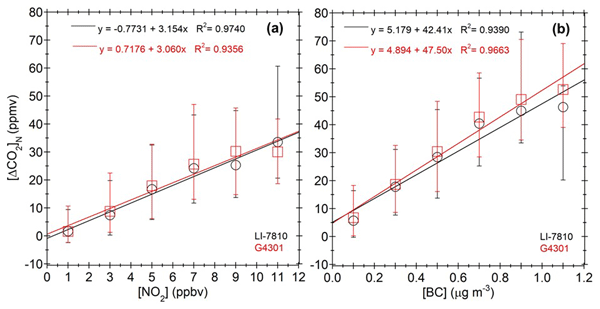
Abstract. Year-round continuous measurements of near-surface carbon dioxide (CO2) concentrations using in-situ trace gas analyzers were conducted simultaneously with nitrogen dioxide (NO2) measurements by International Air Quality and SKY Research Remote Sensing Network (A-SKY) Multi-Axis Differential Optical Absorption Spectroscopy (MAX-DOAS) at Chiba (35.625° N, 140.104° E, 60 m above sea level), located within the Tokyo megacity, Japan, during 2024. These simultaneous measurements revealed that CO2 concentrations were low on days when near-surface NO2 concentrations were markedly reduced. Furthermore, the CO2 enhancement relative to the baseline concentration determined based on such low-NO2-concentration days ([ΔCO2]N) was positively correlated with NO2 and black carbon concentrations. This finding indicates that [ΔCO2]N is useful in observing the increase in fossil-fuel combustion-derived CO2 within the Tokyo megacity. By employing this relatively simple method, CO2 concentrations in megacities can be monitored with high accuracy and precision, contributing to more effective emission mitigation strategies.
-
Notice on discussion status
The requested preprint has a corresponding peer-reviewed final revised paper. You are encouraged to refer to the final revised version.
-
Preprint
(2719 KB)
-
The requested preprint has a corresponding peer-reviewed final revised paper. You are encouraged to refer to the final revised version.
- Preprint
(2719 KB) - Metadata XML
- BibTeX
- EndNote
- Final revised paper


Journal article(s) based on this preprint
Interactive discussion
Status: closed
-
RC1: 'Comment on egusphere-2025-6517', Anonymous Referee #1, 29 Jan 2026
-
AC1: 'Reply on RC1', Hitoshi Irie, 16 Mar 2026
The comment was uploaded in the form of a supplement: https://egusphere.copernicus.org/preprints/2026/egusphere-2025-6517/egusphere-2025-6517-AC1-supplement.pdf
-
AC1: 'Reply on RC1', Hitoshi Irie, 16 Mar 2026
-
RC2: 'Comment on egusphere-2025-6517', Anonymous Referee #2, 18 Feb 2026
Review of a manuscript, titled “Simultaneous measurements of near-surface CO2 and NO2 to monitor the fossil-fuel combustion-derived CO2 in the Tokyo megacity” by Irie et al.
General comments:
This manuscript presents simultaneous measurements of NO2 by ASKY and near-surface CO2 concentrations using LI-7810 and G4301 trace gas analyzers. [ΔCO2] was also estimated from the positive correlation of CO2 to NO2 and BC, respectively. This work is scientifically meaningful and contains annual measurement data, but need more clarification to be published at AMT.
To clarify the usefulness of simultaneous near-surface CO2 and NO2 measurements for simple and accurate monitoring of fossil-fuel combustion-derived CO2 in the Tokyo megacity, thorough analysis is required with appropriate literature surveys.
To estimate CO2 concentrations from NO2 and/or BC using their relationship, it is assumed that the NO2/BC emission sources are related to that of CO2. The relationship depends on region, season, time scale, meteorology, winds in particular, lifetime in the atmosphere, the ratio between NO and NO2 etc. High correlation between the two species does not guarantee the estimation of one species’ concentrations, which may lead biases. Comparison of measurements from the remote sensing instrument, MAX-DOAS to in situ instrument may represent spatial scale. At the same time, this assumption depends on the carbon dependence of energy source and emission reduction mechanism from region to region. Japan is one of the leading countries in minimizing NOx emissions and utilizing renewable energy source with high technologies. Thus, it requires more thorough evaluation process to infer CO2 concentration from NO2.
LI 7810 trace gas analyzer measures CH4, CO2 and H2O at wavelengths of 1.6 micron, where CO2 absorption signal is weak. Thus,
Authors need to elaborate further on Section 4 (Conclusion) by including quantitative evaluation results and relevant statistical metrics to support the main findings.
Minor comments:
94: The use of 70 degree instead of 90 degree was justified with the signal stabilization. Can you suggest reference or supporting evidence?
Fig. 5: There are clear two data groups above and below the linear regression line. Would it be possible to find the cause of this difference ?
Citation: https://doi.org/10.5194/egusphere-2025-6517-RC2 -
AC2: 'Reply on RC2', Hitoshi Irie, 16 Mar 2026
The comment was uploaded in the form of a supplement: https://egusphere.copernicus.org/preprints/2026/egusphere-2025-6517/egusphere-2025-6517-AC2-supplement.pdf
-
AC2: 'Reply on RC2', Hitoshi Irie, 16 Mar 2026


Interactive discussion
Status: closed
-
RC1: 'Comment on egusphere-2025-6517', Anonymous Referee #1, 29 Jan 2026
Estimation of CO2 and other greenhouse gases from megacities is an important research topics, and requires set of observations at strategically located sites using suitable instruments or measurement systems. This study discusses measurements of CO2 using two types of CO2 measurement systems and comes up with useful conclusions about the usefulness of tier-2 instrument (often referred to as low-cost sensor or LCS) for tracking emissions of CO2. The results are supplemented using Max-DOAS NO2 and BC measurements. The article is very well written and a little more efforts in improving the Abstract and Introduction are needed to properly reflect the outcomes of this study and also to put this study in perspective of growing number of literature for this area of study. I recommend a major revision before accepting for publication in AMT, but I feel the works involved are not difficult to conduct. Details below.
Line 14: Not sure if this is the right terminology - may be Greater Tokyo area ? and please explain a bit what you mean by this.
Line 28-29 : reference needed, I feel
Line 30 : Definition needed, e.g., Greater Tokyo includes Tokyo Metropolis (includes 23 special wards) Yokohama Kawasaki Saitama Kawaguchi Chiba Sagamihara
Only at line 61 you say that the site "is located east of Tokyo", which is correct in my view.Introduction : Efforts should be made to improve. It will help the readers to provide a review of existing literatures and how the results from this study improves our knowledge. There are several more recent papers (a few listed below, in addition to Yamada et al.) who have tried to discuss CO2 measurements and models from the Tokyo and surrounding areas like this paper, e.g.,
Pisso et al., https://doi.org/10.1186/s13021-019-0118-8
Ballav et al., https://doi.org/10.1007/s12040‐015‐0653‐y
Sugawara et al., https://doi.org/10.1029/2021GL092600
Bisht et al. https://doi.org/10.1029/2025JD043589Line 71ff : Why different treatment to the intake air samples ?
Line 120ff : referring to Fig. 1d ? I think this is not a reasonable metric to discuss, without water vapour correction. Additionally, I would also like the authors to analyse % error for the “localised” spikes, not the absolute differences, e.g., if a peak height is frequently seen at 60 ppm, the 12 ppm is a 20% uncertainty - not terrible. For baseline observation, 12 ppm is a serious error.
Figure 2 and associated discussions: Why not apply a water vapour correction - otherwise the two instruments are not comparable. See for example - https://www.nature.com/articles/s41597-024-03243-x
Line 150ff : Why this selection ? Why not apply mathematically a well-known correction term for H2O.
Figure 5 and associated discussions: Can this analysis be done by month or so? There seems to be more than one factor in the scatter plot.
Figure 6 and associated discussions: Why the same analysis is not performed using the data from G4301 instrument ?
This decision here and also many earlier decisions to select data and analysis methods are not well argued - why one method/data is chosen over other. A general checking by the authors to improve the contents would be much appreciated by the readers.
Line 208 ff: I guess this is something similar to Tohjima et al., 2020; but there is another way that GHG community use for deriving seasonal and synoptic variability in time series data (Nakazawa et al., environometrics, 1997). Please take a look and if possible a comparison of your method and fitting-filtering method would be helpful for the readers.
Line 245 : Or is the high BC point causing this trouble ? e.g., if you did a fitting without the highest BC value the intercept would come down? Then it could mean that the high BC emission activities do not emit CO2 as much (say the BBQ restaurants nearby!), because the del-CO2 level remained flat for the two high BC values.
Line 257ff: I strongly urge the authors to prepare another scatter plot after applying water vapour correction to the LI-7810 data because the G4301 is making dry air mole fraction measurement while the LI isn’t. This study is making significant conclusions and can go further by a little additional calculation.
Looks like repitation in Acknowledgements and Financial support - "...by the Environment Research and Technology Development Fund (JPMEERF21S20810 and JPMEERF24S12202) of the Environmental Restoration and Conservation Agency, provided by the Ministry of the Environment of Japan."
Citation: https://doi.org/10.5194/egusphere-2025-6517-RC1 -
AC1: 'Reply on RC1', Hitoshi Irie, 16 Mar 2026
The comment was uploaded in the form of a supplement: https://egusphere.copernicus.org/preprints/2026/egusphere-2025-6517/egusphere-2025-6517-AC1-supplement.pdf
-
AC1: 'Reply on RC1', Hitoshi Irie, 16 Mar 2026
-
RC2: 'Comment on egusphere-2025-6517', Anonymous Referee #2, 18 Feb 2026
Review of a manuscript, titled “Simultaneous measurements of near-surface CO2 and NO2 to monitor the fossil-fuel combustion-derived CO2 in the Tokyo megacity” by Irie et al.
General comments:
This manuscript presents simultaneous measurements of NO2 by ASKY and near-surface CO2 concentrations using LI-7810 and G4301 trace gas analyzers. [ΔCO2] was also estimated from the positive correlation of CO2 to NO2 and BC, respectively. This work is scientifically meaningful and contains annual measurement data, but need more clarification to be published at AMT.
To clarify the usefulness of simultaneous near-surface CO2 and NO2 measurements for simple and accurate monitoring of fossil-fuel combustion-derived CO2 in the Tokyo megacity, thorough analysis is required with appropriate literature surveys.
To estimate CO2 concentrations from NO2 and/or BC using their relationship, it is assumed that the NO2/BC emission sources are related to that of CO2. The relationship depends on region, season, time scale, meteorology, winds in particular, lifetime in the atmosphere, the ratio between NO and NO2 etc. High correlation between the two species does not guarantee the estimation of one species’ concentrations, which may lead biases. Comparison of measurements from the remote sensing instrument, MAX-DOAS to in situ instrument may represent spatial scale. At the same time, this assumption depends on the carbon dependence of energy source and emission reduction mechanism from region to region. Japan is one of the leading countries in minimizing NOx emissions and utilizing renewable energy source with high technologies. Thus, it requires more thorough evaluation process to infer CO2 concentration from NO2.
LI 7810 trace gas analyzer measures CH4, CO2 and H2O at wavelengths of 1.6 micron, where CO2 absorption signal is weak. Thus,
Authors need to elaborate further on Section 4 (Conclusion) by including quantitative evaluation results and relevant statistical metrics to support the main findings.
Minor comments:
94: The use of 70 degree instead of 90 degree was justified with the signal stabilization. Can you suggest reference or supporting evidence?
Fig. 5: There are clear two data groups above and below the linear regression line. Would it be possible to find the cause of this difference ?
Citation: https://doi.org/10.5194/egusphere-2025-6517-RC2 -
AC2: 'Reply on RC2', Hitoshi Irie, 16 Mar 2026
The comment was uploaded in the form of a supplement: https://egusphere.copernicus.org/preprints/2026/egusphere-2025-6517/egusphere-2025-6517-AC2-supplement.pdf
-
AC2: 'Reply on RC2', Hitoshi Irie, 16 Mar 2026
Peer review completion


Journal article(s) based on this preprint
Viewed
| HTML | XML | Total | BibTeX | EndNote | |
|---|---|---|---|---|---|
| 320 | 110 | 30 | 460 | 18 | 20 |
- HTML: 320
- PDF: 110
- XML: 30
- Total: 460
- BibTeX: 18
- EndNote: 20
Viewed (geographical distribution)
| Country | # | Views | % |
|---|
| Total: | 0 |
| HTML: | 0 |
| PDF: | 0 |
| XML: | 0 |
- 1
Hitoshi Irie
Masataka Nomoto
Yoshikazu Kamiya
Yukio Terao
The requested preprint has a corresponding peer-reviewed final revised paper. You are encouraged to refer to the final revised version.
- Preprint
(2719 KB) - Metadata XML
Estimation of CO2 and other greenhouse gases from megacities is an important research topics, and requires set of observations at strategically located sites using suitable instruments or measurement systems. This study discusses measurements of CO2 using two types of CO2 measurement systems and comes up with useful conclusions about the usefulness of tier-2 instrument (often referred to as low-cost sensor or LCS) for tracking emissions of CO2. The results are supplemented using Max-DOAS NO2 and BC measurements. The article is very well written and a little more efforts in improving the Abstract and Introduction are needed to properly reflect the outcomes of this study and also to put this study in perspective of growing number of literature for this area of study. I recommend a major revision before accepting for publication in AMT, but I feel the works involved are not difficult to conduct. Details below.
Line 14: Not sure if this is the right terminology - may be Greater Tokyo area ? and please explain a bit what you mean by this.
Line 28-29 : reference needed, I feel
Line 30 : Definition needed, e.g., Greater Tokyo includes Tokyo Metropolis (includes 23 special wards) Yokohama Kawasaki Saitama Kawaguchi Chiba Sagamihara
Only at line 61 you say that the site "is located east of Tokyo", which is correct in my view.
Introduction : Efforts should be made to improve. It will help the readers to provide a review of existing literatures and how the results from this study improves our knowledge. There are several more recent papers (a few listed below, in addition to Yamada et al.) who have tried to discuss CO2 measurements and models from the Tokyo and surrounding areas like this paper, e.g.,
Pisso et al., https://doi.org/10.1186/s13021-019-0118-8
Ballav et al., https://doi.org/10.1007/s12040‐015‐0653‐y
Sugawara et al., https://doi.org/10.1029/2021GL092600
Bisht et al. https://doi.org/10.1029/2025JD043589
Line 71ff : Why different treatment to the intake air samples ?
Line 120ff : referring to Fig. 1d ? I think this is not a reasonable metric to discuss, without water vapour correction. Additionally, I would also like the authors to analyse % error for the “localised” spikes, not the absolute differences, e.g., if a peak height is frequently seen at 60 ppm, the 12 ppm is a 20% uncertainty - not terrible. For baseline observation, 12 ppm is a serious error.
Figure 2 and associated discussions: Why not apply a water vapour correction - otherwise the two instruments are not comparable. See for example - https://www.nature.com/articles/s41597-024-03243-x
Line 150ff : Why this selection ? Why not apply mathematically a well-known correction term for H2O.
Figure 5 and associated discussions: Can this analysis be done by month or so? There seems to be more than one factor in the scatter plot.
Figure 6 and associated discussions: Why the same analysis is not performed using the data from G4301 instrument ?
This decision here and also many earlier decisions to select data and analysis methods are not well argued - why one method/data is chosen over other. A general checking by the authors to improve the contents would be much appreciated by the readers.
Line 208 ff: I guess this is something similar to Tohjima et al., 2020; but there is another way that GHG community use for deriving seasonal and synoptic variability in time series data (Nakazawa et al., environometrics, 1997). Please take a look and if possible a comparison of your method and fitting-filtering method would be helpful for the readers.
Line 245 : Or is the high BC point causing this trouble ? e.g., if you did a fitting without the highest BC value the intercept would come down? Then it could mean that the high BC emission activities do not emit CO2 as much (say the BBQ restaurants nearby!), because the del-CO2 level remained flat for the two high BC values.
Line 257ff: I strongly urge the authors to prepare another scatter plot after applying water vapour correction to the LI-7810 data because the G4301 is making dry air mole fraction measurement while the LI isn’t. This study is making significant conclusions and can go further by a little additional calculation.
Looks like repitation in Acknowledgements and Financial support - "...by the Environment Research and Technology Development Fund (JPMEERF21S20810 and JPMEERF24S12202) of the Environmental Restoration and Conservation Agency, provided by the Ministry of the Environment of Japan."