
the Creative Commons Attribution 4.0 License.
the Creative Commons Attribution 4.0 License.
 | 02 Feb 2026
The impact of spatial resolution on hourly flood modeling in large watersheds
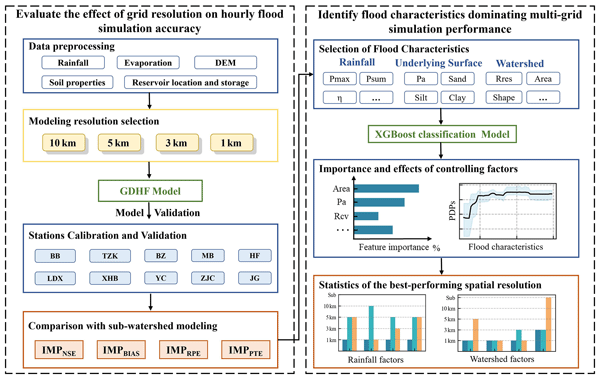
Abstract. The spatial resolution of hydrological modeling is a critical factor affecting flood simulation accuracy, especially in large watersheds characterized by complex watershed characteristics. However, its influence on the accuracy of hourly flood simulations at both watershed outlets and internal locations remains insufficiently understood, hindering rational spatial-resolution selection for large-scale flood forecasting. This study evaluates hourly flood simulations across five spatial resolutions (1 km, 3 km, 5 km, 10 km, and sub-watershed) at the watershed outlet and multiple internal stations in the Jialing River Basin, China (157,000 km²). An XGBoost–based model is employed to identify flood characteristics sensitive to spatial resolution and to quantify their nonlinear effects on simulation accuracy. Based on these relationships, spatial-resolution recommendations are derived for different flood-characteristic categories, and the effectiveness of spatial refinement under coarse rainfall inputs is examined. Results show that spatial refinement markedly improves simulation accuracy at internal locations but yields only marginal gains at the watershed outlet. Watershed area is identified as the dominant factor governing resolution sensitivity, while rainfall characteristics and underlying-surface properties exert strong nonlinear influences. Fine grids (1–3 km) are most effective under flood conditions with strong nonlinearity, but their advantages diminish rapidly as rainfall inputs become coarser, indicating that increased spatial resolution cannot compensate for insufficient rainfall information. Overall, these findings advance current understanding of spatial-resolution effects on hourly flood simulations and provide practical guidance for spatial-resolution selection in large-watershed modeling.
-
Notice on discussion status
The requested preprint has a corresponding peer-reviewed final revised paper. You are encouraged to refer to the final revised version.
-
Preprint
(3620 KB)
-
The requested preprint has a corresponding peer-reviewed final revised paper. You are encouraged to refer to the final revised version.
- Preprint
(3620 KB) - Metadata XML
- BibTeX
- EndNote
- Final revised paper


Journal article(s) based on this preprint
Interactive discussion
Status: closed
-
RC1: 'Comment on egusphere-2025-6515', Anonymous Referee #1, 02 Mar 2026
- AC1: 'Reply on RC1', xiaoyang Li, 09 Apr 2026
-
RC2: 'Comment on egusphere-2025-6515', Anonymous Referee #2, 30 Mar 2026
Review Comments
This study systematically evaluates the impact of spatial resolution on hourly flood simulation accuracy in large watersheds by integrating distributed hydrological modeling with machine learning–based analysis. The authors employ the GDHF model across multiple spatial resolutions and introduce an improvement index (IMP) framework to quantify performance gains relative to a sub-watershed scheme. By coupling model simulations with XGBoost and partial dependence analysis, the study identifies key controlling factors governing resolution sensitivity and reveals their nonlinear influence on simulation performance. The framework is further strengthened through experiments under varying rainfall station densities, providing insight into the limitations of spatial refinement under data-sparse conditions. The results demonstrate that finer resolutions significantly enhance simulation accuracy in smaller basins, while offering limited gains in large drainage areas, and highlight the dominant role of basin area and rainfall characteristics in determining optimal resolution. Overall, the manuscript presents the methodology that is well designed and aligned with the study objectives, with a clear framework and appropriate integration of hydrological modeling and machine learning. The results effectively address all objectives, providing a coherent evaluation of spatial resolution effects, controlling factors, and rainfall station density impacts. The conclusions are consistent with the results and accurately summarize the key findings without overinterpretation. The paper is well organized; however, some minor issues related to sentence structure and presentation consistency should be addressed to further improve readability and precision, as outlined below.
Minor Comments
- In the Introduction section (lines 50–55), “key characteristic” should be revised to “key characteristics” to match the plural context.
- In the Introduction section (line 85-90), “pronounced topographic relief” is slightly repetitive with “hilly and mountainous terrain” mentioned earlier and could be revised for conciseness, and control areas mean “drainage areas” or “catchment areas” ?
- In the Data and Methods section (line 95-100), “km2·gauge-1” should be formatted using proper superscripts (e.g., km²·gauge⁻¹) for consistency and clarity.
- In the Methods section (line 125-130), “Li et al. (2024” is missing a closing parenthesis and should be corrected to “Li et al. (2024)”.
- In Appendix A (line 470-475), there is a typo in “P(t) epresents”; it should be corrected to “P(t) represents”.
- In Appendix A (around line 515), the equation for Shape (A15) is repeated; one instance should be removed to avoid redundancy.
Citation: https://doi.org/10.5194/egusphere-2025-6515-RC2 - AC2: 'Reply on RC2', xiaoyang Li, 09 Apr 2026


Interactive discussion
Status: closed
-
RC1: 'Comment on egusphere-2025-6515', Anonymous Referee #1, 02 Mar 2026
This study evaluates the impact of spatial resolution on hourly flood simulation accuracy in large watersheds. It identifies key flood characteristics that influence multi-grid simulation performance and provides practical guidance for selecting spatial resolutions. The study is interesting, and the methodology offers valuable insights. However, there are still some points that should be addressed to improve the quality of the paper.
Major comments:
- Section 2.3.2 selects flood characteristics potentially sensitive to grid resolution, but the criteria for selecting these characteristics are unclear. Additionally, the manuscript lacks detailed explanation of how these indicators are calculated. It is recommended to provide the selection criteria and explain the calculation process in detail, which would help improve the clarity and credibility of the paper.
- The manuscript uses partial dependence plots (PDPs) for feature-effect interpretation. Since SHAP values are more commonly used for nonlinear analysis, the authors should explain why they chose PDPs instead of SHAP.
- In section 2.3.4, three different criteria are used to determine the optimal spatial resolution. What is the purpose and rationale behind setting different scenarios? This should be explained in the manuscript.
- Results and Discussion section has limited discussion or reference to other studies. For example, Section 4.3 lacks a discussion of the results from previous studies on grid controlling factors. Section 4.6 should also include a discussion of how previous studies have analyzed the impact of rainfall gauge density on the accuracy of different grid resolutions.
Minor comments:
- Figure 1: Please include the control areas for all hydrological stations.
- Lines 100-105: Add the sources of the DEM and soil data. Additionally, please provide information on the number of reservoirs and their storage capacities within the study area.
- Figure 2: Is there a reference for this figure? It would be helpful to add one.
- Section 2.3.1: The title “Equations” may not clearly convey the content of the section. It is recommended to revise the title to “Evaluation of GDHF Model Performance at Different Spatial Resolutions” for greater clarity and alignment with the section's focus.
- Line 190: The statement "spatial refinement yields a significant improvement (IMPNSE > 0.10, IMPBIAS > 5%, IMPRPE > 5%, or IMPPTE > 1 h)" requires further clarification. The rationale behind selecting these specific thresholds should be provided.
- Figure 4: Please ensure that it clearly specifies that the modeling process is based on a 10 km resolution.
- Figure 12: The y-axis should be clearly labeled to indicate whether it represents the results of grid resolution selection or the precision of different grid resolutions.
- Appendix A: Why are references not included in Appendix A? Any references used to describe details and equations in the appendix should be cited.
Citation: https://doi.org/10.5194/egusphere-2025-6515-RC1 - AC1: 'Reply on RC1', xiaoyang Li, 09 Apr 2026
-
RC2: 'Comment on egusphere-2025-6515', Anonymous Referee #2, 30 Mar 2026
Review Comments
This study systematically evaluates the impact of spatial resolution on hourly flood simulation accuracy in large watersheds by integrating distributed hydrological modeling with machine learning–based analysis. The authors employ the GDHF model across multiple spatial resolutions and introduce an improvement index (IMP) framework to quantify performance gains relative to a sub-watershed scheme. By coupling model simulations with XGBoost and partial dependence analysis, the study identifies key controlling factors governing resolution sensitivity and reveals their nonlinear influence on simulation performance. The framework is further strengthened through experiments under varying rainfall station densities, providing insight into the limitations of spatial refinement under data-sparse conditions. The results demonstrate that finer resolutions significantly enhance simulation accuracy in smaller basins, while offering limited gains in large drainage areas, and highlight the dominant role of basin area and rainfall characteristics in determining optimal resolution. Overall, the manuscript presents the methodology that is well designed and aligned with the study objectives, with a clear framework and appropriate integration of hydrological modeling and machine learning. The results effectively address all objectives, providing a coherent evaluation of spatial resolution effects, controlling factors, and rainfall station density impacts. The conclusions are consistent with the results and accurately summarize the key findings without overinterpretation. The paper is well organized; however, some minor issues related to sentence structure and presentation consistency should be addressed to further improve readability and precision, as outlined below.
Minor Comments
- In the Introduction section (lines 50–55), “key characteristic” should be revised to “key characteristics” to match the plural context.
- In the Introduction section (line 85-90), “pronounced topographic relief” is slightly repetitive with “hilly and mountainous terrain” mentioned earlier and could be revised for conciseness, and control areas mean “drainage areas” or “catchment areas” ?
- In the Data and Methods section (line 95-100), “km2·gauge-1” should be formatted using proper superscripts (e.g., km²·gauge⁻¹) for consistency and clarity.
- In the Methods section (line 125-130), “Li et al. (2024” is missing a closing parenthesis and should be corrected to “Li et al. (2024)”.
- In Appendix A (line 470-475), there is a typo in “P(t) epresents”; it should be corrected to “P(t) represents”.
- In Appendix A (around line 515), the equation for Shape (A15) is repeated; one instance should be removed to avoid redundancy.
Citation: https://doi.org/10.5194/egusphere-2025-6515-RC2 - AC2: 'Reply on RC2', xiaoyang Li, 09 Apr 2026
Peer review completion


Journal article(s) based on this preprint
Viewed
| HTML | XML | Total | BibTeX | EndNote | |
|---|---|---|---|---|---|
| 756 | 577 | 101 | 1,434 | 101 | 120 |
- HTML: 756
- PDF: 577
- XML: 101
- Total: 1,434
- BibTeX: 101
- EndNote: 120
Viewed (geographical distribution)
| Country | # | Views | % |
|---|
| Total: | 0 |
| HTML: | 0 |
| PDF: | 0 |
| XML: | 0 |
- 1
Lei Ye
Xiaoyang Li
Jilie Li
Chi Zhang
Huicheng Zhou
The requested preprint has a corresponding peer-reviewed final revised paper. You are encouraged to refer to the final revised version.
- Preprint
(3620 KB) - Metadata XML
This study evaluates the impact of spatial resolution on hourly flood simulation accuracy in large watersheds. It identifies key flood characteristics that influence multi-grid simulation performance and provides practical guidance for selecting spatial resolutions. The study is interesting, and the methodology offers valuable insights. However, there are still some points that should be addressed to improve the quality of the paper.
Major comments:
Minor comments: