
the Creative Commons Attribution 4.0 License.
the Creative Commons Attribution 4.0 License.
 | 21 Jan 2026
Microphysical properties and light absorption enhancement of refractory Black carbon aerosols in the central Arctic marine boundary layer: Role of warm airmass intrusions on mixing state
Abstract. Refractory black carbon (rBC) aerosols strongly influence Arctic atmospheric radiative transfer, making it essential to understand their microphysical properties and mixing state. However, in-situ studies on microphysical properties and mixing state of rBC over the central Arctic marine boundary layer are scarce. To address this gap, we carried out a comprehensive investigation of rBC in the central Arctic onboard the RV Polarstern during the ATWAICE cruise. Our results revealed pronounced spatial and temporal variability in microphysical properties rBC in the Arctic marine boundary layer, governed by transport pathways and removal mechanisms. Under pristine background conditions, rBC mass concentrations were at their lowest (median ~0.4–0.6 ng m-³). Warm airmass intrusions into the Arctic atmosphere were found to bring polluted anthropogenic aerosols into this pristine environment with an eightfold increase in rBC mass concentrations (median ~3.4 ng m-³, maximum ~74 ng m-³). A dominant influence of biomass-burning emissions from Eurasia during the warm airmass intrusion, which coincided with a shift toward larger rBC cores (~264 nm) and moderate coating thickness. The light absorption enhancement of rBC remained low during warm-air-mass intrusions (~1–1.2) than under background conditions (~1.1–1.6), underscoring a strong dependence of rBC radiative effects in the central Arctic on source regions and aging/processing during long-range transport. This study highlights the complexity of rBC aging and mixing state in the central Arctic and will help to increase the accuracy in representing rBC in climate models.
Competing interests: At least one of the (co-)authors is a member of the editorial board of Atmospheric Chemistry and Physics. The peer-review process was guided by an independent editor, and the authors also have no other competing interests to declare.
Publisher's note: Copernicus Publications remains neutral with regard to jurisdictional claims made in the text, published maps, institutional affiliations, or any other geographical representation in this paper. While Copernicus Publications makes every effort to include appropriate place names, the final responsibility lies with the authors. Views expressed in the text are those of the authors and do not necessarily reflect the views of the publisher.-
Notice on discussion status
The requested preprint has a corresponding peer-reviewed final revised paper. You are encouraged to refer to the final revised version.
-
Preprint
(2160 KB)
-
Supplement
(779 KB)
-
The requested preprint has a corresponding peer-reviewed final revised paper. You are encouraged to refer to the final revised version.
- Preprint
(2160 KB) - Metadata XML
-
Supplement
(779 KB) - BibTeX
- EndNote
- Final revised paper


Journal article(s) based on this preprint
Interactive discussion
Status: closed
- RC1: 'Comment on egusphere-2025-6493', Anonymous Referee #1, 07 Feb 2026
-
RC2: 'Comment on egusphere-2025-6493', Anonymous Referee #2, 13 Feb 2026
This manuscript presents rBC concentrations measured by SP2 in the Arctic Ocean and carefully explains the relationship between the concentrations, cover thickness, and temperature and trajectories. The rBC observation data in the Arctic are valuable, interesting, and appropriately processed. However, there are many less substantiated suggestions and insufficient discussion, making the manuscript overall redundant and hindering understanding of the important measurement results. Furthermore, as noted in the comments below, there are several deficiencies and errors in the discussion. If these are sufficiently improved, I can recommend publication.
Major comments
1. Eabs: This paper calculates Eabs under the assumption of a core-shell (presumably spherical) structure. However, many previous studies have already shown that the lensing effect calculated for a core-shell structure is overestimated compared to that of actual particles with complex shapes and mixing states, based on model calculations and Eabs observations (e.g., doi:10.1029/2009JD012868, doi:10.5194/acp-16-2525-2016, doi:10.1021/acs.est.5c10094). Therefore, I believe that the Eabs calculated for a core-shell structure are not of sufficient quality to be used in other studies. However, I think it is acceptable to use it in the study to discuss the causes of the difference. The authors should take this into account when discussing Eabs. Therefore, the authors should refer to the multiple previous studies listed above and state that the estimated values differ from the observed values. Furthermore, in the abstract, I recommend that this value should either be deleted or noted that it was calculated assuming a core-shell structure.
2. 3 Result and discussion: The section is redundant (especially 3.1). While the details are provided in the Specific Comments, many sentences lack sufficient evidence. I recommend reducing unrobust suggestions that ignore other possibilities and providing a more solid presentation of the results. Furthermore, several parts of the figures appear to be misread due to inadequate representation. We recommend providing appropriate evidence to improve the overall section.
Specific Comments
Fig. 1: Please include the place names and ocean areas described in section 2.1 on the map whenever possible. Also, please indicate what the contrast in the figure represents (probably sea ice).
2.2: Variables should be in italics.
L165 Volume equation: probably, 2CT or 2×CT, not 2xCT.
3.1: σsca: Section 2 does not explain how this value was measured.
Fig. 2: Faint and difficult to read, and the coloring of SE and NE is inconsistent.
L264: If possible, please show the scattering plots between MrBC and eBC in a supplement, and clearly indicate the value below which eBC becomes unreliable.
Fig. 3: The caption should also indicate that this is a 5-day trajectory.
Fig. 4b: It's difficult to read. Also, as I'll explain later, I recommend showing mass concentration rather than just mass fraction.
Fig. 4c, d Polluted, Near-pristine, Pristine, Warm air mass: It would be better to explain these observation days in Sec. 2.1 or 3.1 to clarify the correspondence between these and Fig. 1.
L310, L323, etc.: Regarding the comparison of σsca and Fig. 4b: The discussion of comparisons is often unconvincing because it fails to account for important aerosol factors, such as particle size, number, and concentration. For example, under conditions where BC from urban areas is high, it is assumed that secondary particles such as SO4 and OC will also be high. Generally, Na and Cl are generally coarse particles, while SO4 and OC are often fine particles. Fine particles, which are numerous and close to the wavelength of scattered light, scatter light efficiently, so they can contribute significantly to σsca even if they have a mass similar to that of coarse particles. Unfortunately, the particle composition was not classified by particle size in this observation. However, I recommend at least discussing this as a concentration, not just as a mass fraction. It may also be effective to create a line graph by separating each component rather than stacking them. However, it would be easier to read if you just showed the results without making any unnecessary suggestions in the text.
L314 "SE3 trajectories, although marine-dominated, originated from the northern Atlantic sector, including the Barents and Norwegian Seas. ..." This is unsubstantiated. This result shows that SE2 and SE3 are clean, with no significant difference in MrBC, and that their trajectories are not significantly different.
L390: The increase in K+ in Fig. 4b is unclear. I recommend including a time series graph in the supplement.
L438 "...This increase in MMD suggests a reduced influence from fossil fuel sources and a dominant role for biomass burning emissions in the central Arctic region via long-range atmospheric transport." This is unsubstantiated. As the author notes in the following paragraph, MMD in remote areas may change not only due to emission sources, but also due to changes during transport, such as removal and coagulation. Coagulation via clouds without precipitation may also effectively shift BC size significantly. I also think there are clear factors behind the small BC in SE1 and the large BC in WA1. However, for the rest cases, there is no support reason to suggest that the contribution of biomass burning is greater than that of transport processes.
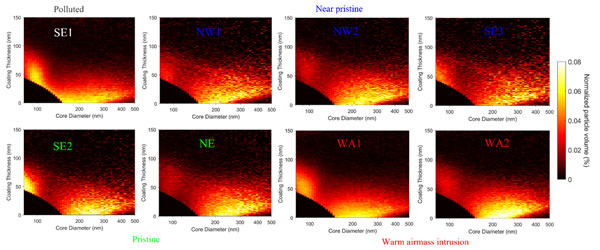
Sec. 3.4 Fig. 7 and paragraphs 1, 2, and 3: The color bars are shown as a % of max., so the contrast varies depending on the maximum values. This can lead to many misinterpretations. For example, L483 "It is interesting to note a higher volume of rBC with core sizes >150 nm, except for SE2 and SE3." The overall low contrast in the SE2 and SE3 figures is likely because the used max. values were high. Probably, SE2 and SE3, like other air masses, also have a relatively higher volume of rBC with core sizes >150 nm. This figure makes it unclear what is being compared (are large cores being compared to small cores, or absolute values for each air mass?). If discussing absolute values (particle volume concentration), we recommend using a color bar with units of nm3/m3 for each figure. If discussing relative distributions, we recommend redrawing the distribution normalized by the integrated volume (not maximum). I would like you to check your interpretation of section 3.4 as a whole to ensure there are no errors.
Sec. 3.4 Fig. 8 and paragraphs 4, 5, 6, and 7: I found the discussion of the relationship between air masses and CT interesting. While I don't strongly recommend it, have you considered the relationship between particle number concentration (e.g., scattering particles measured by a SP2) and CT as a factor determining CT? For example, in cases like WA1, where particle number concentration is high, even if precursor gas is present, secondary products may be distributed among many particles, preventing a thick CT.
3.5: As mentioned in the major comment, there are many previous studies on Eabs, including observational results and model calculations, and it is best to consider that values calculated using the core-shell assumption have limited utility. I recommend confirming the Eabs values observed in previous studies relative to the overlying pressure and discussing the range of values that can be used to interpret this study.
Conclusion: I recommend reorganizing the section based on the above corrections.
Citation: https://doi.org/10.5194/egusphere-2025-6493-RC2 -
AC1: 'Comment on egusphere-2025-6493', Arun Babu Suja, 16 Apr 2026
The comment was uploaded in the form of a supplement: https://egusphere.copernicus.org/preprints/2026/egusphere-2025-6493/egusphere-2025-6493-AC1-supplement.pdf
Peer review completion


Post-review adjustments


Interactive discussion
Status: closed
-
RC1: 'Comment on egusphere-2025-6493', Anonymous Referee #1, 07 Feb 2026
Referee Report on egusphere-2025-6493
Manuscript title
Microphysical properties and light absorption enhancement of refractory black carbon aerosols in the central Arctic marine boundary layer: Role of warm airmass intrusions on mixing state
Summary and overall assessment
The manuscript presents a strong observational analysis of refractory black carbon (rBC) in the central Arctic marine boundary layer during the ATWAICE (PS131) campaign, with a specific emphasis on warm air-mass intrusions (WAIs) and their influence on rBC size, coating thickness, and absorption enhancement. The study is timely and relevant given the increasing frequency of WAIs and their implications for Arctic aerosol–radiation interactions.
The work is scientifically sound, the dataset is valuable, and the interpretation is largely well supported. The minor revisions needed are:
(i) improved clarity around interpretation boundaries (source vs. processing, morphology vs. coating effects),
(ii) strengthened contextualization and framing for absorption enhancement retrievals, and
(iii) a figure/presentation fixe—most notably Figure 4b, where overlapping text reduces readability and must be corrected.Recommendation: I would strongly recommend to publish this study as a research article in ACP with suggested minor revisions
Comments
1) Low absorption enhancement during WA1: clarify source vs. processing attribution
The manuscript shows that WA1 is associated with larger rBC cores but lower coating thickness and lower Eabs relative to “pristine” regimes. The interpretation currently risks reading as “limited coating → low Eabs” as the dominant mechanism.
Why this needs tightening:
For Arctic transport events, source-type differences (biomass burning vs. flaring vs. anthropogenic) and particle-scale heterogeneity (morphology, internal structure, compositional mixing) can influence lensing behavior and the validity of idealized core–shell assumptions used in Mie-based calculations.Requested action:
Add explicit wording that the observed low Eabs during WA1 may reflect a combination of:- limited atmospheric aging and coating growth (processing constraint), and
- source-related differences in rBC composition and morphology that can make core–shell Mie lensing less effective or less representative.
2) Figure 4b presentation issue (required fix)
Figure 4, panel (b) requires modification or recomposition, as text overlaps on the bar chart, making labels difficult to read and potentially ambiguous. While this is a production-level issue, it affects scientific clarity.
3) Chemical interpretation: daily PM₁₀ filters vs. submicron rBC mixing state
The manuscript appropriately notes that PM₁₀ filter composition does not directly represent the coating composition on submicron rBC cores measured by SP2. However, some interpretive statements still rely on PM₁₀-derived sulfate and OC fractions.
Requested action:
Insert one explicit sentence stating that links between bulk chemical composition and rBC coating thickness are qualitative and should not be interpreted as direct coating composition closure. Where sulfate/OC fractions are used, frame them as supportive consistency rather than mechanistic proof.4) Missing fraction of rBC
I would recommend to add a sentence regarding the missing fraction of rBC considered in this study.
5) Comparison with marine environments
- Strengthen comparison with recent marine-environment studies (e.g., Pan et al., 2026 and similar recent literature), focusing on rBC concentrations and size distributions
- If feasible include a summary table with mean and median valus comparing rBC mass concentration and MMD
This addition would significantly improve the broader relevance and interpretability of the results.
Supplement integration
The supplement provides important context for meteorology and EC variability. Consider adding one sentence in the main text explicitly directing readers to the relevant supplementary figures for context.
Terminology and consistency
- Use one consistent spelling of air mass / air-mass / airmass throughout.
- Ensure consistent use of “rBC” vs. “BC” when referring specifically to SP2-derived refractory black carbon.
Interpretation balance relative to prior work
Where the manuscript contrasts its findings with earlier studies, consider phrasing such as “in contrast to” rather than language implying inconsistency or error. Briefly noting differences in season, meteorology, or boundary-layer regime will strengthen the comparison.
Citation: https://doi.org/10.5194/egusphere-2025-6493-RC1 -
RC2: 'Comment on egusphere-2025-6493', Anonymous Referee #2, 13 Feb 2026
This manuscript presents rBC concentrations measured by SP2 in the Arctic Ocean and carefully explains the relationship between the concentrations, cover thickness, and temperature and trajectories. The rBC observation data in the Arctic are valuable, interesting, and appropriately processed. However, there are many less substantiated suggestions and insufficient discussion, making the manuscript overall redundant and hindering understanding of the important measurement results. Furthermore, as noted in the comments below, there are several deficiencies and errors in the discussion. If these are sufficiently improved, I can recommend publication.
Major comments
1. Eabs: This paper calculates Eabs under the assumption of a core-shell (presumably spherical) structure. However, many previous studies have already shown that the lensing effect calculated for a core-shell structure is overestimated compared to that of actual particles with complex shapes and mixing states, based on model calculations and Eabs observations (e.g., doi:10.1029/2009JD012868, doi:10.5194/acp-16-2525-2016, doi:10.1021/acs.est.5c10094). Therefore, I believe that the Eabs calculated for a core-shell structure are not of sufficient quality to be used in other studies. However, I think it is acceptable to use it in the study to discuss the causes of the difference. The authors should take this into account when discussing Eabs. Therefore, the authors should refer to the multiple previous studies listed above and state that the estimated values differ from the observed values. Furthermore, in the abstract, I recommend that this value should either be deleted or noted that it was calculated assuming a core-shell structure.
2. 3 Result and discussion: The section is redundant (especially 3.1). While the details are provided in the Specific Comments, many sentences lack sufficient evidence. I recommend reducing unrobust suggestions that ignore other possibilities and providing a more solid presentation of the results. Furthermore, several parts of the figures appear to be misread due to inadequate representation. We recommend providing appropriate evidence to improve the overall section.
Specific Comments
Fig. 1: Please include the place names and ocean areas described in section 2.1 on the map whenever possible. Also, please indicate what the contrast in the figure represents (probably sea ice).
2.2: Variables should be in italics.
L165 Volume equation: probably, 2CT or 2×CT, not 2xCT.
3.1: σsca: Section 2 does not explain how this value was measured.
Fig. 2: Faint and difficult to read, and the coloring of SE and NE is inconsistent.
L264: If possible, please show the scattering plots between MrBC and eBC in a supplement, and clearly indicate the value below which eBC becomes unreliable.
Fig. 3: The caption should also indicate that this is a 5-day trajectory.
Fig. 4b: It's difficult to read. Also, as I'll explain later, I recommend showing mass concentration rather than just mass fraction.
Fig. 4c, d Polluted, Near-pristine, Pristine, Warm air mass: It would be better to explain these observation days in Sec. 2.1 or 3.1 to clarify the correspondence between these and Fig. 1.
L310, L323, etc.: Regarding the comparison of σsca and Fig. 4b: The discussion of comparisons is often unconvincing because it fails to account for important aerosol factors, such as particle size, number, and concentration. For example, under conditions where BC from urban areas is high, it is assumed that secondary particles such as SO4 and OC will also be high. Generally, Na and Cl are generally coarse particles, while SO4 and OC are often fine particles. Fine particles, which are numerous and close to the wavelength of scattered light, scatter light efficiently, so they can contribute significantly to σsca even if they have a mass similar to that of coarse particles. Unfortunately, the particle composition was not classified by particle size in this observation. However, I recommend at least discussing this as a concentration, not just as a mass fraction. It may also be effective to create a line graph by separating each component rather than stacking them. However, it would be easier to read if you just showed the results without making any unnecessary suggestions in the text.
L314 "SE3 trajectories, although marine-dominated, originated from the northern Atlantic sector, including the Barents and Norwegian Seas. ..." This is unsubstantiated. This result shows that SE2 and SE3 are clean, with no significant difference in MrBC, and that their trajectories are not significantly different.
L390: The increase in K+ in Fig. 4b is unclear. I recommend including a time series graph in the supplement.
L438 "...This increase in MMD suggests a reduced influence from fossil fuel sources and a dominant role for biomass burning emissions in the central Arctic region via long-range atmospheric transport." This is unsubstantiated. As the author notes in the following paragraph, MMD in remote areas may change not only due to emission sources, but also due to changes during transport, such as removal and coagulation. Coagulation via clouds without precipitation may also effectively shift BC size significantly. I also think there are clear factors behind the small BC in SE1 and the large BC in WA1. However, for the rest cases, there is no support reason to suggest that the contribution of biomass burning is greater than that of transport processes.
Sec. 3.4 Fig. 7 and paragraphs 1, 2, and 3: The color bars are shown as a % of max., so the contrast varies depending on the maximum values. This can lead to many misinterpretations. For example, L483 "It is interesting to note a higher volume of rBC with core sizes >150 nm, except for SE2 and SE3." The overall low contrast in the SE2 and SE3 figures is likely because the used max. values were high. Probably, SE2 and SE3, like other air masses, also have a relatively higher volume of rBC with core sizes >150 nm. This figure makes it unclear what is being compared (are large cores being compared to small cores, or absolute values for each air mass?). If discussing absolute values (particle volume concentration), we recommend using a color bar with units of nm3/m3 for each figure. If discussing relative distributions, we recommend redrawing the distribution normalized by the integrated volume (not maximum). I would like you to check your interpretation of section 3.4 as a whole to ensure there are no errors.
Sec. 3.4 Fig. 8 and paragraphs 4, 5, 6, and 7: I found the discussion of the relationship between air masses and CT interesting. While I don't strongly recommend it, have you considered the relationship between particle number concentration (e.g., scattering particles measured by a SP2) and CT as a factor determining CT? For example, in cases like WA1, where particle number concentration is high, even if precursor gas is present, secondary products may be distributed among many particles, preventing a thick CT.
3.5: As mentioned in the major comment, there are many previous studies on Eabs, including observational results and model calculations, and it is best to consider that values calculated using the core-shell assumption have limited utility. I recommend confirming the Eabs values observed in previous studies relative to the overlying pressure and discussing the range of values that can be used to interpret this study.
Conclusion: I recommend reorganizing the section based on the above corrections.
Citation: https://doi.org/10.5194/egusphere-2025-6493-RC2 -
AC1: 'Comment on egusphere-2025-6493', Arun Babu Suja, 16 Apr 2026
The comment was uploaded in the form of a supplement: https://egusphere.copernicus.org/preprints/2026/egusphere-2025-6493/egusphere-2025-6493-AC1-supplement.pdf
Peer review completion
Post-review adjustments
Journal article(s) based on this preprint
Viewed
| HTML | XML | Total | Supplement | BibTeX | EndNote | |
|---|---|---|---|---|---|---|
| 1,648 | 777 | 132 | 2,557 | 317 | 142 | 152 |
- HTML: 1,648
- PDF: 777
- XML: 132
- Total: 2,557
- Supplement: 317
- BibTeX: 142
- EndNote: 152
Viewed (geographical distribution)
| Country | # | Views | % |
|---|
| Total: | 0 |
| HTML: | 0 |
| PDF: | 0 |
| XML: | 0 |
- 1

Thomas Müller
Mira L. Pöhlker
Andreas Held
Christopher Pöhlker
Manuela van Pinxteren
Yifan Yang
Sabine Lüchtrath
Andreas Walbröl
Janna E. Rückert
Philipp Oehlke
Maik Merkel
Birgit Wehner
The requested preprint has a corresponding peer-reviewed final revised paper. You are encouraged to refer to the final revised version.
- Preprint
(2160 KB) - Metadata XML
-
Supplement
(779 KB) - BibTeX
- EndNote
- Final revised paper
Referee Report on egusphere-2025-6493
Manuscript title
Microphysical properties and light absorption enhancement of refractory black carbon aerosols in the central Arctic marine boundary layer: Role of warm airmass intrusions on mixing state
Summary and overall assessment
The manuscript presents a strong observational analysis of refractory black carbon (rBC) in the central Arctic marine boundary layer during the ATWAICE (PS131) campaign, with a specific emphasis on warm air-mass intrusions (WAIs) and their influence on rBC size, coating thickness, and absorption enhancement. The study is timely and relevant given the increasing frequency of WAIs and their implications for Arctic aerosol–radiation interactions.
The work is scientifically sound, the dataset is valuable, and the interpretation is largely well supported. The minor revisions needed are:
(i) improved clarity around interpretation boundaries (source vs. processing, morphology vs. coating effects),
(ii) strengthened contextualization and framing for absorption enhancement retrievals, and
(iii) a figure/presentation fixe—most notably Figure 4b, where overlapping text reduces readability and must be corrected.
Recommendation: I would strongly recommend to publish this study as a research article in ACP with suggested minor revisions
Comments
1) Low absorption enhancement during WA1: clarify source vs. processing attribution
The manuscript shows that WA1 is associated with larger rBC cores but lower coating thickness and lower Eabs relative to “pristine” regimes. The interpretation currently risks reading as “limited coating → low Eabs” as the dominant mechanism.
Why this needs tightening:
For Arctic transport events, source-type differences (biomass burning vs. flaring vs. anthropogenic) and particle-scale heterogeneity (morphology, internal structure, compositional mixing) can influence lensing behavior and the validity of idealized core–shell assumptions used in Mie-based calculations.
Requested action:
Add explicit wording that the observed low Eabs during WA1 may reflect a combination of:
2) Figure 4b presentation issue (required fix)
Figure 4, panel (b) requires modification or recomposition, as text overlaps on the bar chart, making labels difficult to read and potentially ambiguous. While this is a production-level issue, it affects scientific clarity.
3) Chemical interpretation: daily PM₁₀ filters vs. submicron rBC mixing state
The manuscript appropriately notes that PM₁₀ filter composition does not directly represent the coating composition on submicron rBC cores measured by SP2. However, some interpretive statements still rely on PM₁₀-derived sulfate and OC fractions.
Requested action:
Insert one explicit sentence stating that links between bulk chemical composition and rBC coating thickness are qualitative and should not be interpreted as direct coating composition closure. Where sulfate/OC fractions are used, frame them as supportive consistency rather than mechanistic proof.
4) Missing fraction of rBC
I would recommend to add a sentence regarding the missing fraction of rBC considered in this study.
5) Comparison with marine environments
This addition would significantly improve the broader relevance and interpretability of the results.
Supplement integration
The supplement provides important context for meteorology and EC variability. Consider adding one sentence in the main text explicitly directing readers to the relevant supplementary figures for context.
Terminology and consistency
Interpretation balance relative to prior work
Where the manuscript contrasts its findings with earlier studies, consider phrasing such as “in contrast to” rather than language implying inconsistency or error. Briefly noting differences in season, meteorology, or boundary-layer regime will strengthen the comparison.