
the Creative Commons Attribution 4.0 License.
the Creative Commons Attribution 4.0 License.
 | 20 Feb 2026
Oxidative potential of fine particles at urban and rural sites in eastern and western Japan: Effects of transboundary transport from continental Asia and local emissions
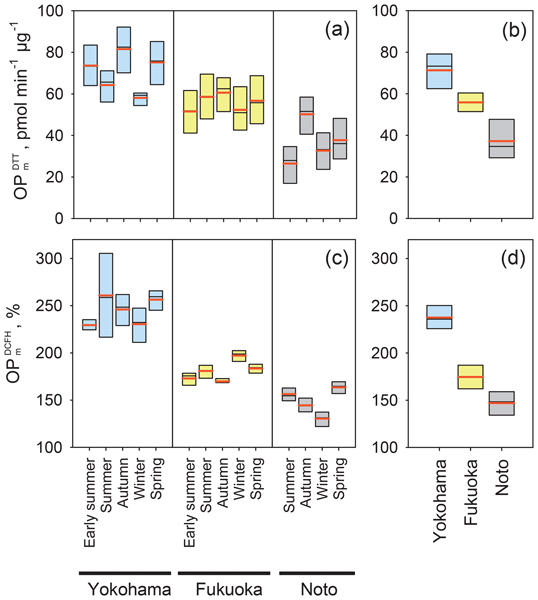
Abstract. Oxidative stress is a key mechanism that contribute to the toxicity of atmospheric aerosol particles. This study investigated the mass-normalized oxidative potential (OP) of fine particles collected at three sites in Japan: Yokohama (an urban background site in the Greater Tokyo Area), Fukuoka (an urban background site in western Japan), and Noto (a rural site on the Noto Peninsula facing the Sea of Japan). The OP was evaluated using two assays: a cell-free dithiothreitol (DTT) assay (OPDTT m) and a cell-based assay employing 5-(and-6)-chloromethyl-2',7'-dichlorodihydrofluorescein diacetate, acetyl ester (CM-H2DCFDA) with alveolar epithelial cells (OPDCFH m). Both OP metrics exhibited significant spatial variation, with the highest values in Yokohama, followed by those in Fukuoka and Noto. This spatial pattern suggests that fine particles influenced by local urban emissions have higher intrinsic OP than those affected by long-range transport from continental Asia. Secondary particle formation during atmospheric transport likely alters the chemical composition of the particles, providing a plausible explanation for the lower intrinsic OP compared to those of locally emitted urban aerosol particles. OPDCFH m was correlated strongly with carbonaceous components derived from fuel combustion and transition metals (Cu, Mn, and Fe), whereas OPDTT m was associated mainly with the transition metals. These results indicate different pathways for reactive oxygen species (ROS) generation in the two assays. Despite these differences, OPDTT m and OPDCFH m were correlated strongly (r = 0.81), indicating that DTT reactivity can reasonably predict cellular ROS-generating capacity of anthropogenic fine particles.
-
Notice on discussion status
The requested preprint has a corresponding peer-reviewed final revised paper. You are encouraged to refer to the final revised version.
-
Preprint
(4242 KB)
-
The requested preprint has a corresponding peer-reviewed final revised paper. You are encouraged to refer to the final revised version.
- Preprint
(4242 KB) - Metadata XML
- BibTeX
- EndNote
- Final revised paper


Journal article(s) based on this preprint
Interactive discussion
Status: closed
- RC1: 'Comment on egusphere-2025-6478', Anonymous Referee #1, 03 Mar 2026
-
RC2: 'Comment on egusphere-2025-6478', Anonymous Referee #3, 17 Apr 2026
General Comment
This study examines the mass-normalized oxidative potential (OP) of fine particles collected at three sites in Japan, an urban background site in the Greater Tokyo Area (Yokohama), an urban background site in western Japan (Fukuoka), and a rural site on the Noto Peninsula (Noto), over approximately one year (May 2022–June 2023). OP was assessed using two complementary approaches: a cell-free dithiothreitol (DTT) assay (OPDTTm) and a cell-based assay using CM-H2DCFDA with A549 alveolar epithelial cells (OPDCFHm). The authors relate spatial gradients in OP to differences in the relative contributions of transboundary transport from continental Asia versus local anthropogenic emissions and compare the two OP metrics to assess the utility of the DTT assay as a predictor of cellular ROS production.
The paper addresses a genuine and timely question in the oxidative potential literature: how source type, local urban emissions versus long-range transported aerosol, shapes the intrinsic oxidative character of fine particles on a per-mass basis. The study design is well suited to this question: the three-site gradient provides a natural experiment, the year-long sampling captures seasonal variability, and the parallel use of a cell-free and a cell-based assay adds important mechanistic texture. The writing is generally clear and the data are presented transparently.
However, the manuscript has several weaknesses that should be addressed before publication. The most significant concern is literature positioning: the introduction does not adequately situate the study within the now-substantial global and regional literature on OP spatial gradients and source contributions, particularly work from East Asia. Several important recent papers, including studies comparing OP across urban/rural or urban/background gradients in China, Korea, and Europe, and reviews of OP drivers, are absent, making it difficult to judge the novelty and generalizability of the findings. Beyond literature, the study's interpretive framework relies almost entirely on backward trajectory analysis and qualitative source attribution from chemical clustering, without formal source apportionment (e.g., PMF), which limits the strength of the source–OP relationship claims. Methodological choices for the cell-based assay, particularly particle concentration, particle suspension medium, and the absence of a cytotoxicity check at the tested dose, are underreported. The discussion of the DTT–DCFH correlation, while interesting, does not fully explore conditions under which this relationship might break down in the study site context.
Overall, this is a solid observational dataset with an interesting multi-assay design.
Specific Comments
- Insufficient engagement with the broader OP spatial gradient and source-attribution literature
The authors are commended for citing key foundational DTT and DCFH-DA literature and for referencing relevant Japan-based work. However, the introduction does not engage with the now-large body of research examining OP spatial gradients in relation to source type, particularly from East Asia and Europe. Studies examining transboundary OP transport to Korea and Japan, and reviews specifically addressing how long-range transport alters OP per unit mass (e.g., the Shiraiwa et al., 2017 review is cited but primarily for the DTT range benchmark) are largely absent from the introduction's framing. I also suggest considering the list below for Asian context OP studies.
The claim that the finding, lower mass-normalized OP for transported versus local aerosol, represents a novel contribution needs to be validated against what has already been shown in the literature. The authors should add a dedicated paragraph in the introduction reviewing what is known about OP spatial variability and source effects on OP from the global and regional literature, and explicitly state what this study adds. Relevant recent literature includes, but is not limited to:
(Borlaza et al., 2022, 2018; Dominutti et al., 2023; Park et al., 2018, 2020; Weber et al., 2021)
Borlaza, L. J., Weber, S., Marsal, A., Uzu, G., Jacob, V., Besombes, J.-L., Chatain, M., Conil, S., and Jaffrezo, J.-L.: Nine-year trends of PM 10 sources and oxidative potential in a rural background site in France, Atmospheric Chem. Phys., 22, 8701–8723, https://doi.org/10.5194/acp-22-8701-2022, 2022.
Borlaza, L. J. S., Cosep, E. M. R., Kim, S., Lee, K., Joo, H., Park, M., Bate, D., Cayetano, M. G., and Park, K.: Oxidative potential of fine ambient particles in various environments, Environ. Pollut., 243, 1679–1688, https://doi.org/10.1016/j.envpol.2018.09.074, 2018.
Dominutti, P. A., Borlaza, L. J. S., Sauvain, J.-J., Ngoc Thuy, V. D., Houdier, S., Suarez, G., Jaffrezo, J.-L., Tobin, S., Trébuchon, C., Socquet, S., Moussu, E., Mary, G., and Uzu, G.: Source apportionment of oxidative potential depends on the choice of the assay: insights into 5 protocols comparison and implications for mitigation measures, Environ. Sci. Atmospheres, 3, 1497–1512, https://doi.org/10.1039/D3EA00007A, 2023.
Park, M., Joo, H. S., Lee, K., Jang, M., Kim, S. D., Kim, I., Borlaza, L. J. S., Lim, H., Shin, H., Chung, K. H., Choi, Y.-H., Park, S. G., Bae, M.-S., Lee, J., Song, H., and Park, K.: Differential toxicities of fine particulate matters from various sources, Sci. Rep., 8, 17007, https://doi.org/10.1038/s41598-018-35398-0, 2018.
Park, M., Wang, Y., Chong, J., Lee, H., Jang, J., Song, H., Kwak, N., Borlaza, L. J. S., Maeng, H., Cosep, E. M. R., Denna, Ma. C. F. J., Chen, S., Seo, I., Bae, M.-S., Jang, K.-S., Choi, M., Kim, Y. H., Park, M., Ryu, J.-S., Park, S., Hu, M., and Park, K.: Simultaneous Measurements of Chemical Compositions of Fine Particles during Winter Haze Period in Urban Sites in China and Korea, Atmosphere, 11, 292, https://doi.org/10.3390/atmos11030292, 2020.
Weber, S., Uzu, G., Favez, O., Borlaza, L. J. S., Calas, A., Salameh, D., Chevrier, F., Allard, J., Besombes, J.-L., Albinet, A., Pontet, S., Mesbah, B., Gille, G., Zhang, S., Pallares, C., Leoz-Garziandia, E., and Jaffrezo, J.-L.: Source apportionment of atmospheric PM10 oxidative potential: synthesis of 15 year-round urban datasets in France, Atmospheric Chem. Phys., 21, 11353–11378, https://doi.org/10.5194/acp-21-11353-2021, 2021.
- Absence of formal source apportionment
The authors use backward trajectory analysis combined with hierarchical clustering of chemical composition data to attribute OP to local versus transported sources. This approach is reasonable and the clustering analysis (Figure 9) is informative. However, the interpretive claims, for example, that Group 3 species are unambiguously associated with local emissions, or that transboundary transport dilutes OP through secondary sulfate formation, rely on qualitative reasoning that would be substantially strengthened by a formal source apportionment approach such as positive matrix factorization (PMF), a research-grade technique.
The authors acknowledge that sampling periods of 2–3 months preclude high-resolution temporal analysis, but PMF has been applied successfully to similar 2–3 month bulk samples in the literature. The authors should either (a) perform PMF or an equivalent receptor model on the available chemical data and correlate source factor contributions with OP, or (b) explicitly acknowledge this limitation and discuss how it affects the confidence with which source–OP relationships can be drawn from the clustering approach alone.
Simply noting that the sampling period is long (lines 342–343) is insufficient as a methodological justification. The source attribution of Cu and Zn to waste fly ash rather than brake dust (lines 344–347) also deserves greater scrutiny: the Cu/Zn ratio argument depends on the reference values chosen, and the authors should note that traffic-related non-exhaust emissions (including brake dust and tire wear) are also commonly reported at urban sites in Japan, and that a mixed contribution is likely.
- Underreporting of CM-H₂DCFDA assay methodology and dose justification
CM-H₂DCFDA protocol (lines 141–157), while adequate in outline, omits several details that are necessary for reproducibility and scientific interpretation. First, the particle mass concentration used in the exposure (100 μL of a 2 mg/20 mL suspension = 100 μg/mL) is never stated explicitly, readers must calculate it from the dispersed information in the text. Second, no cytotoxicity assessment is reported at this dose. A549 cell viability under particle exposure should be verified (e.g., by LDH release, MTT, or trypan blue), particularly for the high-OP Yokohama samples; without this, it is unclear whether elevated fluorescence in some samples reflects genuine ROS production or cell membrane disruption. Third, the decision to express OPᴰᴰᴹᴴm as percentage of fluorescence at 6 hr relative to immediately post-exposure is unconventional, most DCFH-based studies normalize to vehicle control or unexposed cells at the same time point, making inter-study comparison difficult. The authors should justify this normalization choice and discuss how it affects comparability with the literature values they cite. Fourth, a dose–response relationship for at least one representative sample would strengthen confidence that the measured fluorescence differences among sites reflect genuine OP differences and not saturation or threshold effects.
- Seasonal OP patterns require more complete mechanistic explanation
The authors note that seasonal variations in OPᴰᴰᴹm and OPᴰᴰᴴᴹm were smaller than inter-site differences, and attribute this to the counteracting effects of seasonal air mass origin and boundary layer height (lines 246–263). This is a plausible explanation, and the reference to Hara et al. (2021) supports it. However, the observation that OPᴰᴰᴹm peaks in autumn at all three sites (line 211) is interesting and not fully explained. Autumn in Japan is associated with increased continental transport (as shown in Figures 5 and 6) but also with biomass burning in continental Asia (crop residue burning, particularly in northeastern China, is well documented during September–November). The contribution of biomass burning to autumn OP, including via the levoglucosan/potassium pathway, deserves explicit consideration, especially since the nssK⁺ is classified in Group 1 (continental transport) and shows only weak correlation with OP. The authors should address whether autumn peaks in OPᴰᴰᴹm might reflect a modest biomass burning signal superimposed on local emissions, and whether the available chemical tracers are sufficient to detect such a contribution given the 2–3 month sampling resolution.
- Conditions limiting the DTT–DCFH correlation should be addressed more explicitly
The strong correlation between OPᴰᴰᴹm and OPᴰᴰᴴᴹm (r = 0.81) across all sites is a useful and interesting result, and the authors compare it appropriately to prior studies. However, the discussion focuses primarily on why the correlation holds rather than examining the boundary conditions under which it might break down specifically for Japanese aerosols. Given the unique source mixture in Japan, characterized by strong transboundary transport of sulfate-rich, metal-poor aerosols mixed with local combustion emissions, it would be informative to discuss whether the correlation is driven largely by the between-site gradient (i.e., the Yokohama points anchoring the high end) or whether it also holds within-site across seasons. A within-site correlation analysis would address this and would add interpretive value. Additionally, the discussion notes that the DCFH assay uses CM-H₂DCFDA rather than the conventional DCFH-DA probe (lines 57–70), and the authors correctly describe differences in cellular retention and ROS specificity. However, the consequence of this probe choice for the DTT–DCFH correlation comparison with prior studies that used conventional DCFH-DA should be discussed: since CM-H₂DCFDA may have different sensitivity profiles for specific ROS, the comparability of r-values across studies is not guaranteed.
- Comparison with published OP values from East Asia needs greater context
The authors compare their OPᴰᴰᴹm values with those from Beijing (Yu et al., 2019) and from the Fukuoka site in prior work (Nishita-Hara et al., 2019; Fujitani et al., 2023), and explain differences in terms of assay conditions. This is handled well. However, given the stated aim of positioning the study in the context of transboundary transport from continental Asia, comparison with OP data from Korean sites, which sit geographically between China and Japan and thus represent an intermediate point along the transport pathway, would substantially strengthen the narrative. Published OP data from Seoul and other Korean cities are available in recent literature. Similarly, the discussion of the 'dilution by secondary sulfate' mechanism (lines 355–357, 419–421) is invoked as a plausible explanation for the OP decrease during transport, but this mechanism has been discussed in prior OP literature and should be cited more explicitly. The authors should expand the geographic comparison and engage more directly with the dilution-versus-chemical-transformation debate in the OP transport literature.
- Minor issues
Several minor issues should be corrected. (a) Line 81: 'intercellular' should read 'intracellular'. (b) Line 465: 'Rditing' should read 'Editing'. (c) Line 382 refers to 'Figure 6' when describing the order of transition metal concentrations, this appears to be a reference error; the relevant data are in Figure 7 or Figure 8. Please verify all figure cross-references. (d) The abstract states that OPᴰᴰᴴᴹm was correlated 'strongly' with carbonaceous components and transition metals, the word 'strongly' should be qualified or replaced with the actual correlation range (r = 0.47–0.84 for the relevant species in Figure 10) to be accurate.
Citation: https://doi.org/10.5194/egusphere-2025-6478-RC2 - AC1: 'Comment on egusphere-2025-6478', Chiharu Nishita-Hara, 29 May 2026
Peer review completion


Interactive discussion
Status: closed
-
RC1: 'Comment on egusphere-2025-6478', Anonymous Referee #1, 03 Mar 2026
The submitted manuscript presents a study dealing with the effect of transboundary transport from continental Asia and local emissions on the oxidative potential OP) of fine particles at urban and rural sites in Japan. The OP was evaluated using a cell-free dithiothreitol (DTT) assay and an alveolar epithelial cell-based dichlorofluorescin diacetate assay.
The results are interesting and of high quality. The paper will provide more insights into the impact of different pollution sources on the different pathways for reactive oxygen species (ROS) generation in the two employed assays. However, there are a few issues that need to be addressed before accepting the paper for publication in ACP. Major revisions of the paper, taking into consideration the comments reported below, are requested.
Specific comments:
Table 1: Recalculate the mass of the collected sample to the average mass concentration of PM2.5 during the sampling periods and compare it with the corresponding data from nearby monitoring stations. Data from monitoring stations provide also as average concentrations. Give all results to 3 valid digits.
Lines 144-154: The procedure used to measure OPDCFH differs from similar papers; in particular, there is no positive control using zymosan. The authors should discuss the reasons for their choice in detail. The relative percentages used as the unit for OPDCFH measurement then prevent direct comparison with other papers.
Lines 220-225: The difference in the contribution from transboundary transport from continental Asia and local anthropogenic emissions to observed both OPDTT and OPDCFH was more significant than seasonal variations. Could you, therefore, quantify the difference in the contribution from transboundary transport and local anthropogenic emissions to OPDTT and OPDCFH at all sites studied?
Lines 281-315: Expression of the concentration of particulate component as a mass fraction (%) is unusual and prevents direct comparison of results with other studies. It is appropriate to replace the mass fraction (%) with commonly used units (i.e., ng/m3, ug/m3) or, at least, express the concentration in both ways in parallel.
Lines 321-322: K+ serves as an indicator of biomass burning, not coal combustion.
Lines 363-372: It is known that transition metals, quinones and many other particulate components contribute significantly to ROS generation. In this study, only transition metals were analysed. Why did you not also analyse quinones and other organic compounds that are known to contribute to ROS production?
Trivial mistakes:
Line 126: Correct KHPO4 to KH2PO4
Line 379: Correct Fig. 6 to Fig. 7
Citation: https://doi.org/10.5194/egusphere-2025-6478-RC1 -
RC2: 'Comment on egusphere-2025-6478', Anonymous Referee #3, 17 Apr 2026
General Comment
This study examines the mass-normalized oxidative potential (OP) of fine particles collected at three sites in Japan, an urban background site in the Greater Tokyo Area (Yokohama), an urban background site in western Japan (Fukuoka), and a rural site on the Noto Peninsula (Noto), over approximately one year (May 2022–June 2023). OP was assessed using two complementary approaches: a cell-free dithiothreitol (DTT) assay (OPDTTm) and a cell-based assay using CM-H2DCFDA with A549 alveolar epithelial cells (OPDCFHm). The authors relate spatial gradients in OP to differences in the relative contributions of transboundary transport from continental Asia versus local anthropogenic emissions and compare the two OP metrics to assess the utility of the DTT assay as a predictor of cellular ROS production.
The paper addresses a genuine and timely question in the oxidative potential literature: how source type, local urban emissions versus long-range transported aerosol, shapes the intrinsic oxidative character of fine particles on a per-mass basis. The study design is well suited to this question: the three-site gradient provides a natural experiment, the year-long sampling captures seasonal variability, and the parallel use of a cell-free and a cell-based assay adds important mechanistic texture. The writing is generally clear and the data are presented transparently.
However, the manuscript has several weaknesses that should be addressed before publication. The most significant concern is literature positioning: the introduction does not adequately situate the study within the now-substantial global and regional literature on OP spatial gradients and source contributions, particularly work from East Asia. Several important recent papers, including studies comparing OP across urban/rural or urban/background gradients in China, Korea, and Europe, and reviews of OP drivers, are absent, making it difficult to judge the novelty and generalizability of the findings. Beyond literature, the study's interpretive framework relies almost entirely on backward trajectory analysis and qualitative source attribution from chemical clustering, without formal source apportionment (e.g., PMF), which limits the strength of the source–OP relationship claims. Methodological choices for the cell-based assay, particularly particle concentration, particle suspension medium, and the absence of a cytotoxicity check at the tested dose, are underreported. The discussion of the DTT–DCFH correlation, while interesting, does not fully explore conditions under which this relationship might break down in the study site context.
Overall, this is a solid observational dataset with an interesting multi-assay design.
Specific Comments
- Insufficient engagement with the broader OP spatial gradient and source-attribution literature
The authors are commended for citing key foundational DTT and DCFH-DA literature and for referencing relevant Japan-based work. However, the introduction does not engage with the now-large body of research examining OP spatial gradients in relation to source type, particularly from East Asia and Europe. Studies examining transboundary OP transport to Korea and Japan, and reviews specifically addressing how long-range transport alters OP per unit mass (e.g., the Shiraiwa et al., 2017 review is cited but primarily for the DTT range benchmark) are largely absent from the introduction's framing. I also suggest considering the list below for Asian context OP studies.
The claim that the finding, lower mass-normalized OP for transported versus local aerosol, represents a novel contribution needs to be validated against what has already been shown in the literature. The authors should add a dedicated paragraph in the introduction reviewing what is known about OP spatial variability and source effects on OP from the global and regional literature, and explicitly state what this study adds. Relevant recent literature includes, but is not limited to:
(Borlaza et al., 2022, 2018; Dominutti et al., 2023; Park et al., 2018, 2020; Weber et al., 2021)
Borlaza, L. J., Weber, S., Marsal, A., Uzu, G., Jacob, V., Besombes, J.-L., Chatain, M., Conil, S., and Jaffrezo, J.-L.: Nine-year trends of PM 10 sources and oxidative potential in a rural background site in France, Atmospheric Chem. Phys., 22, 8701–8723, https://doi.org/10.5194/acp-22-8701-2022, 2022.
Borlaza, L. J. S., Cosep, E. M. R., Kim, S., Lee, K., Joo, H., Park, M., Bate, D., Cayetano, M. G., and Park, K.: Oxidative potential of fine ambient particles in various environments, Environ. Pollut., 243, 1679–1688, https://doi.org/10.1016/j.envpol.2018.09.074, 2018.
Dominutti, P. A., Borlaza, L. J. S., Sauvain, J.-J., Ngoc Thuy, V. D., Houdier, S., Suarez, G., Jaffrezo, J.-L., Tobin, S., Trébuchon, C., Socquet, S., Moussu, E., Mary, G., and Uzu, G.: Source apportionment of oxidative potential depends on the choice of the assay: insights into 5 protocols comparison and implications for mitigation measures, Environ. Sci. Atmospheres, 3, 1497–1512, https://doi.org/10.1039/D3EA00007A, 2023.
Park, M., Joo, H. S., Lee, K., Jang, M., Kim, S. D., Kim, I., Borlaza, L. J. S., Lim, H., Shin, H., Chung, K. H., Choi, Y.-H., Park, S. G., Bae, M.-S., Lee, J., Song, H., and Park, K.: Differential toxicities of fine particulate matters from various sources, Sci. Rep., 8, 17007, https://doi.org/10.1038/s41598-018-35398-0, 2018.
Park, M., Wang, Y., Chong, J., Lee, H., Jang, J., Song, H., Kwak, N., Borlaza, L. J. S., Maeng, H., Cosep, E. M. R., Denna, Ma. C. F. J., Chen, S., Seo, I., Bae, M.-S., Jang, K.-S., Choi, M., Kim, Y. H., Park, M., Ryu, J.-S., Park, S., Hu, M., and Park, K.: Simultaneous Measurements of Chemical Compositions of Fine Particles during Winter Haze Period in Urban Sites in China and Korea, Atmosphere, 11, 292, https://doi.org/10.3390/atmos11030292, 2020.
Weber, S., Uzu, G., Favez, O., Borlaza, L. J. S., Calas, A., Salameh, D., Chevrier, F., Allard, J., Besombes, J.-L., Albinet, A., Pontet, S., Mesbah, B., Gille, G., Zhang, S., Pallares, C., Leoz-Garziandia, E., and Jaffrezo, J.-L.: Source apportionment of atmospheric PM10 oxidative potential: synthesis of 15 year-round urban datasets in France, Atmospheric Chem. Phys., 21, 11353–11378, https://doi.org/10.5194/acp-21-11353-2021, 2021.
- Absence of formal source apportionment
The authors use backward trajectory analysis combined with hierarchical clustering of chemical composition data to attribute OP to local versus transported sources. This approach is reasonable and the clustering analysis (Figure 9) is informative. However, the interpretive claims, for example, that Group 3 species are unambiguously associated with local emissions, or that transboundary transport dilutes OP through secondary sulfate formation, rely on qualitative reasoning that would be substantially strengthened by a formal source apportionment approach such as positive matrix factorization (PMF), a research-grade technique.
The authors acknowledge that sampling periods of 2–3 months preclude high-resolution temporal analysis, but PMF has been applied successfully to similar 2–3 month bulk samples in the literature. The authors should either (a) perform PMF or an equivalent receptor model on the available chemical data and correlate source factor contributions with OP, or (b) explicitly acknowledge this limitation and discuss how it affects the confidence with which source–OP relationships can be drawn from the clustering approach alone.
Simply noting that the sampling period is long (lines 342–343) is insufficient as a methodological justification. The source attribution of Cu and Zn to waste fly ash rather than brake dust (lines 344–347) also deserves greater scrutiny: the Cu/Zn ratio argument depends on the reference values chosen, and the authors should note that traffic-related non-exhaust emissions (including brake dust and tire wear) are also commonly reported at urban sites in Japan, and that a mixed contribution is likely.
- Underreporting of CM-H₂DCFDA assay methodology and dose justification
CM-H₂DCFDA protocol (lines 141–157), while adequate in outline, omits several details that are necessary for reproducibility and scientific interpretation. First, the particle mass concentration used in the exposure (100 μL of a 2 mg/20 mL suspension = 100 μg/mL) is never stated explicitly, readers must calculate it from the dispersed information in the text. Second, no cytotoxicity assessment is reported at this dose. A549 cell viability under particle exposure should be verified (e.g., by LDH release, MTT, or trypan blue), particularly for the high-OP Yokohama samples; without this, it is unclear whether elevated fluorescence in some samples reflects genuine ROS production or cell membrane disruption. Third, the decision to express OPᴰᴰᴹᴴm as percentage of fluorescence at 6 hr relative to immediately post-exposure is unconventional, most DCFH-based studies normalize to vehicle control or unexposed cells at the same time point, making inter-study comparison difficult. The authors should justify this normalization choice and discuss how it affects comparability with the literature values they cite. Fourth, a dose–response relationship for at least one representative sample would strengthen confidence that the measured fluorescence differences among sites reflect genuine OP differences and not saturation or threshold effects.
- Seasonal OP patterns require more complete mechanistic explanation
The authors note that seasonal variations in OPᴰᴰᴹm and OPᴰᴰᴴᴹm were smaller than inter-site differences, and attribute this to the counteracting effects of seasonal air mass origin and boundary layer height (lines 246–263). This is a plausible explanation, and the reference to Hara et al. (2021) supports it. However, the observation that OPᴰᴰᴹm peaks in autumn at all three sites (line 211) is interesting and not fully explained. Autumn in Japan is associated with increased continental transport (as shown in Figures 5 and 6) but also with biomass burning in continental Asia (crop residue burning, particularly in northeastern China, is well documented during September–November). The contribution of biomass burning to autumn OP, including via the levoglucosan/potassium pathway, deserves explicit consideration, especially since the nssK⁺ is classified in Group 1 (continental transport) and shows only weak correlation with OP. The authors should address whether autumn peaks in OPᴰᴰᴹm might reflect a modest biomass burning signal superimposed on local emissions, and whether the available chemical tracers are sufficient to detect such a contribution given the 2–3 month sampling resolution.
- Conditions limiting the DTT–DCFH correlation should be addressed more explicitly
The strong correlation between OPᴰᴰᴹm and OPᴰᴰᴴᴹm (r = 0.81) across all sites is a useful and interesting result, and the authors compare it appropriately to prior studies. However, the discussion focuses primarily on why the correlation holds rather than examining the boundary conditions under which it might break down specifically for Japanese aerosols. Given the unique source mixture in Japan, characterized by strong transboundary transport of sulfate-rich, metal-poor aerosols mixed with local combustion emissions, it would be informative to discuss whether the correlation is driven largely by the between-site gradient (i.e., the Yokohama points anchoring the high end) or whether it also holds within-site across seasons. A within-site correlation analysis would address this and would add interpretive value. Additionally, the discussion notes that the DCFH assay uses CM-H₂DCFDA rather than the conventional DCFH-DA probe (lines 57–70), and the authors correctly describe differences in cellular retention and ROS specificity. However, the consequence of this probe choice for the DTT–DCFH correlation comparison with prior studies that used conventional DCFH-DA should be discussed: since CM-H₂DCFDA may have different sensitivity profiles for specific ROS, the comparability of r-values across studies is not guaranteed.
- Comparison with published OP values from East Asia needs greater context
The authors compare their OPᴰᴰᴹm values with those from Beijing (Yu et al., 2019) and from the Fukuoka site in prior work (Nishita-Hara et al., 2019; Fujitani et al., 2023), and explain differences in terms of assay conditions. This is handled well. However, given the stated aim of positioning the study in the context of transboundary transport from continental Asia, comparison with OP data from Korean sites, which sit geographically between China and Japan and thus represent an intermediate point along the transport pathway, would substantially strengthen the narrative. Published OP data from Seoul and other Korean cities are available in recent literature. Similarly, the discussion of the 'dilution by secondary sulfate' mechanism (lines 355–357, 419–421) is invoked as a plausible explanation for the OP decrease during transport, but this mechanism has been discussed in prior OP literature and should be cited more explicitly. The authors should expand the geographic comparison and engage more directly with the dilution-versus-chemical-transformation debate in the OP transport literature.
- Minor issues
Several minor issues should be corrected. (a) Line 81: 'intercellular' should read 'intracellular'. (b) Line 465: 'Rditing' should read 'Editing'. (c) Line 382 refers to 'Figure 6' when describing the order of transition metal concentrations, this appears to be a reference error; the relevant data are in Figure 7 or Figure 8. Please verify all figure cross-references. (d) The abstract states that OPᴰᴰᴴᴹm was correlated 'strongly' with carbonaceous components and transition metals, the word 'strongly' should be qualified or replaced with the actual correlation range (r = 0.47–0.84 for the relevant species in Figure 10) to be accurate.
Citation: https://doi.org/10.5194/egusphere-2025-6478-RC2 - AC1: 'Comment on egusphere-2025-6478', Chiharu Nishita-Hara, 29 May 2026
Peer review completion
Journal article(s) based on this preprint
Viewed
| HTML | XML | Total | BibTeX | EndNote | |
|---|---|---|---|---|---|
| 951 | 414 | 128 | 1,493 | 83 | 133 |
- HTML: 951
- PDF: 414
- XML: 128
- Total: 1,493
- BibTeX: 83
- EndNote: 133
Viewed (geographical distribution)
| Country | # | Views | % |
|---|
| Total: | 0 |
| HTML: | 0 |
| PDF: | 0 |
| XML: | 0 |
- 1
Chiharu Nishita-Hara

Kohei Nakano
Keiichiro Hara
Hiroko Yamanaka
Atsushi Matsuki
Masahiko Hayashi
Tomoaki Okuda
The requested preprint has a corresponding peer-reviewed final revised paper. You are encouraged to refer to the final revised version.
- Preprint
(4242 KB) - Metadata XML
The submitted manuscript presents a study dealing with the effect of transboundary transport from continental Asia and local emissions on the oxidative potential OP) of fine particles at urban and rural sites in Japan. The OP was evaluated using a cell-free dithiothreitol (DTT) assay and an alveolar epithelial cell-based dichlorofluorescin diacetate assay.
The results are interesting and of high quality. The paper will provide more insights into the impact of different pollution sources on the different pathways for reactive oxygen species (ROS) generation in the two employed assays. However, there are a few issues that need to be addressed before accepting the paper for publication in ACP. Major revisions of the paper, taking into consideration the comments reported below, are requested.
Specific comments:
Table 1: Recalculate the mass of the collected sample to the average mass concentration of PM2.5 during the sampling periods and compare it with the corresponding data from nearby monitoring stations. Data from monitoring stations provide also as average concentrations. Give all results to 3 valid digits.
Lines 144-154: The procedure used to measure OPDCFH differs from similar papers; in particular, there is no positive control using zymosan. The authors should discuss the reasons for their choice in detail. The relative percentages used as the unit for OPDCFH measurement then prevent direct comparison with other papers.
Lines 220-225: The difference in the contribution from transboundary transport from continental Asia and local anthropogenic emissions to observed both OPDTT and OPDCFH was more significant than seasonal variations. Could you, therefore, quantify the difference in the contribution from transboundary transport and local anthropogenic emissions to OPDTT and OPDCFH at all sites studied?
Lines 281-315: Expression of the concentration of particulate component as a mass fraction (%) is unusual and prevents direct comparison of results with other studies. It is appropriate to replace the mass fraction (%) with commonly used units (i.e., ng/m3, ug/m3) or, at least, express the concentration in both ways in parallel.
Lines 321-322: K+ serves as an indicator of biomass burning, not coal combustion.
Lines 363-372: It is known that transition metals, quinones and many other particulate components contribute significantly to ROS generation. In this study, only transition metals were analysed. Why did you not also analyse quinones and other organic compounds that are known to contribute to ROS production?
Trivial mistakes:
Line 126: Correct KHPO4 to KH2PO4
Line 379: Correct Fig. 6 to Fig. 7