
the Creative Commons Attribution 4.0 License.
the Creative Commons Attribution 4.0 License.
 | 12 Jan 2026
Spectroscopic detection of terrestrial lightning from space by JUICE-MAJIS during Earth Gravity Assist
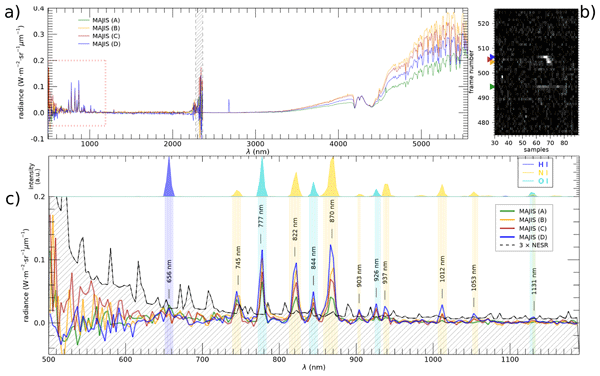
Abstract. A lightning event was detected by the MAJIS imaging spectrometer onboard the Jupiter Icy Moons Explorer (JUICE) spacecraft during its first Earth gravity assist maneuver. This serendipitous space-based spectroscopic observation represents the first detection of its kind for any planetary atmosphere. The event, composed of four flashes, was registered on 2024, August, 20th in an area offshore of Sumatra island, during local nighttime, near to optically thick clouds probed by MAJIS thermal wavelengths. No coincident detection has been obtained by ground-based lightning sensor networks, yet MAJIS observations provide unambiguous evidence of neutral atomic oxygen and nitrogen emissions, identified through several diagnostic lines. A faint Hα signature may also tentatively be associated with lightning flashes.
As MAJIS is not optimized for such observations, a number of caveats related to spectral and temporal resolutions have been considered when deriving absolute quantities, such as lightning energy and temperature. Retrieved energies are overall consistent with known emission by lightning of average strength, ranging from (0.7 ± 0.2) to (1.3 ± 0.3) MJ in the 777 nm O I line and from (0.5 ± 0.2) to (1.5 ± 0.4) MJ in the 870 nm N I line. Temperature estimates, more sensitive to observing biases, yield a broad range of values, spanning between 5000 and 20000 K, with standard uncertainties of the order of 2000–3000 K depending on the retrieval method.
This observation represents a useful benchmark for guiding detection and interpreting possible lightning events on Jupiter, a primary target of the JUICE mission. A preliminary extrapolation of the terrestrial case to the conditions of Jovian atmosphere suggests that H I emissions in the 650 nm and 1870 nm spectral ranges are the most promising for identifying lightning on Jupiter with the MAJIS instrument.
-
Notice on discussion status
The requested preprint has a corresponding peer-reviewed final revised paper. You are encouraged to refer to the final revised version.
-
Preprint
(2292 KB)
-
The requested preprint has a corresponding peer-reviewed final revised paper. You are encouraged to refer to the final revised version.
- Preprint
(2292 KB) - Metadata XML
- BibTeX
- EndNote
- Final revised paper


Journal article(s) based on this preprint
Interactive discussion
Status: closed
-
RC1: 'Comment on egusphere-2025-6453', Anonymous Referee #1, 23 Feb 2026
-
AC1: 'Reply on RC1', Emiliano D'Aversa, 25 Feb 2026
[radio obs and synergies]
- Both historical and more recent radio and microwave measurements at Jupiter (and other planets) are recalled at the beginning of Section 4.6. Regarding future JUICE detections, we agree with the reviewer that synergistic observations will add value to lightning studies. Anyway, as already pointed out by the reviewer, a more in-depth discussion seems off-topic in this context, since we are only preliminary discussing how MAJIS might detect lightning on Jupiter. It is also worth noting that the probability of a coincident detection, e.g. by MAJIS and RPWI, of the same lightning event is reduced by the strict constraints on both spacecraft position and MAJIS pointing/timing. Conversely, general synergy in global statistical analyses could be more easily envisaged.
- We take advantage of this point raised to add a brief comment about synergies at the very end of the conclusion (Section 5) ("In that case, several synergistic approaches with other JUICE instruments can be envisaged, like with UVS for detecting shorter-wavelength emission lines, with JANUS for higher spatial resolution and context images, or with RPWI for coincident radio signals. Even if the likelihood of simultaneous observations of the same event will decrease proportionally to the number of observing constraints to be satisfied, a comparison of events on a statistical basis at global scale could be achieved.")
[observation timing]
- We confirm that the MAJIS time sequence contains long gaps among acquisitions: obs[22ms],gap[178ms],obs[22ms],gap[178ms],etc... and that this was done in order to avoid spatial gaps on the surface, given the high flyby speed. The temporal issue of the observations arises from the fact that we cannot know what was the temporal variability of the lightning flashes, what number of strokes they were made of, their lifetime and exact timing. This is why we could only derive the integrated energy as a lower limit (only that registered during acquisitions, not gaps) and we have large discrepancies in temperature retrievals. We will add a further comment in Section 3.5 to make this point clearer ("A further source of uncertainty is the presence of large temporal gaps between MAJIS acquisitions: consecutive frames start 200 ms apart but the signal is integrated for only 22 ms, leaving 178 ms gaps between them. Therefore, we have no information not only on the number of strokes occurring but also whether the detectable flashes were shorter or longer than 22 ms, and which portion of their lifetime is sampled by the MAJIS acquisitions or falls within the gaps.")
- The only further quantitative estimate we could make concerns the integrated energy: if we assume the average energy measured in flashes B,C,D to be also emitted during the gaps between B-C and C-D, the final total energy increases by a factor (22x3+200x2)/(22x3) ~ 7.1. However, we deem this to be a rather arbitrary assumption, since we do not know which portions of flash light curves fall inside the acquisition intervals and which ones in the gaps in between. Therefore, to avoid making the results more confusing, we would prefer to keep only the lower limit indicated.
- To this regard, we add in Section 4.2 a citation of the work by Wemhoner et al.2025, where they compare lightning energy derived from ground- and space-based observations (their fig.6c) ("As highlighted by systematic comparisons of ground- and space-based lightning observations, the energy measured from space can be significantly lower than that from ground, probably due to the fact that most of the optical energy emitted by a return stroke comes from its near-ground portion, thus considerably absorbed by overlying clouds (Wemhoner et al.2025).")
["kelvin" --> "Kelvin"]
- No problem in changing it, even if, in the usage as measurement unit, the lowercase should be more appropriate (e.g. https://chec.engineering.cornell.edu/units-of-measurement/). We leave it to the editor's choice.
[further references]
- We are very grateful to the reviewer for highlighting interesting references that we have not covered.
- A citation of Kákona et al.(2023) will be added in discussing temporal issues (Section 3.5);
- Wemhoner et al.(2026) retrieve 17600 K as average peak temperatures for CG flashes, in line with our large retrieved range (citation to be added in Section 4.3.3).
Citation: https://doi.org/10.5194/egusphere-2025-6453-AC1 -
AC3: 'Reply on RC1', Emiliano D'Aversa, 03 Apr 2026
IMPORTANT - LATE ADDENDUM REQUEST - During the review time, we have found another clue of lightning in an image taken by the navigation camera onboard the same Juice spacecraft (NavCam). Even if it is a facility instrument, not suitable for quantitative retrievals, we interpret the fact that we see a lightning flash on exactly the same cloud as MAJIS (although a bit separated in both space and time) as a confirmation of the MAJIS observation, and we think the manuscript can benefit for a small addiction. Therefore, in the revised version we are going to add one figure and the relative paragraph at the end of Sect 4.5 (“Search for independent lightning detection”).
Citation: https://doi.org/10.5194/egusphere-2025-6453-AC3
-
AC1: 'Reply on RC1', Emiliano D'Aversa, 25 Feb 2026
-
RC2: 'Comment on egusphere-2025-6453', Anonymous Referee #2, 19 Mar 2026
The manuscript entitled “Spectroscopic detection of terrestrial lightning from space by JUICE-MAJIS during Earth Gravity Assist” by Emiliano D'Aversa et al. presents a thorough and carefully conducted analysis, which I found overall to be of high quality. In particular, I greatly appreciated the level of detail in the spectroscopic investigation. The authors make a commendable effort to explore multiple approaches for constraining the temperature and for assigning the observed spectral lines, while consistently acknowledging the limitations of the observations and the potential biases affecting their interpretation. This balanced and transparent discussion significantly strengthens the manuscript. Overall, this work is very promising and constitutes an encouraging step forward in view of future observations of Jupiter’s atmosphere with this instrument.
Below, I provide a series of specific comments and questions that I believe could help further improve the clarity and robustness of the manuscript, followed by a short list of technical corrections.Specific comments
l. 52: Can the authors clarify what they mean by “the first detection of its kind for any planetary atmosphere”? Lightning in planetary atmospheres has already been observed, for instance from the ISS (see caption of Fig. 4).
l. 63–64: “Temperature estimates, more sensitive to observational biases, yield a broad range of values (…)” – this sentence could be clearer. The temperature of what is being referred to? Could the authors also provide examples of observational biases?
l. 100: “very low flyby”: can the authors specify the corresponding altitude range?
l. 129: Can the authors define the acronym FWHM upon first use?
l. 134–137: The authors cite seven papers describing the instrument. This seems excessive for an overview. Are all of these references equally relevant?
l. 167: Can the authors explain what f represents?
l. 181 and 186: Can the authors define NESR?
Fig. 2: Can the authors label the four panels as (a–d) and refer to them accordingly in the text?
Fig. 2: Can the authors double-check the units in the lower right panel? Is 0.08% indeed the maximum value?
Fig. 2 (caption): Is the lower-left spectrum shown after correction? If so, could this be specified in the caption?
Table 1: Can the authors explain what the last column (flash length) represents and how it is derived?
l. 249: Can the authors confirm whether the wavelength is 4610 nm and not 3979 nm, as indicated in Fig. 3? More generally, the use of different wavelengths is somewhat confusing. What difference does it make to use 3979 or 4610 nm to derive brightness temperature? A brief clarification would be helpful.
l. 274: Can the authors remind the reader of the value of f? Is it still 10% as stated in l. 167?
l. 286: Can the authors ensure consistent notation for the peak at 744.5 nm? Both 744 and 745 nm are used.
l. 290: Can the authors comment on the uncertainty in the line assignments? The use of “possible” introduces ambiguity.
l. 305: Can the authors remind the reader of the spectral resolution at this point?
l. 306–308: Can the authors elaborate on why this Balmer line is considered “interesting”? Is it related to lightning detection?
Tables 3 and 4 vs Table 2: These tables partly contain the same lines but not completely. Could the authors clarify in the captions and/or text how they differ and which one supersedes the others?
l. 447 and 452: The lines at 630.03 and 631 nm are both reported as undetected. Are these the same line? Please harmonize the notation.
l. 527: Could the authors clarify the meaning of the first sentence?
l. 641: Could the authors remind the reader which figure shows flash D?
Table 5: Could the authors explain how the last row is obtained? The values do not appear to correspond to a simple “B+C+D” sum.
Eq. 15: Could the authors provide a reference (textbook or paper) detailing each term?
l. 712: Could the authors provide a reference for multiplet parameter uncertainties and maybe an estimation too?
Fig. 9 (x-axis): The label “ratio I_b + I_q” is unclear. Is this a sum or a ratio? Please rephrase.
l. 774: Please add a reference for the values of χ and D.
l. 811: “different distance from the noise level” is unclear; please rephrase.
l. 850: Please define LNOₓ molecules.
Technical corrections
l. 129: Define FWHM upon first use.
l. 261: Check the font for μ in μm (units should not be italicized).
Fig. 4 (inset): Improve arrow color contrast.
l. 326 (Table 2 caption): Use “positions” instead of “locations”.
Table 2: Revise column titles for clarity. For instance change the title of the columns for “Observed positions (nm) & Most likely assignments & Additional contributions\\\”.
Tables 3 and 4: Can the authors revise the titles of the column as “Observed line positions & Electronic transitions & Spectral filling factor\\\” and “(nm) & (nm) & Line assignment & $\delta_{k,b}$\\\”, for instance?
Tables 3 and 4: Check font in the last column (appears struck through).
l. 416: Use “MAJIS spectral band”.
l. 445: “a decrease in temperature”
l. 480: Replace “are seen peaking” with “are centered”.
l. 487: Check spacing (“related to other”).
l. 491: Check spacing (“in Figure 8b”).
Fig. 8: Increase thickness of dashed orange curves.
l. 624–625: Check parentheses around references.
Table 5: Improve layout (duplicate “$\sum f$”, units formatting).
Fig. 9: Increase label font size.
l. 755: Add “-s” to “ratio”.
l. 806: I smiled when I read the sentence: “It is evident that the two methods investigated do not fully agree with each other (…)”. Can the authors remove the word “fully”?
l. 862: Check parentheses.
l. 923: Use superscript in cm⁻¹.
l. 944: Check parentheses and confirm Fletcher et al. (2025) status.
l. 974: Prefer “neither … nor”.
l. 1070, 1098, 1193: Check references.
l. 1240, 1259: Add DOIs if available.Citation: https://doi.org/10.5194/egusphere-2025-6453-RC2 -
AC2: 'Reply on RC2', Emiliano D'Aversa, 03 Apr 2026
The authors are grateful to this anonymous referee for his very accurate review, including interesting comments useful for improving both clarity and coherence of the manuscript.
We enclose responses to all referee's comments in the attached file.
IMPORTANT - LATE ADDENDUM REQUEST - During the review time, we have found another clue of lightning in an image taken by the navigation camera onboard the same Juice spacecraft (NavCam). Even if it is a facility instrument, not suitable for quantitative retrievals, we interpret the fact that we see a lightning flash on exactly the same cloud as MAJIS (although a bit separated in both space and time) as a confirmation of the MAJIS observation, and we think the manuscript can benefit for a small addiction. Therefore, in the revised version we are going to add one figure and the relative paragraph at the end of Sect 4.5 (“Search for independent lightning detection”).
-
AC2: 'Reply on RC2', Emiliano D'Aversa, 03 Apr 2026


Interactive discussion
Status: closed
-
RC1: 'Comment on egusphere-2025-6453', Anonymous Referee #1, 23 Feb 2026
Review of egusphere-2025-6453
Spectroscopic detection of terrestrial lightning from space by JUICE-MAJIS during Earth Gravity Assist
by Emiliano d’Aversa et al.
The authors convincingly argue that terrestrial lightning has benn spectroscopically observed with the JUICE-MAJIS instrument during the Earth Gravity Assist flyby. The analysis is quantitative, detailed and covers multiple aspects. Discussed is both the observation of terrestrial lightning as well as an outlook on future observations at Jupiter. Not mentioned are the effects of lightning in the radio spectrum, prominently VLF whistlers. These have been observed historically and numerously, on the ground and also in space. JUICE has also the RPW (radio and plasma waves), this could enable coordinated optical and radio waves analysis and studies of lightning. However, this can be left for the future. The manuscript is already quite rich. I recommend to publish the work after only minor comments.
Minor comments:
Lines 153-156: "It has been obtained by rotating the line of sight by about 4° (2° of rotation of the internal mirror) in steps for a total time of seconds. At every step (i.e. every 200 ms), a 128-pixels spectral frame encompassing 1016 wavelengths has been acquired, with an integration time of 22 ms." This is a bit confusing for me: Does it mean, that there are gaps in time, in a 200 ms long step the integration happens for 22 ms, i.e. about 11% of the time. At the other time (~89%) no integration of light is going on? I understand that the motion of the mirror is adjusted to the distance to the planet/moon (11500 km at EGA) and spacecraft rotation such that there spatial gaps are avoided: pixel width on Earth ~1.7 km (2 km with motional smearing). The duration of lightning flashes measured on the ground varies, a median duration of 0.52 s is given in Kákona et al., 2023, so the 200 ms step duration would be no problem, However, a flash typically consists of much shorter "strokea". This temporal characteristics of lightning flashes is discussed in section 3.5, but the possible effects of the integration in time by MAIJIs with gaps (if I understood correctly) and of relatively slow sampling (200 ms) could perhaps be elaborated on a bit more.
Line 301: "kelvin" --> "Kelvin"
Section 3.3 Oxygen lines
A recent publication with temperature estimates in lightning based on atomic oxygen lines (observed at the ground) is by Wemhoner et al. (2026). I'm not sure how relevant this would be for the discussion in this manuscript, and suggest to the authors to have a look at this paper.
Section 3.5. Temporal resolution
Kákona et al. (2023), already mentioned above, might be a fresh reference with some relevance for this discussion.
References
Kákona, J., Mikeš, J., Ambrožová, I., Ploc, O., Velychko, O., Sihver, L., and Kákona, M.: In situ ground-based mobile measurement of lightning events above central Europe, Atmos. Meas. Tech., 16, 547–561, https://doi.org/10.5194/amt-16-547-2023, 2023.
Wemhoner, J., Leal, A.F.R., da Silva, C.L. et al. Atomic oxygen photometric temperature of lightning and its sub-processes with SOPAPILLA. Sci Rep 16, 4068 (2026). https://doi.org/10.1038/s41598-025-34189-8
Citation: https://doi.org/10.5194/egusphere-2025-6453-RC1 -
AC1: 'Reply on RC1', Emiliano D'Aversa, 25 Feb 2026
[radio obs and synergies]
- Both historical and more recent radio and microwave measurements at Jupiter (and other planets) are recalled at the beginning of Section 4.6. Regarding future JUICE detections, we agree with the reviewer that synergistic observations will add value to lightning studies. Anyway, as already pointed out by the reviewer, a more in-depth discussion seems off-topic in this context, since we are only preliminary discussing how MAJIS might detect lightning on Jupiter. It is also worth noting that the probability of a coincident detection, e.g. by MAJIS and RPWI, of the same lightning event is reduced by the strict constraints on both spacecraft position and MAJIS pointing/timing. Conversely, general synergy in global statistical analyses could be more easily envisaged.
- We take advantage of this point raised to add a brief comment about synergies at the very end of the conclusion (Section 5) ("In that case, several synergistic approaches with other JUICE instruments can be envisaged, like with UVS for detecting shorter-wavelength emission lines, with JANUS for higher spatial resolution and context images, or with RPWI for coincident radio signals. Even if the likelihood of simultaneous observations of the same event will decrease proportionally to the number of observing constraints to be satisfied, a comparison of events on a statistical basis at global scale could be achieved.")
[observation timing]
- We confirm that the MAJIS time sequence contains long gaps among acquisitions: obs[22ms],gap[178ms],obs[22ms],gap[178ms],etc... and that this was done in order to avoid spatial gaps on the surface, given the high flyby speed. The temporal issue of the observations arises from the fact that we cannot know what was the temporal variability of the lightning flashes, what number of strokes they were made of, their lifetime and exact timing. This is why we could only derive the integrated energy as a lower limit (only that registered during acquisitions, not gaps) and we have large discrepancies in temperature retrievals. We will add a further comment in Section 3.5 to make this point clearer ("A further source of uncertainty is the presence of large temporal gaps between MAJIS acquisitions: consecutive frames start 200 ms apart but the signal is integrated for only 22 ms, leaving 178 ms gaps between them. Therefore, we have no information not only on the number of strokes occurring but also whether the detectable flashes were shorter or longer than 22 ms, and which portion of their lifetime is sampled by the MAJIS acquisitions or falls within the gaps.")
- The only further quantitative estimate we could make concerns the integrated energy: if we assume the average energy measured in flashes B,C,D to be also emitted during the gaps between B-C and C-D, the final total energy increases by a factor (22x3+200x2)/(22x3) ~ 7.1. However, we deem this to be a rather arbitrary assumption, since we do not know which portions of flash light curves fall inside the acquisition intervals and which ones in the gaps in between. Therefore, to avoid making the results more confusing, we would prefer to keep only the lower limit indicated.
- To this regard, we add in Section 4.2 a citation of the work by Wemhoner et al.2025, where they compare lightning energy derived from ground- and space-based observations (their fig.6c) ("As highlighted by systematic comparisons of ground- and space-based lightning observations, the energy measured from space can be significantly lower than that from ground, probably due to the fact that most of the optical energy emitted by a return stroke comes from its near-ground portion, thus considerably absorbed by overlying clouds (Wemhoner et al.2025).")
["kelvin" --> "Kelvin"]
- No problem in changing it, even if, in the usage as measurement unit, the lowercase should be more appropriate (e.g. https://chec.engineering.cornell.edu/units-of-measurement/). We leave it to the editor's choice.
[further references]
- We are very grateful to the reviewer for highlighting interesting references that we have not covered.
- A citation of Kákona et al.(2023) will be added in discussing temporal issues (Section 3.5);
- Wemhoner et al.(2026) retrieve 17600 K as average peak temperatures for CG flashes, in line with our large retrieved range (citation to be added in Section 4.3.3).
Citation: https://doi.org/10.5194/egusphere-2025-6453-AC1 -
AC3: 'Reply on RC1', Emiliano D'Aversa, 03 Apr 2026
IMPORTANT - LATE ADDENDUM REQUEST - During the review time, we have found another clue of lightning in an image taken by the navigation camera onboard the same Juice spacecraft (NavCam). Even if it is a facility instrument, not suitable for quantitative retrievals, we interpret the fact that we see a lightning flash on exactly the same cloud as MAJIS (although a bit separated in both space and time) as a confirmation of the MAJIS observation, and we think the manuscript can benefit for a small addiction. Therefore, in the revised version we are going to add one figure and the relative paragraph at the end of Sect 4.5 (“Search for independent lightning detection”).
Citation: https://doi.org/10.5194/egusphere-2025-6453-AC3
-
AC1: 'Reply on RC1', Emiliano D'Aversa, 25 Feb 2026
-
RC2: 'Comment on egusphere-2025-6453', Anonymous Referee #2, 19 Mar 2026
The manuscript entitled “Spectroscopic detection of terrestrial lightning from space by JUICE-MAJIS during Earth Gravity Assist” by Emiliano D'Aversa et al. presents a thorough and carefully conducted analysis, which I found overall to be of high quality. In particular, I greatly appreciated the level of detail in the spectroscopic investigation. The authors make a commendable effort to explore multiple approaches for constraining the temperature and for assigning the observed spectral lines, while consistently acknowledging the limitations of the observations and the potential biases affecting their interpretation. This balanced and transparent discussion significantly strengthens the manuscript. Overall, this work is very promising and constitutes an encouraging step forward in view of future observations of Jupiter’s atmosphere with this instrument.
Below, I provide a series of specific comments and questions that I believe could help further improve the clarity and robustness of the manuscript, followed by a short list of technical corrections.Specific comments
l. 52: Can the authors clarify what they mean by “the first detection of its kind for any planetary atmosphere”? Lightning in planetary atmospheres has already been observed, for instance from the ISS (see caption of Fig. 4).
l. 63–64: “Temperature estimates, more sensitive to observational biases, yield a broad range of values (…)” – this sentence could be clearer. The temperature of what is being referred to? Could the authors also provide examples of observational biases?
l. 100: “very low flyby”: can the authors specify the corresponding altitude range?
l. 129: Can the authors define the acronym FWHM upon first use?
l. 134–137: The authors cite seven papers describing the instrument. This seems excessive for an overview. Are all of these references equally relevant?
l. 167: Can the authors explain what f represents?
l. 181 and 186: Can the authors define NESR?
Fig. 2: Can the authors label the four panels as (a–d) and refer to them accordingly in the text?
Fig. 2: Can the authors double-check the units in the lower right panel? Is 0.08% indeed the maximum value?
Fig. 2 (caption): Is the lower-left spectrum shown after correction? If so, could this be specified in the caption?
Table 1: Can the authors explain what the last column (flash length) represents and how it is derived?
l. 249: Can the authors confirm whether the wavelength is 4610 nm and not 3979 nm, as indicated in Fig. 3? More generally, the use of different wavelengths is somewhat confusing. What difference does it make to use 3979 or 4610 nm to derive brightness temperature? A brief clarification would be helpful.
l. 274: Can the authors remind the reader of the value of f? Is it still 10% as stated in l. 167?
l. 286: Can the authors ensure consistent notation for the peak at 744.5 nm? Both 744 and 745 nm are used.
l. 290: Can the authors comment on the uncertainty in the line assignments? The use of “possible” introduces ambiguity.
l. 305: Can the authors remind the reader of the spectral resolution at this point?
l. 306–308: Can the authors elaborate on why this Balmer line is considered “interesting”? Is it related to lightning detection?
Tables 3 and 4 vs Table 2: These tables partly contain the same lines but not completely. Could the authors clarify in the captions and/or text how they differ and which one supersedes the others?
l. 447 and 452: The lines at 630.03 and 631 nm are both reported as undetected. Are these the same line? Please harmonize the notation.
l. 527: Could the authors clarify the meaning of the first sentence?
l. 641: Could the authors remind the reader which figure shows flash D?
Table 5: Could the authors explain how the last row is obtained? The values do not appear to correspond to a simple “B+C+D” sum.
Eq. 15: Could the authors provide a reference (textbook or paper) detailing each term?
l. 712: Could the authors provide a reference for multiplet parameter uncertainties and maybe an estimation too?
Fig. 9 (x-axis): The label “ratio I_b + I_q” is unclear. Is this a sum or a ratio? Please rephrase.
l. 774: Please add a reference for the values of χ and D.
l. 811: “different distance from the noise level” is unclear; please rephrase.
l. 850: Please define LNOₓ molecules.
Technical corrections
l. 129: Define FWHM upon first use.
l. 261: Check the font for μ in μm (units should not be italicized).
Fig. 4 (inset): Improve arrow color contrast.
l. 326 (Table 2 caption): Use “positions” instead of “locations”.
Table 2: Revise column titles for clarity. For instance change the title of the columns for “Observed positions (nm) & Most likely assignments & Additional contributions\\\”.
Tables 3 and 4: Can the authors revise the titles of the column as “Observed line positions & Electronic transitions & Spectral filling factor\\\” and “(nm) & (nm) & Line assignment & $\delta_{k,b}$\\\”, for instance?
Tables 3 and 4: Check font in the last column (appears struck through).
l. 416: Use “MAJIS spectral band”.
l. 445: “a decrease in temperature”
l. 480: Replace “are seen peaking” with “are centered”.
l. 487: Check spacing (“related to other”).
l. 491: Check spacing (“in Figure 8b”).
Fig. 8: Increase thickness of dashed orange curves.
l. 624–625: Check parentheses around references.
Table 5: Improve layout (duplicate “$\sum f$”, units formatting).
Fig. 9: Increase label font size.
l. 755: Add “-s” to “ratio”.
l. 806: I smiled when I read the sentence: “It is evident that the two methods investigated do not fully agree with each other (…)”. Can the authors remove the word “fully”?
l. 862: Check parentheses.
l. 923: Use superscript in cm⁻¹.
l. 944: Check parentheses and confirm Fletcher et al. (2025) status.
l. 974: Prefer “neither … nor”.
l. 1070, 1098, 1193: Check references.
l. 1240, 1259: Add DOIs if available.Citation: https://doi.org/10.5194/egusphere-2025-6453-RC2 -
AC2: 'Reply on RC2', Emiliano D'Aversa, 03 Apr 2026
The authors are grateful to this anonymous referee for his very accurate review, including interesting comments useful for improving both clarity and coherence of the manuscript.
We enclose responses to all referee's comments in the attached file.
IMPORTANT - LATE ADDENDUM REQUEST - During the review time, we have found another clue of lightning in an image taken by the navigation camera onboard the same Juice spacecraft (NavCam). Even if it is a facility instrument, not suitable for quantitative retrievals, we interpret the fact that we see a lightning flash on exactly the same cloud as MAJIS (although a bit separated in both space and time) as a confirmation of the MAJIS observation, and we think the manuscript can benefit for a small addiction. Therefore, in the revised version we are going to add one figure and the relative paragraph at the end of Sect 4.5 (“Search for independent lightning detection”).
-
AC2: 'Reply on RC2', Emiliano D'Aversa, 03 Apr 2026
Peer review completion


Journal article(s) based on this preprint
Viewed
| HTML | XML | Total | BibTeX | EndNote | |
|---|---|---|---|---|---|
| 1,303 | 444 | 137 | 1,884 | 93 | 116 |
- HTML: 1,303
- PDF: 444
- XML: 137
- Total: 1,884
- BibTeX: 93
- EndNote: 116
Viewed (geographical distribution)
| Country | # | Views | % |
|---|
| Total: | 0 |
| HTML: | 0 |
| PDF: | 0 |
| XML: | 0 |
- 1
Cited


2 citations as recorded by crossref.
- ESA/JUICE encounters Earth/Moon in 2024: overview of the Moons And Jupiter Imaging Spectrometer (MAJIS) observations F. Poulet et al. https://doi.org/10.5194/angeo-44-163-2026
- An Ensemble of Deep Transfer Learning Models for Plant Disease Prediction Using Thermal Images I. Bhakta et al. https://doi.org/10.1007/s11220-026-00799-3
Emiliano D'Aversa
Fabrizio Oliva
Giuseppe Piccioni
François Poulet
Ivana Kolmašová
Alessandra Migliorini
Gianrico Filacchione
Leigh Fletcher
Alessandro Mura
Yves Langevin
Benoît Seignovert
Davide Grassi
Sébastien Rodriguez
Federico Tosi
Nicolas Ligier
Giuseppe Sindoni
Marco Giardino
Christina Plainaki
The requested preprint has a corresponding peer-reviewed final revised paper. You are encouraged to refer to the final revised version.
- Preprint
(2292 KB) - Metadata XML
Review of egusphere-2025-6453
Spectroscopic detection of terrestrial lightning from space by JUICE-MAJIS during Earth Gravity Assist
by Emiliano d’Aversa et al.
The authors convincingly argue that terrestrial lightning has benn spectroscopically observed with the JUICE-MAJIS instrument during the Earth Gravity Assist flyby. The analysis is quantitative, detailed and covers multiple aspects. Discussed is both the observation of terrestrial lightning as well as an outlook on future observations at Jupiter. Not mentioned are the effects of lightning in the radio spectrum, prominently VLF whistlers. These have been observed historically and numerously, on the ground and also in space. JUICE has also the RPW (radio and plasma waves), this could enable coordinated optical and radio waves analysis and studies of lightning. However, this can be left for the future. The manuscript is already quite rich. I recommend to publish the work after only minor comments.
Minor comments:
Lines 153-156: "It has been obtained by rotating the line of sight by about 4° (2° of rotation of the internal mirror) in steps for a total time of seconds. At every step (i.e. every 200 ms), a 128-pixels spectral frame encompassing 1016 wavelengths has been acquired, with an integration time of 22 ms." This is a bit confusing for me: Does it mean, that there are gaps in time, in a 200 ms long step the integration happens for 22 ms, i.e. about 11% of the time. At the other time (~89%) no integration of light is going on? I understand that the motion of the mirror is adjusted to the distance to the planet/moon (11500 km at EGA) and spacecraft rotation such that there spatial gaps are avoided: pixel width on Earth ~1.7 km (2 km with motional smearing). The duration of lightning flashes measured on the ground varies, a median duration of 0.52 s is given in Kákona et al., 2023, so the 200 ms step duration would be no problem, However, a flash typically consists of much shorter "strokea". This temporal characteristics of lightning flashes is discussed in section 3.5, but the possible effects of the integration in time by MAIJIs with gaps (if I understood correctly) and of relatively slow sampling (200 ms) could perhaps be elaborated on a bit more.
Line 301: "kelvin" --> "Kelvin"
Section 3.3 Oxygen lines
A recent publication with temperature estimates in lightning based on atomic oxygen lines (observed at the ground) is by Wemhoner et al. (2026). I'm not sure how relevant this would be for the discussion in this manuscript, and suggest to the authors to have a look at this paper.
Section 3.5. Temporal resolution
Kákona et al. (2023), already mentioned above, might be a fresh reference with some relevance for this discussion.
References
Kákona, J., Mikeš, J., Ambrožová, I., Ploc, O., Velychko, O., Sihver, L., and Kákona, M.: In situ ground-based mobile measurement of lightning events above central Europe, Atmos. Meas. Tech., 16, 547–561, https://doi.org/10.5194/amt-16-547-2023, 2023.
Wemhoner, J., Leal, A.F.R., da Silva, C.L. et al. Atomic oxygen photometric temperature of lightning and its sub-processes with SOPAPILLA. Sci Rep 16, 4068 (2026). https://doi.org/10.1038/s41598-025-34189-8