
the Creative Commons Attribution 4.0 License.
the Creative Commons Attribution 4.0 License.
 | 14 Jan 2026
Challenges in reconstructing seasonally driven landslide motion from optical satellite data: insights from the Del Medio catchment, NW Argentina
Abstract. Optical satellite images are a valuable resource for studying slow-moving landslides from space. However, monitoring displacement through pairwise image correlation and time-series inversion presents several challenges, including the impact of seasonality on measurement accuracy. Seasonal biases arise from systematic measurement errors related to variable illumination conditions and shadows. These errors manifest in the form of an oscillation pattern in the satellite-derived time series. This complicates the identification of a true seasonal component linked to feedback mechanisms between landslide displacement and a seasonally variable climate.
Here, we provide a comprehensive evaluation of different strategies to reduce the magnitude of seasonal biases. These include modeling the seasonal error component, restricting correlation to pairs with similar illumination, weighting, and upsampling optical images. We find that all methods can reduce the impact of systematic seasonal bias at different trade-offs: longer processing times, creation of sparse or disconnected networks, dependence on topographic data, or potential alteration of the true displacement signal.
We evaluated the removal of seasonal bias from displacement time series derived from optical satellite data (Landsat-8, Sentinel-2, PlanetScope) over a large slow-moving landslide in the Río Del Medio catchment in northwest Argentina. The transition zone between the Altiplano-Puna plateau and the Andean foreland is characterized by a highly seasonal climate, with intense rainfall during the South American summer monsoon and semi-arid conditions throughout the rest of the year. Over the 10-year observation period, the landslide accumulated approximately 35 m of displacement at spatially and temporally variable rates. After the removal of the seasonal bias component, three acceleration phases remain. These date to early 2017, early 2018, and late 2021, and all fall within the rainy season of the respective year. The timing of the acceleration suggests precipitation as a major driver of a landslide that is already preconditioned by infiltration and sliding through inherited fault structures, weakened lithologies, and freeze-thaw processes at high altitudes of up to 4500 m above sea level.
Based on this example, our study provides a basis for selecting the appropriate correction methods to address seasonal biases. Considering all effects of seasonality is essential to improve the accuracy of satellite-derived displacement measurements and better constrain the feedback mechanisms between landslide velocity and a seasonal climate.
-
Notice on discussion status
The requested preprint has a corresponding peer-reviewed final revised paper. You are encouraged to refer to the final revised version.
-
Preprint
(35082 KB)
-
Supplement
(27811 KB)
-
The requested preprint has a corresponding peer-reviewed final revised paper. You are encouraged to refer to the final revised version.
- Preprint
(35082 KB) - Metadata XML
-
Supplement
(27811 KB) - BibTeX
- EndNote
- Final revised paper


Journal article(s) based on this preprint
Interactive discussion
Status: closed
-
RC1: 'Comment on egusphere-2025-6445', Anonymous Referee #1, 11 Feb 2026
-
AC1: 'Reply on RC1', Ariane Mueting, 10 Jun 2026
The comment was uploaded in the form of a supplement: https://egusphere.copernicus.org/preprints/2026/egusphere-2025-6445/egusphere-2025-6445-AC1-supplement.pdf
-
AC1: 'Reply on RC1', Ariane Mueting, 10 Jun 2026
-
RC2: 'Comment on egusphere-2025-6445', Pascal Lacroix, 13 Apr 2026
I really appreciated reading the paper titled Challenges in reconstructing seasonally driven landslide motion from optical satellite data: insights from the Del Medio catchment, NW Argentina. The paper tackles the problem of variation of sun illumination in the reconstruction of ground-displacement time-series from optical satellites. This effect creates a seasonal signal, that can sometimes be misinterpreted on seasonally moving objects like landslides. Different strategies have been proposed in the past to correct this effect, but have never been compared. I found the paper clear and well organized, well written with a good choice of the Figures. The results on the comparison of the illumination correction strategies and on the multi-sensor comparison are really interesting and worth publishing.
This study also has some limitations that should be taken into account. For instance, too much importance is given to the single-case-study of the Del-Medio landslide, given that no validation dataset exists on this active site, and that the resulting time-series present weak signals, whose analysis is not particularly convincing in the absence of validation data. I set out in more detail below the various points needed to clarify this matter. Also, the validation of the results on the different mitigation strategies is not completely convincing as their might be a bias of validation between stable and moving areas, due to the non-linear aspect of the correlation operator. I also think that the methodological results, particularly the multi-sensor work can be more in depth analyzed, especially since the results are not really intuitives. This should also be reflected in the abstract and title, and the introduction—which needs to be partially rewritten—should include more information on the current state of research.
Finally I have also set out below a few points that require clarification.
Overall, I believe this study deserves being published, provided that these various points are taken into account.
Detailed comments
- The comparison of the different mitigation strategies are valid on the stable areas, but are more questionable on moving areas. Because the correlation operator is not linear, I am wondering what is the combined effect of bias illumination variation and a moving target on the results. Since no validation datasets exist on the Del-Medio landslide, this question is still open.
This question also relates to the terrain features the correlation algorithm is sensitive to, depending on the optical sensor (resolution, noise), the parameters of the correlation algorithm and the type of land-cover. My feeling is that for a similar area of study, the high- and medium resolution images are sensitive to different features of the terrain. Your results on the different sensors could perhaps elucidate this question ?
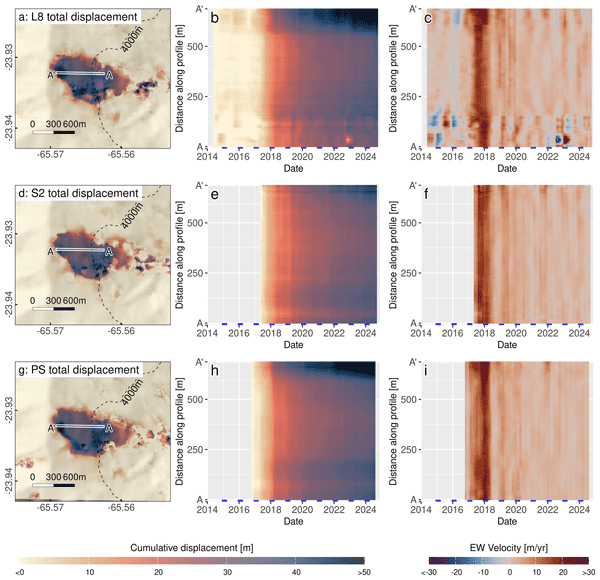
- The results obtained with different sensors are really intriguing as S2 and PS present lower displacement values on the Del-Medio landslide than with L8 (Figure 2), despite their higher resolution. This is counter-intuitive (cf e.g. Bontemps et al., 2018 ; Cusicanqui et al., 2025), and questions me a lot on the ground of these results. Is that also an effect of the terrain-feature depending on the sensor type (or resolution) ? That would be really interesting to apply your method to another area with validation data (or synthetic data). In the suplementary material, Figure S17 shows a result of synthetic tests, but it is not clear how it has been developed and what are the results for the different sensors. Maybe it could be worth focusing on that aspect ?
- The results on the impact of the sensors presented in Figure 5 (and section 4.3) investigate the effect of the spatial resolution only, whereas the satellite images have not only their own pixel resolution but also their own pixel noise (radiometric noise). A pixel from a Planetscope image is much noisier than a pixel of S2, so that modelling a S2 image by downsampling a Planetscope image at 9m (~10m) resolution is certainly not valid. To me this paragraph does not allow you to elucidate the differences observed between the different sensors. I would rather try to compare correlation results obtained with different satellite images taken at similar days/hours of acquisitions. Nevertheless, I found this part interesting as it made me also wonder « does a PlanetScope upsampled at 1m lead to even lower seasonal oscillation ? ».
- Some technical aspects must be clarified : (i) no phase delay on the modelling of the seasonal oscillation appears in the Equation 9, despite a map of phase delay is shown in Figure S8 and S10. How is the phase delay taken into account ? This phase delay is, by the way, not analyzed at all in your results/discussion. I think that’s a bit of a shame. (ii) the definition of « short-baseline » pairs in relation with inter-annual trend and the choice to not used these « short-baseline » pairs in the inversion strategy are not clear. (iii) how is done the upsampling of S2 and L8 images ?
- I found that the section « 4.4 mitigation of seasonal bias » must appear in the methodological section rather than in the results. One key aspect of your study is a comparison of the mitigation strategies of the seasonal bias. This different straegies should first appear in the methods, before showing the results.
- The introduction/title/abstract are too much focused on the Del-Medio landslide. whereas this single-case study is just an example of application of your methods to one specific case-study. To my point of view, the main broughts of your work are elsewhere, on the comparison of the seasonal bias mitgation, including for a multi-sensor approach. I think the introduction should be partly rewritten, to decrease the parts related to the Del-Medio landslide (for instance the text from lines 42 to 48 could be placed in the « site study » section), and to bring more elements on the state of the art on the multi-sensor approach for ground-motion measurements.
The title/abstract should also reflect this aspect of the study, and provide less importance to the Del-Medio results given that no validation datasets are existing here.
- The results obtained on the Del-Medio landslide with and without seasonal bias mitigation using the L8 sensor (Figure 7) are not intuitive to me. Indeed removing the seasonal bias leads to a much lower L8 total displacement. This is not the case for S2 and PS. How would you explan it ?
- Paragraph 4.5 is not really clear to me :
The « high » standard deviation observed in the Figure 7 is not only linked to difference of unit kinematics. If I understand well, the ribbons shown in the Figure 7 reflects the standard deviation of all the pixels. To me this pixel variations is linked both to the kinematics of the different units and to border effects due to size of the correlation windows (See for instance Bontemps et al., 2018).
Also I am wondering the effect of averaging cumulative displacement time-series over areas not showing the same velocities. I don’t think this is the best way to highlight the kinematics of the landslide. I would rather pick up some selected pixels in the middle of the different units of the landslide (to limit the border effects very common with medium resolution satellites). This comment could also apply to the time-series of Figure 10.
It is also not really clear what does the term « uniform acceleration » refer to ?
The word « surge » is used a lot in the glacier community but is not really common for the landslide community. It is sometimes used to describe specific events like landslide-induced-tsunamis. I don’t think it is the right word to use here (and elesewhere in the text).
The accelerations from 2018 and 2021 are not really obvious to see in Figure 7, also given that Figure 7 averages pixels with different velocities (and maybe even different timing of accelerations of the different units). Maybe try to better highlight these accelerations in the mean time-series normalized per-pixel of individual time-series in the fastest parts of the landslide where the signal to noise ratio will be higher?
- The analysis of the link between the landslide accelerations and the rainstorms can be improved (after these 2018 and 2021 accelerations have been better highlighted. See my previous comment). First of all the brought of ERA5, due its low quality in this area, is very limited (as also pointed out by the author). I don’t see the point of showing it. I would keep only the GPM dataset. However, I found interesting that extreme rainfall events could accelerate deep-seated slow-moving landslides. This is not the first case-study showing this. I don’t know the complete bibliography, but I have in mind the Joshimath landslide (Sreejith et al., 2023). A better analysis of the litterature can be done and the mechanics behind this acceleration analyzed.
- The Figure 10 is really confusing to me : Is that a total displacement or the amplitude of the seasonal acceleration ? The caption and the legend says different things. Since I didn’t understand this Figure, I can’t really comment it as well as the section 5.2 that relies on this Figure. Please clarify and I could comment during a second round of review.
- In Figure 4, it would be interesting to have a probability density function of the slopes (both slope gradient and aspects) and the sun-azimuth differences. Indeed for slopes or sun-azimuth difference appearing few times, the results are certainly too noisy, and the bins must be removed.
- If I understand well, for the specific case of the Del-Medio landslide, the seasonal oscillation has been removed per pixel (lines 270-278). As the authors say, this can be applied to the Del Medio landslide only as it seems to not show any seasonal movement (even if the absence of in-situ measurements this assumption is complex to validate). I think it must be even more clearly stated that this method should not be applied to any landslides.
- The choice of not using the short-baselines must be better discussed. Indeed it is certainly a good choice in the case of the Del Medio landslide where the land-cover doesn’t seem to evolve much with time (maybe I am wrong?), but this might not be a good choice in other areas with a human presence and modification of the land-cover with time, that can lead to a decay of the coherence with time. This must be discussed.
- In Figure 8, we still observe seasonal oscillations, despite a per-pixel seasonal signal has been removed (if I understand well). This is not really intuitive to me why these oscillations still remain ? Also the transect AA’ seems purely EW oriented, and not exactly longitudinal. Wouldn’t it be better to use a longitudinal transect of the landslide ?
- In Figure 10, the standard deviations of the difference of displacement fields on stable areas between L8-S2, L8-PS and S2-PS are calculated. This can be exploited to estimate separately the standard deviation of the displacement fields of L8, PS, and S2. Given the values shown in Figure 10, it will show sigmaS2 and L8 higher than sigmaPS, with sigmaS2 and L8 relatively similar. In this context I am wondering why S2 and L8 do not show similar time-series ? Also, adding these standard deviations to the individual time-series (for instance on Figure 9a) would provide a more convincing argument to the analysis of the accelerations period.
- Some Figures could be partly improved. In Figure 3, the dashed black contour of the landslide is not well visible. Maybe choose another color or symbol ? In Figure 9b the dashed black line indicating the accelerations mask the precipitations. In Figure 9a, indicate more clearly that the major debris flow is not occuring on the landslide but nearby.
Citation: https://doi.org/10.5194/egusphere-2025-6445-RC2 -
AC2: 'Reply on RC2', Ariane Mueting, 10 Jun 2026
The comment was uploaded in the form of a supplement: https://egusphere.copernicus.org/preprints/2026/egusphere-2025-6445/egusphere-2025-6445-AC2-supplement.pdf
-
AC2: 'Reply on RC2', Ariane Mueting, 10 Jun 2026
Peer review completion


Interactive discussion
Status: closed
-
RC1: 'Comment on egusphere-2025-6445', Anonymous Referee #1, 11 Feb 2026
General assessment:
I reviewed the study Challenges in reconstructing seasonally driven landslide motion from optical satellite data: insights from the Del Medio catchment, NW Argentina by Mueting et al. I really enjoyed reading this article that presents a well-thought and well-written study of the effect of seasonal changes on the measurement of landslide movement using times series of satellite optical images. Authors compare measurements made using images from different satellite sensors (Landsat8, Sentinel2, and PlanetScope), and with different bias mitigation strategies (image and pairing strategies, weighting, and signal fitting). The analysis is sound, well described and illustrated, and the conclusions mostly supported by the analysis.
Aside from comments on figures and points that need to be clarified or more elaborated, my main critic on this work is regarding the correction method used to separate the seasonal bias from the landslide displacement. In the conclusion, authors acknowledge that their choice of fitting a sine function to the displacement time series at every pixel might remove a seasonal component of the landslide displacement, though the implications of this are never really discussed. Quite the contrary, the authors assume at several places in the text that they do not observe any signal landslide movement. I think this is an incoherence in the study that needs to be clarified. To this regard, authors entirely overlooked post-processing strategies based on Independent component analysis and machine learning ethnics. If not tested, these technics along with their efficiency and accuracy need to be mentioned.
Eventually, authors present some of the post-processing technics section 3 (methodology) while later presenting and comparing different post-processing strategies in section 4.4. This creates some redundancy in the writing and also brings some confusions as it seems the post-processing technics presented in section 3 are not applied to all datasets but rather tested against other ones. She should be better organized or explained in the Methodology part.
In conclusions, I think this is a great study which publication would large benefit the community working on time series analysis of optical images. Though, I do have concerns regarding the post-processing strategy and how it could affect the seasonal landslide displacement signal. I think the authors should present clarifications and eventually further analysis of this seasonal correction and its impact on the landslide displacement. That said, I am rather an expert on image correlation technics than on time series analysis technics, so there might be aspects of this work that I did not understand properly. If this is the case, I apologize.
Line by-line-comment:
Lines 15-17: Can authors mention the type and density of vegetation present in the area? It is also an important parameter influencing the accuracy of the measurements and can be correlated to seasonal changes.
Lines 38-39: Why not mentioning the seasonal variations such as illumination, humidity, and vegetation changes that can create ground displacement measurement biases? Indeed seasonal shadow refers to exactly? Shadows occur because of topography or obstruction, independently from the seasonal conditions; however their pattern is correlated to illumination conditions subject to seasonal changes (then at the origin of the oscillatory pattern in the time series). Please be more specific in the description of this process.
Lines 40-41: The sentence “Erroneous measurements will degrade the quality of inverted displacement time series, depending on their magnitude and distribution” reads odd. Erroneous measurements will anyways degrade the inverted displacements. It is the bias in the inverted displacements that will depend on the magnitude and distribution of these erroneous measurements. It is maybe just a matter of rephrasing.
Lines 47-48: What about humidity and vegetation changes?
Lines 55-56: This is a great point.
Line 77: It would have been interesting to look at the vertical component from stereo imagery, at least for the cumulative displacement, to be able to infer the possible vertical deformation and rotation of the landslide body as a result of its downslope movement. I know it is not the main focus of this study though.
Line 83: The displacement rate was indicated to be ~2.5 m/yr in the introduction. It is indicated 2-5 m/yr here. Which one is the correct one?
Lines 89-91: I agree that the question of whether the landslide behavior is being affected by the rainfall is an important question. Though the relation between rainfall and landslide have been well studies from observations on other case studies as well as analogue experiments. Authors should raise more specific questions that can be answered using the dense observations they propose, such as: Do the landslide movement reacts seasonally in response to the varying seasonal conditions? If not, what type of response does it show (linear for example) and why (controls of the kinematic of the sliding or bulk creeping)? Can we identify a delay between the start of the rainfall events and the landslide acceleration? Is there a minimum rainfall intensity (or volume) that is required before we start seeing any acceleration in the landslide movement? Further reading the study, it appears that the authors do not aim at studying any seasonal changes in the landslide behavior as it would appear correlated to the seasonal bias that is removed from the inverted time series (and only the inter-annual changes are kept). Authors should be more specific regarding the frequency of the landslide displacement signal they are trying to retrieve (and separate from the seasonal one). This is an unclear point all along the study, that I also raise at other places later in my review.
Figure 1: Please indicate the source of the DEM (SRTM, Copernicus?) and its ground resolution? Black lines showing the scarps and faults should be thicker, and possibly indicated in a legend directly in the figure. Text within panel (a) could also be larger (elevation legend, “moving surface”, and “satellite displacement”). Does the purple bow in (a) is similar to that in (b) and (c)? It seems like the ratio of the landslide size to the box size is bigger in (b) and (c). It could be nice to have an arrow indicated the landslide in (b) and (c). Eventually, can authors mention why the landslide is of a whitish color? Is it because if the lack of growing vegetation and soil on the surface that therefore reflects more light? Surprisingly, it appears more whitish in the “before” image, which could be related to the changing illuminations conditions. To this regard, it would be interesting to have information on the sun elevation and azimuth to visually assess the relation between illumination conditions and shades in the images (as we see there are more shades in panel (c)).
Lines 101-102: What sampling strategy (frequency? Acquisition geometry? Illumination conditions?) was chosen to select the scenes when too many are available?
Line 103: I do understand that results from Lacroix et al (2018) show no difference in the results between the difference bands (or too small compared to the overall landslide displacement), though it would be interesting to test it here since the study specifically focuses on the effect of seasonal effects on the displacement measurements. The green band is the most sensitive to moisture changes. Sentinel-2 has a NIR band (band 8) that usually have a higher radiometric contrast, better feature stability, and less atmospheric noise. Even though all bands are correlated and that the results will not strongly be affected, it would be interesting to see how the choice of the band affects the results. See https://custom-scripts.sentinel-hub.com/custom-scripts/sentinel-2/bands/ for a description of the characteristics of all the bands. On the same subject, it would be interesting to mention that one should not cross-correlate a reconstructed RGB image as each band have different geometric distortions which would add up in the reconstructed RGB and so the final correlation product.
Line 105: Why not using the Sentinel2 L2A that have been corrected from atmospheric effects?
Line 117: Would it be possible to have an assessment of the effect of resampling (and so of the introduced aliasing) on the correlation results? It would be interesting to see how it affects the geometry of the shadows and of the resulting the displacement bias. Though I agree that upsampling is a better strategy than downsampling for preserving the PlanetScope image resolution and reducing the correlation noise. After further reading, I understand that the goal of upsampling the images in the current study is not to be able to cross-correlate images from the different sensors, but to compare correlation results made at similar ground resolution because of the effect of image resolution on noise (as proposed in Antoine and Liu (2025). Please specify this aspect as, from the current text, the reader is later expecting multi-sensor cross-correlations.
Line 125: Which half-year threshold? Maybe I missed this information earlier in the text.
Line 127: What is the range chosen for the common perspective (±10º around a given looking geometry for example)?
Lines 128-130: It is maybe worth clarifying here that the study aims at correlating separately the different sates of images (L8, S2, and PlanetScope) to create three sets of displacement products that can be compared. Correlating all the pairs together is possible (if one focuses on the physical signal and needs as many data as possible); however, this would lead to mixing numerous confounding factors and a more difficult separation of the source different measurement biases (DEM, image and sensor distortions etc).
Line 133: Do the authors considered a uniform shift over the entire image or was polynomial form fit to the correlation results (with the landslides masked)? Can the authors justify the choice of a uniform shift. Sentinel2 and Landsat8 images are not subject to the same type or image distortions and orthorectification biases than higher-resolution images acquired with more oblique geometries; however, I am wondering whether this uniform assumption is entirely valid.
Line 136-137: How is the topography accounted for in the polynomial correction. This is not clear. Please elaborate as it is an important point.
Lines 156-164: This is a very interesting approach! However, I suppose that ASP gives a “correlation score” map at the end of the correlation process as COSI-Corr and MicMac do. In this case, why not using it to weight the different pixels as well? It could also be interesting to see if weighting the displacement maps based on the temporal difference between correlated pairs would have an effect on the inversion result (as in Lacroix et al., 2019). I see that temporal difference is accounted for in the regularization matrix when inverting the PlanetScope correlation results, but this is different and not applied to S2 and L8. I guess in the case of a more complex acquisition geometry, one could use the same principle to weight the displacement maps based on the similarity of image look angles (but this is not the case of S2 and L8, and the authors already put a constraint on the PlanetScope image geometry).
Line 186-187: It is not clear here which signal is preserved to analyze the landslide displacement. In fact, I guess the non-linear inter-annual displacement trend is not “removed” as it contains the landslide displacement signal. It is rather “separated” from the rest of the signal that likely include the seasonal variations that can be fit with a sinusoidal function with a frequency of 1 year, and a possible additional linear trend. In this case, this separated signal (using the 13-month kernel) will smooth out any higher-frequency variations of the landslide displacement. This suggest that the authors do not aim at studying the correlation between seasonal water load changes and landslide displacement, but more likely interannual changes due to longer-period climatic variations (El Nino/La Nina for example). Please rephrase, and add the mentioned specifications regarding the higher-frequency (maybe seasonal) landslide displacement signal that will be overlooked. I also suggest the authors add examples of uncorrected and corrected time series with the different components separated (as for example Figure 3 in Lacroix et al., 2019). This would significantly help the reader understand the post-processing step taken by the authors.
Figure 2: In relation with my previous comment, it is not very clear whereas the time series of displacement presented in panels d-f were corrected from the seasonal variations. From the text, it seems like this figure presents the final product (after correction) though the seasonal variations are really visible. Are these residuals after correction? Or maybe the un-corrected time series are presented at this stage?
Line 227: Are the seasonal landslide displacement variations really analyzed or only the inter-annual ones? Please refer to my previous comment regarding the post-processing strategy and the separation of the different components.
Figure 3: Which period of the modeled seasonal signal is currently shown? Please specify. Moreover, there is a seasonal East-West signal at the location of the landslide. How do the authors treat this signal given that it could both be measurement bias but also seasonal changes in the landslide behavior triggered by temperature and humidity changes? Please elaborate on this aspect.
Line 236: This is because decreasing the pixel size and therefore the correlation window size will reduce the introduction of larger scale and amplitude seasonal signal. Maybe specify.
Line 241: The term “however” suggests a difference between the method used and the other ones. Maybe use “also” as the effect of resolution is seen for all methods?
Line 242: Of course, the subpixel matching precision depends on the resolution as it is usually around 1/10th of a pixel. However, I am not sure that the matching between upsampled pixels will be more precise as there is redundancy in the information and a greater number of positively matching pixels within a given area. This would need to be studied in more detail.
Line 243: Why would the number of pixels be different in the correlation windows if the correlation windows are set in pixel units?
Line 244: I do agree that the amplitude of the seasonal signal that will be captured is function of the image resolution (as discussed right before), and therefore that it makes sense to correlate the images at similar resolutions if one wants to focus on the seasonal signal. however, there will be aliasing introduced into the correlation results, affecting the subsequent time series. How is this identified?
Line 255: Missing “,” between “For the correction” and “Lacroix et al. (2019)”.
Lines 265-268: Could a high-resolution DEM be derived from Pleiades stereo imagery for that area to resolve this issue? Maybe even multiple Pleiades DEMs could be derived if more imagery is available. WorldView imagery could also be used but accessing those images is more complicated unless authors have an ongoing collaboration or project with American institutions such as NASA and USGS.
Lines 272-275: Would it be possible to assess a per-pixel oscillation in stable terrain areas and interpolate over the landslide area, therefore not including the true landslide displacement? This would not be ideal as slip and aspect can be different at the location of the landslide compared to its surrounding, but I am wondering whether it could be an option in some cases.
Line 77: Should it be “responses of the displacement” instead of “responses to the displacement”? What are the arguments for supporting that seasonal response should be variable? If the structure of the landslide has not changed much over one year, its response will also be the same isn’t?
Line 279: What about other strategies based on ICA decompositions? These are proven quite efficient at separating signal from different source. I think these following studies used ICA to decompose the signal: Ali et al. (2020), Beaud et al. (2022), and Bontemps et al. (2018).
Line 301-302 : Very nice approach indeed ! However, I do not understand why the temporal difference is not also accounted for in the image-pair selection. Lacroix et al. (2019) proposed an approach to do so.
Lines 303-311: This is a good point. But maybe the best strategy is then to keep all the pairs, but weighting the correlation products based on the temporal, illumination, and viewing angle similarities.
Line 310: I do not understand this part. One would expect seasonal biases to have different characteristics during different seasons. Moreover, the regular sampling mentioned has a period of 1-month. I do not understand how a seasonal signal would average to zero over a period of 1 month. Please clarify.
Lines 324-326: The weighting approach seems more efficient (similar to the since correction) for the PlanetScope time series compared to the L8 and S2 ones. Maybe this could be due to the fact that L8 and S2 images are acquired overall in similar illumination and look angle conditions (at the same time in general) compared to the PlanetScope that has a more variable imaging schedule and geometry? Then the weighting would be more impactful. Eventually, there is a shift between the original and the corrected time series derived from L8 imagery. Does this come from additional corrections which are not mentioned here? Please elaborate.
Line 360: The lack of correlation between the landslide movement and the seasonal variations has not been discussed much. Thie needs more elaborated discussion before assuming there is no string correlation. See also my previous comment regarding the frequencies of the signal that are separated, and how some of the landslide seasonal signal could have been missed.
Line 367: A radius of 100 km is not enough if a large subduction earthquake; however, there is no record of such event in 2017 (Michel et al., 2023). Beside this, authors need to support their statement citing a seismicity catalogue for the given area. All earthquakes are not published on the USGS website or other if they are not large or impactful enough. Maybe small earthquakes occurred locally?
Line 381: This still remains to be better demonstrated (see my previous related comment).
Line 382: This sentence reads incorrectly. The “periods” are not “documented in landslide motion”. I guess what the authors meant to write is that studies showed that landslide motion can be significantly influenced by periods of extreme draught and rainfall. Please correct the sentence.
Figure 10: What is the reference used to calculate the difference maps? This is not indicated in the caption nor in the figure. Did the author do a difference between the landslide displacement map (corrected) and the uncorrected map, and so separately for each sensor? Can authors also indicate the location of the box chosen for plotting the time series in j-k? (see another comment below to this regard). This should also be indicated for profiles from Figures 2, 7 and 9.
429: I do not understand this sentence. The closest correspondence rather seems to be achieved between the S2 and PlanetScope images. The L8 time series analysis rather shows a deviation towards the later dates with a lower inferred cumulative displacement over the total period (Figure 10 j,k). Moreover, what could explain that less cumulative displacement is detected using L8 images? Can this be related to the image native resolution that is lower and therefore not capturing more local and higher amplitude displacements? Or maybe to a lower image radiometric or geometric (orthorectification) quality? Or maybe this is just a matter of spatial representation of the point chosen for displaying the time series. In fact, in Figure 8, it does not seem that the total displacement inferred from the L8 images is lower than inferred from the S2 and PlanetScope images. Can authors explain better how they select the point for displaying the time series (location, width, and interpolation if choosing a box)? The location and width of this area should also be indicated in all the figures.
Line 458: Indeed, the correction method used can remove seasonal landslide displacement signal. This is not well discussed int eh manuscript where authors assume several times that the landslide does not present seasonal motion, but maybe it has just been removed during post-processing. This is an important point of this manuscript that needs to be clarified.
Line 468: Indeed, weighting factor based on temporal changes might be more efficient. Please mention it.
Line 469: Choosing this specific approach implies that authors focus on the inter-annual signal, and do not aim at analyzing the possible seasonal landslide movement variations (removed during the correction using the since function). Please specify.
Line 479: This remains to be better demonstrated (see all my previous comments related to this point).
Line 480: What about fire? Was there any significant fire that would have removed the vegetation and therefore making the landslide more unstable? Just searching in Google, I could find there were significant fires in 2016 and 2017 in Argentina in the provinces of Jujuy (where the study area is) and Salta (just south of it) that were affected. See https://www.batimes.com.ar/news/argentina/argentina-ablaze.phtml. See also interesting references in https://science.nasa.gov/earth/earth-observatory/fire-threatens-rare-forests-in-argentina/. I think this is worth looking into as there is a known correlation between fires and landslides (Kean and Staley, 2021; and https://scienceexchange.caltech.edu/topics/sustainability/ask-expert-sustainability/debris-flows-michael-lamb).
Lines 591-592: The link https://doi.org/10.5194/egusphere-2023-1698 in “Mueting, A. and Bookhagen, B.: Tracking slow-moving landslides with PlanetScope data: new perspectives on the satellite’s perspective, EGUsphere, 2023, 1–36, https://doi.org/10.5194/egusphere-2023-1698, 2023.” Takes to the preprint, not the journal article. Please update.
References from the review:
Ali, E., Xu, W., Ding, X., 2020. Improved optical image matching time series inversion approach for monitoring dune migration in North Sinai Sand Sea: Algorithm procedure, application, and validation. ISPRS Journal of Photogrammetry and Remote Sensing 164, 106–124. https://doi.org/10.1016/j.isprsjprs.2020.04.004
Beaud, F., Aati, S., Delaney, I., Adhikari, S., Avouac, J.-P., 2022. Surge dynamics of Shisper Glacier revealed by time-series correlation of optical satellite images and their utility to substantiate a generalized sliding law. The Cryosphere 16, 3123–3148. https://doi.org/10.5194/tc-16-3123-2022
Bontemps, N., Lacroix, P., Doin, M.-P., 2018. Inversion of deformation fields time-series from optical images, and application to the long term kinematics of slow-moving landslides in Peru. Remote Sensing of Environment 210, 144–158. https://doi.org/10.1016/j.rse.2018.02.023
Kean, J.W., Staley, D.M., 2021. Forecasting the Frequency and Magnitude of Postfire Debris Flows Across Southern California. Earth’s Future 9, e2020EF001735. https://doi.org/10.1029/2020EF001735
Michel, S., Jolivet, R., Jara, J., Rollins, C., 2023. Seismogenic Potential of the Subduction Zone in Northern Chile. Bulletin of the Seismological Society of America 113, 1013–1024. https://doi.org/10.1785/0120220142
Citation: https://doi.org/10.5194/egusphere-2025-6445-RC1 -
AC1: 'Reply on RC1', Ariane Mueting, 10 Jun 2026
The comment was uploaded in the form of a supplement: https://egusphere.copernicus.org/preprints/2026/egusphere-2025-6445/egusphere-2025-6445-AC1-supplement.pdf
-
AC1: 'Reply on RC1', Ariane Mueting, 10 Jun 2026
-
RC2: 'Comment on egusphere-2025-6445', Pascal Lacroix, 13 Apr 2026
I really appreciated reading the paper titled Challenges in reconstructing seasonally driven landslide motion from optical satellite data: insights from the Del Medio catchment, NW Argentina. The paper tackles the problem of variation of sun illumination in the reconstruction of ground-displacement time-series from optical satellites. This effect creates a seasonal signal, that can sometimes be misinterpreted on seasonally moving objects like landslides. Different strategies have been proposed in the past to correct this effect, but have never been compared. I found the paper clear and well organized, well written with a good choice of the Figures. The results on the comparison of the illumination correction strategies and on the multi-sensor comparison are really interesting and worth publishing.
This study also has some limitations that should be taken into account. For instance, too much importance is given to the single-case-study of the Del-Medio landslide, given that no validation dataset exists on this active site, and that the resulting time-series present weak signals, whose analysis is not particularly convincing in the absence of validation data. I set out in more detail below the various points needed to clarify this matter. Also, the validation of the results on the different mitigation strategies is not completely convincing as their might be a bias of validation between stable and moving areas, due to the non-linear aspect of the correlation operator. I also think that the methodological results, particularly the multi-sensor work can be more in depth analyzed, especially since the results are not really intuitives. This should also be reflected in the abstract and title, and the introduction—which needs to be partially rewritten—should include more information on the current state of research.
Finally I have also set out below a few points that require clarification.
Overall, I believe this study deserves being published, provided that these various points are taken into account.
Detailed comments
- The comparison of the different mitigation strategies are valid on the stable areas, but are more questionable on moving areas. Because the correlation operator is not linear, I am wondering what is the combined effect of bias illumination variation and a moving target on the results. Since no validation datasets exist on the Del-Medio landslide, this question is still open.
This question also relates to the terrain features the correlation algorithm is sensitive to, depending on the optical sensor (resolution, noise), the parameters of the correlation algorithm and the type of land-cover. My feeling is that for a similar area of study, the high- and medium resolution images are sensitive to different features of the terrain. Your results on the different sensors could perhaps elucidate this question ?
- The results obtained with different sensors are really intriguing as S2 and PS present lower displacement values on the Del-Medio landslide than with L8 (Figure 2), despite their higher resolution. This is counter-intuitive (cf e.g. Bontemps et al., 2018 ; Cusicanqui et al., 2025), and questions me a lot on the ground of these results. Is that also an effect of the terrain-feature depending on the sensor type (or resolution) ? That would be really interesting to apply your method to another area with validation data (or synthetic data). In the suplementary material, Figure S17 shows a result of synthetic tests, but it is not clear how it has been developed and what are the results for the different sensors. Maybe it could be worth focusing on that aspect ?
- The results on the impact of the sensors presented in Figure 5 (and section 4.3) investigate the effect of the spatial resolution only, whereas the satellite images have not only their own pixel resolution but also their own pixel noise (radiometric noise). A pixel from a Planetscope image is much noisier than a pixel of S2, so that modelling a S2 image by downsampling a Planetscope image at 9m (~10m) resolution is certainly not valid. To me this paragraph does not allow you to elucidate the differences observed between the different sensors. I would rather try to compare correlation results obtained with different satellite images taken at similar days/hours of acquisitions. Nevertheless, I found this part interesting as it made me also wonder « does a PlanetScope upsampled at 1m lead to even lower seasonal oscillation ? ».
- Some technical aspects must be clarified : (i) no phase delay on the modelling of the seasonal oscillation appears in the Equation 9, despite a map of phase delay is shown in Figure S8 and S10. How is the phase delay taken into account ? This phase delay is, by the way, not analyzed at all in your results/discussion. I think that’s a bit of a shame. (ii) the definition of « short-baseline » pairs in relation with inter-annual trend and the choice to not used these « short-baseline » pairs in the inversion strategy are not clear. (iii) how is done the upsampling of S2 and L8 images ?
- I found that the section « 4.4 mitigation of seasonal bias » must appear in the methodological section rather than in the results. One key aspect of your study is a comparison of the mitigation strategies of the seasonal bias. This different straegies should first appear in the methods, before showing the results.
- The introduction/title/abstract are too much focused on the Del-Medio landslide. whereas this single-case study is just an example of application of your methods to one specific case-study. To my point of view, the main broughts of your work are elsewhere, on the comparison of the seasonal bias mitgation, including for a multi-sensor approach. I think the introduction should be partly rewritten, to decrease the parts related to the Del-Medio landslide (for instance the text from lines 42 to 48 could be placed in the « site study » section), and to bring more elements on the state of the art on the multi-sensor approach for ground-motion measurements.
The title/abstract should also reflect this aspect of the study, and provide less importance to the Del-Medio results given that no validation datasets are existing here.
- The results obtained on the Del-Medio landslide with and without seasonal bias mitigation using the L8 sensor (Figure 7) are not intuitive to me. Indeed removing the seasonal bias leads to a much lower L8 total displacement. This is not the case for S2 and PS. How would you explan it ?
- Paragraph 4.5 is not really clear to me :
The « high » standard deviation observed in the Figure 7 is not only linked to difference of unit kinematics. If I understand well, the ribbons shown in the Figure 7 reflects the standard deviation of all the pixels. To me this pixel variations is linked both to the kinematics of the different units and to border effects due to size of the correlation windows (See for instance Bontemps et al., 2018).
Also I am wondering the effect of averaging cumulative displacement time-series over areas not showing the same velocities. I don’t think this is the best way to highlight the kinematics of the landslide. I would rather pick up some selected pixels in the middle of the different units of the landslide (to limit the border effects very common with medium resolution satellites). This comment could also apply to the time-series of Figure 10.
It is also not really clear what does the term « uniform acceleration » refer to ?
The word « surge » is used a lot in the glacier community but is not really common for the landslide community. It is sometimes used to describe specific events like landslide-induced-tsunamis. I don’t think it is the right word to use here (and elesewhere in the text).
The accelerations from 2018 and 2021 are not really obvious to see in Figure 7, also given that Figure 7 averages pixels with different velocities (and maybe even different timing of accelerations of the different units). Maybe try to better highlight these accelerations in the mean time-series normalized per-pixel of individual time-series in the fastest parts of the landslide where the signal to noise ratio will be higher?
- The analysis of the link between the landslide accelerations and the rainstorms can be improved (after these 2018 and 2021 accelerations have been better highlighted. See my previous comment). First of all the brought of ERA5, due its low quality in this area, is very limited (as also pointed out by the author). I don’t see the point of showing it. I would keep only the GPM dataset. However, I found interesting that extreme rainfall events could accelerate deep-seated slow-moving landslides. This is not the first case-study showing this. I don’t know the complete bibliography, but I have in mind the Joshimath landslide (Sreejith et al., 2023). A better analysis of the litterature can be done and the mechanics behind this acceleration analyzed.
- The Figure 10 is really confusing to me : Is that a total displacement or the amplitude of the seasonal acceleration ? The caption and the legend says different things. Since I didn’t understand this Figure, I can’t really comment it as well as the section 5.2 that relies on this Figure. Please clarify and I could comment during a second round of review.
- In Figure 4, it would be interesting to have a probability density function of the slopes (both slope gradient and aspects) and the sun-azimuth differences. Indeed for slopes or sun-azimuth difference appearing few times, the results are certainly too noisy, and the bins must be removed.
- If I understand well, for the specific case of the Del-Medio landslide, the seasonal oscillation has been removed per pixel (lines 270-278). As the authors say, this can be applied to the Del Medio landslide only as it seems to not show any seasonal movement (even if the absence of in-situ measurements this assumption is complex to validate). I think it must be even more clearly stated that this method should not be applied to any landslides.
- The choice of not using the short-baselines must be better discussed. Indeed it is certainly a good choice in the case of the Del Medio landslide where the land-cover doesn’t seem to evolve much with time (maybe I am wrong?), but this might not be a good choice in other areas with a human presence and modification of the land-cover with time, that can lead to a decay of the coherence with time. This must be discussed.
- In Figure 8, we still observe seasonal oscillations, despite a per-pixel seasonal signal has been removed (if I understand well). This is not really intuitive to me why these oscillations still remain ? Also the transect AA’ seems purely EW oriented, and not exactly longitudinal. Wouldn’t it be better to use a longitudinal transect of the landslide ?
- In Figure 10, the standard deviations of the difference of displacement fields on stable areas between L8-S2, L8-PS and S2-PS are calculated. This can be exploited to estimate separately the standard deviation of the displacement fields of L8, PS, and S2. Given the values shown in Figure 10, it will show sigmaS2 and L8 higher than sigmaPS, with sigmaS2 and L8 relatively similar. In this context I am wondering why S2 and L8 do not show similar time-series ? Also, adding these standard deviations to the individual time-series (for instance on Figure 9a) would provide a more convincing argument to the analysis of the accelerations period.
- Some Figures could be partly improved. In Figure 3, the dashed black contour of the landslide is not well visible. Maybe choose another color or symbol ? In Figure 9b the dashed black line indicating the accelerations mask the precipitations. In Figure 9a, indicate more clearly that the major debris flow is not occuring on the landslide but nearby.
Citation: https://doi.org/10.5194/egusphere-2025-6445-RC2 -
AC2: 'Reply on RC2', Ariane Mueting, 10 Jun 2026
The comment was uploaded in the form of a supplement: https://egusphere.copernicus.org/preprints/2026/egusphere-2025-6445/egusphere-2025-6445-AC2-supplement.pdf
-
AC2: 'Reply on RC2', Ariane Mueting, 10 Jun 2026
Peer review completion
Journal article(s) based on this preprint
Viewed
| HTML | XML | Total | Supplement | BibTeX | EndNote | |
|---|---|---|---|---|---|---|
| 1,258 | 668 | 138 | 2,064 | 543 | 121 | 174 |
- HTML: 1,258
- PDF: 668
- XML: 138
- Total: 2,064
- Supplement: 543
- BibTeX: 121
- EndNote: 174
Viewed (geographical distribution)
| Country | # | Views | % |
|---|
| Total: | 0 |
| HTML: | 0 |
| PDF: | 0 |
| XML: | 0 |
- 1

Laurane Charrier
Bodo Bookhagen
The requested preprint has a corresponding peer-reviewed final revised paper. You are encouraged to refer to the final revised version.
- Preprint
(35082 KB) - Metadata XML
-
Supplement
(27811 KB) - BibTeX
- EndNote
- Final revised paper
General assessment:
I reviewed the study Challenges in reconstructing seasonally driven landslide motion from optical satellite data: insights from the Del Medio catchment, NW Argentina by Mueting et al. I really enjoyed reading this article that presents a well-thought and well-written study of the effect of seasonal changes on the measurement of landslide movement using times series of satellite optical images. Authors compare measurements made using images from different satellite sensors (Landsat8, Sentinel2, and PlanetScope), and with different bias mitigation strategies (image and pairing strategies, weighting, and signal fitting). The analysis is sound, well described and illustrated, and the conclusions mostly supported by the analysis.
Aside from comments on figures and points that need to be clarified or more elaborated, my main critic on this work is regarding the correction method used to separate the seasonal bias from the landslide displacement. In the conclusion, authors acknowledge that their choice of fitting a sine function to the displacement time series at every pixel might remove a seasonal component of the landslide displacement, though the implications of this are never really discussed. Quite the contrary, the authors assume at several places in the text that they do not observe any signal landslide movement. I think this is an incoherence in the study that needs to be clarified. To this regard, authors entirely overlooked post-processing strategies based on Independent component analysis and machine learning ethnics. If not tested, these technics along with their efficiency and accuracy need to be mentioned.
Eventually, authors present some of the post-processing technics section 3 (methodology) while later presenting and comparing different post-processing strategies in section 4.4. This creates some redundancy in the writing and also brings some confusions as it seems the post-processing technics presented in section 3 are not applied to all datasets but rather tested against other ones. She should be better organized or explained in the Methodology part.
In conclusions, I think this is a great study which publication would large benefit the community working on time series analysis of optical images. Though, I do have concerns regarding the post-processing strategy and how it could affect the seasonal landslide displacement signal. I think the authors should present clarifications and eventually further analysis of this seasonal correction and its impact on the landslide displacement. That said, I am rather an expert on image correlation technics than on time series analysis technics, so there might be aspects of this work that I did not understand properly. If this is the case, I apologize.
Line by-line-comment:
Lines 15-17: Can authors mention the type and density of vegetation present in the area? It is also an important parameter influencing the accuracy of the measurements and can be correlated to seasonal changes.
Lines 38-39: Why not mentioning the seasonal variations such as illumination, humidity, and vegetation changes that can create ground displacement measurement biases? Indeed seasonal shadow refers to exactly? Shadows occur because of topography or obstruction, independently from the seasonal conditions; however their pattern is correlated to illumination conditions subject to seasonal changes (then at the origin of the oscillatory pattern in the time series). Please be more specific in the description of this process.
Lines 40-41: The sentence “Erroneous measurements will degrade the quality of inverted displacement time series, depending on their magnitude and distribution” reads odd. Erroneous measurements will anyways degrade the inverted displacements. It is the bias in the inverted displacements that will depend on the magnitude and distribution of these erroneous measurements. It is maybe just a matter of rephrasing.
Lines 47-48: What about humidity and vegetation changes?
Lines 55-56: This is a great point.
Line 77: It would have been interesting to look at the vertical component from stereo imagery, at least for the cumulative displacement, to be able to infer the possible vertical deformation and rotation of the landslide body as a result of its downslope movement. I know it is not the main focus of this study though.
Line 83: The displacement rate was indicated to be ~2.5 m/yr in the introduction. It is indicated 2-5 m/yr here. Which one is the correct one?
Lines 89-91: I agree that the question of whether the landslide behavior is being affected by the rainfall is an important question. Though the relation between rainfall and landslide have been well studies from observations on other case studies as well as analogue experiments. Authors should raise more specific questions that can be answered using the dense observations they propose, such as: Do the landslide movement reacts seasonally in response to the varying seasonal conditions? If not, what type of response does it show (linear for example) and why (controls of the kinematic of the sliding or bulk creeping)? Can we identify a delay between the start of the rainfall events and the landslide acceleration? Is there a minimum rainfall intensity (or volume) that is required before we start seeing any acceleration in the landslide movement? Further reading the study, it appears that the authors do not aim at studying any seasonal changes in the landslide behavior as it would appear correlated to the seasonal bias that is removed from the inverted time series (and only the inter-annual changes are kept). Authors should be more specific regarding the frequency of the landslide displacement signal they are trying to retrieve (and separate from the seasonal one). This is an unclear point all along the study, that I also raise at other places later in my review.
Figure 1: Please indicate the source of the DEM (SRTM, Copernicus?) and its ground resolution? Black lines showing the scarps and faults should be thicker, and possibly indicated in a legend directly in the figure. Text within panel (a) could also be larger (elevation legend, “moving surface”, and “satellite displacement”). Does the purple bow in (a) is similar to that in (b) and (c)? It seems like the ratio of the landslide size to the box size is bigger in (b) and (c). It could be nice to have an arrow indicated the landslide in (b) and (c). Eventually, can authors mention why the landslide is of a whitish color? Is it because if the lack of growing vegetation and soil on the surface that therefore reflects more light? Surprisingly, it appears more whitish in the “before” image, which could be related to the changing illuminations conditions. To this regard, it would be interesting to have information on the sun elevation and azimuth to visually assess the relation between illumination conditions and shades in the images (as we see there are more shades in panel (c)).
Lines 101-102: What sampling strategy (frequency? Acquisition geometry? Illumination conditions?) was chosen to select the scenes when too many are available?
Line 103: I do understand that results from Lacroix et al (2018) show no difference in the results between the difference bands (or too small compared to the overall landslide displacement), though it would be interesting to test it here since the study specifically focuses on the effect of seasonal effects on the displacement measurements. The green band is the most sensitive to moisture changes. Sentinel-2 has a NIR band (band 8) that usually have a higher radiometric contrast, better feature stability, and less atmospheric noise. Even though all bands are correlated and that the results will not strongly be affected, it would be interesting to see how the choice of the band affects the results. See https://custom-scripts.sentinel-hub.com/custom-scripts/sentinel-2/bands/ for a description of the characteristics of all the bands. On the same subject, it would be interesting to mention that one should not cross-correlate a reconstructed RGB image as each band have different geometric distortions which would add up in the reconstructed RGB and so the final correlation product.
Line 105: Why not using the Sentinel2 L2A that have been corrected from atmospheric effects?
Line 117: Would it be possible to have an assessment of the effect of resampling (and so of the introduced aliasing) on the correlation results? It would be interesting to see how it affects the geometry of the shadows and of the resulting the displacement bias. Though I agree that upsampling is a better strategy than downsampling for preserving the PlanetScope image resolution and reducing the correlation noise. After further reading, I understand that the goal of upsampling the images in the current study is not to be able to cross-correlate images from the different sensors, but to compare correlation results made at similar ground resolution because of the effect of image resolution on noise (as proposed in Antoine and Liu (2025). Please specify this aspect as, from the current text, the reader is later expecting multi-sensor cross-correlations.
Line 125: Which half-year threshold? Maybe I missed this information earlier in the text.
Line 127: What is the range chosen for the common perspective (±10º around a given looking geometry for example)?
Lines 128-130: It is maybe worth clarifying here that the study aims at correlating separately the different sates of images (L8, S2, and PlanetScope) to create three sets of displacement products that can be compared. Correlating all the pairs together is possible (if one focuses on the physical signal and needs as many data as possible); however, this would lead to mixing numerous confounding factors and a more difficult separation of the source different measurement biases (DEM, image and sensor distortions etc).
Line 133: Do the authors considered a uniform shift over the entire image or was polynomial form fit to the correlation results (with the landslides masked)? Can the authors justify the choice of a uniform shift. Sentinel2 and Landsat8 images are not subject to the same type or image distortions and orthorectification biases than higher-resolution images acquired with more oblique geometries; however, I am wondering whether this uniform assumption is entirely valid.
Line 136-137: How is the topography accounted for in the polynomial correction. This is not clear. Please elaborate as it is an important point.
Lines 156-164: This is a very interesting approach! However, I suppose that ASP gives a “correlation score” map at the end of the correlation process as COSI-Corr and MicMac do. In this case, why not using it to weight the different pixels as well? It could also be interesting to see if weighting the displacement maps based on the temporal difference between correlated pairs would have an effect on the inversion result (as in Lacroix et al., 2019). I see that temporal difference is accounted for in the regularization matrix when inverting the PlanetScope correlation results, but this is different and not applied to S2 and L8. I guess in the case of a more complex acquisition geometry, one could use the same principle to weight the displacement maps based on the similarity of image look angles (but this is not the case of S2 and L8, and the authors already put a constraint on the PlanetScope image geometry).
Line 186-187: It is not clear here which signal is preserved to analyze the landslide displacement. In fact, I guess the non-linear inter-annual displacement trend is not “removed” as it contains the landslide displacement signal. It is rather “separated” from the rest of the signal that likely include the seasonal variations that can be fit with a sinusoidal function with a frequency of 1 year, and a possible additional linear trend. In this case, this separated signal (using the 13-month kernel) will smooth out any higher-frequency variations of the landslide displacement. This suggest that the authors do not aim at studying the correlation between seasonal water load changes and landslide displacement, but more likely interannual changes due to longer-period climatic variations (El Nino/La Nina for example). Please rephrase, and add the mentioned specifications regarding the higher-frequency (maybe seasonal) landslide displacement signal that will be overlooked. I also suggest the authors add examples of uncorrected and corrected time series with the different components separated (as for example Figure 3 in Lacroix et al., 2019). This would significantly help the reader understand the post-processing step taken by the authors.
Figure 2: In relation with my previous comment, it is not very clear whereas the time series of displacement presented in panels d-f were corrected from the seasonal variations. From the text, it seems like this figure presents the final product (after correction) though the seasonal variations are really visible. Are these residuals after correction? Or maybe the un-corrected time series are presented at this stage?
Line 227: Are the seasonal landslide displacement variations really analyzed or only the inter-annual ones? Please refer to my previous comment regarding the post-processing strategy and the separation of the different components.
Figure 3: Which period of the modeled seasonal signal is currently shown? Please specify. Moreover, there is a seasonal East-West signal at the location of the landslide. How do the authors treat this signal given that it could both be measurement bias but also seasonal changes in the landslide behavior triggered by temperature and humidity changes? Please elaborate on this aspect.
Line 236: This is because decreasing the pixel size and therefore the correlation window size will reduce the introduction of larger scale and amplitude seasonal signal. Maybe specify.
Line 241: The term “however” suggests a difference between the method used and the other ones. Maybe use “also” as the effect of resolution is seen for all methods?
Line 242: Of course, the subpixel matching precision depends on the resolution as it is usually around 1/10th of a pixel. However, I am not sure that the matching between upsampled pixels will be more precise as there is redundancy in the information and a greater number of positively matching pixels within a given area. This would need to be studied in more detail.
Line 243: Why would the number of pixels be different in the correlation windows if the correlation windows are set in pixel units?
Line 244: I do agree that the amplitude of the seasonal signal that will be captured is function of the image resolution (as discussed right before), and therefore that it makes sense to correlate the images at similar resolutions if one wants to focus on the seasonal signal. however, there will be aliasing introduced into the correlation results, affecting the subsequent time series. How is this identified?
Line 255: Missing “,” between “For the correction” and “Lacroix et al. (2019)”.
Lines 265-268: Could a high-resolution DEM be derived from Pleiades stereo imagery for that area to resolve this issue? Maybe even multiple Pleiades DEMs could be derived if more imagery is available. WorldView imagery could also be used but accessing those images is more complicated unless authors have an ongoing collaboration or project with American institutions such as NASA and USGS.
Lines 272-275: Would it be possible to assess a per-pixel oscillation in stable terrain areas and interpolate over the landslide area, therefore not including the true landslide displacement? This would not be ideal as slip and aspect can be different at the location of the landslide compared to its surrounding, but I am wondering whether it could be an option in some cases.
Line 77: Should it be “responses of the displacement” instead of “responses to the displacement”? What are the arguments for supporting that seasonal response should be variable? If the structure of the landslide has not changed much over one year, its response will also be the same isn’t?
Line 279: What about other strategies based on ICA decompositions? These are proven quite efficient at separating signal from different source. I think these following studies used ICA to decompose the signal: Ali et al. (2020), Beaud et al. (2022), and Bontemps et al. (2018).
Line 301-302 : Very nice approach indeed ! However, I do not understand why the temporal difference is not also accounted for in the image-pair selection. Lacroix et al. (2019) proposed an approach to do so.
Lines 303-311: This is a good point. But maybe the best strategy is then to keep all the pairs, but weighting the correlation products based on the temporal, illumination, and viewing angle similarities.
Line 310: I do not understand this part. One would expect seasonal biases to have different characteristics during different seasons. Moreover, the regular sampling mentioned has a period of 1-month. I do not understand how a seasonal signal would average to zero over a period of 1 month. Please clarify.
Lines 324-326: The weighting approach seems more efficient (similar to the since correction) for the PlanetScope time series compared to the L8 and S2 ones. Maybe this could be due to the fact that L8 and S2 images are acquired overall in similar illumination and look angle conditions (at the same time in general) compared to the PlanetScope that has a more variable imaging schedule and geometry? Then the weighting would be more impactful. Eventually, there is a shift between the original and the corrected time series derived from L8 imagery. Does this come from additional corrections which are not mentioned here? Please elaborate.
Line 360: The lack of correlation between the landslide movement and the seasonal variations has not been discussed much. Thie needs more elaborated discussion before assuming there is no string correlation. See also my previous comment regarding the frequencies of the signal that are separated, and how some of the landslide seasonal signal could have been missed.
Line 367: A radius of 100 km is not enough if a large subduction earthquake; however, there is no record of such event in 2017 (Michel et al., 2023). Beside this, authors need to support their statement citing a seismicity catalogue for the given area. All earthquakes are not published on the USGS website or other if they are not large or impactful enough. Maybe small earthquakes occurred locally?
Line 381: This still remains to be better demonstrated (see my previous related comment).
Line 382: This sentence reads incorrectly. The “periods” are not “documented in landslide motion”. I guess what the authors meant to write is that studies showed that landslide motion can be significantly influenced by periods of extreme draught and rainfall. Please correct the sentence.
Figure 10: What is the reference used to calculate the difference maps? This is not indicated in the caption nor in the figure. Did the author do a difference between the landslide displacement map (corrected) and the uncorrected map, and so separately for each sensor? Can authors also indicate the location of the box chosen for plotting the time series in j-k? (see another comment below to this regard). This should also be indicated for profiles from Figures 2, 7 and 9.
429: I do not understand this sentence. The closest correspondence rather seems to be achieved between the S2 and PlanetScope images. The L8 time series analysis rather shows a deviation towards the later dates with a lower inferred cumulative displacement over the total period (Figure 10 j,k). Moreover, what could explain that less cumulative displacement is detected using L8 images? Can this be related to the image native resolution that is lower and therefore not capturing more local and higher amplitude displacements? Or maybe to a lower image radiometric or geometric (orthorectification) quality? Or maybe this is just a matter of spatial representation of the point chosen for displaying the time series. In fact, in Figure 8, it does not seem that the total displacement inferred from the L8 images is lower than inferred from the S2 and PlanetScope images. Can authors explain better how they select the point for displaying the time series (location, width, and interpolation if choosing a box)? The location and width of this area should also be indicated in all the figures.
Line 458: Indeed, the correction method used can remove seasonal landslide displacement signal. This is not well discussed int eh manuscript where authors assume several times that the landslide does not present seasonal motion, but maybe it has just been removed during post-processing. This is an important point of this manuscript that needs to be clarified.
Line 468: Indeed, weighting factor based on temporal changes might be more efficient. Please mention it.
Line 469: Choosing this specific approach implies that authors focus on the inter-annual signal, and do not aim at analyzing the possible seasonal landslide movement variations (removed during the correction using the since function). Please specify.
Line 479: This remains to be better demonstrated (see all my previous comments related to this point).
Line 480: What about fire? Was there any significant fire that would have removed the vegetation and therefore making the landslide more unstable? Just searching in Google, I could find there were significant fires in 2016 and 2017 in Argentina in the provinces of Jujuy (where the study area is) and Salta (just south of it) that were affected. See https://www.batimes.com.ar/news/argentina/argentina-ablaze.phtml. See also interesting references in https://science.nasa.gov/earth/earth-observatory/fire-threatens-rare-forests-in-argentina/. I think this is worth looking into as there is a known correlation between fires and landslides (Kean and Staley, 2021; and https://scienceexchange.caltech.edu/topics/sustainability/ask-expert-sustainability/debris-flows-michael-lamb).
Lines 591-592: The link https://doi.org/10.5194/egusphere-2023-1698 in “Mueting, A. and Bookhagen, B.: Tracking slow-moving landslides with PlanetScope data: new perspectives on the satellite’s perspective, EGUsphere, 2023, 1–36, https://doi.org/10.5194/egusphere-2023-1698, 2023.” Takes to the preprint, not the journal article. Please update.
References from the review:
Ali, E., Xu, W., Ding, X., 2020. Improved optical image matching time series inversion approach for monitoring dune migration in North Sinai Sand Sea: Algorithm procedure, application, and validation. ISPRS Journal of Photogrammetry and Remote Sensing 164, 106–124. https://doi.org/10.1016/j.isprsjprs.2020.04.004
Beaud, F., Aati, S., Delaney, I., Adhikari, S., Avouac, J.-P., 2022. Surge dynamics of Shisper Glacier revealed by time-series correlation of optical satellite images and their utility to substantiate a generalized sliding law. The Cryosphere 16, 3123–3148. https://doi.org/10.5194/tc-16-3123-2022
Bontemps, N., Lacroix, P., Doin, M.-P., 2018. Inversion of deformation fields time-series from optical images, and application to the long term kinematics of slow-moving landslides in Peru. Remote Sensing of Environment 210, 144–158. https://doi.org/10.1016/j.rse.2018.02.023
Kean, J.W., Staley, D.M., 2021. Forecasting the Frequency and Magnitude of Postfire Debris Flows Across Southern California. Earth’s Future 9, e2020EF001735. https://doi.org/10.1029/2020EF001735
Michel, S., Jolivet, R., Jara, J., Rollins, C., 2023. Seismogenic Potential of the Subduction Zone in Northern Chile. Bulletin of the Seismological Society of America 113, 1013–1024. https://doi.org/10.1785/0120220142