
the Creative Commons Attribution 4.0 License.
the Creative Commons Attribution 4.0 License.
 | 04 Jan 2026
Glacial-interglacial shifts in dominant climate forcing over the last 33 ka in the northern South China Sea
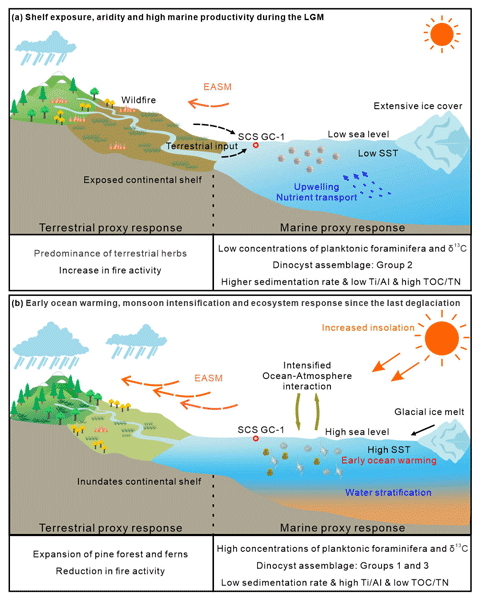
Abstract. The northern South China Sea is a critical region for understanding East Asian Monsoon dynamics. However, integrated, multi-proxy records elucidating long-term climatic and vegetation changes in this region remain fragmented, with a notable scarcity of coherent land-ocean interaction data during the Last Glacial Maximum (LGM). This gap has impeded progress in elucidating the mechanisms underpinning monsoon variability and in rigorously evaluating the performance of palaeoclimate models. To address this, we conducted a multi-proxy analysis combining palynological, organic- and inorganic-geochemical methods on a marine sediment core from the northern South China Sea to reconstruct environmental and oceanic dynamics at millennial-scale resolution that spans the last 33 ka. Our results reveal a clear contrast between glacial and interglacial conditions and drivers: the glacial period was characterized by higher sedimentation rates, elevated marine primary productivity, cooler climate, lower humidity and herb-dominated vegetation associated with enhanced fire activity in the adjacent terrestrial ecosystems. Deglaciation was characterized by pronounced warming and reduced productivity, together with increased moisture availability, a shift toward pine-dominated vegetation, minimal fire activity, and reduced fluvial input as the coastline retreated. The overall findings highlight a fundamental transition in climatic controls, from a regime dominated by sea level forcing during the glacial period to one increasingly governed by tropical ocean-atmosphere interactions initiated by early ocean warming during the interglacial.
-
Notice on discussion status
The requested preprint has a corresponding peer-reviewed final revised paper. You are encouraged to refer to the final revised version.
-
Preprint
(1429 KB)
-
Supplement
(908 KB)
-
The requested preprint has a corresponding peer-reviewed final revised paper. You are encouraged to refer to the final revised version.
- Preprint
(1429 KB) - Metadata XML
-
Supplement
(908 KB) - BibTeX
- EndNote
- Final revised paper


Journal article(s) based on this preprint
Interactive discussion
Status: closed
-
RC1: 'Comment on egusphere-2025-6415', Anonymous Referee #1, 31 Jan 2026
-
AC1: 'Reply on RC1', Xueqin Zhao, 03 Mar 2026
Answers to reviewers
Referee #1
This manuscript employs multiple proxies—including pollen, dinoflagellate cysts, total organic carbon (TOC), total nitrogen (TN), foraminiferal Mg/Ca ratios, and XRF elemental analysis—to reconstruct environmental changes from a marine core in the northern South China Sea (SCS) covering the Marine Isotope Stages 1-3. To date, numerous palynological and paleoceanographic studies from the northern SCS have already documented epicontinental vegetation dynamics and oceanographic variability since the last glaciation, along with their driving mechanisms, as exemplified by the classic work of Wang et al. (1999), East Asian monsoon climate during the Late Pleistocene: high-resolution sediment records from the South China Sea (Marine Geology). In comparison with these previous studies, however, this manuscript does not appear to offer clear new insights or conceptual advances. In addition, the discussion focuses predominantly on climatic responses (e.g., vegetation and SST changes), while the underlying climate forcing mechanisms are only weakly addressed. I therefore recommend a major revision to substantially strengthen the manuscript’s novelty and interpretative depth.
Response: We thank the reviewer for raising these critical points. We recognize that previous studies have documented glacial-interglacial changes in the northern SCS. However, the relative importance of different forcing mechanisms, particularly the interplay between high- and low-latitude forcing across these transitions, has remained uncertain. Our work’s main advance is to integrate a multi-proxy approach (including dinocyst records, which are rarely reported from this region) at millennial-scale resolution within a single core to explicitly disentangle and compare how land-ocean interactions and dominant climate forcings shift across glacial-interglacial transitions. This is a question which has not been systematically addressed in previous studies.
In our revised manuscript, we have significantly strengthened the focus on climate forcing mechanisms and clarified our study’s novel contributions through the following modifications:
(1) Reframed the conceptual framework: We now demonstrate that the glacial regime was shaped by the effects of low sea-level and continental aridity, whereas the deglacial-interglacial transition was triggered and governed by low-latitude ocean-atmosphere interactions. This mechanistic shift is now the central theme throughout the revised manuscript (Abstract, Introduction, and Sections 5.2 & 5.3).
(2) Expanded discussion of climate mechanisms: We now weave our multi-proxy data into a more robust mechanistic framework. We explicitly discuss how sea-level changes and glacial aridity altered terrestrial ecosystems and nutrient supply during the glacial period, and how early ocean warming initiated a cascade of oceanographic (stratification, Kuroshio intrusion) and atmospheric (monsoon intensification) feedbacks during the deglaciation, thereby driving the observed environmental transformation.
Specific comments:
- The pollen analysis does not present fundamentally new evidence regarding epicontinental vegetation changes. The most pronounced shift in pollen assemblages appears to be primarily controlled by changes in pollen source areas, from the exposed continental shelf during sea-level lowstands to inland regions during highstands. The authors need to provide more robust evidence to clarify the relationship between vegetation changes and climate forcing, rather than source-area effects alone. Moreover, lines 341–346 interpret Pinus pollen as an indicator of a strengthened winter monsoon or a cold–humid climate. If this interpretation is valid, how do the authors explain the substantially higher abundance of Pinus pollen during the Holocene compared with the Last Glacial Maximum?
Response: We agree that distinguishing source-area effects from climatic signals is crucial. We have taken the following steps to address this:
(1) Enhanced data presentation: As Referee #2 suggested, in the revised manuscript, we recalculated pollen percentages based on the pollen sum excluding Pinus in the main text (Figs. 4, 5 and 6) and supplementary figures (Fig. S2). The updated pollen diagram better reveals changes in other tree taxa and terrestrial herb pollen, which are more directly linked to regional climate rather than long-distance transport artifacts. Detailed percentage and concentration diagrams of pollen and dinocysts are added in the supplementary figures (Fig. S2-S5).
(2) Multi-proxy integration to isolate climate signal: In the revised manuscript, we rediscussed the data and used dinocyst groups and geochemical proxies (TOC/TN, Ti/Al, K/Al) as independent tracers to distinguish source effects from climate signals. During the LGM, our multi-proxy data reveal that the environment was not simply a result of a closer pollen source. The concurrently low Ti/Al and K/Al ratios indicate a dominance of weathered felsic material from rivers and reduced chemical weathering under drier conditions, not just local shelf exposure. This, combined with the dominance of highly nutrient-dependent Group 2, supports the interpretation of a drier climate with expanded grasslands on both the shelf and adjacent uplands. We now propose that the glacial terrestrial signal reflects dual control: the exposed continental shelf provided a proximal source area, while the contemporaneous arid climate determined that this area would be occupied by drought-adapted grassland/steppe vegetation.
(3) Reinterpretation of the Pinus: We have refined our interpretation of Pinus.
During the LGM, a strong but dry EAWM efficiently transported Pinus pollen from distant montane refugia (e.g., southern China/Taiwan). However, arid conditions on the exposed shelf itself limited local conifer growth, leading to moderate percentages in the record.
During the Holocene, sea-level rise inundated the shelf, increasing the distance to the main Pinus source areas. However, the simultaneous intensification of the EASM (supported by speleothem δ¹⁸O and fern spore increases) created more humid conditions in the mountainous source regions, potentially enhancing Pinus productivity. The strengthened summer monsoon circulation may have altered long-distance pollen transport pathways. Thus, the high percentage of Pinus during the Holocene does not contradict a strong winter monsoon during the LGM but reflects a shift in the primary forcing mechanism and source area conditions:
- Dinoflagellate cysts are a valuable proxy for reconstructing oceanographic conditions and fluvial influences, and they offer an important opportunity for synchronous land–ocean comparisons. I suggest that the manuscript should place greater emphasis on integrating dinoflagellate cyst data with other paleoceanographic proxies, such as biomarkers and foraminiferal records, in order to better distinguish between climate forcing and the oceanographic responses to that forcing.
Response: Thank you very much for the suggestion. We have strengthened the integration of dinocyst data throughout the discussion:
(1) In Section 5.1.3: We expanded the environmental interpretation of dinocyst groups more clearly. Group 1 is linked to the influence of the warm, oligotrophic open ocean environments influenced by Kuroshio Current. Group 2 reflects nutrient-rich conditions from terrestrial input and winter monsoon-driven upwelling. Group 3 indicates eutrophic, stratified conditions.
(2) In Sections 5.2 and 5.3: Dinocyst data are systematically integrated with other palaeoceanographic proxies to disentangle climatic forcing from oceanographic responses. During the LGM, high percentages of Group 2 dinocysts are coupled with low Mg/Ca-SST, high δ¹³C, and high TOC/TN to build a coherent picture of high marine productivity driven by terrestrial nutrient input under a strong, dry East Asian Winter Monsoon condition, amplified by the lowest sea-level. Since the deglaciation, we highlight a clear sequence: an early SST rise (~18.7 ka) precedes the decline in dinocyst Group 2 and increased in dinocyst Group 3 (18.0 ka), and then decreased TOC/TN. This sequence is interpreted as a direct oceanographic response to tropical warming: enhanced upper water column stratification reduced vertical nutrient supply, shifting productivity from a terrigenous-driven regime (Group 2) to a more stratified, marine-dominated one (Group 3). The subsequent two peaks in dioncyst Group 1 (ca. 10.6 ka and 5.8 ka) are then linked to increased Kuroshio intrusion, reflecting ocean circulation response to changing monsoon winds. This creates a clear narrative where dinocysts are key to tracing the transition from terrestrial nutrient forcing during the glacial period to ocean thermal and circulation forcing since the deglaciation.
We acknowledge that further integration with other paleoceanographic proxies, such as biomarkers would be valuable. Analysis of lipid biomarkers for this core is currently underway and will form the focus of a subsequent manuscript.
In summary, our revised manuscript now clearly establishes that the northern SCS experienced a fundamental shift in the primary drivers of environmental change: from a glacial state co-dominated by shelf exposure and aridity to a deglacial-interglacial state initiated and controlled by tropical ocean dynamics. We sincerely thank the reviewer for the detailed and constructive review which has helped us to significantly improve the manuscript and hope to have answered the questions and comments satisfactory.
Citation: https://doi.org/10.5194/egusphere-2025-6415-AC1
-
AC1: 'Reply on RC1', Xueqin Zhao, 03 Mar 2026
-
RC2: 'Comment on egusphere-2025-6415', Anonymous Referee #2, 02 Feb 2026
Zhao et al.’s manuscript presents a multi-proxy study of a core from the South China Sea using a wide range of tracers, including microfossil (dinocyst, microcharcoal, pollen) and bio-geochemical proxies (TOC, TN, XRF elemental data, isotopic analysis from planktonic foraminifera, and Mg/Ca-SST). I do not question the quality of the data or the multi-proxy approach of the study. Indeed, the authors have made a remarkable effort to integrate the various proxy data in order to propose a coherent environmental reconstruction. However, this work aims to propose a conceptual framework to explain the observed variations in the different tracers and it provides little discussion and advancement in our understanding of the climate variability affecting oceanographic and atmospheric circulations in the East Asian tropics/subtropics.
Furthermore, this article has some gaps and weaknesses. In particular, it does not consider the millennial climate variability affecting deglaciation (e.g., the interval associated with the LGM is much larger than the LGM itself and includes the Heinrich Stadial 1), and the zonation and representation of pollen data is questionable.
In my opinion, there is not enough in-depth paleoclimatic discussion. Submitting this work to a journal with a slightly different scope would be a favorable option.
Detailed comments:
L.79-83: In the section (2.1 Atmospheric circulation and climate): Please, add information on the mean temperature and precipitation during the summer and winter monsoon season on the adjacent landmasses, as well as on the latitudinal and seasonal temperature gradients. This information is required to relate climate to vegetation distribution.
Please also provide information on the main taxa that are included within the dominant vegetation types of the study area. This would greatly help the reader to related the main pollen taxa to the vegetation
l.156 : Primostar?
L.177: Was the CANOCO software used only for dinoyst data or for both pollen and dinocyst data?
L.182: Was the cluster analysis performed on both pollen and dinocyst data together, or were separate analyses conducted for each dataset? This is unclear here. The cluster analysis should not include both proxy datasets because they give different information.
L.212: Should be “stable carbon δ13CVPDB”
L.229: Variable pollen concentration may also be attributable to changes in pollen supply and sea level changes rather than pollen preservation only. Is there any evidence of variations in pollen preservation, for instance intervals with increasing corroded pollen?
L.238: Please, explain what the shading represents. If it refers to uncertainties in pollen percentages, how were these calculated?
I also recommend presenting the pollen data, at least in a supplementary figure, with pollen percentages calculated based on a pollen sum excluding Pinus. Pinus is always overrepresented in marine sediments; excluding pollen from the main allows better evaluation of changes in other taxa, which are likely underrepresented when Pinus become dominant. In addition, if Pinus pollen originates from a far-distant vegetation and is mainly supplied to the site by long-distance winter monsoon wind transport, it is even more useful to present a diagram with percentages based on a pollen sum excluding Pinus.
In the supplementary material, more detailed percentage diagram and a diagram showing pollen taxa concentrations are also needed. The number of taxa shown in the current percentage diagram is too restricted to discuss the pollen source vegetation adequately.
L.327: Cyperaceae does not exclusively indicate wet environments; it can develop with Poaceae in dry grasslands or semi-arid steppes. Poaceae, Cyperaceae and semi-arid taxa such as Artemisia often develop together in subtropical/tropoical dry glacial environments or in modern drylands such as in the Middle East.
Pollen diagram zonation should be done for pollen and dinocyst separately. It is not reliable to assume that dinocyst (and thus sea surface changes) will occur consistently or synchronously with pollen changes These records should be compared, not amalgamated.
The authors define pollen zone 2 as the LGM but this zone ends at 15.6 ka, therefore largely later than the LGM. It includes the HS-1. I wonder whether CONISS applied only to pollen data and to percentages excluding Pinus would produce a similar zonation. Is millennial-scale variability during the deglaciation detected in pollen or dinocyst data?
L.387: Can the tree/herb ratio low values only be explained by the expansion of vegetation on the exposed shelf due to lower sea-level? Higher pollen and charcoal concentrations may also be due to a more open vegetation and a lesser silico-clastic input (as shown by lower sedimentation rate). Why is the expansion of open vegetation in the river catchments of the study area not considered? May the microcharcoal and pollen data be also interpreted in terms of variability in fire regime depending on the vegetation type and structure and climate conditions?
Citation: https://doi.org/10.5194/egusphere-2025-6415-RC2 -
AC2: 'Reply on RC2', Xueqin Zhao, 03 Mar 2026
Answers to reviewers
Referee #2
Zhao et al.’s manuscript presents a multi-proxy study of a core from the South China Sea using a wide range of tracers, including microfossil (dinocyst, microcharcoal, pollen) and bio-geochemical proxies (TOC, TN, XRF elemental data, isotopic analysis from planktonic foraminifera, and Mg/Ca-SST). I do not question the quality of the data or the multi-proxy approach of the study. Indeed, the authors have made a remarkable effort to integrate the various proxy data in order to propose a coherent environmental reconstruction. However, this work aims to propose a conceptual framework to explain the observed variations in the different tracers and it provides little discussion and advancement in our understanding of the climate variability affecting oceanographic and atmospheric circulations in the East Asian tropics/subtropics.
Furthermore, this article has some gaps and weaknesses. In particular, it does not consider the millennial climate variability affecting deglaciation (e.g., the interval associated with the LGM is much larger than the LGM itself and includes the Heinrich Stadial 1), and the zonation and representation of pollen data is questionable.
In my opinion, there is not enough in-depth paleoclimatic discussion. Submitting this work to a journal with a slightly different scope would be a favorable option.
Response: We thank the reviewer for acknowledging the quality of our data and multi-proxy approach, and for the constructive suggestions that have helped us to substantially improve the manuscript. We have undertaken major revisions to address these concerns, especially regarding paleoclimatic depth and the manuscript’s scope:
(1) Enhanced paleoclimatic discussion and conceptual framework
We agree with the reviewer that advancing our understanding of climate variability requires disentangling forcing mechanisms, not just documenting changes. While previous studies have documented glacial-interglacial changes in the northern SCS, the interplay between high- and low-latitude forcing across these transitions, has remained uncertain. Our work’s main advance is to integrate a multi-proxy approach (including dinocyst records which are rarely reported from this region) at millennial-scale resolution within a single core to explicitly disentangle and compare how land-ocean interactions and dominant climate forcings shift across glacial-interglacial transitions. This is a question which has not been systematically addressed in previous studies.
We now demonstrate that the glacial regime (pre-LGM and LGM) was shaped by the combined effects of low sea-level and continental aridity, which together promoted open terrestrial vegetation, enhanced nutrient supply to the ocean, and sustained high marine productivity through terrestrial-ocean coupling (Section 5.2). Whereas the deglacial-interglacial transition was triggered and governed by low-latitude ocean-atmosphere interactions. Critically, our Mg/Ca-SST and stable oxygen isotope δ¹⁸O of planktonic foraminifera reveals that ocean began ~1.4 ka earlier than major terrestrial changes, providing direct evidence that tropical ocean warming initiated the deglacial transition. This early warming then triggered a cascade of response: enhanced stratification (reflected in the shift from dinocyst Group 2 to Group 3), reduced nutrient supply, subsequent monsoon intensification (supported by speleothem δ¹⁸O and fern spore increases), and ecosystem reorganization (Section 5.3).
This framework directly addresses the reviewer’s concern by providing an in-depth mechanistic discussion that goes beyond pattern description to explain why and how the system changed.
(2) Millennial-scale variability and improved zonation
Following the reviewer’s suggestions, we have refined our analysis of millennial-scale variability: We performed separated CONISS cluster analyses for pollen (based on percentages excluding Pinus) and dinocyst data. The results exhibit a notable sub-zone (zone 3: 17.0-14.5 ka) characterized by a slight SST reversal, elevated δ¹⁸O and a decrease in trees/herbs ratio (Sections 4.5.3 and 5.3). We now link this interval to Heinrich Stadial 1 (HS-1), demonstrating that North Atlantic forcing temporarily modulated but did not override the underlying tropical warming trend. This millennial-scale event is now integrated into our phased framework, with the last deglaciation period defined as 17.0-11.7 ka (including H1).
The separate CONISS analyses show similar but not identical zonations for pollen and dinocysts, allowing us to compare terrestrial and marine responses to forcing. This comparison strengthens our interpretation of asynchronous responses (e.g., early warming preceding vegetation change) and highlights the value of integrated land-sea proxies.
(3) Improve data presentation and interpretation
We have revised the pollen data presentation as recommended:
1) Pollen percentages are now calculated based on a sum excluding Pinus (Figures 4, 6j, and supplementary Figure S2). This better reveals changes in other tree taxa and terrestrial herbs, which are more directly linked to regional climate signals rather than long-distance transport artifacts.
2) Detailed percentage and concentration diagrams for both pollen and dinocysts are now provided in supplementary Figures S2-S5, allowing readers to fully evaluate the data.
3) We have refined our interpretation of Pinus (Section 5.1.2): During the LGM, a strong but dry EAWM transported Pinus pollen from distant montane refugia, while arid conditions on the exposed shelf limited local conifer growth; during the Holocene, EASM intensification created more humid conditions in source regions, enhancing Pinus productivity, while altered circulation patterns facilitated long-distance transport. Thus, the high Pinus percentages during the Holocene do not contradict a strong winter monsoon during the LGM but reflect a change in the primary forcing mechanism.
(4) Strengthened integration of dinocyst data
As suggested, we have placed greater emphasis on integrating dinocyst data with other paleoceanographic proxies:
1) In Section 5.1.3, we now provide clearer environmental interpretation of dinocyst groups: Group 1 is linked to the influence of the warm, oligotrophic open ocean environments influenced by Kuroshio Current; Group 2 reflects nutrient-rich conditions from terrestrial input and winter monsoon-driven upwelling; Group 3 indicates eutrophic, stratified conditions.
2) In Sections 5.2 and 5.3, dinocyst data are systematically integrated with Mg/Ca-SST, δ13C, TOC/TN and XRF data. This integration reveals a clear mechanistic sequence: LGM was characterized by high Group 2 coupled with low SST, high δ13C, and low Ti/Al, indicating terrestrial nutrient-driven productivity under strong, dry winter monsoon; the onset of the deglacial was marked by early SST rise preceding decline in Group 2 and increase in Group 3, interpreted as stratification response to warming; During the Holocene, subsequent peaks in Group 1 linked to enhanced Kuroshio intrusion, reflecting ocean circulation response to changing monsoon winds.
(5) Scope and contribution
Regarding the reviewer's comment that "submitting this work to a journal with a slightly different scope would be a favorable option," we respectfully submit that our revised manuscript now offers a significant contribution to Climate of the Past. Our work directly addresses the scope by:
1) Quantifying the relative roles of high-latitude (sea level, ice sheet) versus low-latitude (ocean-atmosphere) forcing mechanisms across a glacial-interglacial cycle.
2) Demonstrating asynchronous marine-terrestrial responses and identifying tropical ocean warming as the trigger for deglacial transition.
3) Providing a testable mechanistic framework that can inform model simulations of past and future climate change in the Asian monsoon region.
Additionally, the integration of rarely-reported dinocyst records with established proxies, at millennial-scale resolution, allows us to move beyond pattern description to mechanism identification—precisely the type of in-depth paleoclimatic discussion the reviewer found lacking in the original submission.
In summary, our revised manuscript now presents a coherent conceptual framework demonstrating a fundamental shift in dominant climate forcing from the glacial period (sea level and aridity) to the deglacial-interglacial period (tropical ocean-atmosphere dynamics). We believe these revisions substantially enhance the manuscript's analytical rigor, paleoclimatic depth, and contribution to understanding climate mechanisms. We sincerely thank the reviewer for the detailed and constructive comments that guided these improvements.
Detailed comments:
L.79-83: In the section (2.1 Atmospheric circulation and climate): Please, add information on the mean temperature and precipitation during the summer and winter monsoon season on the adjacent landmasses, as well as on the latitudinal and seasonal temperature gradients. This information is required to relate climate to vegetation distribution. Please also provide information on the main taxa that are included within the dominant vegetation types of the study area. This would greatly help the reader to related the main pollen taxa to the vegetation
Response: Thank you for this suggestion. We have added typical temperature/precipitation ranges for the monsoon seasons in Section 2.1. In Section 2.3, we have added the main taxa constituting the tropical rain forest, tropical monsoon forest and subtropical evergreen forests which helps link pollen taxa to vegetation.
l.156 : Primostar?
Response: Primostar 3 is a mode of ZEISS light microscope. To make it clearer, we rephrase the sentence to “Routine identification was performed under a light microscope (ZEISS Promostar 3) at 400x magnification, with 1000x used for detailed taxonomic identification.”.
L.177: Was the CANOCO software used only for dinoyst data or for both pollen and dinocyst data?
Response: Yes, the CANOCO software was used both for pollen and dinocyst data, and the cluster analysis was performed on pollen and dinocyst data separately. We added the explanation in the revised manuscript.
L.182: Was the cluster analysis performed on both pollen and dinocyst data together, or were separate analyses conducted for each dataset? This is unclear here. The cluster analysis should not include both proxy datasets because they give different information.
Response: The cluster analysis was performed on pollen and dinocyst data separately. We added the explanation in the revised manuscript.
L.212: Should be “stable carbon δ13CVPDB”
Response: Done.
L.229: Variable pollen concentration may also be attributable to changes in pollen supply and sea level changes rather than pollen preservation only. Is there any evidence of variations in pollen preservation, for instance intervals with increasing corroded pollen?
Response: The pollen preservation we mentioned in the manuscript did not refer to preservation under different sedimentation, but to pollen concentrations. To avoid misunderstanding, we rephrased the sentence to “Pollen concentration is variable……”. We did not observe systematic changes in corrosion states. The concentration changes are primarily interpreted as changes in supply related to sea level and vegetation cover/density. Please see the detailed changes in the revised manuscript.
L.238: Please, explain what the shading represents. If it refers to uncertainties in pollen percentages, how were these calculated?
Response: Yes, the shadings refer to the 95% confidence intervals of percentages which were calculated following Maher (1972). Here is the detailed information of the literature: Maher, L.J., 1972. Nomograms for computing 0.95 confidence limits of pollen data. Review of Palaeobotany and Palynology 13, 85-93. http://dx.doi.org/10.1016/0034-6667(72)90038-3. We added the information in the revised manuscript (Section 3.5 Palynological analysis).
I also recommend presenting the pollen data, at least in a supplementary figure, with pollen percentages calculated based on a pollen sum excluding Pinus. Pinus is always overrepresented in marine sediments; excluding pollen from the main allows better evaluation of changes in other taxa, which are likely underrepresented when Pinus become dominant. In addition, if Pinus pollen originates from a far-distant vegetation and is mainly supplied to the site by long-distance winter monsoon wind transport, it is even more useful to present a diagram with percentages based on a pollen sum excluding Pinus.
Response: Thank you very much for the comment. We recalculated the pollen percentages based on a pollen sum excluding Pinus. All main-text pollen percentage plots (Figures 4, 5 and 6) as well as the supplementary Figure S2 have been revised.
In the supplementary material, more detailed percentage diagram and a diagram showing pollen taxa concentrations are also needed. The number of taxa shown in the current percentage diagram is too restricted to discuss the pollen source vegetation adequately.
Response: A more detailed percentage and concentration diagrams of both pollen and dinocyst are added in the supplementary Figures S2-S4.
L.327: Cyperaceae does not exclusively indicate wet environments; it can develop with Poaceae in dry grasslands or semi-arid steppes. Poaceae, Cyperaceae and semi-arid taxa such as Artemisia often develop together in subtropical/tropical dry glacial environments or in modern drylands such as in the Middle East.
Response: The reviewer is right. We added the information to the related discussion part.
Pollen diagram zonation should be done for pollen and dinocyst separately. It is not reliable to assume that dinocyst (and thus sea surface changes) will occur consistently or synchronously with pollen changes These records should be compared, not amalgamated.
Response: We agree with the reviewer. As described above, we have performed the pollen and dinocyst diagram zonation separately in the revised manuscript. The results are shown and compared in supplementary Figures S2 and S4, and the main text discussed their similarities and differences.
The authors define pollen zone 2 as the LGM but this zone ends at 15.6 ka, therefore largely later than the LGM. It includes the HS-1. I wonder whether CONISS applied only to pollen data and to percentages excluding Pinus would produce a similar zonation. Is millennial-scale variability during the deglaciation detected in pollen or dinocyst data?
Response: In the revised manuscript, we recalculated the pollen and dinocyst diagram zonation separately both based on CONISS analysis and then determined the zonation with the consideration of all data presented in this manuscript. The results of CONISS applied only to pollen data and to percentages excluding Pinus indeed produce a very similar zonation. However, as the reviewer suggested above, we observed a sub-zone boundary around 17.0-14.5 ka, which we associate with the onset of Heinrich Stadial 1 (H1) conditions (an interval of low Mg/Ca-SST and high percentages of terrestrial herb pollen). We adjusted our phase description accordingly, now referring to the period from 17.0-11.7 ka as “last deglaciation (including H1)” (Sections 4.5.3 and 5.3).
L.387: Can the tree/herb ratio low values only be explained by the expansion of vegetation on the exposed shelf due to lower sea-level? Higher pollen and charcoal concentrations may also be due to a more open vegetation and a lesser silico-clastic input (as shown by lower sedimentation rate). Why is the expansion of open vegetation in the river catchments of the study area not considered? May the microcharcoal and pollen data be also interpreted in terms of variability in fire regime depending on the vegetation type and structure and climate conditions?
Response: We agree with the reviewer’s comment:
(1) We have stated that the expansion of open, terrestrial-herb dominated vegetation likely occurred both on the exposed shelf and in the adjacent continental catchments due to the overall drier climate.
(2) We incorporate the interpretation of microcharcoal: the high concentrations and larger particle size (>100 µm) during the LGM indicate frequent, likely intense fires. This fire regime is ecologically consistent with a dry, open landscape with abundant herbaceous fuel and supports the interpretation of an arid, seasonal climate. The decline in charcoal concentrations during the Holocene aligns with the shift to more humid, forested conditions less prone to burning. Therefore, the charcoal data can provide an independent line of evidence for the inferred vegetation structure and climate.
We sincerely thank the reviewer for the detailed and constructive review which has helped us to significantly improve the manuscript. We believe the revisions have addressed all concerns and enhanced their analytical rigor and depth of paleoclimatic discussion.
Citation: https://doi.org/10.5194/egusphere-2025-6415-AC2
-
AC2: 'Reply on RC2', Xueqin Zhao, 03 Mar 2026


Interactive discussion
Status: closed
-
RC1: 'Comment on egusphere-2025-6415', Anonymous Referee #1, 31 Jan 2026
This manuscript employs multiple proxies—including pollen, dinoflagellate cysts, total organic carbon (TOC), total nitrogen (TN), foraminiferal Mg/Ca ratios, and XRF elemental analysis—to reconstruct environmental changes from a marine core in the northern South China Sea (SCS covering the Marine Isotope Stages 1-3. To date, numerous palynological and paleoceanographic studies from the northern SCS have already documented epicontinental vegetation dynamics and oceanographic variability since the last glaciation, along with their driving mechanisms, as exemplified by the classic work of Wang et al. (1999), East Asian monsoon climate during the Late Pleistocene: high-resolution sediment records from the South China Sea (Marine Geology). In comparison with these previous studies, however, this manuscript does not appear to offer clear new insights or conceptual advances. In addition, the discussion focuses predominantly on climatic responses (e.g., vegetation and SST changes), while the underlying climate forcing mechanisms are only weakly addressed. I therefore recommend a major revision to substantially strengthen the manuscript’s novelty and interpretative depth.
-
The pollen analysis does not present fundamentally new evidence regarding epicontinental vegetation changes. The most pronounced shift in pollen assemblages appears to be primarily controlled by changes in pollen source areas, from the exposed continental shelf during sea-level lowstands to inland regions during highstands. The authors need to provide more robust evidence to clarify the relationship between vegetation changes and climate forcing, rather than source-area effects alone. Moreover, lines 341–346 interpret Pinus pollen as an indicator of a strengthened winter monsoon or a cold–humid climate. If this interpretation is valid, how do the authors explain the substantially higher abundance of Pinus pollen during the Holocene compared with the Last Glacial Maximum?
-
Dinoflagellate cysts are a valuable proxy for reconstructing oceanographic conditions and fluvial influences, and they offer an important opportunity for synchronous land–ocean comparisons. I suggest that the manuscript should place greater emphasis on integrating dinoflagellate cyst data with other paleoceanographic proxies, such as biomarkers and foraminiferal records, in order to better distinguish between climate forcing and the oceanographic responses to that forcing.
Citation: https://doi.org/10.5194/egusphere-2025-6415-RC1 -
AC1: 'Reply on RC1', Xueqin Zhao, 03 Mar 2026
Answers to reviewers
Referee #1
This manuscript employs multiple proxies—including pollen, dinoflagellate cysts, total organic carbon (TOC), total nitrogen (TN), foraminiferal Mg/Ca ratios, and XRF elemental analysis—to reconstruct environmental changes from a marine core in the northern South China Sea (SCS) covering the Marine Isotope Stages 1-3. To date, numerous palynological and paleoceanographic studies from the northern SCS have already documented epicontinental vegetation dynamics and oceanographic variability since the last glaciation, along with their driving mechanisms, as exemplified by the classic work of Wang et al. (1999), East Asian monsoon climate during the Late Pleistocene: high-resolution sediment records from the South China Sea (Marine Geology). In comparison with these previous studies, however, this manuscript does not appear to offer clear new insights or conceptual advances. In addition, the discussion focuses predominantly on climatic responses (e.g., vegetation and SST changes), while the underlying climate forcing mechanisms are only weakly addressed. I therefore recommend a major revision to substantially strengthen the manuscript’s novelty and interpretative depth.
Response: We thank the reviewer for raising these critical points. We recognize that previous studies have documented glacial-interglacial changes in the northern SCS. However, the relative importance of different forcing mechanisms, particularly the interplay between high- and low-latitude forcing across these transitions, has remained uncertain. Our work’s main advance is to integrate a multi-proxy approach (including dinocyst records, which are rarely reported from this region) at millennial-scale resolution within a single core to explicitly disentangle and compare how land-ocean interactions and dominant climate forcings shift across glacial-interglacial transitions. This is a question which has not been systematically addressed in previous studies.
In our revised manuscript, we have significantly strengthened the focus on climate forcing mechanisms and clarified our study’s novel contributions through the following modifications:
(1) Reframed the conceptual framework: We now demonstrate that the glacial regime was shaped by the effects of low sea-level and continental aridity, whereas the deglacial-interglacial transition was triggered and governed by low-latitude ocean-atmosphere interactions. This mechanistic shift is now the central theme throughout the revised manuscript (Abstract, Introduction, and Sections 5.2 & 5.3).
(2) Expanded discussion of climate mechanisms: We now weave our multi-proxy data into a more robust mechanistic framework. We explicitly discuss how sea-level changes and glacial aridity altered terrestrial ecosystems and nutrient supply during the glacial period, and how early ocean warming initiated a cascade of oceanographic (stratification, Kuroshio intrusion) and atmospheric (monsoon intensification) feedbacks during the deglaciation, thereby driving the observed environmental transformation.
Specific comments:
- The pollen analysis does not present fundamentally new evidence regarding epicontinental vegetation changes. The most pronounced shift in pollen assemblages appears to be primarily controlled by changes in pollen source areas, from the exposed continental shelf during sea-level lowstands to inland regions during highstands. The authors need to provide more robust evidence to clarify the relationship between vegetation changes and climate forcing, rather than source-area effects alone. Moreover, lines 341–346 interpret Pinus pollen as an indicator of a strengthened winter monsoon or a cold–humid climate. If this interpretation is valid, how do the authors explain the substantially higher abundance of Pinus pollen during the Holocene compared with the Last Glacial Maximum?
Response: We agree that distinguishing source-area effects from climatic signals is crucial. We have taken the following steps to address this:
(1) Enhanced data presentation: As Referee #2 suggested, in the revised manuscript, we recalculated pollen percentages based on the pollen sum excluding Pinus in the main text (Figs. 4, 5 and 6) and supplementary figures (Fig. S2). The updated pollen diagram better reveals changes in other tree taxa and terrestrial herb pollen, which are more directly linked to regional climate rather than long-distance transport artifacts. Detailed percentage and concentration diagrams of pollen and dinocysts are added in the supplementary figures (Fig. S2-S5).
(2) Multi-proxy integration to isolate climate signal: In the revised manuscript, we rediscussed the data and used dinocyst groups and geochemical proxies (TOC/TN, Ti/Al, K/Al) as independent tracers to distinguish source effects from climate signals. During the LGM, our multi-proxy data reveal that the environment was not simply a result of a closer pollen source. The concurrently low Ti/Al and K/Al ratios indicate a dominance of weathered felsic material from rivers and reduced chemical weathering under drier conditions, not just local shelf exposure. This, combined with the dominance of highly nutrient-dependent Group 2, supports the interpretation of a drier climate with expanded grasslands on both the shelf and adjacent uplands. We now propose that the glacial terrestrial signal reflects dual control: the exposed continental shelf provided a proximal source area, while the contemporaneous arid climate determined that this area would be occupied by drought-adapted grassland/steppe vegetation.
(3) Reinterpretation of the Pinus: We have refined our interpretation of Pinus.
During the LGM, a strong but dry EAWM efficiently transported Pinus pollen from distant montane refugia (e.g., southern China/Taiwan). However, arid conditions on the exposed shelf itself limited local conifer growth, leading to moderate percentages in the record.
During the Holocene, sea-level rise inundated the shelf, increasing the distance to the main Pinus source areas. However, the simultaneous intensification of the EASM (supported by speleothem δ¹⁸O and fern spore increases) created more humid conditions in the mountainous source regions, potentially enhancing Pinus productivity. The strengthened summer monsoon circulation may have altered long-distance pollen transport pathways. Thus, the high percentage of Pinus during the Holocene does not contradict a strong winter monsoon during the LGM but reflects a shift in the primary forcing mechanism and source area conditions:
- Dinoflagellate cysts are a valuable proxy for reconstructing oceanographic conditions and fluvial influences, and they offer an important opportunity for synchronous land–ocean comparisons. I suggest that the manuscript should place greater emphasis on integrating dinoflagellate cyst data with other paleoceanographic proxies, such as biomarkers and foraminiferal records, in order to better distinguish between climate forcing and the oceanographic responses to that forcing.
Response: Thank you very much for the suggestion. We have strengthened the integration of dinocyst data throughout the discussion:
(1) In Section 5.1.3: We expanded the environmental interpretation of dinocyst groups more clearly. Group 1 is linked to the influence of the warm, oligotrophic open ocean environments influenced by Kuroshio Current. Group 2 reflects nutrient-rich conditions from terrestrial input and winter monsoon-driven upwelling. Group 3 indicates eutrophic, stratified conditions.
(2) In Sections 5.2 and 5.3: Dinocyst data are systematically integrated with other palaeoceanographic proxies to disentangle climatic forcing from oceanographic responses. During the LGM, high percentages of Group 2 dinocysts are coupled with low Mg/Ca-SST, high δ¹³C, and high TOC/TN to build a coherent picture of high marine productivity driven by terrestrial nutrient input under a strong, dry East Asian Winter Monsoon condition, amplified by the lowest sea-level. Since the deglaciation, we highlight a clear sequence: an early SST rise (~18.7 ka) precedes the decline in dinocyst Group 2 and increased in dinocyst Group 3 (18.0 ka), and then decreased TOC/TN. This sequence is interpreted as a direct oceanographic response to tropical warming: enhanced upper water column stratification reduced vertical nutrient supply, shifting productivity from a terrigenous-driven regime (Group 2) to a more stratified, marine-dominated one (Group 3). The subsequent two peaks in dioncyst Group 1 (ca. 10.6 ka and 5.8 ka) are then linked to increased Kuroshio intrusion, reflecting ocean circulation response to changing monsoon winds. This creates a clear narrative where dinocysts are key to tracing the transition from terrestrial nutrient forcing during the glacial period to ocean thermal and circulation forcing since the deglaciation.
We acknowledge that further integration with other paleoceanographic proxies, such as biomarkers would be valuable. Analysis of lipid biomarkers for this core is currently underway and will form the focus of a subsequent manuscript.
In summary, our revised manuscript now clearly establishes that the northern SCS experienced a fundamental shift in the primary drivers of environmental change: from a glacial state co-dominated by shelf exposure and aridity to a deglacial-interglacial state initiated and controlled by tropical ocean dynamics. We sincerely thank the reviewer for the detailed and constructive review which has helped us to significantly improve the manuscript and hope to have answered the questions and comments satisfactory.
Citation: https://doi.org/10.5194/egusphere-2025-6415-AC1
-
-
RC2: 'Comment on egusphere-2025-6415', Anonymous Referee #2, 02 Feb 2026
Zhao et al.’s manuscript presents a multi-proxy study of a core from the South China Sea using a wide range of tracers, including microfossil (dinocyst, microcharcoal, pollen) and bio-geochemical proxies (TOC, TN, XRF elemental data, isotopic analysis from planktonic foraminifera, and Mg/Ca-SST). I do not question the quality of the data or the multi-proxy approach of the study. Indeed, the authors have made a remarkable effort to integrate the various proxy data in order to propose a coherent environmental reconstruction. However, this work aims to propose a conceptual framework to explain the observed variations in the different tracers and it provides little discussion and advancement in our understanding of the climate variability affecting oceanographic and atmospheric circulations in the East Asian tropics/subtropics.
Furthermore, this article has some gaps and weaknesses. In particular, it does not consider the millennial climate variability affecting deglaciation (e.g., the interval associated with the LGM is much larger than the LGM itself and includes the Heinrich Stadial 1), and the zonation and representation of pollen data is questionable.
In my opinion, there is not enough in-depth paleoclimatic discussion. Submitting this work to a journal with a slightly different scope would be a favorable option.
Detailed comments:
L.79-83: In the section (2.1 Atmospheric circulation and climate): Please, add information on the mean temperature and precipitation during the summer and winter monsoon season on the adjacent landmasses, as well as on the latitudinal and seasonal temperature gradients. This information is required to relate climate to vegetation distribution.
Please also provide information on the main taxa that are included within the dominant vegetation types of the study area. This would greatly help the reader to related the main pollen taxa to the vegetation
l.156 : Primostar?
L.177: Was the CANOCO software used only for dinoyst data or for both pollen and dinocyst data?
L.182: Was the cluster analysis performed on both pollen and dinocyst data together, or were separate analyses conducted for each dataset? This is unclear here. The cluster analysis should not include both proxy datasets because they give different information.
L.212: Should be “stable carbon δ13CVPDB”
L.229: Variable pollen concentration may also be attributable to changes in pollen supply and sea level changes rather than pollen preservation only. Is there any evidence of variations in pollen preservation, for instance intervals with increasing corroded pollen?
L.238: Please, explain what the shading represents. If it refers to uncertainties in pollen percentages, how were these calculated?
I also recommend presenting the pollen data, at least in a supplementary figure, with pollen percentages calculated based on a pollen sum excluding Pinus. Pinus is always overrepresented in marine sediments; excluding pollen from the main allows better evaluation of changes in other taxa, which are likely underrepresented when Pinus become dominant. In addition, if Pinus pollen originates from a far-distant vegetation and is mainly supplied to the site by long-distance winter monsoon wind transport, it is even more useful to present a diagram with percentages based on a pollen sum excluding Pinus.
In the supplementary material, more detailed percentage diagram and a diagram showing pollen taxa concentrations are also needed. The number of taxa shown in the current percentage diagram is too restricted to discuss the pollen source vegetation adequately.
L.327: Cyperaceae does not exclusively indicate wet environments; it can develop with Poaceae in dry grasslands or semi-arid steppes. Poaceae, Cyperaceae and semi-arid taxa such as Artemisia often develop together in subtropical/tropoical dry glacial environments or in modern drylands such as in the Middle East.
Pollen diagram zonation should be done for pollen and dinocyst separately. It is not reliable to assume that dinocyst (and thus sea surface changes) will occur consistently or synchronously with pollen changes These records should be compared, not amalgamated.
The authors define pollen zone 2 as the LGM but this zone ends at 15.6 ka, therefore largely later than the LGM. It includes the HS-1. I wonder whether CONISS applied only to pollen data and to percentages excluding Pinus would produce a similar zonation. Is millennial-scale variability during the deglaciation detected in pollen or dinocyst data?
L.387: Can the tree/herb ratio low values only be explained by the expansion of vegetation on the exposed shelf due to lower sea-level? Higher pollen and charcoal concentrations may also be due to a more open vegetation and a lesser silico-clastic input (as shown by lower sedimentation rate). Why is the expansion of open vegetation in the river catchments of the study area not considered? May the microcharcoal and pollen data be also interpreted in terms of variability in fire regime depending on the vegetation type and structure and climate conditions?
Citation: https://doi.org/10.5194/egusphere-2025-6415-RC2 -
AC2: 'Reply on RC2', Xueqin Zhao, 03 Mar 2026
Answers to reviewers
Referee #2
Zhao et al.’s manuscript presents a multi-proxy study of a core from the South China Sea using a wide range of tracers, including microfossil (dinocyst, microcharcoal, pollen) and bio-geochemical proxies (TOC, TN, XRF elemental data, isotopic analysis from planktonic foraminifera, and Mg/Ca-SST). I do not question the quality of the data or the multi-proxy approach of the study. Indeed, the authors have made a remarkable effort to integrate the various proxy data in order to propose a coherent environmental reconstruction. However, this work aims to propose a conceptual framework to explain the observed variations in the different tracers and it provides little discussion and advancement in our understanding of the climate variability affecting oceanographic and atmospheric circulations in the East Asian tropics/subtropics.
Furthermore, this article has some gaps and weaknesses. In particular, it does not consider the millennial climate variability affecting deglaciation (e.g., the interval associated with the LGM is much larger than the LGM itself and includes the Heinrich Stadial 1), and the zonation and representation of pollen data is questionable.
In my opinion, there is not enough in-depth paleoclimatic discussion. Submitting this work to a journal with a slightly different scope would be a favorable option.
Response: We thank the reviewer for acknowledging the quality of our data and multi-proxy approach, and for the constructive suggestions that have helped us to substantially improve the manuscript. We have undertaken major revisions to address these concerns, especially regarding paleoclimatic depth and the manuscript’s scope:
(1) Enhanced paleoclimatic discussion and conceptual framework
We agree with the reviewer that advancing our understanding of climate variability requires disentangling forcing mechanisms, not just documenting changes. While previous studies have documented glacial-interglacial changes in the northern SCS, the interplay between high- and low-latitude forcing across these transitions, has remained uncertain. Our work’s main advance is to integrate a multi-proxy approach (including dinocyst records which are rarely reported from this region) at millennial-scale resolution within a single core to explicitly disentangle and compare how land-ocean interactions and dominant climate forcings shift across glacial-interglacial transitions. This is a question which has not been systematically addressed in previous studies.
We now demonstrate that the glacial regime (pre-LGM and LGM) was shaped by the combined effects of low sea-level and continental aridity, which together promoted open terrestrial vegetation, enhanced nutrient supply to the ocean, and sustained high marine productivity through terrestrial-ocean coupling (Section 5.2). Whereas the deglacial-interglacial transition was triggered and governed by low-latitude ocean-atmosphere interactions. Critically, our Mg/Ca-SST and stable oxygen isotope δ¹⁸O of planktonic foraminifera reveals that ocean began ~1.4 ka earlier than major terrestrial changes, providing direct evidence that tropical ocean warming initiated the deglacial transition. This early warming then triggered a cascade of response: enhanced stratification (reflected in the shift from dinocyst Group 2 to Group 3), reduced nutrient supply, subsequent monsoon intensification (supported by speleothem δ¹⁸O and fern spore increases), and ecosystem reorganization (Section 5.3).
This framework directly addresses the reviewer’s concern by providing an in-depth mechanistic discussion that goes beyond pattern description to explain why and how the system changed.
(2) Millennial-scale variability and improved zonation
Following the reviewer’s suggestions, we have refined our analysis of millennial-scale variability: We performed separated CONISS cluster analyses for pollen (based on percentages excluding Pinus) and dinocyst data. The results exhibit a notable sub-zone (zone 3: 17.0-14.5 ka) characterized by a slight SST reversal, elevated δ¹⁸O and a decrease in trees/herbs ratio (Sections 4.5.3 and 5.3). We now link this interval to Heinrich Stadial 1 (HS-1), demonstrating that North Atlantic forcing temporarily modulated but did not override the underlying tropical warming trend. This millennial-scale event is now integrated into our phased framework, with the last deglaciation period defined as 17.0-11.7 ka (including H1).
The separate CONISS analyses show similar but not identical zonations for pollen and dinocysts, allowing us to compare terrestrial and marine responses to forcing. This comparison strengthens our interpretation of asynchronous responses (e.g., early warming preceding vegetation change) and highlights the value of integrated land-sea proxies.
(3) Improve data presentation and interpretation
We have revised the pollen data presentation as recommended:
1) Pollen percentages are now calculated based on a sum excluding Pinus (Figures 4, 6j, and supplementary Figure S2). This better reveals changes in other tree taxa and terrestrial herbs, which are more directly linked to regional climate signals rather than long-distance transport artifacts.
2) Detailed percentage and concentration diagrams for both pollen and dinocysts are now provided in supplementary Figures S2-S5, allowing readers to fully evaluate the data.
3) We have refined our interpretation of Pinus (Section 5.1.2): During the LGM, a strong but dry EAWM transported Pinus pollen from distant montane refugia, while arid conditions on the exposed shelf limited local conifer growth; during the Holocene, EASM intensification created more humid conditions in source regions, enhancing Pinus productivity, while altered circulation patterns facilitated long-distance transport. Thus, the high Pinus percentages during the Holocene do not contradict a strong winter monsoon during the LGM but reflect a change in the primary forcing mechanism.
(4) Strengthened integration of dinocyst data
As suggested, we have placed greater emphasis on integrating dinocyst data with other paleoceanographic proxies:
1) In Section 5.1.3, we now provide clearer environmental interpretation of dinocyst groups: Group 1 is linked to the influence of the warm, oligotrophic open ocean environments influenced by Kuroshio Current; Group 2 reflects nutrient-rich conditions from terrestrial input and winter monsoon-driven upwelling; Group 3 indicates eutrophic, stratified conditions.
2) In Sections 5.2 and 5.3, dinocyst data are systematically integrated with Mg/Ca-SST, δ13C, TOC/TN and XRF data. This integration reveals a clear mechanistic sequence: LGM was characterized by high Group 2 coupled with low SST, high δ13C, and low Ti/Al, indicating terrestrial nutrient-driven productivity under strong, dry winter monsoon; the onset of the deglacial was marked by early SST rise preceding decline in Group 2 and increase in Group 3, interpreted as stratification response to warming; During the Holocene, subsequent peaks in Group 1 linked to enhanced Kuroshio intrusion, reflecting ocean circulation response to changing monsoon winds.
(5) Scope and contribution
Regarding the reviewer's comment that "submitting this work to a journal with a slightly different scope would be a favorable option," we respectfully submit that our revised manuscript now offers a significant contribution to Climate of the Past. Our work directly addresses the scope by:
1) Quantifying the relative roles of high-latitude (sea level, ice sheet) versus low-latitude (ocean-atmosphere) forcing mechanisms across a glacial-interglacial cycle.
2) Demonstrating asynchronous marine-terrestrial responses and identifying tropical ocean warming as the trigger for deglacial transition.
3) Providing a testable mechanistic framework that can inform model simulations of past and future climate change in the Asian monsoon region.
Additionally, the integration of rarely-reported dinocyst records with established proxies, at millennial-scale resolution, allows us to move beyond pattern description to mechanism identification—precisely the type of in-depth paleoclimatic discussion the reviewer found lacking in the original submission.
In summary, our revised manuscript now presents a coherent conceptual framework demonstrating a fundamental shift in dominant climate forcing from the glacial period (sea level and aridity) to the deglacial-interglacial period (tropical ocean-atmosphere dynamics). We believe these revisions substantially enhance the manuscript's analytical rigor, paleoclimatic depth, and contribution to understanding climate mechanisms. We sincerely thank the reviewer for the detailed and constructive comments that guided these improvements.
Detailed comments:
L.79-83: In the section (2.1 Atmospheric circulation and climate): Please, add information on the mean temperature and precipitation during the summer and winter monsoon season on the adjacent landmasses, as well as on the latitudinal and seasonal temperature gradients. This information is required to relate climate to vegetation distribution. Please also provide information on the main taxa that are included within the dominant vegetation types of the study area. This would greatly help the reader to related the main pollen taxa to the vegetation
Response: Thank you for this suggestion. We have added typical temperature/precipitation ranges for the monsoon seasons in Section 2.1. In Section 2.3, we have added the main taxa constituting the tropical rain forest, tropical monsoon forest and subtropical evergreen forests which helps link pollen taxa to vegetation.
l.156 : Primostar?
Response: Primostar 3 is a mode of ZEISS light microscope. To make it clearer, we rephrase the sentence to “Routine identification was performed under a light microscope (ZEISS Promostar 3) at 400x magnification, with 1000x used for detailed taxonomic identification.”.
L.177: Was the CANOCO software used only for dinoyst data or for both pollen and dinocyst data?
Response: Yes, the CANOCO software was used both for pollen and dinocyst data, and the cluster analysis was performed on pollen and dinocyst data separately. We added the explanation in the revised manuscript.
L.182: Was the cluster analysis performed on both pollen and dinocyst data together, or were separate analyses conducted for each dataset? This is unclear here. The cluster analysis should not include both proxy datasets because they give different information.
Response: The cluster analysis was performed on pollen and dinocyst data separately. We added the explanation in the revised manuscript.
L.212: Should be “stable carbon δ13CVPDB”
Response: Done.
L.229: Variable pollen concentration may also be attributable to changes in pollen supply and sea level changes rather than pollen preservation only. Is there any evidence of variations in pollen preservation, for instance intervals with increasing corroded pollen?
Response: The pollen preservation we mentioned in the manuscript did not refer to preservation under different sedimentation, but to pollen concentrations. To avoid misunderstanding, we rephrased the sentence to “Pollen concentration is variable……”. We did not observe systematic changes in corrosion states. The concentration changes are primarily interpreted as changes in supply related to sea level and vegetation cover/density. Please see the detailed changes in the revised manuscript.
L.238: Please, explain what the shading represents. If it refers to uncertainties in pollen percentages, how were these calculated?
Response: Yes, the shadings refer to the 95% confidence intervals of percentages which were calculated following Maher (1972). Here is the detailed information of the literature: Maher, L.J., 1972. Nomograms for computing 0.95 confidence limits of pollen data. Review of Palaeobotany and Palynology 13, 85-93. http://dx.doi.org/10.1016/0034-6667(72)90038-3. We added the information in the revised manuscript (Section 3.5 Palynological analysis).
I also recommend presenting the pollen data, at least in a supplementary figure, with pollen percentages calculated based on a pollen sum excluding Pinus. Pinus is always overrepresented in marine sediments; excluding pollen from the main allows better evaluation of changes in other taxa, which are likely underrepresented when Pinus become dominant. In addition, if Pinus pollen originates from a far-distant vegetation and is mainly supplied to the site by long-distance winter monsoon wind transport, it is even more useful to present a diagram with percentages based on a pollen sum excluding Pinus.
Response: Thank you very much for the comment. We recalculated the pollen percentages based on a pollen sum excluding Pinus. All main-text pollen percentage plots (Figures 4, 5 and 6) as well as the supplementary Figure S2 have been revised.
In the supplementary material, more detailed percentage diagram and a diagram showing pollen taxa concentrations are also needed. The number of taxa shown in the current percentage diagram is too restricted to discuss the pollen source vegetation adequately.
Response: A more detailed percentage and concentration diagrams of both pollen and dinocyst are added in the supplementary Figures S2-S4.
L.327: Cyperaceae does not exclusively indicate wet environments; it can develop with Poaceae in dry grasslands or semi-arid steppes. Poaceae, Cyperaceae and semi-arid taxa such as Artemisia often develop together in subtropical/tropical dry glacial environments or in modern drylands such as in the Middle East.
Response: The reviewer is right. We added the information to the related discussion part.
Pollen diagram zonation should be done for pollen and dinocyst separately. It is not reliable to assume that dinocyst (and thus sea surface changes) will occur consistently or synchronously with pollen changes These records should be compared, not amalgamated.
Response: We agree with the reviewer. As described above, we have performed the pollen and dinocyst diagram zonation separately in the revised manuscript. The results are shown and compared in supplementary Figures S2 and S4, and the main text discussed their similarities and differences.
The authors define pollen zone 2 as the LGM but this zone ends at 15.6 ka, therefore largely later than the LGM. It includes the HS-1. I wonder whether CONISS applied only to pollen data and to percentages excluding Pinus would produce a similar zonation. Is millennial-scale variability during the deglaciation detected in pollen or dinocyst data?
Response: In the revised manuscript, we recalculated the pollen and dinocyst diagram zonation separately both based on CONISS analysis and then determined the zonation with the consideration of all data presented in this manuscript. The results of CONISS applied only to pollen data and to percentages excluding Pinus indeed produce a very similar zonation. However, as the reviewer suggested above, we observed a sub-zone boundary around 17.0-14.5 ka, which we associate with the onset of Heinrich Stadial 1 (H1) conditions (an interval of low Mg/Ca-SST and high percentages of terrestrial herb pollen). We adjusted our phase description accordingly, now referring to the period from 17.0-11.7 ka as “last deglaciation (including H1)” (Sections 4.5.3 and 5.3).
L.387: Can the tree/herb ratio low values only be explained by the expansion of vegetation on the exposed shelf due to lower sea-level? Higher pollen and charcoal concentrations may also be due to a more open vegetation and a lesser silico-clastic input (as shown by lower sedimentation rate). Why is the expansion of open vegetation in the river catchments of the study area not considered? May the microcharcoal and pollen data be also interpreted in terms of variability in fire regime depending on the vegetation type and structure and climate conditions?
Response: We agree with the reviewer’s comment:
(1) We have stated that the expansion of open, terrestrial-herb dominated vegetation likely occurred both on the exposed shelf and in the adjacent continental catchments due to the overall drier climate.
(2) We incorporate the interpretation of microcharcoal: the high concentrations and larger particle size (>100 µm) during the LGM indicate frequent, likely intense fires. This fire regime is ecologically consistent with a dry, open landscape with abundant herbaceous fuel and supports the interpretation of an arid, seasonal climate. The decline in charcoal concentrations during the Holocene aligns with the shift to more humid, forested conditions less prone to burning. Therefore, the charcoal data can provide an independent line of evidence for the inferred vegetation structure and climate.
We sincerely thank the reviewer for the detailed and constructive review which has helped us to significantly improve the manuscript. We believe the revisions have addressed all concerns and enhanced their analytical rigor and depth of paleoclimatic discussion.
Citation: https://doi.org/10.5194/egusphere-2025-6415-AC2
-
AC2: 'Reply on RC2', Xueqin Zhao, 03 Mar 2026
Peer review completion


Journal article(s) based on this preprint
Viewed
| HTML | XML | Total | Supplement | BibTeX | EndNote | |
|---|---|---|---|---|---|---|
| 1,899 | 1,108 | 123 | 3,130 | 238 | 109 | 114 |
- HTML: 1,899
- PDF: 1,108
- XML: 123
- Total: 3,130
- Supplement: 238
- BibTeX: 109
- EndNote: 114
Viewed (geographical distribution)
| Country | # | Views | % |
|---|
| Total: | 0 |
| HTML: | 0 |
| PDF: | 0 |
| XML: | 0 |
- 1
Shengjie Ye
Jiahui Yao
Michael E. Meadows
Chengyu Weng
Yasong Wang
Mingxing Zhang
Yunping Xu
The requested preprint has a corresponding peer-reviewed final revised paper. You are encouraged to refer to the final revised version.
- Preprint
(1429 KB) - Metadata XML
-
Supplement
(908 KB) - BibTeX
- EndNote
- Final revised paper
This manuscript employs multiple proxies—including pollen, dinoflagellate cysts, total organic carbon (TOC), total nitrogen (TN), foraminiferal Mg/Ca ratios, and XRF elemental analysis—to reconstruct environmental changes from a marine core in the northern South China Sea (SCS covering the Marine Isotope Stages 1-3. To date, numerous palynological and paleoceanographic studies from the northern SCS have already documented epicontinental vegetation dynamics and oceanographic variability since the last glaciation, along with their driving mechanisms, as exemplified by the classic work of Wang et al. (1999), East Asian monsoon climate during the Late Pleistocene: high-resolution sediment records from the South China Sea (Marine Geology). In comparison with these previous studies, however, this manuscript does not appear to offer clear new insights or conceptual advances. In addition, the discussion focuses predominantly on climatic responses (e.g., vegetation and SST changes), while the underlying climate forcing mechanisms are only weakly addressed. I therefore recommend a major revision to substantially strengthen the manuscript’s novelty and interpretative depth.
The pollen analysis does not present fundamentally new evidence regarding epicontinental vegetation changes. The most pronounced shift in pollen assemblages appears to be primarily controlled by changes in pollen source areas, from the exposed continental shelf during sea-level lowstands to inland regions during highstands. The authors need to provide more robust evidence to clarify the relationship between vegetation changes and climate forcing, rather than source-area effects alone. Moreover, lines 341–346 interpret Pinus pollen as an indicator of a strengthened winter monsoon or a cold–humid climate. If this interpretation is valid, how do the authors explain the substantially higher abundance of Pinus pollen during the Holocene compared with the Last Glacial Maximum?
Dinoflagellate cysts are a valuable proxy for reconstructing oceanographic conditions and fluvial influences, and they offer an important opportunity for synchronous land–ocean comparisons. I suggest that the manuscript should place greater emphasis on integrating dinoflagellate cyst data with other paleoceanographic proxies, such as biomarkers and foraminiferal records, in order to better distinguish between climate forcing and the oceanographic responses to that forcing.