
the Creative Commons Attribution 4.0 License.
the Creative Commons Attribution 4.0 License.
 | 23 Jan 2026
Climate changes in Anatolia across the late Eocene and the Eocene-Oligocene Transition: successive warming and cooling, aridification, and implications for the westward dispersal of Asian terrestrial mammals
Abstract. The Eocene–Oligocene Transition (EOT dated at ~34 Ma) represents one of the most significant climatic shifts of the Cenozoic, marking the transition from the last warmhouse state to a coolhouse state. This global cooling had major consequences for terrestrial ecosystems and was synchronous with the dispersal of numerous Asian mammalian clades towards western Europe. However, the terrestrial expression of the EOT exhibits strong regional heterogeneity. Consequently, its role in establishing dispersal corridors associated with the Grande Coupure remains unclear.
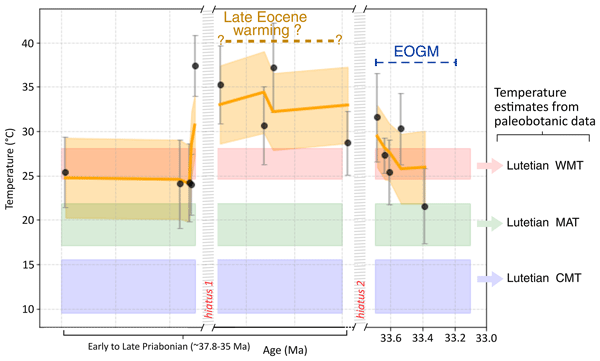
Here, we describe, date, and document the paleoenvironments of a continental sedimentary section from Balkanatolia, a biogeographic province that most likely functioned as a critical stepping stone for the dispersal of Asian mammals toward western Europe. Our sedimentary record represents a fluvio-lacustrine system dated by magnetostratigraphy to the Priabonian and the lower Rupelian, including the Oi-1 glaciation (~33.65 Ma). Clumped isotopic analyses on pedogenic carbonates across our record show evidence for a Late Eocene Warming starting during the middle Priabonian (ca. 37 Ma), followed by a marked cooling event at the Eocene–Oligocene Glacial Maximum (EOGM). Stable isotopic data and sedimentary facies further indicate that this complete interval is associated with a long-term aridification trend, starting during the Late Eocene warming and culminating at the EOT. Our results provide the first quantitative record of late Eocene warming on land, and our temperature estimates for the earliest Oligocene cooling are consistent with other Eurasian clumped-isotope records. These temperature shifts and associated aridification steps may have acted as contributing drivers of the late Eocene decline of Balkanatolian endemic taxa and likely facilitated the westward expansion of Asia-derived mammals ultimately resulting in the colonization of western Europe.
-
Notice on discussion status
The requested preprint has a corresponding peer-reviewed final revised paper. You are encouraged to refer to the final revised version.
-
Preprint
(2352 KB)
-
Supplement
(1849 KB)
-
The requested preprint has a corresponding peer-reviewed final revised paper. You are encouraged to refer to the final revised version.
- Preprint
(2352 KB) - Metadata XML
-
Supplement
(1849 KB) - BibTeX
- EndNote
- Final revised paper


Journal article(s) based on this preprint
Interactive discussion
Status: closed
-
RC1: 'Comment on egusphere-2025-6383', Maud J.M. Meijers, 06 Feb 2026
-
AC1: 'Reply on RC1', Paul Botté, 17 Apr 2026
Dear editor, dear referees,
The two reviewers have provided insightful and constructive feedback that will enable us to significantly improve the clarity and fidelity of our manuscript. We discuss below every point raised by the reviewers and explain how they will be addressed in the revised manuscript.
Note that the reply PDF with the revised figures has been included in the Supplementary Data
Review 1:
Review of Botté et al.
Climate changes in Anatolia across the late Eocene and the Eocene-Oligocene Transition: successive warming and cooling, aridification, and implications for the westward dispersal of Asian terrestrial mammals
Submitted to EGU Climate of the Past
In the manuscript submitted by Botté et al., sedimentological observations are combined with stable isotope (δ13C, δ18O, Δ47), paleomagnetic, and x-ray diffraction results from an Anatolian basin with Eocene-Oligocene terrestrial deposits. They interpret the data in terms of paleoenvironment and paleoclimate with important implications for the understanding of climate dynamics around the Eocene-Oligocene transition (EOT), as well as large mammal dispersal between Asia and Europe.
The manuscript is well-written and the figures generally support the text and findings in an efficient way. The results are of great importance for our understanding of continental climate dynamics around the EOT and the potential relationships between climate and faunal migration between Europe and Asia. Besides a number of comments and suggestions that should be relatively easy to take care of (see line-by-line comments), I have three major concerns. However, I do believe the authors should be able to address and resolve them.
Major concerns:
1) Pedogenic carbonate samples misplaced with respect to hiatus:
As I had trouble seeing the individual clumped temperatures and the relationship of the data with hiatus 1 (Fig. 6), I plotted them from the supplementary data. When doing so, I figured that the clumped T’s are misplaced with respect to hiatus 1 (level 263 m), as it should be located between the two stratigraphically lowest clumped samples (18CIC09 at level 253 m and BTCARB5 at level 265 m) and not between clumped samples 5 & 6 (in stratigraphic order; see Fig. 8). Alternatively, there is a mistake in the level of hiatus 1 in the manuscript (263 m) or the stratigraphic levels of the reported clumped samples (see suppl tables 3 & 4). Please clarify this. I do not believe that it has major implications for the interpretation of the clumped data and one could still argue for a similar paleoclimatic interpretation, although the discussion would need to be adjusted. For instance, it would imply that the warming trajectory is captured between the two hiatuses. Also, the origin of hiatus 1 would require a different interpretation if it comes before the Late Eocene warming (see e.g., lines 558-559 and lines 576-577).
We indeed misplaced the level of the samples in the supplementary data, but the levels on the figures of the main manuscript were correct. We uploaded an outdated version of the supplementary data that included a correlation error to the log of Licht et al. 2022. All levels were shifted by about 4m. We corrected the level of the samples in the supplementary excel sheet, but this does not impact our discussion and the figures.
2) Data availability:
The demagnetization data and XRD patterns should be made available. Add the following information for each demagnetized sample: sample, sample volume, the X-Y-Z components and intensity for each demag step, sample orientation, bedding orientation. I would strongly suggest the authors upload the paleomagnetic data to an online database (e.g., MagIC), as should be common practice nowadays.
We have now added the raw files from our Paleomagnetic software (PuffinPlot), including sample volume and each demag step. (As supplementary data 1). XRD patterns have been added as Supplementary data 2.
Sample in situ orientation and bedding have been added to Supplementary table 6.We are currently formatting and submitting our data to Pangaea
3) Paleomagnetic data and magnetostratigraphy:
-The files do not include stereographic projections with ChRM directions in geographic coordinates (or bedding planes for each sample that would allow to produce them). How do they relate to the present-day field at the location? The absence of the data and plots does not allow the reader to assess whether the samples may have undergone remagnetization, as the presence of normal and reverse polarities alone is not a guarantee for a primary origin of the ChRM. Please address this in the manuscript.
The lacking information and the ChRM diagrams (geo. and tect. coordinates) have been added to the supplementary files. We have also addressed the primary origin of the ChRM in the main text on lines on section 4.3:
“Regarding ChRM directional statistics (See Supplementary Figures Fig. S5), the inclination derived from geographic coordinates (53.2°) is consistent with the site’s latitude, whereas it drops to 26.5° after tectonic correction, which is inconsistent with the expected value for the site’s location. Notably the α95 value of inclination data shows minimal change (from 3.2° to 4.7°) when switching from geographic to tectonically corrected coordinates is not significant, suggesting that the inclination discrepancy is not driven by increased data scatter but rather reflects a systematic bias. That discrepancy between the expected and calculated inclinations is most likely due to a shallowing effect often observed in laminated lake sediments (e.g. Philippe et al. 2023).
The observed angle between the mean normal and reversed (corrected) directions is γ = 21.0°, whereas the critical angle at the 95% confidence level is γc = 13°, resulting in a formal failure of the reversal test. The datasets are strongly unbalanced (N=85 vs. N = 21), and the reversed population shows greater dispersion (k = 7.51; α95 = 12.4°) than the normal population (k = 17.49; α95 = 3.8°; see Supplementary Figures Fig. S5). This statistical failure likely reflects the smaller sample size and higher scatter of the reversed dataset rather than a true departure from geomagnetic antipodality, and the angular difference between the means remains moderate. Given that this study is based on continental sedimentary rocks, such angular differences between mean directions remain within acceptable limits (Tauxe et al., 2010). Fisher statistics indicate a mean inclination of 28.7° for the normal samples and 34.7° for the reversed (corrected) samples (See Supplementary Figures Fig. S5).These relatively low and comparable values further support the presence of inclination shallowing. Consequently, the tilting observed in the section indicates that the magnetization was acquired prior to tilting rather than post-tilting.
The primary character of the magnetization is further supported by the presence of several magnetic reversals along the section. Furthermore, samples containing both magnetite and hematite exhibit a single-component magnetization, suggesting that hematite recorded the ambient magnetic field during or shortly after deposition, rather than during later mineralogical alteration, and thus supporting a primary nature for the magnetization. Four distinct magnetic chrons have been identified within the Sekili Member interval of the studied section. These chrons are defined based on the presence of at least five consecutive, reliable samples exhibiting consistent magnetic polarity. In contrast, the lower part of the section, corresponding to the Incik Formation, displays less well-defined magnetic chrons, possibly reflecting either lower sampling resolution and/or enhanced diagenetic overprinting. However, the dominance of normal polarity intervals in this portion of the section led us to interpret it as representing a normal chron.“
-The paleomagnetic methods should include details on the criteria that were used to deem samples (un)reliable and exclude or include them in the magnetostratigraphy. From the supplement, I can deduct some information about the confidence levels of the data set by the authors, but this is very qualitative. The authors will have to make sure to use more quantitative criteria, as is common in paleomagnetic studies, e.g.: 1) how many demag steps were use as a minimum for the calculation of the ChRM for each sample?, 2) what is the maximum allowed MAD? 3) how was the ‘uncertain polarity’ cutoff in Fig. 4 determined and how were samples excluded based on this?
This has been clarified in the method section 3.3 :
“The dataset of this study has been supplemented with the paleomagnetic data from Licht et al. (2022)(60 samples). The sample levels were adjusted to match our stratigraphic log using field descriptions and marker beds.
Samples exhibiting low magnetic intensity or lacking a coherent directional trend, which likely reflects local noise rather than a primary signal, were excluded from the dataset. The Component Remanent Magnetization (ChRM) for each sample was isolated using progressive thermal or alternating field (AF) demagnetization, performed in at least four steps covering the ranges 120–660°C or 5–70 mT (See demagnetization steps, e.g. samples BT_82, BT_48_2 and BT28_2 Fig. 5A,E,F; See Supplementary tables 1 & 6 and Supplementary data 1 & 2), respectively, to ensure stable endpoint determination. Reliability was assessed based on these criteria: the stability of demagnetization trajectories, ensuring the absence of erratic behaviour or secondary components, a maximum Maximum Angular Deviation (MAD) of 15° (Fisher, 1953; McFadden & McElhinny, 1990), and reversal tests and reversal angle calculations performed via custom Python scripts and the Paleomagnetism.org platform, to validate polarity consistency (Fisher, 1953; Arason et al., 2010; Deenen et al., 2011; Heslop et al., 2023; McFadden et al., 1990; King, 1955; Tauxe, 2010; Tauxe et al., 2010; Tauxe & Watson, 1994; Tauxe et al., 2008; Zijderveld, 1967). These tests were applied to both our data and the one from Licht et al. (2022), and 28 samples were subsequently classified as outliers. Given the intrinsic uncertainties in paleomagnetic measurements, which can exceed ±30° in Virtual Geomagnetic Pole (VGP) latitude for equatorial sites due to shallowing and low inclination resolution (Tauxe et al., 2010), VGPs with latitudes between -30° and 30° were classified as uncertain, and no polarity interpretation was attempted for these cases. “
-Reversal R2 seems to consist of three consecutive samples in Fig. 4. However, there are only two samples with reverse polarity in the supplementary table. Where does the third sample come from? And why are there four samples marked as reverse in the supplement for R2, whereas there are really only two reverse samples? Where do the inconsistencies come from? I think this partially has to do with the combination of the data in this manuscript with those from Licht et al., (2022), but it’s difficult to assess, because the Licht et al. data are not included in the supplementary table and not discernable from the newly presented data in Fig. 4. Make sure to add them to the supplement (which will make it easier for other scientists to build on these data) and give the Licht et al. data a different color/symbol in Fig. 4.
There are actually five samples with reverse polarity for chron R2. The figure was misleading and inconsistent with the Supplementary table, and we have now corrected it.
The four reverse samples of the supplemental data are correct. The inconsistency between the supplementary tables and the figure comes from PuffinPlot, the software that was used to calculate and display declination and inclination (and that we used to compute the figure). PuffinPlot can occasionally produce errors, and the two samples 78_2 and 79_2 have reverse polarities but the data plotted by PuffinPlot are wrong (see screenshots below) and were thus plotted with the wrong polarity. The tectonic corrected declination was flipped by 180° and the inclination reversed (it should be negative instead of positive). To correct that, we have flipped by 180° the declination and reversed (from positive to negative) the inclination. They are now correctly plotted.
Moreover, there is a fifth reverse sample in this interval from the data of Licht et al. (2022). This sample has now been included in the supplementary data. Therefore, there are five consecutive reverse samples included in R2.
-The preferred correlation of N4 with the GPTS does not allow for the well-dated marine fossil assemblage (ca. 50 m in strat column) to be Priabonian in age (see how level 150 m is loosely correlated to the bottom of the Priabonian). Based on the dated tuffs it is solid to correlate R1 with C12r, but for the entire section below that it is difficult to provide reliable correlations, because of the very limited number of reverse samples, the sampling resolution, and (un)identified hiatuses (let alone changing sedimentation rates). I’d suggest to correlate the marine beds to the bottom of the Priabonian and then calculate a minimum sedimentation rate for the interval between the marine beds and R1 (minimum, because one can’t know how to correlate the marine beds to the Priabonian). Indeed, as the current preferred correlation suggests, hiatus 2 is likely coinciding with chron C13r. I think the authors can then reasonably build a case for the age of the high Δ47 T’s interval to be latest Eocene, i.e. older than the start of the EOT (as is the case in the current preferred correlation). It may not change that much to the discussion of the temperatures, but it makes the discussion a bit fairer.
Following the reviewer’s suggestion, we calculated a minimum sedimentation rate for the interval between the marine beds (correlated to the bottom of the Priabonian) and R1 (correlated to chron C12r). We have considered the section below R1 as a single, continuous normal magnetozone, and assumed that it corresponds to chron C13n. This approach yields a minimum sedimentation rate of 53.7 cm/ka, which is unrealistically high and thus geologically implausible. Consequently, these rates do not support an Oligocene age for the underlying section, as initially hypothesized.
As previously noted, our reverse magnetozone R2 comprises five reverse samples; this magnetozone cannot be disregarded. The correlation of N1 to Chron C13n is well constrained by the presence of a tuff a few meters above the top of N1. Therefore, R2 must be correlated to one of the five reverse chrons between C13r and the base of the Priabonian. We now include these points of discussion in the main text and acknowledge that the section below N2 remains difficult to correlate precisely within the Priabonian. We still propose a preferred correlation of R2 to chron C16n.1r based on accumulation rates, but we acknowledge that other correlations are possible. The new paleoclimatic discussion takes into account that the chronology of the Priabonian part of our section is less clear than for the Rupelian part, and we nuance the proposed age for the middle Priabonian warming event.
Line-by-line comments:
Title: please try to shorten. E.g.: the part after the colon already implies that the manuscript presents paleoenvironmnetal/paleoclimatic reconstructions, so the start of the title is somewhat redundant.
Done
Abstract (and maybe title?): indicate that Anatolia forms part of Türkiye. Same for the location of Balkananatolia in the Abstract (e.g. NE Mediterranean region?).
Done
23: Grande Coupure needs half a sentence of introduction in the abstract.
Done
53: Something seems missing here. Do you mean stable isotope records from carbonates? Or clumped records from carbonates?
Both. Done
58: Please detail ‘other’?
By using the term “other”, we aimed to highlight results that contrast with those mentioned in the previous sentence. We therefore opted for the term “alternative” to clarify our intention.
75: I doubt that Eronen et al. mention this correlation or constrain surface uplift of the Alps. Rather, they write: ‘…and contrasts with contemporaneous faunal response in Eurasia where tectonics and associated surface uplift played only a subordinate role.’
This has been clarified.
Importantly, Kocsis et al. interpret a decrease in δ18OPO4values of herbivore tooth enamel after 31 Ma to result from surface uplift of the Alps. However, the youngest deposits for which clumped data are provided are from ca. 33.5 Ma soil carbonates.
Please rewrite accordingly, which also implies rewriting the last sentence of the discussion.
Indeed, the wide low δ18OPO4values of Kocsis et al. were interpreted as resulting from Alpine uplift after 31 Ma: “The wide appearance of low d18OPO4 values from 31 Ma is best explained by topography-induced fractionation of the drinking water and/ or redistribution of this water due to modification of drainage patterns”. However, Kocsis et al also suggest a signature of alpine uplift already occurring between 35 and 31, with the isotopic shift observed in d18OPO4 values between north and west/southwest sites : “The significant division in the data between the north and west-southwest regions between 35 and 31 Ma points to the existence of a potential orographic barrier for these air masses; otherwise, more mixed isotopic values would be expected.”
85: Please add a some of information about the impact of orbital configurations and pCO2 changes on the dispersal routes. It would really help the reader.
Done
86-88: Add e.g. the word ‘Collectively’ to the start of the sentence, so the reader is guided to what research is carried out in this study.
Done
89-90: add the sedimentological observations/facies analysis to the methods used. You did a lot of good work there!
Done
101: E.g. Tisza and the Pontides have basements of Gondwana affinity. Fix and check for the other terranes.
Some Balkanatolian terranes, such as the Pontides and Tisza, have indeed incorporated Gondwanan fragments during the Paleozoic. But they were incorporated to the Laurasian margin during the Late Paleozoic, and their later stratigraphic section and zircon age distribution display closer Laurasian affinities (See Okay et al., 2008 and Okay et al., 2015)
106: add spaces to ‘Asiaby theParatethys’
Done
107: There are two Montheil et al., (2025) publications in the ref list. Make sure to add a and b.
Done
115-116: Luda Kamchiya Through and Moesian Platform need to be included on the map in Fig. 2.
Done
120: ‘anthracotheriidae, gelocidae and amphicyonidae’. For most readers, it would be nice to include that these are artiodactyla and carnivores.
Done
128-131: There is no contradiction between the Lefebvre and Van Hinsbergen studies. Also Lefebvre et al. regard the Kirsehir Massif as a metamorphosed northern tip of the Taurides. So please remove the controversy.
Done
135-137: see my previous comment. Remove the controversy.
Done
137: is Licht et al., (2017) the reference that was intended to be placed here?
Done. This was not intended.
148: ‘(reference here)’ indeed needs a reference.
Done
150: Only lacustrine or also fluvial?
It’s actually both. Done
157: ‘Brontotheriidae and Hyracodontidae’ please add that these are Perissodactyla. That increases readability for non-specialists.
Done
163: Balakananatolia --> Balkananatolia
Done, from “Balakanatolia” to “Balkanatolia”
184: Please point out what new work was conducted in this study while building on the work of Licht et al. (2022). This seems to be explained in line 186, but it is not very clear, so please rewrite.
Done
185: there are two Licht et al., (2022) publications in the reference list. Please add a and b.
Done
200-214: indicate more clearly how the new samples relate to those of Licht et al. and that the data in this manuscript are combined with theirs in the results/discussion.
Done
200-214: make sure to include methods and references to the statistical methods that were used to carry out the reversal test, to calculate confidence ellipses (see Fig. S5) and methods to exclude outliers in case those were used. I can also not find information about how the ‘uncertain polarity’ in Fig. 4 was defined and if this led to the exclusion of samples. This will need to be transparent.
References and methods have been added to the supp. data Fig S5 ; Statistics have been detailed in the methods. Done
200: convert inches to cm as per journal policy (SI units).
Done
201: retrived-->retrieved
Done
202: given the available XRD data and thin sections, can something be said about the mineralogy of the clasts?
Our XRD analyses were specifically focused on identifying carbonate phases (calcite and dolomite) for clumped isotope analysis, and the thin sections were prepared exclusively from pedogenic carbonates. Therefore, our available data do not provide detailed information on the mineralogy of the siliciclastic fraction. A comprehensive mineralogical characterization of the clasts would require additional XRD analyses on bulk clastic samples and/or petrographic observations of thin sections from the clastic intervals, which were not performed in this study.
203: remove comma
Done
204: Natural Remanent magnetization and--> Natural remanent magnetization (NRM) and
Done
209: using alternating field (AF) demagnetization--> using AF demagnetization
Done
210: demagnetization. Among these, 14 --> demagnetization, of which 14
Done
210: orthogonal diagrams--> orthogonal vector diagrams
Done
211: projection--> projections
Done
213: lacked a coherent directional trend, likely--> lacking a coherent directional trend, which is likely
Done
214: how many were excluded and on the basis of what criteria? See major comment #3 above.
This has been clarified in the text. These criteria are mentioned in response to comment #3
217: isotopic--> isotope
Done
221: ove--> oven
Done
221: *--> °
Done
223: isotopes--> isotope
Done
224: spell out V-PDB
Done
224: frame-->materials
Done
225: what were the criteria for selecting these particular samples?
They were chosen according to their carbonate content and their distribution along our stratigraphic log. We have clarified this in the text
230: stale--> stable
Done
232: faraday--> Faraday
Done
242: there is a statistically significant difference between the pretreated and non-treated samples for some samples (see suppl table), so this statement is incorrect. However, there is no systematic offset, is that what the authors intended to write? Please adjust.
This has been clarified. We meant that there is no systematic offset across the dataset. For two samples, pre-treated and non-treated samples lie at 1s of each other. For a third sample, they lie at 2.5s.
260: 4.1 Sedimentology of the Büyükteflek section. Please include XRD in the title (and make the patterns available, see major comment 2)).
Done
320-322: if these are NRM intensities, please name them as such.
Done
323: up to what field strength/T’s is this viscous component typically visible?
We did not specifically test whether this component corresponds to a viscous magnetization. However, a low-coercivity component is consistently removed between 5 and 10 mT, eliminating an initial directional component that is not antipodal to the main characteristic remanant magnetization. We therefore interpret this component as a secondary overprint carried by low-coercivity minerals rather than a primary magnetization. We clarified this in the text.
322-326: include this type of information also for the AF demagnetized samples
This section addresses both AF and thermal demagnetized samples
326-327: this is methods, not results. Please move. But: why 120-500°C? According to what I read in the methods, the highest T was 660°C? Please clarify.
Indeed, the demagnetization steps were conducted up to 660°C, this was an oversight on our part. This has been corrected.
328-330: in the absence of rock magnetic measurements, the unblocking T ranges indicate the presence of mt and ht in the samples. So why the ‘sometimes’ after the comma? Please adjust the sentence.
Done
329: can a reference be made to an example in the data?
Reference is done line 330: “see representative example in Fig. 5”
332: remove ‘primary’ from the sentence. The argumentation as to why these directions are primary comes later.
Done
336-337: this is methods, please move it there and include references to the statistical methods that were used.
Done
337: add the visual and statistical results of the reversal test to the supplement and include the statistical results here (critical angle, classification etc).
We thank the reviewer for this comment and for encouraging us to provide greater details regarding the reversal test. Following the reviewer’s suggestion, we calculated the reversal test using the statistical approach of McFadden & McElhinny (1990) in order to produce the corresponding figure and statistical results. While doing so and re-examining our initial implementation in which the test was mistakenly reported as positive, we realize that the observed angle between the mean normal and reversed (corrected) directions is γ = 21.02°, whereas the critical angle at the 95% confidence level is γc = 13°, resulting in a formal FAIL classification. The two polarity datasets are markedly unbalanced (N = 85 for normal directions versus N = 21 for reversed directions), and the reversed population exhibits significantly higher dispersion (k = 7.51; α95 = 12.44°) compared to the normal population (k = 17.49; α95 = 3.78°) (See Supplementary Figures Fig. S5).
àWe therefore interpret this statistical failure as primarily reflecting the limited size and greater scatter of the reversed dataset rather than a fundamental departure from geomagnetic antipodality (see our reply to a previous comment). Notably, the angular difference between the two mean directions remains moderate in magnitude.
Our results section has been corrected accordingly.
344: what is considered ‘reliable’? See also major comment 3)
Done
346: a) the lower part was not sampled at a lower resolution (as far as I can see), so this confuses me? b) are there any reasons to assume that diagenesis is more of an issue in the lower part of the section?
- a) What we meant is that our sampling resolution was probably not enough to catch small reversal excursions, even though R2 is assimilated to the short reversal C16.1r. We could have missed some very short chrons considering the estimated accumulation rates, such as chron C17.1r. On the lowest part of the log, there are parts where we were not able to collect paleomag samples over 3 to 4 m. Our R2 magnetozone is only 3 m thick.
- b) We agree that this point requires clarification. We have revised the manuscript to indicate that the less well-defined chrons may reflect lower sampling resolution and/or possible diagenetic overprinting. There is yet no direct evidence demonstrating stronger diagenetic alteration in the lower part of the section.
355-357: for the averages in these lines: add standard deviations
Done
367: add the sample number of the one that contains dolomite.
Done
371: remove ‘with it’
Done
377: δ18Owater values--> δ18O values of soil water (δ18Owater)
Done
Section 5.1 in general: see major comment 3)
Done
392: the fact that the magnetostratigraphy of Licht et al., (2022) was correlated to the GPTS through biostratigraphy and U-Pb dating needs to be reflected in this sentence, as this is crucial information.
Done
393-395: move this information downward. It’s always better to start with what one knows rather than what one doesn’t know.
Done
395: refer to the Paleogene time scale chapter of Speijer et al., (2020) within the book, rather than the entire book.
Done
439: add ‘tectonic’ in from of ‘uplift’
Done
471: can the dolomite and its potential origin from evaporation be related to the thin sections?
The thin sections (see Supplementary Figures Fig. S2) show diffuse dolomite within a fine-grained matrix of a coarse sandstone (see the example of BTCARB19 on panel C), not pure dolomite. Diffuse dolomitic cement is a common by-product of early diagenetic processes, but it can hardly be distinguished from evaporative dolomite when it is mixed with clayey content. An evaporative or early diagenetic nature for the dolomite can not be clearly identified or ruled out, and the thin sections alone do not provide sufficient evidence for evaporation-driven dolomite precipitation.
498: soil carbonates only form in seasonally dry climates, so ‘alternating wet and dry climates’ can be removed in my opinion. Instead, point out why in sub-humid climates the T’s rather reflect MAT. Or did the authors mean that there are multiple annual wet and dry cycles?
We indeed meant that there are multiple annual wet and dry cycles instead of seasons, which can enable pedogenic formation during the whole year regarding the MAP (Breecker et al., 2009). Then we changed “seasons” to --> “cycles”
502: I think it could be useful to add the numerical age for the Lutetian stage.
Done
Sections 5.4 & 5.5: need to be rewritten once the relationship of the pedogenic carbonates to hiatus 1 is sorted.
See reply of major concern 1). As the relationship of the pedogenic carbonates to the hiatus 1 hasn’t been changed, the discussion hasn’t been impacted
720: year of publication missing.
Done
Figure 2:
(B): what are these reconstructions based on?
Done. This has been modified from Montheil et al., 2025b
(C): I believe this map was first published by Gülyüz et al., (2013) and based on a geological map of Ketin (1955). Please refer to it accordingly in the caption. ‘Younger Units’ are named ‘cover series’ in line 143. Use one of them throughout.
Done
Figure 4:
- ‘VGP’ and ‘Outliers’ are indistinguishable, please give them different symbols and/or colors. Also make sure the data from Licht et al., (2022) are discernable from those presented in this manuscript.
Done
-Given the statement in l. 343-344, the upper normal polarity interval should be colored grey.
Done
-add the levels of the pedogenic carbonate samples with clumped data to the log (also in Fig. 7)
Done
Figure 5:
-These diagrams are not Zijderveld diagrams, but orthogonal vector diagrams. Replacing them with Zijderveld diagrams would be great, as the link between dec and inc for each demag step is better visualized.
Thanks for this comment. The diagrams presented are orthogonal vector Zijderveld plots, displaying both declination and inclination components at each demagnetization step. A detailed legend has been added to the figures to better highlight these directional components and facilitate their interpretation.
-Add several demag steps to the diagrams, so one can see what the first and last steps, as well as some intermediate ones, represent.
We added a demagnetization diagram and clarified the inc/dec steps on the Zijderveld plots for better clarity, as suggested.
Figure 6:
-the numerical stratigraphic levels are irregularly placed
-the last column with the clumped T’s needs more space, as it is tough to discern the different points. See also major comment 1).
-in the caption, indicate whether the plot includes 1s or 2s analytical uncertainties.
We have made the figure clearer, as both the clumped isotope temperatures and the stratigraphic levels are now more easily readable. The caption has been updated accordingly.
Figure 7:
-Add the EOGM to the figure, as well as the pedogenic carbonate levels with clumped data.
-See also major comment 3).
-Add the interval of the Grande Coupure, so the reader can more easily relate to it.
All these changes have been implemented in the new figure.
Figure 8:
-See major comment 1): if the soil carbonate clumped T’s are indeed misplaced with respect to hiatus 1, the figure needs to be adjusted.
As our samples were correctly positioned, no changes were necessary. However, following the reviewer's comments on our paleomagnetic correlation, we have updated the timescale/dating of our samples.
Supplementary materials:
Supplementary Table 1: what are the _1 and _2 samples? Add the information to the table caption.
Samples that were split in two for demagnetization using both AF and thermal methods have been annotated as _1 and _2, respectively. This has been clarified in the table caption.
General comments:
-The manuscript lacks coordinates. Add them for the clumped samples, the start and end of the section, as well as some intermediate points (e.g. the hiatuses, the dates tuffs, the fossil level). This is incredibly important for other scientists who would like to visit and/or study the sites.
We did not record the exact coordinates for each carbonate sample, but they can be found in the field by following the stratigraphic log. The stratigraphic levels of clumped isotope samples have been updated in Supplementary Table 4. Coordinates for paleomagnetic sampling sites have been added to Supplementary Table 6.
Regarding the exact coordinates of the hiatuses and tuff levels, these have been added to Supplementary Text 1 "Stratigraphic coordinates". Note that the hiatuses are also illustrated with field photographs in Fig. 3 and in the overview of the section in Supplementary Figures Fig. 1 to facilitate their recognition in the field.
-Pay attention to sub- and superscripts throughout the manuscript (CO2, Δ47, δ13C etc.)
-Use words for cardinal numbers less than 10 (as per journal policy)
Done
Maud Meijers
Citation: https://doi.org/10.5194/egusphere-2025-6383-AC1
-
AC1: 'Reply on RC1', Paul Botté, 17 Apr 2026
-
RC2: 'Comment on egusphere-2025-6383', Anonymous Referee #2, 21 Mar 2026
This study presents magnetostratigraphic results from the Büyükteflek section in the Balkanatolia Basin and reconstructs a quantitative paleotemperature record using carbonate clumped isotope (Δ47) thermometry. The results provide the first quantitative terrestrial record of late Eocene warming and indicate an approximately 7 °C decline in summer surface temperatures during the Eocene–Oligocene Glacial Maximum (EOGM). The manuscript also explores the potential influence of regional climate changes on terrestrial mammal evolution. Overall, this is an interesting and valuable contribution. However, several issues need to be addressed, particularly regarding the geochronological framework. My specific comments are outlined below.
1. Structure, Formatting, and Presentation. Some aspects of the manuscript structure and formatting require improvement. For example, Paragraph 1 would benefit from being split at the sentence:
“While the EOT and the EOGM are well documented in marine records, their impact on land remains poorly understood.” A new paragraph should begin here to introduce the discussion of terrestrial records, which would improve readability and reduce the density of information.In addition, minor typographical errors should be corrected (e.g., “Eastern Asiaby theParatethys” should read “Eastern Asia by the Paratethys”). A thorough proofreading of the manuscript is recommended to eliminate similar issues.
Finally, I suggest including one or two summary tables: One summarizing climate and biotic changes across the EOT in different regions; Another outlining the regional geological setting.
These additions would improve clarity and accessibility for readers.2. Figure Presentation. The paleomagnetic correlation scheme shown in Figure 7 could be merged with that in Figure 4 to streamline presentation and facilitate comparison. It would also be helpful to include data from Licht et al. (2022) for direct comparison, allowing readers to better evaluate similarities and discrepancies between studies.
Since the Δ47 analyses were conducted on pure calcite, the authors should present corresponding XRD data to verify sample purity.
Additionally, several published EOT paleotemperature records are mentioned but not directly compared. These should be compiled into a single figure alongside the new data presented here, enabling readers to assess spatial variability in the EOT climate response on a broader, potentially global scale.3. Age Model and Magnetostratigraphy. While I agree that the Büyükteflek section likely spans the EOT interval, I have concerns regarding the precision of the age model. The presence of two hiatuses introduces uncertainty, and without independent high-precision dating methods, their durations cannot be tightly constrained.
This uncertainty is further compounded by the relatively low quality of the paleomagnetic data, which shows a poor correlation with the GPTS 2020, particularly between 150 and 300 m (as seen in Figure 7).
Therefore, I recommend that the authors adopt a more cautious interpretation and avoid overstating the precision of the age model unless stronger supporting evidence can be provided. This also reinforces the need to compare the paleomagnetic results with those of Licht et al. (2022).
4. Diagenetic and Secondary Controls on Carbonate Geochemistry. Although the authors selected pure calcite for Δ47-based paleotemperature reconstruction, the manuscript does not sufficiently address potential post-depositional alterations. These may include burial diagenesis, reworking, detrital contamination, changes in moisture source, and possible hydrothermal influences.Such processes can modify the oxygen isotope composition of calcite and potentially bias paleotemperature estimates. I strongly recommend adding a dedicated discussion evaluating these potential effects and their implications for the robustness of the results.
5. Interpretation of Aridification. While the general temperature trend appears reasonable, the interpretation of aridification requires further support.
The authors state (Lines 479–481): “Interestingly, the peak of lake retreat starts during the latest Priabonian and covers the EOT, and thus predates the EOGM and the global low of eustatic level (Miller et al., 2008); lake levels increase again during the EOGM.” It is unclear what proxy evidence supports this inference. Reliance solely on sedimentary facies may not be sufficient to robustly reconstruct lake-level changes. Furthermore, the use of δ¹⁸Owater as an indicator of aridification assumes a stable moisture source and constant precipitation isotopic composition through time. This assumption needs to be justified with additional evidence. Without such support, attributing δ¹⁸Owater variations primarily to evaporation remains insufficiently constrained.
6. Linkages to Regional Biotic Evolution. Although the introduction highlights the importance of the EOT for terrestrial mammal evolution, this aspect is not fully developed in the results and discussion sections.
I recommend that the authors expand this component by synthesizing and, where possible, quantifying changes in mammalian assemblages (e.g., taxonomic composition, diversity, and body size) across the study interval. Integrating these data into Figure 8 would provide a more comprehensive and compelling synthesis, rather than relying solely on qualitative discussion.
Citation: https://doi.org/10.5194/egusphere-2025-6383-RC2 -
AC2: 'Reply on RC2', Paul Botté, 17 Apr 2026
Dear editor, dear referees,
The two reviewers have provided insightful and constructive feedback that will enable us to significantly improve the clarity and fidelity of our manuscript. We discuss below every point raised by the reviewers and explain how they will be addressed in the revised manuscript.
Note that the reply PDF with the revised figures has been included in the Supplementary Data.
This study presents magnetostratigraphic results from the Büyükteflek section in the Balkanatolia Basin and reconstructs a quantitative paleotemperature record using carbonate clumped isotope (Δ47) thermometry. The results provide the first quantitative terrestrial record of late Eocene warming and indicate an approximately 7 °C decline in summer surface temperatures during the Eocene–Oligocene Glacial Maximum (EOGM). The manuscript also explores the potential influence of regional climate changes on terrestrial mammal evolution. Overall, this is an interesting and valuable contribution. However, several issues need to be addressed, particularly regarding the geochronological framework. My specific comments are outlined below.
- Structure, Formatting, and Presentation. Some aspects of the manuscript structure and formatting require improvement. For example, Paragraph 1 would benefit from being split at the sentence:
“While the EOT and the EOGM are well documented in marine records, their impact on land remains poorly understood.” A new paragraph should begin here to introduce the discussion of terrestrial records, which would improve readability and reduce the density of information.
Done
In addition, minor typographical errors should be corrected (e.g., “Eastern Asiaby theParatethys” should read “Eastern Asia by the Paratethys”). A thorough proofreading of the manuscript is recommended to eliminate similar issues.
Finally, I suggest including one or two summary tables: One summarizing climate and biotic changes across the EOT in different regions; Another outlining the regional geological setting.
We tried to polish and fluidify the introduction. However, we do not think that adding these tables would be a great improvement. First, we only explore the link between one Eurasian biotic event (the Grande Coupure) and the EOT; adding details about other biotic events would take unnecessary space in an already long article. However, we added a table that synthesizes all other terrestrial paleotemperature records of the EOT, in order to fluidify the discussion of our data. This table has been added in the discussion.
Moreover, the regional geological setting includes multiple angles (tectonic and paleogeographic evolution of the region, sedimentation in the broad Cankiri Basin and in the area of study) and we do not see how this would fit in a table with columns and rows. Such a composite table would not be self-explanatory and would thus require a long text. We thus think that leaving the geological context under text format is better, as made in most paleoclimatic studies.
These additions would improve clarity and accessibility for readers.
- Figure Presentation. The paleomagnetic correlation scheme shown in Figure 7 could be merged with that in Figure 4 to streamline presentation and facilitate comparison. It would also be helpful to include data from Licht et al. (2022) for direct comparison, allowing readers to better evaluate similarities and discrepancies between studies.
This comment is similar to Reviewer 1’s regarding the distinction between our data and that of Licht et al. (2022). The data points have now been clearly distinguished and specified in the figure legend.
Regarding the addition of the correlation to Figure 4, we chose to keep the figure in its current form to avoid making it overly complex and difficult to read, especially since Figure 4 also focuses on sedimentary facies.
Since the Δ47 analyses were conducted on pure calcite, the authors should present corresponding XRD data to verify sample purity.
Done, XRD patterns are now given as a new supplementary material. The patterns are already mentioned in the main text.
Additionally, several published EOT paleotemperature records are mentioned but not directly compared. These should be compiled into a single figure alongside the new data presented here, enabling readers to assess spatial variability in the EOT climate response on a broader, potentially global scale.
As mentioned previously, we have now added a synthetic table with all other terrestrial paleotemperature records of the EOT from geochemical proxies, to directly compare our data with previous studies. We tried to display these other studies in a single figure for comparison, but they all have different sampling resolutions, age range and uncertainties, making their display on a single figure very tricky. A table seemed easier to read.
- Age Model and Magnetostratigraphy. While I agree that the Büyükteflek section likely spans the EOT interval, I have concerns regarding the precision of the age model. The presence of two hiatuses introduces uncertainty, and without independent high-precision dating methods, their durations cannot be tightly constrained.
This uncertainty is further compounded by the relatively low quality of the paleomagnetic data, which shows a poor correlation with the GPTS 2020, particularly between 150 and 300 m (as seen in Figure 7).
We have now significantly improved this part of the text following the comments of reviewer#1 and we provide a more nuanced correlation for the base of the section. Our new age model takes into account the uncertainty of our correlation for the Priabonian part of our section.
Therefore, I recommend that the authors adopt a more cautious interpretation and avoid overstating the precision of the age model unless stronger supporting evidence can be provided. This also reinforces the need to compare the paleomagnetic results with those of Licht et al. (2022).
Done. We have also ensured that the figures distinctly separate the data from our study and the one from Licht et al. (2022).
Diagenetic and Secondary Controls on Carbonate Geochemistry. Although the authors selected pure calcite for Δ47-based paleotemperature reconstruction, the manuscript does not sufficiently address potential post-depositional alterations. These may include burial diagenesis, reworking, detrital contamination, changes in moisture source, and possible hydrothermal influences.
Such processes can modify the oxygen isotope composition of calcite and potentially bias paleotemperature estimates. I strongly recommend adding a dedicated discussion evaluating these potential effects and their implications for the robustness of the results.
We have now expanded the discussion on this topic.
Thin section observations (Supplementary Figure S2) show well-preserved micritic to microsparitic textures in all analyzed pedogenic carbonates. Calcite and dolomite occur as diffuse cements between detrital grains (e.g., samples BTCARB08, BTCARB13, BTCARB15, BTCARB19), with no evidence of coarse sparite recrystallization, blocky calcite cement, or hydrothermal mineral assemblages. Such features would typically accompany significant burial diagenesis or hydrothermal overprinting (Henkes et al., 2014; Stolper and Eiler, 2015). The analyzed carbonates occur as in situ nodules and caliche horizons within paleosols (facies Smp), or as diffuse cements in floodplain deposits (facies Fmp, Gmm). Their stratigraphic position and micritic textures strongly argue against significant reworking or detrital carbonate contamination. The Δ47-derived temperatures are coherent with formation in the vadose zone, where temperature variations reflect near-surface soil conditions (Quade et al., 2013). Importantly, the reconstructed temperatures fall well below the threshold required for solid-state reordering of clumped isotopes (>100-150°C over geological timescales; Henkes et al., 2014; Stolper and Eiler, 2015), further supporting preservation of the primary isotopic signal. Variations in δ¹⁸O values likely reflect changes in soil water δ¹⁸O under evolving aridity, consistent with sedimentological evidence such as increased caliche development. Given the proximity to the Neotethys and the Paratethys of the study area, major shifts in moisture source beyond these proximal moisture sources would require substantial paleogeographic changes (Kaiseri-Özer et al., 2013). Calculated soil water δ¹⁸O values (after Kim and O’Neil, 1997) are consistent with progressive evaporative enrichment rather than abrupt changes in moisture source. Replicate Δ47 analyses show high reproducibility (±4,6°C, 2SE), and our temperature trends are consistent with other Eurasian clumped isotope records (e.g., Page et al., 2019; Semmani et al., 2024).
Overall, the convergence of petrographic, stratigraphic, and geochemical evidence supports the primary nature of the Δ47 signal and the robustness of the reconstructed paleotemperatures.
- Interpretation of Aridification. While the general temperature trend appears reasonable, the interpretation of aridification requires further support.
The authors state (Lines 479–481): “Interestingly, the peak of lake retreat starts during the latest Priabonian and covers the EOT, and thus predates the EOGM and the global low of eustatic level (Miller et al., 2008); lake levels increase again during the EOGM.” It is unclear what proxy evidence supports this inference. Reliance solely on sedimentary facies may not be sufficient to robustly reconstruct lake-level changes. Furthermore, the use of δ¹⁸Owater as an indicator of aridification assumes a stable moisture source and constant precipitation isotopic composition through time. This assumption needs to be justified with additional evidence. Without such support, attributing δ¹⁸Owater variations primarily to evaporation remains insufficiently constrained.
Our interpretation of lake-level fluctuations is based on stratigraphic, facies, and unconformity evidence. Lake levels in ancient lacustrine deposits are commonly reconstructed based on such sedimentary proxies (e.g. Shaban et al., 2021; Zavala et al., 2024)
The appearance of well-developed caliches and cemented carbonate horizons within the Smp facies indicates phases of subaerial exposure, reflecting lake-level fluctuations associated with increased aridity. As mentioned in the text, local climate is not the only factor controlling sedimentary activity: tectonics also plays a role in reorganizing paleodrainages. The first unconformity (Hiatus 1) is associated with a shift from fine-grained to coarser deposits, which we attribute primarily to tectonic reorganization (uplift of the Cicekdagi anticline and establishment of a new drainage network; See Gülyüz et al., 2013). However, the second unconformity (Hiatus 2) is marked not only by a sedimentological change but also by a dramatic increase in cemented carbonate facies and the development of exceptionally thick paleosols. The paleosol associated with hiatus 2 exceeds 2 meters in thickness and displays well-developed caliche horizons, indicating prolonged subaerial exposure under arid conditions. Such thick caliche development requires an abrupt and sustained arid episode, likely involving significant lake-level retreat.
We interpret the significant increase of δ¹⁸Owater values between hiatus 1 and hiatus 2 reflect increasing aridity, likely driven by enhanced evaporative enrichment, as it is commonly seen in pedogenic carbonates(e.g. Kelson et al., 2018; Broz et al., 2021; Kelson et al., 2023) . As mentioned previously, the context does not support a change in moisture source during this interval: the Paratethys/Neotethys is inferred to have remained the dominant regional moisture source for Balkanatolia throughout the latest Eocene (Kayseri-Öser, 2013), with no documented major reorganization of atmospheric circulation patterns until later in the Oligocene. Under such stable moisture-source conditions, the development of an exceptionally thick caliche requires an abrupt climatic event as specifically a drastic arid episode coupled with lake-level lowering. This interpretation is further supported by the occurrence of Oligocene evaporites elsewhere in the Çankırı Basin (Kaymakcı et al., 2003), indicating a basin-wide shift toward hypersaline conditions during the early Oligocene.
Above hiatus 2, the presence of well-developed cemented carbonates, caliches, and dolomite-dominated facies supports continued lake-level fluctuations within a persistently arid and hypersaline system. Lake-level recovery and subsequent fluctuations are inferred to have initiated during the EOGM, as evidenced by the resumption of sedimentation immediately above hiatus 2. In contrast to the lower part of the section (below hiatus 1), which is dominated by fine-grained floodplain deposits of the Fmp facies association, the upper part (above hiatus 1) is characterized by coarser Smp facies interpreted as distal fan-delta to lake-margin deposits. This transitional setting made these deposits highly sensitive to lake-level changes: the widespread occurrence of diffuse and cemented carbonates in the Smp facies is diagnostic of lake-influenced deposition, with repeated phases of subaerial exposure allowing pedogenic processes and carbonate cementation to occur.
We have added additional details to the text to improve clarity.
- Linkages to Regional Biotic Evolution. Although the introduction highlights the importance of the EOT for terrestrial mammal evolution, this aspect is not fully developed in the results and discussion sections.
I recommend that the authors expand this component by synthesizing and, where possible, quantifying changes in mammalian assemblages (e.g., taxonomic composition, diversity, and body size) across the study interval. Integrating these data into Figure 8 would provide a more comprehensive and compelling synthesis, rather than relying solely on qualitative discussion.
We have now included more context on the grande coupure and expanded this paragraph (5.5) by providing more explicit detail on the Grande Coupure and its potential climatic context. Specifically, we added quantitative information on the decline in endemic artiodactyl diversity in Western Europe (Weppe et al., 2023), clarified the temporal relationship between mammalian biohorizons (MP18–MP20) and the two aridification steps identified in our record, and further discussed the possible role of increasing aridity and cooling in shaping faunal turnover in Balkanatolia and Western Europe. Quantitative data on the Grande coupure exist in areas where there are multiple sites (see, for example, Weppe et al., 2022, PNAS for western Europe) and they are now mentioned in the text. Yet, we do not think that adding quantitative paleontological data from our study area (or for all Balkanatolia) and comparing them with our paleoclimatic data is adequate. There are less than 10 Priabonian paleontological sites on Balkanatolia, and even less Rupelian sites, and most of them have yielded 1 or 2 taxa only (see, e.g., Licht et al., 2022, ESR for a review). It is, at this point, impossible to provide a quantitative and statistically robust view of the evolution of body size or taxon diversity before and at the Grande Coupure during this time interval.
- Structure, Formatting, and Presentation. Some aspects of the manuscript structure and formatting require improvement. For example, Paragraph 1 would benefit from being split at the sentence:
-
AC2: 'Reply on RC2', Paul Botté, 17 Apr 2026
Peer review completion


Interactive discussion
Status: closed
-
RC1: 'Comment on egusphere-2025-6383', Maud J.M. Meijers, 06 Feb 2026
Review of Botté et al.
Climate changes in Anatolia across the late Eocene and the Eocene-Oligocene Transition: successive warming and cooling, aridification, and implications for the westward dispersal of Asian terrestrial mammals
Submitted to EGU Climate of the Past
In the manuscript submitted by Botté et al., sedimentological observations are combined with stable isotope (δ13C, δ18O, Δ47), paleomagnetic, and x-ray diffraction results from an Anatolian basin with Eocene-Oligocene terrestrial deposits. They interpret the data in terms of paleoenvironment and paleoclimate with important implications for the understanding of climate dynamics around the Eocene-Oligocene transition (EOT), as well as large mammal dispersal between Asia and Europe.
The manuscript is well-written and the figures generally support the text and findings in an efficient way. The results are of great importance for our understanding of continental climate dynamics around the EOT and the potential relationships between climate and faunal migration between Europe and Asia. Besides a number of comments and suggestions that should be relatively easy to take care of (see line-by-line comments), I have three major concerns. However, I do believe the authors should be able to address and resolve them.
Major concerns:
1) Pedogenic carbonate samples misplaced with respect to hiatus:
As I had trouble seeing the individual clumped temperatures and the relationship of the data with hiatus 1 (Fig. 6), I plotted them from the supplementary data. When doing so, I figured that the clumped T’s are misplaced with respect to hiatus 1 (level 263 m), as it should be located between the two stratigraphically lowest clumped samples (18CIC09 at level 253 m and BTCARB5 at level 265 m) and not between clumped samples 5 & 6 (in stratigraphic order; see Fig. 8). Alternatively, there is a mistake in the level of hiatus 1 in the manuscript (263 m) or the stratigraphic levels of the reported clumped samples (see suppl tables 3 & 4). Please clarify this. I do not believe that it has major implications for the interpretation of the clumped data and one could still argue for a similar paleoclimatic interpretation, although the discussion would need to be adjusted. For instance, it would imply that the warming trajectory is captured between the two hiatuses. Also, the origin of hiatus 1 would require a different interpretation if it comes before the Late Eocene warming (see e.g., lines 558-559 and lines 576-577).
2) Data availability:
The demagnetization data and XRD patterns should be made available. Add the following information for each demagnetized sample: sample, sample volume, the X-Y-Z components and intensity for each demag step, sample orientation, bedding orientation. I would strongly suggest the authors upload the paleomagnetic data to an online database (e.g., MagIC), as should be common practice nowadays.
3) Paleomagnetic data and magnetostratigraphy:
-The files do not include stereographic projections with ChRM directions in geographic coordinates (or bedding planes for each sample that would allow to produce them). How do they relate to the present-day field at the location? The absence of the data and plots does not allow the reader to assess whether the samples may have undergone remagnetization, as the presence of normal and reverse polarities alone is not a guarantee for a primary origin of the ChRM. Please address this in the manuscript.
-The paleomagnetic methods should include details on the criteria that were used to deem samples (un)reliable and exclude or include them in the magnetostratigraphy. From the supplement, I can deduct some information about the confidence levels of the data set by the authors, but this is very qualitative. The authors will have to make sure to use more quantitative criteria, as is common in paleomagnetic studies, e.g.: 1) how many demag steps were use as a minimum for the calculation of the ChRM for each sample?, 2) what is the maximum allowed MAD? 3) how was the ‘uncertain polarity’ cutoff in Fig. 4 determined and how were samples excluded based on this?
-Reversal R2 seems to consist of three consecutive samples in Fig. 4. However, there are only two samples with reverse polarity in the supplementary table. Where does the third sample come from? And why are there four samples marked as reverse in the supplement for R2, whereas there are really only two reverse samples? Where do the inconsistencies come from? I think this partially has to do with the combination of the data in this manuscript with those from Licht et al., (2022), but it’s difficult to assess, because the Licht et al. data are not included in the supplementary table and not discernable from the newly presented data in Fig. 4. Make sure to add them to the supplement (which will make it easier for other scientists to build on these data) and give the Licht et al. data a different color/symbol in Fig. 4.
-The preferred correlation of N4 with the GPTS does not allow for the well-dated marine fossil assemblage (ca. 50 m in strat column) to be Priabonian in age (see how level 150 m is loosely correlated to the bottom of the Priabonian). Based on the dated tuffs it is solid to correlate R1 with C12r, but for the entire section below that it is difficult to provide reliable correlations, because of the very limited number of reverse samples, the sampling resolution, and (un)identified hiatuses (let alone changing sedimentation rates). I’d suggest to correlate the marine beds to the bottom of the Priabonian and then calculate a minimum sedimentation rate for the interval between the marine beds and R1 (minimum, because one can’t know how to correlate the marine beds to the Priabonian). Indeed, as the current preferred correlation suggests, hiatus 2 is likely coinciding with chron C13r. I think the authors can then reasonably build a case for the age of the high Δ47 T’s interval to be latest Eocene, i.e. older than the start of the EOT (as is the case in the current preferred correlation). It may not change that much to the discussion of the temperatures, but it makes the discussion a bit fairer.
Line-by-line comments:
Title: please try to shorten. E.g.: the part after the colon already implies that the manuscript presents paleoenvironmnetal/paleoclimatic reconstructions, so the start of the title is somewhat redundant.
Abstract (and maybe title?): indicate that Anatolia forms part of Türkiye. Same for the location of Balkananatolia in the Abstract (e.g. NE Mediterranean region?).
23: Grande Coupure needs half a sentence of introduction in the abstract.
53: Something seems missing here. Do you mean stable isotope records from carbonates? Or clumped records from carbonates?
58: Please detail ‘other’?
75: I doubt that Eronen et al. mention this correlation or constrain surface uplift of the Alps. Rather, they write: ‘…and contrasts with contemporaneous faunal response in Eurasia where tectonics and associated surface uplift played only a subordinate role.’ Importantly, Kocsis et al. interpret a decrease in δ18OPO4values of herbivore tooth enamel after 31 Ma to result from surface uplift of the Alps. However, the youngest deposits for which clumped data are provided are from ca. 33.5 Ma soil carbonates.
Please rewrite accordingly, which also implies rewriting the last sentence of the discussion.
85: Please add a some of information about the impact of orbital configurations and pCO2 changes on the dispersal routes. It would really help the reader.
86-88: Add e.g. the word ‘Collectively’ to the start of the sentence, so the reader is guided to what research is carried out in this study.
89-90: add the sedimentological observations/facies analysis to the methods used. You did a lot of good work there!
101: E.g. Tisza and the Pontides have basements of Gondwana affinity. Fix and check for the other terranes.
106: add spaces to ‘Asiaby theParatethys’
107: There are two Montheil et al., (2025) publications in the ref list. Make sure to add a and b.
115-116: Luda Kamchiya Through and Moesian Platform need to be included on the map in Fig. 2.
120: ‘anthracotheriidae, gelocidae and amphicyonidae’. For most readers, it would be nice to include that these are artiodactyla and carnivores.
128-131: There is no contradiction between the Lefebvre and Van Hinsbergen studies. Also Lefebvre et al. regard the Kirsehir Massif as a metamorphosed northern tip of the Taurides. So please remove the controversy.
135-137: see my previous comment. Remove the controversy.
137: is Licht et al., (2017) the reference that was intended to be placed here?
148: ‘(reference here)’ indeed needs a reference.
150: Only lacustrine or also fluvial?
157: ‘Brontotheriidae and Hyracodontidae’ please add that these are Perissodactyla. That increases readability for non-specialists.
163: Balakananatolia --> Balkananatolia
184: Please point out what new work was conducted in this study while building on the work of Licht et al. (2022). This seems to be explained in line 186, but it is not very clear, so please rewrite.
185: there are two Licht et al., (2022) publications in the reference list. Please add a and b.
200-214: indicate more clearly how the new samples relate to those of Licht et al. and that the data in this manuscript are combined with theirs in the results/discussion.
200-214: make sure to include methods and references to the statistical methods that were used to carry out the reversal test, to calculate confidence ellipses (see Fig. S5) and methods to exclude outliers in case those were used. I can also not find information about how the ‘uncertain polarity’ in Fig. 4 was defined and if this led to the exclusion of samples. This will need to be transparent.
200: convert inches to cm as per journal policy (SI units).
201: retrived-->retrieved
202: given the available XRD data and thin sections, can something be said about the mineralogy of the clasts?
203: remove comma
204: Natural Remanent magnetization and--> Natural remanent magnetization (NRM) and
209: using alternating field (AF) demagnetization--> using AF demagnetization
210: demagnetization. Among these, 14 --> demagnetization, of which 14
210: orthogonal diagrams--> orthogonal vector diagrams
211: projection--> projections
213: lacked a coherent directional trend, likely--> lacking a coherent directional trend, which is likely
214: how many were excluded and on the basis of what criteria? See major comment #3 above.
217: isotopic--> isotope
221: ove--> oven
221: *--> °
223: isotopes--> isotope
224: spell out V-PDB
224: frame-->materials
225: what were the criteria for selecting these particular samples?
230: stale--> stable
232: faraday--> Faraday
242: there is a statistically significant difference between the pretreated and non-treated samples for some samples (see suppl table), so this statement is incorrect. However, there is no systematic offset, is that what the authors intended to write? Please adjust.
260: 4.1 Sedimentology of the Büyükteflek section. Please include XRD in the title (and make the patterns available, see major comment 2)).
320-322: if these are NRM intensities, please name them as such.
323: up to what field strength/T’s is this viscous component typically visible?
322-326: include this type of information also for the AF demagnetized samples
326-327: this is methods, not results. Please move. But: why 120-500°C? According to what I read in the methods, the highest T was 660°C? Please clarify.
328-330: in the absence of rock magnetic measurements, the unblocking T ranges indicate the presence of mt and ht in the samples. So why the ‘sometimes’ after the comma? Please adjust the sentence.
329: can a reference be made to an example in the data?
332: remove ‘primary’ from the sentence. The argumentation as to why these directions are primary comes later.
336-337: this is methods, please move it there and include references to the statistical methods that were used.
337: add the visual and statistical results of the reversal test to the supplement and include the statistical results here (critical angle, classification etc).
344: what is considered ‘reliable’? See also major comment 3)
346: a) the lower part was not sampled at a lower resolution (as far as I can see), so this confuses me? b) are there any reasons to assume that diagenesis is more of an issue in the lower part of the section?
355-357: for the averages in these lines: add standard deviations
367: add the sample number of the one that contains dolomite.
371: remove ‘with it’
377: δ18Owater values--> δ18O values of soil water (δ18Owater)
Section 5.1 in general: see major comment 3)
392: the fact that the magnetostratigraphy of Licht et al., (2022) was correlated to the GPTS through biostratigraphy and U-Pb dating needs to be reflected in this sentence, as this is crucial information.
393-395: move this information downward. It’s always better to start with what one knows rather than what one doesn’t know.
395: refer to the Paleogene time scale chapter of Speijer et al., (2020) within the book, rather than the entire book.
439: add ‘tectonic’ in from of ‘uplift’
471: can the dolomite and its potential origin from evaporation be related to the thin sections?
498: soil carbonates only form in seasonally dry climates, so ‘alternating wet and dry climates’ can be removed in my opinion. Instead, point out why in sub-humid climates the T’s rather reflect MAT. Or did the authors mean that there are multiple annual wet and dry cycles?
502: I think it could be useful to add the numerical age for the Lutetian stage.
Sections 5.4 & 5.5: need to be rewritten once the relationship of the pedogenic carbonates to hiatus 1 is sorted.
720: year of publication missing.
Figure 2:
(B): what are these reconstructions based on?
(C): I believe this map was first published by Gülyüz et al., (2013) and based on a geological map of Ketin (1955). Please refer to it accordingly in the caption. ‘Younger Units’ are named ‘cover series’ in line 143. Use one of them throughout.
Figure 4:
- ‘VGP’ and ‘Outliers’ are indistinguishable, please give them different symbols and/or colors. Also make sure the data from Licht et al., (2022) are discernable from those presented in this manuscript.
-Given the statement in l. 343-344, the upper normal polarity interval should be colored grey.
-add the levels of the pedogenic carbonate samples with clumped data to the log (also in Fig. 7)
Figure 5:
-These diagrams are not Zijderveld diagrams, but orthogonal vector diagrams. Replacing them with Zijderveld diagrams would be great, as the link between dec and inc for each demag step is better visualized.
-Add several demag steps to the diagrams, so one can see what the first and last steps, as well as some intermediate ones, represent.
Figure 6:
-the numerical stratigraphic levels are irregularly placed
-the last column with the clumped T’s needs more space, as it is tough to discern the different points. See also major comment 1).
-in the caption, indicate whether the plot includes 1s or 2s analytical uncertainties.
Figure 7:
-Add the EOGM to the figure, as well as the pedogenic carbonate levels with clumped data.
-See also major comment 3).
-Add the interval of the Grande Coupure, so the reader can more easily relate to it.
Figure 8:
-See major comment 1): if the soil carbonate clumped T’s are indeed misplaced with respect to hiatus 1, the figure needs to be adjusted.
Supplementary materials:
Supplementary Table 1: what are the _1 and _2 samples? Add the information to the table caption.
General comments:
-The manuscript lacks coordinates. Add them for the clumped samples, the start and end of the section, as well as some intermediate points (e.g. the hiatuses, the dates tuffs, the fossil level). This is incredibly important for other scientists who would like to visit and/or study the sites.
-Pay attention to sub- and superscripts throughout the manuscript (CO2, Δ47, δ13C etc.)
-Use words for cardinal numbers less than 10 (as per journal policy)
Maud Meijers
Citation: https://doi.org/10.5194/egusphere-2025-6383-RC1 -
AC1: 'Reply on RC1', Paul Botté, 17 Apr 2026
Dear editor, dear referees,
The two reviewers have provided insightful and constructive feedback that will enable us to significantly improve the clarity and fidelity of our manuscript. We discuss below every point raised by the reviewers and explain how they will be addressed in the revised manuscript.
Note that the reply PDF with the revised figures has been included in the Supplementary Data
Review 1:
Review of Botté et al.
Climate changes in Anatolia across the late Eocene and the Eocene-Oligocene Transition: successive warming and cooling, aridification, and implications for the westward dispersal of Asian terrestrial mammals
Submitted to EGU Climate of the Past
In the manuscript submitted by Botté et al., sedimentological observations are combined with stable isotope (δ13C, δ18O, Δ47), paleomagnetic, and x-ray diffraction results from an Anatolian basin with Eocene-Oligocene terrestrial deposits. They interpret the data in terms of paleoenvironment and paleoclimate with important implications for the understanding of climate dynamics around the Eocene-Oligocene transition (EOT), as well as large mammal dispersal between Asia and Europe.
The manuscript is well-written and the figures generally support the text and findings in an efficient way. The results are of great importance for our understanding of continental climate dynamics around the EOT and the potential relationships between climate and faunal migration between Europe and Asia. Besides a number of comments and suggestions that should be relatively easy to take care of (see line-by-line comments), I have three major concerns. However, I do believe the authors should be able to address and resolve them.
Major concerns:
1) Pedogenic carbonate samples misplaced with respect to hiatus:
As I had trouble seeing the individual clumped temperatures and the relationship of the data with hiatus 1 (Fig. 6), I plotted them from the supplementary data. When doing so, I figured that the clumped T’s are misplaced with respect to hiatus 1 (level 263 m), as it should be located between the two stratigraphically lowest clumped samples (18CIC09 at level 253 m and BTCARB5 at level 265 m) and not between clumped samples 5 & 6 (in stratigraphic order; see Fig. 8). Alternatively, there is a mistake in the level of hiatus 1 in the manuscript (263 m) or the stratigraphic levels of the reported clumped samples (see suppl tables 3 & 4). Please clarify this. I do not believe that it has major implications for the interpretation of the clumped data and one could still argue for a similar paleoclimatic interpretation, although the discussion would need to be adjusted. For instance, it would imply that the warming trajectory is captured between the two hiatuses. Also, the origin of hiatus 1 would require a different interpretation if it comes before the Late Eocene warming (see e.g., lines 558-559 and lines 576-577).
We indeed misplaced the level of the samples in the supplementary data, but the levels on the figures of the main manuscript were correct. We uploaded an outdated version of the supplementary data that included a correlation error to the log of Licht et al. 2022. All levels were shifted by about 4m. We corrected the level of the samples in the supplementary excel sheet, but this does not impact our discussion and the figures.
2) Data availability:
The demagnetization data and XRD patterns should be made available. Add the following information for each demagnetized sample: sample, sample volume, the X-Y-Z components and intensity for each demag step, sample orientation, bedding orientation. I would strongly suggest the authors upload the paleomagnetic data to an online database (e.g., MagIC), as should be common practice nowadays.
We have now added the raw files from our Paleomagnetic software (PuffinPlot), including sample volume and each demag step. (As supplementary data 1). XRD patterns have been added as Supplementary data 2.
Sample in situ orientation and bedding have been added to Supplementary table 6.We are currently formatting and submitting our data to Pangaea
3) Paleomagnetic data and magnetostratigraphy:
-The files do not include stereographic projections with ChRM directions in geographic coordinates (or bedding planes for each sample that would allow to produce them). How do they relate to the present-day field at the location? The absence of the data and plots does not allow the reader to assess whether the samples may have undergone remagnetization, as the presence of normal and reverse polarities alone is not a guarantee for a primary origin of the ChRM. Please address this in the manuscript.
The lacking information and the ChRM diagrams (geo. and tect. coordinates) have been added to the supplementary files. We have also addressed the primary origin of the ChRM in the main text on lines on section 4.3:
“Regarding ChRM directional statistics (See Supplementary Figures Fig. S5), the inclination derived from geographic coordinates (53.2°) is consistent with the site’s latitude, whereas it drops to 26.5° after tectonic correction, which is inconsistent with the expected value for the site’s location. Notably the α95 value of inclination data shows minimal change (from 3.2° to 4.7°) when switching from geographic to tectonically corrected coordinates is not significant, suggesting that the inclination discrepancy is not driven by increased data scatter but rather reflects a systematic bias. That discrepancy between the expected and calculated inclinations is most likely due to a shallowing effect often observed in laminated lake sediments (e.g. Philippe et al. 2023).
The observed angle between the mean normal and reversed (corrected) directions is γ = 21.0°, whereas the critical angle at the 95% confidence level is γc = 13°, resulting in a formal failure of the reversal test. The datasets are strongly unbalanced (N=85 vs. N = 21), and the reversed population shows greater dispersion (k = 7.51; α95 = 12.4°) than the normal population (k = 17.49; α95 = 3.8°; see Supplementary Figures Fig. S5). This statistical failure likely reflects the smaller sample size and higher scatter of the reversed dataset rather than a true departure from geomagnetic antipodality, and the angular difference between the means remains moderate. Given that this study is based on continental sedimentary rocks, such angular differences between mean directions remain within acceptable limits (Tauxe et al., 2010). Fisher statistics indicate a mean inclination of 28.7° for the normal samples and 34.7° for the reversed (corrected) samples (See Supplementary Figures Fig. S5).These relatively low and comparable values further support the presence of inclination shallowing. Consequently, the tilting observed in the section indicates that the magnetization was acquired prior to tilting rather than post-tilting.
The primary character of the magnetization is further supported by the presence of several magnetic reversals along the section. Furthermore, samples containing both magnetite and hematite exhibit a single-component magnetization, suggesting that hematite recorded the ambient magnetic field during or shortly after deposition, rather than during later mineralogical alteration, and thus supporting a primary nature for the magnetization. Four distinct magnetic chrons have been identified within the Sekili Member interval of the studied section. These chrons are defined based on the presence of at least five consecutive, reliable samples exhibiting consistent magnetic polarity. In contrast, the lower part of the section, corresponding to the Incik Formation, displays less well-defined magnetic chrons, possibly reflecting either lower sampling resolution and/or enhanced diagenetic overprinting. However, the dominance of normal polarity intervals in this portion of the section led us to interpret it as representing a normal chron.“
-The paleomagnetic methods should include details on the criteria that were used to deem samples (un)reliable and exclude or include them in the magnetostratigraphy. From the supplement, I can deduct some information about the confidence levels of the data set by the authors, but this is very qualitative. The authors will have to make sure to use more quantitative criteria, as is common in paleomagnetic studies, e.g.: 1) how many demag steps were use as a minimum for the calculation of the ChRM for each sample?, 2) what is the maximum allowed MAD? 3) how was the ‘uncertain polarity’ cutoff in Fig. 4 determined and how were samples excluded based on this?
This has been clarified in the method section 3.3 :
“The dataset of this study has been supplemented with the paleomagnetic data from Licht et al. (2022)(60 samples). The sample levels were adjusted to match our stratigraphic log using field descriptions and marker beds.
Samples exhibiting low magnetic intensity or lacking a coherent directional trend, which likely reflects local noise rather than a primary signal, were excluded from the dataset. The Component Remanent Magnetization (ChRM) for each sample was isolated using progressive thermal or alternating field (AF) demagnetization, performed in at least four steps covering the ranges 120–660°C or 5–70 mT (See demagnetization steps, e.g. samples BT_82, BT_48_2 and BT28_2 Fig. 5A,E,F; See Supplementary tables 1 & 6 and Supplementary data 1 & 2), respectively, to ensure stable endpoint determination. Reliability was assessed based on these criteria: the stability of demagnetization trajectories, ensuring the absence of erratic behaviour or secondary components, a maximum Maximum Angular Deviation (MAD) of 15° (Fisher, 1953; McFadden & McElhinny, 1990), and reversal tests and reversal angle calculations performed via custom Python scripts and the Paleomagnetism.org platform, to validate polarity consistency (Fisher, 1953; Arason et al., 2010; Deenen et al., 2011; Heslop et al., 2023; McFadden et al., 1990; King, 1955; Tauxe, 2010; Tauxe et al., 2010; Tauxe & Watson, 1994; Tauxe et al., 2008; Zijderveld, 1967). These tests were applied to both our data and the one from Licht et al. (2022), and 28 samples were subsequently classified as outliers. Given the intrinsic uncertainties in paleomagnetic measurements, which can exceed ±30° in Virtual Geomagnetic Pole (VGP) latitude for equatorial sites due to shallowing and low inclination resolution (Tauxe et al., 2010), VGPs with latitudes between -30° and 30° were classified as uncertain, and no polarity interpretation was attempted for these cases. “
-Reversal R2 seems to consist of three consecutive samples in Fig. 4. However, there are only two samples with reverse polarity in the supplementary table. Where does the third sample come from? And why are there four samples marked as reverse in the supplement for R2, whereas there are really only two reverse samples? Where do the inconsistencies come from? I think this partially has to do with the combination of the data in this manuscript with those from Licht et al., (2022), but it’s difficult to assess, because the Licht et al. data are not included in the supplementary table and not discernable from the newly presented data in Fig. 4. Make sure to add them to the supplement (which will make it easier for other scientists to build on these data) and give the Licht et al. data a different color/symbol in Fig. 4.
There are actually five samples with reverse polarity for chron R2. The figure was misleading and inconsistent with the Supplementary table, and we have now corrected it.
The four reverse samples of the supplemental data are correct. The inconsistency between the supplementary tables and the figure comes from PuffinPlot, the software that was used to calculate and display declination and inclination (and that we used to compute the figure). PuffinPlot can occasionally produce errors, and the two samples 78_2 and 79_2 have reverse polarities but the data plotted by PuffinPlot are wrong (see screenshots below) and were thus plotted with the wrong polarity. The tectonic corrected declination was flipped by 180° and the inclination reversed (it should be negative instead of positive). To correct that, we have flipped by 180° the declination and reversed (from positive to negative) the inclination. They are now correctly plotted.
Moreover, there is a fifth reverse sample in this interval from the data of Licht et al. (2022). This sample has now been included in the supplementary data. Therefore, there are five consecutive reverse samples included in R2.
-The preferred correlation of N4 with the GPTS does not allow for the well-dated marine fossil assemblage (ca. 50 m in strat column) to be Priabonian in age (see how level 150 m is loosely correlated to the bottom of the Priabonian). Based on the dated tuffs it is solid to correlate R1 with C12r, but for the entire section below that it is difficult to provide reliable correlations, because of the very limited number of reverse samples, the sampling resolution, and (un)identified hiatuses (let alone changing sedimentation rates). I’d suggest to correlate the marine beds to the bottom of the Priabonian and then calculate a minimum sedimentation rate for the interval between the marine beds and R1 (minimum, because one can’t know how to correlate the marine beds to the Priabonian). Indeed, as the current preferred correlation suggests, hiatus 2 is likely coinciding with chron C13r. I think the authors can then reasonably build a case for the age of the high Δ47 T’s interval to be latest Eocene, i.e. older than the start of the EOT (as is the case in the current preferred correlation). It may not change that much to the discussion of the temperatures, but it makes the discussion a bit fairer.
Following the reviewer’s suggestion, we calculated a minimum sedimentation rate for the interval between the marine beds (correlated to the bottom of the Priabonian) and R1 (correlated to chron C12r). We have considered the section below R1 as a single, continuous normal magnetozone, and assumed that it corresponds to chron C13n. This approach yields a minimum sedimentation rate of 53.7 cm/ka, which is unrealistically high and thus geologically implausible. Consequently, these rates do not support an Oligocene age for the underlying section, as initially hypothesized.
As previously noted, our reverse magnetozone R2 comprises five reverse samples; this magnetozone cannot be disregarded. The correlation of N1 to Chron C13n is well constrained by the presence of a tuff a few meters above the top of N1. Therefore, R2 must be correlated to one of the five reverse chrons between C13r and the base of the Priabonian. We now include these points of discussion in the main text and acknowledge that the section below N2 remains difficult to correlate precisely within the Priabonian. We still propose a preferred correlation of R2 to chron C16n.1r based on accumulation rates, but we acknowledge that other correlations are possible. The new paleoclimatic discussion takes into account that the chronology of the Priabonian part of our section is less clear than for the Rupelian part, and we nuance the proposed age for the middle Priabonian warming event.
Line-by-line comments:
Title: please try to shorten. E.g.: the part after the colon already implies that the manuscript presents paleoenvironmnetal/paleoclimatic reconstructions, so the start of the title is somewhat redundant.
Done
Abstract (and maybe title?): indicate that Anatolia forms part of Türkiye. Same for the location of Balkananatolia in the Abstract (e.g. NE Mediterranean region?).
Done
23: Grande Coupure needs half a sentence of introduction in the abstract.
Done
53: Something seems missing here. Do you mean stable isotope records from carbonates? Or clumped records from carbonates?
Both. Done
58: Please detail ‘other’?
By using the term “other”, we aimed to highlight results that contrast with those mentioned in the previous sentence. We therefore opted for the term “alternative” to clarify our intention.
75: I doubt that Eronen et al. mention this correlation or constrain surface uplift of the Alps. Rather, they write: ‘…and contrasts with contemporaneous faunal response in Eurasia where tectonics and associated surface uplift played only a subordinate role.’
This has been clarified.
Importantly, Kocsis et al. interpret a decrease in δ18OPO4values of herbivore tooth enamel after 31 Ma to result from surface uplift of the Alps. However, the youngest deposits for which clumped data are provided are from ca. 33.5 Ma soil carbonates.
Please rewrite accordingly, which also implies rewriting the last sentence of the discussion.
Indeed, the wide low δ18OPO4values of Kocsis et al. were interpreted as resulting from Alpine uplift after 31 Ma: “The wide appearance of low d18OPO4 values from 31 Ma is best explained by topography-induced fractionation of the drinking water and/ or redistribution of this water due to modification of drainage patterns”. However, Kocsis et al also suggest a signature of alpine uplift already occurring between 35 and 31, with the isotopic shift observed in d18OPO4 values between north and west/southwest sites : “The significant division in the data between the north and west-southwest regions between 35 and 31 Ma points to the existence of a potential orographic barrier for these air masses; otherwise, more mixed isotopic values would be expected.”
85: Please add a some of information about the impact of orbital configurations and pCO2 changes on the dispersal routes. It would really help the reader.
Done
86-88: Add e.g. the word ‘Collectively’ to the start of the sentence, so the reader is guided to what research is carried out in this study.
Done
89-90: add the sedimentological observations/facies analysis to the methods used. You did a lot of good work there!
Done
101: E.g. Tisza and the Pontides have basements of Gondwana affinity. Fix and check for the other terranes.
Some Balkanatolian terranes, such as the Pontides and Tisza, have indeed incorporated Gondwanan fragments during the Paleozoic. But they were incorporated to the Laurasian margin during the Late Paleozoic, and their later stratigraphic section and zircon age distribution display closer Laurasian affinities (See Okay et al., 2008 and Okay et al., 2015)
106: add spaces to ‘Asiaby theParatethys’
Done
107: There are two Montheil et al., (2025) publications in the ref list. Make sure to add a and b.
Done
115-116: Luda Kamchiya Through and Moesian Platform need to be included on the map in Fig. 2.
Done
120: ‘anthracotheriidae, gelocidae and amphicyonidae’. For most readers, it would be nice to include that these are artiodactyla and carnivores.
Done
128-131: There is no contradiction between the Lefebvre and Van Hinsbergen studies. Also Lefebvre et al. regard the Kirsehir Massif as a metamorphosed northern tip of the Taurides. So please remove the controversy.
Done
135-137: see my previous comment. Remove the controversy.
Done
137: is Licht et al., (2017) the reference that was intended to be placed here?
Done. This was not intended.
148: ‘(reference here)’ indeed needs a reference.
Done
150: Only lacustrine or also fluvial?
It’s actually both. Done
157: ‘Brontotheriidae and Hyracodontidae’ please add that these are Perissodactyla. That increases readability for non-specialists.
Done
163: Balakananatolia --> Balkananatolia
Done, from “Balakanatolia” to “Balkanatolia”
184: Please point out what new work was conducted in this study while building on the work of Licht et al. (2022). This seems to be explained in line 186, but it is not very clear, so please rewrite.
Done
185: there are two Licht et al., (2022) publications in the reference list. Please add a and b.
Done
200-214: indicate more clearly how the new samples relate to those of Licht et al. and that the data in this manuscript are combined with theirs in the results/discussion.
Done
200-214: make sure to include methods and references to the statistical methods that were used to carry out the reversal test, to calculate confidence ellipses (see Fig. S5) and methods to exclude outliers in case those were used. I can also not find information about how the ‘uncertain polarity’ in Fig. 4 was defined and if this led to the exclusion of samples. This will need to be transparent.
References and methods have been added to the supp. data Fig S5 ; Statistics have been detailed in the methods. Done
200: convert inches to cm as per journal policy (SI units).
Done
201: retrived-->retrieved
Done
202: given the available XRD data and thin sections, can something be said about the mineralogy of the clasts?
Our XRD analyses were specifically focused on identifying carbonate phases (calcite and dolomite) for clumped isotope analysis, and the thin sections were prepared exclusively from pedogenic carbonates. Therefore, our available data do not provide detailed information on the mineralogy of the siliciclastic fraction. A comprehensive mineralogical characterization of the clasts would require additional XRD analyses on bulk clastic samples and/or petrographic observations of thin sections from the clastic intervals, which were not performed in this study.
203: remove comma
Done
204: Natural Remanent magnetization and--> Natural remanent magnetization (NRM) and
Done
209: using alternating field (AF) demagnetization--> using AF demagnetization
Done
210: demagnetization. Among these, 14 --> demagnetization, of which 14
Done
210: orthogonal diagrams--> orthogonal vector diagrams
Done
211: projection--> projections
Done
213: lacked a coherent directional trend, likely--> lacking a coherent directional trend, which is likely
Done
214: how many were excluded and on the basis of what criteria? See major comment #3 above.
This has been clarified in the text. These criteria are mentioned in response to comment #3
217: isotopic--> isotope
Done
221: ove--> oven
Done
221: *--> °
Done
223: isotopes--> isotope
Done
224: spell out V-PDB
Done
224: frame-->materials
Done
225: what were the criteria for selecting these particular samples?
They were chosen according to their carbonate content and their distribution along our stratigraphic log. We have clarified this in the text
230: stale--> stable
Done
232: faraday--> Faraday
Done
242: there is a statistically significant difference between the pretreated and non-treated samples for some samples (see suppl table), so this statement is incorrect. However, there is no systematic offset, is that what the authors intended to write? Please adjust.
This has been clarified. We meant that there is no systematic offset across the dataset. For two samples, pre-treated and non-treated samples lie at 1s of each other. For a third sample, they lie at 2.5s.
260: 4.1 Sedimentology of the Büyükteflek section. Please include XRD in the title (and make the patterns available, see major comment 2)).
Done
320-322: if these are NRM intensities, please name them as such.
Done
323: up to what field strength/T’s is this viscous component typically visible?
We did not specifically test whether this component corresponds to a viscous magnetization. However, a low-coercivity component is consistently removed between 5 and 10 mT, eliminating an initial directional component that is not antipodal to the main characteristic remanant magnetization. We therefore interpret this component as a secondary overprint carried by low-coercivity minerals rather than a primary magnetization. We clarified this in the text.
322-326: include this type of information also for the AF demagnetized samples
This section addresses both AF and thermal demagnetized samples
326-327: this is methods, not results. Please move. But: why 120-500°C? According to what I read in the methods, the highest T was 660°C? Please clarify.
Indeed, the demagnetization steps were conducted up to 660°C, this was an oversight on our part. This has been corrected.
328-330: in the absence of rock magnetic measurements, the unblocking T ranges indicate the presence of mt and ht in the samples. So why the ‘sometimes’ after the comma? Please adjust the sentence.
Done
329: can a reference be made to an example in the data?
Reference is done line 330: “see representative example in Fig. 5”
332: remove ‘primary’ from the sentence. The argumentation as to why these directions are primary comes later.
Done
336-337: this is methods, please move it there and include references to the statistical methods that were used.
Done
337: add the visual and statistical results of the reversal test to the supplement and include the statistical results here (critical angle, classification etc).
We thank the reviewer for this comment and for encouraging us to provide greater details regarding the reversal test. Following the reviewer’s suggestion, we calculated the reversal test using the statistical approach of McFadden & McElhinny (1990) in order to produce the corresponding figure and statistical results. While doing so and re-examining our initial implementation in which the test was mistakenly reported as positive, we realize that the observed angle between the mean normal and reversed (corrected) directions is γ = 21.02°, whereas the critical angle at the 95% confidence level is γc = 13°, resulting in a formal FAIL classification. The two polarity datasets are markedly unbalanced (N = 85 for normal directions versus N = 21 for reversed directions), and the reversed population exhibits significantly higher dispersion (k = 7.51; α95 = 12.44°) compared to the normal population (k = 17.49; α95 = 3.78°) (See Supplementary Figures Fig. S5).
àWe therefore interpret this statistical failure as primarily reflecting the limited size and greater scatter of the reversed dataset rather than a fundamental departure from geomagnetic antipodality (see our reply to a previous comment). Notably, the angular difference between the two mean directions remains moderate in magnitude.
Our results section has been corrected accordingly.
344: what is considered ‘reliable’? See also major comment 3)
Done
346: a) the lower part was not sampled at a lower resolution (as far as I can see), so this confuses me? b) are there any reasons to assume that diagenesis is more of an issue in the lower part of the section?
- a) What we meant is that our sampling resolution was probably not enough to catch small reversal excursions, even though R2 is assimilated to the short reversal C16.1r. We could have missed some very short chrons considering the estimated accumulation rates, such as chron C17.1r. On the lowest part of the log, there are parts where we were not able to collect paleomag samples over 3 to 4 m. Our R2 magnetozone is only 3 m thick.
- b) We agree that this point requires clarification. We have revised the manuscript to indicate that the less well-defined chrons may reflect lower sampling resolution and/or possible diagenetic overprinting. There is yet no direct evidence demonstrating stronger diagenetic alteration in the lower part of the section.
355-357: for the averages in these lines: add standard deviations
Done
367: add the sample number of the one that contains dolomite.
Done
371: remove ‘with it’
Done
377: δ18Owater values--> δ18O values of soil water (δ18Owater)
Done
Section 5.1 in general: see major comment 3)
Done
392: the fact that the magnetostratigraphy of Licht et al., (2022) was correlated to the GPTS through biostratigraphy and U-Pb dating needs to be reflected in this sentence, as this is crucial information.
Done
393-395: move this information downward. It’s always better to start with what one knows rather than what one doesn’t know.
Done
395: refer to the Paleogene time scale chapter of Speijer et al., (2020) within the book, rather than the entire book.
Done
439: add ‘tectonic’ in from of ‘uplift’
Done
471: can the dolomite and its potential origin from evaporation be related to the thin sections?
The thin sections (see Supplementary Figures Fig. S2) show diffuse dolomite within a fine-grained matrix of a coarse sandstone (see the example of BTCARB19 on panel C), not pure dolomite. Diffuse dolomitic cement is a common by-product of early diagenetic processes, but it can hardly be distinguished from evaporative dolomite when it is mixed with clayey content. An evaporative or early diagenetic nature for the dolomite can not be clearly identified or ruled out, and the thin sections alone do not provide sufficient evidence for evaporation-driven dolomite precipitation.
498: soil carbonates only form in seasonally dry climates, so ‘alternating wet and dry climates’ can be removed in my opinion. Instead, point out why in sub-humid climates the T’s rather reflect MAT. Or did the authors mean that there are multiple annual wet and dry cycles?
We indeed meant that there are multiple annual wet and dry cycles instead of seasons, which can enable pedogenic formation during the whole year regarding the MAP (Breecker et al., 2009). Then we changed “seasons” to --> “cycles”
502: I think it could be useful to add the numerical age for the Lutetian stage.
Done
Sections 5.4 & 5.5: need to be rewritten once the relationship of the pedogenic carbonates to hiatus 1 is sorted.
See reply of major concern 1). As the relationship of the pedogenic carbonates to the hiatus 1 hasn’t been changed, the discussion hasn’t been impacted
720: year of publication missing.
Done
Figure 2:
(B): what are these reconstructions based on?
Done. This has been modified from Montheil et al., 2025b
(C): I believe this map was first published by Gülyüz et al., (2013) and based on a geological map of Ketin (1955). Please refer to it accordingly in the caption. ‘Younger Units’ are named ‘cover series’ in line 143. Use one of them throughout.
Done
Figure 4:
- ‘VGP’ and ‘Outliers’ are indistinguishable, please give them different symbols and/or colors. Also make sure the data from Licht et al., (2022) are discernable from those presented in this manuscript.
Done
-Given the statement in l. 343-344, the upper normal polarity interval should be colored grey.
Done
-add the levels of the pedogenic carbonate samples with clumped data to the log (also in Fig. 7)
Done
Figure 5:
-These diagrams are not Zijderveld diagrams, but orthogonal vector diagrams. Replacing them with Zijderveld diagrams would be great, as the link between dec and inc for each demag step is better visualized.
Thanks for this comment. The diagrams presented are orthogonal vector Zijderveld plots, displaying both declination and inclination components at each demagnetization step. A detailed legend has been added to the figures to better highlight these directional components and facilitate their interpretation.
-Add several demag steps to the diagrams, so one can see what the first and last steps, as well as some intermediate ones, represent.
We added a demagnetization diagram and clarified the inc/dec steps on the Zijderveld plots for better clarity, as suggested.
Figure 6:
-the numerical stratigraphic levels are irregularly placed
-the last column with the clumped T’s needs more space, as it is tough to discern the different points. See also major comment 1).
-in the caption, indicate whether the plot includes 1s or 2s analytical uncertainties.
We have made the figure clearer, as both the clumped isotope temperatures and the stratigraphic levels are now more easily readable. The caption has been updated accordingly.
Figure 7:
-Add the EOGM to the figure, as well as the pedogenic carbonate levels with clumped data.
-See also major comment 3).
-Add the interval of the Grande Coupure, so the reader can more easily relate to it.
All these changes have been implemented in the new figure.
Figure 8:
-See major comment 1): if the soil carbonate clumped T’s are indeed misplaced with respect to hiatus 1, the figure needs to be adjusted.
As our samples were correctly positioned, no changes were necessary. However, following the reviewer's comments on our paleomagnetic correlation, we have updated the timescale/dating of our samples.
Supplementary materials:
Supplementary Table 1: what are the _1 and _2 samples? Add the information to the table caption.
Samples that were split in two for demagnetization using both AF and thermal methods have been annotated as _1 and _2, respectively. This has been clarified in the table caption.
General comments:
-The manuscript lacks coordinates. Add them for the clumped samples, the start and end of the section, as well as some intermediate points (e.g. the hiatuses, the dates tuffs, the fossil level). This is incredibly important for other scientists who would like to visit and/or study the sites.
We did not record the exact coordinates for each carbonate sample, but they can be found in the field by following the stratigraphic log. The stratigraphic levels of clumped isotope samples have been updated in Supplementary Table 4. Coordinates for paleomagnetic sampling sites have been added to Supplementary Table 6.
Regarding the exact coordinates of the hiatuses and tuff levels, these have been added to Supplementary Text 1 "Stratigraphic coordinates". Note that the hiatuses are also illustrated with field photographs in Fig. 3 and in the overview of the section in Supplementary Figures Fig. 1 to facilitate their recognition in the field.
-Pay attention to sub- and superscripts throughout the manuscript (CO2, Δ47, δ13C etc.)
-Use words for cardinal numbers less than 10 (as per journal policy)
Done
Maud Meijers
Citation: https://doi.org/10.5194/egusphere-2025-6383-AC1
-
AC1: 'Reply on RC1', Paul Botté, 17 Apr 2026
-
RC2: 'Comment on egusphere-2025-6383', Anonymous Referee #2, 21 Mar 2026
This study presents magnetostratigraphic results from the Büyükteflek section in the Balkanatolia Basin and reconstructs a quantitative paleotemperature record using carbonate clumped isotope (Δ47) thermometry. The results provide the first quantitative terrestrial record of late Eocene warming and indicate an approximately 7 °C decline in summer surface temperatures during the Eocene–Oligocene Glacial Maximum (EOGM). The manuscript also explores the potential influence of regional climate changes on terrestrial mammal evolution. Overall, this is an interesting and valuable contribution. However, several issues need to be addressed, particularly regarding the geochronological framework. My specific comments are outlined below.
1. Structure, Formatting, and Presentation. Some aspects of the manuscript structure and formatting require improvement. For example, Paragraph 1 would benefit from being split at the sentence:
“While the EOT and the EOGM are well documented in marine records, their impact on land remains poorly understood.” A new paragraph should begin here to introduce the discussion of terrestrial records, which would improve readability and reduce the density of information.In addition, minor typographical errors should be corrected (e.g., “Eastern Asiaby theParatethys” should read “Eastern Asia by the Paratethys”). A thorough proofreading of the manuscript is recommended to eliminate similar issues.
Finally, I suggest including one or two summary tables: One summarizing climate and biotic changes across the EOT in different regions; Another outlining the regional geological setting.
These additions would improve clarity and accessibility for readers.2. Figure Presentation. The paleomagnetic correlation scheme shown in Figure 7 could be merged with that in Figure 4 to streamline presentation and facilitate comparison. It would also be helpful to include data from Licht et al. (2022) for direct comparison, allowing readers to better evaluate similarities and discrepancies between studies.
Since the Δ47 analyses were conducted on pure calcite, the authors should present corresponding XRD data to verify sample purity.
Additionally, several published EOT paleotemperature records are mentioned but not directly compared. These should be compiled into a single figure alongside the new data presented here, enabling readers to assess spatial variability in the EOT climate response on a broader, potentially global scale.3. Age Model and Magnetostratigraphy. While I agree that the Büyükteflek section likely spans the EOT interval, I have concerns regarding the precision of the age model. The presence of two hiatuses introduces uncertainty, and without independent high-precision dating methods, their durations cannot be tightly constrained.
This uncertainty is further compounded by the relatively low quality of the paleomagnetic data, which shows a poor correlation with the GPTS 2020, particularly between 150 and 300 m (as seen in Figure 7).
Therefore, I recommend that the authors adopt a more cautious interpretation and avoid overstating the precision of the age model unless stronger supporting evidence can be provided. This also reinforces the need to compare the paleomagnetic results with those of Licht et al. (2022).
4. Diagenetic and Secondary Controls on Carbonate Geochemistry. Although the authors selected pure calcite for Δ47-based paleotemperature reconstruction, the manuscript does not sufficiently address potential post-depositional alterations. These may include burial diagenesis, reworking, detrital contamination, changes in moisture source, and possible hydrothermal influences.Such processes can modify the oxygen isotope composition of calcite and potentially bias paleotemperature estimates. I strongly recommend adding a dedicated discussion evaluating these potential effects and their implications for the robustness of the results.
5. Interpretation of Aridification. While the general temperature trend appears reasonable, the interpretation of aridification requires further support.
The authors state (Lines 479–481): “Interestingly, the peak of lake retreat starts during the latest Priabonian and covers the EOT, and thus predates the EOGM and the global low of eustatic level (Miller et al., 2008); lake levels increase again during the EOGM.” It is unclear what proxy evidence supports this inference. Reliance solely on sedimentary facies may not be sufficient to robustly reconstruct lake-level changes. Furthermore, the use of δ¹⁸Owater as an indicator of aridification assumes a stable moisture source and constant precipitation isotopic composition through time. This assumption needs to be justified with additional evidence. Without such support, attributing δ¹⁸Owater variations primarily to evaporation remains insufficiently constrained.
6. Linkages to Regional Biotic Evolution. Although the introduction highlights the importance of the EOT for terrestrial mammal evolution, this aspect is not fully developed in the results and discussion sections.
I recommend that the authors expand this component by synthesizing and, where possible, quantifying changes in mammalian assemblages (e.g., taxonomic composition, diversity, and body size) across the study interval. Integrating these data into Figure 8 would provide a more comprehensive and compelling synthesis, rather than relying solely on qualitative discussion.
Citation: https://doi.org/10.5194/egusphere-2025-6383-RC2 -
AC2: 'Reply on RC2', Paul Botté, 17 Apr 2026
Dear editor, dear referees,
The two reviewers have provided insightful and constructive feedback that will enable us to significantly improve the clarity and fidelity of our manuscript. We discuss below every point raised by the reviewers and explain how they will be addressed in the revised manuscript.
Note that the reply PDF with the revised figures has been included in the Supplementary Data.
This study presents magnetostratigraphic results from the Büyükteflek section in the Balkanatolia Basin and reconstructs a quantitative paleotemperature record using carbonate clumped isotope (Δ47) thermometry. The results provide the first quantitative terrestrial record of late Eocene warming and indicate an approximately 7 °C decline in summer surface temperatures during the Eocene–Oligocene Glacial Maximum (EOGM). The manuscript also explores the potential influence of regional climate changes on terrestrial mammal evolution. Overall, this is an interesting and valuable contribution. However, several issues need to be addressed, particularly regarding the geochronological framework. My specific comments are outlined below.
- Structure, Formatting, and Presentation. Some aspects of the manuscript structure and formatting require improvement. For example, Paragraph 1 would benefit from being split at the sentence:
“While the EOT and the EOGM are well documented in marine records, their impact on land remains poorly understood.” A new paragraph should begin here to introduce the discussion of terrestrial records, which would improve readability and reduce the density of information.
Done
In addition, minor typographical errors should be corrected (e.g., “Eastern Asiaby theParatethys” should read “Eastern Asia by the Paratethys”). A thorough proofreading of the manuscript is recommended to eliminate similar issues.
Finally, I suggest including one or two summary tables: One summarizing climate and biotic changes across the EOT in different regions; Another outlining the regional geological setting.
We tried to polish and fluidify the introduction. However, we do not think that adding these tables would be a great improvement. First, we only explore the link between one Eurasian biotic event (the Grande Coupure) and the EOT; adding details about other biotic events would take unnecessary space in an already long article. However, we added a table that synthesizes all other terrestrial paleotemperature records of the EOT, in order to fluidify the discussion of our data. This table has been added in the discussion.
Moreover, the regional geological setting includes multiple angles (tectonic and paleogeographic evolution of the region, sedimentation in the broad Cankiri Basin and in the area of study) and we do not see how this would fit in a table with columns and rows. Such a composite table would not be self-explanatory and would thus require a long text. We thus think that leaving the geological context under text format is better, as made in most paleoclimatic studies.
These additions would improve clarity and accessibility for readers.
- Figure Presentation. The paleomagnetic correlation scheme shown in Figure 7 could be merged with that in Figure 4 to streamline presentation and facilitate comparison. It would also be helpful to include data from Licht et al. (2022) for direct comparison, allowing readers to better evaluate similarities and discrepancies between studies.
This comment is similar to Reviewer 1’s regarding the distinction between our data and that of Licht et al. (2022). The data points have now been clearly distinguished and specified in the figure legend.
Regarding the addition of the correlation to Figure 4, we chose to keep the figure in its current form to avoid making it overly complex and difficult to read, especially since Figure 4 also focuses on sedimentary facies.
Since the Δ47 analyses were conducted on pure calcite, the authors should present corresponding XRD data to verify sample purity.
Done, XRD patterns are now given as a new supplementary material. The patterns are already mentioned in the main text.
Additionally, several published EOT paleotemperature records are mentioned but not directly compared. These should be compiled into a single figure alongside the new data presented here, enabling readers to assess spatial variability in the EOT climate response on a broader, potentially global scale.
As mentioned previously, we have now added a synthetic table with all other terrestrial paleotemperature records of the EOT from geochemical proxies, to directly compare our data with previous studies. We tried to display these other studies in a single figure for comparison, but they all have different sampling resolutions, age range and uncertainties, making their display on a single figure very tricky. A table seemed easier to read.
- Age Model and Magnetostratigraphy. While I agree that the Büyükteflek section likely spans the EOT interval, I have concerns regarding the precision of the age model. The presence of two hiatuses introduces uncertainty, and without independent high-precision dating methods, their durations cannot be tightly constrained.
This uncertainty is further compounded by the relatively low quality of the paleomagnetic data, which shows a poor correlation with the GPTS 2020, particularly between 150 and 300 m (as seen in Figure 7).
We have now significantly improved this part of the text following the comments of reviewer#1 and we provide a more nuanced correlation for the base of the section. Our new age model takes into account the uncertainty of our correlation for the Priabonian part of our section.
Therefore, I recommend that the authors adopt a more cautious interpretation and avoid overstating the precision of the age model unless stronger supporting evidence can be provided. This also reinforces the need to compare the paleomagnetic results with those of Licht et al. (2022).
Done. We have also ensured that the figures distinctly separate the data from our study and the one from Licht et al. (2022).
Diagenetic and Secondary Controls on Carbonate Geochemistry. Although the authors selected pure calcite for Δ47-based paleotemperature reconstruction, the manuscript does not sufficiently address potential post-depositional alterations. These may include burial diagenesis, reworking, detrital contamination, changes in moisture source, and possible hydrothermal influences.
Such processes can modify the oxygen isotope composition of calcite and potentially bias paleotemperature estimates. I strongly recommend adding a dedicated discussion evaluating these potential effects and their implications for the robustness of the results.
We have now expanded the discussion on this topic.
Thin section observations (Supplementary Figure S2) show well-preserved micritic to microsparitic textures in all analyzed pedogenic carbonates. Calcite and dolomite occur as diffuse cements between detrital grains (e.g., samples BTCARB08, BTCARB13, BTCARB15, BTCARB19), with no evidence of coarse sparite recrystallization, blocky calcite cement, or hydrothermal mineral assemblages. Such features would typically accompany significant burial diagenesis or hydrothermal overprinting (Henkes et al., 2014; Stolper and Eiler, 2015). The analyzed carbonates occur as in situ nodules and caliche horizons within paleosols (facies Smp), or as diffuse cements in floodplain deposits (facies Fmp, Gmm). Their stratigraphic position and micritic textures strongly argue against significant reworking or detrital carbonate contamination. The Δ47-derived temperatures are coherent with formation in the vadose zone, where temperature variations reflect near-surface soil conditions (Quade et al., 2013). Importantly, the reconstructed temperatures fall well below the threshold required for solid-state reordering of clumped isotopes (>100-150°C over geological timescales; Henkes et al., 2014; Stolper and Eiler, 2015), further supporting preservation of the primary isotopic signal. Variations in δ¹⁸O values likely reflect changes in soil water δ¹⁸O under evolving aridity, consistent with sedimentological evidence such as increased caliche development. Given the proximity to the Neotethys and the Paratethys of the study area, major shifts in moisture source beyond these proximal moisture sources would require substantial paleogeographic changes (Kaiseri-Özer et al., 2013). Calculated soil water δ¹⁸O values (after Kim and O’Neil, 1997) are consistent with progressive evaporative enrichment rather than abrupt changes in moisture source. Replicate Δ47 analyses show high reproducibility (±4,6°C, 2SE), and our temperature trends are consistent with other Eurasian clumped isotope records (e.g., Page et al., 2019; Semmani et al., 2024).
Overall, the convergence of petrographic, stratigraphic, and geochemical evidence supports the primary nature of the Δ47 signal and the robustness of the reconstructed paleotemperatures.
- Interpretation of Aridification. While the general temperature trend appears reasonable, the interpretation of aridification requires further support.
The authors state (Lines 479–481): “Interestingly, the peak of lake retreat starts during the latest Priabonian and covers the EOT, and thus predates the EOGM and the global low of eustatic level (Miller et al., 2008); lake levels increase again during the EOGM.” It is unclear what proxy evidence supports this inference. Reliance solely on sedimentary facies may not be sufficient to robustly reconstruct lake-level changes. Furthermore, the use of δ¹⁸Owater as an indicator of aridification assumes a stable moisture source and constant precipitation isotopic composition through time. This assumption needs to be justified with additional evidence. Without such support, attributing δ¹⁸Owater variations primarily to evaporation remains insufficiently constrained.
Our interpretation of lake-level fluctuations is based on stratigraphic, facies, and unconformity evidence. Lake levels in ancient lacustrine deposits are commonly reconstructed based on such sedimentary proxies (e.g. Shaban et al., 2021; Zavala et al., 2024)
The appearance of well-developed caliches and cemented carbonate horizons within the Smp facies indicates phases of subaerial exposure, reflecting lake-level fluctuations associated with increased aridity. As mentioned in the text, local climate is not the only factor controlling sedimentary activity: tectonics also plays a role in reorganizing paleodrainages. The first unconformity (Hiatus 1) is associated with a shift from fine-grained to coarser deposits, which we attribute primarily to tectonic reorganization (uplift of the Cicekdagi anticline and establishment of a new drainage network; See Gülyüz et al., 2013). However, the second unconformity (Hiatus 2) is marked not only by a sedimentological change but also by a dramatic increase in cemented carbonate facies and the development of exceptionally thick paleosols. The paleosol associated with hiatus 2 exceeds 2 meters in thickness and displays well-developed caliche horizons, indicating prolonged subaerial exposure under arid conditions. Such thick caliche development requires an abrupt and sustained arid episode, likely involving significant lake-level retreat.
We interpret the significant increase of δ¹⁸Owater values between hiatus 1 and hiatus 2 reflect increasing aridity, likely driven by enhanced evaporative enrichment, as it is commonly seen in pedogenic carbonates(e.g. Kelson et al., 2018; Broz et al., 2021; Kelson et al., 2023) . As mentioned previously, the context does not support a change in moisture source during this interval: the Paratethys/Neotethys is inferred to have remained the dominant regional moisture source for Balkanatolia throughout the latest Eocene (Kayseri-Öser, 2013), with no documented major reorganization of atmospheric circulation patterns until later in the Oligocene. Under such stable moisture-source conditions, the development of an exceptionally thick caliche requires an abrupt climatic event as specifically a drastic arid episode coupled with lake-level lowering. This interpretation is further supported by the occurrence of Oligocene evaporites elsewhere in the Çankırı Basin (Kaymakcı et al., 2003), indicating a basin-wide shift toward hypersaline conditions during the early Oligocene.
Above hiatus 2, the presence of well-developed cemented carbonates, caliches, and dolomite-dominated facies supports continued lake-level fluctuations within a persistently arid and hypersaline system. Lake-level recovery and subsequent fluctuations are inferred to have initiated during the EOGM, as evidenced by the resumption of sedimentation immediately above hiatus 2. In contrast to the lower part of the section (below hiatus 1), which is dominated by fine-grained floodplain deposits of the Fmp facies association, the upper part (above hiatus 1) is characterized by coarser Smp facies interpreted as distal fan-delta to lake-margin deposits. This transitional setting made these deposits highly sensitive to lake-level changes: the widespread occurrence of diffuse and cemented carbonates in the Smp facies is diagnostic of lake-influenced deposition, with repeated phases of subaerial exposure allowing pedogenic processes and carbonate cementation to occur.
We have added additional details to the text to improve clarity.
- Linkages to Regional Biotic Evolution. Although the introduction highlights the importance of the EOT for terrestrial mammal evolution, this aspect is not fully developed in the results and discussion sections.
I recommend that the authors expand this component by synthesizing and, where possible, quantifying changes in mammalian assemblages (e.g., taxonomic composition, diversity, and body size) across the study interval. Integrating these data into Figure 8 would provide a more comprehensive and compelling synthesis, rather than relying solely on qualitative discussion.
We have now included more context on the grande coupure and expanded this paragraph (5.5) by providing more explicit detail on the Grande Coupure and its potential climatic context. Specifically, we added quantitative information on the decline in endemic artiodactyl diversity in Western Europe (Weppe et al., 2023), clarified the temporal relationship between mammalian biohorizons (MP18–MP20) and the two aridification steps identified in our record, and further discussed the possible role of increasing aridity and cooling in shaping faunal turnover in Balkanatolia and Western Europe. Quantitative data on the Grande coupure exist in areas where there are multiple sites (see, for example, Weppe et al., 2022, PNAS for western Europe) and they are now mentioned in the text. Yet, we do not think that adding quantitative paleontological data from our study area (or for all Balkanatolia) and comparing them with our paleoclimatic data is adequate. There are less than 10 Priabonian paleontological sites on Balkanatolia, and even less Rupelian sites, and most of them have yielded 1 or 2 taxa only (see, e.g., Licht et al., 2022, ESR for a review). It is, at this point, impossible to provide a quantitative and statistically robust view of the evolution of body size or taxon diversity before and at the Grande Coupure during this time interval.
- Structure, Formatting, and Presentation. Some aspects of the manuscript structure and formatting require improvement. For example, Paragraph 1 would benefit from being split at the sentence:
-
AC2: 'Reply on RC2', Paul Botté, 17 Apr 2026
Peer review completion
Journal article(s) based on this preprint
Viewed
| HTML | XML | Total | Supplement | BibTeX | EndNote | |
|---|---|---|---|---|---|---|
| 1,779 | 1,218 | 155 | 3,152 | 265 | 173 | 231 |
- HTML: 1,779
- PDF: 1,218
- XML: 155
- Total: 3,152
- Supplement: 265
- BibTeX: 173
- EndNote: 231
Viewed (geographical distribution)
| Country | # | Views | % |
|---|
| Total: | 0 |
| HTML: | 0 |
| PDF: | 0 |
| XML: | 0 |
- 1

Alexis Licht
Anne-Lise Jourdan
Leny Montheil
François Demory
Mustafa Kaya
Faruk Ocakoğlu
Mehmet Serkan Akkiraz
Deniz İbilioğlu
Pauline Coster
Grégoire Métais
Benjamin Raynaud
K. Christopher Beard
The requested preprint has a corresponding peer-reviewed final revised paper. You are encouraged to refer to the final revised version.
- Preprint
(2352 KB) - Metadata XML
-
Supplement
(1849 KB) - BibTeX
- EndNote
- Final revised paper
Review of Botté et al.
Climate changes in Anatolia across the late Eocene and the Eocene-Oligocene Transition: successive warming and cooling, aridification, and implications for the westward dispersal of Asian terrestrial mammals
Submitted to EGU Climate of the Past
In the manuscript submitted by Botté et al., sedimentological observations are combined with stable isotope (δ13C, δ18O, Δ47), paleomagnetic, and x-ray diffraction results from an Anatolian basin with Eocene-Oligocene terrestrial deposits. They interpret the data in terms of paleoenvironment and paleoclimate with important implications for the understanding of climate dynamics around the Eocene-Oligocene transition (EOT), as well as large mammal dispersal between Asia and Europe.
The manuscript is well-written and the figures generally support the text and findings in an efficient way. The results are of great importance for our understanding of continental climate dynamics around the EOT and the potential relationships between climate and faunal migration between Europe and Asia. Besides a number of comments and suggestions that should be relatively easy to take care of (see line-by-line comments), I have three major concerns. However, I do believe the authors should be able to address and resolve them.
Major concerns:
1) Pedogenic carbonate samples misplaced with respect to hiatus:
As I had trouble seeing the individual clumped temperatures and the relationship of the data with hiatus 1 (Fig. 6), I plotted them from the supplementary data. When doing so, I figured that the clumped T’s are misplaced with respect to hiatus 1 (level 263 m), as it should be located between the two stratigraphically lowest clumped samples (18CIC09 at level 253 m and BTCARB5 at level 265 m) and not between clumped samples 5 & 6 (in stratigraphic order; see Fig. 8). Alternatively, there is a mistake in the level of hiatus 1 in the manuscript (263 m) or the stratigraphic levels of the reported clumped samples (see suppl tables 3 & 4). Please clarify this. I do not believe that it has major implications for the interpretation of the clumped data and one could still argue for a similar paleoclimatic interpretation, although the discussion would need to be adjusted. For instance, it would imply that the warming trajectory is captured between the two hiatuses. Also, the origin of hiatus 1 would require a different interpretation if it comes before the Late Eocene warming (see e.g., lines 558-559 and lines 576-577).
2) Data availability:
The demagnetization data and XRD patterns should be made available. Add the following information for each demagnetized sample: sample, sample volume, the X-Y-Z components and intensity for each demag step, sample orientation, bedding orientation. I would strongly suggest the authors upload the paleomagnetic data to an online database (e.g., MagIC), as should be common practice nowadays.
3) Paleomagnetic data and magnetostratigraphy:
-The files do not include stereographic projections with ChRM directions in geographic coordinates (or bedding planes for each sample that would allow to produce them). How do they relate to the present-day field at the location? The absence of the data and plots does not allow the reader to assess whether the samples may have undergone remagnetization, as the presence of normal and reverse polarities alone is not a guarantee for a primary origin of the ChRM. Please address this in the manuscript.
-The paleomagnetic methods should include details on the criteria that were used to deem samples (un)reliable and exclude or include them in the magnetostratigraphy. From the supplement, I can deduct some information about the confidence levels of the data set by the authors, but this is very qualitative. The authors will have to make sure to use more quantitative criteria, as is common in paleomagnetic studies, e.g.: 1) how many demag steps were use as a minimum for the calculation of the ChRM for each sample?, 2) what is the maximum allowed MAD? 3) how was the ‘uncertain polarity’ cutoff in Fig. 4 determined and how were samples excluded based on this?
-Reversal R2 seems to consist of three consecutive samples in Fig. 4. However, there are only two samples with reverse polarity in the supplementary table. Where does the third sample come from? And why are there four samples marked as reverse in the supplement for R2, whereas there are really only two reverse samples? Where do the inconsistencies come from? I think this partially has to do with the combination of the data in this manuscript with those from Licht et al., (2022), but it’s difficult to assess, because the Licht et al. data are not included in the supplementary table and not discernable from the newly presented data in Fig. 4. Make sure to add them to the supplement (which will make it easier for other scientists to build on these data) and give the Licht et al. data a different color/symbol in Fig. 4.
-The preferred correlation of N4 with the GPTS does not allow for the well-dated marine fossil assemblage (ca. 50 m in strat column) to be Priabonian in age (see how level 150 m is loosely correlated to the bottom of the Priabonian). Based on the dated tuffs it is solid to correlate R1 with C12r, but for the entire section below that it is difficult to provide reliable correlations, because of the very limited number of reverse samples, the sampling resolution, and (un)identified hiatuses (let alone changing sedimentation rates). I’d suggest to correlate the marine beds to the bottom of the Priabonian and then calculate a minimum sedimentation rate for the interval between the marine beds and R1 (minimum, because one can’t know how to correlate the marine beds to the Priabonian). Indeed, as the current preferred correlation suggests, hiatus 2 is likely coinciding with chron C13r. I think the authors can then reasonably build a case for the age of the high Δ47 T’s interval to be latest Eocene, i.e. older than the start of the EOT (as is the case in the current preferred correlation). It may not change that much to the discussion of the temperatures, but it makes the discussion a bit fairer.
Line-by-line comments:
Title: please try to shorten. E.g.: the part after the colon already implies that the manuscript presents paleoenvironmnetal/paleoclimatic reconstructions, so the start of the title is somewhat redundant.
Abstract (and maybe title?): indicate that Anatolia forms part of Türkiye. Same for the location of Balkananatolia in the Abstract (e.g. NE Mediterranean region?).
23: Grande Coupure needs half a sentence of introduction in the abstract.
53: Something seems missing here. Do you mean stable isotope records from carbonates? Or clumped records from carbonates?
58: Please detail ‘other’?
75: I doubt that Eronen et al. mention this correlation or constrain surface uplift of the Alps. Rather, they write: ‘…and contrasts with contemporaneous faunal response in Eurasia where tectonics and associated surface uplift played only a subordinate role.’ Importantly, Kocsis et al. interpret a decrease in δ18OPO4values of herbivore tooth enamel after 31 Ma to result from surface uplift of the Alps. However, the youngest deposits for which clumped data are provided are from ca. 33.5 Ma soil carbonates.
Please rewrite accordingly, which also implies rewriting the last sentence of the discussion.
85: Please add a some of information about the impact of orbital configurations and pCO2 changes on the dispersal routes. It would really help the reader.
86-88: Add e.g. the word ‘Collectively’ to the start of the sentence, so the reader is guided to what research is carried out in this study.
89-90: add the sedimentological observations/facies analysis to the methods used. You did a lot of good work there!
101: E.g. Tisza and the Pontides have basements of Gondwana affinity. Fix and check for the other terranes.
106: add spaces to ‘Asiaby theParatethys’
107: There are two Montheil et al., (2025) publications in the ref list. Make sure to add a and b.
115-116: Luda Kamchiya Through and Moesian Platform need to be included on the map in Fig. 2.
120: ‘anthracotheriidae, gelocidae and amphicyonidae’. For most readers, it would be nice to include that these are artiodactyla and carnivores.
128-131: There is no contradiction between the Lefebvre and Van Hinsbergen studies. Also Lefebvre et al. regard the Kirsehir Massif as a metamorphosed northern tip of the Taurides. So please remove the controversy.
135-137: see my previous comment. Remove the controversy.
137: is Licht et al., (2017) the reference that was intended to be placed here?
148: ‘(reference here)’ indeed needs a reference.
150: Only lacustrine or also fluvial?
157: ‘Brontotheriidae and Hyracodontidae’ please add that these are Perissodactyla. That increases readability for non-specialists.
163: Balakananatolia --> Balkananatolia
184: Please point out what new work was conducted in this study while building on the work of Licht et al. (2022). This seems to be explained in line 186, but it is not very clear, so please rewrite.
185: there are two Licht et al., (2022) publications in the reference list. Please add a and b.
200-214: indicate more clearly how the new samples relate to those of Licht et al. and that the data in this manuscript are combined with theirs in the results/discussion.
200-214: make sure to include methods and references to the statistical methods that were used to carry out the reversal test, to calculate confidence ellipses (see Fig. S5) and methods to exclude outliers in case those were used. I can also not find information about how the ‘uncertain polarity’ in Fig. 4 was defined and if this led to the exclusion of samples. This will need to be transparent.
200: convert inches to cm as per journal policy (SI units).
201: retrived-->retrieved
202: given the available XRD data and thin sections, can something be said about the mineralogy of the clasts?
203: remove comma
204: Natural Remanent magnetization and--> Natural remanent magnetization (NRM) and
209: using alternating field (AF) demagnetization--> using AF demagnetization
210: demagnetization. Among these, 14 --> demagnetization, of which 14
210: orthogonal diagrams--> orthogonal vector diagrams
211: projection--> projections
213: lacked a coherent directional trend, likely--> lacking a coherent directional trend, which is likely
214: how many were excluded and on the basis of what criteria? See major comment #3 above.
217: isotopic--> isotope
221: ove--> oven
221: *--> °
223: isotopes--> isotope
224: spell out V-PDB
224: frame-->materials
225: what were the criteria for selecting these particular samples?
230: stale--> stable
232: faraday--> Faraday
242: there is a statistically significant difference between the pretreated and non-treated samples for some samples (see suppl table), so this statement is incorrect. However, there is no systematic offset, is that what the authors intended to write? Please adjust.
260: 4.1 Sedimentology of the Büyükteflek section. Please include XRD in the title (and make the patterns available, see major comment 2)).
320-322: if these are NRM intensities, please name them as such.
323: up to what field strength/T’s is this viscous component typically visible?
322-326: include this type of information also for the AF demagnetized samples
326-327: this is methods, not results. Please move. But: why 120-500°C? According to what I read in the methods, the highest T was 660°C? Please clarify.
328-330: in the absence of rock magnetic measurements, the unblocking T ranges indicate the presence of mt and ht in the samples. So why the ‘sometimes’ after the comma? Please adjust the sentence.
329: can a reference be made to an example in the data?
332: remove ‘primary’ from the sentence. The argumentation as to why these directions are primary comes later.
336-337: this is methods, please move it there and include references to the statistical methods that were used.
337: add the visual and statistical results of the reversal test to the supplement and include the statistical results here (critical angle, classification etc).
344: what is considered ‘reliable’? See also major comment 3)
346: a) the lower part was not sampled at a lower resolution (as far as I can see), so this confuses me? b) are there any reasons to assume that diagenesis is more of an issue in the lower part of the section?
355-357: for the averages in these lines: add standard deviations
367: add the sample number of the one that contains dolomite.
371: remove ‘with it’
377: δ18Owater values--> δ18O values of soil water (δ18Owater)
Section 5.1 in general: see major comment 3)
392: the fact that the magnetostratigraphy of Licht et al., (2022) was correlated to the GPTS through biostratigraphy and U-Pb dating needs to be reflected in this sentence, as this is crucial information.
393-395: move this information downward. It’s always better to start with what one knows rather than what one doesn’t know.
395: refer to the Paleogene time scale chapter of Speijer et al., (2020) within the book, rather than the entire book.
439: add ‘tectonic’ in from of ‘uplift’
471: can the dolomite and its potential origin from evaporation be related to the thin sections?
498: soil carbonates only form in seasonally dry climates, so ‘alternating wet and dry climates’ can be removed in my opinion. Instead, point out why in sub-humid climates the T’s rather reflect MAT. Or did the authors mean that there are multiple annual wet and dry cycles?
502: I think it could be useful to add the numerical age for the Lutetian stage.
Sections 5.4 & 5.5: need to be rewritten once the relationship of the pedogenic carbonates to hiatus 1 is sorted.
720: year of publication missing.
Figure 2:
(B): what are these reconstructions based on?
(C): I believe this map was first published by Gülyüz et al., (2013) and based on a geological map of Ketin (1955). Please refer to it accordingly in the caption. ‘Younger Units’ are named ‘cover series’ in line 143. Use one of them throughout.
Figure 4:
- ‘VGP’ and ‘Outliers’ are indistinguishable, please give them different symbols and/or colors. Also make sure the data from Licht et al., (2022) are discernable from those presented in this manuscript.
-Given the statement in l. 343-344, the upper normal polarity interval should be colored grey.
-add the levels of the pedogenic carbonate samples with clumped data to the log (also in Fig. 7)
Figure 5:
-These diagrams are not Zijderveld diagrams, but orthogonal vector diagrams. Replacing them with Zijderveld diagrams would be great, as the link between dec and inc for each demag step is better visualized.
-Add several demag steps to the diagrams, so one can see what the first and last steps, as well as some intermediate ones, represent.
Figure 6:
-the numerical stratigraphic levels are irregularly placed
-the last column with the clumped T’s needs more space, as it is tough to discern the different points. See also major comment 1).
-in the caption, indicate whether the plot includes 1s or 2s analytical uncertainties.
Figure 7:
-Add the EOGM to the figure, as well as the pedogenic carbonate levels with clumped data.
-See also major comment 3).
-Add the interval of the Grande Coupure, so the reader can more easily relate to it.
Figure 8:
-See major comment 1): if the soil carbonate clumped T’s are indeed misplaced with respect to hiatus 1, the figure needs to be adjusted.
Supplementary materials:
Supplementary Table 1: what are the _1 and _2 samples? Add the information to the table caption.
General comments:
-The manuscript lacks coordinates. Add them for the clumped samples, the start and end of the section, as well as some intermediate points (e.g. the hiatuses, the dates tuffs, the fossil level). This is incredibly important for other scientists who would like to visit and/or study the sites.
-Pay attention to sub- and superscripts throughout the manuscript (CO2, Δ47, δ13C etc.)
-Use words for cardinal numbers less than 10 (as per journal policy)
Maud Meijers