
the Creative Commons Attribution 4.0 License.
the Creative Commons Attribution 4.0 License.
 | 09 Jan 2026
Evaluate the impact of a 4-hour tandem phase on the continuity of nadir altimetry measurements between S3 and S3NG-T
Abstract. The upcoming Sentinel-3 Next Generation Topography (S3NG-T) mission, designed to succeed the current Sentinel-3 (S3) mission, will operate on the same ground tracks as the current S3 constellation to maximise continuity of measurements, but with a fixed 4-hour temporal lag due to satellite design constraints. This configuration prevents the implementation of a classical near-simultaneous tandem phase, traditionally used for inter-mission cross-calibration, and raises concerns regarding the impact of short-term oceanic variability on continuity assessment.
In this study, we evaluate the feasibility and expected performance of a 4-hour delayed tandem phase for cross-calibrating S3 and S3NG-T. Using tandem datasets from Sentinel-3A/B and Jason-3/Sentinel-6 missions, combined with SWOT KaRIn observations, we develop a methodology to quantify the oceanic variability introduced by a 4-hour delay and to evaluate its effect on the accuracy of inter-mission offset estimates.
Results indicate that the classical tandem configuration achieves regional offset uncertainties of approximately 2 mm over a three-month period. In contrast, a 4-hour delayed tandem phase increases this uncertainty to about 7 mm in the same period, but still performs significantly better than non-tandem scenarios. Extending the 4-hour tandem phase to one year enables the detection of systematic errors of ± 3.5 mm amplitude, sufficient to ensure continuity between S3 and S3NG-T. These findings demonstrate that, despite additional oceanic variability, a 4-hour tandem configuration remains a viable and effective strategy for cross-calibration, especially when supported by improved environmental corrections and extended observation duration.
-
Notice on discussion status
The requested preprint has a corresponding peer-reviewed final revised paper. You are encouraged to refer to the final revised version.
-
Preprint
(3855 KB)
-
The requested preprint has a corresponding peer-reviewed final revised paper. You are encouraged to refer to the final revised version.
- Preprint
(3855 KB) - Metadata XML
- BibTeX
- EndNote
- Final revised paper


Journal article(s) based on this preprint
Interactive discussion
Status: closed
-
RC1: 'Comment on egusphere-2025-6364', David Cotton, 22 Jan 2026
-
AC2: 'Reply on RC1', Noémie Lalau, 06 May 2026
Dear Reviewer,
On behalf of all the Co-Authors I would like to thank you for your constructive feedback and for recommending the publication of our manuscript. Your suggestions regarding the presentation of our results and the integration of the appendix figures have significantly strengthened the physical and methodological justifications within the paper. We believe these revisions provide the reader with a much clearer understanding of the data and fully justify the operational conclusions drawn for the S3NG-T mission. Please find our detailed, point-by-point responses to your specific comments below.
Best regards,
Noémie LalauInitial Comments
I recommend publication after revision, as detailed below
Scientific Significance – Good (2)
This paper addresses an important issue, the need to provide a sound scientific basis to evaluate the performance of the Sentinel-3 Next Generation Topography Mission, in terms of the cross-calibration with the fore-running Sentinel-3 mission during a tandem phase mission. The approach described is new, developed from previous approaches applied to previous satellite altimeter tandem phase validation studies.
Thus the prime objective of the study is to support understanding of the impact of a proposed orbit selection on measurements from the S3 and S3NG-T missions, rather than to present new scientific results on the state and behaviour of the ocean. I therefore agree the paper is most appropriately included as a technical note.
Scientific Quality – Fair (3)
The scientific approach and applied methods are valid and developed from relevant previous work. Appropriate references are provided throughout.
The discussions in Sections 4 (Results) and 5 (Assessment) do not provide sufficient detail to enable a good understanding on how figures have been generated, what can be seen in these figures, and to justify the conclusions that have been drawn.
Presentation Quality – Good (2)
The text is well written and structured, although as mentioned above, more detail is needed in the description and discussion of the figures.
Thus I would recommend some revisions primarily to sections 4 and 5 to provide more detailed presentation and discussions of the results, to provide a more solid justification of the main findings.
We completely agree that more detailed discussions were needed to solidify the justification of our main findings. We have significantly expanded the physical interpretations of our results in both Sections 4 and 5. For example, we now provide explanations of the spatial patterns observed in the regional SLA offsets. Furthermore, we moved the detailed explanation of the extrapolation model (and its associated figure) out of the Conclusions and directly into Section 5.1. We also added comprehensive discussions explaining exactly what conclusions can be drawn when comparing our two uncertainty estimation approaches.
Two of the figures are listed as A1 and A2, and the contents of these figures provide useful and important information on the geographical variability in the processed and gridded data. I cannot find any guidance regarding constraints on the number of figures within a paper. As there are only 4 other figures, I would recommend including these figures in the main body of the paper.
We agree that the geographical variability maps provide crucial information that belongs in the main text. We have followed your recommendation and moved these figures out of the appendix. To further improve the reader's understanding of the high-frequency variability observed by SWOT, we also paired figure A2 with a complementary new figure showing the temporal evolution of this variance.
The labelling of axes on the figures and the content of the captions should be improved to allow readers to understand what is presented. For all Figures 1-4 the y axes are labelled “Uncertainty”, and the captions do not explain what the uncertainty is in.
We have corrected this across all relevant figures (Figures 1-4); all y-axes have been strictly renamed to "Regional SLA offset uncertainty [mm]". Furthermore, we have updated the figure captions and the accompanying text to explicitly state both the physical parameter being measured and the specific methodology used to compute the plotted values.
Detailed CommentsAbstract
The abstract is well written and accurately summarises the contents of the paper.
10 – “…uncertainties of approximately 2mm” – in what?
We have corrected the text to clarify that this 2 mm precision refers specifically to the uncertainty of the regional Sea Level Anomaly (SLA) offsets.
13 -Extending tandem phase to one year enables the detection of errors of ±3.5mm amplitude – see later comments around Figure 4 (Line 274 onwards).
This comment has been detailed below the comment on Figure 4, and we have added a paragraph at the end of Section 5.1 (L.243) to describe the analysis.
Introduction
The background and context for the study are in general well described.
41 – I understand that during the tandem phases the interval between successive satellites for the Jason series reference missions was around 60 seconds and for Sentinel 3A/3B it was 30 seconds. However that for ERS-2 and ENVISAT it was longer - 30 minutes. The text gives the impression the delay was under one minute for all tandem phases.
Please rewrite this section to more accurately describe the tandem missions referred to.
The tandem phases have indeed different time intervals between successive satellites:
- ERS-2 & ENVISAT: 30 minutes
- TOPEX/Poseidon & Jason-1: 70 seconds
- Jason-1 & Jason-2: 55 seconds
- Jason-2 & Jason-3: 80 seconds
- Jason-3 & Sentinel-6 MF: 30 seconds
- Sentinel-3A & Sentinel-3B: 30 seconds
The manuscript has been corrected consequently (L.37-41) with track change:
“During a tandem phase, two successive missions follow an identical ground track separated by a strictly controlled time interval. Tandem phases have been systematically implemented following the launch of new reference altimetry missions, including TOPEX-Poseidon and Jason-1 (2002; 70-second gap), Jason-1 and Jason-2 (2008; 55-second gap), Jason-2 and Jason-3 (2016; 80-second gap), and Jason-3 and Sentinel-6 Michael Freilich (2021-2022; 30-second gap). They have also been used between non-reference missions, such as ERS-2 / Envisat (2007-2008, 2010-2011; ~30-minute gap) and Sentinel-3A and Sentinel-3B (2018; 30-second gap).”
44- LEULIETTE et al - correct link and reference to correct capitalisation.
Corrected
The approach only considers using recorded satellite altimeter data sets. Was using ocean model hindcast data, sampled along the exact ground tracks, considered? It would be useful to include a short discussion on the potential to use model data for these types of study, and why it was not considered appropriate for this study.
We chose not to use traditional global Ocean General Circulation Models (OGCMs) or operational model hindcasts because they struggle to faithfully represent true high-frequency ocean variability. The variability introduced over a short 4-hour delay is heavily dominated by high-frequency, sub-daily ocean dynamics, specifically internal gravity waves, internal tides, and sub-mesoscale turbulence. While state-of-the-art global ocean models successfully reproduce large-scale mesoscale circulation, accurately resolving the exact global phase and amplitude of these specific high-frequency signals remains a significant modeling challenge.
New ultra-high-resolution experimental models, such as the MITgcm LLC4320 global simulation, are now capable of capturing internal tides and high-frequency submesoscale structures. However, these remain advanced research tools rather than standard operational global hindcasts. Therefore, relying on actual recorded satellite altimeter data sets was considered the most appropriate and robust approach to capture the true physical noise floor for this study. SWOT resolves kilometer-scale SLA structures across a 120-km swath, enabling a fair representation of the submesoscale structure.
We have added a dedicated paragraph summarizing these modeling limitations and justifying our empirical approach to the revised manuscript.
Data
83 Suggest to note here that S3A and S3B were only 30 s apart on the same ground track.
Corrected, a sentence has been added L.87 and 91 for S3A/S3B and J3/S6A tandem phases.
“The S3A/S3B tandem phase lasted from 7 June to 16 October 2018, spanning four complete 27-day cycles or ten 12-day sub-cycles, with a 30-second time interval between the satellites (Clerc et al., 2020).”
100 – Link to Jason CS Sentinel 6 product handbook
Corrected
Methods
3.1 Comparison between two missions
I find the description in this subsection confusing. Has the same gridding process been applied to S3A and S3B data and also to J3 and S6A data, covering periods in and out of the tandem phase, so that there are effectively four data sets? A table listing the gridded data sets as generated might help to clarify the situation.
Yes, the exact same gridding process (a 3°x3° spatial resolution and a 12-day temporal window) is systematically applied to all individual missions and all pairs, across all time periods (in, out, and simulated 4-hour tandem phases). To clarify this in the manuscript, we have added the suggested summary table in the appendix, detailing the individual SLA grids and the paired ΔSLA grids generated for each scenario.
SLA grid
[3° x 3°, 12 days]
(Individual missions)ΔSLA grid
[3° x 3°, 12 days]
(Mission pairs)Tandem phase
S3A, S3B, J3, S6A
S3A/S3B and J3/S6A
Outside tandem phase
S3A, S3B, J3, S6A
S3A/S3B and J3/S6A
4-hour tandem phase
S3A, S3B, J3, S6A
S3A/S3B and J3/S6A
127 “For each cycle” - Does this refer to the S3A, S3B 27 day cycle, or the earlier defined 12 day “sub-cycle” (itself made up of 3 4-day subcycles)
'For each cycle' referred to the 12-day sub-cycle, but we agree the original formulation was confusing. This section has been clarified in the revised manuscript (L123-126):
“To ensure a consistent comparison between missions with differing orbital characteristics (e.g., the 10-day cycle of J3/S6A versus the 27-day cycle of S3A/S3B), we adopted a fixed 12-day temporal window for all configurations, corresponding to three 4-day sub-cycles of the S3 orbit. These gridded fields are computed independently for each 12-day period.”
If these data are used to generate Figure A1 provide an explanation and a discussion. (Note the recommendation to include this figure in the main body of the paper.)
We have moved the former Figure A1 to the main body of the paper (now Figure 3 in the Results section) and added a detailed explanation of the data and physical patterns observed.
To clarify the methodology:
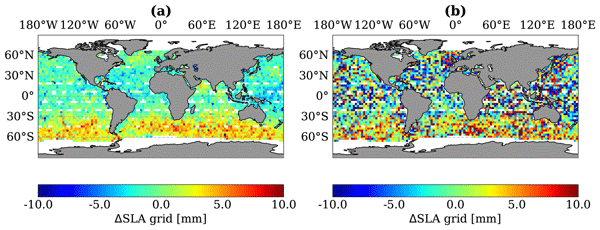
- Panel (a) is generated using the time-averaged ∆SLA grids from the S3A/S3B classical tandem phase (~30s time interval).
- Panel (b) is generated by adding the 4-hour oceanic variability, derived from SWOT and S3 dual-crossovers, to the S3A/S3B ∆SLA data, simulating the '4-hour tandem phase' scenario.
We have added the following discussion regarding the interpretation of these patterns to the Results section (Lines 201-210):
"The classical tandem phase enables highly effective detection of systematic differences mainly due to instrumental errors by minimising the effect of differences in oceanic variability. These spatially correlated systematic differences are clearly visible on the regional SLA offset map in panel (a) of Fig. 2. Notably, a distinctive positive offset (up to 7 mm) dominates the high southern latitudes (south of 30°S). This can likely be attributed to differences in how the two altimeters' retracking algorithms process Sea State Bias (SSB), as the Southern Ocean is characterized by high Significant Wave Heights (SWH) and long ocean waves. These zonal patterns are significantly harder to detect in panel (b), demonstrating how the oceanic variability differences introduced by a 4-hour delay masks underlying instrumental errors."
3.2 Uncertainty Computation
Two approaches are given for the calculation of the uncertainty in the estimates of regional offsets of sea surface height anomaly. Results from the two approaches are compared in Figure 3, but it is not clear which approach was used to generate the values presented in Figures 1 and 2. Please clarify.
We have clarified in the text and the figure captions that the uncertainties presented in Figures 1 and 2 were calculated using the local temporal method.
Corrected, a sentence has been added L.195-196:
“The uncertainty presented in these results is computed using the temporal method, which is based on analysing the temporal variability of the ∆SLA grids within each grid cell, as described in Section 3.2.2.”
Additionally, the captions for Figures 1 and 2 have been updated to explicitly state the methodology used.
3.3 Accounting for 4-hour variability
185 Figure A2 – is the first panel for zero time offset? – Please provide a more detailed discussion on what is in the figure, and of the important features in the figure..
To clarify the time intervals in the original appendix figures: Panel (a) of the original Figure A1 represented the classical tandem phase (which has a ~30-second time interval), whereas the original Figure A2 specifically represented the oceanic variability for a 4-hour interval.
We have expanded our analysis of the features within the 4-hour variability map in the main text. Furthermore, to improve the reader's understanding of the high-frequency oceanic variability observed by SWOT and to assess the limitations of our approach, we have added a complementary new figure showing the temporal evolution of this variance.
These two elements are now combined and discussed in detail in the Section 3.3 of the revised manuscript.
193 -remind readers that “Classic tandem phase” implies near zero delay (less than one minute).
Corrected, merged with next comment.
Results
This is a key section, as it presents the results of the estimated uncertainty in regional SSHA for the 4 hour delay tandem phase. As identified in the initial remarks, more detailed discussion is required in this section to provide the reader with a better understanding of these key findings
We have improved this section by including the former Figure A1 to the main body of the paper (now Figure 3 in the Results section) and added a detailed explanation of the data and physical patterns observed.
194 How exactly are the values for the “non-tandem” scenario calculated – from data outside tandem phase.. (duh).
We have clarified the text to explicitly state both the near zero delay of the classical tandem phase, and the data used to calculate the non-tandem scenario.
We have updated the introduction of Section 4 (L.200) to read:
“In this section, we compare the continuity performance of three configurations: the classical S3A/S3B tandem phase with a 30-second time interval, a 4-hour delayed tandem configuration, and a non-tandem scenario exploiting S3A and S3B data acquired after their tandem phase.”
195 Provide a more detailed discussion of Figure 1.
Which version of Regional Inter Mission Bias Uncertainty is being plotted?
Corrected, a sentence has been added L.203-205 to explicitly state the methodology used:
“The uncertainty presented in these results is computed using the temporal method, which is based on analysing the temporal variability of the ∆SLA within each grid cell, as described in Section 3.2.2.”
Figure 1 (and 2, 3 4)– Include parameter for uncertainty ( on y-axis) in caption – i.e. “Regional intermission bias uncertainty in SSHA”
Corrected, all the axes have been renamed as “Regional SLA offset uncertainty [mm]”
AssessmentComparison with J3/S6A missions
Again – provide a more detailed description and discussion of Figure 2. What measure of uncertainty has been calculated (3.2.1 or 3.2.2)?
Corrected, a sentence has been added L.232:
“The uncertainty presented in this comparison is computed using the temporal method described in Section 3.2.2.”
Additionally, the caption for Figure 2 has been updated to explicitly state the methodology used.
Comparison with Cross-Over Based Approach.
231 - The text does not describe how uncertainty values are derived from the SLA difference values and the regional offset.
We have updated the text to clarify that the uncertainty is derived using the exact same local temporal method applied to the along-track configurations. A sentence has been added L.262:
“The differences are spatially averaged into 3°x3° grid cells, resulting in gridded SLA difference fields analogous to those derived from along-track comparisons. The regional SLA offset is then estimated by averaging the time series of each cell across multiple cycles. The associated uncertainty is calculated using the temporal method (described in Section 3.2.2), ensuring a homogeneous calculation with the other configurations presented in Fig. 4.”
Comparison of two uncertainty estimation methods
258 Again provide a more detailed discussion of Figure 3.
What conclusions can be drawn from Figure 3? Which calculation approach is better?
We have expanded the text to directly answer both of your questions. To summarize our conclusions: Figure 3 (now Figure 6) demonstrates that both calculation approaches yield highly consistent uncertainty estimates as the number of observation cycles increases. This strong agreement acts as a cross-validation, proving the robustness of our overall uncertainty estimation framework.
Regarding which approach is "better": we now explicitly state in the text that we recommend the temporal method (Method 2) whenever sufficient data cycles are available. This is because the temporal approach is mathematically consistent with the global mean uncertainty assessment, accounts for temporal correlation and provides geographically resolved insights. However, the spatial method remains a valuable, robust alternative for very short datasets where temporal statistics cannot be reliably computed. We have restructured the corresponding paragraphs to make these conclusions and recommendations immediately clear to the reader.
Conclusions
261 – “Traditional tandem phase(s), where missions fly in close formation, are crucial for mission continuity.” - add the (s)
Corrected
273 …through (an) extended calibration period. Add the (an)
Corrected
276 – Insufficient description in the text on how the curves in figure 4 were calculated, and also insufficient discussion of the details in Figure 4. How were the results from the J3/S6a comparison used to fit a curve to the S3A S3B results?
What are the 1, 2, 3 year thresholds?
Without this information it is not possible to assess whether the key findings of the paper are justified :
“A 4 hour tandem phase would require approximately two years of continuous observations to reach a similar level of calibration precision (Fig. 4).
“However, the demonstrated ability to detect systematic differences of ±3.5 mm within one year highlights the feasibility of this approach….)”
We agree that detailing the extrapolation method is crucial for justifying the paper’s key findings. To improve the logical flow of the manuscript, we have moved Figure 4 (now Figure 5) and the detailed explanation out of the Conclusions and into Section 5.1 (Comparison with J3/S6A missions), where the J3/S6A baseline dataset is first introduced.
To answer the specific questions:
- Statistically, the uncertainty of a temporal mean decreases proportionally to 1/√n, where n is the number of observation cycles. Both the S3A/S3B and J3/S6A classical tandem phases shared an identical operational configuration with a 30-second time delay, and their initial uncertainty results show excellent consistency. Because the S3A/S3B tandem phase was relatively short (~120 days), we used the longer J3/S6A tandem (~200 days) to achieve a more robust fit.
- The horizontal lines are simply visual markers for 1 year, 2 years, and 3 years so the reader can easily read the logarithmic y-axis.
We have added a paragraph at the end of Section 5.1 (L.243) to describe the analysis.
References
Caps on Surnames of authors and co-authors. Leulliette et al (2004)
Zhao Z (2024) – non standard characters (${\mathrm{M}}_{2}$ )
Corrected
-
AC2: 'Reply on RC1', Noémie Lalau, 06 May 2026
-
RC2: 'Comment on egusphere-2025-6364', Anonymous Referee #2, 08 Apr 2026
The paper is relevant to understand possible effects and limitation in the configuration chosen for S3NGT. Unfortunately the quality of writing and the definition of the parameters is not accurate enough for the topic. A re-reading in a geodetic aim is highly needed. There is a lack of precision spread in the paper description.
Detailed Comments:
Line 102: revise the definition of parameters in Eq. (1). The "orbit" should be the radial distance between satellite and ELLIPSOID, otherwise how can be the Mean Sea Surface defined as usual above the ELLIPSOID? If is above the geoid is not the MSS but the MDT. Also the other parameters "sea surface height" are above the ELLIPSOID. It seams that here the geodetic definition is lost and misused in the all manuscript
Line 119: MSL is defined here as acronym and used already as "MeanSeaSurface" in line 102.
Line 128: Differences of MSL grids does not give a SLA (sea level anomaly). SLA above which surface, I guess the MSS. But the differences of two MSLs are still above the ellipsoid. What is really computed and above which reference surface should be correctly described, otherwise results are not reproducible.
Line 134: difficult to interpret the bias if the reference surface is sometime the ellispoid and sometime a not well defined MSS.
Line 144: regional offset map is not defined
Line 145: SLA differences between what and above which surface should be defined at start of the paper.
Line 156: "time series of MSL" is unclear, how can be the MSL variable in time? Probably a wrong and inaccurate use of words, again.
Line 167: SSHA, and now the SSHA is used but not defined. The authors use probably the names selected for the variables in the netcdf, which is unfortunate and misleading, but we are in a paper. The authors should not confuse further the readers and tell wajt is th difference with the SLA used a few lines above.
Line 169: if the satellites are two, the crossover is called dual-crossover in the literature.
Lin 185: still not defined the reference surface for SSHA.
Line 231: here SLA again
line 284: without a clear definition of parameters SLA, SSHA, MSL, MSS the paper is unclear and results and discussion very difficult to follow.
I suggest a rewriting.
Best regards
Citation: https://doi.org/10.5194/egusphere-2025-6364-RC2 -
AC1: 'Reply on RC2', Noémie Lalau, 06 May 2026
Dear Reviewer,
On behalf of all the Co-Authors I would like to thank you for your comments and insights, that helped to improve the quality of the manuscript. We particularly thank the reviewer for highlighting the critical lack of precision in our geodetic terminology and parameter definitions in the original draft. We completely agree that the mixed use of terms created unnecessary confusion regarding the proper geodetic reference surfaces. To address this, we have completely harmonized the terminology across all sections and figures. Below you will find our responses and changes applied to the document.
Best regards,
Noémie LalauReviewer #2 (https://doi.org/10.5194/egusphere-2025-6364-RC2 )
The paper is relevant to understand possible effects and limitation in the configuration chosen for S3NGT. Unfortunately the quality of writing and the definition of the parameters is not accurate enough for the topic. A re-reading in a geodetic aim is highly needed. There is a lack of precision spread in the paper description.
Detailed Comments:
Line 102: revise the definition of parameters in Eq. (1). The "orbit" should be the radial distance between satellite and ELLIPSOID, otherwise how can be the Mean Sea Surface defined as usual above the ELLIPSOID? If is above the geoid is not the MSS but the MDT. Also the other parameters "sea surface height" are above the ELLIPSOID. It seams that here the geodetic definition is lost and misused in the all manuscript
Corrected, the manuscript has been corrected consequently (L.105-106) with track change:
"[...] where Orbit is the radial distance between the satellite's center of mass and the reference ellipsoid, Range is the distance between the satellite and the sea surface [...] Mean Sea Surface is the time-averaged sea surface height referenced to the ellipsoid, from which sea level anomalies are derived."
Line 119: MSL is defined here as acronym and used already as "MeanSeaSurface" in line 102.
Corrected, the use of the term “MSL” has been removed from the paper.
The manuscript has been corrected consequently (L.121-122) with track change:
“For each mission, along-track SLA data are aggregated into regular 3° x 3° spatial grids to generate SLA grids.”
Line 128: Differences of MSL grids does not give a SLA (sea level anomaly). SLA above which surface, I guess the MSS. But the differences of two MSLs are still above the ellipsoid. What is really computed and above which reference surface should be correctly described, otherwise results are not reproducible.
To correctly describe exactly what is being computed and avoid any confusion regarding the reference surfaces, we have updated the text:
“From these SLA grids, we calculate the difference between the two missions for each 12-day window, yielding a series of ∆SLA grids. By taking a weighted spatial average of each ∆SLA grid, we obtain a time series of global mean SLA differences between the two missions. The temporal mean of this time series provides an estimate of the global mean SLA offset.”
Line 134: difficult to interpret the bias if the reference surface is sometime the ellispoid and sometime a not well defined MSS.
We understand the reviewer's difficulty here, which stemmed directly from our inaccurate use of "MSL" in the original draft. As detailed in our previous responses (see our replies regarding Eq. 1 and the general terminology table), we have fully corrected and harmonized the terminology throughout the revised manuscript.
Line 144: regional offset map is not defined
Corrected, the manuscript has been corrected consequently (L.131-132) with track change:
“Within each grid cell, we extract a time series of the ∆SLA values across the observation period. The temporal mean of these localised time series generates a spatially resolved map of regional SLA offsets.”
And L.143-144:
"The first method uses the spatial variance in regional SLA offsets to provide a single global uncertainty value, capturing the overall spread of the regional SLA offset estimates."
Line 145: SLA differences between what and above which surface should be defined at start of the paper.
Corrected, the manuscript has been corrected consequently (L.145-146) with track change:
"The second method estimates regional uncertainty at each grid point by analysing the temporal variability of SLA differences between two missions. This approach incorporates the autocorrelation structure of the time series to ensure more realistic uncertainty estimates.”
Line 156: "time series of MSL" is unclear, how can be the MSL variable in time? Probably a wrong and inaccurate use of words, again.
Corrected, the manuscript has been corrected consequently (L.156-157) with track change:
"Another way to calculate the uncertainty of the regional SLA offset is to compute the standard deviation of each temporal time series of SLA in each grid cell"
Line 167: SSHA, and now the SSHA is used but not defined. The authors use probably the names selected for the variables in the netcdf, which is unfortunate and misleading, but we are in a paper. The authors should not confuse further the readers and tell wajt is th difference with the SLA used a few lines above.
Corrected, all mentions of SSHA have been changed to SLA.
Line 169: if the satellites are two, the crossover is called dual-crossover in the literature.
Corrected, the manuscript has been corrected consequently (L.166-170 and all mention of “crossover”) with track change:
“To quantify the variance of oceanic variability and measurement errors over short time intervals, we analysed dual-crossover differences between SWOT’s KaRIn swath data and Sentinel-3A/3B nadir data (ΔSLA). This analysis is based on almost one year of data from SWOT's science phase, leveraging a high number of dual-crossovers and an extensive spatial coverage. A dual-crossover is defined as the intersection of ground tracks from two different satellites, enabling the comparison of spatially colocated measurements, although acquired at different times.”
Lin 185: still not defined the reference surface for SSHA.
Corrected, all mentions of SSHA have been changed to SLA.
Line 231: here SLA again
Unchanged, the notations have been homogenised in the paper, and only the parameter SLA has been kept.
line 284: without a clear definition of parameters SLA, SSHA, MSL, MSS the paper is unclear and results and discussion very difficult to follow.
We thank the reviewer for highlighting this critical point. We agree that the mixed use of terms like SLA, SSHA, MSL, and MSS created unnecessary confusion regarding the geodetic reference surfaces. To ensure strict geodetic accuracy and readability, we have completely harmonized the terminology throughout the revised manuscript.
Specifically, we have removed all instances of "SSHA" to avoid introducing multiple acronyms for the same variable. Furthermore, we have removed the use of "MSL" (Mean Sea Level) when referring to our cycle-by-cycle spatial grids, as this implied a climatological or temporal average that did not reflect our methodology. All of these terms have been corrected to consistently use "SLA" (Sea Level Anomaly).
These terminology updates, along with their corresponding notations, are summarized in the table below:
Term used in the paper
Corrected term
Notation
Regional MSL grid
SLA grid
SLA(lon, lat)
RMSL differences
Difference of SLA grids
ΔSLA(lon, lat)
Global Mean Sea Level (GMSL) differences
Global mean SLA differences
RMSL offset
Regional SLA offset
GMSL offset
Global mean SLA offset
Sea Surface Height Anomaly (SSHA)
Sea Level Anomaly
SLA
SSHA differences
(ΔSSHA)
SLA differences
ΔSLA
-
AC1: 'Reply on RC2', Noémie Lalau, 06 May 2026
-
EC1: 'Comment on egusphere-2025-6364', Karen J. Heywood, 08 Apr 2026
I am very grateful to both reviewers for their thoughtful and insightful comments and suggestions. I encourage the authors to consider these comments carefully and to respond here in the online discussion. After submission of your responses in the open discussion forum, you will then have a few weeks to submit your revised paper, together with your final responses to the reviewers (which can be the same as the ones you posted online, but can be updated).
I also encourage the authors to expand the discussion and rationale for the paper, to make the conclusions and implications clearer for the majority of Ocean Science readers, who are not experts in satellite altimetry. Please explain more clearly what the implications of your results are for (current or future) users of altimetry data. How might our understanding of the ocean be helped or hindered in future by decisions taken about satellite phases, for example? Although your paper is methodological, it is helpful to discuss more how the results might impact our understanding of (or monitoring of) the ocean. Ocean Science publishes studies with important implications for our understanding of the state and behaviour of the ocean, so spelling out those implications will help.
Karen J Heywood (co-editor-in-chief)
Citation: https://doi.org/10.5194/egusphere-2025-6364-EC1 -
AC3: 'Reply on EC1', Noémie Lalau, 06 May 2026
Thank you for your guidance and for managing the review process. We greatly appreciate your encouraging feedback and the highly constructive comments from both reviewers, which have significantly strengthened the manuscript. We have carefully considered all comments and will post our detailed point-by-point responses in the open discussion forum, followed by the submission of our fully revised manuscript.
We completely agree with your recommendation to make the broader implications clearer for readers who are not experts in satellite altimetry. To address this, we have integrated a dedicated paragraph in the Conclusions section to explicitly explain what our results mean for the oceanography and climate science communities. It emphasizes how our results inform the reliability of future S3NG-T data and are relevant for climate scientists who require a stable, well-calibrated and seamless sea-level record to detect long-term signals. We now explicitly state our primary operational recommendation: to successfully mitigate the oceanic variability differences introduced by the 4-hour delay, the classical 3-to-9 month tandem phase must be extended to a full one-year tandem phase. By spelling out this requirement, we highlight how our methodology provides actionable guidance to ensure the continuity of future S3NG-T data with S3 without degrading the long-term sea level monitoring record.
The study includes a first-of-its-kind characterization of 4-hour sea-level variance using SWOT KaRIn data, providing new scientific insights into sub-daily, high-frequency ocean dynamics. Furthermore, guided by the reviewers' insightful questions, we have significantly expanded the physical discussion surrounding this variability analysis and moved the corresponding figures from the appendix into the main body of the text.
Best regards,
Noémie Lalau
Citation: https://doi.org/10.5194/egusphere-2025-6364-AC3
-
AC3: 'Reply on EC1', Noémie Lalau, 06 May 2026
Peer review completion


Interactive discussion
Status: closed
-
RC1: 'Comment on egusphere-2025-6364', David Cotton, 22 Jan 2026
Initial Comments
I recommend publication after revision, as detailed below
Scientific Significance – Good (2)
This paper addresses an important issue, the need to provide a sound scientific basis to evaluate the performance of the Sentinel-3 Next Generation Topography Mission, in terms of the cross-calibration with the fore-running Sentinel-3 mission during a tandem phase mission. The approach described is new, developed from previous approaches applied to previous satellite altimeter tandem phase validation studies.
Thus the prime objective of the study is to support understanding of the impact of a proposed orbit selection on measurements from the S3 and S3NG-T missions, rather than to present new scientific results on the state and behaviour of the ocean. I therefore agree the paper is most appropriately included as a technical note.
Scientific Quality – Fair (3)
The scientific approach and applied methods are valid and developed from relevant previous work. Appropriate references are provided throughout.
The discussions in Sections 4 (Results) and 5 (Assessment) do not provide sufficient detail to enable a good understanding on how figures have been generated, what can be seen in these figures, and to justify the conclusions that have been drawn.
Presentation Quality – Good (2)
The text is well written and structured, although as mentioned above, more detail is needed in the description and discussion of the figures.
Thus I would recommend some revisions primarily to sections 4 and 5 to provide more detailed presentation and discussions of the results, to provide a more solid justification of the main findings.
Two of the figures are listed as A1 and A2, and the contents of these figures provide useful and important information on the geographical variability in the processed and gridded data. I cannot find any guidance regarding constraints on the number of figures within a paper. As there are only 4 other figures, I would recommend including these figures in the main body of the paper.
The labelling of axes on the figures and the content of the captions should be improved to allow readers to understand what is presented. For all Figures 1-4 the y axes are labelled “Uncertainty”, and the captions do not explain what the uncertainty is in.
Detailed Comments
Abstract
The abstract is well written and accurately summarises the contents of the paper.
10 – “…uncertainties of approximately 2mm” – in what?
13 -Extending tandem phase to one year enables the detection of errors of ±3.5mm amplitude – see later comments around Figure 4 (Line 274 onwards).
- Introduction
The background and context for the study are in general well described.
41 – I understand that during the tandem phases the interval between successive satellites for the Jason series reference missions was around 60 seconds and for Sentinel 3A/3B it was 30 seconds. However that for ERS-2 and ENVISAT it was longer - 30 minutes. The text gives the impression the delay was under one minute for all tandem phases.
Please rewrite this section to more accurately describe the tandem missions referred to.
44- LEULIETTE et al - correct link and reference to correct capitalisation.
The approach only considers using recorded satellite altimeter data sets. Was using ocean model hindcast data, sampled along the exact ground tracks, considered? It would be useful to include a short discussion on the potential to use model data for these types of study, and why it was not considered appropriate for this study.
- Data
83 Suggest to note here that S3A and S3B were only 30 s apart on the same ground track.
100 – Link to Jason CS Sentinel 6 product handbook
- Methods
3.1 Comparison between two missions
I find the description in this subsection confusing. Has the same gridding process been applied to S3A and S3B data and also to J3 and S6A data, covering periods in and out of the tandem phase, so that there are effectively four data sets? A table listing the gridded data sets as generated might help to clarify the situation.
127 “For each cycle” - Does this refer to the S3A, S3B 27 day cycle, or the earlier defined 12 day “sub-cycle” (itself made up of 3 4-day subcycles)
If these data are used to generate Figure A1 provide an explanation and a discussion. (Note the recommendation to include this figure in the main body of the paper.)
3.2 Uncertainty Computation
Two approaches are given for the calculation of the uncertainty in the estimates of regional offsets of sea surface height anomaly. Results from the two approaches are compared in Figure 3, but it is not clear which approach was used to generate the values presented in Figures 1 and 2. Please clarify.
3.3 Accounting for 4-hour variability
185 Figure A2 – is the first panel for zero time offset? – Please provide a more detailed discussion on what is in the figure, and of the important features in the figure..
193 -remind readers that “Classic tandem phase” implies near zero delay (less than one minute).
4 Results
This is a key section, as it presents the results of the estimated uncertainty in regional SSHA for the 4 hour delay tandem phase. As identified in the initial remarks, more detailed discussion is required in this section to provide the reader with a better understanding of these key findings
194 How exactly are the values for the “non-tandem” scenario calculated – from data outside tandem phase.. (duh).
195 Provide a more detailed discussion of Figure 1.
Which version of Regional Inter Mission Bias Uncertainty is being plotted?
Figure 1 (and 2, 3 4)– Include parameter for uncertainty ( on y-axis) in caption – i.e. “Regional intermission bias uncertainty in SSHA”
5 Assessment
Comparison with J3/S6A missions
Again – provide a more detailed description and discussion of Figure 2. What measure of uncertainty has been calculated (3.2.1 or 3.2.2)?
Comparison with Cross-Over Based Approach.
231 - The text does not describe how uncertainty values are derived from the SLA difference values and the regional offset.
Comparison of two uncertainty estimation methods
258 Again provide a more detailed discussion of Figure 3.
What conclusions can be drawn from Figure 3? Which calculation approach is better?
Conclusions
261 – “Traditional tandem phase(s), where missions fly in close formation, are crucial for mission continuity.” - add the (s)
273 …through (an) extended calibration period. Add the (an)
276 – Insufficient description in the text on how the curves in figure 4 were calculated, and also insufficient discussion of the details in Figure 4. How were the results from the J3/S6a comparison used to fit a curve to the S3A S3B results?
What are the 1, 2, 3 year thresholds?
Without this information it is not possible to assess whether the key findings of the paper are justified :
“A 4 hour tandem phase would require approximately two years of continuous observations to reach a similar level of calibration precision (Fig. 4).
“However, the demonstrated ability to detect systematic differences of ±3.5 mm within one year highlights the feasibility of this approach….)”
327 – References –
Caps on Surnames of authors and co-authors. Leulliette et al (2004)
Zhao Z (2024) – non standard characters (${\mathrm{M}}_{2}$ )
Citation: https://doi.org/10.5194/egusphere-2025-6364-RC1 -
AC2: 'Reply on RC1', Noémie Lalau, 06 May 2026
Dear Reviewer,
On behalf of all the Co-Authors I would like to thank you for your constructive feedback and for recommending the publication of our manuscript. Your suggestions regarding the presentation of our results and the integration of the appendix figures have significantly strengthened the physical and methodological justifications within the paper. We believe these revisions provide the reader with a much clearer understanding of the data and fully justify the operational conclusions drawn for the S3NG-T mission. Please find our detailed, point-by-point responses to your specific comments below.
Best regards,
Noémie LalauInitial Comments
I recommend publication after revision, as detailed below
Scientific Significance – Good (2)
This paper addresses an important issue, the need to provide a sound scientific basis to evaluate the performance of the Sentinel-3 Next Generation Topography Mission, in terms of the cross-calibration with the fore-running Sentinel-3 mission during a tandem phase mission. The approach described is new, developed from previous approaches applied to previous satellite altimeter tandem phase validation studies.
Thus the prime objective of the study is to support understanding of the impact of a proposed orbit selection on measurements from the S3 and S3NG-T missions, rather than to present new scientific results on the state and behaviour of the ocean. I therefore agree the paper is most appropriately included as a technical note.
Scientific Quality – Fair (3)
The scientific approach and applied methods are valid and developed from relevant previous work. Appropriate references are provided throughout.
The discussions in Sections 4 (Results) and 5 (Assessment) do not provide sufficient detail to enable a good understanding on how figures have been generated, what can be seen in these figures, and to justify the conclusions that have been drawn.
Presentation Quality – Good (2)
The text is well written and structured, although as mentioned above, more detail is needed in the description and discussion of the figures.
Thus I would recommend some revisions primarily to sections 4 and 5 to provide more detailed presentation and discussions of the results, to provide a more solid justification of the main findings.
We completely agree that more detailed discussions were needed to solidify the justification of our main findings. We have significantly expanded the physical interpretations of our results in both Sections 4 and 5. For example, we now provide explanations of the spatial patterns observed in the regional SLA offsets. Furthermore, we moved the detailed explanation of the extrapolation model (and its associated figure) out of the Conclusions and directly into Section 5.1. We also added comprehensive discussions explaining exactly what conclusions can be drawn when comparing our two uncertainty estimation approaches.
Two of the figures are listed as A1 and A2, and the contents of these figures provide useful and important information on the geographical variability in the processed and gridded data. I cannot find any guidance regarding constraints on the number of figures within a paper. As there are only 4 other figures, I would recommend including these figures in the main body of the paper.
We agree that the geographical variability maps provide crucial information that belongs in the main text. We have followed your recommendation and moved these figures out of the appendix. To further improve the reader's understanding of the high-frequency variability observed by SWOT, we also paired figure A2 with a complementary new figure showing the temporal evolution of this variance.
The labelling of axes on the figures and the content of the captions should be improved to allow readers to understand what is presented. For all Figures 1-4 the y axes are labelled “Uncertainty”, and the captions do not explain what the uncertainty is in.
We have corrected this across all relevant figures (Figures 1-4); all y-axes have been strictly renamed to "Regional SLA offset uncertainty [mm]". Furthermore, we have updated the figure captions and the accompanying text to explicitly state both the physical parameter being measured and the specific methodology used to compute the plotted values.
Detailed CommentsAbstract
The abstract is well written and accurately summarises the contents of the paper.
10 – “…uncertainties of approximately 2mm” – in what?
We have corrected the text to clarify that this 2 mm precision refers specifically to the uncertainty of the regional Sea Level Anomaly (SLA) offsets.
13 -Extending tandem phase to one year enables the detection of errors of ±3.5mm amplitude – see later comments around Figure 4 (Line 274 onwards).
This comment has been detailed below the comment on Figure 4, and we have added a paragraph at the end of Section 5.1 (L.243) to describe the analysis.
Introduction
The background and context for the study are in general well described.
41 – I understand that during the tandem phases the interval between successive satellites for the Jason series reference missions was around 60 seconds and for Sentinel 3A/3B it was 30 seconds. However that for ERS-2 and ENVISAT it was longer - 30 minutes. The text gives the impression the delay was under one minute for all tandem phases.
Please rewrite this section to more accurately describe the tandem missions referred to.
The tandem phases have indeed different time intervals between successive satellites:
- ERS-2 & ENVISAT: 30 minutes
- TOPEX/Poseidon & Jason-1: 70 seconds
- Jason-1 & Jason-2: 55 seconds
- Jason-2 & Jason-3: 80 seconds
- Jason-3 & Sentinel-6 MF: 30 seconds
- Sentinel-3A & Sentinel-3B: 30 seconds
The manuscript has been corrected consequently (L.37-41) with track change:
“During a tandem phase, two successive missions follow an identical ground track separated by a strictly controlled time interval. Tandem phases have been systematically implemented following the launch of new reference altimetry missions, including TOPEX-Poseidon and Jason-1 (2002; 70-second gap), Jason-1 and Jason-2 (2008; 55-second gap), Jason-2 and Jason-3 (2016; 80-second gap), and Jason-3 and Sentinel-6 Michael Freilich (2021-2022; 30-second gap). They have also been used between non-reference missions, such as ERS-2 / Envisat (2007-2008, 2010-2011; ~30-minute gap) and Sentinel-3A and Sentinel-3B (2018; 30-second gap).”
44- LEULIETTE et al - correct link and reference to correct capitalisation.
Corrected
The approach only considers using recorded satellite altimeter data sets. Was using ocean model hindcast data, sampled along the exact ground tracks, considered? It would be useful to include a short discussion on the potential to use model data for these types of study, and why it was not considered appropriate for this study.
We chose not to use traditional global Ocean General Circulation Models (OGCMs) or operational model hindcasts because they struggle to faithfully represent true high-frequency ocean variability. The variability introduced over a short 4-hour delay is heavily dominated by high-frequency, sub-daily ocean dynamics, specifically internal gravity waves, internal tides, and sub-mesoscale turbulence. While state-of-the-art global ocean models successfully reproduce large-scale mesoscale circulation, accurately resolving the exact global phase and amplitude of these specific high-frequency signals remains a significant modeling challenge.
New ultra-high-resolution experimental models, such as the MITgcm LLC4320 global simulation, are now capable of capturing internal tides and high-frequency submesoscale structures. However, these remain advanced research tools rather than standard operational global hindcasts. Therefore, relying on actual recorded satellite altimeter data sets was considered the most appropriate and robust approach to capture the true physical noise floor for this study. SWOT resolves kilometer-scale SLA structures across a 120-km swath, enabling a fair representation of the submesoscale structure.
We have added a dedicated paragraph summarizing these modeling limitations and justifying our empirical approach to the revised manuscript.
Data
83 Suggest to note here that S3A and S3B were only 30 s apart on the same ground track.
Corrected, a sentence has been added L.87 and 91 for S3A/S3B and J3/S6A tandem phases.
“The S3A/S3B tandem phase lasted from 7 June to 16 October 2018, spanning four complete 27-day cycles or ten 12-day sub-cycles, with a 30-second time interval between the satellites (Clerc et al., 2020).”
100 – Link to Jason CS Sentinel 6 product handbook
Corrected
Methods
3.1 Comparison between two missions
I find the description in this subsection confusing. Has the same gridding process been applied to S3A and S3B data and also to J3 and S6A data, covering periods in and out of the tandem phase, so that there are effectively four data sets? A table listing the gridded data sets as generated might help to clarify the situation.
Yes, the exact same gridding process (a 3°x3° spatial resolution and a 12-day temporal window) is systematically applied to all individual missions and all pairs, across all time periods (in, out, and simulated 4-hour tandem phases). To clarify this in the manuscript, we have added the suggested summary table in the appendix, detailing the individual SLA grids and the paired ΔSLA grids generated for each scenario.
SLA grid
[3° x 3°, 12 days]
(Individual missions)ΔSLA grid
[3° x 3°, 12 days]
(Mission pairs)Tandem phase
S3A, S3B, J3, S6A
S3A/S3B and J3/S6A
Outside tandem phase
S3A, S3B, J3, S6A
S3A/S3B and J3/S6A
4-hour tandem phase
S3A, S3B, J3, S6A
S3A/S3B and J3/S6A
127 “For each cycle” - Does this refer to the S3A, S3B 27 day cycle, or the earlier defined 12 day “sub-cycle” (itself made up of 3 4-day subcycles)
'For each cycle' referred to the 12-day sub-cycle, but we agree the original formulation was confusing. This section has been clarified in the revised manuscript (L123-126):
“To ensure a consistent comparison between missions with differing orbital characteristics (e.g., the 10-day cycle of J3/S6A versus the 27-day cycle of S3A/S3B), we adopted a fixed 12-day temporal window for all configurations, corresponding to three 4-day sub-cycles of the S3 orbit. These gridded fields are computed independently for each 12-day period.”
If these data are used to generate Figure A1 provide an explanation and a discussion. (Note the recommendation to include this figure in the main body of the paper.)
We have moved the former Figure A1 to the main body of the paper (now Figure 3 in the Results section) and added a detailed explanation of the data and physical patterns observed.
To clarify the methodology:
- Panel (a) is generated using the time-averaged ∆SLA grids from the S3A/S3B classical tandem phase (~30s time interval).
- Panel (b) is generated by adding the 4-hour oceanic variability, derived from SWOT and S3 dual-crossovers, to the S3A/S3B ∆SLA data, simulating the '4-hour tandem phase' scenario.
We have added the following discussion regarding the interpretation of these patterns to the Results section (Lines 201-210):
"The classical tandem phase enables highly effective detection of systematic differences mainly due to instrumental errors by minimising the effect of differences in oceanic variability. These spatially correlated systematic differences are clearly visible on the regional SLA offset map in panel (a) of Fig. 2. Notably, a distinctive positive offset (up to 7 mm) dominates the high southern latitudes (south of 30°S). This can likely be attributed to differences in how the two altimeters' retracking algorithms process Sea State Bias (SSB), as the Southern Ocean is characterized by high Significant Wave Heights (SWH) and long ocean waves. These zonal patterns are significantly harder to detect in panel (b), demonstrating how the oceanic variability differences introduced by a 4-hour delay masks underlying instrumental errors."
3.2 Uncertainty Computation
Two approaches are given for the calculation of the uncertainty in the estimates of regional offsets of sea surface height anomaly. Results from the two approaches are compared in Figure 3, but it is not clear which approach was used to generate the values presented in Figures 1 and 2. Please clarify.
We have clarified in the text and the figure captions that the uncertainties presented in Figures 1 and 2 were calculated using the local temporal method.
Corrected, a sentence has been added L.195-196:
“The uncertainty presented in these results is computed using the temporal method, which is based on analysing the temporal variability of the ∆SLA grids within each grid cell, as described in Section 3.2.2.”
Additionally, the captions for Figures 1 and 2 have been updated to explicitly state the methodology used.
3.3 Accounting for 4-hour variability
185 Figure A2 – is the first panel for zero time offset? – Please provide a more detailed discussion on what is in the figure, and of the important features in the figure..
To clarify the time intervals in the original appendix figures: Panel (a) of the original Figure A1 represented the classical tandem phase (which has a ~30-second time interval), whereas the original Figure A2 specifically represented the oceanic variability for a 4-hour interval.
We have expanded our analysis of the features within the 4-hour variability map in the main text. Furthermore, to improve the reader's understanding of the high-frequency oceanic variability observed by SWOT and to assess the limitations of our approach, we have added a complementary new figure showing the temporal evolution of this variance.
These two elements are now combined and discussed in detail in the Section 3.3 of the revised manuscript.
193 -remind readers that “Classic tandem phase” implies near zero delay (less than one minute).
Corrected, merged with next comment.
Results
This is a key section, as it presents the results of the estimated uncertainty in regional SSHA for the 4 hour delay tandem phase. As identified in the initial remarks, more detailed discussion is required in this section to provide the reader with a better understanding of these key findings
We have improved this section by including the former Figure A1 to the main body of the paper (now Figure 3 in the Results section) and added a detailed explanation of the data and physical patterns observed.
194 How exactly are the values for the “non-tandem” scenario calculated – from data outside tandem phase.. (duh).
We have clarified the text to explicitly state both the near zero delay of the classical tandem phase, and the data used to calculate the non-tandem scenario.
We have updated the introduction of Section 4 (L.200) to read:
“In this section, we compare the continuity performance of three configurations: the classical S3A/S3B tandem phase with a 30-second time interval, a 4-hour delayed tandem configuration, and a non-tandem scenario exploiting S3A and S3B data acquired after their tandem phase.”
195 Provide a more detailed discussion of Figure 1.
Which version of Regional Inter Mission Bias Uncertainty is being plotted?
Corrected, a sentence has been added L.203-205 to explicitly state the methodology used:
“The uncertainty presented in these results is computed using the temporal method, which is based on analysing the temporal variability of the ∆SLA within each grid cell, as described in Section 3.2.2.”
Figure 1 (and 2, 3 4)– Include parameter for uncertainty ( on y-axis) in caption – i.e. “Regional intermission bias uncertainty in SSHA”
Corrected, all the axes have been renamed as “Regional SLA offset uncertainty [mm]”
AssessmentComparison with J3/S6A missions
Again – provide a more detailed description and discussion of Figure 2. What measure of uncertainty has been calculated (3.2.1 or 3.2.2)?
Corrected, a sentence has been added L.232:
“The uncertainty presented in this comparison is computed using the temporal method described in Section 3.2.2.”
Additionally, the caption for Figure 2 has been updated to explicitly state the methodology used.
Comparison with Cross-Over Based Approach.
231 - The text does not describe how uncertainty values are derived from the SLA difference values and the regional offset.
We have updated the text to clarify that the uncertainty is derived using the exact same local temporal method applied to the along-track configurations. A sentence has been added L.262:
“The differences are spatially averaged into 3°x3° grid cells, resulting in gridded SLA difference fields analogous to those derived from along-track comparisons. The regional SLA offset is then estimated by averaging the time series of each cell across multiple cycles. The associated uncertainty is calculated using the temporal method (described in Section 3.2.2), ensuring a homogeneous calculation with the other configurations presented in Fig. 4.”
Comparison of two uncertainty estimation methods
258 Again provide a more detailed discussion of Figure 3.
What conclusions can be drawn from Figure 3? Which calculation approach is better?
We have expanded the text to directly answer both of your questions. To summarize our conclusions: Figure 3 (now Figure 6) demonstrates that both calculation approaches yield highly consistent uncertainty estimates as the number of observation cycles increases. This strong agreement acts as a cross-validation, proving the robustness of our overall uncertainty estimation framework.
Regarding which approach is "better": we now explicitly state in the text that we recommend the temporal method (Method 2) whenever sufficient data cycles are available. This is because the temporal approach is mathematically consistent with the global mean uncertainty assessment, accounts for temporal correlation and provides geographically resolved insights. However, the spatial method remains a valuable, robust alternative for very short datasets where temporal statistics cannot be reliably computed. We have restructured the corresponding paragraphs to make these conclusions and recommendations immediately clear to the reader.
Conclusions
261 – “Traditional tandem phase(s), where missions fly in close formation, are crucial for mission continuity.” - add the (s)
Corrected
273 …through (an) extended calibration period. Add the (an)
Corrected
276 – Insufficient description in the text on how the curves in figure 4 were calculated, and also insufficient discussion of the details in Figure 4. How were the results from the J3/S6a comparison used to fit a curve to the S3A S3B results?
What are the 1, 2, 3 year thresholds?
Without this information it is not possible to assess whether the key findings of the paper are justified :
“A 4 hour tandem phase would require approximately two years of continuous observations to reach a similar level of calibration precision (Fig. 4).
“However, the demonstrated ability to detect systematic differences of ±3.5 mm within one year highlights the feasibility of this approach….)”
We agree that detailing the extrapolation method is crucial for justifying the paper’s key findings. To improve the logical flow of the manuscript, we have moved Figure 4 (now Figure 5) and the detailed explanation out of the Conclusions and into Section 5.1 (Comparison with J3/S6A missions), where the J3/S6A baseline dataset is first introduced.
To answer the specific questions:
- Statistically, the uncertainty of a temporal mean decreases proportionally to 1/√n, where n is the number of observation cycles. Both the S3A/S3B and J3/S6A classical tandem phases shared an identical operational configuration with a 30-second time delay, and their initial uncertainty results show excellent consistency. Because the S3A/S3B tandem phase was relatively short (~120 days), we used the longer J3/S6A tandem (~200 days) to achieve a more robust fit.
- The horizontal lines are simply visual markers for 1 year, 2 years, and 3 years so the reader can easily read the logarithmic y-axis.
We have added a paragraph at the end of Section 5.1 (L.243) to describe the analysis.
References
Caps on Surnames of authors and co-authors. Leulliette et al (2004)
Zhao Z (2024) – non standard characters (${\mathrm{M}}_{2}$ )
Corrected
-
RC2: 'Comment on egusphere-2025-6364', Anonymous Referee #2, 08 Apr 2026
The paper is relevant to understand possible effects and limitation in the configuration chosen for S3NGT. Unfortunately the quality of writing and the definition of the parameters is not accurate enough for the topic. A re-reading in a geodetic aim is highly needed. There is a lack of precision spread in the paper description.
Detailed Comments:
Line 102: revise the definition of parameters in Eq. (1). The "orbit" should be the radial distance between satellite and ELLIPSOID, otherwise how can be the Mean Sea Surface defined as usual above the ELLIPSOID? If is above the geoid is not the MSS but the MDT. Also the other parameters "sea surface height" are above the ELLIPSOID. It seams that here the geodetic definition is lost and misused in the all manuscript
Line 119: MSL is defined here as acronym and used already as "MeanSeaSurface" in line 102.
Line 128: Differences of MSL grids does not give a SLA (sea level anomaly). SLA above which surface, I guess the MSS. But the differences of two MSLs are still above the ellipsoid. What is really computed and above which reference surface should be correctly described, otherwise results are not reproducible.
Line 134: difficult to interpret the bias if the reference surface is sometime the ellispoid and sometime a not well defined MSS.
Line 144: regional offset map is not defined
Line 145: SLA differences between what and above which surface should be defined at start of the paper.
Line 156: "time series of MSL" is unclear, how can be the MSL variable in time? Probably a wrong and inaccurate use of words, again.
Line 167: SSHA, and now the SSHA is used but not defined. The authors use probably the names selected for the variables in the netcdf, which is unfortunate and misleading, but we are in a paper. The authors should not confuse further the readers and tell wajt is th difference with the SLA used a few lines above.
Line 169: if the satellites are two, the crossover is called dual-crossover in the literature.
Lin 185: still not defined the reference surface for SSHA.
Line 231: here SLA again
line 284: without a clear definition of parameters SLA, SSHA, MSL, MSS the paper is unclear and results and discussion very difficult to follow.
I suggest a rewriting.
Best regards
Citation: https://doi.org/10.5194/egusphere-2025-6364-RC2 -
AC1: 'Reply on RC2', Noémie Lalau, 06 May 2026
Dear Reviewer,
On behalf of all the Co-Authors I would like to thank you for your comments and insights, that helped to improve the quality of the manuscript. We particularly thank the reviewer for highlighting the critical lack of precision in our geodetic terminology and parameter definitions in the original draft. We completely agree that the mixed use of terms created unnecessary confusion regarding the proper geodetic reference surfaces. To address this, we have completely harmonized the terminology across all sections and figures. Below you will find our responses and changes applied to the document.
Best regards,
Noémie LalauReviewer #2 (https://doi.org/10.5194/egusphere-2025-6364-RC2 )
The paper is relevant to understand possible effects and limitation in the configuration chosen for S3NGT. Unfortunately the quality of writing and the definition of the parameters is not accurate enough for the topic. A re-reading in a geodetic aim is highly needed. There is a lack of precision spread in the paper description.
Detailed Comments:
Line 102: revise the definition of parameters in Eq. (1). The "orbit" should be the radial distance between satellite and ELLIPSOID, otherwise how can be the Mean Sea Surface defined as usual above the ELLIPSOID? If is above the geoid is not the MSS but the MDT. Also the other parameters "sea surface height" are above the ELLIPSOID. It seams that here the geodetic definition is lost and misused in the all manuscript
Corrected, the manuscript has been corrected consequently (L.105-106) with track change:
"[...] where Orbit is the radial distance between the satellite's center of mass and the reference ellipsoid, Range is the distance between the satellite and the sea surface [...] Mean Sea Surface is the time-averaged sea surface height referenced to the ellipsoid, from which sea level anomalies are derived."
Line 119: MSL is defined here as acronym and used already as "MeanSeaSurface" in line 102.
Corrected, the use of the term “MSL” has been removed from the paper.
The manuscript has been corrected consequently (L.121-122) with track change:
“For each mission, along-track SLA data are aggregated into regular 3° x 3° spatial grids to generate SLA grids.”
Line 128: Differences of MSL grids does not give a SLA (sea level anomaly). SLA above which surface, I guess the MSS. But the differences of two MSLs are still above the ellipsoid. What is really computed and above which reference surface should be correctly described, otherwise results are not reproducible.
To correctly describe exactly what is being computed and avoid any confusion regarding the reference surfaces, we have updated the text:
“From these SLA grids, we calculate the difference between the two missions for each 12-day window, yielding a series of ∆SLA grids. By taking a weighted spatial average of each ∆SLA grid, we obtain a time series of global mean SLA differences between the two missions. The temporal mean of this time series provides an estimate of the global mean SLA offset.”
Line 134: difficult to interpret the bias if the reference surface is sometime the ellispoid and sometime a not well defined MSS.
We understand the reviewer's difficulty here, which stemmed directly from our inaccurate use of "MSL" in the original draft. As detailed in our previous responses (see our replies regarding Eq. 1 and the general terminology table), we have fully corrected and harmonized the terminology throughout the revised manuscript.
Line 144: regional offset map is not defined
Corrected, the manuscript has been corrected consequently (L.131-132) with track change:
“Within each grid cell, we extract a time series of the ∆SLA values across the observation period. The temporal mean of these localised time series generates a spatially resolved map of regional SLA offsets.”
And L.143-144:
"The first method uses the spatial variance in regional SLA offsets to provide a single global uncertainty value, capturing the overall spread of the regional SLA offset estimates."
Line 145: SLA differences between what and above which surface should be defined at start of the paper.
Corrected, the manuscript has been corrected consequently (L.145-146) with track change:
"The second method estimates regional uncertainty at each grid point by analysing the temporal variability of SLA differences between two missions. This approach incorporates the autocorrelation structure of the time series to ensure more realistic uncertainty estimates.”
Line 156: "time series of MSL" is unclear, how can be the MSL variable in time? Probably a wrong and inaccurate use of words, again.
Corrected, the manuscript has been corrected consequently (L.156-157) with track change:
"Another way to calculate the uncertainty of the regional SLA offset is to compute the standard deviation of each temporal time series of SLA in each grid cell"
Line 167: SSHA, and now the SSHA is used but not defined. The authors use probably the names selected for the variables in the netcdf, which is unfortunate and misleading, but we are in a paper. The authors should not confuse further the readers and tell wajt is th difference with the SLA used a few lines above.
Corrected, all mentions of SSHA have been changed to SLA.
Line 169: if the satellites are two, the crossover is called dual-crossover in the literature.
Corrected, the manuscript has been corrected consequently (L.166-170 and all mention of “crossover”) with track change:
“To quantify the variance of oceanic variability and measurement errors over short time intervals, we analysed dual-crossover differences between SWOT’s KaRIn swath data and Sentinel-3A/3B nadir data (ΔSLA). This analysis is based on almost one year of data from SWOT's science phase, leveraging a high number of dual-crossovers and an extensive spatial coverage. A dual-crossover is defined as the intersection of ground tracks from two different satellites, enabling the comparison of spatially colocated measurements, although acquired at different times.”
Lin 185: still not defined the reference surface for SSHA.
Corrected, all mentions of SSHA have been changed to SLA.
Line 231: here SLA again
Unchanged, the notations have been homogenised in the paper, and only the parameter SLA has been kept.
line 284: without a clear definition of parameters SLA, SSHA, MSL, MSS the paper is unclear and results and discussion very difficult to follow.
We thank the reviewer for highlighting this critical point. We agree that the mixed use of terms like SLA, SSHA, MSL, and MSS created unnecessary confusion regarding the geodetic reference surfaces. To ensure strict geodetic accuracy and readability, we have completely harmonized the terminology throughout the revised manuscript.
Specifically, we have removed all instances of "SSHA" to avoid introducing multiple acronyms for the same variable. Furthermore, we have removed the use of "MSL" (Mean Sea Level) when referring to our cycle-by-cycle spatial grids, as this implied a climatological or temporal average that did not reflect our methodology. All of these terms have been corrected to consistently use "SLA" (Sea Level Anomaly).
These terminology updates, along with their corresponding notations, are summarized in the table below:
Term used in the paper
Corrected term
Notation
Regional MSL grid
SLA grid
SLA(lon, lat)
RMSL differences
Difference of SLA grids
ΔSLA(lon, lat)
Global Mean Sea Level (GMSL) differences
Global mean SLA differences
RMSL offset
Regional SLA offset
GMSL offset
Global mean SLA offset
Sea Surface Height Anomaly (SSHA)
Sea Level Anomaly
SLA
SSHA differences
(ΔSSHA)
SLA differences
ΔSLA
-
AC1: 'Reply on RC2', Noémie Lalau, 06 May 2026
-
EC1: 'Comment on egusphere-2025-6364', Karen J. Heywood, 08 Apr 2026
I am very grateful to both reviewers for their thoughtful and insightful comments and suggestions. I encourage the authors to consider these comments carefully and to respond here in the online discussion. After submission of your responses in the open discussion forum, you will then have a few weeks to submit your revised paper, together with your final responses to the reviewers (which can be the same as the ones you posted online, but can be updated).
I also encourage the authors to expand the discussion and rationale for the paper, to make the conclusions and implications clearer for the majority of Ocean Science readers, who are not experts in satellite altimetry. Please explain more clearly what the implications of your results are for (current or future) users of altimetry data. How might our understanding of the ocean be helped or hindered in future by decisions taken about satellite phases, for example? Although your paper is methodological, it is helpful to discuss more how the results might impact our understanding of (or monitoring of) the ocean. Ocean Science publishes studies with important implications for our understanding of the state and behaviour of the ocean, so spelling out those implications will help.
Karen J Heywood (co-editor-in-chief)
Citation: https://doi.org/10.5194/egusphere-2025-6364-EC1 -
AC3: 'Reply on EC1', Noémie Lalau, 06 May 2026
Thank you for your guidance and for managing the review process. We greatly appreciate your encouraging feedback and the highly constructive comments from both reviewers, which have significantly strengthened the manuscript. We have carefully considered all comments and will post our detailed point-by-point responses in the open discussion forum, followed by the submission of our fully revised manuscript.
We completely agree with your recommendation to make the broader implications clearer for readers who are not experts in satellite altimetry. To address this, we have integrated a dedicated paragraph in the Conclusions section to explicitly explain what our results mean for the oceanography and climate science communities. It emphasizes how our results inform the reliability of future S3NG-T data and are relevant for climate scientists who require a stable, well-calibrated and seamless sea-level record to detect long-term signals. We now explicitly state our primary operational recommendation: to successfully mitigate the oceanic variability differences introduced by the 4-hour delay, the classical 3-to-9 month tandem phase must be extended to a full one-year tandem phase. By spelling out this requirement, we highlight how our methodology provides actionable guidance to ensure the continuity of future S3NG-T data with S3 without degrading the long-term sea level monitoring record.
The study includes a first-of-its-kind characterization of 4-hour sea-level variance using SWOT KaRIn data, providing new scientific insights into sub-daily, high-frequency ocean dynamics. Furthermore, guided by the reviewers' insightful questions, we have significantly expanded the physical discussion surrounding this variability analysis and moved the corresponding figures from the appendix into the main body of the text.
Best regards,
Noémie Lalau
Citation: https://doi.org/10.5194/egusphere-2025-6364-AC3
-
AC3: 'Reply on EC1', Noémie Lalau, 06 May 2026
Peer review completion
Journal article(s) based on this preprint
Viewed
| HTML | XML | Total | BibTeX | EndNote | |
|---|---|---|---|---|---|
| 1,102 | 471 | 114 | 1,687 | 82 | 205 |
- HTML: 1,102
- PDF: 471
- XML: 114
- Total: 1,687
- BibTeX: 82
- EndNote: 205
Viewed (geographical distribution)
| Country | # | Views | % |
|---|
| Total: | 0 |
| HTML: | 0 |
| PDF: | 0 |
| XML: | 0 |
- 1
Noémie Lalau

Michaël Ablain
Thomas Vaujour
François Boy
Gerald Dibarboure
Alejandro Egido
The requested preprint has a corresponding peer-reviewed final revised paper. You are encouraged to refer to the final revised version.
- Preprint
(3855 KB) - Metadata XML
Initial Comments
I recommend publication after revision, as detailed below
Scientific Significance – Good (2)
This paper addresses an important issue, the need to provide a sound scientific basis to evaluate the performance of the Sentinel-3 Next Generation Topography Mission, in terms of the cross-calibration with the fore-running Sentinel-3 mission during a tandem phase mission. The approach described is new, developed from previous approaches applied to previous satellite altimeter tandem phase validation studies.
Thus the prime objective of the study is to support understanding of the impact of a proposed orbit selection on measurements from the S3 and S3NG-T missions, rather than to present new scientific results on the state and behaviour of the ocean. I therefore agree the paper is most appropriately included as a technical note.
Scientific Quality – Fair (3)
The scientific approach and applied methods are valid and developed from relevant previous work. Appropriate references are provided throughout.
The discussions in Sections 4 (Results) and 5 (Assessment) do not provide sufficient detail to enable a good understanding on how figures have been generated, what can be seen in these figures, and to justify the conclusions that have been drawn.
Presentation Quality – Good (2)
The text is well written and structured, although as mentioned above, more detail is needed in the description and discussion of the figures.
Thus I would recommend some revisions primarily to sections 4 and 5 to provide more detailed presentation and discussions of the results, to provide a more solid justification of the main findings.
Two of the figures are listed as A1 and A2, and the contents of these figures provide useful and important information on the geographical variability in the processed and gridded data. I cannot find any guidance regarding constraints on the number of figures within a paper. As there are only 4 other figures, I would recommend including these figures in the main body of the paper.
The labelling of axes on the figures and the content of the captions should be improved to allow readers to understand what is presented. For all Figures 1-4 the y axes are labelled “Uncertainty”, and the captions do not explain what the uncertainty is in.
Detailed Comments
Abstract
The abstract is well written and accurately summarises the contents of the paper.
10 – “…uncertainties of approximately 2mm” – in what?
13 -Extending tandem phase to one year enables the detection of errors of ±3.5mm amplitude – see later comments around Figure 4 (Line 274 onwards).
The background and context for the study are in general well described.
41 – I understand that during the tandem phases the interval between successive satellites for the Jason series reference missions was around 60 seconds and for Sentinel 3A/3B it was 30 seconds. However that for ERS-2 and ENVISAT it was longer - 30 minutes. The text gives the impression the delay was under one minute for all tandem phases.
Please rewrite this section to more accurately describe the tandem missions referred to.
44- LEULIETTE et al - correct link and reference to correct capitalisation.
The approach only considers using recorded satellite altimeter data sets. Was using ocean model hindcast data, sampled along the exact ground tracks, considered? It would be useful to include a short discussion on the potential to use model data for these types of study, and why it was not considered appropriate for this study.
83 Suggest to note here that S3A and S3B were only 30 s apart on the same ground track.
100 – Link to Jason CS Sentinel 6 product handbook
3.1 Comparison between two missions
I find the description in this subsection confusing. Has the same gridding process been applied to S3A and S3B data and also to J3 and S6A data, covering periods in and out of the tandem phase, so that there are effectively four data sets? A table listing the gridded data sets as generated might help to clarify the situation.
127 “For each cycle” - Does this refer to the S3A, S3B 27 day cycle, or the earlier defined 12 day “sub-cycle” (itself made up of 3 4-day subcycles)
If these data are used to generate Figure A1 provide an explanation and a discussion. (Note the recommendation to include this figure in the main body of the paper.)
3.2 Uncertainty Computation
Two approaches are given for the calculation of the uncertainty in the estimates of regional offsets of sea surface height anomaly. Results from the two approaches are compared in Figure 3, but it is not clear which approach was used to generate the values presented in Figures 1 and 2. Please clarify.
3.3 Accounting for 4-hour variability
185 Figure A2 – is the first panel for zero time offset? – Please provide a more detailed discussion on what is in the figure, and of the important features in the figure..
193 -remind readers that “Classic tandem phase” implies near zero delay (less than one minute).
4 Results
This is a key section, as it presents the results of the estimated uncertainty in regional SSHA for the 4 hour delay tandem phase. As identified in the initial remarks, more detailed discussion is required in this section to provide the reader with a better understanding of these key findings
194 How exactly are the values for the “non-tandem” scenario calculated – from data outside tandem phase.. (duh).
195 Provide a more detailed discussion of Figure 1.
Which version of Regional Inter Mission Bias Uncertainty is being plotted?
Figure 1 (and 2, 3 4)– Include parameter for uncertainty ( on y-axis) in caption – i.e. “Regional intermission bias uncertainty in SSHA”
5 Assessment
Comparison with J3/S6A missions
Again – provide a more detailed description and discussion of Figure 2. What measure of uncertainty has been calculated (3.2.1 or 3.2.2)?
Comparison with Cross-Over Based Approach.
231 - The text does not describe how uncertainty values are derived from the SLA difference values and the regional offset.
Comparison of two uncertainty estimation methods
258 Again provide a more detailed discussion of Figure 3.
What conclusions can be drawn from Figure 3? Which calculation approach is better?
Conclusions
261 – “Traditional tandem phase(s), where missions fly in close formation, are crucial for mission continuity.” - add the (s)
273 …through (an) extended calibration period. Add the (an)
276 – Insufficient description in the text on how the curves in figure 4 were calculated, and also insufficient discussion of the details in Figure 4. How were the results from the J3/S6a comparison used to fit a curve to the S3A S3B results?
What are the 1, 2, 3 year thresholds?
Without this information it is not possible to assess whether the key findings of the paper are justified :
“A 4 hour tandem phase would require approximately two years of continuous observations to reach a similar level of calibration precision (Fig. 4).
“However, the demonstrated ability to detect systematic differences of ±3.5 mm within one year highlights the feasibility of this approach….)”
327 – References –
Caps on Surnames of authors and co-authors. Leulliette et al (2004)
Zhao Z (2024) – non standard characters (${\mathrm{M}}_{2}$ )