
the Creative Commons Attribution 4.0 License.
the Creative Commons Attribution 4.0 License.
 | 13 Jan 2026
Surface Kinetic Energy Distributions in the North and Equatorial Atlantic Derived from Surface Drifter Observations and High-Resolution Numerical Models with Tidal Forcing
Abstract. Surface kinetic energy (KE) reflects the distribution of ocean circulation across temporal and spatial scales, shaping energy transfer and mixing in the upper ocean. Quantifying both total KE and its frequency content helps characterize processes from low-frequency motions to tides and near-inertial waves, but KE variability is difficult to quantify with observations alone. High-resolution tidal-resolving ocean models can bridge gaps in our understanding, yet the modeling results depend on the realism of the configuration choices. Focusing on the North and Equatorial Atlantic, we compare surface drifter observations to seven HYCOM high-resolution simulations. We assess model parameters that influence KE across the frequency bands. We first quantify the impact of a Lagrangian versus Eulerian framework in interpreting the KE variability and then perform a series of experiments to quantify the sensitivity of the KE distribution to parameter choices. These experiments show that horizontal resolution is the dominant control for the offshore KE, strongly increasing total and semidiurnal KE, while vertical refinement has a smaller impact offshore, and a stronger impact on the shelf. High-frequency wind forcing amplifies the diurnal and near-inertial variability, while finer bathymetry increases the semidiurnal energy. In contrast, adding wave drag reduces the offshore energy only below the critical latitudes. Overall, the in-depth quantification of the sensitivity of the modeled total KE and its spectral distribution to the parameters offers guidance for setting up high-resolution tide-resolving model experiments.
-
Notice on discussion status
The requested preprint has a corresponding peer-reviewed final revised paper. You are encouraged to refer to the final revised version.
-
Preprint
(43714 KB)
-
The requested preprint has a corresponding peer-reviewed final revised paper. You are encouraged to refer to the final revised version.
- Preprint
(43714 KB) - Metadata XML
- BibTeX
- EndNote
- Final revised paper


Journal article(s) based on this preprint
Interactive discussion
Status: closed
-
CEC1: 'Comment on egusphere-2025-6355 - No compliance with the policy of the journal', Juan Antonio Añel, 11 Feb 2026
-
AC1: 'Reply on CEC1', Rémi Laxenaire, 24 Feb 2026
Dear Dr. Añel,
Thank you for drawing our attention to our non-compliance with the GMD Code and Data Policy. We have revised the manuscript accordingly and it now includes a) clear identification of the numerical models and software used in the paper, b) explicit provenance of the simulations, and c) an updated the “Code and Data Availability” section.
SEANOE is operated by SISMER (IFREMER) and provides institutional support and long-term preservation infrastructure. In response to your remark that SEANOE’s data management policy was not easily accessible, the SEANOE administrators have added a dedicated “data preservation policy” page that explicitly addresses long-term preservation and withdrawal conditions: https://www.seanoe.org/html/policy-data-preservation.htm. Related information was already available in the CoreTrustSeal documentation (https://www.coretrustseal.org/wp-content/uploads/2019/11/IFREMER-SISMER.pdf), but the SEANOE administrators took the opportunity to make these points easier to locate. We believe this satisfies the GMD compliance requirements; if not, the SEANOE administrators indicated that they would be pleased to discuss with you what additional guarantees might be needed.
All seven HYCOM experiments in the paper were performed as dedicated numerical simulations by the HYCOM team involved in this study (i.e., X. Xu and E. Chassignet). The manuscript has been updated to state this explicitly in the section “HYbrid Coordinate Ocean Model (HYCOM) simulations”. We also clarify four of the seven simulations analysed in this apper are being reviewed for the first time while three of the configurations were used previously in a paper with a different focus (Xu et al., 2022).
Regarding software and data traceability, we now explicitly document the precise versions used and ensure that the exact versions underlying the results are persistently accessible. The Parcels Python package version used in this study (v2.3.1) is archived on Zenodo (doi:10.5281/zenodo.6827981). For resources that do not provide an immutable, versioned archival release at the time of use, or that evolve continuously (i.e., the HYCOM source code hosted on GitHub, and the continuously updated Global Drifter Program dataset), we have archived the versions and subsets used in this study at SEANOE (doi:10.17882/111296). This SEANOE archive also contains the gridded 1° × 1° rotary spectra and kinetic energy diagnostics used to generate the figures and tables in the manuscript, together with a MATLAB script to reproduce the figures.
Thank you again for drawing our attention to these points. We trust that these revisions address the policy requirements and allow the discussion to proceed. Please let us know if any additional information is needed.
Sincerely,
Rémi Laxenaire, on behalf of the co-authors.
Citation: https://doi.org/10.5194/egusphere-2025-6355-AC1 -
AC2: 'Addition on AC1', Rémi Laxenaire, 25 Feb 2026
Dear Dr. Añel,
Thank you for your message, and please accept my apologies for the follow-up. This is my first time as first author in the EGUsphere interactive discussion system; when I posted my initial reply, I did not realize that I should explicitly quote the modified passages in the comment rather than attempting to upload a revised manuscript version at this stage.
Following the editorial guidance, I therefore add below the exact passages that were inserted/updated in the manuscript.
“Code and Data Availability” section (updated text): The HYCOM 2.3.01 source code is available at https://github.com/HYCOM/HYCOM-src/tree/2.3.01 and is archived at SEANOE (doi:10.17882/111296; Laxenaire et al., 2026). The full-resolution HYCOM model outputs are stored in the U.S. Army Engineer Research and Development Center (ERDC) and U.S. Navy DoD Supercomputing Resource Center (DSRC) archive servers and are available on request. The Parcels Python package used in this study (v2.3.1) is archived on Zenodo (doi:10.5281/zenodo.6827981; Van Sebille et al., 2021). Version 2.01 of the hourly Global Drifter Program dataset (Elipot et al., 2016, 2022) was downloaded on 30 April 2025, and an archived copy of the subset used in this study is available at SEANOE (doi:10.17882/111296; Laxenaire et al., 2026). The gridded 1◦×1◦ rotary surface velocity spectra and derived kinetic energy diagnostics (total, low-frequency, diurnal, semidiurnal, and near-inertial) for the seven HYCOM NEATL simulations, the OceanParcels experiment, and the four drifter datasets (drogued or undrogued; all positions or GPS only), together with a Matlab script to reproduce the figures of this paper, are archived at SEANOE (doi:10.17882/111296; Laxenaire et al.,2026).
“HYbrid Coordinate Ocean Model (HYCOM) simulations” section (sentence added): Three of these configurations have been used previously in Xu et al. (2022), while four simulations (NEATL12-T, NEATL12-M$_2$, NEATL12-T-HVR, and NEATL50-T-WD) are analyzed for the first time.
“Reference” section (entry added) : Van Sebille, E., Kehl, C., Lange, M., Delandmeter, P., and contributors, T. P.: Parcels, https://doi.org/10.5281/zenodo.6827981, 2021.
Sincerely,
Rémi Laxenaire, on behalf of the co-authorsCitation: https://doi.org/10.5194/egusphere-2025-6355-AC2 -
CEC2: 'Reply on AC2', Juan Antonio Añel, 26 Feb 2026
Dear authors,
Many thanks for your reply and the work to comply with the policy of the journal. Given the information provided, we can consider now your manuscript in compliance with the Code and Data policy of the journal.
However, it would be good if you could clarify an additional issue: in your new Code and Data Availability section you indicate that you have used a "Matlab" code. Matlab is a proprietary software, not a language for a script. Matlab is a very specific interpreter for the M language. In this regard, probably it would be more accurate to state that you are sharing a M language script. Also, if such script only runs in Matlab (for example due to its dependence on some highly specific functions), and therefore depends on it, you should clarify it. It could be (and would be desirable for the sake of scientific replicability) that your script runs under, for example, GNU Octave. If this is the case, you do not need to indicate anything additional, as compatibility of your script across interpreters would be enough. However, if your manuscript only runs under Matlab, please, indicate the specific version of the interpreter that you have used for your work. Matlab does not guarantee compatibility across versions, and therefore it is desirable to know the exact version of the software necessary to replicate your work.
Juan A. Añel
Geosci. Model Dev. Executive Editor
Citation: https://doi.org/10.5194/egusphere-2025-6355-CEC2 -
AC3: 'Reply on CEC2', Rémi Laxenaire, 02 Mar 2026
Dear Dr. Añel,
We are pleased to know that our efforts have brought the manuscript into compliance with the Code and Data Policy of the journal.
Thank you for your additional remark regarding the wording and interpreter compatibility of our M-language script. We modified the script so that it runs under both MATLAB and GNU Octave. This updated version, together with an updated README, has been uploaded to the SEANOE archive.
We also updated the “Code and Data Availability” section : “The gridded 1° × 1° rotary surface velocity spectra and derived kinetic energy diagnostics (total, low-frequency, diurnal, semidiurnal, and near-inertial) for the seven HYCOM NEATL simulations, the OceanParcels experiment, and the four drifter datasets (drogued or undrogued; all positions or GPS only), together with an M-language script to reproduce the figures of this paper (compatible with both MATLAB and GNU Octave), are archived at SEANOE (doi:10.17882/111296; Laxenaire et al. (2026)).”
Sincerely,
Rémi Laxenaire, on behalf of the co-authorsCitation: https://doi.org/10.5194/egusphere-2025-6355-AC3
-
AC3: 'Reply on CEC2', Rémi Laxenaire, 02 Mar 2026
-
CEC2: 'Reply on AC2', Juan Antonio Añel, 26 Feb 2026
-
AC2: 'Addition on AC1', Rémi Laxenaire, 25 Feb 2026
-
AC1: 'Reply on CEC1', Rémi Laxenaire, 24 Feb 2026
-
RC1: 'Comment on egusphere-2025-6355', Anonymous Referee #1, 04 Mar 2026
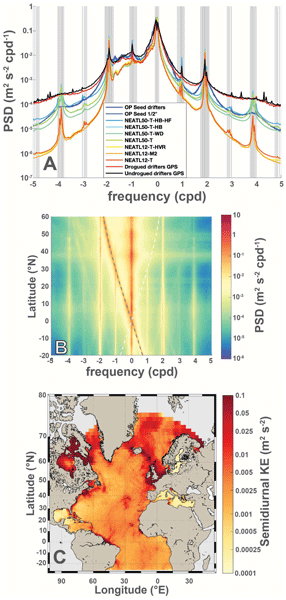
This paper presents recent findings regarding surface horizontal kinetic energy (SHKE) levels in a series of high-resolution, realistic numerical simulations of the North and Equatorial Atlantic Oceans. These results are then compared with surface drifter data. This comparison uses simulated Lagrangian time series in the numerical simulations to provide an accurate comparison, as described by Zhang et al. (2024). The paper then explores the impact of various numerical parameters, including resolution, the presence of drag for internal waves, bathymetry resolution, and wind forcing frequency. The paper is clearly written and logically organised, providing results of interest to the ocean modelling community. However, I have a few remarks regarding the objectives of the paper – which I think could be clarified – and possible redundancies with previously published results, considering that the present paper is somewhat long.
Indeed, the main message of the paper is unclear to me. From the title, it sounds like it is about characterising the surface kinetics, which is actually discussed in Section 3. However, this has essentially been reported previously using very similar datasets and diagnostics in the referenced papers (Yu et al., 2019; Arbic et al., 2022; Zhang et al., 2024). Similarly, section 4.3 provides a lengthy comparison of Lagrangian estimates and Lagrangian vs. Eulerian spectra of SHKE, which seems redundant with previously published results. Section 5 then provides a discussion of the different numerical parameters, which corresponds best with the description provided in the abstract. This is probably the most interesting and novel part of the study. However, it is difficult to link these two sections (3 and 4 on the one hand, and 5 on the other). This is exemplified by the introductory paragraph at the beginning of Section 5, the logical path of which I could not understand (previous results -> motivations for next analysis). Therefore, I suggest that the authors provide clarifications on these points and perhaps take the opportunity to shorten the paper by using appendices for the detailed diagnostics that are not entirely novel, while retaining only the key messages relevant to the paper.
Finally, I think the authors could provide explanations for their results in numerous places to go beyond a mere description of their diagnostics. For instance, around lines 285–290, why is there such a bias? Likewise, I could not get the added value of the discussion in section 5.1, which discusses the differences between including only the M2 tidal component vs. all tidal components: what are the outcomes of this experiment, either in terms of model behaviour or ocean dynamics? At the end of section 5.2, why do you think a higher resolution reduces the diurnal HKE in nearshore domains? At line 493, why does semidiurnal energy increase in a closed sea with a higher wind frequency?
Minor comments and questions
- There are very few typos, and I am grateful for the authors for having been careful on this point
- l.45 and 46: I don’t understand what “significant vertical structure” means here
- l.142 ongoing: is this an offline advection of the numerical particles? What is the temporal scheme used, and what is the time resolution of the surface data? These details are lacking in this section.
- first paragraph in section 4: I was a bit surprised that you used undrogged drifter, although you provide some justification later on in this section. Indeed, I thought that undrogged drifters are more sensitive to wind effect, which can alter the resulting signal. Is this not important? Could the authors just mention whether it can be expected to have an impact or not (or maybe I am just completely wrong and this is merely negligible)?
- l. 262-264: I do not see the patterns described by the authors in the corresponding figure. In particular, it is said that low frequency HKE is higher in the center of the North Atlantic in the model, contrary to the observations, but there is a big blue patch there in the right panel. Could you please clarify?
- l.270: Once -> One
- l.336-339: sentence is repeated.
- l.554: insufficient horizontal resolution can enhance energy in the SD band by preventing scattering into the wave continuum (not promoting)
Citation: https://doi.org/10.5194/egusphere-2025-6355-RC1 - AC4: 'Reply on RC1', Rémi Laxenaire, 12 May 2026
-
RC2: 'Comment on egusphere-2025-6355', Anonymous Referee #2, 16 Mar 2026
This study provides a comprehensive analysis of surface horizontal kinetic energy (KE) levels using high-resolution numerical simulations of the North and Equatorial Atlantic Oceans. They compared the results of numerical drifter experiments with surface drifter observations. and further KE estimates in the Lagrangian versus Eulerian framework. The most distinguished part of this manuscript from previous published studies, is the sensitivity tests to explore the impacts of the forcings (tidal & winds) and model parameters on KE estimates by numerical simulations. Overall, this paper is well written and clearly organized, and the findings are of significant interest, offering valuable insights to the modelling community.
I highly recommend this paper for publication in Geoscientific Model Development after addressing the following major concerns about the objectives, results and reasons for the discrepancies between observations, different framework, and various numerical simulations. And some minor corrections are also required to be done.
This manuscript can benefit from improvements in several aspects before it is accepted. I have a couple of concerns and comments as below:
Major concerns
- 1. Title Alignment: I think the title does not convey the motivation and key findings of this paper. In both abstract and most of the results section, the authors focus more on the numerical Lagrangian versus Eulerian analysis, as well as the sensitivity of the Eulerian simulation to the choices of parameters and forcings. The comparison between the surface drifter observations with numerical simulations seem not a central topic of this study. I suggest the authors carefully think about the title that can better summary their results, to avoid misleading the readers before they go through this paper.
- Manuscript Structure and Visualization:The whole manuscript looks a bit long and difficult to follow. It would be easier to read if the authors try to find a better way to arrange their figures and texts. For example, the zonally averaged rotary sepctra plot can be combined with the KE maps for each subsection, right following the corresponding results and discussion on these figures. Then the readers will not be bothered by the mismatching of the texts and figures next to them. And the current figures are somewhat repetitive. The authors could consider using more diverse plots to present the results (e.g. figure 5 in Arbic et al., 2022, Figure 4 & Figure 5 d-f in Zhang et al., 2024). At present, most of the figures in this manuscript look highly similar and sometimes the maps may not a best or the only way to display your results.
- Drifter Experiment Design: Even though the novel part of this munscript lies in the third part (i.e. sensitivity tests of parameter choices), the comparison between the surface drifter observations and the Ocean Parcel experiments based on NEATL simulations are important as well (despite previous studies like Yu et al. 2019, Arbic et al. 2022 and Zhang et al. 2024 have shown similar results). The authors need to provide more information and discussion on the design of their numerical drifter experiments (OP Seed 1/2 and OP Seed drifters). For this part I have a few questions: Why the authors choose observations from undrogued drifters for comparison? Why in Figure 1b the OP 1/2 have a very different coverage compared to the distribution of undrogued drifters in Figure 1c (I mean the less coverage of the northern part of the domain, say 50N and further north)? And the distribution of trajectories in Figure 1b and 1c looks highly different, in this case, does the comparison in section 4.1 (Figure 3-4) make sense? Why not using OP Seed drifters to directly compare with drifter observations instead? As such, may be section 4.2 and its figures are not necessary or at least could be moved to suppplementary materials. The length of the munuscript could be shorter then.
- Depth of Discussion: Most of the results are about the basic description of plots and comparisons. I would like to see more discussion about the underlying resons or potential machnisms of these difference, then this paper would be more valuable for future studies. The summary is also too long and kind of repeating the information in previous sections. It will be a good idea to make this section brief, leaving key takeaway messages only, and perhaps to have a short paragraph in the end of Section 6 Summary, to provide some implications for using drifter observations and numerical Lagrangian vs Eulerian analysis for KE, and point out directions for future studies.
Minor comments
- Table 2 & 3: These show overlapping information. I suggest keeping only one in the main text, the other could be removed or placed in the supplementary materials.
- L243: this sentence refers to Yu et al. (2019)? Then Yu et al. 2019 should be put into the brackets.
- L266-267: repeating information” The bipolar pattern in the diurnal band, with more KE
- poleward of 30.N in the observations but equatorward in the model,” You have said this at the beginning of L265. Try to be concise when describing the results.
- L270: “Once can…”, Once -> One?
- There maight be some other typos and minor errors throughout the text, the authors should carefully check and correct them.
Citation: https://doi.org/10.5194/egusphere-2025-6355-RC2 - AC5: 'Reply on RC2', Rémi Laxenaire, 12 May 2026
Peer review completion


Interactive discussion
Status: closed
-
CEC1: 'Comment on egusphere-2025-6355 - No compliance with the policy of the journal', Juan Antonio Añel, 11 Feb 2026
Dear authors,
Unfortunately, after checking your manuscript, it has come to our attention that it does not comply with our "Code and Data Policy".
https://www.geoscientific-model-development.net/policies/code_and_data_policy.html
First, it is not clear in your manuscript whether you have performed the simulations described or whether you are simply using data from previous experiments. Please clarify it. If you have run the simulations, then you must publish the exact version of the model used for the experiments. In the case that you are simply using the data, it is necessary to note that we can not accept the SEANOE site to store the data related to your submitted manuscript, but you must use to store them a repository acceptable according to the policy of the journal. It does not appear to have a published policy for data preservation over many years or decades (some flexibility exists over the precise length of preservation, but the policy must exist), and it does not appear to have a published mechanism for preventing authors from unilaterally removing material. Archives must have a policy which makes removal of materials only possible in exceptional circumstances and subject to an independent curatorial decision.If we have missed a published policy which does in fact address this matter satisfactorily, please post a response linking to it. If you have any questions about this issue, please post them in a reply.Also, it is important to note that for your work you have used other software packages, such as the Parcels Python package, and you have not included a repository for it in the Code and Data Availability section of the manuscript neither. It is necessary that you do so.The GMD review process depends on reviewers and community commentators being able to access, during the discussion phase, the code and data on which a manuscript depends. Please, therefore, publish your code and data in one of the appropriate repositories and reply to this comment with the relevant information (link and a permanent identifier for it (e.g. DOI)) as soon as possible. We cannot have manuscripts under discussion that do not comply with our policy.
The 'Code and Data Availability’ section must also be modified to cite the new repository locations, and corresponding references added to the bibliography.
I must note that if you do not fix this problem, we cannot continue with the peer-review process or accept your manuscript for publication in GMD.
Juan A. Añel
Geosci. Model Dev. Executive EditorCitation: https://doi.org/10.5194/egusphere-2025-6355-CEC1 -
AC1: 'Reply on CEC1', Rémi Laxenaire, 24 Feb 2026
Dear Dr. Añel,
Thank you for drawing our attention to our non-compliance with the GMD Code and Data Policy. We have revised the manuscript accordingly and it now includes a) clear identification of the numerical models and software used in the paper, b) explicit provenance of the simulations, and c) an updated the “Code and Data Availability” section.
SEANOE is operated by SISMER (IFREMER) and provides institutional support and long-term preservation infrastructure. In response to your remark that SEANOE’s data management policy was not easily accessible, the SEANOE administrators have added a dedicated “data preservation policy” page that explicitly addresses long-term preservation and withdrawal conditions: https://www.seanoe.org/html/policy-data-preservation.htm. Related information was already available in the CoreTrustSeal documentation (https://www.coretrustseal.org/wp-content/uploads/2019/11/IFREMER-SISMER.pdf), but the SEANOE administrators took the opportunity to make these points easier to locate. We believe this satisfies the GMD compliance requirements; if not, the SEANOE administrators indicated that they would be pleased to discuss with you what additional guarantees might be needed.
All seven HYCOM experiments in the paper were performed as dedicated numerical simulations by the HYCOM team involved in this study (i.e., X. Xu and E. Chassignet). The manuscript has been updated to state this explicitly in the section “HYbrid Coordinate Ocean Model (HYCOM) simulations”. We also clarify four of the seven simulations analysed in this apper are being reviewed for the first time while three of the configurations were used previously in a paper with a different focus (Xu et al., 2022).
Regarding software and data traceability, we now explicitly document the precise versions used and ensure that the exact versions underlying the results are persistently accessible. The Parcels Python package version used in this study (v2.3.1) is archived on Zenodo (doi:10.5281/zenodo.6827981). For resources that do not provide an immutable, versioned archival release at the time of use, or that evolve continuously (i.e., the HYCOM source code hosted on GitHub, and the continuously updated Global Drifter Program dataset), we have archived the versions and subsets used in this study at SEANOE (doi:10.17882/111296). This SEANOE archive also contains the gridded 1° × 1° rotary spectra and kinetic energy diagnostics used to generate the figures and tables in the manuscript, together with a MATLAB script to reproduce the figures.
Thank you again for drawing our attention to these points. We trust that these revisions address the policy requirements and allow the discussion to proceed. Please let us know if any additional information is needed.
Sincerely,
Rémi Laxenaire, on behalf of the co-authors.
Citation: https://doi.org/10.5194/egusphere-2025-6355-AC1 -
AC2: 'Addition on AC1', Rémi Laxenaire, 25 Feb 2026
Dear Dr. Añel,
Thank you for your message, and please accept my apologies for the follow-up. This is my first time as first author in the EGUsphere interactive discussion system; when I posted my initial reply, I did not realize that I should explicitly quote the modified passages in the comment rather than attempting to upload a revised manuscript version at this stage.
Following the editorial guidance, I therefore add below the exact passages that were inserted/updated in the manuscript.
“Code and Data Availability” section (updated text): The HYCOM 2.3.01 source code is available at https://github.com/HYCOM/HYCOM-src/tree/2.3.01 and is archived at SEANOE (doi:10.17882/111296; Laxenaire et al., 2026). The full-resolution HYCOM model outputs are stored in the U.S. Army Engineer Research and Development Center (ERDC) and U.S. Navy DoD Supercomputing Resource Center (DSRC) archive servers and are available on request. The Parcels Python package used in this study (v2.3.1) is archived on Zenodo (doi:10.5281/zenodo.6827981; Van Sebille et al., 2021). Version 2.01 of the hourly Global Drifter Program dataset (Elipot et al., 2016, 2022) was downloaded on 30 April 2025, and an archived copy of the subset used in this study is available at SEANOE (doi:10.17882/111296; Laxenaire et al., 2026). The gridded 1◦×1◦ rotary surface velocity spectra and derived kinetic energy diagnostics (total, low-frequency, diurnal, semidiurnal, and near-inertial) for the seven HYCOM NEATL simulations, the OceanParcels experiment, and the four drifter datasets (drogued or undrogued; all positions or GPS only), together with a Matlab script to reproduce the figures of this paper, are archived at SEANOE (doi:10.17882/111296; Laxenaire et al.,2026).
“HYbrid Coordinate Ocean Model (HYCOM) simulations” section (sentence added): Three of these configurations have been used previously in Xu et al. (2022), while four simulations (NEATL12-T, NEATL12-M$_2$, NEATL12-T-HVR, and NEATL50-T-WD) are analyzed for the first time.
“Reference” section (entry added) : Van Sebille, E., Kehl, C., Lange, M., Delandmeter, P., and contributors, T. P.: Parcels, https://doi.org/10.5281/zenodo.6827981, 2021.
Sincerely,
Rémi Laxenaire, on behalf of the co-authorsCitation: https://doi.org/10.5194/egusphere-2025-6355-AC2 -
CEC2: 'Reply on AC2', Juan Antonio Añel, 26 Feb 2026
Dear authors,
Many thanks for your reply and the work to comply with the policy of the journal. Given the information provided, we can consider now your manuscript in compliance with the Code and Data policy of the journal.
However, it would be good if you could clarify an additional issue: in your new Code and Data Availability section you indicate that you have used a "Matlab" code. Matlab is a proprietary software, not a language for a script. Matlab is a very specific interpreter for the M language. In this regard, probably it would be more accurate to state that you are sharing a M language script. Also, if such script only runs in Matlab (for example due to its dependence on some highly specific functions), and therefore depends on it, you should clarify it. It could be (and would be desirable for the sake of scientific replicability) that your script runs under, for example, GNU Octave. If this is the case, you do not need to indicate anything additional, as compatibility of your script across interpreters would be enough. However, if your manuscript only runs under Matlab, please, indicate the specific version of the interpreter that you have used for your work. Matlab does not guarantee compatibility across versions, and therefore it is desirable to know the exact version of the software necessary to replicate your work.
Juan A. Añel
Geosci. Model Dev. Executive Editor
Citation: https://doi.org/10.5194/egusphere-2025-6355-CEC2 -
AC3: 'Reply on CEC2', Rémi Laxenaire, 02 Mar 2026
Dear Dr. Añel,
We are pleased to know that our efforts have brought the manuscript into compliance with the Code and Data Policy of the journal.
Thank you for your additional remark regarding the wording and interpreter compatibility of our M-language script. We modified the script so that it runs under both MATLAB and GNU Octave. This updated version, together with an updated README, has been uploaded to the SEANOE archive.
We also updated the “Code and Data Availability” section : “The gridded 1° × 1° rotary surface velocity spectra and derived kinetic energy diagnostics (total, low-frequency, diurnal, semidiurnal, and near-inertial) for the seven HYCOM NEATL simulations, the OceanParcels experiment, and the four drifter datasets (drogued or undrogued; all positions or GPS only), together with an M-language script to reproduce the figures of this paper (compatible with both MATLAB and GNU Octave), are archived at SEANOE (doi:10.17882/111296; Laxenaire et al. (2026)).”
Sincerely,
Rémi Laxenaire, on behalf of the co-authorsCitation: https://doi.org/10.5194/egusphere-2025-6355-AC3
-
AC3: 'Reply on CEC2', Rémi Laxenaire, 02 Mar 2026
-
CEC2: 'Reply on AC2', Juan Antonio Añel, 26 Feb 2026
-
AC2: 'Addition on AC1', Rémi Laxenaire, 25 Feb 2026
-
AC1: 'Reply on CEC1', Rémi Laxenaire, 24 Feb 2026
-
RC1: 'Comment on egusphere-2025-6355', Anonymous Referee #1, 04 Mar 2026
This paper presents recent findings regarding surface horizontal kinetic energy (SHKE) levels in a series of high-resolution, realistic numerical simulations of the North and Equatorial Atlantic Oceans. These results are then compared with surface drifter data. This comparison uses simulated Lagrangian time series in the numerical simulations to provide an accurate comparison, as described by Zhang et al. (2024). The paper then explores the impact of various numerical parameters, including resolution, the presence of drag for internal waves, bathymetry resolution, and wind forcing frequency. The paper is clearly written and logically organised, providing results of interest to the ocean modelling community. However, I have a few remarks regarding the objectives of the paper – which I think could be clarified – and possible redundancies with previously published results, considering that the present paper is somewhat long.
Indeed, the main message of the paper is unclear to me. From the title, it sounds like it is about characterising the surface kinetics, which is actually discussed in Section 3. However, this has essentially been reported previously using very similar datasets and diagnostics in the referenced papers (Yu et al., 2019; Arbic et al., 2022; Zhang et al., 2024). Similarly, section 4.3 provides a lengthy comparison of Lagrangian estimates and Lagrangian vs. Eulerian spectra of SHKE, which seems redundant with previously published results. Section 5 then provides a discussion of the different numerical parameters, which corresponds best with the description provided in the abstract. This is probably the most interesting and novel part of the study. However, it is difficult to link these two sections (3 and 4 on the one hand, and 5 on the other). This is exemplified by the introductory paragraph at the beginning of Section 5, the logical path of which I could not understand (previous results -> motivations for next analysis). Therefore, I suggest that the authors provide clarifications on these points and perhaps take the opportunity to shorten the paper by using appendices for the detailed diagnostics that are not entirely novel, while retaining only the key messages relevant to the paper.
Finally, I think the authors could provide explanations for their results in numerous places to go beyond a mere description of their diagnostics. For instance, around lines 285–290, why is there such a bias? Likewise, I could not get the added value of the discussion in section 5.1, which discusses the differences between including only the M2 tidal component vs. all tidal components: what are the outcomes of this experiment, either in terms of model behaviour or ocean dynamics? At the end of section 5.2, why do you think a higher resolution reduces the diurnal HKE in nearshore domains? At line 493, why does semidiurnal energy increase in a closed sea with a higher wind frequency?
Minor comments and questions
- There are very few typos, and I am grateful for the authors for having been careful on this point
- l.45 and 46: I don’t understand what “significant vertical structure” means here
- l.142 ongoing: is this an offline advection of the numerical particles? What is the temporal scheme used, and what is the time resolution of the surface data? These details are lacking in this section.
- first paragraph in section 4: I was a bit surprised that you used undrogged drifter, although you provide some justification later on in this section. Indeed, I thought that undrogged drifters are more sensitive to wind effect, which can alter the resulting signal. Is this not important? Could the authors just mention whether it can be expected to have an impact or not (or maybe I am just completely wrong and this is merely negligible)?
- l. 262-264: I do not see the patterns described by the authors in the corresponding figure. In particular, it is said that low frequency HKE is higher in the center of the North Atlantic in the model, contrary to the observations, but there is a big blue patch there in the right panel. Could you please clarify?
- l.270: Once -> One
- l.336-339: sentence is repeated.
- l.554: insufficient horizontal resolution can enhance energy in the SD band by preventing scattering into the wave continuum (not promoting)
Citation: https://doi.org/10.5194/egusphere-2025-6355-RC1 - AC4: 'Reply on RC1', Rémi Laxenaire, 12 May 2026
-
RC2: 'Comment on egusphere-2025-6355', Anonymous Referee #2, 16 Mar 2026
This study provides a comprehensive analysis of surface horizontal kinetic energy (KE) levels using high-resolution numerical simulations of the North and Equatorial Atlantic Oceans. They compared the results of numerical drifter experiments with surface drifter observations. and further KE estimates in the Lagrangian versus Eulerian framework. The most distinguished part of this manuscript from previous published studies, is the sensitivity tests to explore the impacts of the forcings (tidal & winds) and model parameters on KE estimates by numerical simulations. Overall, this paper is well written and clearly organized, and the findings are of significant interest, offering valuable insights to the modelling community.
I highly recommend this paper for publication in Geoscientific Model Development after addressing the following major concerns about the objectives, results and reasons for the discrepancies between observations, different framework, and various numerical simulations. And some minor corrections are also required to be done.
This manuscript can benefit from improvements in several aspects before it is accepted. I have a couple of concerns and comments as below:
Major concerns
- 1. Title Alignment: I think the title does not convey the motivation and key findings of this paper. In both abstract and most of the results section, the authors focus more on the numerical Lagrangian versus Eulerian analysis, as well as the sensitivity of the Eulerian simulation to the choices of parameters and forcings. The comparison between the surface drifter observations with numerical simulations seem not a central topic of this study. I suggest the authors carefully think about the title that can better summary their results, to avoid misleading the readers before they go through this paper.
- Manuscript Structure and Visualization:The whole manuscript looks a bit long and difficult to follow. It would be easier to read if the authors try to find a better way to arrange their figures and texts. For example, the zonally averaged rotary sepctra plot can be combined with the KE maps for each subsection, right following the corresponding results and discussion on these figures. Then the readers will not be bothered by the mismatching of the texts and figures next to them. And the current figures are somewhat repetitive. The authors could consider using more diverse plots to present the results (e.g. figure 5 in Arbic et al., 2022, Figure 4 & Figure 5 d-f in Zhang et al., 2024). At present, most of the figures in this manuscript look highly similar and sometimes the maps may not a best or the only way to display your results.
- Drifter Experiment Design: Even though the novel part of this munscript lies in the third part (i.e. sensitivity tests of parameter choices), the comparison between the surface drifter observations and the Ocean Parcel experiments based on NEATL simulations are important as well (despite previous studies like Yu et al. 2019, Arbic et al. 2022 and Zhang et al. 2024 have shown similar results). The authors need to provide more information and discussion on the design of their numerical drifter experiments (OP Seed 1/2 and OP Seed drifters). For this part I have a few questions: Why the authors choose observations from undrogued drifters for comparison? Why in Figure 1b the OP 1/2 have a very different coverage compared to the distribution of undrogued drifters in Figure 1c (I mean the less coverage of the northern part of the domain, say 50N and further north)? And the distribution of trajectories in Figure 1b and 1c looks highly different, in this case, does the comparison in section 4.1 (Figure 3-4) make sense? Why not using OP Seed drifters to directly compare with drifter observations instead? As such, may be section 4.2 and its figures are not necessary or at least could be moved to suppplementary materials. The length of the munuscript could be shorter then.
- Depth of Discussion: Most of the results are about the basic description of plots and comparisons. I would like to see more discussion about the underlying resons or potential machnisms of these difference, then this paper would be more valuable for future studies. The summary is also too long and kind of repeating the information in previous sections. It will be a good idea to make this section brief, leaving key takeaway messages only, and perhaps to have a short paragraph in the end of Section 6 Summary, to provide some implications for using drifter observations and numerical Lagrangian vs Eulerian analysis for KE, and point out directions for future studies.
Minor comments
- Table 2 & 3: These show overlapping information. I suggest keeping only one in the main text, the other could be removed or placed in the supplementary materials.
- L243: this sentence refers to Yu et al. (2019)? Then Yu et al. 2019 should be put into the brackets.
- L266-267: repeating information” The bipolar pattern in the diurnal band, with more KE
- poleward of 30.N in the observations but equatorward in the model,” You have said this at the beginning of L265. Try to be concise when describing the results.
- L270: “Once can…”, Once -> One?
- There maight be some other typos and minor errors throughout the text, the authors should carefully check and correct them.
Citation: https://doi.org/10.5194/egusphere-2025-6355-RC2 - AC5: 'Reply on RC2', Rémi Laxenaire, 12 May 2026
Peer review completion
Journal article(s) based on this preprint
Viewed
| HTML | XML | Total | BibTeX | EndNote | |
|---|---|---|---|---|---|
| 1,574 | 723 | 187 | 2,484 | 114 | 140 |
- HTML: 1,574
- PDF: 723
- XML: 187
- Total: 2,484
- BibTeX: 114
- EndNote: 140
Viewed (geographical distribution)
| Country | # | Views | % |
|---|
| Total: | 0 |
| HTML: | 0 |
| PDF: | 0 |
| XML: | 0 |
- 1
Rémi Laxenaire

Eric P. Chassignet
Xiaobiao Xu
Alan J. Wallcraft
Luna Hiron
Brian K. Arbic
Maarten C. Buijsman
Miguel Solano
Shane Elipot
The requested preprint has a corresponding peer-reviewed final revised paper. You are encouraged to refer to the final revised version.
- Preprint
(43714 KB) - Metadata XML
Dear authors,
Unfortunately, after checking your manuscript, it has come to our attention that it does not comply with our "Code and Data Policy".
https://www.geoscientific-model-development.net/policies/code_and_data_policy.html
The GMD review process depends on reviewers and community commentators being able to access, during the discussion phase, the code and data on which a manuscript depends. Please, therefore, publish your code and data in one of the appropriate repositories and reply to this comment with the relevant information (link and a permanent identifier for it (e.g. DOI)) as soon as possible. We cannot have manuscripts under discussion that do not comply with our policy.
The 'Code and Data Availability’ section must also be modified to cite the new repository locations, and corresponding references added to the bibliography.
I must note that if you do not fix this problem, we cannot continue with the peer-review process or accept your manuscript for publication in GMD.
Juan A. Añel
Geosci. Model Dev. Executive Editor