
the Creative Commons Attribution 4.0 License.
the Creative Commons Attribution 4.0 License.
 | 05 Jan 2026
Physical Processes Leading to Extreme Day-to-day Temperature Change – Part II: Future Climate Change
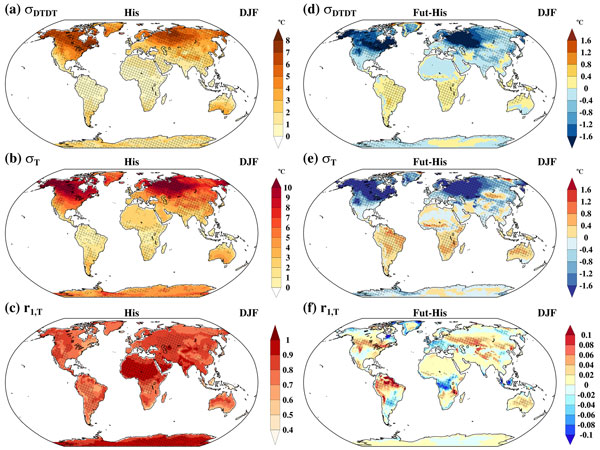
Abstract. Extreme temperature swings from one day to the next, whether warming or cooling, can significantly impact human health, ecosystems, and the economy. These effects may become more pronounced or attenuated in the future. Part I of this research identified the physical processes – advection, as well as adiabatic and diabatic temperature changes – that cause extreme day-to-day temperature (DTDT) fluctuations in the present climate. However, how these processes influence the projected extreme DTDT change under warming scenarios remains unknown. This study addresses this question globally by analysing physical processes in Community Earth System Model Large Ensemble (CESM-LE) simulations under a high-emission scenario, employing both Eulerian composite and Lagrangian backwards-trajectory analyses. The projected changes in (extreme) DTDT variations display a clear seasonal contrast with a dipole pattern: weakening in mid- to high latitudes and intensification in the tropics during December–February (DJF), while during June–August (JJA), tropical intensification is more widespread, and only some extratropical locations experience reductions in DTDT variations. The projected changes in the magnitude of DTDT variations are mostly linked to changes in the standard deviation of daily temperature, while changes in the temporal autocorrelation also play a role in some regions. In the extratropics during DJF, the weakening of DTDT extremes is mainly driven by reduced advection contributions due to Arctic amplification. However, during JJA, reductions in extremes result from changes in advection, diabatic, and adiabatic processes, with differences between events and regions in their relative contributions. Furthermore, changes in diabatic processes play a significant role in the projected intensification of extremes in JJA over land areas in the tropics and subtropics, while the tropical intensification during DJF results from local changes in diabatic and adiabatic processes. Our findings demonstrate that a regional and seasonal perspective that, in addition to the well-established role of changes in advection, also accounts for diabatic and adiabatic heating processes, is essential for understanding projected extreme DTDT changes and for developing suitable adaptation strategies.
Competing interests: At least one of the (co-)authors is a member of the editorial board of Weather and Climate Dynamics.
Publisher's note: Copernicus Publications remains neutral with regard to jurisdictional claims made in the text, published maps, institutional affiliations, or any other geographical representation in this paper. While Copernicus Publications makes every effort to include appropriate place names, the final responsibility lies with the authors. Views expressed in the text are those of the authors and do not necessarily reflect the views of the publisher.-
Notice on discussion status
The requested preprint has a corresponding peer-reviewed final revised paper. You are encouraged to refer to the final revised version.
-
Preprint
(13940 KB)
-
Supplement
(10696 KB)
-
The requested preprint has a corresponding peer-reviewed final revised paper. You are encouraged to refer to the final revised version.
- Preprint
(13940 KB) - Metadata XML
-
Supplement
(10696 KB) - BibTeX
- EndNote
- Final revised paper


Journal article(s) based on this preprint
Interactive discussion
Status: closed
-
RC1: 'Comment on egusphere-2025-6343', Anonymous Referee #1, 30 Jan 2026
The comment was uploaded in the form of a supplement: https://egusphere.copernicus.org/preprints/2026/egusphere-2025-6343/egusphere-2025-6343-RC1-supplement.pdfCitation: https://doi.org/
10.5194/egusphere-2025-6343-RC1 - AC1: 'Reply on RC1', Kalpana Hamal, 17 Mar 2026
-
RC2: 'Comment on egusphere-2025-6343', Anonymous Referee #2, 02 Feb 2026
- AC2: 'Reply on RC2', Kalpana Hamal, 17 Mar 2026


Interactive discussion
Status: closed
-
RC1: 'Comment on egusphere-2025-6343', Anonymous Referee #1, 30 Jan 2026
The comment was uploaded in the form of a supplement: https://egusphere.copernicus.org/preprints/2026/egusphere-2025-6343/egusphere-2025-6343-RC1-supplement.pdf
- AC1: 'Reply on RC1', Kalpana Hamal, 17 Mar 2026
-
RC2: 'Comment on egusphere-2025-6343', Anonymous Referee #2, 02 Feb 2026
- AC2: 'Reply on RC2', Kalpana Hamal, 17 Mar 2026
Peer review completion


Journal article(s) based on this preprint
Viewed
| HTML | XML | Total | Supplement | BibTeX | EndNote | |
|---|---|---|---|---|---|---|
| 1,750 | 725 | 160 | 2,635 | 314 | 96 | 156 |
- HTML: 1,750
- PDF: 725
- XML: 160
- Total: 2,635
- Supplement: 314
- BibTeX: 96
- EndNote: 156
Viewed (geographical distribution)
| Country | # | Views | % |
|---|
| Total: | 0 |
| HTML: | 0 |
| PDF: | 0 |
| XML: | 0 |
- 1
Kalpana Hamal
Stephan Pfahl
The requested preprint has a corresponding peer-reviewed final revised paper. You are encouraged to refer to the final revised version.
- Preprint
(13940 KB) - Metadata XML
-
Supplement
(10696 KB) - BibTeX
- EndNote
- Final revised paper