
the Creative Commons Attribution 4.0 License.
the Creative Commons Attribution 4.0 License.
 | 07 Jan 2026
Impact of Sentinel-5 SWIR Detector Persistence on Trace Gas Retrievals
Abstract. Launched in August 2025, the Sentinel-5 (S5) mission aims to enhance greenhouse gas monitoring by working alongside existing Copernicus satellites, such as the Sentinel-5 Precursor. S5 is equipped with shortwave-infrared (SWIR) grating spectrometers that provide operational daily retrievals of CH4 and CO, while the coverage of the SWIR region also makes S5 measurements sensitive to atmospheric CO2. One particular challenge for S5 is the persistence effect in its SWIR mercury-cadmium-telluride (MCT) detectors, which can introduce scene-dependent radiometric biases when the signal at a detector pixel changes between consecutive readouts, as occurs in scenes with along-track brightness variations.
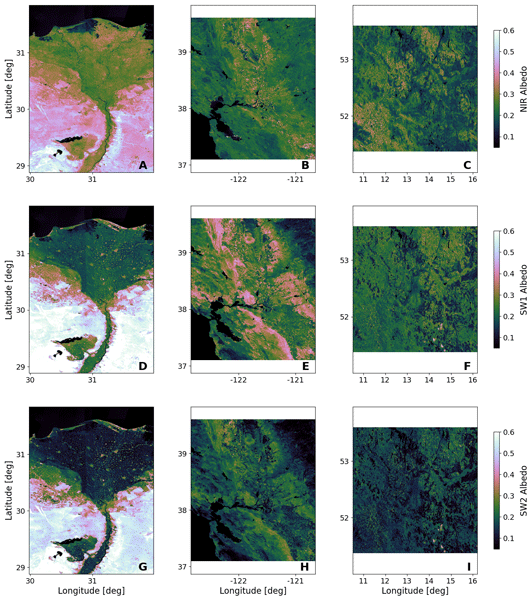
This study quantifies persistence-induced biases for CH4, CO, and the CH4/CO2 proxy ratio using the operational RemoTeC CH4 retrieval algorithm, an also examines persistence errors for a potential CO2 product. We simulate realistic scenes over regions like the Nile Delta, California's Central Valley, and the Lusatian lignite district, which exhibit the spatial radiance variability relevant for persistence effects. Across these scenes, the induced biases remain small, with typical amplitudes below 0.12 % for CH4, 0.10 % for CO2, 0.34 % for CO, and 0.06 % for the CH4/CO2 proxy. However, localized outliers reaching up to 1.59 % for CH4, 1.55 % for CO2, 4.01 % for CO and 0.71 % for the proxy constitute a substantial fraction of the CO and the proxy performance targets, and exceed those defined for CH4 and CO2. Our findings suggest that targeted post-filtering, such as omitting coastal and land–water interface pixels, can effectively reduce the most significant outliers in the persistence bias, thus aligning the retrieval biases with the required mission performance.
-
Notice on discussion status
The requested preprint has a corresponding peer-reviewed final revised paper. You are encouraged to refer to the final revised version.
-
Preprint
(4280 KB)
-
The requested preprint has a corresponding peer-reviewed final revised paper. You are encouraged to refer to the final revised version.
- Preprint
(4280 KB) - Metadata XML
- BibTeX
- EndNote
- Final revised paper


Journal article(s) based on this preprint
Interactive discussion
Status: closed
-
RC1: 'Comment on egusphere-2025-6328', Anonymous Referee #1, 25 Jan 2026
- AC1: 'Reply on RC1', Tobias Borsdorff, 04 May 2026
-
RC2: 'Comment on egusphere-2025-6328', Anonymous Referee #2, 11 Mar 2026
- AC2: 'Reply on RC2', Tobias Borsdorff, 04 May 2026
-
RC3: 'Comment on egusphere-2025-6328', Anonymous Referee #3, 27 Mar 2026
This paper presents a simulation study to quantify the effect of detector persistence on trace gas retrievals from Sentinel 5. The study looked both at radiance scenes with a surface albedo step as well as three different true radiance scenes. The overall bias observed was significant and larger than the mission target parameters for single pixels around surface albedo transitions; however, the paper shows that these can be filtered out by applying radiance change masks. Overall, the paper is well written and clearly describes the work. I only have a few minor comments:
P2 l58: Can you add a reference for the MicroCarb and CO2M requirements?
P3 l79: "where CNES model applies a temporal sampling of the incoming signal". This was unclear. Would it be more appropriate to call it a "temporal smoothing" and then also reference the appendix where it is described in more detail?
P4 l116: Was HITRAN08 used for all of the line parameters? Why? What profile was assumed?
P6 l165: I'm not sure what the '(numerical range)' indicates
P6 l175: 'extend' -> extent
Fig7: font very small
Citation: https://doi.org/10.5194/egusphere-2025-6328-RC3 - AC3: 'Reply on RC3', Tobias Borsdorff, 04 May 2026
Peer review completion


Post-review adjustments


Interactive discussion
Status: closed
-
RC1: 'Comment on egusphere-2025-6328', Anonymous Referee #1, 25 Jan 2026
This paper uses an OSSE to examine the effect of lagged SWIR detector response on Sentinel-5 retrievals of CH4, CO2, and CO. The work appears to have been carefully done and is clearly explained. But it is technical in nature, narrowly specific to Sentinel-5, not particularly original, and in the end the effect turns out to cause relatively small errors. It uses an OSSE formulation originally developed for MicroCarb that the MicroCarb team apparently did not bother to publish (it is cited as personal communication). I would expect the work described here to be in a Sentinel-5 ATBD, or as part of a broader Sentinel-5 publication, not as a stand-alone peer-reviewed publication. At the same time, I welcome information on Sentinel-5 in the peer-reviewed literature. I didn't know how to express this in the "For final publication..." buttons and the only reason I clicked on "major revisions" is for the editors to decide whether this paper passes the bar for AMT. It is marginal in my opinion. But if the editors decide that it passes the bar then only minor revisions are needed.
Specific comments:
- Lines 13-14, and elsewhere: The abstract and conclusions refer to CH4 errors as those from the full-physics retrieval and just mention “proxy” without reference to what it means, but a strength of Sentinel-5 is precisely that one can use the proxy method for CH4 (unlike TROPOMI). The proxy product will receive far more use than the full-physics product for CH4 and it should be presented as the default product for CH4.
- Lines 13-14, and conclusions: Giving maximum errors in abstract/conclusions is misleading without the error statistics, which would show that the errors are in general considerably smaller than these maxima. In fact, what I get from this work is that the detector lag will not significantly affect my use of the proxy product for CH4 – I have other errors to worry about.
- Figure 1 is not very helpful. It would be more helpful without unfamiliar abbreviations and with a more substantial caption that describes the overall OSSE strategy.
- Line 120: I didn’t understand reff = 4. Is it missing a unit? But um would be too large and nm too small?
- Line 120: I didn’t understand “Surface albedo spectral dependence is modeled as wavelength-independent.” Does this mean that the albedo spectra are just scaled up or down depending on surface? That wouldn’t make sense because the wavelength dependence of the albedo should vary with surface type.
- Line 199 and elsewhere. I don’t understand why the detector lag would affect the CH4 proxy retrieval at all, since the albedo cancels between CO2 and CH4, except for some smearing which is maybe what the “one pixel” refers to? But that effect would be independent of change in albedo and it would not translate into a systematic bias.
- Line 205: I don’t understand the nits unit. Aren’t the % errors reported for column mixing ratio?
- Line 260 and elsewhere: I think that the authors’ recommendation to exclude fractional water scenes is too radical and would result in unnecessary loss of information for important locations such as coastal cities. The errors reported are not that large, and I certainly would not want to filter out proxy data on that basis.
Citation: https://doi.org/10.5194/egusphere-2025-6328-RC1 - AC1: 'Reply on RC1', Tobias Borsdorff, 04 May 2026
-
RC2: 'Comment on egusphere-2025-6328', Anonymous Referee #2, 11 Mar 2026
- AC2: 'Reply on RC2', Tobias Borsdorff, 04 May 2026
-
RC3: 'Comment on egusphere-2025-6328', Anonymous Referee #3, 27 Mar 2026
This paper presents a simulation study to quantify the effect of detector persistence on trace gas retrievals from Sentinel 5. The study looked both at radiance scenes with a surface albedo step as well as three different true radiance scenes. The overall bias observed was significant and larger than the mission target parameters for single pixels around surface albedo transitions; however, the paper shows that these can be filtered out by applying radiance change masks. Overall, the paper is well written and clearly describes the work. I only have a few minor comments:
P2 l58: Can you add a reference for the MicroCarb and CO2M requirements?
P3 l79: "where CNES model applies a temporal sampling of the incoming signal". This was unclear. Would it be more appropriate to call it a "temporal smoothing" and then also reference the appendix where it is described in more detail?
P4 l116: Was HITRAN08 used for all of the line parameters? Why? What profile was assumed?
P6 l165: I'm not sure what the '(numerical range)' indicates
P6 l175: 'extend' -> extent
Fig7: font very small
Citation: https://doi.org/10.5194/egusphere-2025-6328-RC3 - AC3: 'Reply on RC3', Tobias Borsdorff, 04 May 2026
Peer review completion
Post-review adjustments
Journal article(s) based on this preprint
Viewed
| HTML | XML | Total | BibTeX | EndNote | |
|---|---|---|---|---|---|
| 1,467 | 624 | 153 | 2,244 | 138 | 146 |
- HTML: 1,467
- PDF: 624
- XML: 153
- Total: 2,244
- BibTeX: 138
- EndNote: 146
Viewed (geographical distribution)
| Country | # | Views | % |
|---|
| Total: | 0 |
| HTML: | 0 |
| PDF: | 0 |
| XML: | 0 |
- 1
Mari C. Martinez-Velarte
Jochen Landgraf
Ben Veihelmann
Bernd Sierk

The requested preprint has a corresponding peer-reviewed final revised paper. You are encouraged to refer to the final revised version.
- Preprint
(4280 KB) - Metadata XML
This paper uses an OSSE to examine the effect of lagged SWIR detector response on Sentinel-5 retrievals of CH4, CO2, and CO. The work appears to have been carefully done and is clearly explained. But it is technical in nature, narrowly specific to Sentinel-5, not particularly original, and in the end the effect turns out to cause relatively small errors. It uses an OSSE formulation originally developed for MicroCarb that the MicroCarb team apparently did not bother to publish (it is cited as personal communication). I would expect the work described here to be in a Sentinel-5 ATBD, or as part of a broader Sentinel-5 publication, not as a stand-alone peer-reviewed publication. At the same time, I welcome information on Sentinel-5 in the peer-reviewed literature. I didn't know how to express this in the "For final publication..." buttons and the only reason I clicked on "major revisions" is for the editors to decide whether this paper passes the bar for AMT. It is marginal in my opinion. But if the editors decide that it passes the bar then only minor revisions are needed.
Specific comments: