
the Creative Commons Attribution 4.0 License.
the Creative Commons Attribution 4.0 License.
 | 17 Mar 2026
DeepMelt-GL v1: A neural network emulator of ice-shelf melt rates for use in ocean models which partially resolve ice-shelf cavities
Abstract. The spatial pattern of melting beneath Antarctic ice shelves influences ice flow and retreat, and the resulting fresh-water input into the Southern Ocean influences global carbon storage and primary productivity. It is therefore crucial that interactions at the ice-ocean interface are adequately represented in global climate models. However, due to computational limitations, existing climate models are forced to choose between either high resolution or long period simulations, and struggle to resolve melt rates in ice shelf cavities. Here, we show that a simple multilayer perceptron can be used to emulate sub-shelf melt rates in the parts of cavities closest to the grounding zone. We find that the melt rates produced by applying neural network emulators are a good match for melt rates from high resolution simulations, provided that similar conditions were included in the neural network training. We also find that neural networks are particularly sensitive to temperatures and ice-draft slopes outside those used in the training dataset. However, if we train multiple neural networks on the same input data, we demonstrate that the ensemble spread of the neural networks is a good indicator of the reliability of the emulator in any given conditions. The neural network emulator of sub-shelf melt which is presented here, DeepMelt-GL, can be used to improve the representation of ice shelf cavities in both ocean and global climate models.
-
Notice on discussion status
The requested preprint has a corresponding peer-reviewed final revised paper. You are encouraged to refer to the final revised version.
-
Preprint
(5733 KB)
-
The requested preprint has a corresponding peer-reviewed final revised paper. You are encouraged to refer to the final revised version.
- Preprint
(5733 KB) - Metadata XML
- BibTeX
- EndNote
- Final revised paper


Journal article(s) based on this preprint
Interactive discussion
Status: closed
-
RC1: 'Comment on egusphere-2025-6314', Anonymous Referee #1, 19 Apr 2026
-
AC1: 'Reply on RC1', Helen Ockenden, 08 Jun 2026
We would like to thank both reviewers for their insightful comments, in particular to improve the explanation of machine learning for an audience which may not be familiar with some terminology, and to improve the legibility of the figures. We have responded to each comment individually in the attached pdf.
-
AC1: 'Reply on RC1', Helen Ockenden, 08 Jun 2026
-
RC2: 'Comment on egusphere-2025-6314', Anonymous Referee #2, 04 May 2026
Manuscript Review
Title: “DeepMelt-GL v1: A neural network emulator of ice-shelf melt rates for use in ocean models which partially resolve ice-shelf cavities”
Authors: Helen Ockenden, Clara Burgard, Pierre Mathiot, Christoph Kittel, Achille Gellens, Cécile Agosta, and Nicolas C. Jourdain
Manuscript ID: EGUSPHERE-2025-6314
Overview
The work presented in this manuscript produces an emulator for sub shelf melt rates not resolved in 1-degree resolution models for use with the NEMO model. Unique to this paper, this emulator allows for ocean physics to be solved in parts of the ice shelf cavity where model resolution allows. Accompanying the manuscript is code for generating the emulator dataset (if wanting to train on other data) and their trained output.
Major Comments
This work is well written and addresses a relevant gap in current modeling capability for ocean-induced ice shelf melt rates. I applaud the authors' methodology for being easily updated for when NEMO’s model physics improves and for preserving model physics when possible. This manuscript will be a nice addition to the ice sheet/ocean modeling and will be useful for a wide variety of future research questions. My main concerns are with the manuscript’s figures and some clarifying questions. Additionally, there are a few typos throughout the paper. Below, I have specific comments and suggestions.
Specific Minor Comments (manuscript text unbolded, suggested edits bolded)
Line 11: Please fix the word ‘The’.
Figure 1: The colors should have higher contrast to increase readability. I would suggest making the ocean a lighter blue (or white or light grey) and making the ice shelf cavity resolved in the 0.25 degree only a darker blue. This should make it more color blind friendly as well.
Line 95: For the thinned ice shelf draft scenario, ANTFGEOM, does the grounding line placement move? I find that in general, there is a missing discussion on how the grounding line position will affect the applicability of the trained data to future scenarios. Could you add a few sentences (here or in the discussion) on how you expect changing pinning points to affect the emulator’s performance?
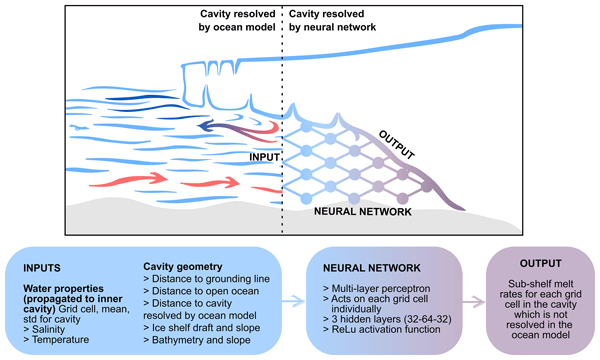
Figure 2: This figure is not easy to read, and I would suggest a major edit. I would suggest moving the schematic of the ocean, ice shelf, and topography up and increasing the opacity to 100%. The topography should be brown or gray, really any color besides blue.
Below the schematic, there could be an ‘algorithm flow chart’ with boxes for water property inputs, and geometry inputs, each with arrows pointing to the emulator box. The emulator box would describe what it does and have an arrow pointed to the ‘output’ box containing melt rates.
I do think a figure like this is needed as it helps with understanding methodology, but it should be cleaned up.
Line 141: What are hidden layers? I recognize that describing these might be outside the scope of this paper, but for someone not familiar with machine learning/emulators, this is unclear. Please change ‘3’ to three.
Line 146: What is a ReLU activation function? Why use this?
Line 207: Please change ‘4’ to ‘four’.
Line 228: Please fix ‘warmm’.
Line 231: Please fix ‘ANt2300’.
Line 233: Why specifically a temperature threshold and not a salinity one? You should expand on this and potentially reference Figure 5 which shows RMSE varies mostly across CT. You touch on this a bit in line 261, but it could be expanded upon!
Figure 4: Ideally, each segment could have its own color. Please adjust Filchner Ronne and Amery’s titles so they don’t overlap with the coastline segment.
Figure 5: For panels a and b, why are there two outlined groups of training data? Should this outline not connect and be one group? Why isn’t this outline on panel c? What is the purpose of panel f?
Line 267: So, the geometry is fixed, except for in the ANTFGEOM case. In the ANTFGEOM case, does the grounding line retreat? Does the area of ice shelf cavities not resolved in the 1-degree model increase because of grounding line retreat? One or two sentences addressing the issue of grounding line migration would be helpful!
Line 273: Please fix ‘FILL IN’.
Line 287: Please fix ‘Instead.’ to be ‘Instead,’.
Figure 6: I’m unsure if the middle figure (panel ‘t’) is providing much information. I believe this figure could be improved by instead using a center inset like figure A1 and only plotting Filchner-Ronne (J-Jpp, Jpp-K) and Amundsen (G-H). Then this circum-Antarctic figure can be in the appendix. Since Figure 6 mirrors Figure 4, I would suggest having the regional names also printed in text in the inset figure.
Figure 7: Panel c is difficult to see since it is small. If Figure 6 is changed to highlight only the Weddell and Amundsen Sea regions, I would also limit panel c in Figure 6 to show only those areas.
Figure 8: Please adjust the placement of the grey text in panel a so it is not covered by the plotted lines. In the caption, please edit “… applied to the ANT2100 simulation is also shown in grey (67.5 Gt yr−1)…” to be: “… applied to the ANT2100 simulation is also shown in light grey (67.5 Gt yr−1)”.
Panel b needs a legend or explanation of what the simulation clusters represent. Why is the same color used for different groupings? Are they a part of the same cluster? That is, each color has a cluster near 0,0 as well as in the middle of the figure.
Lines 314-315: “Sometimes, a high ensemble spread can be assocaited with a low RMSE, but we do not see any examples of a low ensemble spread and high RMSE value.” Please fix the spelling of associated.
Citation: https://doi.org/10.5194/egusphere-2025-6314-RC2 -
AC2: 'Reply on RC2', Helen Ockenden, 08 Jun 2026
We would like to thank both reviewers for their insightful comments, in particular to improve the explanation of machine learning for an audience which may not be familiar with some terminology, and to improve the legibility of the figures. We have responded to each comment individually in the attached pdf.
-
AC2: 'Reply on RC2', Helen Ockenden, 08 Jun 2026
Peer review completion


Interactive discussion
Status: closed
-
RC1: 'Comment on egusphere-2025-6314', Anonymous Referee #1, 19 Apr 2026
The study looks at ways of improving Antarctic ice shelf melt rate estimation in climate models with particular focus on the landward margins of the models. The authors describe a comprehensive study examining how fine resolution models might be used to improve coarser models to enable some form of cross talk between small scales and those that large/long scale models need to work at if they are to provide useful climate insights.
This bridging of timescales is a major challenge for climate science and so studies like this are important in helping “speed up” simulations in ways that still brings the needed physics along.
I find some of the technical terminology in machine learning articles as a little challenging but probably OK from a GMD perspective.
“Partially resolve” in the title is somewhat broad brush given that the actual advance is to examine the thin water column margins of cavities. The frontal terminal face and major crevasses also likely are resolution induced challenges – can they be examined in a similar way?
A critical point that stands out to me is the training is happening from model to model with no reference to any in situ evidence base. There are studies that describe processes in these marginal regions - all that in red in Fig 2. As far as I could tell there was no appeal to the insight provided from this important evidence base (see references). They point to issues like stratification, basal crevasses, tidal variability, even tsunamis - as all being present (lead authors – Begeman, Davis, Lawrence, Schmidt, Stewart & Washam). It would seem useful to have a reality check as to if these observed scales are reflected at some level in the high-resolution modelling. Is there a way of walking through the various likely processes in this unique environment and identifying how each process might fare in the upscaling?
Martin et al provide a useful insight into the connection between modelling and observations and point to (i) the need for approaches such as this manuscript but also (ii) ways to better connect with observations. I am not suggesting including these direct observations in the training but I think a few sentences connecting between the challenge at hand and the in situ evidence – and what extra evidence might be gathered – would help the impact of the work.
I also thought the final paragraph on the NEMO application was somewhat abrupt as it is an important future aspect of the work if it is to help improve ocean models more generally. The authors are proposing a significant shift in how future ocean models might operate and it raises lots of questions around how this might play out in terms tracking the ML enhancements within the general ocean model evolution. Can this be expanded a little in terms of speculation or next steps?
References
Begeman, C.B., Tulaczyk, S.M., Marsh, O.J., Mikucki, J.A., Stanton, T.P., Hodson, T.O., Siegfried, M.R., Powell, R.D., Christianson, K. and King, M.A., 2018. Ocean stratification and low melt rates at the Ross Ice Shelf grounding zone. Journal of Geophysical Research: Oceans, 123(10), pp.7438-7452.
Davis, P.E., Nicholls, K.W., Holland, D.M., Schmidt, B.E., Washam, P., Riverman, K.L., Arthern, R.J., Vaňková, I., Eayrs, C., Smith, J.A. and Anker, P.G., 2023. Suppressed basal melting in the eastern Thwaites Glacier grounding zone. Nature, 614(7948), pp.479-485.
Lawrence, J.D., Washam, P.M., Stevens, C., Hulbe, C., Horgan, H.J., Dunbar, G., Calkin, T., Stewart, C., Robinson, N., Mullen, A.D. and Meister, M.R., 2023. Crevasse refreezing and signatures of retreat observed at Kamb Ice Stream grounding zone. Nature Geoscience, 16(3), pp.238-243.
Martin, T., Dufour, C. O., Meijers, A. J. S., and Hancock, A. M.: Opinion: Status, Plans and Needs of Southern Ocean Modelling, EGUsphere [preprint], https://doi.org/10.5194/egusphere-2026-213, 2026.
Schmidt, B.E., Washam, P., Davis, P.E., Nicholls, K.W., Holland, D.M., Lawrence, J.D., Riverman, K.L., Smith, J.A., Spears, A., Dichek, D.J.G. and Mullen, A.D., 2023. Heterogeneous melting near the Thwaites Glacier grounding line. Nature, 614(7948), pp.471-478.
Stewart, C., Horgan, H. and Stevens, C., 2024. Short Note: 2022 Hunga Tonga-Hunga Ha'apai tsunami measured beneath the Ross Ice Shelf. Antarctic Science, 36(3), pp.181-183.
Washam, P., Lawrence, J.D., Stevens, C.L., Hulbe, C.L., Horgan, H.J., Robinson, N.J., Stewart, C.L., Spears, A., Quartini, E., Hurwitz, B. and Meister, M.R., 2023. Direct observations of melting, freezing, and ocean circulation in an ice shelf basal crevasse. Science Advances, 9(43), p.eadi7638.
Citation: https://doi.org/10.5194/egusphere-2025-6314-RC1 -
AC1: 'Reply on RC1', Helen Ockenden, 08 Jun 2026
We would like to thank both reviewers for their insightful comments, in particular to improve the explanation of machine learning for an audience which may not be familiar with some terminology, and to improve the legibility of the figures. We have responded to each comment individually in the attached pdf.
-
AC1: 'Reply on RC1', Helen Ockenden, 08 Jun 2026
-
RC2: 'Comment on egusphere-2025-6314', Anonymous Referee #2, 04 May 2026
Manuscript Review
Title: “DeepMelt-GL v1: A neural network emulator of ice-shelf melt rates for use in ocean models which partially resolve ice-shelf cavities”
Authors: Helen Ockenden, Clara Burgard, Pierre Mathiot, Christoph Kittel, Achille Gellens, Cécile Agosta, and Nicolas C. Jourdain
Manuscript ID: EGUSPHERE-2025-6314
Overview
The work presented in this manuscript produces an emulator for sub shelf melt rates not resolved in 1-degree resolution models for use with the NEMO model. Unique to this paper, this emulator allows for ocean physics to be solved in parts of the ice shelf cavity where model resolution allows. Accompanying the manuscript is code for generating the emulator dataset (if wanting to train on other data) and their trained output.
Major Comments
This work is well written and addresses a relevant gap in current modeling capability for ocean-induced ice shelf melt rates. I applaud the authors' methodology for being easily updated for when NEMO’s model physics improves and for preserving model physics when possible. This manuscript will be a nice addition to the ice sheet/ocean modeling and will be useful for a wide variety of future research questions. My main concerns are with the manuscript’s figures and some clarifying questions. Additionally, there are a few typos throughout the paper. Below, I have specific comments and suggestions.
Specific Minor Comments (manuscript text unbolded, suggested edits bolded)
Line 11: Please fix the word ‘The’.
Figure 1: The colors should have higher contrast to increase readability. I would suggest making the ocean a lighter blue (or white or light grey) and making the ice shelf cavity resolved in the 0.25 degree only a darker blue. This should make it more color blind friendly as well.
Line 95: For the thinned ice shelf draft scenario, ANTFGEOM, does the grounding line placement move? I find that in general, there is a missing discussion on how the grounding line position will affect the applicability of the trained data to future scenarios. Could you add a few sentences (here or in the discussion) on how you expect changing pinning points to affect the emulator’s performance?
Figure 2: This figure is not easy to read, and I would suggest a major edit. I would suggest moving the schematic of the ocean, ice shelf, and topography up and increasing the opacity to 100%. The topography should be brown or gray, really any color besides blue.
Below the schematic, there could be an ‘algorithm flow chart’ with boxes for water property inputs, and geometry inputs, each with arrows pointing to the emulator box. The emulator box would describe what it does and have an arrow pointed to the ‘output’ box containing melt rates.
I do think a figure like this is needed as it helps with understanding methodology, but it should be cleaned up.
Line 141: What are hidden layers? I recognize that describing these might be outside the scope of this paper, but for someone not familiar with machine learning/emulators, this is unclear. Please change ‘3’ to three.
Line 146: What is a ReLU activation function? Why use this?
Line 207: Please change ‘4’ to ‘four’.
Line 228: Please fix ‘warmm’.
Line 231: Please fix ‘ANt2300’.
Line 233: Why specifically a temperature threshold and not a salinity one? You should expand on this and potentially reference Figure 5 which shows RMSE varies mostly across CT. You touch on this a bit in line 261, but it could be expanded upon!
Figure 4: Ideally, each segment could have its own color. Please adjust Filchner Ronne and Amery’s titles so they don’t overlap with the coastline segment.
Figure 5: For panels a and b, why are there two outlined groups of training data? Should this outline not connect and be one group? Why isn’t this outline on panel c? What is the purpose of panel f?
Line 267: So, the geometry is fixed, except for in the ANTFGEOM case. In the ANTFGEOM case, does the grounding line retreat? Does the area of ice shelf cavities not resolved in the 1-degree model increase because of grounding line retreat? One or two sentences addressing the issue of grounding line migration would be helpful!
Line 273: Please fix ‘FILL IN’.
Line 287: Please fix ‘Instead.’ to be ‘Instead,’.
Figure 6: I’m unsure if the middle figure (panel ‘t’) is providing much information. I believe this figure could be improved by instead using a center inset like figure A1 and only plotting Filchner-Ronne (J-Jpp, Jpp-K) and Amundsen (G-H). Then this circum-Antarctic figure can be in the appendix. Since Figure 6 mirrors Figure 4, I would suggest having the regional names also printed in text in the inset figure.
Figure 7: Panel c is difficult to see since it is small. If Figure 6 is changed to highlight only the Weddell and Amundsen Sea regions, I would also limit panel c in Figure 6 to show only those areas.
Figure 8: Please adjust the placement of the grey text in panel a so it is not covered by the plotted lines. In the caption, please edit “… applied to the ANT2100 simulation is also shown in grey (67.5 Gt yr−1)…” to be: “… applied to the ANT2100 simulation is also shown in light grey (67.5 Gt yr−1)”.
Panel b needs a legend or explanation of what the simulation clusters represent. Why is the same color used for different groupings? Are they a part of the same cluster? That is, each color has a cluster near 0,0 as well as in the middle of the figure.
Lines 314-315: “Sometimes, a high ensemble spread can be assocaited with a low RMSE, but we do not see any examples of a low ensemble spread and high RMSE value.” Please fix the spelling of associated.
Citation: https://doi.org/10.5194/egusphere-2025-6314-RC2 -
AC2: 'Reply on RC2', Helen Ockenden, 08 Jun 2026
We would like to thank both reviewers for their insightful comments, in particular to improve the explanation of machine learning for an audience which may not be familiar with some terminology, and to improve the legibility of the figures. We have responded to each comment individually in the attached pdf.
-
AC2: 'Reply on RC2', Helen Ockenden, 08 Jun 2026
Peer review completion
Journal article(s) based on this preprint
Data sets
Data which accompanies the manuscript "A neural network emulator of ice-shelf melt rates for use in ocean models which partially resolve ice-shelf cavities" Helen Ockenden, Clara Burgard, Pierre Mathiot, and Christoph Kittel https://doi.org/10.5281/zenodo.17358229
Model code and software
Code which accompanies the manuscript "A neural network emulator of ice-shelf melt rates for use in ocean models which partially resolve ice-shelf cavities" Helen Ockenden and Clara Burgard https://doi.org/10.5281/zenodo.17358195
Viewed
| HTML | XML | Total | BibTeX | EndNote | |
|---|---|---|---|---|---|
| 897 | 400 | 97 | 1,394 | 92 | 101 |
- HTML: 897
- PDF: 400
- XML: 97
- Total: 1,394
- BibTeX: 92
- EndNote: 101
Viewed (geographical distribution)
| Country | # | Views | % |
|---|
| Total: | 0 |
| HTML: | 0 |
| PDF: | 0 |
| XML: | 0 |
- 1
Helen Ockenden

Clara Burgard
Pierre Mathiot
Christoph Kittel
Achille Gellens
Cécile Agosta
Nicolas C. Jourdain
The requested preprint has a corresponding peer-reviewed final revised paper. You are encouraged to refer to the final revised version.
- Preprint
(5733 KB) - Metadata XML
The study looks at ways of improving Antarctic ice shelf melt rate estimation in climate models with particular focus on the landward margins of the models. The authors describe a comprehensive study examining how fine resolution models might be used to improve coarser models to enable some form of cross talk between small scales and those that large/long scale models need to work at if they are to provide useful climate insights.
This bridging of timescales is a major challenge for climate science and so studies like this are important in helping “speed up” simulations in ways that still brings the needed physics along.
I find some of the technical terminology in machine learning articles as a little challenging but probably OK from a GMD perspective.
“Partially resolve” in the title is somewhat broad brush given that the actual advance is to examine the thin water column margins of cavities. The frontal terminal face and major crevasses also likely are resolution induced challenges – can they be examined in a similar way?
A critical point that stands out to me is the training is happening from model to model with no reference to any in situ evidence base. There are studies that describe processes in these marginal regions - all that in red in Fig 2. As far as I could tell there was no appeal to the insight provided from this important evidence base (see references). They point to issues like stratification, basal crevasses, tidal variability, even tsunamis - as all being present (lead authors – Begeman, Davis, Lawrence, Schmidt, Stewart & Washam). It would seem useful to have a reality check as to if these observed scales are reflected at some level in the high-resolution modelling. Is there a way of walking through the various likely processes in this unique environment and identifying how each process might fare in the upscaling?
Martin et al provide a useful insight into the connection between modelling and observations and point to (i) the need for approaches such as this manuscript but also (ii) ways to better connect with observations. I am not suggesting including these direct observations in the training but I think a few sentences connecting between the challenge at hand and the in situ evidence – and what extra evidence might be gathered – would help the impact of the work.
I also thought the final paragraph on the NEMO application was somewhat abrupt as it is an important future aspect of the work if it is to help improve ocean models more generally. The authors are proposing a significant shift in how future ocean models might operate and it raises lots of questions around how this might play out in terms tracking the ML enhancements within the general ocean model evolution. Can this be expanded a little in terms of speculation or next steps?
References
Begeman, C.B., Tulaczyk, S.M., Marsh, O.J., Mikucki, J.A., Stanton, T.P., Hodson, T.O., Siegfried, M.R., Powell, R.D., Christianson, K. and King, M.A., 2018. Ocean stratification and low melt rates at the Ross Ice Shelf grounding zone. Journal of Geophysical Research: Oceans, 123(10), pp.7438-7452.
Davis, P.E., Nicholls, K.W., Holland, D.M., Schmidt, B.E., Washam, P., Riverman, K.L., Arthern, R.J., Vaňková, I., Eayrs, C., Smith, J.A. and Anker, P.G., 2023. Suppressed basal melting in the eastern Thwaites Glacier grounding zone. Nature, 614(7948), pp.479-485.
Lawrence, J.D., Washam, P.M., Stevens, C., Hulbe, C., Horgan, H.J., Dunbar, G., Calkin, T., Stewart, C., Robinson, N., Mullen, A.D. and Meister, M.R., 2023. Crevasse refreezing and signatures of retreat observed at Kamb Ice Stream grounding zone. Nature Geoscience, 16(3), pp.238-243.
Martin, T., Dufour, C. O., Meijers, A. J. S., and Hancock, A. M.: Opinion: Status, Plans and Needs of Southern Ocean Modelling, EGUsphere [preprint], https://doi.org/10.5194/egusphere-2026-213, 2026.
Schmidt, B.E., Washam, P., Davis, P.E., Nicholls, K.W., Holland, D.M., Lawrence, J.D., Riverman, K.L., Smith, J.A., Spears, A., Dichek, D.J.G. and Mullen, A.D., 2023. Heterogeneous melting near the Thwaites Glacier grounding line. Nature, 614(7948), pp.471-478.
Stewart, C., Horgan, H. and Stevens, C., 2024. Short Note: 2022 Hunga Tonga-Hunga Ha'apai tsunami measured beneath the Ross Ice Shelf. Antarctic Science, 36(3), pp.181-183.
Washam, P., Lawrence, J.D., Stevens, C.L., Hulbe, C.L., Horgan, H.J., Robinson, N.J., Stewart, C.L., Spears, A., Quartini, E., Hurwitz, B. and Meister, M.R., 2023. Direct observations of melting, freezing, and ocean circulation in an ice shelf basal crevasse. Science Advances, 9(43), p.eadi7638.