
the Creative Commons Attribution 4.0 License.
the Creative Commons Attribution 4.0 License.
 | 06 Jan 2026
Hello world! Teaching an interdisciplinary understanding of climate modelling
Abstract. Climate models are not just physics translated into computer code. They are powerful actors influencing and influenced by humans. Thus modelers need to learn and modeling courses need to teach not only the techniques of numerical discretisation and the physical understanding of the climate system, but also the underlying motivations, the uncertainties and the societal embededness of the modeling approach. Following a design-based research approach, this study develops a course at Bachelor level that aims to teach students such interdisciplinary perspectives. With a reflective open-ended exercise, we elicit students' learning process through challenging climate modeling topics. We find that the students learn to appreciate the complexity of climate models and the intricacies of scientific practice itself, highlighting for example the role of values in science. The exercise reveals few misconceptions and no major hurdles in the students' learning that may have been expected from the interdisciplinary nature of the material. We thus conclude that the course is a practice-proven approach to teaching the physical basis of climate modeling as well as its critical reflection. Together with the openly shared material, it supplies an inspiration and practical template for lecturers to include more interdisciplinary content and reflection into their modeling courses.
-
Notice on discussion status
The requested preprint has a corresponding peer-reviewed final revised paper. You are encouraged to refer to the final revised version.
-
Preprint
(7386 KB)
-
The requested preprint has a corresponding peer-reviewed final revised paper. You are encouraged to refer to the final revised version.
- Preprint
(7386 KB) - Metadata XML
- BibTeX
- EndNote
- Final revised paper


Journal article(s) based on this preprint
Interactive discussion
Status: closed
-
RC1: 'Comment on egusphere-2025-6313', Anonymous Referee #1, 04 Feb 2026
- AC1: 'Reply on RC1 and RC2', Ulrike Proske, 01 Apr 2026
-
RC2: 'Reply on RC1', Anonymous Referee #2, 04 Feb 2026
Thank you for inviting me to review this manuscript. The research presents an interesting example of a BSc level interdisciplinary course covering both the technical, conceptual and social aspects of climate modelling. The course has been taught multiple times already and was continuously improved by the authors through each iteration. In addition to the relevant course content, the authors also provide the results of an analysis of two key reflection exercises included in the third iteration of the course. The manuscript is well written and to the point. From my perspective, it should go through a round of minor revisions before being ready for publication. In particular, I would recommend the following minor improvements, which mostly aim at including clarity, particularly on the overall structure of the course and its phases:
Specific comments:
-I would recommend already mentioning how the course was taught to high school students (although it is at a BSc level) earlier in the manuscript, ideally in the introduction section already. From my perspective this further highlights how the course achieves to be both entry-level (no BSc level knowledge, or even coding, expected) and to reach the learning objectives you present.
L47 Here you also refer here to a 'generally small base of literature that explicitly treats the teaching of climate modelling': could you refer to some of this literature? There may be relevant previous publications from this Journal that could be useful for this.
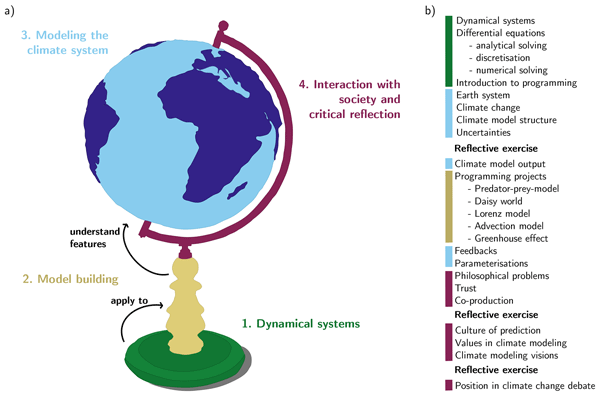
To strengthen the connection between the course topics in Figure 1 and the bullet points in page 2, I would suggest you change the bullet points to a numbered list, and use the same numbers for each line in the figure. The connection with the following figures is already clear thanks to the colours used.
L122: What are the modules which you foresee would trigger thought processes in teh students? I would recommend to strenghten the connection between this section and the course structure to avoid confusion. This paragraph is not also somewhat confusing as it remains ambiguous on which rounds of improvements did the course go through, when you implemented which improvements and why, and which course iteration are your results based on (I believe the results are 'just' from the 3rd iteration. But you mention this somewhat inconsistently throughout the text.
L142: Please mention what software (Nvivo, Atlas.ti…) you used for the qualitative coding. If no software was used, please also clarify by mentioning you coded the text manually.
The last paragraph of the methods section (starting at L156) would better belong to the discussion section.
Your results section would much benefit from the inclusion of a simple figure visualizing the course structure. This may be the figure you currently have in the annexes, or you could have in the main text a more simplified version of that image and leave the full one in the annexes. This would allow the reader to better grasp the different course components (and which course components where used for data collection and the results are based on) and your results would also become clearer. You may then also clarify when the reflective exercises took place throughout the course.
Please differentiate the two reflective exercises by calling them 1 and 2 or providing them a name to make sure their distinction is clear throughout the results and discussion sections. Clearly naming them in the new figure suggested above would also help with this. Similarly, it would be helpful if you could more clearly introduce when multiple discussion rounds were included in the reflective exercises (may also be included in the visualization if you deem fit).
L271: 'Informal conversations with students…' Can you provide more context here with your suggested explanation, and where possible referencing? Would also be interesting to know more about the impact of the changes implemented mentioned in L 278: Did your efforts help solving the issue? What do you/did the student deem 'a right balance' and why?
Technical comments:
I would recommend you start the conclusion section by reiterating what your research questions were and how you attempted to answer them through your paper, so to recontextualise your findings.
L214 will you include the index cards used and some of the constructed timelines (if available) in the annexes?
L228: What is a 'fish bowl discussion'? Please explain, as knowing more about the teaching techniques is definitively interesting for the audience reading his Journal.
Please state clearly whether the course content included in the annexes is that used through the 3rd iteration of the course. This can be mentioned throughout the manuscript and should be iterated in section 3.2.
L27 typo: you write GMCs instead of GCMs
L35 can you provide some referencing here on said scientific debate and/or discussion papers on modelling practices?
Citation: https://doi.org/10.5194/egusphere-2025-6313-RC2 - AC1: 'Reply on RC1 and RC2', Ulrike Proske, 01 Apr 2026
Peer review completion


Interactive discussion
Status: closed
-
RC1: 'Comment on egusphere-2025-6313', Anonymous Referee #1, 04 Feb 2026
In the article “Hello world! Teaching an interdisciplinary understanding of climate modelling”, the authors present a course developed for high-school students to introduce the technical and social considerations of climate modelling. They share learnings from the course organizers as well as from the students throughout the development process. As such, this article offers interesting insights into the considerations of designing an interdisciplinary course.
The authors do a great job in transparently sharing the intentions and potential biases that possibly affected the design and evaluation of the course. The article is well and comprehensively written but could benefit from some additional elaborations and reorganization in the methods and result section. Additionally, there are couple of minor aspects I would suggest to address to further enhance the flow and clarity of this interesting article:
- Title: I am wondering if the title of this article is capturing the essence of the article which seems less on the teaching process than the outline/structure of the course and the learnings by the students.
- l.4: worth mentioning the number of hours the course is designed for?
- l.25: the citation format seems incorrect (Ward (2021)..). Please correct throughout the article.
- l.25: allow to enter [the design and analysis process]?
- l.27: GCM instead of GMC
- l.44: It would be interesting to briefly reflect on the gap of such courses that combine the development aspects with critical thinking. I could imagine that there are couple of initiatives out there trying to address the gap the authors have argued.
- l.46: the period mentioned here is a bit confusing. In the methodology, the authors mention that the final evaluation of the course by means of the open reflection is done in 2024. But here the authors mention that the course has been taught 4 times. Even though that might be factually correct, I wonder if that is relevant for the purpose of this study which has the focus of reflecting on the learning process of students and the development of a course combining climate model development with critical thinking. Also see l. 243ff: this seems to be a sentence that could be well suited in the conclusion as an outlook, while keeping the main focus of the study on the period until 2024.
- Figure 1: I wonder if it could be useful to number the different themes in order of how approached in the course to improve the sequential logic in a figure which cannot just be read left > right, top > bottom? Check spelling errors (e.g. Dscretization)
- l.55-57: these lines seem repetitive, especially since similar information is shared just a couple lines later (l. 63-65).
- l.64: “… take part in the NAka program [each year]”
- l.65: The last piece of information the authors shared was that they taught the course four times. But now they only mention information regarding the 2024 course edition. This either needs to be justified better or captured more broadly. As the authors mention the iterative design process, it might be interesting to mention the numbers of the other years too.
- l.65: apart from mixed gender, does age also play a role?
- l.63ff: A complaint on high level, but I am wondering if the section would benefit from some reorganization. As it reads now, information about the general context of the academy and the specifics of the course(s) subject to this article is quite intertwined (e.g. l.64-65), limitations and ethical considerations are spread across the section (e.g. l. 69-70; l.79-80; l.154-155). An approach could be to be a bit more concise regarding the boundary conditions the academy offers followed by a more elaborate introduction to the course specifics.
- l.130ff: Did the authors also describe the method that led to the generation of figure 3? That seemed to be an additional reflection before / at the end of the course which is different from the module-related reflections?
- l.145: It is unclear what the authors mean by assessment cycle. Do they mean the different link to one of the modules? A bit later the authors talk about pre-existing labels. Which ones do they mean?
- l.145ff: I find this elaboration on the calibration of the coding unclear. The authors report that the confirmation aligned for at least one label for each of the inputs for 88% of the inputs. However, if I understand correctly, multiple groups of labels were applied (a priori vs. a posteriori; assessment cycle; topic).
- l.146: at this point it is unclear to judge whether the sample of 17 inputs is representative of the entire sample as the authors don’t provide information on the total amount of inputs that were coded. Just assuming every student provided one input for each reflection round, I would expect 5 times 2 times 17, so 170 inputs to be coded. This also links to the disclaimer by the authors that not all codes were considered for the analysis in the study. Do the authors intend to share the statements and their coding?
- l.156ff: in line with one of my earlier comments, this section on participant bias could be better integrated. It is currently presented as an afterthought not really linked to the previous paragraph.
- l.176: The authors use ‘theme’ in different, but aligned contexts (see also figure 1), which is a bit confusing to the reader. I also wonder if it might be more helpful to add figure 1 in this section than in the introduction as a representation of the dense description of the course contents. In line with later comments it could also be good to introduce the figure and its components as part of the methods to offer clear elaboration on the different components of the course.
- l.236: I just noticed here that somewhere between the introduction and the results, the authors start using the term science and technology studies (STS) content as a placeholder for certain aspects of the course. It might be helpful to clearly introduce or link these aspects to STS instead of keeping it implicit.
- Figure 2: This is an interesting representation. The colors don’t seem to be color-blind friendly (I checked on grey-scale). I have a couple of comments/questions:
- Reflections on Human influences seem to be only linked to introduced values. One could argue that values are also a source of uncertainty. Likewise, values link to the fact that science is not objective (how science works). Similar patterns could be identified across different categories (e.g. linked to parametrization and choices; errors and uncertainty). What I am aiming at is the question of how the authors justify the labels they chose, how they defined each of the categories to ensure they are clearly distinct.
- For a moment, I thought the authors have used the categories as mentioned in Figure 1, but this seems not the case strictly speaking (see e.g. complexity, model development etc.). I wonder if that could be helpful to make the boundaries clearer and offer a consistent set of aspects considered/discussed. It could for example also help show that some of the aspects of Figure 1 seem to be not represented in the reflections at all (e.g. greenhouse gas,…), which also shows where the focus of the course lies (or the focus of the things new to the students). If such an approach were used, it could still be important to introduce Figure 1 and the mentioned categories a bit more explicitly.
- Also, while the authors mention that they apply a red-blue color-coding, they also have grey and green(ish) colors, which seem (at least to me) to fall outside the promised color-scheme.
- Why are the bubbles of the same color not next to each other? It makes it more difficult to discover the relative importance of different labels. Also, if some of the statements are coded with up to 4 labels, it could be helpful to consider alternative visualization types, like Sankey or Circles, which also show linkages between different reflections and labels. It could even help to distinguish different levels of detail of the reflections.
- l.251-279: I would like to suggest the authors reconsider the structure of the first part of section 3.3. The emphasis in the text does not seem to align well with the emphasis in the figure 2. For example, the authors start by talking about visions as one of the prominent themes (which seems not to be one of the most important themes according to Figure 2). Instead, I would expect to first get some high-level interpretation of the figure highlighting biases regarding the amount/intensity of reflections between STS or model technicalities or the respective themes, especially when also taking into account how much time was dedicated to these themes during the course. I would also be curious why the authors chose to share some reflections on the theme of visions and not Climate model development, which seems to have received the most reflections according to Figure 2. I like the emphasis of a topic (how science works) which was not intended to arise during the course but seemed to keep the students busy anyways. In line with the discussion of the theme where students had most similar reflections (scenario manipulation), it could also be interesting to reflect on the theme where the reflections are most diverse.
- Figure 3: I again find this an interesting visualization. Similar comments as to Figure 2 apply regarding the design (color-palette). Some more comments:
- Some of these labels seem quite frank and plain (e.g. disappointed in physics’ unimportance”, “Some things are simple”). I was wondering if the authors have some reflections on these label-choices, their representativeness and value for the study, especially in the light of earlier discussed lack of obvious misconceptions.
- Spelling in caption: “The circles for “a[ ]priori””
Citation: https://doi.org/10.5194/egusphere-2025-6313-RC1 - AC1: 'Reply on RC1 and RC2', Ulrike Proske, 01 Apr 2026
-
RC2: 'Reply on RC1', Anonymous Referee #2, 04 Feb 2026
Thank you for inviting me to review this manuscript. The research presents an interesting example of a BSc level interdisciplinary course covering both the technical, conceptual and social aspects of climate modelling. The course has been taught multiple times already and was continuously improved by the authors through each iteration. In addition to the relevant course content, the authors also provide the results of an analysis of two key reflection exercises included in the third iteration of the course. The manuscript is well written and to the point. From my perspective, it should go through a round of minor revisions before being ready for publication. In particular, I would recommend the following minor improvements, which mostly aim at including clarity, particularly on the overall structure of the course and its phases:
Specific comments:
-I would recommend already mentioning how the course was taught to high school students (although it is at a BSc level) earlier in the manuscript, ideally in the introduction section already. From my perspective this further highlights how the course achieves to be both entry-level (no BSc level knowledge, or even coding, expected) and to reach the learning objectives you present.
L47 Here you also refer here to a 'generally small base of literature that explicitly treats the teaching of climate modelling': could you refer to some of this literature? There may be relevant previous publications from this Journal that could be useful for this.
To strengthen the connection between the course topics in Figure 1 and the bullet points in page 2, I would suggest you change the bullet points to a numbered list, and use the same numbers for each line in the figure. The connection with the following figures is already clear thanks to the colours used.
L122: What are the modules which you foresee would trigger thought processes in teh students? I would recommend to strenghten the connection between this section and the course structure to avoid confusion. This paragraph is not also somewhat confusing as it remains ambiguous on which rounds of improvements did the course go through, when you implemented which improvements and why, and which course iteration are your results based on (I believe the results are 'just' from the 3rd iteration. But you mention this somewhat inconsistently throughout the text.
L142: Please mention what software (Nvivo, Atlas.ti…) you used for the qualitative coding. If no software was used, please also clarify by mentioning you coded the text manually.
The last paragraph of the methods section (starting at L156) would better belong to the discussion section.
Your results section would much benefit from the inclusion of a simple figure visualizing the course structure. This may be the figure you currently have in the annexes, or you could have in the main text a more simplified version of that image and leave the full one in the annexes. This would allow the reader to better grasp the different course components (and which course components where used for data collection and the results are based on) and your results would also become clearer. You may then also clarify when the reflective exercises took place throughout the course.
Please differentiate the two reflective exercises by calling them 1 and 2 or providing them a name to make sure their distinction is clear throughout the results and discussion sections. Clearly naming them in the new figure suggested above would also help with this. Similarly, it would be helpful if you could more clearly introduce when multiple discussion rounds were included in the reflective exercises (may also be included in the visualization if you deem fit).
L271: 'Informal conversations with students…' Can you provide more context here with your suggested explanation, and where possible referencing? Would also be interesting to know more about the impact of the changes implemented mentioned in L 278: Did your efforts help solving the issue? What do you/did the student deem 'a right balance' and why?
Technical comments:
I would recommend you start the conclusion section by reiterating what your research questions were and how you attempted to answer them through your paper, so to recontextualise your findings.
L214 will you include the index cards used and some of the constructed timelines (if available) in the annexes?
L228: What is a 'fish bowl discussion'? Please explain, as knowing more about the teaching techniques is definitively interesting for the audience reading his Journal.
Please state clearly whether the course content included in the annexes is that used through the 3rd iteration of the course. This can be mentioned throughout the manuscript and should be iterated in section 3.2.
L27 typo: you write GMCs instead of GCMs
L35 can you provide some referencing here on said scientific debate and/or discussion papers on modelling practices?
Citation: https://doi.org/10.5194/egusphere-2025-6313-RC2 - AC1: 'Reply on RC1 and RC2', Ulrike Proske, 01 Apr 2026
Peer review completion
Journal article(s) based on this preprint
Data sets
Teaching materials for "Hello world! Teaching an interdisciplinary understanding of climate modelling" Ulrike Proske and Martin Staab https://doi.org/10.5281/zenodo.17791563
Viewed
| HTML | XML | Total | BibTeX | EndNote | |
|---|---|---|---|---|---|
| 1,386 | 993 | 141 | 2,520 | 88 | 105 |
- HTML: 1,386
- PDF: 993
- XML: 141
- Total: 2,520
- BibTeX: 88
- EndNote: 105
Viewed (geographical distribution)
| Country | # | Views | % |
|---|
| Total: | 0 |
| HTML: | 0 |
| PDF: | 0 |
| XML: | 0 |
- 1

Martin Staab
The requested preprint has a corresponding peer-reviewed final revised paper. You are encouraged to refer to the final revised version.
- Preprint
(7386 KB) - Metadata XML
In the article “Hello world! Teaching an interdisciplinary understanding of climate modelling”, the authors present a course developed for high-school students to introduce the technical and social considerations of climate modelling. They share learnings from the course organizers as well as from the students throughout the development process. As such, this article offers interesting insights into the considerations of designing an interdisciplinary course.
The authors do a great job in transparently sharing the intentions and potential biases that possibly affected the design and evaluation of the course. The article is well and comprehensively written but could benefit from some additional elaborations and reorganization in the methods and result section. Additionally, there are couple of minor aspects I would suggest to address to further enhance the flow and clarity of this interesting article: