
the Creative Commons Attribution 4.0 License.
the Creative Commons Attribution 4.0 License.
 | 05 Mar 2026
Vertical Structure and Driving Mechanism of PM2.5 and PM10 Aerosols in Hefei Based on LiDAR Observations (2021–2023)
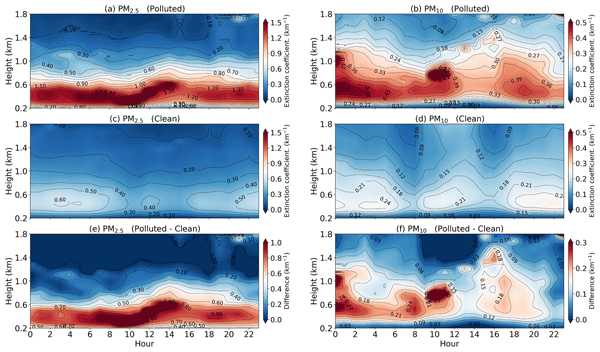
Abstract. Aerosol pollution remains a significant environmental concern in China. However, the vertical structure and evolution of particulate matter are poorly understood due to the lack of long-term, high-resolution observations. In Hefei, the aerosols during the study period were dominated by a mixture of fine particulate matter (PM2.5) and coarse particulate matter (PM10), mainly originating from urban traffic emissions, industrial activities, and regional transport, with significant contributions from secondary inorganic aerosols and occasional dust events. To address the knowledge gap in aerosol vertical distribution during different pollution episodes, this study employed an aerosol LiDAR system with 532 nm band to investigate the vertical profile characteristics of aerosols, with a focus on comparing the stratification differences of optical properties between PM2.5 and PM10 pollution events over Hefei across different periods and altitudes. The seasonal and diurnal variations of aerosol profiles were investigated, and vertical structures were compared on polluted and clean days. The relationship between near-surface particulate matter concentrations and aerosol stratification was analyzed, alongside the dynamic evolution of aerosol layers during typical pollution events. Our results demonstrated that the extinction coefficient (532 nm) of PM2.5-polluted days below 0.6 km was approximately three times that of PM10-polluted days. In contrast, the depolarization ratio of PM10-polluted episodes remains consistently higher than that of PM2.5-polluted cases throughout the entire observed altitude range. The differences in extinction between polluted and clean days for PM2.5 were most pronounced below 0.9 km and subsequently decreased as altitude increased, whereas the differences in PM10 remained significant below 1.2 km. For PM2.5, the strongest enhancement appeared between 7:00 and 14:00 (Beijing time, BJT). A subtle lifting with height was observed around midday. PM10-polluted days were characterized by a greater vertical extension of high aerosol extinction (reaching up to ~1.2–1.4 km) but a shorter duration of strong extinction, in contrast to PM2.5-polluted days, which exhibited a more persistent but vertically confined aerosol layer. PM10 pollutant tended to accumulate within the altitude range of 0.4–1.2 km on polluted days. The vertical wind shear (VWS) was weaker on PM2.5-polluted days compared to clean days. On PM10-polluted days, the VWS in the near-surface layer (1000–900 hPa) was significantly stronger than that on clean days, especially during the early morning and evening periods. The PM2.5 pollution in Hefei was mostly contributed by temperature inversion and high relative humidity, while PM10 pollution was driven by long-range transport of aerosol particles under the cold front system and dry conditions. These findings highlight the complex interactions between aerosol optical properties, boundary-layer dynamics, and synoptic-scale meteorology, providing new insights into the vertical processes governing air quality in eastern China.
-
Notice on discussion status
The requested preprint has a corresponding peer-reviewed final revised paper. You are encouraged to refer to the final revised version.
-
Preprint
(6529 KB)
-
Supplement
(2203 KB)
-
The requested preprint has a corresponding peer-reviewed final revised paper. You are encouraged to refer to the final revised version.
- Preprint
(6529 KB) - Metadata XML
-
Supplement
(2203 KB) - BibTeX
- EndNote
- Final revised paper


Journal article(s) based on this preprint
Interactive discussion
Status: closed
-
RC1: 'Comment on egusphere-2025-6302', Anonymous Referee #1, 19 Mar 2026
- AC1: 'Reply on RC1', Yan Yan, 16 Apr 2026
-
RC2: 'Comment on egusphere-2025-6302', Anonymous Referee #2, 20 Mar 2026
Manuscript #egusphere-2025-6302 titled “Vertical Structure and Driving Mechanism of PM2.5 and PM10 Aerosols in Hefei Based on LiDAR Observations (2021–2023)” employs the long-term aerosol LiDAR datasets, integrated with ground-based particulate matter monitoring, meteorological observations, and ERA5 reanalysis data, to investigate the vertical profile features and formation mechanisms of PM2.5 and PM10 pollution episodes in Hefei over 2021–2023. It examines the seasonal and diurnal evolution of key aerosol optical properties (extinction coefficient and depolarization ratio) across altitude layers, and contrasts the vertical distribution patterns between polluted and clean conditions for both fine and coarse particulate matter.
The multi-source data integration (LiDAR + ground monitoring + reanalysis) enables a robust exploration of how thermodynamic, dynamic, and synoptic-scale meteorological factors differentially modulate PM2.5 and PM10 pollution. This comparative approach effectively highlights the unique vertical dynamics and driving factors of fine versus coarse particles, offering a nuanced perspective on regional air pollution in eastern China. The research design is well-structured, and the analytical framework is scientifically sound. The findings provide actionable insights for targeted air quality management and forecasting in the Yangtze River Delta region, particularly in distinguishing the distinct pathways of PM2.5 and PM10 pollution formation. Overall, the manuscript meets the standards of this journal and delivers meaningful contributions to the field of aerosol vertical observation and pollution mechanism research. I recommend acceptance for publication subject to minor revisions.
Major queries:
- Abstract and Introduction
-L52- The statement “most studies have focused on surface-level air pollution data obtained from ground monitoring networks” is somewhat vague. It would strengthen the context if the authors could briefly specify which types of pollutants or regions these prior studies primarily focused on (e.g., PM2.5 in eastern China, urban air quality in megacities), to better highlight the specific knowledge gap that the present study aims to address regarding aerosol vertical distribution.
-L114- The authors clearly listed four detailed research objectives of this study. It is suggested to briefly state the novelty or main contribution of this work compared with previous studies in the same region, so that readers can more clearly understand the importance of the present study.
- Data and methods
-L140- “The monitoring station is marked by the blue dot.” Where is the blue dot?
-L144- Please clarify whether the present study solely relies on the 532 nm band for aerosol retrieval and analysis. If the data presented in the manuscript are exclusively derived from the 532 nm channel, any discussion of the 355 nm and 1064 nm channels should be removed from the text, as these additional bands do not contribute to the reported results. This will ensure the accuracy and integrity of the methodological description.
-L173- Are PM2.5 and PM10 both obtained from the LGH‑01B monitor? The description of the instrument is repetitive and wordy.
-L171- The authors mention “hourly concentrations of major air pollutants (PM2.5 and PM10)”. Since only PM2.5 and PM10 are used and analyzed in this study, please clarify whether other air pollutants were also included in the analysis. If no other pollutants were used, the word “major” is inappropriate and misleading, and the description should be revised to clearly state that only PM2.5 and PM10 were adopted.
-In Section 2.5. Quality control, what is the temporal resolution (hourly or minute-level) of the LiDAR and ground-based data after quality control for the subsequent analysis in this study?
-L217- For the efficient detection ranges of the extinction coefficient and depolarization ratio, it is suggested to retain 1 or 2 decimal places for the numerical values.
- Results and discussion
-L270- The concentration of clean days is in the range of 50–70 μg/m³ is not sufficiently accurate, as the pollutant concentration on clean days can vary over a wide range and even reach around 100 μg/m³ in some cases. Do you mean the hourly mean concentration (the solid line in Fig.3b) by this range description? Please clarify and revise the relevant textual expression for accuracy.
-The results presented in Figures 5 and 6 are very informative and clearly illustrate the vertical distribution of aerosols during different periods. However, in Figure 6, why does the depolarization ratio for PM10-polluted days show a distinct peak at noon? Please provide a clear physical explanation for this diurnal pattern.
-L462- change "showed reduced values" to "was markedly decreased"
-L465- The depolarization ratio of PM2.5-polluted days showed reduced values at the peak of the extinction coefficient. Does this indicate an inverse relationship between the extinction coefficient and the depolarization ratio? The manuscript lacks a clear, detailed explanation of the physical meaning of these two key aerosol optical properties.
-L491- All physical quantities should be explicitly labeled with their corresponding units to ensure standardization in data presentation.
-Figure 14- The purpose of calculating the differences between polluted and clean days is not clarified.
-Figure 11- The title contains redundant expressions because three-hourly is used twice. Please revise it.
-L576- The comparison is redundant and inconsistent. "Clear days" should be unified with the term "clean days" used elsewhere in the manuscript. Please revise to remove the repetitive comparison (e.g., "subsidence at 500 hPa is significantly stronger than on clean days").
Minor suggestions:
-L332- delete (532 nm
-L459- delete “a.m”
-L521- 850 hPa (not 850 hpa)
-L577- delete “However,”
-change “PM10 accumulation” to “the accumulation of ” The accumulation of PM10”
Citation: https://doi.org/10.5194/egusphere-2025-6302-RC2 - AC2: 'Reply on RC2', Yan Yan, 16 Apr 2026


Interactive discussion
Status: closed
-
RC1: 'Comment on egusphere-2025-6302', Anonymous Referee #1, 19 Mar 2026
General comments
This study investigates the vertical distribution characteristics of atmospheric aerosols in Hefei using a ground-based aerosol lidar system. It effectively compares optical properties between PM2.5 and PM10 pollution events with sufficient data support. The authors systematically present on the advantages and limitations of the aerosol LiDAR. The integration of LiDAR observations with surface particulate matter monitoring and meteorological data (e.g., vertical wind shear, temperature inversion, relative humidity) strengthens the rigor of the analysis, allowing for a comprehensive exploration of the links between aerosol vertical properties and pollution formation mechanisms.
The research design is reasonable, and the conclusions are scientific and reliable. The results reveal the formation mechanisms of the two types of pollution and fill the research gap in aerosol vertical distribution, providing valuable insights for air quality research in eastern China. This studycould enhance our understanding of how vertical aerosol dynamics regulate surface air quality, which is critical for improving air quality forecasting and formulating targeted pollution control strategies. In the context of increasingly frequent regional air pollution events in eastern China, the detailed vertical profile data and comparative analysis of PM2.5 and PM10 presented here provide a new perspective for distinguishing the distinct drivers of fine and coarse particulate pollution.
The supplementary materials are highly valuable for readers to further understand the observational data and analytical results. Nevertheless, several minor issues still need to be addressed to improve readability. The font size in some figures is too small to distinguish clearly, which affects reading efficiency. In addition, a few technical terms are used inappropriately in certain contexts, and some descriptions are unnecessarily repetitive across different sections. These redundant expressions can be further condensed and polished to enhance the conciseness and fluency of the manuscript. I favor publishing this manuscript in Atmospheric Measurement Techniques after minor revisions.
Specific comments
- The abstract is overly lengthy and lacks conciseness. Please condense it to highlight the core issue, key methodologies, and most critical findings, ensuring it meets the standard word count for the journal.
- Line 23: “The relationship between near-surface particulate matter concentrations and aerosol stratification was analyzed, alongside the dynamic evolution of aerosol layers during typical pollution events.” Please clarify whether the analysis of the aforementioned relationship is presented in Figure 8 or 9 of the manuscript. Note that "aerosol stratification" is an appropriate expression if the analysis corresponds to Figure 8, which divides the atmosphere into three distinct vertical layers: 0.2–0.5 km, 0.5–1.0 km, and above 1.0 km. However, this term is not suitable for Figure 9, which shows continuous vertical variations. For Figure 9, a description referring to aerosol properties at different heights would be more accurate.
- Line 82-84:The authors mention that polarization-sensitive aerosol LiDAR can retrieve extinction coefficients and depolarization ratios, which indicate aerosol concentration, morphology, and type, and note that most previous LiDAR-based studies are limited to short-term campaigns or individual pollution episodes lacking spatial and temporal representativeness. Please clarify whether the present study uses polarization‑sensitive LiDAR. Additionally, the authors use the term “spatial and temporal representativeness / spatiotemporal” at Lines 91 and 104, but ground-based LiDAR observations inherently have strong advantages in temporal continuity and vertical resolution, not in spatial coverage. It is recommended that the authors revise this phrasing to more accurately reflect the actual strengths and limitations of LiDAR data (e.g., by emphasizing “long-term temporal continuity and seasonal representativeness” rather than “spatial and temporal representativeness”), to avoid overstating the spatial representativeness of single-site LiDAR measurements.
- Line 143-144: The authors state that the LGJ-05 LiDAR operates at 355 nm, 532 nm, and 1064 nm wavelengths.Please clarify whether all three bands were used in this study, or only the 532 nm channel was employed.If only 532 nm data were analyzed, the description of the other two wavelengths is unnecessary and should be removed to avoid misunderstanding.
- Line 143& Line 162:Line 143 and Line 162 both describe the LGJ-05 LiDAR and its three laser wavelengths (355 nm, 532 nm, 1064 nm). These two descriptions are duplicated and redundant.
- Line178: The study includes observations from two seasons: winter and spring. Please clearly state which seasons are used in the analysis, and specify whether the comparisons between PM5 and PM10 pollution episodes are based on winter, spring, or both seasons. It is recommended to use the word "respectively" to clearly define the corresponding relationship between seasons and pollution types in the text.
- Line 198:The ERA5 reanalysis data used in this study covers the period 2021–2023, while the surface pollutant data only includes winter and spring during 2021–2023.Please clarify whether the ERA5 data were extracted and analyzed for the same period (winter and spring) as the pollutant data. This information should be clearly stated in the data and methodology section.
- Line 207-208: It is mentioned that outliers were removed according to the parameter intervals provided by the instrument.However, what specific normal value ranges or thresholds were applied for each parameter (extinction coefficient and depolarization ratio) remains unclear.
- Line 233: The term VWS bulk is used in the study, but it is not clearly defined or explained.
- Line 248: Clarify the referent of "the PM5/PM10 ratio" by adding a modifier (e.g., "the local PM2.5/PM10 ratio in Hefei") to improve the accuracy of expression.
- Line: What is the physical reason for the decreasing extinction coefficient and increasing depolarization ratio with increasing altitude in Figure 4? Please provide a clear physical explanation and cite relevant literature to support this observed vertical profile pattern.
- Line 324: The phrase “During this period…” is ambiguous in this sentence. It is unclear which specific period you are referring to.
- Figure 5: Why does the aerosol layer rise at noon? What is the reason for this vertical uplift?
- In the title of Figure 5, the letter labels are mixed in upper and lower case. Please change (E, F) to (e, f) to keep the notation consistent.
- Figure 5:Why is the extinction coefficient for PM10 smaller than that for PM5?
- Line 413-414: The statement that “extinction values show limited diurnal variability above 1 km” is misleading.The apparent weak variation is likely caused by using a fixed, consistent Y‑axis scale across panels, not by genuinely small diurnal changes.
- Line 432: “PM5 and PM10 concentrations” instead of “PM2.5 and PM10”
- Line 438: It is stated that the depolarization ratio was negatively correlated with PM5 concentration below 0.9 km on polluted days. Why does a negative correlation exist in this layer, and clarify whether you mean the correlation coefficient becomes more negative (i.e., a stronger negative correlation) with increasing PM2.5.
- Line 497: The phrase "Henan, and even further north" lacks clarity regarding the administrative scope. Please add "Province" to specify the region.
- Line 457-502: The relationships between meteorological factors (temperature, pressure, humidity, wind) and pollutant concentrations have been widely reported in previous studies. Although these factors are necessary for analyzing the driving mechanisms, the detailed description is not required. Simplify this section to make it more concise.
- Line 508: " was " instead of " WAS "
- Revise the non-standard pressure unit "hpa" to the normative "hPa" (capital P).
- Line 521: "00:00 am" is inappropriate in academic writing. "00:00" inherently denotes midnight, so "am" is redundant.
Citation: https://doi.org/10.5194/egusphere-2025-6302-RC1 - AC1: 'Reply on RC1', Yan Yan, 16 Apr 2026
-
RC2: 'Comment on egusphere-2025-6302', Anonymous Referee #2, 20 Mar 2026
Manuscript #egusphere-2025-6302 titled “Vertical Structure and Driving Mechanism of PM2.5 and PM10 Aerosols in Hefei Based on LiDAR Observations (2021–2023)” employs the long-term aerosol LiDAR datasets, integrated with ground-based particulate matter monitoring, meteorological observations, and ERA5 reanalysis data, to investigate the vertical profile features and formation mechanisms of PM2.5 and PM10 pollution episodes in Hefei over 2021–2023. It examines the seasonal and diurnal evolution of key aerosol optical properties (extinction coefficient and depolarization ratio) across altitude layers, and contrasts the vertical distribution patterns between polluted and clean conditions for both fine and coarse particulate matter.
The multi-source data integration (LiDAR + ground monitoring + reanalysis) enables a robust exploration of how thermodynamic, dynamic, and synoptic-scale meteorological factors differentially modulate PM2.5 and PM10 pollution. This comparative approach effectively highlights the unique vertical dynamics and driving factors of fine versus coarse particles, offering a nuanced perspective on regional air pollution in eastern China. The research design is well-structured, and the analytical framework is scientifically sound. The findings provide actionable insights for targeted air quality management and forecasting in the Yangtze River Delta region, particularly in distinguishing the distinct pathways of PM2.5 and PM10 pollution formation. Overall, the manuscript meets the standards of this journal and delivers meaningful contributions to the field of aerosol vertical observation and pollution mechanism research. I recommend acceptance for publication subject to minor revisions.
Major queries:
- Abstract and Introduction
-L52- The statement “most studies have focused on surface-level air pollution data obtained from ground monitoring networks” is somewhat vague. It would strengthen the context if the authors could briefly specify which types of pollutants or regions these prior studies primarily focused on (e.g., PM2.5 in eastern China, urban air quality in megacities), to better highlight the specific knowledge gap that the present study aims to address regarding aerosol vertical distribution.
-L114- The authors clearly listed four detailed research objectives of this study. It is suggested to briefly state the novelty or main contribution of this work compared with previous studies in the same region, so that readers can more clearly understand the importance of the present study.
- Data and methods
-L140- “The monitoring station is marked by the blue dot.” Where is the blue dot?
-L144- Please clarify whether the present study solely relies on the 532 nm band for aerosol retrieval and analysis. If the data presented in the manuscript are exclusively derived from the 532 nm channel, any discussion of the 355 nm and 1064 nm channels should be removed from the text, as these additional bands do not contribute to the reported results. This will ensure the accuracy and integrity of the methodological description.
-L173- Are PM2.5 and PM10 both obtained from the LGH‑01B monitor? The description of the instrument is repetitive and wordy.
-L171- The authors mention “hourly concentrations of major air pollutants (PM2.5 and PM10)”. Since only PM2.5 and PM10 are used and analyzed in this study, please clarify whether other air pollutants were also included in the analysis. If no other pollutants were used, the word “major” is inappropriate and misleading, and the description should be revised to clearly state that only PM2.5 and PM10 were adopted.
-In Section 2.5. Quality control, what is the temporal resolution (hourly or minute-level) of the LiDAR and ground-based data after quality control for the subsequent analysis in this study?
-L217- For the efficient detection ranges of the extinction coefficient and depolarization ratio, it is suggested to retain 1 or 2 decimal places for the numerical values.
- Results and discussion
-L270- The concentration of clean days is in the range of 50–70 μg/m³ is not sufficiently accurate, as the pollutant concentration on clean days can vary over a wide range and even reach around 100 μg/m³ in some cases. Do you mean the hourly mean concentration (the solid line in Fig.3b) by this range description? Please clarify and revise the relevant textual expression for accuracy.
-The results presented in Figures 5 and 6 are very informative and clearly illustrate the vertical distribution of aerosols during different periods. However, in Figure 6, why does the depolarization ratio for PM10-polluted days show a distinct peak at noon? Please provide a clear physical explanation for this diurnal pattern.
-L462- change "showed reduced values" to "was markedly decreased"
-L465- The depolarization ratio of PM2.5-polluted days showed reduced values at the peak of the extinction coefficient. Does this indicate an inverse relationship between the extinction coefficient and the depolarization ratio? The manuscript lacks a clear, detailed explanation of the physical meaning of these two key aerosol optical properties.
-L491- All physical quantities should be explicitly labeled with their corresponding units to ensure standardization in data presentation.
-Figure 14- The purpose of calculating the differences between polluted and clean days is not clarified.
-Figure 11- The title contains redundant expressions because three-hourly is used twice. Please revise it.
-L576- The comparison is redundant and inconsistent. "Clear days" should be unified with the term "clean days" used elsewhere in the manuscript. Please revise to remove the repetitive comparison (e.g., "subsidence at 500 hPa is significantly stronger than on clean days").
Minor suggestions:
-L332- delete (532 nm
-L459- delete “a.m”
-L521- 850 hPa (not 850 hpa)
-L577- delete “However,”
-change “PM10 accumulation” to “the accumulation of ” The accumulation of PM10”
Citation: https://doi.org/10.5194/egusphere-2025-6302-RC2 - AC2: 'Reply on RC2', Yan Yan, 16 Apr 2026
Peer review completion


Journal article(s) based on this preprint
Viewed
| HTML | XML | Total | Supplement | BibTeX | EndNote | |
|---|---|---|---|---|---|---|
| 860 | 322 | 88 | 1,270 | 257 | 48 | 98 |
- HTML: 860
- PDF: 322
- XML: 88
- Total: 1,270
- Supplement: 257
- BibTeX: 48
- EndNote: 98
Viewed (geographical distribution)
| Country | # | Views | % |
|---|
| Total: | 0 |
| HTML: | 0 |
| PDF: | 0 |
| XML: | 0 |
- 1
Yan Yan
Xueliang Deng
Rui Dai
Qianqian Xu
Qinqin Huang
Yang Liu
Chunxuan Wei
Jinhua Xie
Yanfeng Li
Yan Sun
The requested preprint has a corresponding peer-reviewed final revised paper. You are encouraged to refer to the final revised version.
- Preprint
(6529 KB) - Metadata XML
-
Supplement
(2203 KB) - BibTeX
- EndNote
- Final revised paper
General comments
This study investigates the vertical distribution characteristics of atmospheric aerosols in Hefei using a ground-based aerosol lidar system. It effectively compares optical properties between PM2.5 and PM10 pollution events with sufficient data support. The authors systematically present on the advantages and limitations of the aerosol LiDAR. The integration of LiDAR observations with surface particulate matter monitoring and meteorological data (e.g., vertical wind shear, temperature inversion, relative humidity) strengthens the rigor of the analysis, allowing for a comprehensive exploration of the links between aerosol vertical properties and pollution formation mechanisms.
The research design is reasonable, and the conclusions are scientific and reliable. The results reveal the formation mechanisms of the two types of pollution and fill the research gap in aerosol vertical distribution, providing valuable insights for air quality research in eastern China. This studycould enhance our understanding of how vertical aerosol dynamics regulate surface air quality, which is critical for improving air quality forecasting and formulating targeted pollution control strategies. In the context of increasingly frequent regional air pollution events in eastern China, the detailed vertical profile data and comparative analysis of PM2.5 and PM10 presented here provide a new perspective for distinguishing the distinct drivers of fine and coarse particulate pollution.
The supplementary materials are highly valuable for readers to further understand the observational data and analytical results. Nevertheless, several minor issues still need to be addressed to improve readability. The font size in some figures is too small to distinguish clearly, which affects reading efficiency. In addition, a few technical terms are used inappropriately in certain contexts, and some descriptions are unnecessarily repetitive across different sections. These redundant expressions can be further condensed and polished to enhance the conciseness and fluency of the manuscript. I favor publishing this manuscript in Atmospheric Measurement Techniques after minor revisions.
Specific comments