
the Creative Commons Attribution 4.0 License.
the Creative Commons Attribution 4.0 License.
 | 12 Jan 2026
Phytoplankton community structure responses to episodic summer storms in a temperate coastal ecosystem
Abstract. Extreme events potentially modify the physical and biogeochemical environment resulting in dramatic changes of phytoplankton community structure. In this study the impact of 10 well identified storms on phytoplankton communities was explored in a productive coastal temperate ecosystem, the eastern English Channel (EEC). We focussed in summer because it is a low nutrient season where phytoplankton major shifts and blooms are not expected. Low-frequency (weekly to fortnightly) flow cytometry measurements of phytoplankton abundance were combined with high-frequency meteorological data (precipitation and wind) and hydrological records from 2012 to 2022. Storm impacts occurred in three distinct forms: high river inflow events, high wind stress–low inflow events, and low wind stress–low inflow events. High inflow storms, whether accompanied by weak or strong winds, promote coastal advection of riverine plumes enriched in nutrients, sustaining diatom dominance and, under high wind stress, favouring nano-sized phytoplankton (nanophytoplankton and cryptophytes). In contrast, low inflow conditions limit riverine nutrient supply, shifting reliance to regenerated nutrients from vertical mixing. When combined with strong winds, these conditions support nanophytoplankton growth, while short, low-wind storms favour pico-sized phytoplankton (Synechococcus spp. and picoeukaryotes). Across years, storms repeatedly reset seasonal succession and maintained environmental heterogeneity, leading to transient monospecific peaks of phytoplankton. These findings highlight storms as recurrent structuring forces in the EEC, mediating nutrient availability and driving shifts in phytoplankton composition across the summer months.
-
Notice on discussion status
The requested preprint has a corresponding peer-reviewed final revised paper. You are encouraged to refer to the final revised version.
-
Preprint
(4017 KB)
-
The requested preprint has a corresponding peer-reviewed final revised paper. You are encouraged to refer to the final revised version.
- Preprint
(4017 KB) - Metadata XML
- BibTeX
- EndNote
- Final revised paper


Journal article(s) based on this preprint
Interactive discussion
Status: closed
-
RC1: 'Comment on egusphere-2025-6235', Anonymous Referee #1, 02 Apr 2026
-
AC1: 'Reply on RC1', Harshal Chavan, 26 May 2026
Reply to Referees’ Comments
1 Referee 1 comments (RC1)
General Comments
This manuscript provides a unique assessment of phytoplankton responses to different disturbances, here classified as storm events that induce changes in aerial, fluvial, and pluvial regimes, to directly identify the consequences of physical perturbations on the underlying biology of marine systems. Another positive point is the inclusion of different marine areas (coastal vs. open waters) and, in part, the chemical bases (nutrients). I personally find that the efforts reported in this work could be an elegant way to conceptualize the challenging dynamics of blooms. In this regard, I see the authors’ work as a potentially very interesting paper worthy of publication, but at this stage it still requires some polishing, given the number of typos and the need to better structure the methodology section.
We thank the reviewer for the positive remarks and for recognizing the effort invested in this work. We are grateful for the time spent to provide detailed and constructive comments that have improved the manuscript. We have addressed all comments, and the manuscript has been modified accordingly.
To facilitate the review process, all the references to Lines below correspond to the revised non-annotated version.
1 Specific Comments
Abstract
“We focussed in summer because it is a low nutrient season where phytoplankton major shifts and blooms are not expected.”
This sounds counterintuitive. Why would you study plankton shifts when they are not expected to happen?
This sentence was modified into:
“Our study targeted the summer season, which is typically characterised by low nutrient availability, yet transient phytoplankton blooms often occur.” Lines 10–11.
“…phytoplankton abundance were combined with high-frequency meteorological data (precipitation and wind) and hydrological records from 2012 to 2022.”
Hydrological records include several parameters, and as I understand it, you consider only water levels? If that is so, adjust it accordingly.
The sentence is corrected and now reads :“From 2012–2022, low‑frequency (weekly to fortnightly) flow cytometry measurements of phytoplankton abundance were combined with high‑frequency meteorological data (precipitation and wind) and river flow rates as a proxy for riverine influence.” Lines 11–13
“… nano-sized phytoplankton (nanophytoplankton and cryptophytes).” Why are cryptophytes not included in nanophytoplankton? And why do you make this distinction: nano-sized vs nanophytoplankton?
Apologies for the confusion. The parenthetical phrase has been removed in the revised manuscript (Line 17). To avoid confusion, we now use the term nanophytoplankton consistently throughout the text, and cryptophytes are explicitly treated as part of the nanophytoplankton group.
“High inflow storms, whether accompanied by weak or strong winds, promote coastal advection of riverine plumes enriched in nutrients, sustaining diatom dominance and, under high wind stress, favouring nano-sized phytoplankton (nanophytoplankton and cryptophytes). In contrast, low inflow conditions limit riverine nutrient supply, shifting reliance to regenerated nutrients from vertical mixing. When combined with strong winds, these conditions support nanophytoplankton growth,….” High-inflow-strong-wind has the same effect as low-inflow-strong-wind? Please clearly identify the differences and similarities among storms.
The sentence is corrected as follows:
“Regardless of wind conditions, high inflow storms favoured diatoms, as nutrient-rich river plumes supported their growth. In contrast, low inflow events paired with strong winds enhanced vertical mixing and nutrient availability, favouring nanophytoplankton. Finally, weak winds and relatively low-nutrient conditions favoured picophytoplankton (Synechococcus and picoeukaryotes).” Lines 15-18
We hope it is clearer now.
“These findings highlight storms as recurrent structuring forces in the EEC, mediating nutrient availability and driving shifts in phytoplankton composition across the summer months.” Could you say something about the use of your findings in, e.g., prediction models? Storm prognoses might be an important input to prediction models for phytoplankton.
Your suggestion is now added it reads:
“These findings highlight storms as recurrent structuring forces in the EEC, mediating nutrient availability and driving shifts in phytoplankton composition; as such, storm-driven dynamics might be an important input to prediction models for phytoplankton.” Lines 20–22.
Introduction
“The coastal marine ecosystems are vulnerable to changes in weather patterns and various extreme events, such as storms and heatwaves.” Extreme events are also changes in weather patterns. Please, modify your statement.
Corrected. It reads now. “Coastal marine ecosystems are vulnerable to changes in weather patterns, particularly extreme events such as storms and heatwaves.” Lines 24–25.
“At higher latitudes, storm forcing has been associated with enhanced primary productivity; for example, Pozdnyakov et al., (2014) observed appreciable Chl-a increase in oligotrophic Arctic waters within days of a cyclone, while Crawford et al., (2020) reported elevated net primary production in inflow regions such as the Barents and southern Chukchi Seas. Despite these insights, the responses of rapidly changing temperate and high-latitude coastal seas to extreme events remain poorly resolved…” Why do you say that, if the research you cite is tackling polar regions and not temperate regions?
Our intention was to highlight that extratropical storm influence both polar and temperate regions; however, most existing research has examined their effects on primary production and chlorophyll-a in polar environments. This text was modified, we hope it is clear now.
“While studies in polar environments have observed appreciable Chl-a increases in oligotrophic Arctic waters (Pozdnyakov et al., 2014) and elevated primary production in regions like the Barents and southern Chukchi Seas (Crawford et al., 2020) following cyclones, the influence of such storms in coastal temperate waters remains poorly documented.” Lines 30–34
“The English Channel is a temperate coastal sea generally characterized by strong atmospheric frontal activity and frequent extratropical storms, occasionally accompanied by thunderstorms. These systems typically originate in the North Atlantic and track towards north-western Europe…” This is a new paragraph, and it lacks the smooth transition to the study area. You could start with something like: Here we focus on the English Channel etc. State clearly which systems you refer to? Coastal seas? Modify the sentence to represent more clearly what you want to communicate.
Replaced by:
"In this context, we focus on the eastern English Channel (EEC), a temperate coastal sea characterized by strong atmospheric frontal activity and frequent extratropical storms. Extratropical storms typically originate in the North Atlantic and track toward north-western Europe, exerting significant physical forcing on the region's coastal waters.” Lines 37–40
“…eastern English Channel (EEC) is characterized by a nutrient-rich regime, particularly with an excess.“ Provide a reference demonstrating that. So far, you have only assumed that the nutrients are present and have used other parameters (e.g., a phytoplankton bloom) as indicators to support that claim. Cite the reference that claims this is a nutrient-rich area.
We have added supporting references (Dulière et al., 2019; Loquet et al., 2000) to substantiate this statement. Revised sentence is now “Within the English Channel, the EEC is characterized by a nutrient-rich regime (Dulière et al., 2019; Lefebvre et al., 2011), particularly with an excess of nitrogen originating mainly from local rivers (e.g., the Somme; Loquet et al., 2000).” Lines 43–45
“The phytoplankton community was characterized using size-based functional groups derived from flow cytometry along a coastal–offshore gradient in the Strait of Dover, known as the DYPHYRAD (Dynamics of PHYtoplankton on RADiale) transect (Hubert et al., 2025b) by the Strait of Dover. The dataset comprises 1835 samples collected on 268 dates during a ten-year survey (2012–2022). Storm characterization was based on Météo-France meteorological data (wind and precipitation) from the Boulogne-Sur-Mer station (https://meteo.data.gouv.fr/) and river discharge records from Eaufrance (https://www.eaufrance.fr/) near the DYPHYRAD transect.” Reduce the text and move parts to M&M.
We have reduced the description of the dataset in the introduction and moved methodological details (sampling frequency, number of samples, data sources, and URLs) to the Methods section Lines 106, 137 and 151.
The end of the introduction now reads:
“A 10-year dataset (2012–2022) was used to evaluate biological responses alongside local meteorological forcing and riverine inputs. The phytoplankton community was characterized using functional groups derived from flow cytometry along a coastal-offshore gradient in the Strait of Dover, known as the DYPHYRAD (Dynamics of PHYtoplankton on RADiale) transect (Hubert et al., 2026).” Lines 66–70.
Materials and Methods
“… receives substantial nutrient inputs from multiple estuaries…“. You can claim that if you provide evidence for it, e.g., a citation, whereas a figure (map) you cite only shows that there are lots of rivers, but not what they carry.
Thank you for your remark. We added citation and fixed the sentence and deleted reference to the figure 1: “and receives substantial nutrient inputs from multiple estuaries along the Picardy and Opale coasts, most notably the Seine and Somme rivers (Huguet et al., 2024).” Lines 75–76
“Chl-a concentrations were measured…” At which depth?
“2.3 Phytoplankton abundance” Sampling depth was not indicated.
The information is now found in one sentence:
“Subsurface water samples (1–2 m depth) were collected along the DYPHYRAD transect to measure Chl-a, nutrients and phytoplankton abundance.” Lines 94–95.
“ Phytobs stations located …. Additional datasets from SOMLIT stations C and L were used to compare pico‑ and nano‑phytoplankton abundances with DYPHYRAD observations. These complementary observations were not included in the statistical analysis.” This part talks about microscopy? Where is the protocol for sampling, sample fixation, and analysis? You mentioned that you do not use this data (likely microscopy counts) for statistics, but what did you use it for? Maybe you have stated that, but it is not clearly written. Thus, adjust the text accordingly and add all the details: which net was deployed, at which depth, fixatives…
The reviewer is right, this is now clarified in the revised text: “PHYTOBS microscopy data (https://www.phytobs.fr/en) were used only to check for the species related to the observed phytoplankton blooms, while SOMLIT flow‑cytometry data (https://www.somlit.fr/) provided complementary estimates of Chl-a and pico‑ and nano -phytoplankton for comparison with the DYPHYRAD transect (see Fig.1 for the locations). All samples from both networks were collected at sub‑surface (1–2 m).” Lines 120–125
“Table 1. Sampling stations and associated spatial, temporal, and sampling characteristics.” For what did you sample? Just flow cytometry or microscopy, too?
New legend:
Sampling station characteristics.
We agree that it was confusing, we removed from the table 1 SOMLIT and PHYTOBS since the data that were downloaded from the relative databases were only used in the discussion section as described in M+M. Lines 125–127
Table 2. “Coccolithophores, and some autotrophs and armoured dinoflagellates”, what do you mean by some autotrophs? Then you also write: “Diatoms, and other microphytoplankton”, which other microphytoplankton are you referring to?
We apologise for the incomplete information, we recognise that haptophytes are nano-neukaryotes and “some autotrophs” does not make sense; We corrected Table 2 according to Hubert et al. (2026), as follows:
The RedNano cluster is now described as “nanoeukaryotes including haptophytes”, which in the English Channel and North Sea predominantly represent different life stages of Phaeocystis globosa. The HsNano cluster is defined as “coccolithophorids”. Finally, the microphytoplankton group is described as diatoms, with the possibility of including some dinoflagellates and Phaeocystis globosa.
“Storm events in this study were identified as periods when wind speeds exceeded the 90th percentile (Fig. A1) (11.3 m s−1). Storm length was initially identified as the ±3‑day period surrounding the peak wind speed day, with day 3 designated as the storm day.” This should be the initial statement in this paragraph. First, introduce what storms are, then explain the rest. In addition, Fig. A1 shows the results and thus cannot be cited as such. Throughout the following methodology, you refer to numerous figures from the results, e.g., Figs. 3-7 and A1-C. These must be changed, and in addition, every figure/table should be cited in a numerical order; now, you cite Fig. 3 before Fig. 2.
We have revised the paragraph so that it begins with the definition of how storm events were identified. We now introduce the storm criteria first, followed by the description of the ±3‑day window used to characterize storm length. Lines 133–135.
In addition, we removed all references to figures that present results (e.g., Fig. A1 and Figs. 3–7) from the Methods section, as these should not be cited in methodological descriptions. Finally, we corrected the order of figure citations throughout the manuscript to ensure numerical consistency.
“We expect phytoplankton to respond rapidly to changes in nutrient availability.” Why? Elaborate. The summer composition of phytoplankton inevitably includes many mixotrophs and heterotrophs that are already adapted to acquire nutrients in organic form. Why would you expect that such a community would have a rapid response to an inorganic surplus?
The sentence has been removed from the revised manuscript, as it was not appropriate for the Materials and Methods section. The mechanisms linking nutrient pathways to phytoplankton community responses are now addressed in the Discussion, where we examine these processes in the context of our results.
“In the study area, river plumes are transported under the influence of prevailing south–westerly winds.” Is there a reference supporting this claim?
The references are now added. (Brylinski et al., 1991, 1996). Lines 153-154
“Consequently, the River Slack and the Wimereux estuary affect water chemistry along the transect earlier than other estuaries in the region (Fig. 1), thereby initiating changes in community structure.” Slack is located north of the transect. If you apply what you explain here: SW winds, it means that their direction will be NE. How can the River Slack then be important or affect the transect? Moreover, why do you say that the River Slack is affecting the chemistry and the Wimereux estuary? Does that include more rivers? Why not just Wimereux River?
We have clarified the rationale for including both the River Slack and the Wimereux estuary when describing local riverine influence. Although the Slack lies north of the transect, its close proximity means that its freshwater signal can occasionally reach the study area under specific hydrodynamic conditions, such as strong tidal mixing, southward tidal flow during the ebb phase (NE–SW; Brylinski et al., 1991), or short‑lived wind reversals. For this reason, we used the Slack and Wimereux rivers as practical indicators of immediate local riverine inputs affecting water chemistry near the transect. The text has been revised to make this reasoning explicit and to avoid over‑interpreting the role of individual rivers.
Revised sentence: “Because of their close proximity to the transect, the Wimereux and Slack rivers were used as indicators of local riverine influence on water chemistry. Although the Slack lies north of the transect, strong tidal mixing, wind reversals, and the NE–SW ebb‑directed tidal flow (Brylinski et al., 1991) can transport its freshwater signal into the study area.” Lines 154–157
“…number of windy days (wind speed > 8 m s−1) and average river inflow (m3 s−1)…” Unless this is stating the methods/protocols applied, the M&M should be devoid of any results. Please explain why these numbers were chosen.
We agree that these values should not appear in the Materials and Methods, as they represent part of the results rather than the methodological protocol, and we have therefore removed them. To clarify their purpose, the number of windy days (defined as days with wind speed > 8 m s−1) was used as a proxy for periods when wind forcing is strong enough to enhance vertical mixing and entrain subsurface waters into the surface layer. Similarly, the monthly average river discharge from the Slack and Wimereux rivers was used to indicate whether summer conditions were relatively wet or dry, thereby providing a simple metric of how storminess and catchment runoff varied between years. Together, these proxies help characterize interannual variability in summer hydrometeorological conditions and are now presented exclusively in the Results section. Lines 232–234
“Phytoplankton abundances from the pre-storm (−10 days) and post-storm (up to 14 days) periods were compared with this baseline…” Why this asymmetry? Why not 10 before and after?
DYPHYRAD sampling is conducted weekly, with additional observations only when weather and logistics permit. Using a 10‑day pre‑storm window ensured that at least one observation per station was available before each storm event, while avoiding overlap with the post‑storm period. In contrast, the post‑storm window was extended to 14 days to account for the time required for storm‑driven changes to propagate through the system. We have added the following text to make this reasoning explicit: “The pre‑storm window was limited to 10 days to ensure at least one available observation per station given the weekly sampling frequency, whereas the post‑storm window was extended to 14 days to capture the propagation of storm‑driven freshwater and nutrient inputs into the Strait of Dover.” Lines 175–178
Results
First of all, what I find distracting in this paragraph are the different ways of annotating dates. Consider unfirming them in the whole manuscript.
We fixed the date format to YYYY-MM-DD on lines 311, 340, 372, and 390, and throughout the manuscript.
“Several storms persisted for multiple days (e.g., 2016‑07‑02; Fig. A1), with the 2016‑07‑02 event representing the most intense episode, during which wind stress frequently surpassed 0.1 N m−2 (Fig. 2). Storm associated wind stress varied considerably among events (Fig. 2).” How much did the most severe event differ from others? For clarity, it would be best to address when the figure or table is in the appendix.
We agree that the severity of the storms was not clearly described. Among the events considered, the storm on 2016-07-02 had the longest duration (86 h; Fig.A1 in Appendix A) and the strongest wind-stress forcing (mean = 0.12; SD = 0.09 N m−2; Fig. 2). We added this information in Lines 194–195.
Fig. 2 The dashed line should be called Mean or similar, and not numerically 0.1.
We agree that labelling the dashed line as “0.1” may cause confusion. This line represents the “wind stress threshold (0.1 N m−2)”, not a mean value. We have updated the figure 2 legend to label it clearly as ‘Wind stress threshold’ rather than using the numerical value alone.
“Wind stress (τ; N m−2) across 10 storms, derived from wind speed over ±3 days around each storm. The red dashed 220 line marks the 0.1 N m−2 threshold used to categorize storms as high or low wind stress.” To categorize which part of the data? The mean, the medium? Later, you display low and high precipitation and inflow rates, clearly coloring them blue (low) and red (high). The consistency would make the figures more structured and make it clear that you are telling a single story rather than patching data from different sources.
We clarified in the legend of Figure 2 that the storms were classified as high (pink) or low (blue) wind stress. High wind stress storms are those for which the upper quartile (Q3) exceeds the 0.1 N m−2 threshold (dashed line). We also improved visual consistency across figures by applying the same colour scheme used for inflow and precipitation (blue for low, pink for high) and by clearly labelling the wind‑stress threshold.
We now consistently refer to blue and pink as low and high class in all the figures 2, 3, 5 and E1.
…”“High” precipitation was defined as ≥ 16.12 mm, and “High” inflow as ≥ 0.45 m3 s−1 (Fig. B1).” Exact numbers are less important if they are properly cited than the fact that they refer to the 80th percentile.
We revised the text to clarify that the thresholds for high precipitation and high inflow are based on the 80th percentile of their respective June–July distributions. Lines 203–204.
The corresponding numerical values (16.12 mm and 0.45 m3 s−1) are now presented as percentile‑derived thresholds rather than standalone cut-offs. We also revised it in the caption of figure 3.
“Other events also alleviated nutrient limitation, including the 2012‑07‑12 and 2015‑07‑13 storms (Table 3).” Refer to the concrete limitations, e.g., 2012-07-12 was a P-limitation. For 2015-07-13, I do not see a limitation. Please state which nutrient/s you are referring to.
We agree that the 2012-07-12 storm did not alleviate nutrient limitation, and that P-limitation persisted after this event. Post-storm conditions for 2015-07-13 also do not indicate nutrient-limiting conditions. We have therefore removed the original statement from the manuscript to avoid over-interpretation.
Figure 3. “Precipitation classes (“High” and “Low”) were defined from June–July rainfall distribution, with the high threshold set at 16.12 mm (80th percentile); inflow classes were defined from June–July river‑flow distribution, with the high threshold set at 0.45 m3 s−1 (80th percentile).” Use the terminology consistently; here, you say rainfall, and on the figure, precipitation is written. The same goes for inflow/discharge in the text. If the threshold is 16.12 mm, why do you classify 2016-07-02 as high precipitation? In addition, it would be useful to display the threshold lines too.
We have ensured consistent terminology throughout the manuscript and figures by replacing “rainfall” with “precipitation” and “discharge” with “inflow”. We also added the threshold lines for both precipitation and inflow in Fig. 3, as suggested. In addition, we corrected the classification of the 2016‑07‑02 event, which is now shown as a low‑precipitation storm because its precipitation total falls below the 80th percentile (16.12 mm) threshold.
Table 3. Use terms consistently, e.g., you use “after storm” interchangeably with “post-storm”. “Rainiest events were defined as those with total precipitation > 16.12 mm,…” By total, do you mean average or maximum? Why is it relevant how high the nutrients were after the storm if we do not have an idea whether they were higher or lower than before the storm? Revise and argument.
We replaced “after storm” with “post-storm” in Table 3. We clarified that ‘total precipitation’ refers to the accumulated precipitation over the ±3‑day storm window, not an average or maximum value. The text has been revised accordingly. Lines 157–158.
Available pre‑storm samples are limited (1 sample within the 10‑day pre‑storm window) and thus, do not consistently capture the nutrient conditions immediately preceding each storm. Because of this limited temporal resolution, pre‑storm values cannot be used as a reliable baseline for quantifying storm‑driven changes. We therefore compared post‑storm nutrient concentrations to the seasonal means, which provide a robust representation of expected summer nutrient levels under warm and nutrient‑depleted conditions. Post‑storm concentrations that exceed these climatological baselines indicate anomalous nutrient inputs relative to typical seasonal conditions.
This is now added in the revised version:
“Because pre-storm nutrient samples were limited (1 sample per station within the 10-day pre-storm window) and did not consistently capture conditions immediately before each event, we used climatological means as the reference baseline (Fig. C1d–f in Appendix C).” Lines 216–219
Figure 4. I find it a bit confusing to read these multi-coloured bars. Could you keep the same colour for the same parameters and change the hue, e.g., blue for wind that is of a lighter hue for June, and a darker hue for July? This could improve the readability. In the same way, you can also colour the axes/titles in blue for wind and another colour of choice for the inflow. In the legend, the dashed line title should be changed, as it is unnecessary to repeat what is already stated in the figure description.
We have updated the colour scheme to improve readability and now coloured the axes according to windy days and river inflow. We also revised the dashed‑line label in the legend to the shorter and non‑redundant term “Mean inflow”. Therefore, we also updated the caption explaining the blue and green colour gradient in the figure 4.
Figure 5. Why are the vertical dashed lines of different colours from each other? Please indicate that those dashed lines represent the day of the storm event. Adjust the title in the legend for the Chl-a mean as it is redundant, and those details are already stated in the caption. Are the whiskers standard deviations or errors? Are the points outside the boxes outliers?
We standardized the vertical dashed lines so they now share a single colour and explicitly indicate the day of the storm event. We also simplified the legend title for the mean Chl‑a to avoid repeating information already provided in the caption. In addition, we updated the figure/caption by replacing the green colour with pink and blue to represent “High” and “Low” inflow storms, respectively. The whiskers represent the 1.5×IQR range, and points outside this range are plotted as outliers; we do not mention this since it is inherent to box-plot calculation.
Revised caption: “Boxplots of pre‑ and post‑storm Chl‑a distributions (compiled from DYPHYRAD and SOMLIT) for the 10 storms. Vertical dashed lines indicate the day of each storm event. Pre‑storm Chl‑a distributions are shown together with mean inflow over a ±3-day storm period (grey bars). The green dashed line marks the June–July climatological mean of Chl‑a concentration (3.20 µg L−1) in the EEC. Pink and blue colouring indicate “High” and “Low” inflow storms, respectively.”
Figure 6. Why climatological mean and not just mean? If it is climatological, both coastal and offshore would need that adjective too.
Sorry for this; it is corrected as follows:
“Climatological means and standard errors of phytoplankton abundances in the Coastal (R0–R2) and Offshore (R2′–R4) regions along the DYPHRAD transect, based on 15-day means from February 2012 to December 2022. The black line represents the mean value across all stations. (a) RedMicro (diatoms), (b) RedNano (nanoeukaryotes), (c) HsNano (coccolithophorids), (d) OraNano (cryptophytes), (e) OraPicoProk (Synechococcus), and (f) RedPico (picoeukaryotes), respectively (see also Table 2).”
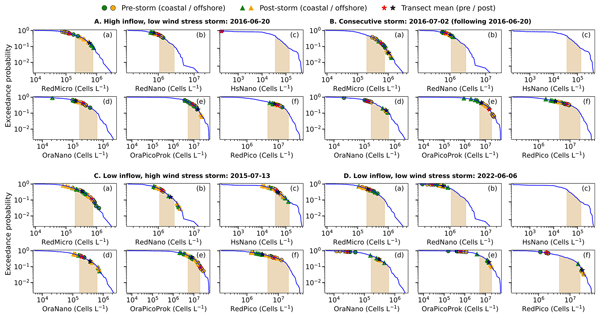
“Coccolithophorids peaked at 1.2 × 10⁵ cells L−1 at the R0′ station (Fig. 7C(c)), while cryptophytes showed a strong increase (Fig. 7C(d)) at stations R1–R3 (mean: 3.6 × 10⁵ cells L−1; max: 7.6 × 10⁵ cells L−1), exceeding their climatological mean of 3.0 × 10⁵ cells L−1 (Fig. 6).” I suggest commenting the results connected to spatial distribution too, e.g., what is closer to shore and what is in the open waters.
We have revised the sentence to explicitly indicate the spatial context by adding “coastal” and “offshore” next to the corresponding stations. This clarifies that R0–R2 are coastal stations and R2′–R4 represent offshore waters. The revised sentence is now “Coccolithophorids peaked at 1.2 × 10⁵ cells L−1 at the nearest to the coast R0′ station (Fig. 7Cc), while cryptophytes showed a strong increase (Fig. 7Cd) moving offshore from R1 to R3 stations (mean: 3.6 × 10⁵ cells L−1; max: 7.6 × 10⁵ cells L−1), exceeding their climatological mean of 3.0 × 10⁵ cells L−1”. Lines 381-384
“Rather than stimulating diatoms, the storm amplified pico‑sized phytoplankton under the prevailing warm conditions, while diatoms were further suppressed (Fig. 7D).” Isn't this expected, as the smaller organisms will reproduce faster? So, why do you say rather than stimulating diatoms? Why did you expect that?
To clarify this point, the revised sentence reads: “Under the prevailing warm conditions, the storm amplified picophytoplankton (Fig. 7D).” Lines 392–393
Discussion
“Summer storm impacts in the EEC were highly variable between years, arising from different combinations of river inflows and wind events that were in turn modulated by large-scale atmospheric circulation.” Cite papers showing that variability.
The following references were added: (Alvarez et al., 2024; Crawford et al., 2023; Turki et al., 2023); Lines 407–408
“These patterns directly support our initial hypothesis that different storm types exert distinct ecological impacts.” You did not hypothesize this; your hypothesis was that storms would induce disturbance in the phytoplankton community, but you did not hypothesize the heterogeneous responses to different storms.
We corrected the sentence now as “These patterns support our hypothesis that variations in river inflow and wind forcing drive changes in phytoplankton abundance and community composition.” Lines 408-409
“Specifically, our findings confirm that high inflow storms favoured diatoms, wind driven mixing, low inflow summers promoted nanophytoplankton, cryptophytes and pico-sized phytoplankton (Table 4).” What are you confirming? Something that was shown in other papers? Modify the statement and cite papers if needed.
The word “confirm” is now replaced by “indicate”. Line 410
Table 4. Rationalize the caption, keep the necessary information, and reduce the redundant information from the table. Elsewhere in the text, you specify P. globosa, so what is it: sp., spp., or globosa? Change the heading “Storm” to “Date”. All the storms under the header “Dominant physical mechanism” have a listed horizontal advection; it is redundant to repeat it. This can go into the caption. In the same way, under the header “Physical description” there is repetitive: “South-westerly wind driven coastal flow transports river plume northward” for every storm.
We agree. This table is now entirely reconsidered, please see new Table 4.
The taxonomic label has been corrected to Phaeocystis globosa to ensure consistency throughout the manuscript.
“Distinct and contrasting patterns emerged between coastal and offshore waters: diatoms were consistently more abundant in coastal zones (Fig. 6a), while Synechococcus dominated offshore waters (Fig. 6e). Seasonal dynamics revealed a June–July mean increase in diatom abundance in early July, following the spring bloom (Fig. 6a). Synechococcus rose in late May but dipped in early July despite warming temperatures, then recovered by late July as diatoms declined. This crossover suggests that transient meteorological disturbances, including storm related reductions in light or shifts in nutrient dynamics, temporarily favoured diatoms over Synechococcus. The subsequent reversal toward late July reflects a return to more stable summer conditions (Fig 6e). Similarly, high standard errors in diatom, pico‑sized phytoplankton, and cryptophyte abundances point to greater fluctuations during June–July (Fig. 6) due to storm driven disturbances.” Could you discuss this part in the context of what the literature says? Is that something others observe, that offshore is dominated by smaller cyanobacteria and close to shore, larger phytoplankton?
This discussion has been expanded by adding:
“Previous studies have shown that large phytoplankton often dominate nutrient-rich upwelling regions of the ocean, whereas open-ocean waters are typically dominated by picophytoplankton (James et al., 2022; Ribalet et al., 2010). A similar pattern was observed in the English Channel, where riverine input represents the dominant mechanism of nutrient supply. This nutrient enrichment supports the abundance of larger phytoplankton, such as diatoms and Phaeocystis globosa, in nearshore waters (Bonato et al., 2015; Napoléon et al., 2014).” Lines 460–464
“Post‑storm peaks in microphytoplankton abundances were often driven by specific diatom taxa such as Leptocylindrus danicus and Chaetoceros socialis, whose abundances exceeded climatological records by more than 3‑fold. Leptocylindrus danicus dominated June diatom blooms between 2016 and 2020 (Houliez et al., 2023; Skouroliakou et al., 2022), except in 2018 when Pseudonitzschia prevailed, reaching ~106 cells L−1 and contributing 90% of total diatom abundance at SOMLIT C and PHYTOBS 1‑Boulogne stations (Fig. 1).” Cite the part demonstrating the 3-fold increase and the abundance of Pseudo-nitzschia.
We cited the table showing a 3-fold increase on post-storm dates relative to the climatological mean (Table H1 in Appendix H) and added the citation to Skouroliakou et al. (2024), which reported that Pseudo-nitzschia reached ~10⁶ cells L⁻¹ (lines 484 and 360, respectively).
“The recurrence of these post‑storm diatom blooms across multiple years (Table 4; 2012, 2013, 2016–2020) indicates that they are not isolated anomalies but rather a consistent feature of coastal phytoplankton dynamics.” OK, is there something like this described in the literature? What kind of post-storm blooms does the literature tell us about? Is the closeness to the shore something that determined a preference for a diatom bloom (e.g., silica availability aside from other nutrients, etc.)?
We have added literature showing that post‑storm diatom blooms have been previously documented in the English Channel. “In a previous study, Rees et al. (2009) reported a monospecific post-storm bloom of Chaetoceros debilis associated with increased Chl-a following enhanced river inflow, supporting our observation that such blooms are recurrent in the region. Higher summer silicate concentrations (~ 1.8 μmol L−1) at the coastal station R0 (Hubert et al., 2025a) likely favour diatom growth in coastal waters.” Lines 488–492
“By contrast, the 2022-06-06 storm produced a different outcome. With only a brief one‑hour windy period, the post‑storm community was dominated by pico‑sized phytoplankton (Table 4), with only marginal increases in nanophytoplankton (Fig. 7D).” How low can your resolution go? Wasn't it day-based? I find it hard to switch to the per h resolution, given that the whole manuscript was written using days, or even a 3-day level. Rephrase! Also, where are the h-to-h data? If they are not shown, please show them as such.
We agree our analysis is based on daily and 3‑day resolutions. We now provide the hourly wind record for each event in Appendix A1 and clarified this in the caption. Accordingly, we removed the reference to a “one‑hour” windy period and rephrased the sentence to remain consistent with the daily scale: “This short-lived event generated only weak wind forcing,……..” Lines 529–530
5 Concluding remarks
This reads as a continuation of the discussion rather than a conclusion. Rename and add to the discussion. If you think that the article is calling out for a concussion chapter, then keep it distilled to the key findings and remarks without a broad discussion.
The text now reads as a continuation of the discussion, and some concluding remarks have been added in the last four lines of the discussion:
“In conclusion, interannual variability in storm impacts (wind and riverine forcing) was reflected in phytoplankton community composition. Higher riverine inputs favoured diatoms through enhanced silicate availability, leading to increased Chl-a concentrations in coastal waters. In contrast, in the absence of strong riverine inputs, wind-driven mixing events favoured nanophytoplankton, whereas strong wind-driven mixing suppressed picophytoplankton.” Lines 553–557
Appendix
All descriptions above the figures can be rationalized and joined into the captions.
Figure A1 Cite it in the Result section. Why is the date on the x-axis in reverse order compared to the one inside the figure? ”Wind speed time series during storm events (±4 days). The red dashed line indicates the selected central storm day, with analyses conducted over a ±3‑day window around this reference point.” Why during storm events ±4 days, in a ±3‑day window? Explain.
All the appendices are now mentioned in the main text. All descriptions above the figures have been incorporated into the figure captions and removed from the main text.
The legend is corrected as follows: The x-axis spans ±4 days to provide visual context around each storm, whereas the analytical window used in the study is ±3 days. We have corrected the figure and caption accordingly and now cite Fig. A1 (Line 416) in the Results section. In addition, the description above the figures has been incorporated into the figure itself.
Figure B1: Rationalize the caption and add the above description and cite it in the results section.
We modified the caption to include a description of Fig. B1 and now cite it in the Results section. Line 204
Figure D1. Shading or otherwise indicating the months used earlier for summer analysis would be useful? Which years were taken for this analysis? And please indicate locations rather than saying just “study site”.
We now shade the June–July period in Figure D1 to indicate the months used for the summer analysis. We also clarified that the climatology is based on hourly wind data from Boulogne-sur-Mer (Meteo-France station) for the period 2010–2025.
Figure E1 Comments similar to Fig. 5.
We simplified the legend title for the mean Chl‑a to avoid repeating information already provided in the caption. In addition, we updated the figure/caption by replacing the green colour with pink and blue to represent “High” and “Low” inflow storms, respectively. Added the description to the caption, noting that precipitation does not exhibit a linear relationship with Chl-a. Revised caption is now “Boxplots of pre‑ and post‑storm Chl‑a distributions (compiled from DYPHYRAD and SOMLIT) for the 10 storms. Vertical dashed lines indicate the timing of each storm event. Pink and blue boxplots denote “high” and “low” inflow storms, respectively, corresponding to increased and decreased Chl-a responses. Pre-storm Chl-a distributions are shown together with total accumulated precipitation over a ±3-day storm period (dark grey bars). Total precipitation and post-storm Chl-a did not exhibit a linear relationship for the storms on 2013-06-15, 2020-07-27 and 2022-06-06. The green dashed line indicates the June–July climatological mean Chl-a concentration (3.20 µg L−1) in the EEC.”
Figures 6 Captions can be rationalized.
The revised caption is now “Climatological means and standard errors of phytoplankton abundances in the Coastal (R0–R2) and Offshore (R2′–R4) regions along the DYPHRAD transect, based on 15-day means from February 2012 to December 2022. The black line represents the mean value across all stations. (a) RedMicro (diatoms), (b) RedNano (nanoeukaryotes), (c) HsNano (coccolithophorids), (d) OraNano (cryptophytes), (e) OraPicoProk (Synechococcus), and (f) RedPico (picoeukaryotes), respectively (see also Table 2).”
Similarly, we rationalized Figure C1 caption.
Table G1 Formatting can be edited, including the thickness of lines, merging cells, and indicating when p<.05
Table G1 has been updated by removing extra borders, merging cells, and highlighting p < 0.05 in bold.
Tables H1&2 Edit table formatting, including the thickness of lines, merging cells, position of text in cells. Header “Date”, indicate the format y-m-d because you are interchangeably using different formats throughout your manuscript. Use station names consistently, preferably as they are indicated on the map. In continuation, is it Phaeocystis sp./spp./globosa? Revise: Chaetoceros socialis f. radians https://marinespecies.org/aphia.php?p=taxdetails&id=163126 Status: uncertain > unassessed; Chaetoceros sp./spp.; Leptocylindrus (autres), you mean other, on which other are you referring to; Asterionellopsis sp./spp.; Chaetoceros (autres), do you mean other than mentioned earlier?
Table H1 & H2 has been updated by removing extra borders, merging cells. Dates formats are mentioned in table H1 and H2. The header “Date” now indicates the format (YYYY–MM–DD) for clarity. Station names are consistent now.
Because the species and genera are reported directly from the PHYTOBS database, we cannot alter or revise them.
References
Add more and reduce the level of self-citation.
The following new citations have been added: Rees et al. (2009), James et al. (2022), Ribalet et al. (2010), and Levasseur et al. (2025) (Lines 442, 461 and 533).
The ‘self citations’ of Houliez et al., 2023 (line 484); Skouroliakou et al., 2022 (line 484), and Hubert et al., 2026 (line 493) were removed where possible.
Technical corrections and typing errors
Abstract
“focussed in”/ focused on, “well identified” / well-identified, “under high wind stress, favouring nano-sized phytoplankton” / under high wind stress, favour nano-sized phytoplankton
“Focussed” has been replaced with “targeted” in line 10, and a hyphen has been added to “well-identified” (line 8). “Favouring” has been retained to maintain the correct verb form (line 17).
Introduction
Redundancy: “Existing studies in lakes and oligotrophic seas in tropical….” / Studies in lakes and oligotrophic seas in tropical.
Removed "Existing" Line 27
“increase in the Chl-a (chlorophyll-a)” / increase in the chlorophyll-a (Chl-a)
Fixed to “increase in the chlorophyll-a (Chl-a)” Lines 27-28
“for example, Pozdnyakov et al., (2014)” / for example, Pozdnyakov et al. (2014)
We revised the sentence as “....increases in oligotrophic Arctic waters (Pozdnyakov et al., 2014) and elevated primary….. ” Line 31
“while Crawford et al., (2020)” / while Crawford et al. (2020)
We revised the sentence as “Barents and southern Chukchi Seas following cyclones (Crawford et al., 2020).... ” Line 32
“Over recent decades, the summer season in the EEC” / Over recent decades, summer seasons in the EEC
Removed “the” Line 52
“…occurrence of the summer phytoplankton blooms and in particular to investigate the possible effect of summer storm events on the magnitude of the blooms and also the phytoplankton community. We were particularly interested to examine how…” / …occurrence of the summer phytoplankton blooms and to investigate the possible effect of summer storm events on the magnitude of the blooms and the phytoplankton community. We were particularly interested to examine how…
Removed “in particular” and “also” from the sentences. Line 63
“…coastal–offshore gradient in the Strait of Dover, known as the DYPHYRAD (Dynamics of PHYtoplankton on RADiale) transect (Hubert et al., 2025b) by the Strait of Dover.” / …coastal–offshore gradient in the Strait of Dover, known as the DYPHYRAD (Dynamics of PHYtoplankton on RADiale) transect (Hubert et al., 2025b).
Corrected to “(Hubert et al., 2026)” and replaced “in the Strait of Dover”. Line 69
Obvious, redundant: “…events, assess the various impacts of storms on the marine environment and phytoplankton structure, and conclude with a synthesis of our findings.” / …events, assess the various impacts of storms on the marine environment and phytoplankton structure.
Removed the sentence. Line 70
Materials and Method
“Materials and Method Section” / Materials and Methods
Deleted “Section”. Line 71
“The The eastern English Channel” / The eastern English Channel
Deleted “The”. Line 73
“…we incorporated datasets from two French National Observation Systems (Systèmes Nationaux d’Observation, SNO): SNO SOMLIT and SNO Phytobs.” / …we incorporated datasets from two French National Observation Systems (Systèmes Nationaux d’Observation, SNO): SOMLIT and Phytobs.
Removed “SNO”. Line 88
Using PSU is discouraged in oceanography and especially in scientific papers, e.g. https://www.coastalwiki.org/wiki/Salinity#:~:text=After%20receiving%20the%20latest%20issue,of%20the%20practical%20salinity%20scale
“…and salinity (S, PSU)…” / salinity (S)
Deleted “PSU”. Line 93
Subsurface water samples were collected for dissolved inorganic nutrients (NO3-, NO2-, PO43- and Si(OH)4.” / Subsurface water samples were collected for dissolved inorganic nutrients, i.e. nitrate(NO3-), nitrite (NO2-), orthophosphate (PO43-), and orthosilicic acid (Si(OH)4).
We agree that, for consistency, only the terms “DIN, DIP, and DISi” are now used throughout the manuscript, figures, and tables. This has been added in line 96 of the Materials and methods section and in Fig. C1.
“…Aminot and Kérouel, (2004).” / Aminot and Kérouel (2004).
Deleted “comma”. Line 98
“SOMLIT SNO measurements used in this study include temperature, salinity, nutrients (nitrate, nitrite, phosphate,and silicate),…” / SOMLIT SNO measurements used in this study include temperature, salinity, nutrients (NO3-,NO2-,PO43- and Si(OH)4),….
This sentence has been deleted. We mentioned SOMLIT datasets in revised sentence at line 125–127.
“…transect, chlorophyll‑a concentrations from…” / …transect, chl‑a concentrations from…
Revised the sentence as: “DYPHYRAD transect to measure Chl-a, nutrients and phytoplankton abundance”. Line 95
Unify the names of the stations and locations, is it: Wimereux SOMLIT‑C / SOMLIT C / SOMLIT Point C, Boulogne‑1 / Boulogne 1 / Point 1 Boulogne / Point 1-B, Boulogne-Sur-Mer/ Boulogne sur mer / Boulogne-sur-Mer…. ? Those also appear differently in Fig. 1, tables, and text.
We regret the previous inconsistency. The stations are now consistently referred to as SOMLIT C, SOMLIT L, PHYTOBS Boulogne, and PHYTOBS C, following the naming used by the data provider. This has been updated in Figure 1. Lines 89–91
“10mV…”/ 10 mV, “…5μL s-1…”/ 5 μL s-1, “…25mV…” / 25 mV
Added the space between quantity and unit. Line 113 and 115
“time (8–10min).” / time (8–10 min).
Added the space between quantity and unit. Line 116
“…(CytoBuoy b.v., Netherlands)…” / …(CytoBuoy b.v., the Netherlands)…
Added “the”. Line 118–119
“… vocabulary of (Thyssen et al., 2022).” / …. vocabulary of Thyssen et al. (2022).
We removed the citation from the revised manuscript.
“Phytobs stations located south of the DYPHYRAD transect (50.8° N, Fig. 1)…” / Phytobs stations located south of the transect (Fig. 1)…
The sentence was removed following revision; therefore, “50.8° N” is no longer mentioned.
Table 1 Edit table formatting. Correct parts of the table. If all have the same time span for sampling, i.e., 2012-22, you can remove it from the table and add it to the table description. Also, the tables contour-lines are varying in thickness, which is something to adjust. You write “ Once/twice a week” with capital letters, but “fortnightly” with small letters. SOMLIT C appears twice, with different sample counts (168 SOMLIT C vs 160 Phytobs Wimereux (SOMLIT C). Explain why?
The sampling period (2012–2022) was removed from each row, and the contour-line thickness was standardized. SOMLIT and PHYTOBS were also removed from table 1, as they were not part of the analysis. Line 128
“90th…” / 90th Throughout the whole text, you miss the superscript for “th”, please correct it in the text, figure, and table captions, and in figures.
Corrected the superscript: 90th to 90th throughout the manuscript. E.g., line 133, 175
“Table 2. Flow cytometry (FCM) phytoplankton…” You have introduced this abbreviation but have never used it elsewhere; remove it if it is unnecessary.
Deleted “FCM” from the table 2 caption. Line 130
The header in Table 2, “Phytoplankton description,” can be shortened to Phytoplankton.
Deleted “description” from Table 2
“Larger cyanobacteria (e.g., large-size Crocosphaera, Richelia)” / Larger cyanobacteria (e.g., Crocosphaera, Richelia)
Deleted “large-size” from Table 2
“…armoured dinoflagellates” / …armored dinoflagellates
We have removed “and some autotrophs and armoured dinoflagellates” and only kept the “Coccolithophores” in Table 2.
“…(assumed here as constant ρair= 1.225 kg m−3)…” / …(assumed to be ρair = 1.225 kg m−3)… because the sign “=” implies a constant.
Deleted “constant” from the sentence. Line 144
“…on the wind speed as (Wu, 1982):” / …on the wind speed as:, because Wu, 1982 was already cited in the same sentence.
Removed repeated citation “(Wu, 1982)”. Line 145
“…(Eaufrance; https://www.eaufrance.fr).” and similar can be shortened by, for instance, hyperlinking the name Eaufrance.
Shortened by hyperlinking “https://www.eaufrance.fr/”. Line 151
“...(Derot et al., 2015), (Fig. 7).” / …(Derot et al., 2015).
Removed the “Fig.7” sentence. Line 169
“…(Derot et al; 2015).” / (Derot et al., 2015).
Fixed “;” to “.,” inside the citation. Line 181
Results
“Storm associated wind stress…” / Storm-associated wind stress…
Fixed to “Storm-associated” Line 188
Redundant sentence, remove: “Figure 3 presents total precipitation and average flow rate during each storm event.”
Removed “Figure 3 presents total precipitation and average flow rate during each storm event.”
Rephrase and remove PSU: “…produced marked salinity reductions (33.4–34.0 PSU; Table 3).”.
New sentence is now: “a corresponding reduction in salinity (33.4–34.0; Table 3)” Line 212
Introduce the abbreviation ahead: “ For example, the 2016‑06‑20 storm exhibited DIN and …”
Added the abbreviations ahead at line 99: “the 2016‑06‑20 storm exhibited DIN and DiSi concentrations of…”
Why do you start a new paragraph that starts with thus: “ …river flow below 0.35 m3 s−1 (Fig. 4).
We have removed the paragraph break. The sentence beginning with “Thus” now remains within the same paragraph, as it synthesizes the preceding observations rather than introducing a new topic. Line 242
Table 3. The “DIP” abbreviation was not introduced. Add horizontal lines or spacing between dates because it is very hard to follow the nutrient content in the current version. The column of nutrients can be split into two columns: the nutrient name in one, and the values in the other.
We have now introduced the “DIP” abbreviation at its first occurrence in the manuscript (Line 99). In Table 3, we added horizontal lines to visually separate each storm event, improving readability. Additionally, the nutrient column has been revised in table 3. Line 255
There is only one green in Fig. 5: “…(depicted in green shades, Fig. 5)…” / …(depicted in green, Fig. 5)…
Removed “shades” from the sentences and revised as “(depicted in pink, Fig. 5)”. Line 265
“…six storms are presented in the appendix…” / …six storms are presented in the appendices…
Replaced “appendix” with “appendices”. Lines 308–309
Figure 7. “Exceedance probability (CCDF) distributions of six phytoplankton groups along the DYPHYRAD…” / Exceedance probability (CCDF) distributions of six phytoplankton groups (a-f) along the DYPHYRAD…
Added “(a-f)” in the caption. Line 332
Discussion
“…wind driven mixing…” / wind-driven mixing
Replaced with “wind-driven” in line 410 and 412
“…Seine estuary…” / …Seine Estuary…
Replaced “estuary” with “Estuary”. Line 423
“…Somme estuary…” / …Somme Estuary…
Replaced “estuary” with “Estuary”. Line 429
Table 4.” South-westerly wind driven coastal flow transports river plume northward” / South-westerly wind-driven coastal flow transports river plume northwards
The caption of Table 4 has been changed to: “Summary of storm impacts and their associated nutrient and phytoplankton responses. See Table 2 for phytoplankton group description.” Line 432
“High Inflow, Low wind” / High inflow, low wind
The phrase “High Inflow, Low wind” has been updated to “High inflow, low wind” in the table 4.
“…phytoplankton blooms can persist for weeks (e.g., (Rees et al., 2009; Skouroliakou et al., 2022) .” / …phytoplankton blooms can persist for weeks (e.g., Rees et al., 2009; Skouroliakou et al., 2022).
Revised and corrected as “(Rees et al., 2009)”. Line 442
“…(number of days > 8 m s −1)…” / …(number of days > 8 m s−1)…
Removed space between “s” and “-1”. Line 448
“…due to storm driven disturbances.” / …due to storm-driven disturbances.
Replaced with “storm-driven” in line 472.
“…when Pseudonitzschia prevailed…” / …when Pseudo-nitzschia prevailed…
Replaced with “Pseudo-nitzschia” in line 360.
Appendix
Keep the consistent annotation, e.g., is it Fig. C1b or C1 (b)?
We have retained the format of “Fig.C1b” and removed the parentheses “(b)” to ensure consistency. E.g., line 427
Table H1&2 “Abundance (Cells L−1)” / Abundance (Cells L−1)
Changed “(cells L−1)” to “(Cells L−1)” in line 664 and line 683 respectively.
Data availability
Doi can be mentioned in the reference list if you mention the standard citation with the surname.
We have updated the citation and references for the respective datasets used in the manuscript. Lines 685–689
-
AC1: 'Reply on RC1', Harshal Chavan, 26 May 2026
-
RC2: 'Comment on egusphere-2025-6235', Anonymous Referee #2, 27 Apr 2026
Chavan et al study a selection of storm events along a coastal transect in the Eastern English Channel for changes in primary production and phytoplankton composition at size group to species level, resulting from storm event related disturbances.
Flow cytometry and microscopy based phytoplankton inventories are investigated for effects of nutrient pulses from riverine outflow and wind driven mixing as a result of storm events.The manuscript reads well and provides valuable insight in weather induced nutrient suppletion in a post-bloom depleted system. The authors identify various mechanisms at play in this complex interaction. Follow-through into conclusions could benefit from some focusing, and some minor points need to be addressed before this worthwhile contribution is published.
General remarks
- One thing this reviewer is missing past a cursory mention is tidal effects. Given the very high tidal ventilation in the region, one naturally wonders if the moment of sampling in the tidal cycle has a potential influence on results. I feel this should be addressed in discussion at the very least, and ideally tested for statistically within the data.
- The discussion could benefit from a bit more attention as to why community structure responds in the way it does. Growth and nutrient utilisation strategies are well-described for the identified groups, and tying these to the different modes of nutrient suppletion with some more detail and focus would strengthen the manuscript.
- The discussion identiefies a number of mechanistic system responses to storm events, but the conclusions as they are tend to reduce these to stochastic disturbances. This puts the sections somewhat at odds with eachother, and it would benefit the manuscript to follow through on mechanistic insights into the conclusions.
- Apart from cursory mentions, extrapolation beyond the immediate locality is limited. Some more discussion of transport into the highly ventilated channel system would be appreciated.
Specific remarks
line 85-86 repeated statement
line 91-94 repeating statements
line 114, 143, 145 inconsistent capitalisation "Phytobs"
line 215-216 dates have inconsistencies with those on the figures' axes
In a more general sense I struggled a bit with the use of just the event dates to identify them, a new reader can lose track somewhat easily. It might help to add another identifier to the events? Worth trying, though the dates are logical and abstraction could have its own issues. Perhaps both?line 237, 449 consider 'depletion' in stead of 'limitation' in these instances, the ECC is hardly a limited system.
line 254 "Some years were notably windy days"
this statement seems to be missing some words.
line 489-499 consider moving to resultsCitation: https://doi.org/10.5194/egusphere-2025-6235-RC2 -
AC2: 'Reply on RC2', Harshal Chavan, 26 May 2026
Referee 2 comments (RC2)
Chavan et al study a selection of storm events along a coastal transect in the Eastern English Channel for changes in primary production and phytoplankton composition at size group to species level, resulting from storm event related disturbances. Flow cytometry and microscopy based phytoplankton inventories are investigated for effects of nutrient pulses from riverine outflow and wind driven mixing as a result of storm events. The manuscript reads well and provides valuable insight in weather induced nutrient suppletion in a post-bloom depleted system. The authors identify various mechanisms at play in this complex interaction. Follow-through into conclusions could benefit from some focusing, and some minor points need to be addressed before this worthwhile contribution is published.
We thank the reviewer for the positive comments. We have addressed all comments below, and the manuscript has been modified accordingly. To facilitate the review process, all the references to Lines below correspond to the revised non-annotated version.
General remarks
One thing this reviewer is missing past a cursory mention is tidal effects. Given the very high tidal ventilation in the region, one naturally wonders if the moment of sampling in the tidal cycle has a potential influence on results. I feel this should be addressed in discussion at the very least, and ideally tested for statistically within the data.
We agree that the tidal cycle also shifts the position of the coastal–offshore frontal zone. This is a complex issue that is addressed through DYPHYRAD transect high spatial resolution (~1km) sampling strategy. The “coastal”– “offshore” distinction was defined within the frontal area to ensure that each category consistently captured coastal and offshore waters, regardless of the tidal state. Frontal waters were distributed across both categories, reflecting the strong mixing in this region, and the tidal conditions primarily influenced only the direction of the tidal flow (northwards or southwards; Brylinski et al., 1991). The following statement has now been added to the Materials and Methods section (lines 78–82): “The “coastal”– “offshore” distinction was set within the frontal area to ensure that each category consistently represented coastal and offshore waters, irrespective of tidal state. Because frontal waters are strongly mixed, they span both categories, and tides mainly influence only the direction of flow (northwards or southwards; Brylinski et al., 1991). To account for tidal influences on phytoplankton communities, the sampling strategy used a high‑resolution (~1 km) coast–offshore transect comprising nine stations (Fig. 1; Table 1)”.
Please also note that DYPHYRAD is an established sampling transect in the coastal EEC (a list of the papers over the last 10 years below)
DYPHYRAD papers 2012–2026:
Bonato, S., Christaki, U., Lefebvre, A., Lizon, F., Thyssen, M., and Artigas, L. F.: High spatial variability of phytoplankton assessed by flow cytometry, in a dynamic productive coastal area, in spring: The eastern English Channel, Estuar. Coast. Shelf Sci., 154, 214–223, https://doi.org/10.1016/j.ecss.2014.12.037, 2015.
Bonato, S., Breton, E., Didry, M., Lizon, F., Cornille, V., Lécuyer, E., Christaki, U., and Artigas, L. F.: Spatio-temporal patterns in phytoplankton assemblages in inshore–offshore gradients using flow cytometry: A case study in the eastern English Channel, J. Mar. Syst., 156, 76–85, https://doi.org/10.1016/j.jmarsys.2015.11.009, 2016.
Breton, E., Christaki, U., Bonato, S., Didry, M., and Artigas, L.: Functional trait variation and nitrogen use efficiency in temperate coastal phytoplankton, Mar. Ecol. Prog. Ser., 563, 35–49, https://doi.org/10.3354/meps11974, 2017.
Christaki, U., Skouroliakou, D., and Jardillier, L.: Interannual dynamics of putative parasites (Syndiniales Group II) in a coastal ecosystem, Environmental Microbiology, 25, 1314–1328, https://doi.org/10.1111/1462-2920.16358, 2023.
Houliez, E., Schmitt, F. G., Breton, E., Skouroliakou, D.-I., and Christaki, U.: On the conditions promoting Pseudo-nitzschia spp. blooms in the eastern English Channel and southern North Sea, Harmful Algae, 125, 102424, https://doi.org/10.1016/j.hal.2023.102424, 2023.
Hubert, Z., Louchart, A. P., Robache, K., Epinoux, A., Gallot, C., Cornille, V., Crouvoisier, M., Monchy, S., and Artigas, L. F.: Decadal changes in phytoplankton functional composition in the Eastern English Channel: possible upcoming major effects of climate change, Ocean Sci., 21, 679–700, https://doi.org/10.5194/os-21-679-2025, 2025.
Hubert, Z., Libeau, A., Gallot, C., Cornille, V., Crouvoisier, M., Lécuyer, É., and Artigas, L. F.: Phytoplankton coastal-offshore monitoring by the Strait of Dover at high spatial resolution: the DYPHYRAD surveys, Earth Syst. Sci. Data, 18, 1877–1903, https://doi.org/10.5194/essd-18-1877-2026, 2026.
Skouroliakou, D.-I., Breton, E., Irion, S., Artigas, L. F., and Christaki, U.: Stochastic and Deterministic Processes Regulate Phytoplankton Assemblages in a Temperate Coastal Ecosystem, Microbiol. Spectr., 10, e02427-22, https://doi.org/10.1128/spectrum.02427-22, 2022.
Skouroliakou, D., Breton, E., and Christaki, U.: Phaeocystis globosa and diatom blooms promote distinct bacterial communities and associations in a coastal ecosystem, Environ Microbiol Rep, 16, e13313, https://doi.org/10.1111/1758-2229.13313, 2024.
In addition, following the referee’s comments, we analysed the post‑storm tidal conditions in relation to phytoplankton community structure. The figure shows that, despite the spring, neap, and transitional tidal situations, we did not identify any clear pattern between the phytoplankton communities that increased after storms and the prevailing meteorological conditions (wind and inflow). This is illustrated in the figure below. We decided not to include this figure in the manuscript.
The figure shows the post-storm sampling dates, and the x-axis denotes the tidal conditions during sampling. Pink dates correspond to high wind-stress storms, whereas blue dates correspond to low wind-stress storms. The underlining denotes high-inflow storms.
The discussion could benefit from a bit more attention as to why community structure responds in the way it does. Growth and nutrient utilisation strategies are well-described for the identified groups, and tying these to the different modes of nutrient suppletion with some more detail and focus would strengthen the manuscript.
We have discussed nutrients and phytoplankton as exhaustively as our data permitted and based available literature. We however added the following:
"This study highlights that certain diatom genera and species are able to dominate storm-driven summer blooms; specifically, Leptocylindrus danicus in June and Chaetoceros socialis in July. This suggests that these taxa are well adapted to post-storm conditions associated with riverine nutrient supply under the well-lit conditions of summer (Polimene et al., 2013; Widdicombe et al., 2010). Moreover, while diatoms in offshore waters during the summer are generally confined to subsurface layers (20–30 m; Barnett et al., 2019), riverine nutrient inputs and mixing can promote their proliferation in surface waters across the transect (e.g., Fig. 7B and F3 in Appendix F)." Lines 506–512
The discussion identifies a number of mechanistic system responses to storm events, but the conclusions as they are tend to reduce these to stochastic disturbances. This puts the sections somewhat at odds with each other, and it would benefit the manuscript to follow through on mechanistic insights into the conclusions.
We agree with the reviewer that the discussion surrounding stochastic mechanisms (Skouroliakou et al., 2022) is beyond the scope of the present study. This part of the text is now shortened and completely rephrased.
“While previous research in this region attributed summer phytoplankton blooms and community turnover primarily to stochastic processes (69%; Skouroliakou et al., 2022), the underlying drivers of these disturbances remained unclear. The present study elucidates these patterns by identifying weather-induced nutrient suppletion as a key mechanism in an otherwise nutrient-depleted environment after the spring bloom. We found that recurrent storms disrupted seasonal succession, triggering short-lived but pronounced community shifts characterized by transient monospecific peaks such as Leptocylindrus danicus and Chaetoceros socialis observed in our study. Similar storm‑related shifts have been documented in other aquatic systems—for example, the post‑storm dominance of cryptomonads in a temperate lake (Jacobsen and Simonsen, 1993) and reduced phytoplankton diversity linked to stochastic processes in the Yangtze River Estuary (Xian et al., 2024)—highlighting the wider relevance of our observations i.e., post-storm high abundance of certain phytoplankton groups.” Lines 544–553
Apart from cursory mentions, extrapolation beyond the immediate locality is limited. Some more discussion of transport into the highly ventilated channel system would be appreciated.
Regarding transport processes, our aim was not to investigate transport dynamics directly, but rather to use the available information on wind forcing, inflow, and phytoplankton as environmental context for interpreting our results. Nevertheless, we have clarified and expanded the discussion of transport-related processes in the Materials and Methods section (lines 153 and 157) and the Discussion section (lines 420, 494, 500, 517 and 519).
Specific remarks
line 85-86 repeated statement
We removed the repetition from the introduction.
line 91-94 repeating statementsWe removed the statements and replaced them with “To account for tidal influences on phytoplankton communities, the sampling strategy used a high‑resolution (~1 km) coast–offshore transect comprising 9 stations (Fig. 1; Table 1). The transect spans approximately 9.7 km from coast to offshore, from R0 (50.8° N, 1.59° E) to R4 (50.8° N, 1.45° E) (Fig. 1). To facilitate analysis of spatial patterns, stations were categorized into two zones based on their proximity to shore: coastal (R0–R2) and offshore (R2′–R4).” Lines 81–85
line 114, 143, 145 inconsistent capitalisation "Phytobs"
This was made consistent with PHYTOBS throughout the document.
line 215-216 dates have inconsistencies with those on the figures' axes
We corrected the dates at lines 191–192 and now it is consistent throughout the document.In a more general sense I struggled a bit with the use of just the event dates to identify them, a new reader can lose track somewhat easily. It might help to add another identifier to the events? Worth trying, though the dates are logical and abstraction could have its own issues. Perhaps both?
To improve readability, we have clarified the presentation of the storm events and now summarise them in Tables 3 and 4. We have chosen to retain the event dates as the primary identifiers, as they allow readers to follow the sequence of observations and link each storm directly to the corresponding phytoplankton responses in the region. We hope that the improved tabular summary provides the additional clarity the reviewer was seeking.
line 237, 449 consider 'depletion' in stead of 'limitation' in these instances, the ECC is hardly a limited system.
We removed line 237 and replaced limitation with “marked by low silicate, nitrate, and phosphate” in line 438.
line 254 "Some years were notably windy days" this statement seems to be missing some words.We revised the sentence now: “Some years were characterised by notably windy conditions (days with wind speeds > 8 m s−1; at least 10 days per month) despite low inflows, including July 2014, 2015,
July 2017, July 2020, and June 2022.” Lines 239-240
line 489-499 consider moving to resultsThis was moved to the result section 3.2.2; Lines 359–370.
Peer review completion


Interactive discussion
Status: closed
-
RC1: 'Comment on egusphere-2025-6235', Anonymous Referee #1, 02 Apr 2026
- General Comments
This manuscript provides a unique assessment of phytoplankton responses to different disturbances, here classified as storm events that induce changes in aerial, fluvial, and pluvial regimes, to directly identify the consequences of physical perturbations on the underlying biology of marine systems. Another positive point is the inclusion of different marine areas (coastal vs. open waters) and, in part, the chemical bases (nutrients). I personally find that the efforts reported in this work could be an elegant way to conceptualize the challenging dynamics of blooms. In this regard, I see the authors’ work as a potentially very interesting paper worthy of publication, but at this stage it still requires some polishing, given the number of typos and the need to better structure the methodology section.
- Specific Comments
Abstract
“We focussed in summer because it is a low nutrient season where phytoplankton major shifts and blooms are not expected.”
This sounds counterintuitive. Why would you study plankton shifts when they are not expected to happen?
“…phytoplankton abundance were combined with high-frequency meteorological data (precipitation and wind) and hydrological records from 2012 to 2022.”
Hydrological records include several parameters, and as I understand it, you consider only water levels? If that is so, adjust it accordingly.
“… nano-sized phytoplankton (nanophytoplankton and cryptophytes).” Why are cryptophytes not included in nanophytoplankton? And why do you make this distinction: nano-sized vs nanophytoplankton?
“High inflow storms, whether accompanied by weak or strong winds, promote coastal advection of riverine plumes enriched in nutrients, sustaining diatom dominance and, under high wind stress, favouring nano-sized phytoplankton (nanophytoplankton and cryptophytes). In contrast, low inflow conditions limit riverine nutrient supply, shifting reliance to regenerated nutrients from vertical mixing. When combined with strong winds, these conditions support nanophytoplankton growth,….” High-inflow-strong-wind has the same effect as low-inflow-strong-wind? Please clearly identify the differences and similarities among storms.
“These findings highlight storms as recurrent structuring forces in the EEC, mediating nutrient availability and driving shifts in phytoplankton composition across the summer months.” Could you say something about the use of your findings in, e.g., prediction models? Storm prognoses might be an important input to prediction models for phytoplankton.
Introduction – could be shortened
“The coastal marine ecosystems are vulnerable to changes in weather patterns and various extreme events, such as storms and heatwaves.” Extreme events are also changes in weather patterns. Please, modify your statement.
“At higher latitudes, storm forcing has been associated with enhanced primary productivity; for example, Pozdnyakov et al., (2014) observed appreciable Chl-a increase in oligotrophic Arctic waters within days of a cyclone, while Crawford et al., (2020) reported elevated net primary production in inflow regions such as the Barents and southern Chukchi Seas. Despite these insights, the responses of rapidly changing 35 temperate and high-latitude coastal seas to extreme events remain poorly resolved…” Why do you say that, if the research you cite is tackling polar regions and not temperate regions?
“The English Channel is a temperate coastal sea generally characterized by strong atmospheric frontal 40 activity and frequent extratropical storms, occasionally accompanied by thunderstorms. These systems typically originate in the North Atlantic and track towards north-western Europe…” This is a new paragraph, and it lacks the smooth transition to the study area. You could start with something like: Here we focus on the English Channel etc. State clearly which systems you refer to? Coastal seas? Modify the sentence to represent more clearly what you want to communicate.
“…eastern English Channel (EEC) is characterized by a nutrient-rich regime, particularly with an excess.“ Provide a reference demonstrating that. So far, you have only assumed that the nutrients are present and have used other parameters (e.g., a phytoplankton bloom) as indicators to support that claim. Cite the reference that claims this is a nutrient-rich area.
“The phytoplankton community was characterized using size-based functional groups derived from flow cytometry along a coastal–offshore gradient in the Strait of Dover, known as the DYPHYRAD (Dynamics of PHYtoplankton on RADiale) transect (Hubert et al., 2025b) by the Strait of Dover. The dataset comprises 1835 samples collected on 268 dates during a ten-year survey (2012–2022). Storm characterization was based on Météo-France meteorological data (wind and precipitation) from the Boulogne-Sur-Mer station (https://meteo.data.gouv.fr/) and river discharge records from Eaufrance (https://www.eaufrance.fr/) near the DYPHYRAD transect.” Reduce the text and move parts to M&M.
Materials and Methods
“… receives substantial nutrient inputs from multiple estuaries…“. You can claim that if you provide evidence for it, e.g., a citation, whereas a figure (map) you cite only shows that there are lots of rivers, but not what they carry.
“Chl-a concentrations were measured…” At which depth?
“2.3 Phytoplankton abundance” Sampling depth was not indicated.
“ Phytobs stations located …. Additional datasets from SOMLIT stations C and L were used to compare pico‑ and nano‑phytoplankton abundances with DYPHYRAD observations. These complementary observations were not included in the statistical analysis.” This part talks about microscopy? Where is the protocol for sampling, sample fixation, and analysis? You mentioned that you do not use this data (likely microscopy counts) for statistics, but what did you use it for? Maybe you have stated that, but it is not clearly written. Thus, adjust the text accordingly and add all the details: which net was deployed, at which depth, fixatives...
“Table 1. Sampling stations and associated spatial, temporal, and sampling characteristics.” For what did you sample? Just flow cytometry or microscopy, too?
Table 2. “Coccolithophores, and some autotrophs and armoured dinoflagellates”, what do you mean by some autotrophs? Then you also write: “Diatoms, and other microphytoplankton”, which other microphytoplankton are you referring to?
“Storm events in this study were identified as periods when wind speeds exceeded the 90th percentile (Fig. A1) (11.3 m s−1). Storm length was initially identified as the ±3‑day period surrounding the peak wind speed day, with day 3 designated as the storm day.” This should be the initial statement in this paragraph. First, introduce what storms are, then explain the rest. In addition, Fig. A1 shows the results and thus cannot be cited as such. Throughout the following methodology, you refer to numerous figures from the results, e.g., Figs. 3-7 and A1-C. These must be changed, and in addition, every figure/table should be cited in a numerical order; now, you cite Fig. 3 before Fig. 2.
“We expect phytoplankton to respond rapidly to changes in nutrient availability.” Why? Elaborate. The summer composition of phytoplankton inevitably includes many mixotrophs and heterotrophs that are already adapted to acquire nutrients in organic form. Why would you expect that such a community would have a rapid response to an inorganic surplus?
“In the study area, river plumes are transported under the influence of prevailing south–westerly winds.” Is there a reference supporting this claim?
“Consequently, the River Slack and the Wimereux estuary affect water chemistry along the transect earlier than other estuaries in the region (Fig. 1), thereby initiating changes in community structure.” Slack is located north of the transect. If you apply what you explain here: SW winds, it means that their direction will be NE. How can the River Slack then be important or affect the transect? Moreover, why do you say that the River Slack is affecting the chemistry and the Wimereux estuary? Does that include more rivers? Why not just Wimereux River?
“…number of windy days (wind speed > 8 m s−1) and average river inflow (m3 s−1)…” Unless this is stating the methods/protocols applied, the M&M should be devoid of any results. Please explain why these numbers were chosen.
“Phytoplankton abundances from the 200 pre-storm (−10 days) and post-storm (up to 14 days) periods were compared with this baseline…” Why this asymmetry? Why not 10 before and after?
Results
First of all, what I find distracting in this paragraph are the different ways of annotating dates. Consider unfirming them in the whole manuscript.
“Several storms persisted for multiple days (e.g., 2016‑07‑02; Fig. A1), with the 2016‑07‑02 event representing the most intense episode, during which wind stress frequently surpassed 0.1 N m−2 (Fig. 2). Storm associated wind stress varied considerably among events (Fig. 2).” How much did the most severe event differ from others? For clarity, it would be best to address when the figure or table is in the appendix.
Fig. 2 The dashed line should be called Mean or similar, and not numerically 0.1.
“Wind stress (τ; N m−2) across 10 storms, derived from wind speed over ±3 days around each storm. The red dashed 220 line marks the 0.1 N m−2 threshold used to categorize storms as high or low wind stress.” To categorize which part of the data? The mean, the medium? Later, you display low and high precipitation and inflow rates, clearly coloring them blue (low) and red (high). The consistency would make the figures more structured and make it clear that you are telling a single story rather than patching data from different sources.
…”“High” precipitation was defined as ≥ 16.12 mm, and “High” inflow as ≥ 0.45 m3 s−1 (Fig. B1).” Exact numbers are less important if they are properly cited than the fact that they refer to the 80th percentile.
“Other events also alleviated nutrient limitation, including the 2012‑07‑12 and 2015‑07‑13 storms (Table 3).” Refer to the concrete limitations, e.g., 2012-07-12 was a P-limitation. For 2015-07-13, I do not see a limitation. Please state which nutrient/s you are referring to.
Figure 3. “Precipitation classes (“High” and “Low”) were defined from June–July rainfall distribution, with the high threshold set at 16.12 mm (80th percentile); inflow classes were defined from June–July river‑flow distribution, with the high threshold set at 0.45 m3 s−1 (80th percentile).” Use the terminology consistently; here, you say rainfall, and on the figure, precipitation is written. The same goes for inflow/discharge in the text. If the threshold is 16.12 mm, why do you classify 2016-07-02 as high precipitation? In addition, it would be useful to display the threshold lines too.
Table 3. Use terms consistently, e.g., you use “after storm” interchangeably with “post-storm”. “Rainiest events were defined as those with total precipitation > 16.12 mm,…” By total, do you mean average or maximum? Why is it relevant how high the nutrients were after the storm if we do not have an idea whether they were higher or lower than before the storm? Revise and argument.
Figure 4. I find it a bit confusing to read these multi-coloured bars. Could you keep the same color for the same parameters and change the hue, e.g., blue for wind that is of a lighter hue for June, and a darker hue for July? This could improve the readability. In the same way, you can also color the axes/titles in blue for wind and another color of choice for the inflow. In the legend, the dashed line title should be changed, as it is unnecessary to repeat what is already stated in the figure description.
Figure 5. Why are the vertical dashed lines of different colors from each other? Please indicate that those dashed lines represent the day of the storm event. Adjust the title in the legend for the Chl-a mean as it is redundant, and those details are already stated in the caption. Are the whiskers standard deviations or errors? Are the points outside the boxes outliers?
Figure 6. Why climatological mean and not just mean? If it is climatological, both coastal and offshore would need that adjective too.
“Coccolithophorids peaked at 1.2 × 10⁵ cells L−1 at the R0′ station (Fig. 7C(c)), while cryptophytes showed a strong increase (Fig. 7C(d)) at stations R1–R3 (mean: 3.6 × 10⁵ cells L−1; max: 7.6 × 10⁵ cells L−1), exceeding their climatological mean of 3.0 × 10⁵ cells L−1 (Fig. 6).” I suggest commenting the results connected to spatial distribution too, e.g. what is closer to shore and what is in the open waters.
“Rather than stimulating diatoms, the storm amplified pico‑sized phytoplankton under the prevailing warm conditions, while diatoms were further suppressed (Fig. 7D).” Isn't this expected, as the smaller organisms will reproduce faster? So, why do you say rather than stimulating diatoms? Why did you expect that?
Discussion
“Summer storm impacts in the EEC were highly variable between years, arising from different combinations of river inflows and wind events that were in turn modulated by large-scale atmospheric circulation.” Cite papers showing that variability.
“These patterns directly support our initial hypothesis that different storm types exert distinct ecological impacts.” You did not hypothesize this; your hypothesis was that storms would induce disturbance in the phytoplankton community, but you did not hypothesize the heterogeneous responses to different storms.
“Specifically, our findings confirm that high inflow storms favoured diatoms, wind driven mixing, low inflow summers promoted nanophytoplankton, cryptophytes and pico-sized phytoplankton (Table 4).” What are you confirming? Something that was shown in other papers? Modify the statement and cite papers if needed.
Table 4. Rationalize the caption, keep the necessary information, and reduce the redundant information from the table. Elsewhere in the text, you specify P. globosa, so what is it: sp., spp., or globosa? Change the heading “Storm” to “Date”. All the storms under the header “Dominant physical mechanism” have a listed horizontal advection; it is redundant to repeat it. This can go into the caption. In the same way, under the header “Physical description” there is repetitive: “South-westerly wind driven coastal flow transports river plume northward” for every storm.
“Distinct and contrasting patterns emerged between coastal and offshore waters: diatoms were consistently more abundant in coastal zones (Fig. 6a), while Synechococcus dominated offshore waters (Fig. 6e). Seasonal dynamics revealed a June–July mean increase in diatom abundance in early July, following the spring bloom (Fig. 6a). Synechococcus rose in late May but dipped in early July despite warming temperatures, then recovered by late July as diatoms declined. This crossover suggests that transient meteorological disturbances, including storm related reductions in light or shifts in nutrient dynamics, temporarily favoured diatoms over Synechococcus. The subsequent reversal toward late July reflects a return to more stable summer conditions (Fig 6e). Similarly, high standard errors in diatom, pico‑sized phytoplankton, and cryptophyte abundances point to greater fluctuations during June–July (Fig. 6) due to storm driven disturbances.” Could you discuss this part in the context of what the literature says? Is that something others observe, that offshore is dominated by smaller cyanobacteria and close to shore, larger phytoplankton?
“Post‑storm peaks in microphytoplankton abundances were often driven by specific diatom taxa such as Leptocylindrus danicus and Chaetoceros socialis, whose abundances exceeded climatological records by more than 3‑fold. Leptocylindrus danicus dominated June diatom blooms between 2016 and 2020 (Houliez et al., 2023; Skouroliakou et al., 2022), except in 2018 when Pseudonitzschia prevailed, reaching ~106 cells L−1 and contributing 90% of total diatom abundance at SOMLIT C and PHYTOBS 1‑Boulogne stations (Fig. 1).” Cite the part demonstrating the 3-fold increase and the abundance of Pseudo-nitzschia.
“The recurrence of these post‑storm diatom blooms across multiple years (Table 4; 2012, 2013, 2016–2020) indicates that they are not isolated anomalies but rather a consistent feature of coastal phytoplankton dynamics.” OK, is there something like this described in the literature? What kind of post-storm blooms does the literature tell us about? Is the closeness to the shore something that determined a preference for a diatom bloom (e.g., silica availability aside from other nutrients, etc.)?
“By contrast, the 2022-06-06 storm produced a different outcome. With only a brief one‑hour windy period, the post‑storm community was dominated by pico‑sized phytoplankton (Table 4), with only marginal increases in nanophytoplankton (Fig. 7D).” How low can your resolution go? Wasn't it day-based? I find it hard to switch to the per h resolution, given that the whole manuscript was written using days, or even a 3-day level. Rephrase! Also, where are the h-to-h data? If they are not shown, please show them as such.
5 Concluding remarks
This reads as a continuation of the discussion rather than a conclusion. Rename and add to the discussion. If you think that the article is calling out for a concussion chapter, then keep it distilled to the key findings and remarks without a broad discussion.
Appendix
All descriptions above the figures can be rationalized and joined into the captions.
Figure A1 Cite it in the Result section. Why is the date on the x-axis in reverse order compared to the one inside the figure? ”Wind speed time series during storm events (±4 days). The red dashed line indicates the selected central storm day, with analyses conducted over a ±3‑day window around this reference point.” Why during storm events ±4 days, in a ±3‑day window? Explain.
Figure B1: Rationalize the caption and add the above description and cite it in the results section.
Figure D1. Shading or otherwise indicating the months used earlier for summer analysis would be useful? Which years were taken for this analysis? And please indicate locations rather than saying just “study site”.
Figure E1 Comments similar to Fig. 5.
Figures 6 Captions can be rationalized.
Table G1 Formatting can be edited, including the thickness of lines, merging cells, and indicating when p<.05
Tables H1&2 Edit table formatting, including the thickness of lines, merging cells, position of text in cells. Header “Date”, indicate the format y-m-d because you are interchangeably using different formats throughout your manuscript. Use station names consistently, preferably as they are indicated on the map. In continuation, is it Phaeocystis sp./spp./globosa? Revise: Chaetoceros socialis f. radians https://marinespecies.org/aphia.php?p=taxdetails&id=163126 Status: uncertain > unassessed; Chaetoceros sp./spp.; Leptocylindrus (autres), you mean other, on which other are you referring to; Asterionellopsis sp./spp.; Chaetoceros (autres), do you mean other than mentioned earlier?
References
Add more and reduce the level of self-citation.
- Technical corrections and typing errors
The manuscript is full of typos of different kinds.
Abstract
“focussed in”/ focused on, “well identified” / well-identified, “under high wind stress, favouring nano-sized phytoplankton” / under high wind stress, favour nano-sized phytoplankton
Introduction
Redundancy: “Existing studies in lakes and oligotrophic seas in tropical….” / Studies in lakes and oligotrophic seas in tropical.
“increase in the Chl-a (chlorophyll-a)” / increase in the chlorophyll-a (Chl-a)
“for example, Pozdnyakov et al., (2014)” / for example, Pozdnyakov et al. (2014)
“while Crawford et al., (2020)” / while Crawford et al. (2020)
“Over recent decades, the summer season in the EEC” / Over recent decades, summer seasons in the EEC
“…occurrence of the summer phytoplankton blooms and in particular to investigate the possible effect of summer storm events on the magnitude of the blooms and also the phytoplankton community. We were particularly interested to examine how…” / …occurrence of the summer phytoplankton blooms and to investigate the possible effect of summer storm events on the magnitude of the blooms and the phytoplankton community. We were particularly interested to examine how…
“…coastal–offshore gradient in the Strait of Dover, known as the DYPHYRAD (Dynamics of PHYtoplankton on RADiale) transect (Hubert et al., 2025b) by the Strait of Dover.” / …coastal–offshore gradient in the Strait of Dover, known as the DYPHYRAD (Dynamics of PHYtoplankton on RADiale) transect (Hubert et al., 2025b).
Obvious, redundant: “…events, assess the various impacts of storms on the marine environment and phytoplankton structure, and conclude with a synthesis of our findings.” / …events, assess the various impacts of storms on the marine environment and phytoplankton structure.
Materials and Methods
“Materials and Method Section” / Materials and Methods
“The The eastern English Channel” / The eastern English Channel
“…we incorporated datasets from two French National Observation Systems (Systèmes Nationaux d’Observation, SNO): SNO SOMLIT and SNO Phytobs.” / …we incorporated datasets from two French National Observation Systems (Systèmes Nationaux d’Observation, SNO): SOMLIT and Phytobs.
Using PSU is discouraged in oceanography and especially in scientific papers, e.g. https://www.coastalwiki.org/wiki/Salinity#:~:text=After%20receiving%20the%20latest%20issue,of%20the%20practical%20salinity%20scale
“…and salinity (S, PSU)…” / salinity (S)
Subsurface water samples were collected for dissolved inorganic nutrients (NO3-, NO2-, PO43- and Si(OH)4.” / Subsurface water samples were collected for dissolved inorganic nutrients, i.e. nitrate(NO3-), nitrite (NO2-), orthophosphate (PO43-), and orthosilicic acid (Si(OH)4).
“…Aminot and Kérouel, (2004).” / Aminot and Kérouel (2004).
“SOMLIT SNO measurements used in this study include temperature, salinity, nutrients (nitrate, nitrite, phosphate,and silicate),…” / SOMLIT SNO measurements used in this study include temperature, salinity, nutrients (NO3-,NO2-,PO43- and Si(OH)4),….
“…transect, chlorophyll‑a concentrations from…” / …transect, chl‑a concentrations from…
Unify the names of the stations and locations, is it: Wimereux SOMLIT‑C / SOMLIT C / SOMLIT Point C, Boulogne‑1 / Boulogne 1 / Point 1 Boulogne / Point 1-B, Boulogne-Sur-Mer/ Boulogne sur mer / Boulogne-sur-Mer…. ? Those also appear differently in Fig. 1, tables, and text.
“10mV…”/ 10 mV, “…5μL s-1…”/ 5 μL s-1, “…25mV…” / 25 mV
“time (8–10min).” / time (8–10 min).
“…(CytoBuoy b.v., Netherlands)…” / …(CytoBuoy b.v., the Netherlands)…
“… vocabulary of (Thyssen et al., 2022).” / …. vocabulary of Thyssen et al. (2022).
“Phytobs stations located south of the DYPHYRAD transect (50.8° N, Fig. 1)…” / Phytobs stations located south of the transect (Fig. 1)…
Table 1 Edit table formatting. Correct parts of the table. If all have the same time span for sampling, i.e., 2012-22, you can remove it from the table and add it to the table description. Also, the tables contour-lines are varying in thickness, which is something to adjust. You write “ Once/twice a week” with capital letters, but “fortnightly” with small letters. SOMLIT C appears twice, with different sample counts (168 SOMLIT C vs 160 Phytobs Wimereux (SOMLIT C). Explain why?
“90th…” / 90th Throughout the whole text, you miss the superscript for “th”, please correct it in the text, figure, and table captions, and in figures.
“Table 2. Flow cytometry (FCM) phytoplankton…” You have introduced this abbreviation but have never used it elsewhere; remove it if it is unnecessary.
The header in Table 2, “Phytoplankton description,” can be shortened to Phytoplankton.
“Larger cyanobacteria (e.g., large-size Crocosphaera, Richelia)” / Larger cyanobacteria (e.g., Crocosphaera, Richelia)
“…armoured dinoflagellates” / …armored dinoflagellates
“…(assumed here as constant ρair= 1.225 kg m−3)…” / …(assumed to be ρair = 1.225 kg m−3)… because the sign “=” implies a constant.
“…on the wind speed as (Wu, 1982):” / …on the wind speed as:, because Wu, 1982 was already cited in the same sentence.
“…(Eaufrance; https://www.eaufrance.fr).” and similar can be shortened by, for instance, hyperlinking the name Eaufrance.
“...(Derot et al., 2015), (Fig. 7).” / …(Derot et al., 2015).
“…(Derot et al; 2015).” / (Derot et al. 2015).
Results
“Storm associated wind stress…” / Storm-associated wind stress…
Redundant sentence, remove: “Figure 3 presents total precipitation and average flow rate during each storm event.”
Rephrase and remove PSU: “…produced marked salinity reductions (33.4–34.0 PSU; Table 3).”.
Introduce the abbreviation ahead: “ For example, the 2016‑06‑20 storm exhibited DIN and …”
Why do you start a new paragraph that starts with thus: “ …river flow below 0.35 m3 s−1 (Fig. 4).
Thus, storm impacts arose either from high inflows….”
Table 3. The “DIP” abbreviation was not introduced. Add horizontal lines or spacing between dates because it is very hard to follow the nutrient content in the current version. The column of nutrients can be split into two columns: the nutrient name in one, and the values in the other.
There is only one green in Fig. 5: “…(depicted in green shades, Fig. 5)…” / …(depicted in green, Fig. 5)…
“…six storms are presented in the appendix…” / …six storms are presented in the appendices…
Figure 7. “Exceedance probability (CCDF) distributions of six phytoplankton groups along the DYPHYRAD…” / Exceedance probability (CCDF) distributions of six phytoplankton groups (a-f) along the DYPHYRAD…
Discussion
“…wind driven mixing…” / wind-driven mixing
“In During June–July…” / During June–July…
“…Seine estuary…” / …Seine Estuary…
“…Somme estuary…” / …Somme Estuary…
Table 4.” South-westerly wind driven coastal flow transports river plume northward” / South-westerly wind-driven coastal flow transports river plume northwards
“High Inflow, Low wind” / High inflow, low wind
“…phytoplankton blooms can persist for weeks (e.g., (Rees et al., 2009; Skouroliakou et al., 2022) .” / …phytoplankton blooms can persist for weeks (e.g., Rees et al., 2009; Skouroliakou et al., 2022).
“…(number of days > 8 m s −1)…” / …(number of days > 8 m s−1)…
“…due to storm driven disturbances.” / …due to storm-driven disturbances.
“…when Pseudonitzschia prevailed…” / …when Pseudo-nitzschia prevailed…
Appendix
Keep the consistent annotation, e.g., is it Fig. C1b or C1 (b)?
Table H1&2 “Abundance (Cells L−1)” / Abundance (Cells L−1)
Data availability
Doi can be mentioned in the reference list if you mention the standard citation with the surname.
Citation: https://doi.org/10.5194/egusphere-2025-6235-RC1 -
AC1: 'Reply on RC1', Harshal Chavan, 26 May 2026
Reply to Referees’ Comments
1 Referee 1 comments (RC1)
General Comments
This manuscript provides a unique assessment of phytoplankton responses to different disturbances, here classified as storm events that induce changes in aerial, fluvial, and pluvial regimes, to directly identify the consequences of physical perturbations on the underlying biology of marine systems. Another positive point is the inclusion of different marine areas (coastal vs. open waters) and, in part, the chemical bases (nutrients). I personally find that the efforts reported in this work could be an elegant way to conceptualize the challenging dynamics of blooms. In this regard, I see the authors’ work as a potentially very interesting paper worthy of publication, but at this stage it still requires some polishing, given the number of typos and the need to better structure the methodology section.
We thank the reviewer for the positive remarks and for recognizing the effort invested in this work. We are grateful for the time spent to provide detailed and constructive comments that have improved the manuscript. We have addressed all comments, and the manuscript has been modified accordingly.
To facilitate the review process, all the references to Lines below correspond to the revised non-annotated version.
1 Specific Comments
Abstract
“We focussed in summer because it is a low nutrient season where phytoplankton major shifts and blooms are not expected.”
This sounds counterintuitive. Why would you study plankton shifts when they are not expected to happen?
This sentence was modified into:
“Our study targeted the summer season, which is typically characterised by low nutrient availability, yet transient phytoplankton blooms often occur.” Lines 10–11.
“…phytoplankton abundance were combined with high-frequency meteorological data (precipitation and wind) and hydrological records from 2012 to 2022.”
Hydrological records include several parameters, and as I understand it, you consider only water levels? If that is so, adjust it accordingly.
The sentence is corrected and now reads :“From 2012–2022, low‑frequency (weekly to fortnightly) flow cytometry measurements of phytoplankton abundance were combined with high‑frequency meteorological data (precipitation and wind) and river flow rates as a proxy for riverine influence.” Lines 11–13
“… nano-sized phytoplankton (nanophytoplankton and cryptophytes).” Why are cryptophytes not included in nanophytoplankton? And why do you make this distinction: nano-sized vs nanophytoplankton?
Apologies for the confusion. The parenthetical phrase has been removed in the revised manuscript (Line 17). To avoid confusion, we now use the term nanophytoplankton consistently throughout the text, and cryptophytes are explicitly treated as part of the nanophytoplankton group.
“High inflow storms, whether accompanied by weak or strong winds, promote coastal advection of riverine plumes enriched in nutrients, sustaining diatom dominance and, under high wind stress, favouring nano-sized phytoplankton (nanophytoplankton and cryptophytes). In contrast, low inflow conditions limit riverine nutrient supply, shifting reliance to regenerated nutrients from vertical mixing. When combined with strong winds, these conditions support nanophytoplankton growth,….” High-inflow-strong-wind has the same effect as low-inflow-strong-wind? Please clearly identify the differences and similarities among storms.
The sentence is corrected as follows:
“Regardless of wind conditions, high inflow storms favoured diatoms, as nutrient-rich river plumes supported their growth. In contrast, low inflow events paired with strong winds enhanced vertical mixing and nutrient availability, favouring nanophytoplankton. Finally, weak winds and relatively low-nutrient conditions favoured picophytoplankton (Synechococcus and picoeukaryotes).” Lines 15-18
We hope it is clearer now.
“These findings highlight storms as recurrent structuring forces in the EEC, mediating nutrient availability and driving shifts in phytoplankton composition across the summer months.” Could you say something about the use of your findings in, e.g., prediction models? Storm prognoses might be an important input to prediction models for phytoplankton.
Your suggestion is now added it reads:
“These findings highlight storms as recurrent structuring forces in the EEC, mediating nutrient availability and driving shifts in phytoplankton composition; as such, storm-driven dynamics might be an important input to prediction models for phytoplankton.” Lines 20–22.
Introduction
“The coastal marine ecosystems are vulnerable to changes in weather patterns and various extreme events, such as storms and heatwaves.” Extreme events are also changes in weather patterns. Please, modify your statement.
Corrected. It reads now. “Coastal marine ecosystems are vulnerable to changes in weather patterns, particularly extreme events such as storms and heatwaves.” Lines 24–25.
“At higher latitudes, storm forcing has been associated with enhanced primary productivity; for example, Pozdnyakov et al., (2014) observed appreciable Chl-a increase in oligotrophic Arctic waters within days of a cyclone, while Crawford et al., (2020) reported elevated net primary production in inflow regions such as the Barents and southern Chukchi Seas. Despite these insights, the responses of rapidly changing temperate and high-latitude coastal seas to extreme events remain poorly resolved…” Why do you say that, if the research you cite is tackling polar regions and not temperate regions?
Our intention was to highlight that extratropical storm influence both polar and temperate regions; however, most existing research has examined their effects on primary production and chlorophyll-a in polar environments. This text was modified, we hope it is clear now.
“While studies in polar environments have observed appreciable Chl-a increases in oligotrophic Arctic waters (Pozdnyakov et al., 2014) and elevated primary production in regions like the Barents and southern Chukchi Seas (Crawford et al., 2020) following cyclones, the influence of such storms in coastal temperate waters remains poorly documented.” Lines 30–34
“The English Channel is a temperate coastal sea generally characterized by strong atmospheric frontal activity and frequent extratropical storms, occasionally accompanied by thunderstorms. These systems typically originate in the North Atlantic and track towards north-western Europe…” This is a new paragraph, and it lacks the smooth transition to the study area. You could start with something like: Here we focus on the English Channel etc. State clearly which systems you refer to? Coastal seas? Modify the sentence to represent more clearly what you want to communicate.
Replaced by:
"In this context, we focus on the eastern English Channel (EEC), a temperate coastal sea characterized by strong atmospheric frontal activity and frequent extratropical storms. Extratropical storms typically originate in the North Atlantic and track toward north-western Europe, exerting significant physical forcing on the region's coastal waters.” Lines 37–40
“…eastern English Channel (EEC) is characterized by a nutrient-rich regime, particularly with an excess.“ Provide a reference demonstrating that. So far, you have only assumed that the nutrients are present and have used other parameters (e.g., a phytoplankton bloom) as indicators to support that claim. Cite the reference that claims this is a nutrient-rich area.
We have added supporting references (Dulière et al., 2019; Loquet et al., 2000) to substantiate this statement. Revised sentence is now “Within the English Channel, the EEC is characterized by a nutrient-rich regime (Dulière et al., 2019; Lefebvre et al., 2011), particularly with an excess of nitrogen originating mainly from local rivers (e.g., the Somme; Loquet et al., 2000).” Lines 43–45
“The phytoplankton community was characterized using size-based functional groups derived from flow cytometry along a coastal–offshore gradient in the Strait of Dover, known as the DYPHYRAD (Dynamics of PHYtoplankton on RADiale) transect (Hubert et al., 2025b) by the Strait of Dover. The dataset comprises 1835 samples collected on 268 dates during a ten-year survey (2012–2022). Storm characterization was based on Météo-France meteorological data (wind and precipitation) from the Boulogne-Sur-Mer station (https://meteo.data.gouv.fr/) and river discharge records from Eaufrance (https://www.eaufrance.fr/) near the DYPHYRAD transect.” Reduce the text and move parts to M&M.
We have reduced the description of the dataset in the introduction and moved methodological details (sampling frequency, number of samples, data sources, and URLs) to the Methods section Lines 106, 137 and 151.
The end of the introduction now reads:
“A 10-year dataset (2012–2022) was used to evaluate biological responses alongside local meteorological forcing and riverine inputs. The phytoplankton community was characterized using functional groups derived from flow cytometry along a coastal-offshore gradient in the Strait of Dover, known as the DYPHYRAD (Dynamics of PHYtoplankton on RADiale) transect (Hubert et al., 2026).” Lines 66–70.
Materials and Methods
“… receives substantial nutrient inputs from multiple estuaries…“. You can claim that if you provide evidence for it, e.g., a citation, whereas a figure (map) you cite only shows that there are lots of rivers, but not what they carry.
Thank you for your remark. We added citation and fixed the sentence and deleted reference to the figure 1: “and receives substantial nutrient inputs from multiple estuaries along the Picardy and Opale coasts, most notably the Seine and Somme rivers (Huguet et al., 2024).” Lines 75–76
“Chl-a concentrations were measured…” At which depth?
“2.3 Phytoplankton abundance” Sampling depth was not indicated.
The information is now found in one sentence:
“Subsurface water samples (1–2 m depth) were collected along the DYPHYRAD transect to measure Chl-a, nutrients and phytoplankton abundance.” Lines 94–95.
“ Phytobs stations located …. Additional datasets from SOMLIT stations C and L were used to compare pico‑ and nano‑phytoplankton abundances with DYPHYRAD observations. These complementary observations were not included in the statistical analysis.” This part talks about microscopy? Where is the protocol for sampling, sample fixation, and analysis? You mentioned that you do not use this data (likely microscopy counts) for statistics, but what did you use it for? Maybe you have stated that, but it is not clearly written. Thus, adjust the text accordingly and add all the details: which net was deployed, at which depth, fixatives…
The reviewer is right, this is now clarified in the revised text: “PHYTOBS microscopy data (https://www.phytobs.fr/en) were used only to check for the species related to the observed phytoplankton blooms, while SOMLIT flow‑cytometry data (https://www.somlit.fr/) provided complementary estimates of Chl-a and pico‑ and nano -phytoplankton for comparison with the DYPHYRAD transect (see Fig.1 for the locations). All samples from both networks were collected at sub‑surface (1–2 m).” Lines 120–125
“Table 1. Sampling stations and associated spatial, temporal, and sampling characteristics.” For what did you sample? Just flow cytometry or microscopy, too?
New legend:
Sampling station characteristics.
We agree that it was confusing, we removed from the table 1 SOMLIT and PHYTOBS since the data that were downloaded from the relative databases were only used in the discussion section as described in M+M. Lines 125–127
Table 2. “Coccolithophores, and some autotrophs and armoured dinoflagellates”, what do you mean by some autotrophs? Then you also write: “Diatoms, and other microphytoplankton”, which other microphytoplankton are you referring to?
We apologise for the incomplete information, we recognise that haptophytes are nano-neukaryotes and “some autotrophs” does not make sense; We corrected Table 2 according to Hubert et al. (2026), as follows:
The RedNano cluster is now described as “nanoeukaryotes including haptophytes”, which in the English Channel and North Sea predominantly represent different life stages of Phaeocystis globosa. The HsNano cluster is defined as “coccolithophorids”. Finally, the microphytoplankton group is described as diatoms, with the possibility of including some dinoflagellates and Phaeocystis globosa.
“Storm events in this study were identified as periods when wind speeds exceeded the 90th percentile (Fig. A1) (11.3 m s−1). Storm length was initially identified as the ±3‑day period surrounding the peak wind speed day, with day 3 designated as the storm day.” This should be the initial statement in this paragraph. First, introduce what storms are, then explain the rest. In addition, Fig. A1 shows the results and thus cannot be cited as such. Throughout the following methodology, you refer to numerous figures from the results, e.g., Figs. 3-7 and A1-C. These must be changed, and in addition, every figure/table should be cited in a numerical order; now, you cite Fig. 3 before Fig. 2.
We have revised the paragraph so that it begins with the definition of how storm events were identified. We now introduce the storm criteria first, followed by the description of the ±3‑day window used to characterize storm length. Lines 133–135.
In addition, we removed all references to figures that present results (e.g., Fig. A1 and Figs. 3–7) from the Methods section, as these should not be cited in methodological descriptions. Finally, we corrected the order of figure citations throughout the manuscript to ensure numerical consistency.
“We expect phytoplankton to respond rapidly to changes in nutrient availability.” Why? Elaborate. The summer composition of phytoplankton inevitably includes many mixotrophs and heterotrophs that are already adapted to acquire nutrients in organic form. Why would you expect that such a community would have a rapid response to an inorganic surplus?
The sentence has been removed from the revised manuscript, as it was not appropriate for the Materials and Methods section. The mechanisms linking nutrient pathways to phytoplankton community responses are now addressed in the Discussion, where we examine these processes in the context of our results.
“In the study area, river plumes are transported under the influence of prevailing south–westerly winds.” Is there a reference supporting this claim?
The references are now added. (Brylinski et al., 1991, 1996). Lines 153-154
“Consequently, the River Slack and the Wimereux estuary affect water chemistry along the transect earlier than other estuaries in the region (Fig. 1), thereby initiating changes in community structure.” Slack is located north of the transect. If you apply what you explain here: SW winds, it means that their direction will be NE. How can the River Slack then be important or affect the transect? Moreover, why do you say that the River Slack is affecting the chemistry and the Wimereux estuary? Does that include more rivers? Why not just Wimereux River?
We have clarified the rationale for including both the River Slack and the Wimereux estuary when describing local riverine influence. Although the Slack lies north of the transect, its close proximity means that its freshwater signal can occasionally reach the study area under specific hydrodynamic conditions, such as strong tidal mixing, southward tidal flow during the ebb phase (NE–SW; Brylinski et al., 1991), or short‑lived wind reversals. For this reason, we used the Slack and Wimereux rivers as practical indicators of immediate local riverine inputs affecting water chemistry near the transect. The text has been revised to make this reasoning explicit and to avoid over‑interpreting the role of individual rivers.
Revised sentence: “Because of their close proximity to the transect, the Wimereux and Slack rivers were used as indicators of local riverine influence on water chemistry. Although the Slack lies north of the transect, strong tidal mixing, wind reversals, and the NE–SW ebb‑directed tidal flow (Brylinski et al., 1991) can transport its freshwater signal into the study area.” Lines 154–157
“…number of windy days (wind speed > 8 m s−1) and average river inflow (m3 s−1)…” Unless this is stating the methods/protocols applied, the M&M should be devoid of any results. Please explain why these numbers were chosen.
We agree that these values should not appear in the Materials and Methods, as they represent part of the results rather than the methodological protocol, and we have therefore removed them. To clarify their purpose, the number of windy days (defined as days with wind speed > 8 m s−1) was used as a proxy for periods when wind forcing is strong enough to enhance vertical mixing and entrain subsurface waters into the surface layer. Similarly, the monthly average river discharge from the Slack and Wimereux rivers was used to indicate whether summer conditions were relatively wet or dry, thereby providing a simple metric of how storminess and catchment runoff varied between years. Together, these proxies help characterize interannual variability in summer hydrometeorological conditions and are now presented exclusively in the Results section. Lines 232–234
“Phytoplankton abundances from the pre-storm (−10 days) and post-storm (up to 14 days) periods were compared with this baseline…” Why this asymmetry? Why not 10 before and after?
DYPHYRAD sampling is conducted weekly, with additional observations only when weather and logistics permit. Using a 10‑day pre‑storm window ensured that at least one observation per station was available before each storm event, while avoiding overlap with the post‑storm period. In contrast, the post‑storm window was extended to 14 days to account for the time required for storm‑driven changes to propagate through the system. We have added the following text to make this reasoning explicit: “The pre‑storm window was limited to 10 days to ensure at least one available observation per station given the weekly sampling frequency, whereas the post‑storm window was extended to 14 days to capture the propagation of storm‑driven freshwater and nutrient inputs into the Strait of Dover.” Lines 175–178
Results
First of all, what I find distracting in this paragraph are the different ways of annotating dates. Consider unfirming them in the whole manuscript.
We fixed the date format to YYYY-MM-DD on lines 311, 340, 372, and 390, and throughout the manuscript.
“Several storms persisted for multiple days (e.g., 2016‑07‑02; Fig. A1), with the 2016‑07‑02 event representing the most intense episode, during which wind stress frequently surpassed 0.1 N m−2 (Fig. 2). Storm associated wind stress varied considerably among events (Fig. 2).” How much did the most severe event differ from others? For clarity, it would be best to address when the figure or table is in the appendix.
We agree that the severity of the storms was not clearly described. Among the events considered, the storm on 2016-07-02 had the longest duration (86 h; Fig.A1 in Appendix A) and the strongest wind-stress forcing (mean = 0.12; SD = 0.09 N m−2; Fig. 2). We added this information in Lines 194–195.
Fig. 2 The dashed line should be called Mean or similar, and not numerically 0.1.
We agree that labelling the dashed line as “0.1” may cause confusion. This line represents the “wind stress threshold (0.1 N m−2)”, not a mean value. We have updated the figure 2 legend to label it clearly as ‘Wind stress threshold’ rather than using the numerical value alone.
“Wind stress (τ; N m−2) across 10 storms, derived from wind speed over ±3 days around each storm. The red dashed 220 line marks the 0.1 N m−2 threshold used to categorize storms as high or low wind stress.” To categorize which part of the data? The mean, the medium? Later, you display low and high precipitation and inflow rates, clearly coloring them blue (low) and red (high). The consistency would make the figures more structured and make it clear that you are telling a single story rather than patching data from different sources.
We clarified in the legend of Figure 2 that the storms were classified as high (pink) or low (blue) wind stress. High wind stress storms are those for which the upper quartile (Q3) exceeds the 0.1 N m−2 threshold (dashed line). We also improved visual consistency across figures by applying the same colour scheme used for inflow and precipitation (blue for low, pink for high) and by clearly labelling the wind‑stress threshold.
We now consistently refer to blue and pink as low and high class in all the figures 2, 3, 5 and E1.
…”“High” precipitation was defined as ≥ 16.12 mm, and “High” inflow as ≥ 0.45 m3 s−1 (Fig. B1).” Exact numbers are less important if they are properly cited than the fact that they refer to the 80th percentile.
We revised the text to clarify that the thresholds for high precipitation and high inflow are based on the 80th percentile of their respective June–July distributions. Lines 203–204.
The corresponding numerical values (16.12 mm and 0.45 m3 s−1) are now presented as percentile‑derived thresholds rather than standalone cut-offs. We also revised it in the caption of figure 3.
“Other events also alleviated nutrient limitation, including the 2012‑07‑12 and 2015‑07‑13 storms (Table 3).” Refer to the concrete limitations, e.g., 2012-07-12 was a P-limitation. For 2015-07-13, I do not see a limitation. Please state which nutrient/s you are referring to.
We agree that the 2012-07-12 storm did not alleviate nutrient limitation, and that P-limitation persisted after this event. Post-storm conditions for 2015-07-13 also do not indicate nutrient-limiting conditions. We have therefore removed the original statement from the manuscript to avoid over-interpretation.
Figure 3. “Precipitation classes (“High” and “Low”) were defined from June–July rainfall distribution, with the high threshold set at 16.12 mm (80th percentile); inflow classes were defined from June–July river‑flow distribution, with the high threshold set at 0.45 m3 s−1 (80th percentile).” Use the terminology consistently; here, you say rainfall, and on the figure, precipitation is written. The same goes for inflow/discharge in the text. If the threshold is 16.12 mm, why do you classify 2016-07-02 as high precipitation? In addition, it would be useful to display the threshold lines too.
We have ensured consistent terminology throughout the manuscript and figures by replacing “rainfall” with “precipitation” and “discharge” with “inflow”. We also added the threshold lines for both precipitation and inflow in Fig. 3, as suggested. In addition, we corrected the classification of the 2016‑07‑02 event, which is now shown as a low‑precipitation storm because its precipitation total falls below the 80th percentile (16.12 mm) threshold.
Table 3. Use terms consistently, e.g., you use “after storm” interchangeably with “post-storm”. “Rainiest events were defined as those with total precipitation > 16.12 mm,…” By total, do you mean average or maximum? Why is it relevant how high the nutrients were after the storm if we do not have an idea whether they were higher or lower than before the storm? Revise and argument.
We replaced “after storm” with “post-storm” in Table 3. We clarified that ‘total precipitation’ refers to the accumulated precipitation over the ±3‑day storm window, not an average or maximum value. The text has been revised accordingly. Lines 157–158.
Available pre‑storm samples are limited (1 sample within the 10‑day pre‑storm window) and thus, do not consistently capture the nutrient conditions immediately preceding each storm. Because of this limited temporal resolution, pre‑storm values cannot be used as a reliable baseline for quantifying storm‑driven changes. We therefore compared post‑storm nutrient concentrations to the seasonal means, which provide a robust representation of expected summer nutrient levels under warm and nutrient‑depleted conditions. Post‑storm concentrations that exceed these climatological baselines indicate anomalous nutrient inputs relative to typical seasonal conditions.
This is now added in the revised version:
“Because pre-storm nutrient samples were limited (1 sample per station within the 10-day pre-storm window) and did not consistently capture conditions immediately before each event, we used climatological means as the reference baseline (Fig. C1d–f in Appendix C).” Lines 216–219
Figure 4. I find it a bit confusing to read these multi-coloured bars. Could you keep the same colour for the same parameters and change the hue, e.g., blue for wind that is of a lighter hue for June, and a darker hue for July? This could improve the readability. In the same way, you can also colour the axes/titles in blue for wind and another colour of choice for the inflow. In the legend, the dashed line title should be changed, as it is unnecessary to repeat what is already stated in the figure description.
We have updated the colour scheme to improve readability and now coloured the axes according to windy days and river inflow. We also revised the dashed‑line label in the legend to the shorter and non‑redundant term “Mean inflow”. Therefore, we also updated the caption explaining the blue and green colour gradient in the figure 4.
Figure 5. Why are the vertical dashed lines of different colours from each other? Please indicate that those dashed lines represent the day of the storm event. Adjust the title in the legend for the Chl-a mean as it is redundant, and those details are already stated in the caption. Are the whiskers standard deviations or errors? Are the points outside the boxes outliers?
We standardized the vertical dashed lines so they now share a single colour and explicitly indicate the day of the storm event. We also simplified the legend title for the mean Chl‑a to avoid repeating information already provided in the caption. In addition, we updated the figure/caption by replacing the green colour with pink and blue to represent “High” and “Low” inflow storms, respectively. The whiskers represent the 1.5×IQR range, and points outside this range are plotted as outliers; we do not mention this since it is inherent to box-plot calculation.
Revised caption: “Boxplots of pre‑ and post‑storm Chl‑a distributions (compiled from DYPHYRAD and SOMLIT) for the 10 storms. Vertical dashed lines indicate the day of each storm event. Pre‑storm Chl‑a distributions are shown together with mean inflow over a ±3-day storm period (grey bars). The green dashed line marks the June–July climatological mean of Chl‑a concentration (3.20 µg L−1) in the EEC. Pink and blue colouring indicate “High” and “Low” inflow storms, respectively.”
Figure 6. Why climatological mean and not just mean? If it is climatological, both coastal and offshore would need that adjective too.
Sorry for this; it is corrected as follows:
“Climatological means and standard errors of phytoplankton abundances in the Coastal (R0–R2) and Offshore (R2′–R4) regions along the DYPHRAD transect, based on 15-day means from February 2012 to December 2022. The black line represents the mean value across all stations. (a) RedMicro (diatoms), (b) RedNano (nanoeukaryotes), (c) HsNano (coccolithophorids), (d) OraNano (cryptophytes), (e) OraPicoProk (Synechococcus), and (f) RedPico (picoeukaryotes), respectively (see also Table 2).”
“Coccolithophorids peaked at 1.2 × 10⁵ cells L−1 at the R0′ station (Fig. 7C(c)), while cryptophytes showed a strong increase (Fig. 7C(d)) at stations R1–R3 (mean: 3.6 × 10⁵ cells L−1; max: 7.6 × 10⁵ cells L−1), exceeding their climatological mean of 3.0 × 10⁵ cells L−1 (Fig. 6).” I suggest commenting the results connected to spatial distribution too, e.g., what is closer to shore and what is in the open waters.
We have revised the sentence to explicitly indicate the spatial context by adding “coastal” and “offshore” next to the corresponding stations. This clarifies that R0–R2 are coastal stations and R2′–R4 represent offshore waters. The revised sentence is now “Coccolithophorids peaked at 1.2 × 10⁵ cells L−1 at the nearest to the coast R0′ station (Fig. 7Cc), while cryptophytes showed a strong increase (Fig. 7Cd) moving offshore from R1 to R3 stations (mean: 3.6 × 10⁵ cells L−1; max: 7.6 × 10⁵ cells L−1), exceeding their climatological mean of 3.0 × 10⁵ cells L−1”. Lines 381-384
“Rather than stimulating diatoms, the storm amplified pico‑sized phytoplankton under the prevailing warm conditions, while diatoms were further suppressed (Fig. 7D).” Isn't this expected, as the smaller organisms will reproduce faster? So, why do you say rather than stimulating diatoms? Why did you expect that?
To clarify this point, the revised sentence reads: “Under the prevailing warm conditions, the storm amplified picophytoplankton (Fig. 7D).” Lines 392–393
Discussion
“Summer storm impacts in the EEC were highly variable between years, arising from different combinations of river inflows and wind events that were in turn modulated by large-scale atmospheric circulation.” Cite papers showing that variability.
The following references were added: (Alvarez et al., 2024; Crawford et al., 2023; Turki et al., 2023); Lines 407–408
“These patterns directly support our initial hypothesis that different storm types exert distinct ecological impacts.” You did not hypothesize this; your hypothesis was that storms would induce disturbance in the phytoplankton community, but you did not hypothesize the heterogeneous responses to different storms.
We corrected the sentence now as “These patterns support our hypothesis that variations in river inflow and wind forcing drive changes in phytoplankton abundance and community composition.” Lines 408-409
“Specifically, our findings confirm that high inflow storms favoured diatoms, wind driven mixing, low inflow summers promoted nanophytoplankton, cryptophytes and pico-sized phytoplankton (Table 4).” What are you confirming? Something that was shown in other papers? Modify the statement and cite papers if needed.
The word “confirm” is now replaced by “indicate”. Line 410
Table 4. Rationalize the caption, keep the necessary information, and reduce the redundant information from the table. Elsewhere in the text, you specify P. globosa, so what is it: sp., spp., or globosa? Change the heading “Storm” to “Date”. All the storms under the header “Dominant physical mechanism” have a listed horizontal advection; it is redundant to repeat it. This can go into the caption. In the same way, under the header “Physical description” there is repetitive: “South-westerly wind driven coastal flow transports river plume northward” for every storm.
We agree. This table is now entirely reconsidered, please see new Table 4.
The taxonomic label has been corrected to Phaeocystis globosa to ensure consistency throughout the manuscript.
“Distinct and contrasting patterns emerged between coastal and offshore waters: diatoms were consistently more abundant in coastal zones (Fig. 6a), while Synechococcus dominated offshore waters (Fig. 6e). Seasonal dynamics revealed a June–July mean increase in diatom abundance in early July, following the spring bloom (Fig. 6a). Synechococcus rose in late May but dipped in early July despite warming temperatures, then recovered by late July as diatoms declined. This crossover suggests that transient meteorological disturbances, including storm related reductions in light or shifts in nutrient dynamics, temporarily favoured diatoms over Synechococcus. The subsequent reversal toward late July reflects a return to more stable summer conditions (Fig 6e). Similarly, high standard errors in diatom, pico‑sized phytoplankton, and cryptophyte abundances point to greater fluctuations during June–July (Fig. 6) due to storm driven disturbances.” Could you discuss this part in the context of what the literature says? Is that something others observe, that offshore is dominated by smaller cyanobacteria and close to shore, larger phytoplankton?
This discussion has been expanded by adding:
“Previous studies have shown that large phytoplankton often dominate nutrient-rich upwelling regions of the ocean, whereas open-ocean waters are typically dominated by picophytoplankton (James et al., 2022; Ribalet et al., 2010). A similar pattern was observed in the English Channel, where riverine input represents the dominant mechanism of nutrient supply. This nutrient enrichment supports the abundance of larger phytoplankton, such as diatoms and Phaeocystis globosa, in nearshore waters (Bonato et al., 2015; Napoléon et al., 2014).” Lines 460–464
“Post‑storm peaks in microphytoplankton abundances were often driven by specific diatom taxa such as Leptocylindrus danicus and Chaetoceros socialis, whose abundances exceeded climatological records by more than 3‑fold. Leptocylindrus danicus dominated June diatom blooms between 2016 and 2020 (Houliez et al., 2023; Skouroliakou et al., 2022), except in 2018 when Pseudonitzschia prevailed, reaching ~106 cells L−1 and contributing 90% of total diatom abundance at SOMLIT C and PHYTOBS 1‑Boulogne stations (Fig. 1).” Cite the part demonstrating the 3-fold increase and the abundance of Pseudo-nitzschia.
We cited the table showing a 3-fold increase on post-storm dates relative to the climatological mean (Table H1 in Appendix H) and added the citation to Skouroliakou et al. (2024), which reported that Pseudo-nitzschia reached ~10⁶ cells L⁻¹ (lines 484 and 360, respectively).
“The recurrence of these post‑storm diatom blooms across multiple years (Table 4; 2012, 2013, 2016–2020) indicates that they are not isolated anomalies but rather a consistent feature of coastal phytoplankton dynamics.” OK, is there something like this described in the literature? What kind of post-storm blooms does the literature tell us about? Is the closeness to the shore something that determined a preference for a diatom bloom (e.g., silica availability aside from other nutrients, etc.)?
We have added literature showing that post‑storm diatom blooms have been previously documented in the English Channel. “In a previous study, Rees et al. (2009) reported a monospecific post-storm bloom of Chaetoceros debilis associated with increased Chl-a following enhanced river inflow, supporting our observation that such blooms are recurrent in the region. Higher summer silicate concentrations (~ 1.8 μmol L−1) at the coastal station R0 (Hubert et al., 2025a) likely favour diatom growth in coastal waters.” Lines 488–492
“By contrast, the 2022-06-06 storm produced a different outcome. With only a brief one‑hour windy period, the post‑storm community was dominated by pico‑sized phytoplankton (Table 4), with only marginal increases in nanophytoplankton (Fig. 7D).” How low can your resolution go? Wasn't it day-based? I find it hard to switch to the per h resolution, given that the whole manuscript was written using days, or even a 3-day level. Rephrase! Also, where are the h-to-h data? If they are not shown, please show them as such.
We agree our analysis is based on daily and 3‑day resolutions. We now provide the hourly wind record for each event in Appendix A1 and clarified this in the caption. Accordingly, we removed the reference to a “one‑hour” windy period and rephrased the sentence to remain consistent with the daily scale: “This short-lived event generated only weak wind forcing,……..” Lines 529–530
5 Concluding remarks
This reads as a continuation of the discussion rather than a conclusion. Rename and add to the discussion. If you think that the article is calling out for a concussion chapter, then keep it distilled to the key findings and remarks without a broad discussion.
The text now reads as a continuation of the discussion, and some concluding remarks have been added in the last four lines of the discussion:
“In conclusion, interannual variability in storm impacts (wind and riverine forcing) was reflected in phytoplankton community composition. Higher riverine inputs favoured diatoms through enhanced silicate availability, leading to increased Chl-a concentrations in coastal waters. In contrast, in the absence of strong riverine inputs, wind-driven mixing events favoured nanophytoplankton, whereas strong wind-driven mixing suppressed picophytoplankton.” Lines 553–557
Appendix
All descriptions above the figures can be rationalized and joined into the captions.
Figure A1 Cite it in the Result section. Why is the date on the x-axis in reverse order compared to the one inside the figure? ”Wind speed time series during storm events (±4 days). The red dashed line indicates the selected central storm day, with analyses conducted over a ±3‑day window around this reference point.” Why during storm events ±4 days, in a ±3‑day window? Explain.
All the appendices are now mentioned in the main text. All descriptions above the figures have been incorporated into the figure captions and removed from the main text.
The legend is corrected as follows: The x-axis spans ±4 days to provide visual context around each storm, whereas the analytical window used in the study is ±3 days. We have corrected the figure and caption accordingly and now cite Fig. A1 (Line 416) in the Results section. In addition, the description above the figures has been incorporated into the figure itself.
Figure B1: Rationalize the caption and add the above description and cite it in the results section.
We modified the caption to include a description of Fig. B1 and now cite it in the Results section. Line 204
Figure D1. Shading or otherwise indicating the months used earlier for summer analysis would be useful? Which years were taken for this analysis? And please indicate locations rather than saying just “study site”.
We now shade the June–July period in Figure D1 to indicate the months used for the summer analysis. We also clarified that the climatology is based on hourly wind data from Boulogne-sur-Mer (Meteo-France station) for the period 2010–2025.
Figure E1 Comments similar to Fig. 5.
We simplified the legend title for the mean Chl‑a to avoid repeating information already provided in the caption. In addition, we updated the figure/caption by replacing the green colour with pink and blue to represent “High” and “Low” inflow storms, respectively. Added the description to the caption, noting that precipitation does not exhibit a linear relationship with Chl-a. Revised caption is now “Boxplots of pre‑ and post‑storm Chl‑a distributions (compiled from DYPHYRAD and SOMLIT) for the 10 storms. Vertical dashed lines indicate the timing of each storm event. Pink and blue boxplots denote “high” and “low” inflow storms, respectively, corresponding to increased and decreased Chl-a responses. Pre-storm Chl-a distributions are shown together with total accumulated precipitation over a ±3-day storm period (dark grey bars). Total precipitation and post-storm Chl-a did not exhibit a linear relationship for the storms on 2013-06-15, 2020-07-27 and 2022-06-06. The green dashed line indicates the June–July climatological mean Chl-a concentration (3.20 µg L−1) in the EEC.”
Figures 6 Captions can be rationalized.
The revised caption is now “Climatological means and standard errors of phytoplankton abundances in the Coastal (R0–R2) and Offshore (R2′–R4) regions along the DYPHRAD transect, based on 15-day means from February 2012 to December 2022. The black line represents the mean value across all stations. (a) RedMicro (diatoms), (b) RedNano (nanoeukaryotes), (c) HsNano (coccolithophorids), (d) OraNano (cryptophytes), (e) OraPicoProk (Synechococcus), and (f) RedPico (picoeukaryotes), respectively (see also Table 2).”
Similarly, we rationalized Figure C1 caption.
Table G1 Formatting can be edited, including the thickness of lines, merging cells, and indicating when p<.05
Table G1 has been updated by removing extra borders, merging cells, and highlighting p < 0.05 in bold.
Tables H1&2 Edit table formatting, including the thickness of lines, merging cells, position of text in cells. Header “Date”, indicate the format y-m-d because you are interchangeably using different formats throughout your manuscript. Use station names consistently, preferably as they are indicated on the map. In continuation, is it Phaeocystis sp./spp./globosa? Revise: Chaetoceros socialis f. radians https://marinespecies.org/aphia.php?p=taxdetails&id=163126 Status: uncertain > unassessed; Chaetoceros sp./spp.; Leptocylindrus (autres), you mean other, on which other are you referring to; Asterionellopsis sp./spp.; Chaetoceros (autres), do you mean other than mentioned earlier?
Table H1 & H2 has been updated by removing extra borders, merging cells. Dates formats are mentioned in table H1 and H2. The header “Date” now indicates the format (YYYY–MM–DD) for clarity. Station names are consistent now.
Because the species and genera are reported directly from the PHYTOBS database, we cannot alter or revise them.
References
Add more and reduce the level of self-citation.
The following new citations have been added: Rees et al. (2009), James et al. (2022), Ribalet et al. (2010), and Levasseur et al. (2025) (Lines 442, 461 and 533).
The ‘self citations’ of Houliez et al., 2023 (line 484); Skouroliakou et al., 2022 (line 484), and Hubert et al., 2026 (line 493) were removed where possible.
Technical corrections and typing errors
Abstract
“focussed in”/ focused on, “well identified” / well-identified, “under high wind stress, favouring nano-sized phytoplankton” / under high wind stress, favour nano-sized phytoplankton
“Focussed” has been replaced with “targeted” in line 10, and a hyphen has been added to “well-identified” (line 8). “Favouring” has been retained to maintain the correct verb form (line 17).
Introduction
Redundancy: “Existing studies in lakes and oligotrophic seas in tropical….” / Studies in lakes and oligotrophic seas in tropical.
Removed "Existing" Line 27
“increase in the Chl-a (chlorophyll-a)” / increase in the chlorophyll-a (Chl-a)
Fixed to “increase in the chlorophyll-a (Chl-a)” Lines 27-28
“for example, Pozdnyakov et al., (2014)” / for example, Pozdnyakov et al. (2014)
We revised the sentence as “....increases in oligotrophic Arctic waters (Pozdnyakov et al., 2014) and elevated primary….. ” Line 31
“while Crawford et al., (2020)” / while Crawford et al. (2020)
We revised the sentence as “Barents and southern Chukchi Seas following cyclones (Crawford et al., 2020).... ” Line 32
“Over recent decades, the summer season in the EEC” / Over recent decades, summer seasons in the EEC
Removed “the” Line 52
“…occurrence of the summer phytoplankton blooms and in particular to investigate the possible effect of summer storm events on the magnitude of the blooms and also the phytoplankton community. We were particularly interested to examine how…” / …occurrence of the summer phytoplankton blooms and to investigate the possible effect of summer storm events on the magnitude of the blooms and the phytoplankton community. We were particularly interested to examine how…
Removed “in particular” and “also” from the sentences. Line 63
“…coastal–offshore gradient in the Strait of Dover, known as the DYPHYRAD (Dynamics of PHYtoplankton on RADiale) transect (Hubert et al., 2025b) by the Strait of Dover.” / …coastal–offshore gradient in the Strait of Dover, known as the DYPHYRAD (Dynamics of PHYtoplankton on RADiale) transect (Hubert et al., 2025b).
Corrected to “(Hubert et al., 2026)” and replaced “in the Strait of Dover”. Line 69
Obvious, redundant: “…events, assess the various impacts of storms on the marine environment and phytoplankton structure, and conclude with a synthesis of our findings.” / …events, assess the various impacts of storms on the marine environment and phytoplankton structure.
Removed the sentence. Line 70
Materials and Method
“Materials and Method Section” / Materials and Methods
Deleted “Section”. Line 71
“The The eastern English Channel” / The eastern English Channel
Deleted “The”. Line 73
“…we incorporated datasets from two French National Observation Systems (Systèmes Nationaux d’Observation, SNO): SNO SOMLIT and SNO Phytobs.” / …we incorporated datasets from two French National Observation Systems (Systèmes Nationaux d’Observation, SNO): SOMLIT and Phytobs.
Removed “SNO”. Line 88
Using PSU is discouraged in oceanography and especially in scientific papers, e.g. https://www.coastalwiki.org/wiki/Salinity#:~:text=After%20receiving%20the%20latest%20issue,of%20the%20practical%20salinity%20scale
“…and salinity (S, PSU)…” / salinity (S)
Deleted “PSU”. Line 93
Subsurface water samples were collected for dissolved inorganic nutrients (NO3-, NO2-, PO43- and Si(OH)4.” / Subsurface water samples were collected for dissolved inorganic nutrients, i.e. nitrate(NO3-), nitrite (NO2-), orthophosphate (PO43-), and orthosilicic acid (Si(OH)4).
We agree that, for consistency, only the terms “DIN, DIP, and DISi” are now used throughout the manuscript, figures, and tables. This has been added in line 96 of the Materials and methods section and in Fig. C1.
“…Aminot and Kérouel, (2004).” / Aminot and Kérouel (2004).
Deleted “comma”. Line 98
“SOMLIT SNO measurements used in this study include temperature, salinity, nutrients (nitrate, nitrite, phosphate,and silicate),…” / SOMLIT SNO measurements used in this study include temperature, salinity, nutrients (NO3-,NO2-,PO43- and Si(OH)4),….
This sentence has been deleted. We mentioned SOMLIT datasets in revised sentence at line 125–127.
“…transect, chlorophyll‑a concentrations from…” / …transect, chl‑a concentrations from…
Revised the sentence as: “DYPHYRAD transect to measure Chl-a, nutrients and phytoplankton abundance”. Line 95
Unify the names of the stations and locations, is it: Wimereux SOMLIT‑C / SOMLIT C / SOMLIT Point C, Boulogne‑1 / Boulogne 1 / Point 1 Boulogne / Point 1-B, Boulogne-Sur-Mer/ Boulogne sur mer / Boulogne-sur-Mer…. ? Those also appear differently in Fig. 1, tables, and text.
We regret the previous inconsistency. The stations are now consistently referred to as SOMLIT C, SOMLIT L, PHYTOBS Boulogne, and PHYTOBS C, following the naming used by the data provider. This has been updated in Figure 1. Lines 89–91
“10mV…”/ 10 mV, “…5μL s-1…”/ 5 μL s-1, “…25mV…” / 25 mV
Added the space between quantity and unit. Line 113 and 115
“time (8–10min).” / time (8–10 min).
Added the space between quantity and unit. Line 116
“…(CytoBuoy b.v., Netherlands)…” / …(CytoBuoy b.v., the Netherlands)…
Added “the”. Line 118–119
“… vocabulary of (Thyssen et al., 2022).” / …. vocabulary of Thyssen et al. (2022).
We removed the citation from the revised manuscript.
“Phytobs stations located south of the DYPHYRAD transect (50.8° N, Fig. 1)…” / Phytobs stations located south of the transect (Fig. 1)…
The sentence was removed following revision; therefore, “50.8° N” is no longer mentioned.
Table 1 Edit table formatting. Correct parts of the table. If all have the same time span for sampling, i.e., 2012-22, you can remove it from the table and add it to the table description. Also, the tables contour-lines are varying in thickness, which is something to adjust. You write “ Once/twice a week” with capital letters, but “fortnightly” with small letters. SOMLIT C appears twice, with different sample counts (168 SOMLIT C vs 160 Phytobs Wimereux (SOMLIT C). Explain why?
The sampling period (2012–2022) was removed from each row, and the contour-line thickness was standardized. SOMLIT and PHYTOBS were also removed from table 1, as they were not part of the analysis. Line 128
“90th…” / 90th Throughout the whole text, you miss the superscript for “th”, please correct it in the text, figure, and table captions, and in figures.
Corrected the superscript: 90th to 90th throughout the manuscript. E.g., line 133, 175
“Table 2. Flow cytometry (FCM) phytoplankton…” You have introduced this abbreviation but have never used it elsewhere; remove it if it is unnecessary.
Deleted “FCM” from the table 2 caption. Line 130
The header in Table 2, “Phytoplankton description,” can be shortened to Phytoplankton.
Deleted “description” from Table 2
“Larger cyanobacteria (e.g., large-size Crocosphaera, Richelia)” / Larger cyanobacteria (e.g., Crocosphaera, Richelia)
Deleted “large-size” from Table 2
“…armoured dinoflagellates” / …armored dinoflagellates
We have removed “and some autotrophs and armoured dinoflagellates” and only kept the “Coccolithophores” in Table 2.
“…(assumed here as constant ρair= 1.225 kg m−3)…” / …(assumed to be ρair = 1.225 kg m−3)… because the sign “=” implies a constant.
Deleted “constant” from the sentence. Line 144
“…on the wind speed as (Wu, 1982):” / …on the wind speed as:, because Wu, 1982 was already cited in the same sentence.
Removed repeated citation “(Wu, 1982)”. Line 145
“…(Eaufrance; https://www.eaufrance.fr).” and similar can be shortened by, for instance, hyperlinking the name Eaufrance.
Shortened by hyperlinking “https://www.eaufrance.fr/”. Line 151
“...(Derot et al., 2015), (Fig. 7).” / …(Derot et al., 2015).
Removed the “Fig.7” sentence. Line 169
“…(Derot et al; 2015).” / (Derot et al., 2015).
Fixed “;” to “.,” inside the citation. Line 181
Results
“Storm associated wind stress…” / Storm-associated wind stress…
Fixed to “Storm-associated” Line 188
Redundant sentence, remove: “Figure 3 presents total precipitation and average flow rate during each storm event.”
Removed “Figure 3 presents total precipitation and average flow rate during each storm event.”
Rephrase and remove PSU: “…produced marked salinity reductions (33.4–34.0 PSU; Table 3).”.
New sentence is now: “a corresponding reduction in salinity (33.4–34.0; Table 3)” Line 212
Introduce the abbreviation ahead: “ For example, the 2016‑06‑20 storm exhibited DIN and …”
Added the abbreviations ahead at line 99: “the 2016‑06‑20 storm exhibited DIN and DiSi concentrations of…”
Why do you start a new paragraph that starts with thus: “ …river flow below 0.35 m3 s−1 (Fig. 4).
We have removed the paragraph break. The sentence beginning with “Thus” now remains within the same paragraph, as it synthesizes the preceding observations rather than introducing a new topic. Line 242
Table 3. The “DIP” abbreviation was not introduced. Add horizontal lines or spacing between dates because it is very hard to follow the nutrient content in the current version. The column of nutrients can be split into two columns: the nutrient name in one, and the values in the other.
We have now introduced the “DIP” abbreviation at its first occurrence in the manuscript (Line 99). In Table 3, we added horizontal lines to visually separate each storm event, improving readability. Additionally, the nutrient column has been revised in table 3. Line 255
There is only one green in Fig. 5: “…(depicted in green shades, Fig. 5)…” / …(depicted in green, Fig. 5)…
Removed “shades” from the sentences and revised as “(depicted in pink, Fig. 5)”. Line 265
“…six storms are presented in the appendix…” / …six storms are presented in the appendices…
Replaced “appendix” with “appendices”. Lines 308–309
Figure 7. “Exceedance probability (CCDF) distributions of six phytoplankton groups along the DYPHYRAD…” / Exceedance probability (CCDF) distributions of six phytoplankton groups (a-f) along the DYPHYRAD…
Added “(a-f)” in the caption. Line 332
Discussion
“…wind driven mixing…” / wind-driven mixing
Replaced with “wind-driven” in line 410 and 412
“…Seine estuary…” / …Seine Estuary…
Replaced “estuary” with “Estuary”. Line 423
“…Somme estuary…” / …Somme Estuary…
Replaced “estuary” with “Estuary”. Line 429
Table 4.” South-westerly wind driven coastal flow transports river plume northward” / South-westerly wind-driven coastal flow transports river plume northwards
The caption of Table 4 has been changed to: “Summary of storm impacts and their associated nutrient and phytoplankton responses. See Table 2 for phytoplankton group description.” Line 432
“High Inflow, Low wind” / High inflow, low wind
The phrase “High Inflow, Low wind” has been updated to “High inflow, low wind” in the table 4.
“…phytoplankton blooms can persist for weeks (e.g., (Rees et al., 2009; Skouroliakou et al., 2022) .” / …phytoplankton blooms can persist for weeks (e.g., Rees et al., 2009; Skouroliakou et al., 2022).
Revised and corrected as “(Rees et al., 2009)”. Line 442
“…(number of days > 8 m s −1)…” / …(number of days > 8 m s−1)…
Removed space between “s” and “-1”. Line 448
“…due to storm driven disturbances.” / …due to storm-driven disturbances.
Replaced with “storm-driven” in line 472.
“…when Pseudonitzschia prevailed…” / …when Pseudo-nitzschia prevailed…
Replaced with “Pseudo-nitzschia” in line 360.
Appendix
Keep the consistent annotation, e.g., is it Fig. C1b or C1 (b)?
We have retained the format of “Fig.C1b” and removed the parentheses “(b)” to ensure consistency. E.g., line 427
Table H1&2 “Abundance (Cells L−1)” / Abundance (Cells L−1)
Changed “(cells L−1)” to “(Cells L−1)” in line 664 and line 683 respectively.
Data availability
Doi can be mentioned in the reference list if you mention the standard citation with the surname.
We have updated the citation and references for the respective datasets used in the manuscript. Lines 685–689
-
RC2: 'Comment on egusphere-2025-6235', Anonymous Referee #2, 27 Apr 2026
Chavan et al study a selection of storm events along a coastal transect in the Eastern English Channel for changes in primary production and phytoplankton composition at size group to species level, resulting from storm event related disturbances.
Flow cytometry and microscopy based phytoplankton inventories are investigated for effects of nutrient pulses from riverine outflow and wind driven mixing as a result of storm events.The manuscript reads well and provides valuable insight in weather induced nutrient suppletion in a post-bloom depleted system. The authors identify various mechanisms at play in this complex interaction. Follow-through into conclusions could benefit from some focusing, and some minor points need to be addressed before this worthwhile contribution is published.
General remarks
- One thing this reviewer is missing past a cursory mention is tidal effects. Given the very high tidal ventilation in the region, one naturally wonders if the moment of sampling in the tidal cycle has a potential influence on results. I feel this should be addressed in discussion at the very least, and ideally tested for statistically within the data.
- The discussion could benefit from a bit more attention as to why community structure responds in the way it does. Growth and nutrient utilisation strategies are well-described for the identified groups, and tying these to the different modes of nutrient suppletion with some more detail and focus would strengthen the manuscript.
- The discussion identiefies a number of mechanistic system responses to storm events, but the conclusions as they are tend to reduce these to stochastic disturbances. This puts the sections somewhat at odds with eachother, and it would benefit the manuscript to follow through on mechanistic insights into the conclusions.
- Apart from cursory mentions, extrapolation beyond the immediate locality is limited. Some more discussion of transport into the highly ventilated channel system would be appreciated.
Specific remarks
line 85-86 repeated statement
line 91-94 repeating statements
line 114, 143, 145 inconsistent capitalisation "Phytobs"
line 215-216 dates have inconsistencies with those on the figures' axes
In a more general sense I struggled a bit with the use of just the event dates to identify them, a new reader can lose track somewhat easily. It might help to add another identifier to the events? Worth trying, though the dates are logical and abstraction could have its own issues. Perhaps both?line 237, 449 consider 'depletion' in stead of 'limitation' in these instances, the ECC is hardly a limited system.
line 254 "Some years were notably windy days"
this statement seems to be missing some words.
line 489-499 consider moving to resultsCitation: https://doi.org/10.5194/egusphere-2025-6235-RC2 -
AC2: 'Reply on RC2', Harshal Chavan, 26 May 2026
Referee 2 comments (RC2)
Chavan et al study a selection of storm events along a coastal transect in the Eastern English Channel for changes in primary production and phytoplankton composition at size group to species level, resulting from storm event related disturbances. Flow cytometry and microscopy based phytoplankton inventories are investigated for effects of nutrient pulses from riverine outflow and wind driven mixing as a result of storm events. The manuscript reads well and provides valuable insight in weather induced nutrient suppletion in a post-bloom depleted system. The authors identify various mechanisms at play in this complex interaction. Follow-through into conclusions could benefit from some focusing, and some minor points need to be addressed before this worthwhile contribution is published.
We thank the reviewer for the positive comments. We have addressed all comments below, and the manuscript has been modified accordingly. To facilitate the review process, all the references to Lines below correspond to the revised non-annotated version.
General remarks
One thing this reviewer is missing past a cursory mention is tidal effects. Given the very high tidal ventilation in the region, one naturally wonders if the moment of sampling in the tidal cycle has a potential influence on results. I feel this should be addressed in discussion at the very least, and ideally tested for statistically within the data.
We agree that the tidal cycle also shifts the position of the coastal–offshore frontal zone. This is a complex issue that is addressed through DYPHYRAD transect high spatial resolution (~1km) sampling strategy. The “coastal”– “offshore” distinction was defined within the frontal area to ensure that each category consistently captured coastal and offshore waters, regardless of the tidal state. Frontal waters were distributed across both categories, reflecting the strong mixing in this region, and the tidal conditions primarily influenced only the direction of the tidal flow (northwards or southwards; Brylinski et al., 1991). The following statement has now been added to the Materials and Methods section (lines 78–82): “The “coastal”– “offshore” distinction was set within the frontal area to ensure that each category consistently represented coastal and offshore waters, irrespective of tidal state. Because frontal waters are strongly mixed, they span both categories, and tides mainly influence only the direction of flow (northwards or southwards; Brylinski et al., 1991). To account for tidal influences on phytoplankton communities, the sampling strategy used a high‑resolution (~1 km) coast–offshore transect comprising nine stations (Fig. 1; Table 1)”.
Please also note that DYPHYRAD is an established sampling transect in the coastal EEC (a list of the papers over the last 10 years below)
DYPHYRAD papers 2012–2026:
Bonato, S., Christaki, U., Lefebvre, A., Lizon, F., Thyssen, M., and Artigas, L. F.: High spatial variability of phytoplankton assessed by flow cytometry, in a dynamic productive coastal area, in spring: The eastern English Channel, Estuar. Coast. Shelf Sci., 154, 214–223, https://doi.org/10.1016/j.ecss.2014.12.037, 2015.
Bonato, S., Breton, E., Didry, M., Lizon, F., Cornille, V., Lécuyer, E., Christaki, U., and Artigas, L. F.: Spatio-temporal patterns in phytoplankton assemblages in inshore–offshore gradients using flow cytometry: A case study in the eastern English Channel, J. Mar. Syst., 156, 76–85, https://doi.org/10.1016/j.jmarsys.2015.11.009, 2016.
Breton, E., Christaki, U., Bonato, S., Didry, M., and Artigas, L.: Functional trait variation and nitrogen use efficiency in temperate coastal phytoplankton, Mar. Ecol. Prog. Ser., 563, 35–49, https://doi.org/10.3354/meps11974, 2017.
Christaki, U., Skouroliakou, D., and Jardillier, L.: Interannual dynamics of putative parasites (Syndiniales Group II) in a coastal ecosystem, Environmental Microbiology, 25, 1314–1328, https://doi.org/10.1111/1462-2920.16358, 2023.
Houliez, E., Schmitt, F. G., Breton, E., Skouroliakou, D.-I., and Christaki, U.: On the conditions promoting Pseudo-nitzschia spp. blooms in the eastern English Channel and southern North Sea, Harmful Algae, 125, 102424, https://doi.org/10.1016/j.hal.2023.102424, 2023.
Hubert, Z., Louchart, A. P., Robache, K., Epinoux, A., Gallot, C., Cornille, V., Crouvoisier, M., Monchy, S., and Artigas, L. F.: Decadal changes in phytoplankton functional composition in the Eastern English Channel: possible upcoming major effects of climate change, Ocean Sci., 21, 679–700, https://doi.org/10.5194/os-21-679-2025, 2025.
Hubert, Z., Libeau, A., Gallot, C., Cornille, V., Crouvoisier, M., Lécuyer, É., and Artigas, L. F.: Phytoplankton coastal-offshore monitoring by the Strait of Dover at high spatial resolution: the DYPHYRAD surveys, Earth Syst. Sci. Data, 18, 1877–1903, https://doi.org/10.5194/essd-18-1877-2026, 2026.
Skouroliakou, D.-I., Breton, E., Irion, S., Artigas, L. F., and Christaki, U.: Stochastic and Deterministic Processes Regulate Phytoplankton Assemblages in a Temperate Coastal Ecosystem, Microbiol. Spectr., 10, e02427-22, https://doi.org/10.1128/spectrum.02427-22, 2022.
Skouroliakou, D., Breton, E., and Christaki, U.: Phaeocystis globosa and diatom blooms promote distinct bacterial communities and associations in a coastal ecosystem, Environ Microbiol Rep, 16, e13313, https://doi.org/10.1111/1758-2229.13313, 2024.
In addition, following the referee’s comments, we analysed the post‑storm tidal conditions in relation to phytoplankton community structure. The figure shows that, despite the spring, neap, and transitional tidal situations, we did not identify any clear pattern between the phytoplankton communities that increased after storms and the prevailing meteorological conditions (wind and inflow). This is illustrated in the figure below. We decided not to include this figure in the manuscript.
The figure shows the post-storm sampling dates, and the x-axis denotes the tidal conditions during sampling. Pink dates correspond to high wind-stress storms, whereas blue dates correspond to low wind-stress storms. The underlining denotes high-inflow storms.
The discussion could benefit from a bit more attention as to why community structure responds in the way it does. Growth and nutrient utilisation strategies are well-described for the identified groups, and tying these to the different modes of nutrient suppletion with some more detail and focus would strengthen the manuscript.
We have discussed nutrients and phytoplankton as exhaustively as our data permitted and based available literature. We however added the following:
"This study highlights that certain diatom genera and species are able to dominate storm-driven summer blooms; specifically, Leptocylindrus danicus in June and Chaetoceros socialis in July. This suggests that these taxa are well adapted to post-storm conditions associated with riverine nutrient supply under the well-lit conditions of summer (Polimene et al., 2013; Widdicombe et al., 2010). Moreover, while diatoms in offshore waters during the summer are generally confined to subsurface layers (20–30 m; Barnett et al., 2019), riverine nutrient inputs and mixing can promote their proliferation in surface waters across the transect (e.g., Fig. 7B and F3 in Appendix F)." Lines 506–512
The discussion identifies a number of mechanistic system responses to storm events, but the conclusions as they are tend to reduce these to stochastic disturbances. This puts the sections somewhat at odds with each other, and it would benefit the manuscript to follow through on mechanistic insights into the conclusions.
We agree with the reviewer that the discussion surrounding stochastic mechanisms (Skouroliakou et al., 2022) is beyond the scope of the present study. This part of the text is now shortened and completely rephrased.
“While previous research in this region attributed summer phytoplankton blooms and community turnover primarily to stochastic processes (69%; Skouroliakou et al., 2022), the underlying drivers of these disturbances remained unclear. The present study elucidates these patterns by identifying weather-induced nutrient suppletion as a key mechanism in an otherwise nutrient-depleted environment after the spring bloom. We found that recurrent storms disrupted seasonal succession, triggering short-lived but pronounced community shifts characterized by transient monospecific peaks such as Leptocylindrus danicus and Chaetoceros socialis observed in our study. Similar storm‑related shifts have been documented in other aquatic systems—for example, the post‑storm dominance of cryptomonads in a temperate lake (Jacobsen and Simonsen, 1993) and reduced phytoplankton diversity linked to stochastic processes in the Yangtze River Estuary (Xian et al., 2024)—highlighting the wider relevance of our observations i.e., post-storm high abundance of certain phytoplankton groups.” Lines 544–553
Apart from cursory mentions, extrapolation beyond the immediate locality is limited. Some more discussion of transport into the highly ventilated channel system would be appreciated.
Regarding transport processes, our aim was not to investigate transport dynamics directly, but rather to use the available information on wind forcing, inflow, and phytoplankton as environmental context for interpreting our results. Nevertheless, we have clarified and expanded the discussion of transport-related processes in the Materials and Methods section (lines 153 and 157) and the Discussion section (lines 420, 494, 500, 517 and 519).
Specific remarks
line 85-86 repeated statement
We removed the repetition from the introduction.
line 91-94 repeating statementsWe removed the statements and replaced them with “To account for tidal influences on phytoplankton communities, the sampling strategy used a high‑resolution (~1 km) coast–offshore transect comprising 9 stations (Fig. 1; Table 1). The transect spans approximately 9.7 km from coast to offshore, from R0 (50.8° N, 1.59° E) to R4 (50.8° N, 1.45° E) (Fig. 1). To facilitate analysis of spatial patterns, stations were categorized into two zones based on their proximity to shore: coastal (R0–R2) and offshore (R2′–R4).” Lines 81–85
line 114, 143, 145 inconsistent capitalisation "Phytobs"
This was made consistent with PHYTOBS throughout the document.
line 215-216 dates have inconsistencies with those on the figures' axes
We corrected the dates at lines 191–192 and now it is consistent throughout the document.In a more general sense I struggled a bit with the use of just the event dates to identify them, a new reader can lose track somewhat easily. It might help to add another identifier to the events? Worth trying, though the dates are logical and abstraction could have its own issues. Perhaps both?
To improve readability, we have clarified the presentation of the storm events and now summarise them in Tables 3 and 4. We have chosen to retain the event dates as the primary identifiers, as they allow readers to follow the sequence of observations and link each storm directly to the corresponding phytoplankton responses in the region. We hope that the improved tabular summary provides the additional clarity the reviewer was seeking.
line 237, 449 consider 'depletion' in stead of 'limitation' in these instances, the ECC is hardly a limited system.
We removed line 237 and replaced limitation with “marked by low silicate, nitrate, and phosphate” in line 438.
line 254 "Some years were notably windy days" this statement seems to be missing some words.We revised the sentence now: “Some years were characterised by notably windy conditions (days with wind speeds > 8 m s−1; at least 10 days per month) despite low inflows, including July 2014, 2015,
July 2017, July 2020, and June 2022.” Lines 239-240
line 489-499 consider moving to resultsThis was moved to the result section 3.2.2; Lines 359–370.
Peer review completion
Journal article(s) based on this preprint
Viewed
| HTML | XML | Total | BibTeX | EndNote | |
|---|---|---|---|---|---|
| 1,191 | 648 | 120 | 1,959 | 148 | 228 |
- HTML: 1,191
- PDF: 648
- XML: 120
- Total: 1,959
- BibTeX: 148
- EndNote: 228
Viewed (geographical distribution)
| Country | # | Views | % |
|---|
| Total: | 0 |
| HTML: | 0 |
| PDF: | 0 |
| XML: | 0 |
- 1
Harshal Chavan

Urania Christaki
Luis Felipe Artigas
Francois G. Schmitt
The requested preprint has a corresponding peer-reviewed final revised paper. You are encouraged to refer to the final revised version.
- Preprint
(4017 KB) - Metadata XML
This manuscript provides a unique assessment of phytoplankton responses to different disturbances, here classified as storm events that induce changes in aerial, fluvial, and pluvial regimes, to directly identify the consequences of physical perturbations on the underlying biology of marine systems. Another positive point is the inclusion of different marine areas (coastal vs. open waters) and, in part, the chemical bases (nutrients). I personally find that the efforts reported in this work could be an elegant way to conceptualize the challenging dynamics of blooms. In this regard, I see the authors’ work as a potentially very interesting paper worthy of publication, but at this stage it still requires some polishing, given the number of typos and the need to better structure the methodology section.
Abstract
“We focussed in summer because it is a low nutrient season where phytoplankton major shifts and blooms are not expected.”
This sounds counterintuitive. Why would you study plankton shifts when they are not expected to happen?
“…phytoplankton abundance were combined with high-frequency meteorological data (precipitation and wind) and hydrological records from 2012 to 2022.”
Hydrological records include several parameters, and as I understand it, you consider only water levels? If that is so, adjust it accordingly.
“… nano-sized phytoplankton (nanophytoplankton and cryptophytes).” Why are cryptophytes not included in nanophytoplankton? And why do you make this distinction: nano-sized vs nanophytoplankton?
“High inflow storms, whether accompanied by weak or strong winds, promote coastal advection of riverine plumes enriched in nutrients, sustaining diatom dominance and, under high wind stress, favouring nano-sized phytoplankton (nanophytoplankton and cryptophytes). In contrast, low inflow conditions limit riverine nutrient supply, shifting reliance to regenerated nutrients from vertical mixing. When combined with strong winds, these conditions support nanophytoplankton growth,….” High-inflow-strong-wind has the same effect as low-inflow-strong-wind? Please clearly identify the differences and similarities among storms.
“These findings highlight storms as recurrent structuring forces in the EEC, mediating nutrient availability and driving shifts in phytoplankton composition across the summer months.” Could you say something about the use of your findings in, e.g., prediction models? Storm prognoses might be an important input to prediction models for phytoplankton.
Introduction – could be shortened
“The coastal marine ecosystems are vulnerable to changes in weather patterns and various extreme events, such as storms and heatwaves.” Extreme events are also changes in weather patterns. Please, modify your statement.
“At higher latitudes, storm forcing has been associated with enhanced primary productivity; for example, Pozdnyakov et al., (2014) observed appreciable Chl-a increase in oligotrophic Arctic waters within days of a cyclone, while Crawford et al., (2020) reported elevated net primary production in inflow regions such as the Barents and southern Chukchi Seas. Despite these insights, the responses of rapidly changing 35 temperate and high-latitude coastal seas to extreme events remain poorly resolved…” Why do you say that, if the research you cite is tackling polar regions and not temperate regions?
“The English Channel is a temperate coastal sea generally characterized by strong atmospheric frontal 40 activity and frequent extratropical storms, occasionally accompanied by thunderstorms. These systems typically originate in the North Atlantic and track towards north-western Europe…” This is a new paragraph, and it lacks the smooth transition to the study area. You could start with something like: Here we focus on the English Channel etc. State clearly which systems you refer to? Coastal seas? Modify the sentence to represent more clearly what you want to communicate.
“…eastern English Channel (EEC) is characterized by a nutrient-rich regime, particularly with an excess.“ Provide a reference demonstrating that. So far, you have only assumed that the nutrients are present and have used other parameters (e.g., a phytoplankton bloom) as indicators to support that claim. Cite the reference that claims this is a nutrient-rich area.
“The phytoplankton community was characterized using size-based functional groups derived from flow cytometry along a coastal–offshore gradient in the Strait of Dover, known as the DYPHYRAD (Dynamics of PHYtoplankton on RADiale) transect (Hubert et al., 2025b) by the Strait of Dover. The dataset comprises 1835 samples collected on 268 dates during a ten-year survey (2012–2022). Storm characterization was based on Météo-France meteorological data (wind and precipitation) from the Boulogne-Sur-Mer station (https://meteo.data.gouv.fr/) and river discharge records from Eaufrance (https://www.eaufrance.fr/) near the DYPHYRAD transect.” Reduce the text and move parts to M&M.
Materials and Methods
“… receives substantial nutrient inputs from multiple estuaries…“. You can claim that if you provide evidence for it, e.g., a citation, whereas a figure (map) you cite only shows that there are lots of rivers, but not what they carry.
“Chl-a concentrations were measured…” At which depth?
“2.3 Phytoplankton abundance” Sampling depth was not indicated.
“ Phytobs stations located …. Additional datasets from SOMLIT stations C and L were used to compare pico‑ and nano‑phytoplankton abundances with DYPHYRAD observations. These complementary observations were not included in the statistical analysis.” This part talks about microscopy? Where is the protocol for sampling, sample fixation, and analysis? You mentioned that you do not use this data (likely microscopy counts) for statistics, but what did you use it for? Maybe you have stated that, but it is not clearly written. Thus, adjust the text accordingly and add all the details: which net was deployed, at which depth, fixatives...
“Table 1. Sampling stations and associated spatial, temporal, and sampling characteristics.” For what did you sample? Just flow cytometry or microscopy, too?
Table 2. “Coccolithophores, and some autotrophs and armoured dinoflagellates”, what do you mean by some autotrophs? Then you also write: “Diatoms, and other microphytoplankton”, which other microphytoplankton are you referring to?
“Storm events in this study were identified as periods when wind speeds exceeded the 90th percentile (Fig. A1) (11.3 m s−1). Storm length was initially identified as the ±3‑day period surrounding the peak wind speed day, with day 3 designated as the storm day.” This should be the initial statement in this paragraph. First, introduce what storms are, then explain the rest. In addition, Fig. A1 shows the results and thus cannot be cited as such. Throughout the following methodology, you refer to numerous figures from the results, e.g., Figs. 3-7 and A1-C. These must be changed, and in addition, every figure/table should be cited in a numerical order; now, you cite Fig. 3 before Fig. 2.
“We expect phytoplankton to respond rapidly to changes in nutrient availability.” Why? Elaborate. The summer composition of phytoplankton inevitably includes many mixotrophs and heterotrophs that are already adapted to acquire nutrients in organic form. Why would you expect that such a community would have a rapid response to an inorganic surplus?
“In the study area, river plumes are transported under the influence of prevailing south–westerly winds.” Is there a reference supporting this claim?
“Consequently, the River Slack and the Wimereux estuary affect water chemistry along the transect earlier than other estuaries in the region (Fig. 1), thereby initiating changes in community structure.” Slack is located north of the transect. If you apply what you explain here: SW winds, it means that their direction will be NE. How can the River Slack then be important or affect the transect? Moreover, why do you say that the River Slack is affecting the chemistry and the Wimereux estuary? Does that include more rivers? Why not just Wimereux River?
“…number of windy days (wind speed > 8 m s−1) and average river inflow (m3 s−1)…” Unless this is stating the methods/protocols applied, the M&M should be devoid of any results. Please explain why these numbers were chosen.
“Phytoplankton abundances from the 200 pre-storm (−10 days) and post-storm (up to 14 days) periods were compared with this baseline…” Why this asymmetry? Why not 10 before and after?
Results
First of all, what I find distracting in this paragraph are the different ways of annotating dates. Consider unfirming them in the whole manuscript.
“Several storms persisted for multiple days (e.g., 2016‑07‑02; Fig. A1), with the 2016‑07‑02 event representing the most intense episode, during which wind stress frequently surpassed 0.1 N m−2 (Fig. 2). Storm associated wind stress varied considerably among events (Fig. 2).” How much did the most severe event differ from others? For clarity, it would be best to address when the figure or table is in the appendix.
Fig. 2 The dashed line should be called Mean or similar, and not numerically 0.1.
“Wind stress (τ; N m−2) across 10 storms, derived from wind speed over ±3 days around each storm. The red dashed 220 line marks the 0.1 N m−2 threshold used to categorize storms as high or low wind stress.” To categorize which part of the data? The mean, the medium? Later, you display low and high precipitation and inflow rates, clearly coloring them blue (low) and red (high). The consistency would make the figures more structured and make it clear that you are telling a single story rather than patching data from different sources.
…”“High” precipitation was defined as ≥ 16.12 mm, and “High” inflow as ≥ 0.45 m3 s−1 (Fig. B1).” Exact numbers are less important if they are properly cited than the fact that they refer to the 80th percentile.
“Other events also alleviated nutrient limitation, including the 2012‑07‑12 and 2015‑07‑13 storms (Table 3).” Refer to the concrete limitations, e.g., 2012-07-12 was a P-limitation. For 2015-07-13, I do not see a limitation. Please state which nutrient/s you are referring to.
Figure 3. “Precipitation classes (“High” and “Low”) were defined from June–July rainfall distribution, with the high threshold set at 16.12 mm (80th percentile); inflow classes were defined from June–July river‑flow distribution, with the high threshold set at 0.45 m3 s−1 (80th percentile).” Use the terminology consistently; here, you say rainfall, and on the figure, precipitation is written. The same goes for inflow/discharge in the text. If the threshold is 16.12 mm, why do you classify 2016-07-02 as high precipitation? In addition, it would be useful to display the threshold lines too.
Table 3. Use terms consistently, e.g., you use “after storm” interchangeably with “post-storm”. “Rainiest events were defined as those with total precipitation > 16.12 mm,…” By total, do you mean average or maximum? Why is it relevant how high the nutrients were after the storm if we do not have an idea whether they were higher or lower than before the storm? Revise and argument.
Figure 4. I find it a bit confusing to read these multi-coloured bars. Could you keep the same color for the same parameters and change the hue, e.g., blue for wind that is of a lighter hue for June, and a darker hue for July? This could improve the readability. In the same way, you can also color the axes/titles in blue for wind and another color of choice for the inflow. In the legend, the dashed line title should be changed, as it is unnecessary to repeat what is already stated in the figure description.
Figure 5. Why are the vertical dashed lines of different colors from each other? Please indicate that those dashed lines represent the day of the storm event. Adjust the title in the legend for the Chl-a mean as it is redundant, and those details are already stated in the caption. Are the whiskers standard deviations or errors? Are the points outside the boxes outliers?
Figure 6. Why climatological mean and not just mean? If it is climatological, both coastal and offshore would need that adjective too.
“Coccolithophorids peaked at 1.2 × 10⁵ cells L−1 at the R0′ station (Fig. 7C(c)), while cryptophytes showed a strong increase (Fig. 7C(d)) at stations R1–R3 (mean: 3.6 × 10⁵ cells L−1; max: 7.6 × 10⁵ cells L−1), exceeding their climatological mean of 3.0 × 10⁵ cells L−1 (Fig. 6).” I suggest commenting the results connected to spatial distribution too, e.g. what is closer to shore and what is in the open waters.
“Rather than stimulating diatoms, the storm amplified pico‑sized phytoplankton under the prevailing warm conditions, while diatoms were further suppressed (Fig. 7D).” Isn't this expected, as the smaller organisms will reproduce faster? So, why do you say rather than stimulating diatoms? Why did you expect that?
Discussion
“Summer storm impacts in the EEC were highly variable between years, arising from different combinations of river inflows and wind events that were in turn modulated by large-scale atmospheric circulation.” Cite papers showing that variability.
“These patterns directly support our initial hypothesis that different storm types exert distinct ecological impacts.” You did not hypothesize this; your hypothesis was that storms would induce disturbance in the phytoplankton community, but you did not hypothesize the heterogeneous responses to different storms.
“Specifically, our findings confirm that high inflow storms favoured diatoms, wind driven mixing, low inflow summers promoted nanophytoplankton, cryptophytes and pico-sized phytoplankton (Table 4).” What are you confirming? Something that was shown in other papers? Modify the statement and cite papers if needed.
Table 4. Rationalize the caption, keep the necessary information, and reduce the redundant information from the table. Elsewhere in the text, you specify P. globosa, so what is it: sp., spp., or globosa? Change the heading “Storm” to “Date”. All the storms under the header “Dominant physical mechanism” have a listed horizontal advection; it is redundant to repeat it. This can go into the caption. In the same way, under the header “Physical description” there is repetitive: “South-westerly wind driven coastal flow transports river plume northward” for every storm.
“Distinct and contrasting patterns emerged between coastal and offshore waters: diatoms were consistently more abundant in coastal zones (Fig. 6a), while Synechococcus dominated offshore waters (Fig. 6e). Seasonal dynamics revealed a June–July mean increase in diatom abundance in early July, following the spring bloom (Fig. 6a). Synechococcus rose in late May but dipped in early July despite warming temperatures, then recovered by late July as diatoms declined. This crossover suggests that transient meteorological disturbances, including storm related reductions in light or shifts in nutrient dynamics, temporarily favoured diatoms over Synechococcus. The subsequent reversal toward late July reflects a return to more stable summer conditions (Fig 6e). Similarly, high standard errors in diatom, pico‑sized phytoplankton, and cryptophyte abundances point to greater fluctuations during June–July (Fig. 6) due to storm driven disturbances.” Could you discuss this part in the context of what the literature says? Is that something others observe, that offshore is dominated by smaller cyanobacteria and close to shore, larger phytoplankton?
“Post‑storm peaks in microphytoplankton abundances were often driven by specific diatom taxa such as Leptocylindrus danicus and Chaetoceros socialis, whose abundances exceeded climatological records by more than 3‑fold. Leptocylindrus danicus dominated June diatom blooms between 2016 and 2020 (Houliez et al., 2023; Skouroliakou et al., 2022), except in 2018 when Pseudonitzschia prevailed, reaching ~106 cells L−1 and contributing 90% of total diatom abundance at SOMLIT C and PHYTOBS 1‑Boulogne stations (Fig. 1).” Cite the part demonstrating the 3-fold increase and the abundance of Pseudo-nitzschia.
“The recurrence of these post‑storm diatom blooms across multiple years (Table 4; 2012, 2013, 2016–2020) indicates that they are not isolated anomalies but rather a consistent feature of coastal phytoplankton dynamics.” OK, is there something like this described in the literature? What kind of post-storm blooms does the literature tell us about? Is the closeness to the shore something that determined a preference for a diatom bloom (e.g., silica availability aside from other nutrients, etc.)?
“By contrast, the 2022-06-06 storm produced a different outcome. With only a brief one‑hour windy period, the post‑storm community was dominated by pico‑sized phytoplankton (Table 4), with only marginal increases in nanophytoplankton (Fig. 7D).” How low can your resolution go? Wasn't it day-based? I find it hard to switch to the per h resolution, given that the whole manuscript was written using days, or even a 3-day level. Rephrase! Also, where are the h-to-h data? If they are not shown, please show them as such.
5 Concluding remarks
This reads as a continuation of the discussion rather than a conclusion. Rename and add to the discussion. If you think that the article is calling out for a concussion chapter, then keep it distilled to the key findings and remarks without a broad discussion.
Appendix
All descriptions above the figures can be rationalized and joined into the captions.
Figure A1 Cite it in the Result section. Why is the date on the x-axis in reverse order compared to the one inside the figure? ”Wind speed time series during storm events (±4 days). The red dashed line indicates the selected central storm day, with analyses conducted over a ±3‑day window around this reference point.” Why during storm events ±4 days, in a ±3‑day window? Explain.
Figure B1: Rationalize the caption and add the above description and cite it in the results section.
Figure D1. Shading or otherwise indicating the months used earlier for summer analysis would be useful? Which years were taken for this analysis? And please indicate locations rather than saying just “study site”.
Figure E1 Comments similar to Fig. 5.
Figures 6 Captions can be rationalized.
Table G1 Formatting can be edited, including the thickness of lines, merging cells, and indicating when p<.05
Tables H1&2 Edit table formatting, including the thickness of lines, merging cells, position of text in cells. Header “Date”, indicate the format y-m-d because you are interchangeably using different formats throughout your manuscript. Use station names consistently, preferably as they are indicated on the map. In continuation, is it Phaeocystis sp./spp./globosa? Revise: Chaetoceros socialis f. radians https://marinespecies.org/aphia.php?p=taxdetails&id=163126 Status: uncertain > unassessed; Chaetoceros sp./spp.; Leptocylindrus (autres), you mean other, on which other are you referring to; Asterionellopsis sp./spp.; Chaetoceros (autres), do you mean other than mentioned earlier?
References
Add more and reduce the level of self-citation.
The manuscript is full of typos of different kinds.
Abstract
“focussed in”/ focused on, “well identified” / well-identified, “under high wind stress, favouring nano-sized phytoplankton” / under high wind stress, favour nano-sized phytoplankton
Introduction
Redundancy: “Existing studies in lakes and oligotrophic seas in tropical….” / Studies in lakes and oligotrophic seas in tropical.
“increase in the Chl-a (chlorophyll-a)” / increase in the chlorophyll-a (Chl-a)
“for example, Pozdnyakov et al., (2014)” / for example, Pozdnyakov et al. (2014)
“while Crawford et al., (2020)” / while Crawford et al. (2020)
“Over recent decades, the summer season in the EEC” / Over recent decades, summer seasons in the EEC
“…occurrence of the summer phytoplankton blooms and in particular to investigate the possible effect of summer storm events on the magnitude of the blooms and also the phytoplankton community. We were particularly interested to examine how…” / …occurrence of the summer phytoplankton blooms and to investigate the possible effect of summer storm events on the magnitude of the blooms and the phytoplankton community. We were particularly interested to examine how…
“…coastal–offshore gradient in the Strait of Dover, known as the DYPHYRAD (Dynamics of PHYtoplankton on RADiale) transect (Hubert et al., 2025b) by the Strait of Dover.” / …coastal–offshore gradient in the Strait of Dover, known as the DYPHYRAD (Dynamics of PHYtoplankton on RADiale) transect (Hubert et al., 2025b).
Obvious, redundant: “…events, assess the various impacts of storms on the marine environment and phytoplankton structure, and conclude with a synthesis of our findings.” / …events, assess the various impacts of storms on the marine environment and phytoplankton structure.
Materials and Methods
“Materials and Method Section” / Materials and Methods
“The The eastern English Channel” / The eastern English Channel
“…we incorporated datasets from two French National Observation Systems (Systèmes Nationaux d’Observation, SNO): SNO SOMLIT and SNO Phytobs.” / …we incorporated datasets from two French National Observation Systems (Systèmes Nationaux d’Observation, SNO): SOMLIT and Phytobs.
Using PSU is discouraged in oceanography and especially in scientific papers, e.g. https://www.coastalwiki.org/wiki/Salinity#:~:text=After%20receiving%20the%20latest%20issue,of%20the%20practical%20salinity%20scale
“…and salinity (S, PSU)…” / salinity (S)
Subsurface water samples were collected for dissolved inorganic nutrients (NO3-, NO2-, PO43- and Si(OH)4.” / Subsurface water samples were collected for dissolved inorganic nutrients, i.e. nitrate(NO3-), nitrite (NO2-), orthophosphate (PO43-), and orthosilicic acid (Si(OH)4).
“…Aminot and Kérouel, (2004).” / Aminot and Kérouel (2004).
“SOMLIT SNO measurements used in this study include temperature, salinity, nutrients (nitrate, nitrite, phosphate,and silicate),…” / SOMLIT SNO measurements used in this study include temperature, salinity, nutrients (NO3-,NO2-,PO43- and Si(OH)4),….
“…transect, chlorophyll‑a concentrations from…” / …transect, chl‑a concentrations from…
Unify the names of the stations and locations, is it: Wimereux SOMLIT‑C / SOMLIT C / SOMLIT Point C, Boulogne‑1 / Boulogne 1 / Point 1 Boulogne / Point 1-B, Boulogne-Sur-Mer/ Boulogne sur mer / Boulogne-sur-Mer…. ? Those also appear differently in Fig. 1, tables, and text.
“10mV…”/ 10 mV, “…5μL s-1…”/ 5 μL s-1, “…25mV…” / 25 mV
“time (8–10min).” / time (8–10 min).
“…(CytoBuoy b.v., Netherlands)…” / …(CytoBuoy b.v., the Netherlands)…
“… vocabulary of (Thyssen et al., 2022).” / …. vocabulary of Thyssen et al. (2022).
“Phytobs stations located south of the DYPHYRAD transect (50.8° N, Fig. 1)…” / Phytobs stations located south of the transect (Fig. 1)…
Table 1 Edit table formatting. Correct parts of the table. If all have the same time span for sampling, i.e., 2012-22, you can remove it from the table and add it to the table description. Also, the tables contour-lines are varying in thickness, which is something to adjust. You write “ Once/twice a week” with capital letters, but “fortnightly” with small letters. SOMLIT C appears twice, with different sample counts (168 SOMLIT C vs 160 Phytobs Wimereux (SOMLIT C). Explain why?
“90th…” / 90th Throughout the whole text, you miss the superscript for “th”, please correct it in the text, figure, and table captions, and in figures.
“Table 2. Flow cytometry (FCM) phytoplankton…” You have introduced this abbreviation but have never used it elsewhere; remove it if it is unnecessary.
The header in Table 2, “Phytoplankton description,” can be shortened to Phytoplankton.
“Larger cyanobacteria (e.g., large-size Crocosphaera, Richelia)” / Larger cyanobacteria (e.g., Crocosphaera, Richelia)
“…armoured dinoflagellates” / …armored dinoflagellates
“…(assumed here as constant ρair= 1.225 kg m−3)…” / …(assumed to be ρair = 1.225 kg m−3)… because the sign “=” implies a constant.
“…on the wind speed as (Wu, 1982):” / …on the wind speed as:, because Wu, 1982 was already cited in the same sentence.
“…(Eaufrance; https://www.eaufrance.fr).” and similar can be shortened by, for instance, hyperlinking the name Eaufrance.
“...(Derot et al., 2015), (Fig. 7).” / …(Derot et al., 2015).
“…(Derot et al; 2015).” / (Derot et al. 2015).
Results
“Storm associated wind stress…” / Storm-associated wind stress…
Redundant sentence, remove: “Figure 3 presents total precipitation and average flow rate during each storm event.”
Rephrase and remove PSU: “…produced marked salinity reductions (33.4–34.0 PSU; Table 3).”.
Introduce the abbreviation ahead: “ For example, the 2016‑06‑20 storm exhibited DIN and …”
Why do you start a new paragraph that starts with thus: “ …river flow below 0.35 m3 s−1 (Fig. 4).
Thus, storm impacts arose either from high inflows….”
Table 3. The “DIP” abbreviation was not introduced. Add horizontal lines or spacing between dates because it is very hard to follow the nutrient content in the current version. The column of nutrients can be split into two columns: the nutrient name in one, and the values in the other.
There is only one green in Fig. 5: “…(depicted in green shades, Fig. 5)…” / …(depicted in green, Fig. 5)…
“…six storms are presented in the appendix…” / …six storms are presented in the appendices…
Figure 7. “Exceedance probability (CCDF) distributions of six phytoplankton groups along the DYPHYRAD…” / Exceedance probability (CCDF) distributions of six phytoplankton groups (a-f) along the DYPHYRAD…
Discussion
“…wind driven mixing…” / wind-driven mixing
“In During June–July…” / During June–July…
“…Seine estuary…” / …Seine Estuary…
“…Somme estuary…” / …Somme Estuary…
Table 4.” South-westerly wind driven coastal flow transports river plume northward” / South-westerly wind-driven coastal flow transports river plume northwards
“High Inflow, Low wind” / High inflow, low wind
“…phytoplankton blooms can persist for weeks (e.g., (Rees et al., 2009; Skouroliakou et al., 2022) .” / …phytoplankton blooms can persist for weeks (e.g., Rees et al., 2009; Skouroliakou et al., 2022).
“…(number of days > 8 m s −1)…” / …(number of days > 8 m s−1)…
“…due to storm driven disturbances.” / …due to storm-driven disturbances.
“…when Pseudonitzschia prevailed…” / …when Pseudo-nitzschia prevailed…
Appendix
Keep the consistent annotation, e.g., is it Fig. C1b or C1 (b)?
Table H1&2 “Abundance (Cells L−1)” / Abundance (Cells L−1)
Data availability
Doi can be mentioned in the reference list if you mention the standard citation with the surname.