
the Creative Commons Attribution 4.0 License.
the Creative Commons Attribution 4.0 License.
 | 03 Feb 2026
Integrating coupled surface–subsurface modeling and field measurements: insights for rewetting a degraded fen peatland
Abstract. Peatlands play a crucial role in regional water balance and carbon dynamics but are often degraded due to drainage and agricultural use. In Germany, many drained peatlands have shifted from carbon sinks to CO₂ sources. Rewetting these ecosystems is therefore essential to restore their ecological functions and mitigate greenhouse gas emissions. However, effective rewetting requires a detailed understanding of peatland hydrology and its response to climatic and management conditions. To address this need, this study employs a fully coupled surface–subsurface hydrological model (HydroGeoSphere) to analyze the complex hydrological functioning of a typical degraded fen peatland site (11.6 ha) in Brandenburg, Germany. The model-based quantification of hydrological fluxes is basis for assessing peatland vulnerability to climate variability and land use while informing potential rewetting strategies aimed at reducing CO₂ emissions. The studied peatland is connected to a regional aquifer and intensively drained by a system of ditches. Simulations used daily meteorological inputs and detailed field measurements from 2015 to 2023. Evapotranspiration (ET) was parameterized using field-measured vegetation dynamics (seasonal leaf area index and management schedules), while measured ditch water levels served as hydraulic boundary conditions. The site was spatially divided into different management units with distinct vegetation parameters. The peat profile was represented by two layers (a 0.3 m highly degraded surface peat overlying a 0.7 m less degraded layer) overlying sand (aquifer) and till (aquifer base). The model was evaluated from different angles against eddy covariance ET and groundwater table dynamics during a calibration period (2016–2020) and a validation period (2021–2023) using a multi-metric approach. The model successfully reproduced seasonal water-table fluctuations and ditch–peatland interactions, including ET-driven hydraulic gradient dynamics between summer and winter. Simulated ET closely matched eddy covariance measurements, with RMSE values of 64 mm yr⁻¹, 10.2 mm month⁻¹, and 1.01 mm d⁻¹, and showed only minor biases during dry conditions, while over the year seasonal dynamics of ET were also well captured by the model. The model reproduced groundwater variations with sufficient accuracy, achieving KGE values of 0.80–0.85, NSE of 0.83–0.86, and RMSE of 0.15 m during calibration and validation. The analysis of seasonal and interannual water-storage changes showed pronounced shifts between hydrological surplus and deficit, demonstrating that drained fens are highly sensitive to evapotranspiration demand and prolonged drought. The modeling approach captured key hydrological processes with high robustness. The model’s water balance analysis provides an initial assessment of potential management measures, under the given climatic and hydrological conditions, that could enable effective rewetting of the peatlands. These findings support ongoing peatland restoration initiatives on drained peatlands in Europe.
-
Notice on discussion status
The requested preprint has a corresponding peer-reviewed final revised paper. You are encouraged to refer to the final revised version.
-
Preprint
(2737 KB)
-
Supplement
(196 KB)
-
The requested preprint has a corresponding peer-reviewed final revised paper. You are encouraged to refer to the final revised version.
- Preprint
(2737 KB) - Metadata XML
-
Supplement
(196 KB) - BibTeX
- EndNote
- Final revised paper


Journal article(s) based on this preprint
Interactive discussion
Status: closed
-
RC1: 'Comment on egusphere-2025-6200', Anonymous Referee #1, 12 Mar 2026
-
AC1: 'Reply on RC1', Nariman Mahmoodi, 10 Jun 2026
The comment was uploaded in the form of a supplement: https://egusphere.copernicus.org/preprints/2026/egusphere-2025-6200/egusphere-2025-6200-AC1-supplement.pdf
-
AC1: 'Reply on RC1', Nariman Mahmoodi, 10 Jun 2026
-
RC2: 'Comment on egusphere-2025-6200', Anonymous Referee #2, 26 May 2026
1. Lines 55–58, are building a quantitative argument about water-storage assessment gaps and then line 58 abruptly pivot to “The specific microclimatic conditions, organic-rich soils and high-water tables within peatlands are the basis for a specific flora and fauna”. This interrupts the logical progression. Consider relocating this sentence to lines 49–53, where ecological functions and biogeochemical cycles are introduced.
2. Grammar of the objectives (iii): consider saying quantifying.
3. instead of saying has used say used (line 94)
4. It would be better to say : This study presents/develops a hydrologic model setup rather than "This study addresses a hydrologic model setup that can be used..." (Line 100)
5. Line154- CO2/H2O - use proper subscripts.
6. Please adopt a single convention, either sentence case or title case and apply it consistently to all figure titles, panel headings, and axis labels.
7. The title promises "insights for rewetting," the abstract states that the model "provides an initial assessment of potential management measures … that could enable effective rewetting" (lines 33–35) the introduction claims the setup allows for "a robust assessment of possible rewetting measures" (line 100). However, the results do not actually simulate any rewetting scenarios. It only models the baseline drained conditions from 2015 to 2023. I recommend that the authors to clarify this in paper. As currently written, the framing overstates what the paper delivers.
8. In the Discussion, it is mentioned that the Kristensen-Jensen evapotranspiration framework caps the effect of LAI at roughly 2.5, even though the actual fen grasses at the site reach an LAI of around 7 during the summer (line 234; also line 302 for summer 2018). The model overestimates AET during the 2018 drought (lines 292–294, 364–365), and the authors acknowledge the LAI cap as a limitation in the Discussion (lines 544–547), but they do not connect these two points. Please clarify whether the LAI saturation at 2.5 contributes to the 2018 overestimation, or whether the overestimation arises from another mechanism.
9. Section 2.4 (lines 195–197) states that observed ditch water levels were imposed as a Dirichlet boundary, but it does not explain how missing observations were handled. This becomes important because the Results (lines 331–335) attribute simulated–observed groundwater deviations in 2018 and 2021 specifically to missing ditch data. Please add 1–2 sentences in Section 2.4 describing the gap-filling approach.
10. The Discussion currently reads as a single, continuous block of text that jumps between different themes. For example, it discusses ET performance, shifts to fen grass physiology, moves to the two-layer peat system, returns to ET and ditch gradients, discusses long-term storage, jumps to mesh quality and subsidence, and then goes back to ET LAI saturation. Lack of organization makes it hard for the reader to follow your core arguments. I recommend organizing the Discussion into clear subsections.Citation: https://doi.org/10.5194/egusphere-2025-6200-RC2 -
AC2: 'Reply on RC2', Nariman Mahmoodi, 10 Jun 2026
The comment was uploaded in the form of a supplement: https://egusphere.copernicus.org/preprints/2026/egusphere-2025-6200/egusphere-2025-6200-AC2-supplement.pdf
-
AC2: 'Reply on RC2', Nariman Mahmoodi, 10 Jun 2026
-
RC3: 'Comment on egusphere-2025-6200', Anonymous Referee #3, 04 Jun 2026
General Comments
This is an interesting application of the Hydrogeosphere model to simulate groundwater-surface water interactions in a small peatland system in north east Germany. The work has relevance to topical issue of re-wetting peatlands to restore them and reinstate their natural function as carbon sinks in the landscape.
The paper is generally clear and well-written, however in places better justification of the modelling decisions could be given, particularly in relation to the parameterisation and the associated calibration. It would also be good to have some explicit description of how the drain flow is managed over the course of the year and how this related to the constant boundaries that are ascribed to the ditches. In addition, there is very little consideration of the uncertainty associated with the modelling results and how this might affect interpretation. Finally, although the study is contextualised in relation to assessing peatland re-wetting, it is unclear how the study helps with that, other than provide a “proof of concept” in using Hydrogeosphere as a tool. As most re-wetting is seeking to enable rapid peat regeneration, the model would need to have a more dynamic soil parameterisation to capture this in future scenarios. Some discussion of this would be appropriate.
The paper is rich in Figures which dilutes the story somewhat. Consider moving less essential Figures to supplementary materials
Specific Comments
L15 Species usually italicised.
L154 Sub-scripts in CO2/H2O
L162 What are the uncertainties with the AE estimates from the tower. There possible influence is mentioned later in the paper, but there
L205 So where do these parameter values come from? Literature values? Were they tuned from trial and error calibration? How are they justified?
L235 What is the justification of these parameter values? Why were they selected? Any likely uncertainties?
L323 Can you say in the methods exactly how the calibration and validation were carried out and why you split the periods as you did?
Figure 10 Any field evidence (e.g. fixed position photography/drone imagery) to validate these spatial patterns of flooding?
L445 It is perhaps a bit of an exaggeration to say ET parameterisation is still rare. It is becoming more common through ecohydrological models.
L448 Here the issue of uncertainty over the AET measurements comes in. Can you provide this in the methods as suggested above.
Citation: https://doi.org/10.5194/egusphere-2025-6200-RC3 -
AC3: 'Reply on RC3', Nariman Mahmoodi, 10 Jun 2026
The comment was uploaded in the form of a supplement: https://egusphere.copernicus.org/preprints/2026/egusphere-2025-6200/egusphere-2025-6200-AC3-supplement.pdf
-
AC3: 'Reply on RC3', Nariman Mahmoodi, 10 Jun 2026
Peer review completion


Interactive discussion
Status: closed
-
RC1: 'Comment on egusphere-2025-6200', Anonymous Referee #1, 12 Mar 2026
The manuscript studies hydrological controls on water-table dynamics in a drained fen peatland. The authors combine long-term field observations with a coupled surface–subsurface hydrological model (HydroGeoSphere). The model is used to quantify the peatland water balance and analyze groundwater dynamics. Results show that strong evapotranspiration in summer lowers groundwater levels and reverses the hydraulic gradient between the peatland and drainage ditches. Peat stratigraphy also plays an important role in controlling water storage and water-table variability. These processes are key to understanding hydrological functioning and challenges for peatland rewetting. The manuscript is generally well written and presents an interesting integration of field observations and modeling. However, several aspects of the methodology and presentation could be improved to strengthen the reproducibility of the model setup and the practical implications for peatland restoration.
Main comments:
1. Although the paper discusses implications for peatland rewetting, the model simulations represent only the current drained conditions. Explicit rewetting scenarios were not tested, which limits the ability to evaluate restoration strategies directly. I suggest including a set of simple scenario simulations (e.g., raising ditch water levels by different amounts or reducing ditch drainage conductivity) to allow the model to directly assess potential rewetting strategies and strengthen the study's practical relevance.
2. The evapotranspiration parameterization assumes that ET reaches potential evapotranspiration at LAI ≈2.5, even though observed LAI at the site reaches about 7. This assumption effectively removes most vegetation variability from the hydrological response and may underestimate the influence of canopy dynamics on transpiration and groundwater drawdown. The model could be improved by testing alternative ET formulations that account for higher LAI values.
3. The paper reports good model performance metrics. Still, it does not clearly describe the calibration procedure or identify which parameters were calibrated, making it difficult to assess parameter sensitivity or reproduce the model setup.
Minor comments:
1. Figure 8 attempts to show seasonal and interannual variability using a heatmap, but the color gradients make the evapotranspiration patterns difficult to interpret. A line plot showing monthly values across years would likely communicate the seasonal cycle and year-to-year differences more clearly.
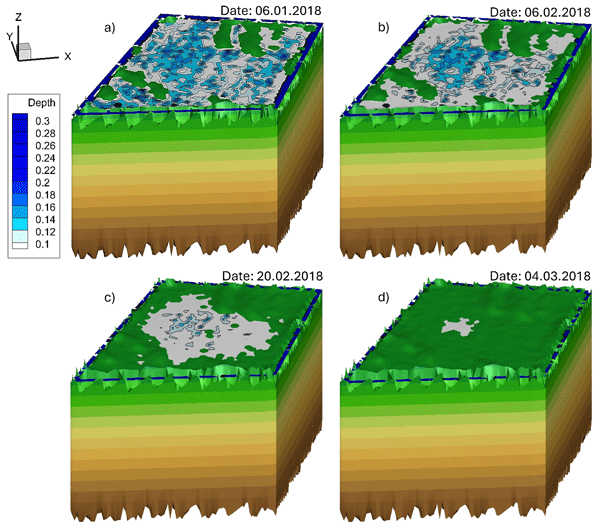
2. Figure 10 uses a 3D perspective to illustrate surface flooding, but the visualization makes it difficult to interpret actual water depths and spatial patterns. A top-down map or cross-sectional slices would likely provide clearer quantitative information about flooding dynamics.
3. Why was NSE not reported for the evapotranspiration comparison in Fig. 11b while it was included for groundwater in Fig. 11c? Including the same performance metrics (e.g., NSE, KGE, RMSE) for both variables, or explaining why different metrics were used, would improve consistency and help readers evaluate model performance.
4. The tables mainly summarize model parameters, but they are rarely referenced explicitly in the text, which makes it harder for readers to connect the discussion to the parameter values used in the simulations. Explicitly referring to the tables in the text (e.g., “soil hydraulic parameters are summarized in Table X”) would help guide readers and improve the clarity of the model description.
Citation: https://doi.org/10.5194/egusphere-2025-6200-RC1 -
AC1: 'Reply on RC1', Nariman Mahmoodi, 10 Jun 2026
The comment was uploaded in the form of a supplement: https://egusphere.copernicus.org/preprints/2026/egusphere-2025-6200/egusphere-2025-6200-AC1-supplement.pdf
-
AC1: 'Reply on RC1', Nariman Mahmoodi, 10 Jun 2026
-
RC2: 'Comment on egusphere-2025-6200', Anonymous Referee #2, 26 May 2026
1. Lines 55–58, are building a quantitative argument about water-storage assessment gaps and then line 58 abruptly pivot to “The specific microclimatic conditions, organic-rich soils and high-water tables within peatlands are the basis for a specific flora and fauna”. This interrupts the logical progression. Consider relocating this sentence to lines 49–53, where ecological functions and biogeochemical cycles are introduced.
2. Grammar of the objectives (iii): consider saying quantifying.
3. instead of saying has used say used (line 94)
4. It would be better to say : This study presents/develops a hydrologic model setup rather than "This study addresses a hydrologic model setup that can be used..." (Line 100)
5. Line154- CO2/H2O - use proper subscripts.
6. Please adopt a single convention, either sentence case or title case and apply it consistently to all figure titles, panel headings, and axis labels.
7. The title promises "insights for rewetting," the abstract states that the model "provides an initial assessment of potential management measures … that could enable effective rewetting" (lines 33–35) the introduction claims the setup allows for "a robust assessment of possible rewetting measures" (line 100). However, the results do not actually simulate any rewetting scenarios. It only models the baseline drained conditions from 2015 to 2023. I recommend that the authors to clarify this in paper. As currently written, the framing overstates what the paper delivers.
8. In the Discussion, it is mentioned that the Kristensen-Jensen evapotranspiration framework caps the effect of LAI at roughly 2.5, even though the actual fen grasses at the site reach an LAI of around 7 during the summer (line 234; also line 302 for summer 2018). The model overestimates AET during the 2018 drought (lines 292–294, 364–365), and the authors acknowledge the LAI cap as a limitation in the Discussion (lines 544–547), but they do not connect these two points. Please clarify whether the LAI saturation at 2.5 contributes to the 2018 overestimation, or whether the overestimation arises from another mechanism.
9. Section 2.4 (lines 195–197) states that observed ditch water levels were imposed as a Dirichlet boundary, but it does not explain how missing observations were handled. This becomes important because the Results (lines 331–335) attribute simulated–observed groundwater deviations in 2018 and 2021 specifically to missing ditch data. Please add 1–2 sentences in Section 2.4 describing the gap-filling approach.
10. The Discussion currently reads as a single, continuous block of text that jumps between different themes. For example, it discusses ET performance, shifts to fen grass physiology, moves to the two-layer peat system, returns to ET and ditch gradients, discusses long-term storage, jumps to mesh quality and subsidence, and then goes back to ET LAI saturation. Lack of organization makes it hard for the reader to follow your core arguments. I recommend organizing the Discussion into clear subsections.Citation: https://doi.org/10.5194/egusphere-2025-6200-RC2 -
AC2: 'Reply on RC2', Nariman Mahmoodi, 10 Jun 2026
The comment was uploaded in the form of a supplement: https://egusphere.copernicus.org/preprints/2026/egusphere-2025-6200/egusphere-2025-6200-AC2-supplement.pdf
-
AC2: 'Reply on RC2', Nariman Mahmoodi, 10 Jun 2026
-
RC3: 'Comment on egusphere-2025-6200', Anonymous Referee #3, 04 Jun 2026
General Comments
This is an interesting application of the Hydrogeosphere model to simulate groundwater-surface water interactions in a small peatland system in north east Germany. The work has relevance to topical issue of re-wetting peatlands to restore them and reinstate their natural function as carbon sinks in the landscape.
The paper is generally clear and well-written, however in places better justification of the modelling decisions could be given, particularly in relation to the parameterisation and the associated calibration. It would also be good to have some explicit description of how the drain flow is managed over the course of the year and how this related to the constant boundaries that are ascribed to the ditches. In addition, there is very little consideration of the uncertainty associated with the modelling results and how this might affect interpretation. Finally, although the study is contextualised in relation to assessing peatland re-wetting, it is unclear how the study helps with that, other than provide a “proof of concept” in using Hydrogeosphere as a tool. As most re-wetting is seeking to enable rapid peat regeneration, the model would need to have a more dynamic soil parameterisation to capture this in future scenarios. Some discussion of this would be appropriate.
The paper is rich in Figures which dilutes the story somewhat. Consider moving less essential Figures to supplementary materials
Specific Comments
L15 Species usually italicised.
L154 Sub-scripts in CO2/H2O
L162 What are the uncertainties with the AE estimates from the tower. There possible influence is mentioned later in the paper, but there
L205 So where do these parameter values come from? Literature values? Were they tuned from trial and error calibration? How are they justified?
L235 What is the justification of these parameter values? Why were they selected? Any likely uncertainties?
L323 Can you say in the methods exactly how the calibration and validation were carried out and why you split the periods as you did?
Figure 10 Any field evidence (e.g. fixed position photography/drone imagery) to validate these spatial patterns of flooding?
L445 It is perhaps a bit of an exaggeration to say ET parameterisation is still rare. It is becoming more common through ecohydrological models.
L448 Here the issue of uncertainty over the AET measurements comes in. Can you provide this in the methods as suggested above.
Citation: https://doi.org/10.5194/egusphere-2025-6200-RC3 -
AC3: 'Reply on RC3', Nariman Mahmoodi, 10 Jun 2026
The comment was uploaded in the form of a supplement: https://egusphere.copernicus.org/preprints/2026/egusphere-2025-6200/egusphere-2025-6200-AC3-supplement.pdf
-
AC3: 'Reply on RC3', Nariman Mahmoodi, 10 Jun 2026
Peer review completion
Journal article(s) based on this preprint
Viewed
| HTML | XML | Total | Supplement | BibTeX | EndNote | |
|---|---|---|---|---|---|---|
| 1,007 | 623 | 140 | 1,770 | 286 | 100 | 124 |
- HTML: 1,007
- PDF: 623
- XML: 140
- Total: 1,770
- Supplement: 286
- BibTeX: 100
- EndNote: 124
Viewed (geographical distribution)
| Country | # | Views | % |
|---|
| Total: | 0 |
| HTML: | 0 |
| PDF: | 0 |
| XML: | 0 |
- 1
Nariman Mahmoodi

Ottfried Dietrich
Jürgen Pickert
Christoph Merz
The requested preprint has a corresponding peer-reviewed final revised paper. You are encouraged to refer to the final revised version.
- Preprint
(2737 KB) - Metadata XML
-
Supplement
(196 KB) - BibTeX
- EndNote
- Final revised paper
The manuscript studies hydrological controls on water-table dynamics in a drained fen peatland. The authors combine long-term field observations with a coupled surface–subsurface hydrological model (HydroGeoSphere). The model is used to quantify the peatland water balance and analyze groundwater dynamics. Results show that strong evapotranspiration in summer lowers groundwater levels and reverses the hydraulic gradient between the peatland and drainage ditches. Peat stratigraphy also plays an important role in controlling water storage and water-table variability. These processes are key to understanding hydrological functioning and challenges for peatland rewetting. The manuscript is generally well written and presents an interesting integration of field observations and modeling. However, several aspects of the methodology and presentation could be improved to strengthen the reproducibility of the model setup and the practical implications for peatland restoration.
Main comments:
1. Although the paper discusses implications for peatland rewetting, the model simulations represent only the current drained conditions. Explicit rewetting scenarios were not tested, which limits the ability to evaluate restoration strategies directly. I suggest including a set of simple scenario simulations (e.g., raising ditch water levels by different amounts or reducing ditch drainage conductivity) to allow the model to directly assess potential rewetting strategies and strengthen the study's practical relevance.
2. The evapotranspiration parameterization assumes that ET reaches potential evapotranspiration at LAI ≈2.5, even though observed LAI at the site reaches about 7. This assumption effectively removes most vegetation variability from the hydrological response and may underestimate the influence of canopy dynamics on transpiration and groundwater drawdown. The model could be improved by testing alternative ET formulations that account for higher LAI values.
3. The paper reports good model performance metrics. Still, it does not clearly describe the calibration procedure or identify which parameters were calibrated, making it difficult to assess parameter sensitivity or reproduce the model setup.
Minor comments:
1. Figure 8 attempts to show seasonal and interannual variability using a heatmap, but the color gradients make the evapotranspiration patterns difficult to interpret. A line plot showing monthly values across years would likely communicate the seasonal cycle and year-to-year differences more clearly.
2. Figure 10 uses a 3D perspective to illustrate surface flooding, but the visualization makes it difficult to interpret actual water depths and spatial patterns. A top-down map or cross-sectional slices would likely provide clearer quantitative information about flooding dynamics.
3. Why was NSE not reported for the evapotranspiration comparison in Fig. 11b while it was included for groundwater in Fig. 11c? Including the same performance metrics (e.g., NSE, KGE, RMSE) for both variables, or explaining why different metrics were used, would improve consistency and help readers evaluate model performance.
4. The tables mainly summarize model parameters, but they are rarely referenced explicitly in the text, which makes it harder for readers to connect the discussion to the parameter values used in the simulations. Explicitly referring to the tables in the text (e.g., “soil hydraulic parameters are summarized in Table X”) would help guide readers and improve the clarity of the model description.