
the Creative Commons Attribution 4.0 License.
the Creative Commons Attribution 4.0 License.
 | 12 Jan 2026
A near-sunset atmospheric sounding during the 14 October 2023 annular solar eclipse over Natal
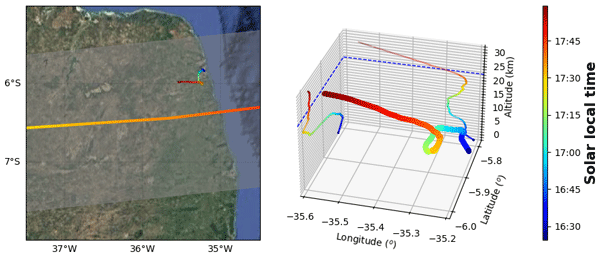
Abstract. Solar eclipses are transient atmospheric events that cause rapid localized reduction in solar radiation, which produces complex changes associate with the vertical coupling of the layers. This study investigates the vertical response of the neutral atmosphere to the 14 October 2023 annular solar eclipse over Natal, Brazil (5.79° S, 35.2° W). This event presented a unique configuration as the maximum obscuration of ∼ 88.5 % occurred near sunset in a region of transition between land an ocean. A stratospheric balloon sounding launched immediately before the umbra reached Natal was used. The balloon collected atmospheric profiles (temperature, pressure, relative humidity, and ozone concentration) for over 1.45 hours, with the umbra passing over the balloon at ∼ 22.35 km altitude for 3 min and 36 s. Comparison with average October profiles and model data revealed significant vertical structures: (i) A notable cooling of 4–5 K was observed in the tropopause region (14 km altitude); (ii) Vertical fluctuations in temperature were enhanced, particularly above 14 km; (iii) atmospheric pressure decreased by 0.2–0.7 hPa above 12 km; (iv) ozone concentration showed strong vertical oscillation and an enhancement of up to 1 ppm above 20 km altitude; (v) relative humidity increased between 5 and 21 km altitude compared to control profiles. These observations of complex, small-scale fluctuations and clear responses in the vertical atmospheric field are consistent with previous reports and theoretical expectations of solar eclipse effects, confirming the importance of even an annular eclipse as a significant driver of localized atmospheric dynamics.
Competing interests: Igo Paulino is a member of the editorial board of Annales Geophysicae
Publisher's note: Copernicus Publications remains neutral with regard to jurisdictional claims made in the text, published maps, institutional affiliations, or any other geographical representation in this paper. While Copernicus Publications makes every effort to include appropriate place names, the final responsibility lies with the authors. Views expressed in the text are those of the authors and do not necessarily reflect the views of the publisher.-
Notice on discussion status
The requested preprint has a corresponding peer-reviewed final revised paper. You are encouraged to refer to the final revised version.
-
Preprint
(725 KB)
-
The requested preprint has a corresponding peer-reviewed final revised paper. You are encouraged to refer to the final revised version.
- Preprint
(725 KB) - Metadata XML
- BibTeX
- EndNote
- Final revised paper


Journal article(s) based on this preprint
Interactive discussion
Status: closed
-
RC1: 'Comment on egusphere-2025-6194', Maria Paulete, 06 Feb 2026
-
AC1: 'Reply on RC1', Igo Paulino, 12 May 2026
We would like to express our gratitude to Referee #1 for the time and effort spent reviewing our manuscript. We are also very grateful for their kind comments and recommendation in favor of publication. We will conduct a detailed revision of the text to correct the typos identified by the Referee.
Citation: https://doi.org/10.5194/egusphere-2025-6194-AC1
-
AC1: 'Reply on RC1', Igo Paulino, 12 May 2026
-
RC2: 'Comment on egusphere-2025-6194', Anonymous Referee #2, 27 Apr 2026
This is an interesting observational study based on a rare balloon sounding during the 14 October 2023 annular solar eclipse over Natal, Brazil. The experimental configuration is valuable, especially because the eclipse occurred near sunset and the shadow crossed the balloon at stratospheric altitude.
The reported temperature cooling near the tropopause, pressure decrease, ozone enhancement, and relative humidity changes are relevant and generally consistent with expected eclipse-related atmospheric responses. However, I think the causal interpretation should be more cautious. The control dataset is limited to only a few October 2023 soundings, and natural day-to-day variability, gravity waves, coastal dynamics, and background meteorological conditions may also explain part of the observed vertical structure.
I recommend that the authors strengthen the analysis in the following ways:
- Include a more robust climatological comparison, if possible, using additional October SHADOZ soundings from multiple years at Natal.
- Compare the observed profiles with reanalysis data, such as ERA5, to better characterize the background meteorological conditions on 14 October 2023.
- Quantify the statistical significance of the temperature, ozone, humidity, and pressure anomalies relative to natural variability.
- Provide a clearer uncertainty discussion for the ozone and relative humidity measurements, especially at higher altitudes where absolute humidity values are very small.
- Moderate some of the causal language. Terms such as “confirms” could be replaced by “is consistent with” or “supports the interpretation that,” unless stronger attribution analysis is added.
- Improve manuscript editing. There are several grammatical and typographical issues, for example “relativity humidity,” “fights” instead of “flights,” and “dowloaded.” Some figure captions also need revision for clarity.
Overall, this is a valuable observational study based on a rare dataset. I recommend publication after revision. The main issue is not the relevance of the observations, but the strength of the causal attribution to the eclipse. The manuscript would be more convincing if the attribution of the observed anomalies were presented with more caution and the comparison with background atmospheric variability were strengthened.
Citation: https://doi.org/10.5194/egusphere-2025-6194-RC2 -
AC2: 'Reply on RC2', Igo Paulino, 12 May 2026
Referee: This is an interesting observational study based on a rare balloon sounding during the 14 October 2023 annular solar eclipse over Natal, Brazil. The experimental configuration is valuable, especially because the eclipse occurred near sunset and the shadow crossed the balloon at stratospheric altitude. The reported temperature cooling near the tropopause, pressure decrease, ozone enhancement, and relative humidity changes are relevant and generally consistent with expected eclipse-related atmospheric responses. However, I think the causal interpretation should be more cautious. The control dataset is limited to only a few October 2023 soundings, and natural day-to-day variability, gravity waves, coastal dynamics, and background meteorological conditions may also explain part of the observed vertical structure.
Authors: We appreciate the time invested by Referee 1, as well as their relevant and constructive comments aimed at improving our manuscript. In the revised version, we will do our best to address all of their concerns.
Referee: Include a more robust climatological comparison, if possible, using additional October SHADOZ soundings from multiple years at Natal.
Authors: Thank you for the excellent suggestion. In the final version of this work, we will incorporate a climatological average for October, as recommended by the referee. An important point to consider is that most of the soundings are generally conducted around local noon. In contrast, the observations taken on the day of the eclipse were recorded in the late afternoon. It is important to note that this difference in timing may naturally lead to some discrepancies, but we will comment in the revised version of the manuscript.
Referee: Compare the observed profiles with reanalysis data, such as ERA5, to better characterize the background meteorological conditions on 14 October 2023.
Authors: Thank you for the suggestion. Yes, we can utilize the reanalysis data instead of the MSIS model and evaluate possible differences.
Referee: Quantify the statistical significance of the temperature, ozone, humidity, and pressure anomalies relative to natural variability.
Authors: This is an interesting suggestion, thank you. By incorporating the climatological averages also suggested by Referee #2, we will be able to perform this quantification. We will present these results in the revised version of the manuscript.
Referee: Provide a clearer uncertainty discussion for the ozone and relative humidity measurements, especially at higher altitudes where absolute humidity values are very small.
Authors: Following your recommendations, we are going to include a detailed look at these uncertainties in the updated version. Thank you for pointing this out.
Referee: Moderate some of the causal language. Terms such as “confirms” could be replaced by “is consistent with” or “supports the interpretation that,” unless stronger attribution analysis is added. Improve manuscript editing. There are several grammatical and typographical issues, for example “relativity humidity,” “fights” instead of “flights,” and “dowloaded.” Some figure captions also need revision for clarity.
Authors: Thank you for these minor suggestions, we will fix them!
Referee: Overall, this is a valuable observational study based on a rare dataset. I recommend publication after revision. The main issue is not the relevance of the observations, but the strength of the causal attribution to the eclipse. The manuscript would be more convincing if the attribution of the observed anomalies were presented with more caution and the comparison with background atmospheric variability were strengthened.
Authors: We are once again grateful for the important suggestions of the Referee #2 and for the careful review process, which will greatly enhance the overall quality of our manuscript.Citation: https://doi.org/10.5194/egusphere-2025-6194-AC2
Peer review completion


Interactive discussion
Status: closed
-
RC1: 'Comment on egusphere-2025-6194', Maria Paulete, 06 Feb 2026
There are minor typing erros in the text that need to be corrected. But the content is suitable for publication.
Citation: https://doi.org/10.5194/egusphere-2025-6194-RC1 -
AC1: 'Reply on RC1', Igo Paulino, 12 May 2026
We would like to express our gratitude to Referee #1 for the time and effort spent reviewing our manuscript. We are also very grateful for their kind comments and recommendation in favor of publication. We will conduct a detailed revision of the text to correct the typos identified by the Referee.
Citation: https://doi.org/10.5194/egusphere-2025-6194-AC1
-
AC1: 'Reply on RC1', Igo Paulino, 12 May 2026
-
RC2: 'Comment on egusphere-2025-6194', Anonymous Referee #2, 27 Apr 2026
This is an interesting observational study based on a rare balloon sounding during the 14 October 2023 annular solar eclipse over Natal, Brazil. The experimental configuration is valuable, especially because the eclipse occurred near sunset and the shadow crossed the balloon at stratospheric altitude.
The reported temperature cooling near the tropopause, pressure decrease, ozone enhancement, and relative humidity changes are relevant and generally consistent with expected eclipse-related atmospheric responses. However, I think the causal interpretation should be more cautious. The control dataset is limited to only a few October 2023 soundings, and natural day-to-day variability, gravity waves, coastal dynamics, and background meteorological conditions may also explain part of the observed vertical structure.
I recommend that the authors strengthen the analysis in the following ways:
- Include a more robust climatological comparison, if possible, using additional October SHADOZ soundings from multiple years at Natal.
- Compare the observed profiles with reanalysis data, such as ERA5, to better characterize the background meteorological conditions on 14 October 2023.
- Quantify the statistical significance of the temperature, ozone, humidity, and pressure anomalies relative to natural variability.
- Provide a clearer uncertainty discussion for the ozone and relative humidity measurements, especially at higher altitudes where absolute humidity values are very small.
- Moderate some of the causal language. Terms such as “confirms” could be replaced by “is consistent with” or “supports the interpretation that,” unless stronger attribution analysis is added.
- Improve manuscript editing. There are several grammatical and typographical issues, for example “relativity humidity,” “fights” instead of “flights,” and “dowloaded.” Some figure captions also need revision for clarity.
Overall, this is a valuable observational study based on a rare dataset. I recommend publication after revision. The main issue is not the relevance of the observations, but the strength of the causal attribution to the eclipse. The manuscript would be more convincing if the attribution of the observed anomalies were presented with more caution and the comparison with background atmospheric variability were strengthened.
Citation: https://doi.org/10.5194/egusphere-2025-6194-RC2 -
AC2: 'Reply on RC2', Igo Paulino, 12 May 2026
Referee: This is an interesting observational study based on a rare balloon sounding during the 14 October 2023 annular solar eclipse over Natal, Brazil. The experimental configuration is valuable, especially because the eclipse occurred near sunset and the shadow crossed the balloon at stratospheric altitude. The reported temperature cooling near the tropopause, pressure decrease, ozone enhancement, and relative humidity changes are relevant and generally consistent with expected eclipse-related atmospheric responses. However, I think the causal interpretation should be more cautious. The control dataset is limited to only a few October 2023 soundings, and natural day-to-day variability, gravity waves, coastal dynamics, and background meteorological conditions may also explain part of the observed vertical structure.
Authors: We appreciate the time invested by Referee 1, as well as their relevant and constructive comments aimed at improving our manuscript. In the revised version, we will do our best to address all of their concerns.
Referee: Include a more robust climatological comparison, if possible, using additional October SHADOZ soundings from multiple years at Natal.
Authors: Thank you for the excellent suggestion. In the final version of this work, we will incorporate a climatological average for October, as recommended by the referee. An important point to consider is that most of the soundings are generally conducted around local noon. In contrast, the observations taken on the day of the eclipse were recorded in the late afternoon. It is important to note that this difference in timing may naturally lead to some discrepancies, but we will comment in the revised version of the manuscript.
Referee: Compare the observed profiles with reanalysis data, such as ERA5, to better characterize the background meteorological conditions on 14 October 2023.
Authors: Thank you for the suggestion. Yes, we can utilize the reanalysis data instead of the MSIS model and evaluate possible differences.
Referee: Quantify the statistical significance of the temperature, ozone, humidity, and pressure anomalies relative to natural variability.
Authors: This is an interesting suggestion, thank you. By incorporating the climatological averages also suggested by Referee #2, we will be able to perform this quantification. We will present these results in the revised version of the manuscript.
Referee: Provide a clearer uncertainty discussion for the ozone and relative humidity measurements, especially at higher altitudes where absolute humidity values are very small.
Authors: Following your recommendations, we are going to include a detailed look at these uncertainties in the updated version. Thank you for pointing this out.
Referee: Moderate some of the causal language. Terms such as “confirms” could be replaced by “is consistent with” or “supports the interpretation that,” unless stronger attribution analysis is added. Improve manuscript editing. There are several grammatical and typographical issues, for example “relativity humidity,” “fights” instead of “flights,” and “dowloaded.” Some figure captions also need revision for clarity.
Authors: Thank you for these minor suggestions, we will fix them!
Referee: Overall, this is a valuable observational study based on a rare dataset. I recommend publication after revision. The main issue is not the relevance of the observations, but the strength of the causal attribution to the eclipse. The manuscript would be more convincing if the attribution of the observed anomalies were presented with more caution and the comparison with background atmospheric variability were strengthened.
Authors: We are once again grateful for the important suggestions of the Referee #2 and for the careful review process, which will greatly enhance the overall quality of our manuscript.Citation: https://doi.org/10.5194/egusphere-2025-6194-AC2
Peer review completion
Journal article(s) based on this preprint
Viewed
| HTML | XML | Total | BibTeX | EndNote | |
|---|---|---|---|---|---|
| 1,071 | 475 | 144 | 1,690 | 129 | 134 |
- HTML: 1,071
- PDF: 475
- XML: 144
- Total: 1,690
- BibTeX: 129
- EndNote: 134
Viewed (geographical distribution)
| Country | # | Views | % |
|---|
| Total: | 0 |
| HTML: | 0 |
| PDF: | 0 |
| XML: | 0 |
- 1

Francisco Raimundo da Silva
Ana Roberta Paulino
Gilvan Borba
The requested preprint has a corresponding peer-reviewed final revised paper. You are encouraged to refer to the final revised version.
- Preprint
(725 KB) - Metadata XML
There are minor typing erros in the text that need to be corrected. But the content is suitable for publication.