
the Creative Commons Attribution 4.0 License.
the Creative Commons Attribution 4.0 License.
 | 28 Jan 2026
Brief communication: Network-wide parameterisation for estimating snow water equivalent through cosmic ray neutron sensors in the Italian Alps
Abstract. We present a novel approach based on leveraging a network-wide parameterisation to derive snow water equivalent (SWE) with cosmic ray neutron sensing (CRNS) probes. The network comprises 26 sites (1422–2901 m asl) in the Italian Alps. The parameterisation was defined by fitting neutron counts to 35 SWE measurements taken at 6 sites in the first half of the 2023–2024 snow season and validated with 111 SWE data from 2023–2024 and 2024–2025 at 13 sites. Our analysis shows that this approach retains good representativeness of the snowpack, which can be extended to unmonitored sites if they have monitored counterparts at similar elevation. This finding overcomes the need for year-round accessibility and increases the number of potential sites for continuous SWE retrieval.
Competing interests: Author Enrico Gazzola is currently empoyed by the company that produces the CRNS probes used for this work. The other authors declare that they have no competing interests.
Publisher's note: Copernicus Publications remains neutral with regard to jurisdictional claims made in the text, published maps, institutional affiliations, or any other geographical representation in this paper. While Copernicus Publications makes every effort to include appropriate place names, the final responsibility lies with the authors. Views expressed in the text are those of the authors and do not necessarily reflect the views of the publisher.-
Notice on discussion status
The requested preprint has a corresponding peer-reviewed final revised paper. You are encouraged to refer to the final revised version.
-
Preprint
(935 KB)
-
Supplement
(152 KB)
-
The requested preprint has a corresponding peer-reviewed final revised paper. You are encouraged to refer to the final revised version.
- Preprint
(935 KB) - Metadata XML
-
Supplement
(152 KB) - BibTeX
- EndNote
- Final revised paper


Journal article(s) based on this preprint
Interactive discussion
Status: closed
-
RC1: 'Comment on egusphere-2025-6148', Heye Bogena, 23 Feb 2026
- AC1: 'Reply on RC1', Mario Gallarate, 18 May 2026
-
RC2: 'Comment on egusphere-2025-6148', Steven Fassnacht, 21 Apr 2026
General
The authors use 35 SWE measurement location-dates to calibrate six sites with cosmic ray neutron sensing (CRNS) probes during one winter of accumulation and then evaluate at 13 sites with 111 SWE location-dates. This is a very relevant “brief communication” that could be a decent paper. However, more information is needed to explain how the calibration (ground-truth) and evaluation SWE data were collected – see below. It is unclear how the data were collected and more importantly whether the data are representative of the area around the CRNS probe.
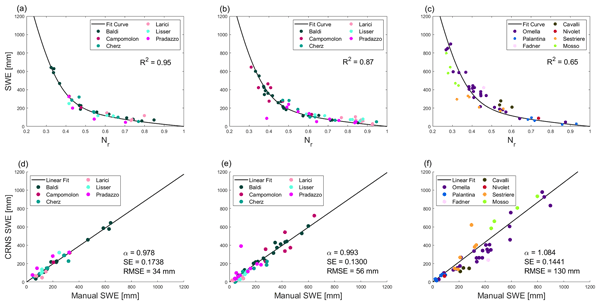
The first results are shown in Figure 2. These are informative. However, it would be useful to consider a different way to show the points, at least the calibration points – I cannot tell some of the colours apart. I suggest using different symbols, and perhaps the elevation colour ramp from Figure 1.
For the Data (and Figure 2), can you provide more information about the 35 location-day samples? A table in an Appendix or Supplementary Materials would be fine. There appear to be 13 samples from Baldi, 3 from Larici, etc. An indication on when these samples were taken would be informative. The calibration station (a) are also used in the evaluation (b). Better explain how and why the data were split into groups.
More information is necessary in explaining how SWE was measured. It appears that samples were either taken as a single core or as a series of horizontal cores. Which method was used for which site and which date?
- For the single vertical core, provide the details about the sampler, including the inside diameter/cross-sectional area (see López-Moreno et al., 2020; https://doi.org/10.1002/hyp.13785). Further, how many samples were taken? For the single corer, at least three samples are usually measured (see López-Moreno et al., 2013; https://doi.org/10.1016/j.advwatres.2012.08.010). No uncertainty can be assigned to a single sample.
- For the horizontal coring, it is unclear how representative horizontal cores are (see the previous references and citations therein, including Elder et al., 2009). Although Valt et al. (2012) and Valt (2019) seem to indicate that the method used here (especially the vertical coring) seems sufficient, these citations are from conference proceedings? [The latter should be 2018.] The method of measuring SWE is crucial for this paper, yet the validity and error are poorly explained. Sampling horizontally with a tube oversamples the middle and undersamples the sides. Further, measurements were only taken within layers. This does not provide a representative sampling of the entire snowpack. How were the layers identified? How do we know that they are homogeneous?
- Finally, were samples taken over an area? The snowpack is not homogeneous and the CRNS collects data in an area with a 200 to 300 meter radius around the CRNS probe. With only measuring SWE near the CRNS probe, we don’t know what SWE (and soil moisture) that the CRNS probe is actually sampling/measuring. This heterogeneity is crucial and explored in many papers. Without having ground-truth, it is unclear what to make of any of the results. Figure 2a presents the calibration and is dependent on four measurements at Baldi (SWE > 400 mm). Without those four measurements, there is limited correlation. Fortunately, Figure 2b seems to show that the calibration works for the evaluation.
Specifics
- Line 23: you are not “validating” the parameterization, but rather “evaluating,” since you don’t know the SWE sensed by the CRNS, nor the actual SWE unless you measure all the snow, i.e., you cannot truly scale from measurements to an area.
- Line 25: why is elevation relevant?
- Line 33: what does “snowmelt dates are projected to be anticipated by as much as” mean? This is unclear.
- Figure 1: show/distinguish the calibration versus evaluation sites. It is unclear what “unmonitored” means
- Line 91: why does N0 vary as a function of elevation?
- Data and Methods: use sub-sections or at least new paragraphs within this section to keep the piece separate.
- Line 107: it is a force gauge or a scale. Or is it a “dynamometer?”
- Figure 2: it should be clearly stated that the curve in (b) is derived from the data in (a).
- Figure 2c: are these the points from (a) and (b) replotted? This is not clear. What are the pink diamonds?
- How do the unmonitored sites fit in? That is not clear. What does unmonitored mean? Does this mean that there are no field SWE measurements? Is SWE computed from the fitted equation?
- Is Figure 3 only between monitored and unmonitored? How were the “distance classes” (I think those are the different colour blocks) decided? These seem random? What about showing the R value for each point in Figure 3a? This plot needs to be better explained. Is this a common plot? Provide a citation.
- There is no real discussion of the results.
Citation: https://doi.org/10.5194/egusphere-2025-6148-RC2 - AC2: 'Reply on RC2', Mario Gallarate, 18 May 2026
Peer review completion


Interactive discussion
Status: closed
-
RC1: 'Comment on egusphere-2025-6148', Heye Bogena, 23 Feb 2026
This manuscript presents a network-wide parameterisation to estimate snow water equivalent (SWE) using cosmic ray neutron sensing (CRNS) across sites in the Italian Alps.
The topic is highly relevant and of significant interest to the cryosphere and hydrological communities, and the authors’ effort to leverage network information to enhance SWE monitoring with CRNS stations represents a highly valuable contribution.
The manuscript is generally well written, and the approach is promising; however, several major issues related to the representation of the network and the methods, the clarity of the validation procedure, and the robustness of the conclusions need to be addressed before publication. I outline these points in the following major and specific comments.
Major comments
From the 26 sites, only 6 sites were used for calibration and 13 sites for validation. In its current form, the narrative risks implying broader validation than is actually demonstrated, e.g. from the title and the abstract. The authors should clearly and consistently distinguish between (i) the full network, (ii) the calibration subset, (iii) the validation subset, and (iv) sites to which the method is extrapolated. In particular, the abstract and conclusions should avoid wording that could be interpreted as network-wide validation. I recommend explicitly stating the number of sites used for calibration and validation wherever network performance is discussed.
The proposed method for converting neutron counts for SWE (Eqs. 1 and 2) introduces five free parameters (Λmax, Λmin, a1, a2, a3), which are calibrated using 35 SWE observations collected across six sites. While 35 measurements may appear sufficient in absolute terms, the effective degrees of freedom are substantially reduced when accounting for site-level clustering, potential temporal autocorrelation, and shared environmental conditions. This raises the question of whether the calibration is over-parameterised relative to the available independent information content. In particular:
- With five fitted parameters and 35 observations, the nominal ratio is only seven observations per parameter. If measurements are not fully independent (e.g., repeated measurements at the same site or within similar snow conditions), the effective sample size may be considerably smaller.
- The physical interpretability of each parameter is not entirely clear. If Λmax and Λmin are meant to represent physically bounded attenuation limits, are they sufficiently constrained during calibration?
- The exponential structure in Eq. (2) already provides substantial flexibility; adding three additional empirical parameters (a1, a2, a3) may risk compensating for noise or site-specific effects rather than capturing generalizable physics.
Given that the study aims to propose a network-wide parameterisation, parameter stability and transferability are critical. I therefore encourage the authors to justify the choice of five free parameters explicitly, assess potential overfitting (e.g., via cross-validation or information criteria), and discuss parameter sensitivity and identifiability. If the goal is broad applicability across sites, a reduced or partially constrained parameter set (for example, fixing Λmax and Λmin based on physical reasoning or literature values) might improve robustness and interpretability. Addressing this issue would significantly strengthen the methodological foundation of the manuscript.
The manuscript would benefit from a substantially more detailed description of the CRNS data processing workflow. At present, key preprocessing steps are either only briefly mentioned or not described in sufficient detail to ensure reproducibility and allow readers to evaluate the robustness of the SWE retrieval. In particular, the authors should clearly document:
- how incoming neutron flux variations were corrected (including data source, temporal resolution, and scaling approach);
- the atmospheric pressure correction procedure and coefficients used;
- atmospheric humidity corrections applied;
- quality control and filtering steps (e.g., temporal averaging, outlier removal, snow-free screening);
Given that SWE estimates derived from CRNS are highly sensitive to preprocessing choices, a transparent, step-by-step description is essential. I strongly recommend either adding a dedicated subsection in Methods that outlines the complete processing chain, or roviding a reproducible workflow (e.g., in the Supplement).
Chapter 2 would benefit from a clearer and more logical restructuring with subchapters as follows: 1) Manual SWE sampling, 2) station setup and 3) CRNS processing and SWE calculation including atmospheric pressure correction, incident neutron flux correction, detailed description of parameterisation and calculation of SWE from neutron counts. This reorganisation improves the logical flow of the chapter.
The use of local muon flux measurements to correct for incoming neutrons has not yet been demonstrated to be highly accurate. I recommend that the authors provide a comparison with the standard correction approach to assess the validity and performance of this method.
Specific comments
L58: You should consistently use the term “sensor”.
L68: It is unclear what the authors are referring to with the term “main Alpine watershed.”
L88: Please change “barometric factor correction” to “atmospheric pressure correction” to align with standard CRNS nomenclature. In addition, recent work by Davies et al. (2026) demonstrates that the barometric coefficient is strongly dependent on-site elevation. Given that the network in this study spans a wide elevation range (1422–2901 m a.s.l.), it is unclear whether elevation-dependent variations in the barometric coefficient were accounted for. In case a single coefficient values was used, please provide justification for why you are confident that this does not introduce systematic bias across the network. Addressing this issue is critical, as uncorrected elevation-dependent variations in the barometric coefficient could directly affect the accuracy and comparability of the SWE estimates across the network.
L90: Please explain in greater detail how you determined the baseline neutron count rate. In addition, the current use of the variable name N₀ may lead to confusion with the well-established N₀ parameter used in standard CRNS soil moisture calibration. Because the present study defines a conceptually different baseline quantity, I strongly recommend to adopt a distinct symbol (e.g., N_ref, N_base, or similar).
L93: Please explain in greater detail how you determined the normalised count rate (Nr).
L124-130: In this case these stations need to be excluded from the analysis.
L149-152: Please refer to Figure S1.
L155: The current validation procedure includes both calibration and non-calibration stations. While this provides an overall assessment of performance, it can potentially overestimate the method’s predictive skill because the calibration sites have already influenced the parameterisation. Therefore, I recommend separating the validation sites from calibration site explicitly.
L173: Given that you are using a buried CRNS sensor, whose footprint is already very small, the explanation provided does not seem physically sensible.
L193: The manuscript cites Gottardi et al., 2013, but this reference appears to be inaccessible. Ensuring that all references are accessible is essential for reproducibility and for readers to follow the methodology or contextual background.
L197: It is unclear which variable is being correlated (e.g., SWE, neutron count rate), which stations are included in the analysis (all 26 network sites, only calibration sites, or only validation sites), and whether the correlation refers to site-averaged values, individual measurements, or temporal series. The authors should clarify these points explicitly in the text and in the figure caption.
L197-203: In my view, this correlation analysis is only meaningful if each station has been individually calibrated. Otherwise, the uncertainties introduced by transferring the parameterisation across sites may dominate the variability and artificially inflate or suppress correlation values.
Literature
Davies, P., Baatz, R., Schattan, P., Quansah, E., Amekudzi, L. K., and Bogena, H. R. (2026). On the Variability of the Barometric Effect and Its Relation to Cosmic-Ray Neutron Sensing. Sensors, 26(3), 925.
Citation: https://doi.org/10.5194/egusphere-2025-6148-RC1 - AC1: 'Reply on RC1', Mario Gallarate, 18 May 2026
-
RC2: 'Comment on egusphere-2025-6148', Steven Fassnacht, 21 Apr 2026
General
The authors use 35 SWE measurement location-dates to calibrate six sites with cosmic ray neutron sensing (CRNS) probes during one winter of accumulation and then evaluate at 13 sites with 111 SWE location-dates. This is a very relevant “brief communication” that could be a decent paper. However, more information is needed to explain how the calibration (ground-truth) and evaluation SWE data were collected – see below. It is unclear how the data were collected and more importantly whether the data are representative of the area around the CRNS probe.
The first results are shown in Figure 2. These are informative. However, it would be useful to consider a different way to show the points, at least the calibration points – I cannot tell some of the colours apart. I suggest using different symbols, and perhaps the elevation colour ramp from Figure 1.
For the Data (and Figure 2), can you provide more information about the 35 location-day samples? A table in an Appendix or Supplementary Materials would be fine. There appear to be 13 samples from Baldi, 3 from Larici, etc. An indication on when these samples were taken would be informative. The calibration station (a) are also used in the evaluation (b). Better explain how and why the data were split into groups.
More information is necessary in explaining how SWE was measured. It appears that samples were either taken as a single core or as a series of horizontal cores. Which method was used for which site and which date?
- For the single vertical core, provide the details about the sampler, including the inside diameter/cross-sectional area (see López-Moreno et al., 2020; https://doi.org/10.1002/hyp.13785). Further, how many samples were taken? For the single corer, at least three samples are usually measured (see López-Moreno et al., 2013; https://doi.org/10.1016/j.advwatres.2012.08.010). No uncertainty can be assigned to a single sample.
- For the horizontal coring, it is unclear how representative horizontal cores are (see the previous references and citations therein, including Elder et al., 2009). Although Valt et al. (2012) and Valt (2019) seem to indicate that the method used here (especially the vertical coring) seems sufficient, these citations are from conference proceedings? [The latter should be 2018.] The method of measuring SWE is crucial for this paper, yet the validity and error are poorly explained. Sampling horizontally with a tube oversamples the middle and undersamples the sides. Further, measurements were only taken within layers. This does not provide a representative sampling of the entire snowpack. How were the layers identified? How do we know that they are homogeneous?
- Finally, were samples taken over an area? The snowpack is not homogeneous and the CRNS collects data in an area with a 200 to 300 meter radius around the CRNS probe. With only measuring SWE near the CRNS probe, we don’t know what SWE (and soil moisture) that the CRNS probe is actually sampling/measuring. This heterogeneity is crucial and explored in many papers. Without having ground-truth, it is unclear what to make of any of the results. Figure 2a presents the calibration and is dependent on four measurements at Baldi (SWE > 400 mm). Without those four measurements, there is limited correlation. Fortunately, Figure 2b seems to show that the calibration works for the evaluation.
Specifics
- Line 23: you are not “validating” the parameterization, but rather “evaluating,” since you don’t know the SWE sensed by the CRNS, nor the actual SWE unless you measure all the snow, i.e., you cannot truly scale from measurements to an area.
- Line 25: why is elevation relevant?
- Line 33: what does “snowmelt dates are projected to be anticipated by as much as” mean? This is unclear.
- Figure 1: show/distinguish the calibration versus evaluation sites. It is unclear what “unmonitored” means
- Line 91: why does N0 vary as a function of elevation?
- Data and Methods: use sub-sections or at least new paragraphs within this section to keep the piece separate.
- Line 107: it is a force gauge or a scale. Or is it a “dynamometer?”
- Figure 2: it should be clearly stated that the curve in (b) is derived from the data in (a).
- Figure 2c: are these the points from (a) and (b) replotted? This is not clear. What are the pink diamonds?
- How do the unmonitored sites fit in? That is not clear. What does unmonitored mean? Does this mean that there are no field SWE measurements? Is SWE computed from the fitted equation?
- Is Figure 3 only between monitored and unmonitored? How were the “distance classes” (I think those are the different colour blocks) decided? These seem random? What about showing the R value for each point in Figure 3a? This plot needs to be better explained. Is this a common plot? Provide a citation.
- There is no real discussion of the results.
Citation: https://doi.org/10.5194/egusphere-2025-6148-RC2 - AC2: 'Reply on RC2', Mario Gallarate, 18 May 2026
Peer review completion
Journal article(s) based on this preprint
Viewed
| HTML | XML | Total | Supplement | BibTeX | EndNote | |
|---|---|---|---|---|---|---|
| 1,337 | 456 | 114 | 1,907 | 237 | 129 | 132 |
- HTML: 1,337
- PDF: 456
- XML: 114
- Total: 1,907
- Supplement: 237
- BibTeX: 129
- EndNote: 132
Viewed (geographical distribution)
| Country | # | Views | % |
|---|
| Total: | 0 |
| HTML: | 0 |
| PDF: | 0 |
| XML: | 0 |
- 1

Nicola Colombo
Enrico Gazzola
Mauro Valt
Christian Ronchi
Luca Lanteri
Roberto Dinale
Rudi Nadalet
Stefano Ferraris
Alessio Gentile
Davide Gisolo
Michele Freppaz
Fiorella Acquaotta
The requested preprint has a corresponding peer-reviewed final revised paper. You are encouraged to refer to the final revised version.
- Preprint
(935 KB) - Metadata XML
-
Supplement
(152 KB) - BibTeX
- EndNote
- Final revised paper
This manuscript presents a network-wide parameterisation to estimate snow water equivalent (SWE) using cosmic ray neutron sensing (CRNS) across sites in the Italian Alps.
The topic is highly relevant and of significant interest to the cryosphere and hydrological communities, and the authors’ effort to leverage network information to enhance SWE monitoring with CRNS stations represents a highly valuable contribution.
The manuscript is generally well written, and the approach is promising; however, several major issues related to the representation of the network and the methods, the clarity of the validation procedure, and the robustness of the conclusions need to be addressed before publication. I outline these points in the following major and specific comments.
Major comments
From the 26 sites, only 6 sites were used for calibration and 13 sites for validation. In its current form, the narrative risks implying broader validation than is actually demonstrated, e.g. from the title and the abstract. The authors should clearly and consistently distinguish between (i) the full network, (ii) the calibration subset, (iii) the validation subset, and (iv) sites to which the method is extrapolated. In particular, the abstract and conclusions should avoid wording that could be interpreted as network-wide validation. I recommend explicitly stating the number of sites used for calibration and validation wherever network performance is discussed.
The proposed method for converting neutron counts for SWE (Eqs. 1 and 2) introduces five free parameters (Λmax, Λmin, a1, a2, a3), which are calibrated using 35 SWE observations collected across six sites. While 35 measurements may appear sufficient in absolute terms, the effective degrees of freedom are substantially reduced when accounting for site-level clustering, potential temporal autocorrelation, and shared environmental conditions. This raises the question of whether the calibration is over-parameterised relative to the available independent information content. In particular:
Given that the study aims to propose a network-wide parameterisation, parameter stability and transferability are critical. I therefore encourage the authors to justify the choice of five free parameters explicitly, assess potential overfitting (e.g., via cross-validation or information criteria), and discuss parameter sensitivity and identifiability. If the goal is broad applicability across sites, a reduced or partially constrained parameter set (for example, fixing Λmax and Λmin based on physical reasoning or literature values) might improve robustness and interpretability. Addressing this issue would significantly strengthen the methodological foundation of the manuscript.
The manuscript would benefit from a substantially more detailed description of the CRNS data processing workflow. At present, key preprocessing steps are either only briefly mentioned or not described in sufficient detail to ensure reproducibility and allow readers to evaluate the robustness of the SWE retrieval. In particular, the authors should clearly document:
Given that SWE estimates derived from CRNS are highly sensitive to preprocessing choices, a transparent, step-by-step description is essential. I strongly recommend either adding a dedicated subsection in Methods that outlines the complete processing chain, or roviding a reproducible workflow (e.g., in the Supplement).
Chapter 2 would benefit from a clearer and more logical restructuring with subchapters as follows: 1) Manual SWE sampling, 2) station setup and 3) CRNS processing and SWE calculation including atmospheric pressure correction, incident neutron flux correction, detailed description of parameterisation and calculation of SWE from neutron counts. This reorganisation improves the logical flow of the chapter.
The use of local muon flux measurements to correct for incoming neutrons has not yet been demonstrated to be highly accurate. I recommend that the authors provide a comparison with the standard correction approach to assess the validity and performance of this method.
Specific comments
L58: You should consistently use the term “sensor”.
L68: It is unclear what the authors are referring to with the term “main Alpine watershed.”
L88: Please change “barometric factor correction” to “atmospheric pressure correction” to align with standard CRNS nomenclature. In addition, recent work by Davies et al. (2026) demonstrates that the barometric coefficient is strongly dependent on-site elevation. Given that the network in this study spans a wide elevation range (1422–2901 m a.s.l.), it is unclear whether elevation-dependent variations in the barometric coefficient were accounted for. In case a single coefficient values was used, please provide justification for why you are confident that this does not introduce systematic bias across the network. Addressing this issue is critical, as uncorrected elevation-dependent variations in the barometric coefficient could directly affect the accuracy and comparability of the SWE estimates across the network.
L90: Please explain in greater detail how you determined the baseline neutron count rate. In addition, the current use of the variable name N₀ may lead to confusion with the well-established N₀ parameter used in standard CRNS soil moisture calibration. Because the present study defines a conceptually different baseline quantity, I strongly recommend to adopt a distinct symbol (e.g., N_ref, N_base, or similar).
L93: Please explain in greater detail how you determined the normalised count rate (Nr).
L124-130: In this case these stations need to be excluded from the analysis.
L149-152: Please refer to Figure S1.
L155: The current validation procedure includes both calibration and non-calibration stations. While this provides an overall assessment of performance, it can potentially overestimate the method’s predictive skill because the calibration sites have already influenced the parameterisation. Therefore, I recommend separating the validation sites from calibration site explicitly.
L173: Given that you are using a buried CRNS sensor, whose footprint is already very small, the explanation provided does not seem physically sensible.
L193: The manuscript cites Gottardi et al., 2013, but this reference appears to be inaccessible. Ensuring that all references are accessible is essential for reproducibility and for readers to follow the methodology or contextual background.
L197: It is unclear which variable is being correlated (e.g., SWE, neutron count rate), which stations are included in the analysis (all 26 network sites, only calibration sites, or only validation sites), and whether the correlation refers to site-averaged values, individual measurements, or temporal series. The authors should clarify these points explicitly in the text and in the figure caption.
L197-203: In my view, this correlation analysis is only meaningful if each station has been individually calibrated. Otherwise, the uncertainties introduced by transferring the parameterisation across sites may dominate the variability and artificially inflate or suppress correlation values.
Literature
Davies, P., Baatz, R., Schattan, P., Quansah, E., Amekudzi, L. K., and Bogena, H. R. (2026). On the Variability of the Barometric Effect and Its Relation to Cosmic-Ray Neutron Sensing. Sensors, 26(3), 925.