
the Creative Commons Attribution 4.0 License.
the Creative Commons Attribution 4.0 License.
 | 03 Feb 2026
The influence of lakes and reservoirs on flood peaks at hourly vs. daily timescales in Switzerland
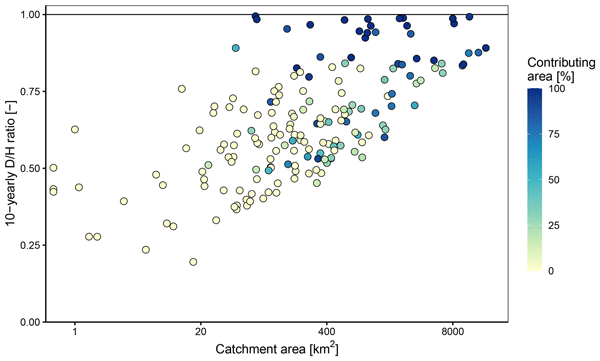
Abstract. Water bodies such as lakes and reservoirs can play a crucial role in reducing flood peaks both on daily and hourly timescales. While the effect of water bodies on flood peaks at different time resolutions has been demonstrated in the past, it remains unclear how they affect the ratio between daily and hourly peaks. Here, we analyse how water bodies attenuate flood peaks at daily and hourly time resolution and the relationship between flood peaks at these two time scales using two approaches: (1) four local case studies with gauges upstream and downstream of reservoirs, and (2) a large-sample hydrological dataset covering Switzerland. Our results show that hourly flows are dampened much more strongly than daily flows, which leads to similar daily and hourly flood peaks downstream of reservoirs. Specifically, our case study analysis highlights that (sub-)hourly flows are attenuated by up to 70 percent downstream of reservoirs during flood events with a 10-year return period. We also find that the attenuation effect is particularly pronounced in catchments that are heavily influenced by water bodies, i.e. those catchments where more than 60 percent of the area contributes to water body inflow. We conclude that considering water body influence on flood peaks is crucial to understand the similarity between daily and hourly flood peaks and that it should be considered in large-sample analyses using suitable metrics.
Competing interests: At least one of the (co-)authors is a member of the editorial board of Hydrology and Earth System Sciences. The peer-review process was guided by an independent editor, and the authors also have no other competing interests to declare.
Publisher's note: Copernicus Publications remains neutral with regard to jurisdictional claims made in the text, published maps, institutional affiliations, or any other geographical representation in this paper. While Copernicus Publications makes every effort to include appropriate place names, the final responsibility lies with the authors. Views expressed in the text are those of the authors and do not necessarily reflect the views of the publisher.-
Notice on discussion status
The requested preprint has a corresponding peer-reviewed final revised paper. You are encouraged to refer to the final revised version.
-
Preprint
(3338 KB)
-
The requested preprint has a corresponding peer-reviewed final revised paper. You are encouraged to refer to the final revised version.
- Preprint
(3338 KB) - Metadata XML
- BibTeX
- EndNote
- Final revised paper


Journal article(s) based on this preprint
Interactive discussion
Status: closed
-
RC1: 'Comment on egusphere-2025-6119', Anonymous Referee #1, 03 Mar 2026
- AC1: 'Reply on RC1', Manuela Irene Brunner, 26 May 2026
-
RC2: 'Comment on egusphere-2025-6119', Anonymous Referee #2, 10 Apr 2026
General comments
I appreciated the manuscript, particularly the clarity of the writing and the way the text guides the reader through the rationale and objectives of the work. The study addresses an interesting and relevant topic, namely the influence of water bodies on flood peaks at hourly versus daily timescales. Overall, the manuscript is well structured and readable, and the topic is timely given the increasing availability of sub daily hydrological data.
I found that the motivation of the study would benefit from being emphasized more clearly in the introductory section. In particular, the availability of instantaneous peak flow (IPFs) information appears to represent a central element underlying the relevance of the work, yet this importance is not always highlighted as strongly as it could be. Strengthening the discussion around the limitations in the availability of IPF data, especially in comparison with daily observations, would help clarify why the present analysis is needed and what gap it is intended to address. Expanding on the challenges related to subdaily data availability would also reinforce the timeliness of the study.
In addition, the conceptual basis for comparing daily and hourly flood peaks could be further strengthened by making the underlying hypothesis more explicit. You stated that in many basin-scale studies, water bodies are not systematically incorporated when estimating peak flows, particularly when transferring information across temporal resolutions. This can obscure the physical mechanisms controlling the relationship between daily and subdaily peaks. Your study recall that attenuation effects are scale-dependent, with a disproportionately stronger damping at the hourly (and sub-hourly) scale, which in turn reduces the contrast between daily and hourly peaks downstream of reservoirs. Explicitly framing the study around this scale-dependent attenuation would help clarify the novelty of the work and better justify the comparison at its core.
A further point that could be improve is the clarity of the two methodological approaches and their respective roles. While the distinction between local case studies and the large-sample Swiss dataset is valuable, their complementary contributions are not fully highlighted. It would strengthen the abstract to briefly clarify how these approaches reinforce each other (e.g., process understanding from case studies versus generalization from the large-sample analysis).
From my perspective, also the discussion could be strengthened by more clearly linking the modelling choices to hydrological processes. The random forest model incorporates several catchment descriptors, yet their role is not consistently interpreted in a physically meaningful way throughout the manuscript. Providing a more explicit process-based explanation of the results would enhance the overall contribution of the study. In this context, it would be helpful to revisit all included predictors when discussing the outcomes, rather than focusing primarily on catchment and contributing area. Descriptors such as geological permeability and biogeographical region are potentially informative, but their influence is not clearly articulated and they are largely absent from the interpretation of the model results. A more balanced discussion that explains how each variable contributes, and why, would improve coherence and reinforce the connection between the data-driven analysis and the underlying hydrological mechanisms.Specific comments
Given that the study is largely descriptive, the interpretation of the results would benefit from additional supporting information or analyses, as detailed below.
• Title
The geographical scope of the study is generally clear in the manuscript, but the title could better reflect the full spatial extent of the analyzed catchments. Since the study includes basins beyond a single national context, aligning the title with the broader geographical coverage would improve consistency between the framing of the work and its actual domain. Since some of the analyzed catchments are located in Germany, I suggest reconsidering the title.
• Return periods and additional analyses
Given the descriptive nature of the study, I suggest adding graphs for at least one additional return period (e.g., 25-year floods). This would allow Figures 3 and 4 to include additional curves and help highlight the influence of return period. Alternatively, the authors should explain why additional return periods were not considered and clarify why the analysis stops at the selected values.
• Robustness of flood estimates
In the sentence “Additionally, we can estimate these 10-yearly floods fairly robustly, given that the streamflow records for most stations exceed 10 years by a large margin,” I suggest being more specific about what “a large margin” means. Please provide quantitative information on record length (e.g., median, minimum, or range of years).
• Figure 2
I understand that the distinction between upstream and downstream stations is conveyed through transparency differences. However, this is not immediately clear. I suggest increasing the transparency contrast to make the distinction more visually evident.
• Lines 205–208
I suggest explicitly recalling the relevant figures after each description of the effects of water bodies on high flows, to facilitate interpretation and improve readability.
• Figure 4
It would be helpful to visualize the relationship between the x and y variables more clearly, for example by adding the regression line and reporting the R² value directly in the figure. This would allow readers to better assess the strength and magnitude of the relationship.
• Line 235 (definitions)
Some parts of the discussion appear repetitive, and multiple terms are used to refer to similar concepts. The term “non-water-body-influenced” is introduced here. Is this equivalent to catchments with a contributing area percentage below 60%? The sentence currently combines several definitions (“weakly correlated,” “contributing area percentage below 60%,” and “non-water-body-influenced”), making it difficult to follow. I suggest reformulating this section to clearly define each category and their relationships.
• Lines 239-240
It is not entirely clear why the model is trained on weakly influenced catchments and then applied to predict the D/H ratio in strongly influenced ones (lines 239–240). The rationale behind this choice should be more explicitly stated. As it stands, the reasoning is only implicit, leaving some ambiguity about the intended purpose of this modelling strategy.
I suggest clarifying whether the objective is to establish a baseline relationship under near-natural conditions and then assess deviations induced by strong water body influence, or whether there is another justification. Providing a clear explanation of this choice, along with its implications and limitations, would improve the transparency of the methodology and help the reader better understand the interpretation of the results.
• General readability
In several places, sentence readability could be improved where multiple definitions are introduced simultaneously (lines 235-245). Shorter sentences and clearer structure would help readability.Final recommendation
Overall, the manuscript addresses an important topic and is clearly written. However, based on the points raised above, particularly regarding the need for clearer terminology, stronger emphasis on the study motivation, and additional supporting analyses, I recommend major revisions before the manuscript can be considered for publication.Citation: https://doi.org/10.5194/egusphere-2025-6119-RC2 - AC2: 'Reply on RC2', Manuela Irene Brunner, 26 May 2026
-
RC3: 'Comment on egusphere-2025-6119', Anonymous Referee #3, 13 Apr 2026
I liked reading this paper which is nicely and clearly written. The results are not surprising but anyway useful in providing some quantitative statements about the effects of the influence of reservoirs/lakes (and area) on the ratio between hourly and daily peaks. I have just some comments that I hope will be useful to improve the paper through a minor revision. More generally I think that:
- Since the ratio between daily and sub-daily peaks does not refer to individual events, but to estimated quantiles, this should be stated clearly in the title/abstract of the paper. Why hasn’t the analysis focused on individual events? With the data available this would have been possible and, in principle, would have allowed an even clearer attribution of the dampening to the reservoir/lakes, I think. Some clarification on this choice is needed.
- The methodology section should provide some more details on the methods and the reasons for choosing them. For example I have not understood why the analysis of sensitivity of peak flows to the catchment area is performed through a log-linear model “without an intercept” (see detailed comments below). Also, it is unclear to me how Figure 5b and Figure 6 are obtained. Some math (not too much) would maybe help.
- As also stressed by another Reviewer, while the analyses done to compare the “area” and the “contributing area percentage” effects are certainly valuable and most important, it is strange that the other attributes, which from Figure 5 appear not that less-important, are then neglected in the analyses and discussions.
Detailed comments:
Lines 85-90: The Walensee does not have a small difference in contributing areas between the upstream and downstream gauges. Why then not including other Swiss cases in the Case-Study analysis?
Line 119: I don’t understand the sentence “we excluded lakes which are part of other lake catchments”. Even the following example does not clarify the point.
Line 144: The ratio between daily and sub-daily peaks does not refer to individual events, but to estimated quantiles. This was not so clear in the previous part of the paper. Maybe the title or, at least, the abstract should include this information. Besides, it would be interesting to know in how many years the daily maxima and the subdaily maxima do not correspond to the same event.
Line 160: How is “impurity” defined?
Line 162: From the description here, I cannot grasp how the “partial dependence plots” work.
Line 174: Why is it necessary to fit log-linear models without an intercept? Is the equation then Q = A^beta? Why should Q be equal to 1 when the area is 1? The property declared in the following section, “The slope shows by how many % points extreme flows increase when the catchment size increases by 1 %”, also holds for the model Q = alpha*A^beta, i.e., a log-linear model with the intercept. Maybe adding the equation would be beneficial. I am not a fan of a too mathematical treatment in hydrology papers but sometimes math helps the reader.
Figure 2: Is there a reason for scaling logarithmically the y-axis (flow estimates)? Besides, data could be added here with a plotting position formula.
Figure 4: Maybe 4 points corresponding to the downstream gauges in the Case-Study analysis could be added here as a reference. This would demonstrate that the two analyses are consistent (even though not geographically).
Lines 222-225: This result is interesting. Even though not dominant, also the biogeo_region and permeability attributes seem important. Why are they neglected in the following analyses?
Figure 6: As said above, I do not understand how these diagrams are obtained.
Lines 239-245: I wonder if your experimental setup is “fair”. In Figure 7 the brown line is calibrated and the light-blue/green one is in extrapolation (if I understand it well). Wouldn’t be better to calibrate the model on some no-water-body influenced catchments and then apply it to both non-infuenced and influenced catchments not used in calibration? I am confident that the result would be similar but not affected by the calibration issue. Or, if the Authors want to demonstrate that the “contributing area percentage” is necessary, wouldn’t it be better to use all catchments for calibrating the model without that attribute? Probably, in that case, also the brown distribution would be biased but in the overestimation range.
Figure 8: Indeed from the figure I assume that the model used is Q = A^beta (the lines meet at the point (1, 1)). It is not clear to me why this should be preferred to Q = alpha*A^beta. Some clarification is needed in the method part.
Citation: https://doi.org/10.5194/egusphere-2025-6119-RC3 - AC3: 'Reply on RC3', Manuela Irene Brunner, 26 May 2026
Peer review completion


Interactive discussion
Status: closed
-
RC1: 'Comment on egusphere-2025-6119', Anonymous Referee #1, 03 Mar 2026
The manuscript “The influence of lakes and reservoirs on flood peaks at hourly vs. daily timescale in Switzerland” (i) analyzes the effect of water bodies (i.e., reservoirs and lakes) on flood peak at both hourly and daily timescale (i.e., the ratio daily/subdaily) in Switzerland, (ii) identifies parameters/catchment features that exhibit a significant effect on the D/H ratio, and (iii) concludes, if I correctly interpret the main message, that the ratio is particularly high (i.e., tends to one, hence daily and subdaily flood peak tends to converge) when the contributing water body area exceeds about 60% of the catchment area. Hence, if only the catchment area is considered to assess the ratio D/H, which is usually 0.8 for catchments larger than 5000 km2, there is a risk of underestimating this ratio in smaller basins that are strongly influenced by water bodies (at least for the small return periods considered here).
Overall, I find the general idea of assessing the water bodies effect on the daily/subdaily ratio quite interesting. In my view, the study suggests that for gauges highly influenced by waterbodies, flood frequency analysis on daily peak flows could, in some cases, provide a reasonable approximation of instantaneous peak flows (IPFs), even in relatively small catchments.
However, I have some concerns regarding the framework setting, the general writing, and, most importantly, the discussion and interpretation of the findings.
In particular, I think that the framework setting, especially the inclusion of different catchment descriptors in the random forest model, is not sufficiently discussed from a physical perspective. A deeper interpretation of the results would be necessary. Catchment area and contributing area remain the main parameters discussed, although two additional descriptors are included in the model (biogeographical region and geological permeability). Their role is not clearly interpreted in the discussion, and they seem to disappear from the narrative once the model results are presented.
In addition, I believe there is room for improvement in the writing, which is sometimes repetitive and slightly dense.
Finally, I do not find that the results and conclusions are fully clarified in terms of their implications. For example, it is not entirely clear what is meant by “large-sample analyses”, which could refer to several different methodological frameworks (e.g., regional flood frequency analysis, IPF estimation, attribution studies). I recommend that the authors be more explicit and precise about the practical message and utility of their findings.
Overall, I recommend publication of the paper, since the topic is highly relevant and I appreciate the general idea, but only after a major revision, where I would expect improvements in the clarity of the text and a deeper interpretation of the findings, especially regarding the role of the selected catchment descriptors and the implications for large-sample studies
Below, I provide specific comments and technical corrections.
(lines 3 to 6): Could you please rephrase this sentence (especially points (1) and (2))? Since you refer to “approaches”, the points would be clearer if presented as “(1) by comparing upstream and downstream gauges over four local case studies, and (2) …”;
(line 6): I suggest using “hourly peak discharge” instead of “hourly flows”, which would be more precise;
(lines 10 to 12): What exactly do you mean by “... that it should be considered in large-sample analyses using suitable metrics”? The term “large-sample analysis” is quite general. It would be useful to specify which type of large-sample study is concerned and how your results would concretely affect such analyses;
(Line 17): “However, information on IPFs is often not available and IPFs can differ substantially from daily flows.” I think this is essentially the core motivation of the study and should be emphasized more strongly, also by highlighting that subdaily data are often less available than daily data;
(line 31): Consider “varying depending on reservoir characteristics” instead of “between reservoirs”;
(line 67): “(2) to which degree can the consideration of water bodies improve the analysis of flood flows in large-sample analyses”
Could you clarify this research question? How exactly do you expect your analysis of the daily/subdaily peak ratio under water body influence to improve large-sample analyses? Which specific aspect of large-sample flood studies would benefit from this? This point should be clarified (also in lines 73–74);(line 68): ‘first’ instead of ‘First’;
(lines 80-81): This part seems partially repetitive;
(lines 89-90): I do not fully understand the configuration of the Walensee case study. From Figure 1b it appears that both gauge stations are located downstream of the lake, or that the “upstream” gauge drains a different catchment. Could you clarify this hydrological configuration? Also, considering the 77% increase in catchment area between the two gauges, how does this affect the interpretation of the attenuation results?
(lines 93-94): I do not fully understand this sentence, specifically why those early periods were excluded from the samples. Please clarify the reasoning;
(line 125): When more than one water body is located upstream of a gauge station, how was the contributing area evaluated?
(lines 224 to 226): Here you describe the random forest model used to identify the most relevant catchment descriptors for explaining the D/H ratio. You identify contributing area percentage and catchment area as the most important descriptors, together with biogeographical region and geological permeability. Regarding the latter two variables, why is no physical interpretation provided? In the discussion, these descriptors are not considered anymore, although they were selected as relevant by the model. I think a deeper interpretation of their role is necessary, especially in terms of hydrological processes controlling the daily/hourly peak relationship. Also, the analysis is conducted only for the 10-year return period, correct? What do you expect would happen for higher return periods, for which the attenuation effect of water bodies is usually smaller? This limitation should be discussed more explicitly.
(line 236): Should this refer to Fig. 6a instead of Fig. 6b?
(lines 273-275): “Therefore we conclude that catchment area is a crucial factor influencing the peak ratio – unless much of the catchment area lies above water bodies.” If I understood correctly, you are highlighting that catchment area generally controls the D/H ratio, but when a large portion of the catchment is drained by water bodies, this control is overridden and the ratio approaches unity due to strong attenuation of hourly peaks. I suggest reformulating this conclusion more explicitly, as it represents one of the key messages of the manuscript.
Citation: https://doi.org/10.5194/egusphere-2025-6119-RC1 - AC1: 'Reply on RC1', Manuela Irene Brunner, 26 May 2026
-
RC2: 'Comment on egusphere-2025-6119', Anonymous Referee #2, 10 Apr 2026
General comments
I appreciated the manuscript, particularly the clarity of the writing and the way the text guides the reader through the rationale and objectives of the work. The study addresses an interesting and relevant topic, namely the influence of water bodies on flood peaks at hourly versus daily timescales. Overall, the manuscript is well structured and readable, and the topic is timely given the increasing availability of sub daily hydrological data.
I found that the motivation of the study would benefit from being emphasized more clearly in the introductory section. In particular, the availability of instantaneous peak flow (IPFs) information appears to represent a central element underlying the relevance of the work, yet this importance is not always highlighted as strongly as it could be. Strengthening the discussion around the limitations in the availability of IPF data, especially in comparison with daily observations, would help clarify why the present analysis is needed and what gap it is intended to address. Expanding on the challenges related to subdaily data availability would also reinforce the timeliness of the study.
In addition, the conceptual basis for comparing daily and hourly flood peaks could be further strengthened by making the underlying hypothesis more explicit. You stated that in many basin-scale studies, water bodies are not systematically incorporated when estimating peak flows, particularly when transferring information across temporal resolutions. This can obscure the physical mechanisms controlling the relationship between daily and subdaily peaks. Your study recall that attenuation effects are scale-dependent, with a disproportionately stronger damping at the hourly (and sub-hourly) scale, which in turn reduces the contrast between daily and hourly peaks downstream of reservoirs. Explicitly framing the study around this scale-dependent attenuation would help clarify the novelty of the work and better justify the comparison at its core.
A further point that could be improve is the clarity of the two methodological approaches and their respective roles. While the distinction between local case studies and the large-sample Swiss dataset is valuable, their complementary contributions are not fully highlighted. It would strengthen the abstract to briefly clarify how these approaches reinforce each other (e.g., process understanding from case studies versus generalization from the large-sample analysis).
From my perspective, also the discussion could be strengthened by more clearly linking the modelling choices to hydrological processes. The random forest model incorporates several catchment descriptors, yet their role is not consistently interpreted in a physically meaningful way throughout the manuscript. Providing a more explicit process-based explanation of the results would enhance the overall contribution of the study. In this context, it would be helpful to revisit all included predictors when discussing the outcomes, rather than focusing primarily on catchment and contributing area. Descriptors such as geological permeability and biogeographical region are potentially informative, but their influence is not clearly articulated and they are largely absent from the interpretation of the model results. A more balanced discussion that explains how each variable contributes, and why, would improve coherence and reinforce the connection between the data-driven analysis and the underlying hydrological mechanisms.Specific comments
Given that the study is largely descriptive, the interpretation of the results would benefit from additional supporting information or analyses, as detailed below.
• Title
The geographical scope of the study is generally clear in the manuscript, but the title could better reflect the full spatial extent of the analyzed catchments. Since the study includes basins beyond a single national context, aligning the title with the broader geographical coverage would improve consistency between the framing of the work and its actual domain. Since some of the analyzed catchments are located in Germany, I suggest reconsidering the title.
• Return periods and additional analyses
Given the descriptive nature of the study, I suggest adding graphs for at least one additional return period (e.g., 25-year floods). This would allow Figures 3 and 4 to include additional curves and help highlight the influence of return period. Alternatively, the authors should explain why additional return periods were not considered and clarify why the analysis stops at the selected values.
• Robustness of flood estimates
In the sentence “Additionally, we can estimate these 10-yearly floods fairly robustly, given that the streamflow records for most stations exceed 10 years by a large margin,” I suggest being more specific about what “a large margin” means. Please provide quantitative information on record length (e.g., median, minimum, or range of years).
• Figure 2
I understand that the distinction between upstream and downstream stations is conveyed through transparency differences. However, this is not immediately clear. I suggest increasing the transparency contrast to make the distinction more visually evident.
• Lines 205–208
I suggest explicitly recalling the relevant figures after each description of the effects of water bodies on high flows, to facilitate interpretation and improve readability.
• Figure 4
It would be helpful to visualize the relationship between the x and y variables more clearly, for example by adding the regression line and reporting the R² value directly in the figure. This would allow readers to better assess the strength and magnitude of the relationship.
• Line 235 (definitions)
Some parts of the discussion appear repetitive, and multiple terms are used to refer to similar concepts. The term “non-water-body-influenced” is introduced here. Is this equivalent to catchments with a contributing area percentage below 60%? The sentence currently combines several definitions (“weakly correlated,” “contributing area percentage below 60%,” and “non-water-body-influenced”), making it difficult to follow. I suggest reformulating this section to clearly define each category and their relationships.
• Lines 239-240
It is not entirely clear why the model is trained on weakly influenced catchments and then applied to predict the D/H ratio in strongly influenced ones (lines 239–240). The rationale behind this choice should be more explicitly stated. As it stands, the reasoning is only implicit, leaving some ambiguity about the intended purpose of this modelling strategy.
I suggest clarifying whether the objective is to establish a baseline relationship under near-natural conditions and then assess deviations induced by strong water body influence, or whether there is another justification. Providing a clear explanation of this choice, along with its implications and limitations, would improve the transparency of the methodology and help the reader better understand the interpretation of the results.
• General readability
In several places, sentence readability could be improved where multiple definitions are introduced simultaneously (lines 235-245). Shorter sentences and clearer structure would help readability.Final recommendation
Overall, the manuscript addresses an important topic and is clearly written. However, based on the points raised above, particularly regarding the need for clearer terminology, stronger emphasis on the study motivation, and additional supporting analyses, I recommend major revisions before the manuscript can be considered for publication.Citation: https://doi.org/10.5194/egusphere-2025-6119-RC2 - AC2: 'Reply on RC2', Manuela Irene Brunner, 26 May 2026
-
RC3: 'Comment on egusphere-2025-6119', Anonymous Referee #3, 13 Apr 2026
I liked reading this paper which is nicely and clearly written. The results are not surprising but anyway useful in providing some quantitative statements about the effects of the influence of reservoirs/lakes (and area) on the ratio between hourly and daily peaks. I have just some comments that I hope will be useful to improve the paper through a minor revision. More generally I think that:
- Since the ratio between daily and sub-daily peaks does not refer to individual events, but to estimated quantiles, this should be stated clearly in the title/abstract of the paper. Why hasn’t the analysis focused on individual events? With the data available this would have been possible and, in principle, would have allowed an even clearer attribution of the dampening to the reservoir/lakes, I think. Some clarification on this choice is needed.
- The methodology section should provide some more details on the methods and the reasons for choosing them. For example I have not understood why the analysis of sensitivity of peak flows to the catchment area is performed through a log-linear model “without an intercept” (see detailed comments below). Also, it is unclear to me how Figure 5b and Figure 6 are obtained. Some math (not too much) would maybe help.
- As also stressed by another Reviewer, while the analyses done to compare the “area” and the “contributing area percentage” effects are certainly valuable and most important, it is strange that the other attributes, which from Figure 5 appear not that less-important, are then neglected in the analyses and discussions.
Detailed comments:
Lines 85-90: The Walensee does not have a small difference in contributing areas between the upstream and downstream gauges. Why then not including other Swiss cases in the Case-Study analysis?
Line 119: I don’t understand the sentence “we excluded lakes which are part of other lake catchments”. Even the following example does not clarify the point.
Line 144: The ratio between daily and sub-daily peaks does not refer to individual events, but to estimated quantiles. This was not so clear in the previous part of the paper. Maybe the title or, at least, the abstract should include this information. Besides, it would be interesting to know in how many years the daily maxima and the subdaily maxima do not correspond to the same event.
Line 160: How is “impurity” defined?
Line 162: From the description here, I cannot grasp how the “partial dependence plots” work.
Line 174: Why is it necessary to fit log-linear models without an intercept? Is the equation then Q = A^beta? Why should Q be equal to 1 when the area is 1? The property declared in the following section, “The slope shows by how many % points extreme flows increase when the catchment size increases by 1 %”, also holds for the model Q = alpha*A^beta, i.e., a log-linear model with the intercept. Maybe adding the equation would be beneficial. I am not a fan of a too mathematical treatment in hydrology papers but sometimes math helps the reader.
Figure 2: Is there a reason for scaling logarithmically the y-axis (flow estimates)? Besides, data could be added here with a plotting position formula.
Figure 4: Maybe 4 points corresponding to the downstream gauges in the Case-Study analysis could be added here as a reference. This would demonstrate that the two analyses are consistent (even though not geographically).
Lines 222-225: This result is interesting. Even though not dominant, also the biogeo_region and permeability attributes seem important. Why are they neglected in the following analyses?
Figure 6: As said above, I do not understand how these diagrams are obtained.
Lines 239-245: I wonder if your experimental setup is “fair”. In Figure 7 the brown line is calibrated and the light-blue/green one is in extrapolation (if I understand it well). Wouldn’t be better to calibrate the model on some no-water-body influenced catchments and then apply it to both non-infuenced and influenced catchments not used in calibration? I am confident that the result would be similar but not affected by the calibration issue. Or, if the Authors want to demonstrate that the “contributing area percentage” is necessary, wouldn’t it be better to use all catchments for calibrating the model without that attribute? Probably, in that case, also the brown distribution would be biased but in the overestimation range.
Figure 8: Indeed from the figure I assume that the model used is Q = A^beta (the lines meet at the point (1, 1)). It is not clear to me why this should be preferred to Q = alpha*A^beta. Some clarification is needed in the method part.
Citation: https://doi.org/10.5194/egusphere-2025-6119-RC3 - AC3: 'Reply on RC3', Manuela Irene Brunner, 26 May 2026
Peer review completion
Journal article(s) based on this preprint
Viewed
| HTML | XML | Total | BibTeX | EndNote | |
|---|---|---|---|---|---|
| 1,083 | 623 | 137 | 1,843 | 104 | 136 |
- HTML: 1,083
- PDF: 623
- XML: 137
- Total: 1,843
- BibTeX: 104
- EndNote: 136
Viewed (geographical distribution)
| Country | # | Views | % |
|---|
| Total: | 0 |
| HTML: | 0 |
| PDF: | 0 |
| XML: | 0 |
- 1
Jonas Götte
Paul Charles Astagneau
Manuela Irene Brunner

The requested preprint has a corresponding peer-reviewed final revised paper. You are encouraged to refer to the final revised version.
- Preprint
(3338 KB) - Metadata XML
The manuscript “The influence of lakes and reservoirs on flood peaks at hourly vs. daily timescale in Switzerland” (i) analyzes the effect of water bodies (i.e., reservoirs and lakes) on flood peak at both hourly and daily timescale (i.e., the ratio daily/subdaily) in Switzerland, (ii) identifies parameters/catchment features that exhibit a significant effect on the D/H ratio, and (iii) concludes, if I correctly interpret the main message, that the ratio is particularly high (i.e., tends to one, hence daily and subdaily flood peak tends to converge) when the contributing water body area exceeds about 60% of the catchment area. Hence, if only the catchment area is considered to assess the ratio D/H, which is usually 0.8 for catchments larger than 5000 km2, there is a risk of underestimating this ratio in smaller basins that are strongly influenced by water bodies (at least for the small return periods considered here).
Overall, I find the general idea of assessing the water bodies effect on the daily/subdaily ratio quite interesting. In my view, the study suggests that for gauges highly influenced by waterbodies, flood frequency analysis on daily peak flows could, in some cases, provide a reasonable approximation of instantaneous peak flows (IPFs), even in relatively small catchments.
However, I have some concerns regarding the framework setting, the general writing, and, most importantly, the discussion and interpretation of the findings.
In particular, I think that the framework setting, especially the inclusion of different catchment descriptors in the random forest model, is not sufficiently discussed from a physical perspective. A deeper interpretation of the results would be necessary. Catchment area and contributing area remain the main parameters discussed, although two additional descriptors are included in the model (biogeographical region and geological permeability). Their role is not clearly interpreted in the discussion, and they seem to disappear from the narrative once the model results are presented.
In addition, I believe there is room for improvement in the writing, which is sometimes repetitive and slightly dense.
Finally, I do not find that the results and conclusions are fully clarified in terms of their implications. For example, it is not entirely clear what is meant by “large-sample analyses”, which could refer to several different methodological frameworks (e.g., regional flood frequency analysis, IPF estimation, attribution studies). I recommend that the authors be more explicit and precise about the practical message and utility of their findings.
Overall, I recommend publication of the paper, since the topic is highly relevant and I appreciate the general idea, but only after a major revision, where I would expect improvements in the clarity of the text and a deeper interpretation of the findings, especially regarding the role of the selected catchment descriptors and the implications for large-sample studies
Below, I provide specific comments and technical corrections.
(lines 3 to 6): Could you please rephrase this sentence (especially points (1) and (2))? Since you refer to “approaches”, the points would be clearer if presented as “(1) by comparing upstream and downstream gauges over four local case studies, and (2) …”;
(line 6): I suggest using “hourly peak discharge” instead of “hourly flows”, which would be more precise;
(lines 10 to 12): What exactly do you mean by “... that it should be considered in large-sample analyses using suitable metrics”? The term “large-sample analysis” is quite general. It would be useful to specify which type of large-sample study is concerned and how your results would concretely affect such analyses;
(Line 17): “However, information on IPFs is often not available and IPFs can differ substantially from daily flows.” I think this is essentially the core motivation of the study and should be emphasized more strongly, also by highlighting that subdaily data are often less available than daily data;
(line 31): Consider “varying depending on reservoir characteristics” instead of “between reservoirs”;
(line 67): “(2) to which degree can the consideration of water bodies improve the analysis of flood flows in large-sample analyses”
Could you clarify this research question? How exactly do you expect your analysis of the daily/subdaily peak ratio under water body influence to improve large-sample analyses? Which specific aspect of large-sample flood studies would benefit from this? This point should be clarified (also in lines 73–74);
(line 68): ‘first’ instead of ‘First’;
(lines 80-81): This part seems partially repetitive;
(lines 89-90): I do not fully understand the configuration of the Walensee case study. From Figure 1b it appears that both gauge stations are located downstream of the lake, or that the “upstream” gauge drains a different catchment. Could you clarify this hydrological configuration? Also, considering the 77% increase in catchment area between the two gauges, how does this affect the interpretation of the attenuation results?
(lines 93-94): I do not fully understand this sentence, specifically why those early periods were excluded from the samples. Please clarify the reasoning;
(line 125): When more than one water body is located upstream of a gauge station, how was the contributing area evaluated?
(lines 224 to 226): Here you describe the random forest model used to identify the most relevant catchment descriptors for explaining the D/H ratio. You identify contributing area percentage and catchment area as the most important descriptors, together with biogeographical region and geological permeability. Regarding the latter two variables, why is no physical interpretation provided? In the discussion, these descriptors are not considered anymore, although they were selected as relevant by the model. I think a deeper interpretation of their role is necessary, especially in terms of hydrological processes controlling the daily/hourly peak relationship. Also, the analysis is conducted only for the 10-year return period, correct? What do you expect would happen for higher return periods, for which the attenuation effect of water bodies is usually smaller? This limitation should be discussed more explicitly.
(line 236): Should this refer to Fig. 6a instead of Fig. 6b?
(lines 273-275): “Therefore we conclude that catchment area is a crucial factor influencing the peak ratio – unless much of the catchment area lies above water bodies.” If I understood correctly, you are highlighting that catchment area generally controls the D/H ratio, but when a large portion of the catchment is drained by water bodies, this control is overridden and the ratio approaches unity due to strong attenuation of hourly peaks. I suggest reformulating this conclusion more explicitly, as it represents one of the key messages of the manuscript.