
the Creative Commons Attribution 4.0 License.
the Creative Commons Attribution 4.0 License.
 | 11 Jan 2026
Development and Validation of an Integrated Ambient Air Test Facility (AATF) for Multi-Instrument Aerosol Characterization
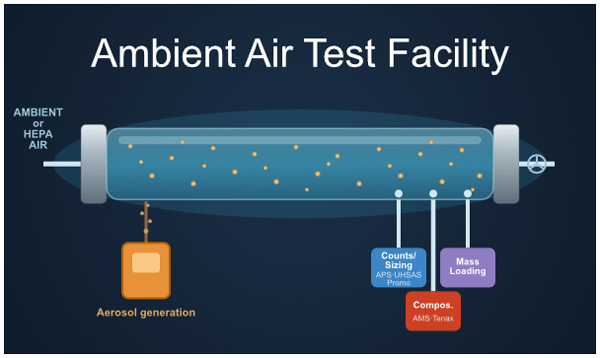
Abstract. The U.S. Naval Research Laboratory has developed and validated an Ambient Air Test Facility (AATF) for controlled multi-instrument aerosol generation and characterization under realistic sampling conditions. The facility consists of a 14 meter flow tube system that provides turbulent (Re = 40,000) outdoor ambient air flow at 2 m/s for testing aerosol detection and measurement systems in a controlled indoor environment. The AATF integrates 13 diagnostic instruments across four measurement categories: individual particle measurement, aerosol loading, aerosol composition, and flow characterization. Multiple aerosol generation systems enable dispersion of both liquid solutions or suspensions and dry powders, producing particle concentrations from 50 to 3,000 μg/m3 and the ability to detect particles across a mean diameter range of 50 nm to 20 μm. Facility validation was conducted using multiple test chemicals including caffeine, oleic acid, phenanthrene, glycerol, tributyl phosphate, and Arizona test dust for three nominal concentration levels (low ∼100, medium ∼500, high >800 μg/m3). Aerosol concentration uniformity across the flow cross-section showed relative standard deviations below 3.5%. Multi-instrument comparisons between redundant particle sizing systems (dual APS units, UHSAS, and Promo) demonstrated good measurement consistency, with gravimetric validation confirming total aerosol mass concentrations with a 20% difference between the types of measurements. The Aerodyne Aerosol Mass Spectrometer correctly identified particle chemical signatures consistent with NIST fragmentation patterns for all test compounds. The facility employs shrouded probe sampling systems with isokinetic coupling to individual instruments to minimize particle losses and sampling biases across the particle size distribution. The AATF provides a repeatable and reliable aerosol generation testbed for detector development, evaluation, instrument intercomparison, and aerosol measurement validation under controlled yet realistic ambient air conditions with controlled size distributions and total mass concentrations for a wide range of chemical aerosols.
-
Notice on discussion status
The requested preprint has a corresponding peer-reviewed final revised paper. You are encouraged to refer to the final revised version.
-
Preprint
(3691 KB)
-
Supplement
(490 KB)
-
The requested preprint has a corresponding peer-reviewed final revised paper. You are encouraged to refer to the final revised version.
- Preprint
(3691 KB) - Metadata XML
-
Supplement
(490 KB) - BibTeX
- EndNote
- Final revised paper


Journal article(s) based on this preprint
Interactive discussion
Status: closed
-
RC1: 'Comment on egusphere-2025-6043', Anonymous Referee #1, 30 Jan 2026
-
AC1: 'Reply on RC1', Paul Johns, 09 Feb 2026
Your feedback has highlighted several areas where we can improve the clarity and detail of our manuscript. We have addressed your specific questions below, and we believe these clarifications will resolve the concerns you have raised.
- We acknowledge your concern regarding the validation of large particle sizes. Our claim of a 20 µm upper limit was based on the AATF's design capabilities. However, you are correct that our presented data does not fully support this range, especially given the Vasilatou et al reference. The validation data, combining the PSL experiments (up to 5 µm) and tests with other chemicals, robustly supports a range up to 15 µm. We agree that this is a more defensible claim based on the presented results. Therefore, we will revise the manuscript to claim a validated upper limit of 15 µm.
- Thank you for raising this important point regarding aerosol homogenization and the potential for particle settling, especially for larger particles. This is a critical consideration that we addressed through the engineering of the AATF's turbulent flow regime, and we appreciate the opportunity to clarify this in the manuscript. Additional explanation will be added to Section 2.2 “Aerosol Homogenization & Turbulence Characteristics,” and we will also add more explicit distances in our diagram of the facility. We will emphasize residence time in our analysis, as this is the more critical parameter for particle transport processes like settling and evaporation. Stokes’ Law gives the terminal settling velocity of a spherical particle in a quiescent environment with settling velocity increasing as the size of the particle increases. For a 10 µm diameter particle, this velocity is on the order of 0.3 cm/s. At 2 m/s flow through the tube, it takes approximately 2.5 s for air to travel from the aerosol input to past the collection tubes. In this short amount of time, the larger particles in the chamber would be expected to travel 0.75 cm downward in a still environment. However, the AATF is not quiescent, but rather has fully developed turbulent flow at Re = 40,000. With fully developed turbulent flow, turbulent fluctuation velocity is estimated as approximately 5–10% of the mean flow velocity, (in this case 10–20 cm/s.) With the turbulent fluctuation velocity being over 30 times greater than the particle's terminal settling velocity, turbulent fluctuation is the dominating factor in determining settling in the AATF. At these velocities, the particles are forcibly entrained in the chaotic flow, keeping them homogenized and suspended throughout their transit in the AATF.
- Using calibrated reference instruments is essential to the validation process. We appreciate you raising this point and apologize that this was not sufficiently clear in the manuscript. In fact, key instruments within the AATF are calibrated and serve as the reference instruments for our intercomparisons. Specifically, the two TSI APS units, the Promo, and the UHSAS were calibrated by their respective manufacturers immediately prior to this effort. Droplet Measurement Technologies (the manufacturers of the UHSAS) specifically states that their calibration exceeds ISO Standard 25101-1. We will revise the manuscript to explicitly state the calibration status of these instruments and to clarify their role as internal reference standards for the AATF. To ensure long-term data quality, we will add to our manuscript our plan to implement a routine verification protocol, such as periodically introducing PSL aerosols, to monitor instrument stability over time. We will also acknowledge that, as is fundamental to all aerosol sizing techniques, measurements of non-ideal aerosols carry inherent uncertainties related to material properties like density and refractive index.
- We would like to clarify that the validation measurements shown in Figure 3 were, in fact, performed using size-certified polystyrene latex (PSL) spheres. We apologize for omitting this critical detail from the figure caption and the main text. This method was chosen precisely to check the sizing accuracy of the instruments, as you correctly recommend, and to ensure sampling consistency throughout the cross-section of the AATF. We will amend the manuscript, specifically to Section 2.2 “Aerosol Homogenization & Turbulence Characteristics” and to the caption for Figure 3, to clearly state that size-certified PSL spheres were used in these validation experiments. This will reinforce the quantitative accuracy of our presented data.
We believe these revisions will fully address your concerns and significantly strengthen the manuscript. We thank you again for your valuable feedback, which has helped us identify where our manuscript can be improved.
Citation: https://doi.org/10.5194/egusphere-2025-6043-AC1
-
AC1: 'Reply on RC1', Paul Johns, 09 Feb 2026
-
RC2: 'Comment on egusphere-2025-6043', Anonymous Referee #2, 06 Jun 2026
The manuscript presents a detailed description of the Ambient Air Test Facility (AATF) where aerosol generation and characterization under controlled and realistic sampling conditions can be used for instrument development, evaluation or intercomparison studies. It also describes a validation study where various detectors were used to measure particle size distribution, mass concentration, composition, and flow characteristics, across two sampling points at the AATF and a range of aerosol compositions and loadings.
The manuscript is well written and clear; however, my main concern is the lack of intercomparison study (or a calibration) for the instruments used. When comparing results from the same instruments such as APSs that sampled at different locations (i.e. TS1 and TS2), it would be good to see first to which extent these instruments actually agree when sampling side-by-side. This could help better understand the results presented in various figures (e.g. Fig.5, 6, S1, S2), where APS2 located at TS2 reports higher number concentration of particles than APS1 located at TS1. This should be addressed, as now it is not clear whether these differences are due to aerosol mixing in the AATF and/or sampling lines or due to instrument response.
Other minor comments:
For consistency, please indicate (throughout the manuscript) whether APS1 or APS2 was used when describing or presenting data – mentioning only “APS” is less informative since two APSs were used. Please review the manuscript accordingly.
Fig.2 and Fig.9: please add information to the figure caption what the blue shaded area represents.
Fig.3: “… the variation across all the sample location…” better reads: “…the variation of the particle counts across all the sample location….” Could you mention somewhere in text what were the sampling fixed positions for the corresponding instrumentation that was used? What is the actual Vmax in the legend there?
Line 149: what does “at different heights and lateral positions” mean exactly – could the authors be more specific?
Line 186: the abbreviation “GC/MS” was not spelled out in the manuscript
Fig.6: “Data shown in Fig.5 is from event 4”: suggestion to rephrase it and place it in the Fig.5 caption.
Fig.7: data in both plots on the right for Promo is out of scale – please extend the y-axis, or explain why that is.
Lines 405-420: Authors mention the issue of drying the aerosol: wouldn’t a drier installed before inserting the aerosol particles into the AATF be helpful to address that?
A general comment: when presenting figures with subfigures it would be good to apply same appriach to all figures: currently the manuscript presents subfigures figures using “a,b,c”, sometimes “left and right", and sometimes nothing.
Citation: https://doi.org/10.5194/egusphere-2025-6043-RC2 -
AC2: 'Reply on RC2', Paul Johns, 10 Jun 2026
We completely agree with the reviewer that a side-by-side intercomparison of the two APS instruments is a crucial baseline step for data validation.
To address this, we have updated the manuscript to include the results of a side-by-side baseline comparison of the two APS units that was performed using NIST-traceable polystyrene latex (PSL) spheres prior to their integration into the AATF. This baseline evaluation showed excellent agreement, with a percent difference of less than 5% at 2 and 4 micrometer sizes. A higher percent difference of approximately 45% was observed at 1 micrometer, which we attribute to differences in the instrument age and calibration cycles between the two specific units at the time of the test (one unit was brand new, while the other was older).
Given this verified baseline and the highly turbulent flow promoting rapid mixing and spatial homogeneity, we can confidently attribute the discrepancies in mass loading observed during the AATF testing to this expected inter-unit variability rather than physical stratification or poor mixing in the flow tube. This is further supported by our observation that restarting APS1 resolved the offset in the 10-20 micrometer range.
We have added a transparent discussion of this limitation to the manuscript. Taking the reviewer's feedback, we have also committed to implementing a mandatory side-by-side baseline comparison protocol for all future multi-instrument campaigns at the AATF.
Response to Minor Comments
- We agree that specifying the exact APS unit improves clarity. We have systematically reviewed the manuscript and figure captions to explicitly specify "APS1" or "APS2" where applicable.
- In Fig. 2 and 9, the blue shaded area represents the standard deviation of the measurements across multiple trials. We apologize for this omission, and the captions have been updated.
- We have adopted the suggested phrasing for the caption of Fig. 3, added the value for Vmax, and clarified the sample probe positions in the text, indicating that the heights and lateral positions were chosen so that no sample probe would be obstructed by a preceding sample probe.
- We have spelled out gas chromatograph/mass spectrometer at the first occurrence of GC/MS.
- 'Data shown in Fig.5 is from event 4' was rephrased and the reference moved.
- In Figure 7, the Promo data appears out of scale due to a highly varying mass calculation triggered by a small number of large particles in the long tail of the phenanthrene distribution. The y-axis scale has been changed to a log plot so as to not provide truncated data.
- While we agree with the reviewer that an in-line dryer would help stabilize the aerosol, implementing dryers at the AATF scale presents significant engineering and operational challenges. First, testing the effects of ambient air humidity on aerosol behavior is often an intended capability of the facility, so drying the main AATF flow itself would be counterproductive. Instead, a dryer would need to be implemented exclusively for the aerosol generator. This would require pulling the generation section offline and adding a large drying section. The dried aerosol would then need to be coupled back into the AATF tubes. This configuration requires a larger facility footprint and introduces additional, uncharacterized wall losses in the generation and drying chambers. While evaluating localized drying approaches for the generators will be considered for future work, full implementation requires structural modifications beyond the scope of this baseline paper.
- We thank the reviewer for pointing out inconsistency in subfigure labels. We have applied a uniform a), b), c) subfigure labeling convention to all figures in the manuscript.
Citation: https://doi.org/10.5194/egusphere-2025-6043-AC2
-
AC2: 'Reply on RC2', Paul Johns, 10 Jun 2026
Peer review completion


Interactive discussion
Status: closed
-
RC1: 'Comment on egusphere-2025-6043', Anonymous Referee #1, 30 Jan 2026
This manuscript describes the development and validation of the so-called Ambient Air Test Facility (AATF), a large-scale setup which enables intercomparison of aerosol instruments under controlled laboratory conditions. The setup comprises several aerosol generators, a 14-meter-long flow tube for aerosol homogenisation and isokinetic sampling ports. The scale of the facility is impressive, allowing parallel measurements with various devices-under-test.
The manuscript is well-structured and easy to read, and the figures are informative. I am puzzled, however, by the lack of reference instruments that would enable a more meaningful intercomparison of aerosol instruments. I am also sceptical about the lack of validation for particles larger than 5 micrometers.
Questions:
- The authors refer in the abstract and main text to a "detection of particles across a mean diameter range of 50 nm to 20 μm". However, nowhere in the manuscript could I find any information about the homogenisation and measurement of particles larger than 10 μm. In fact, the validation measurements shown in Figure 3 refer to particle sizes up to 5 μm. Moreover, none of the diagnostic equipment at AATF (Table 1) can measure 20 μm particles. The APS (TSI Inc.), despite manufacturer's claims, can barely measure particles equal to or larger than 15 μm (see Vasilatou et al. https://doi.org/10.1080/02786826.2022.2139659).
- In page 6, it is mentioned that "sampling takes place 4.5 m downstream of the aerosol injection". However, in Figure 1a) the test section is quite long. How is aerosol homogenisation along the horizontal test section ensured despite particle settling?
- The authors compare instruments with one another without having any reference instruments available. The discussion of the results remains therefore descriptive without any in-depth analysis. Optical and aerodynamic particle sizers can be calibrated with respect to particle size and number concentration (see, for instance, Iida et al. https://doi.org/10.1063/1.4803302; Horender et al. https://doi.org/10.1063/1.5095853 and ISO standard 21501-1). By integrating calibrated instruments that provide reference measurements into the AATF facility, the authors could get more insight into the performance of the various devices-under-test.
- Similarly, by generating size-certified particles (e.g. polystyrene spheres or silica particles) instead of droplets, it would be possible to check the accuracy of the size measurements.
To summarise, I appreciate the effort that went into developing the setup, but I would recommend a more thorough validation for large particle sizes. In addition, to make measurements more quantitative, I would recommend the use of calibrated instruments to provide reference data.
Citation: https://doi.org/10.5194/egusphere-2025-6043-RC1 -
AC1: 'Reply on RC1', Paul Johns, 09 Feb 2026
Your feedback has highlighted several areas where we can improve the clarity and detail of our manuscript. We have addressed your specific questions below, and we believe these clarifications will resolve the concerns you have raised.
- We acknowledge your concern regarding the validation of large particle sizes. Our claim of a 20 µm upper limit was based on the AATF's design capabilities. However, you are correct that our presented data does not fully support this range, especially given the Vasilatou et al reference. The validation data, combining the PSL experiments (up to 5 µm) and tests with other chemicals, robustly supports a range up to 15 µm. We agree that this is a more defensible claim based on the presented results. Therefore, we will revise the manuscript to claim a validated upper limit of 15 µm.
- Thank you for raising this important point regarding aerosol homogenization and the potential for particle settling, especially for larger particles. This is a critical consideration that we addressed through the engineering of the AATF's turbulent flow regime, and we appreciate the opportunity to clarify this in the manuscript. Additional explanation will be added to Section 2.2 “Aerosol Homogenization & Turbulence Characteristics,” and we will also add more explicit distances in our diagram of the facility. We will emphasize residence time in our analysis, as this is the more critical parameter for particle transport processes like settling and evaporation. Stokes’ Law gives the terminal settling velocity of a spherical particle in a quiescent environment with settling velocity increasing as the size of the particle increases. For a 10 µm diameter particle, this velocity is on the order of 0.3 cm/s. At 2 m/s flow through the tube, it takes approximately 2.5 s for air to travel from the aerosol input to past the collection tubes. In this short amount of time, the larger particles in the chamber would be expected to travel 0.75 cm downward in a still environment. However, the AATF is not quiescent, but rather has fully developed turbulent flow at Re = 40,000. With fully developed turbulent flow, turbulent fluctuation velocity is estimated as approximately 5–10% of the mean flow velocity, (in this case 10–20 cm/s.) With the turbulent fluctuation velocity being over 30 times greater than the particle's terminal settling velocity, turbulent fluctuation is the dominating factor in determining settling in the AATF. At these velocities, the particles are forcibly entrained in the chaotic flow, keeping them homogenized and suspended throughout their transit in the AATF.
- Using calibrated reference instruments is essential to the validation process. We appreciate you raising this point and apologize that this was not sufficiently clear in the manuscript. In fact, key instruments within the AATF are calibrated and serve as the reference instruments for our intercomparisons. Specifically, the two TSI APS units, the Promo, and the UHSAS were calibrated by their respective manufacturers immediately prior to this effort. Droplet Measurement Technologies (the manufacturers of the UHSAS) specifically states that their calibration exceeds ISO Standard 25101-1. We will revise the manuscript to explicitly state the calibration status of these instruments and to clarify their role as internal reference standards for the AATF. To ensure long-term data quality, we will add to our manuscript our plan to implement a routine verification protocol, such as periodically introducing PSL aerosols, to monitor instrument stability over time. We will also acknowledge that, as is fundamental to all aerosol sizing techniques, measurements of non-ideal aerosols carry inherent uncertainties related to material properties like density and refractive index.
- We would like to clarify that the validation measurements shown in Figure 3 were, in fact, performed using size-certified polystyrene latex (PSL) spheres. We apologize for omitting this critical detail from the figure caption and the main text. This method was chosen precisely to check the sizing accuracy of the instruments, as you correctly recommend, and to ensure sampling consistency throughout the cross-section of the AATF. We will amend the manuscript, specifically to Section 2.2 “Aerosol Homogenization & Turbulence Characteristics” and to the caption for Figure 3, to clearly state that size-certified PSL spheres were used in these validation experiments. This will reinforce the quantitative accuracy of our presented data.
We believe these revisions will fully address your concerns and significantly strengthen the manuscript. We thank you again for your valuable feedback, which has helped us identify where our manuscript can be improved.
Citation: https://doi.org/10.5194/egusphere-2025-6043-AC1
-
RC2: 'Comment on egusphere-2025-6043', Anonymous Referee #2, 06 Jun 2026
The manuscript presents a detailed description of the Ambient Air Test Facility (AATF) where aerosol generation and characterization under controlled and realistic sampling conditions can be used for instrument development, evaluation or intercomparison studies. It also describes a validation study where various detectors were used to measure particle size distribution, mass concentration, composition, and flow characteristics, across two sampling points at the AATF and a range of aerosol compositions and loadings.
The manuscript is well written and clear; however, my main concern is the lack of intercomparison study (or a calibration) for the instruments used. When comparing results from the same instruments such as APSs that sampled at different locations (i.e. TS1 and TS2), it would be good to see first to which extent these instruments actually agree when sampling side-by-side. This could help better understand the results presented in various figures (e.g. Fig.5, 6, S1, S2), where APS2 located at TS2 reports higher number concentration of particles than APS1 located at TS1. This should be addressed, as now it is not clear whether these differences are due to aerosol mixing in the AATF and/or sampling lines or due to instrument response.
Other minor comments:
For consistency, please indicate (throughout the manuscript) whether APS1 or APS2 was used when describing or presenting data – mentioning only “APS” is less informative since two APSs were used. Please review the manuscript accordingly.
Fig.2 and Fig.9: please add information to the figure caption what the blue shaded area represents.
Fig.3: “… the variation across all the sample location…” better reads: “…the variation of the particle counts across all the sample location….” Could you mention somewhere in text what were the sampling fixed positions for the corresponding instrumentation that was used? What is the actual Vmax in the legend there?
Line 149: what does “at different heights and lateral positions” mean exactly – could the authors be more specific?
Line 186: the abbreviation “GC/MS” was not spelled out in the manuscript
Fig.6: “Data shown in Fig.5 is from event 4”: suggestion to rephrase it and place it in the Fig.5 caption.
Fig.7: data in both plots on the right for Promo is out of scale – please extend the y-axis, or explain why that is.
Lines 405-420: Authors mention the issue of drying the aerosol: wouldn’t a drier installed before inserting the aerosol particles into the AATF be helpful to address that?
A general comment: when presenting figures with subfigures it would be good to apply same appriach to all figures: currently the manuscript presents subfigures figures using “a,b,c”, sometimes “left and right", and sometimes nothing.
Citation: https://doi.org/10.5194/egusphere-2025-6043-RC2 -
AC2: 'Reply on RC2', Paul Johns, 10 Jun 2026
We completely agree with the reviewer that a side-by-side intercomparison of the two APS instruments is a crucial baseline step for data validation.
To address this, we have updated the manuscript to include the results of a side-by-side baseline comparison of the two APS units that was performed using NIST-traceable polystyrene latex (PSL) spheres prior to their integration into the AATF. This baseline evaluation showed excellent agreement, with a percent difference of less than 5% at 2 and 4 micrometer sizes. A higher percent difference of approximately 45% was observed at 1 micrometer, which we attribute to differences in the instrument age and calibration cycles between the two specific units at the time of the test (one unit was brand new, while the other was older).
Given this verified baseline and the highly turbulent flow promoting rapid mixing and spatial homogeneity, we can confidently attribute the discrepancies in mass loading observed during the AATF testing to this expected inter-unit variability rather than physical stratification or poor mixing in the flow tube. This is further supported by our observation that restarting APS1 resolved the offset in the 10-20 micrometer range.
We have added a transparent discussion of this limitation to the manuscript. Taking the reviewer's feedback, we have also committed to implementing a mandatory side-by-side baseline comparison protocol for all future multi-instrument campaigns at the AATF.
Response to Minor Comments
- We agree that specifying the exact APS unit improves clarity. We have systematically reviewed the manuscript and figure captions to explicitly specify "APS1" or "APS2" where applicable.
- In Fig. 2 and 9, the blue shaded area represents the standard deviation of the measurements across multiple trials. We apologize for this omission, and the captions have been updated.
- We have adopted the suggested phrasing for the caption of Fig. 3, added the value for Vmax, and clarified the sample probe positions in the text, indicating that the heights and lateral positions were chosen so that no sample probe would be obstructed by a preceding sample probe.
- We have spelled out gas chromatograph/mass spectrometer at the first occurrence of GC/MS.
- 'Data shown in Fig.5 is from event 4' was rephrased and the reference moved.
- In Figure 7, the Promo data appears out of scale due to a highly varying mass calculation triggered by a small number of large particles in the long tail of the phenanthrene distribution. The y-axis scale has been changed to a log plot so as to not provide truncated data.
- While we agree with the reviewer that an in-line dryer would help stabilize the aerosol, implementing dryers at the AATF scale presents significant engineering and operational challenges. First, testing the effects of ambient air humidity on aerosol behavior is often an intended capability of the facility, so drying the main AATF flow itself would be counterproductive. Instead, a dryer would need to be implemented exclusively for the aerosol generator. This would require pulling the generation section offline and adding a large drying section. The dried aerosol would then need to be coupled back into the AATF tubes. This configuration requires a larger facility footprint and introduces additional, uncharacterized wall losses in the generation and drying chambers. While evaluating localized drying approaches for the generators will be considered for future work, full implementation requires structural modifications beyond the scope of this baseline paper.
- We thank the reviewer for pointing out inconsistency in subfigure labels. We have applied a uniform a), b), c) subfigure labeling convention to all figures in the manuscript.
Citation: https://doi.org/10.5194/egusphere-2025-6043-AC2
-
AC2: 'Reply on RC2', Paul Johns, 10 Jun 2026
Peer review completion
Journal article(s) based on this preprint
Viewed
| HTML | XML | Total | Supplement | BibTeX | EndNote | |
|---|---|---|---|---|---|---|
| 1,305 | 793 | 149 | 2,247 | 216 | 92 | 109 |
- HTML: 1,305
- PDF: 793
- XML: 149
- Total: 2,247
- Supplement: 216
- BibTeX: 92
- EndNote: 109
Viewed (geographical distribution)
| Country | # | Views | % |
|---|
| Total: | 0 |
| HTML: | 0 |
| PDF: | 0 |
| XML: | 0 |
- 1
Paul Johns
Cathy Scotto
Landon Hernandez
Matthew Hart
Oyedoyin Aduroja
Mark Hammond
Braden Giordano
Kenneth Grabowski
Jay Eversole
Vasanthi Sivaprakasam

The requested preprint has a corresponding peer-reviewed final revised paper. You are encouraged to refer to the final revised version.
- Preprint
(3691 KB) - Metadata XML
-
Supplement
(490 KB) - BibTeX
- EndNote
- Final revised paper
This manuscript describes the development and validation of the so-called Ambient Air Test Facility (AATF), a large-scale setup which enables intercomparison of aerosol instruments under controlled laboratory conditions. The setup comprises several aerosol generators, a 14-meter-long flow tube for aerosol homogenisation and isokinetic sampling ports. The scale of the facility is impressive, allowing parallel measurements with various devices-under-test.
The manuscript is well-structured and easy to read, and the figures are informative. I am puzzled, however, by the lack of reference instruments that would enable a more meaningful intercomparison of aerosol instruments. I am also sceptical about the lack of validation for particles larger than 5 micrometers.
Questions:
To summarise, I appreciate the effort that went into developing the setup, but I would recommend a more thorough validation for large particle sizes. In addition, to make measurements more quantitative, I would recommend the use of calibrated instruments to provide reference data.