
the Creative Commons Attribution 4.0 License.
the Creative Commons Attribution 4.0 License.
 | 04 Mar 2026
Effects of assimilating phytoplankton carbon in marine ecosystem modelling in NEMO4.0.4-MEDUSA2.0-PDAF2.0
Abstract. The state of the marine ecosystem can be estimated by a combination of numerical models and satellite observations through data assimilation (DA) methods. Satellite data representing phytoplankton chlorophyll are typically used in operational marine ecosystem prediction. These data are derived from ocean colour from optical satellite observations. Recently a novel phytoplankton carbon product, from the ESA funded BICEP project available from the UK CEDA Archive, has been derived through an alternate processing of ocean colour. With the novel carbon product, the phytoplankton biomass is represented more directly than relying on the chlorophyll. Here, we investigate the effects of assimilating the new carbon product on the modelling of the marine ecosystem. The investigation is carried out in a newly developed global ensemble DA system for the marine ecosystem using a coupled ocean-biogeochemistry model, NEMO-MEDUSA, and the Parallel Data Assimilation Framework. With the ensemble DA system, the evaluation can take the time-dependent uncertainty of the marine ecosystem and the reliability of the ensemble into account. We demonstrate that, compared with solely assimilating chlorophyll product, with the new carbon product the DA can provide different patterns of adjustments in the phytoplankton concentration and seasonal anomalies. Our findings reveal that simultaneously assimilating both phytoplankton chlorophyll and carbon products in a complex marine ecosystem yields more accurate and balanced estimates of phytoplankton biomass than assimilating a single phytoplankton product.
-
Notice on discussion status
The requested preprint has a corresponding peer-reviewed final revised paper. You are encouraged to refer to the final revised version.
-
Preprint
(21496 KB)
-
The requested preprint has a corresponding peer-reviewed final revised paper. You are encouraged to refer to the final revised version.
- Preprint
(21496 KB) - Metadata XML
- BibTeX
- EndNote
- Final revised paper


Journal article(s) based on this preprint
Interactive discussion
Status: closed
-
RC1: 'Comment on egusphere-2025-5851', Emmanuel Boss, 07 Apr 2026
- AC1: 'Reply on RC1', Yumeng Chen, 24 Jun 2026
-
RC2: 'Comment on egusphere-2025-5851', Anonymous Referee #2, 14 May 2026
Effects of assimilating phytoplankton carbon in marine ecosystem modelling in NEMO4.0.4-MEDUSA2.0-PDAF2.0
The paper is overall very well written and the methodology well explained. Even though it is not a breakthrough paper, as the novelty lies more in the technical implementation than in the idea itself, I consider it worth publishing with some clarifications that are hereby expressed, as it represents a solid contribution to the ocean biogeochemical data assimilation community.
The study investigates the impact of assimilating a novel satellite-derived phytoplankton carbon product from the ESA BICEP project into a global marine ecosystem model, using an ensemble data assimilation framework built on NEMO-MEDUSA coupled with the Parallel Data Assimilation Framework (PDAF). The authors compare several assimilation strategies using chlorophyll alone, carbon alone, or both simultaneously and evaluate their effects not only on phytoplankton biomass estimates but also on downstream ecosystem variables such as zooplankton, surface pCO₂, and oxygen. The main finding is that simultaneously assimilating both chlorophyll and carbon products yields more balanced and accurate estimates of phytoplankton biomass than assimilating either product alone, and produces the strongest response in ocean carbon and oxygen cycles.
The paper is within the scope of GMD. The source code and experiment setup are made available via Zenodo, which is commended and meets GMD reproducibility standards. Once the major concerns are addressed, the results are in principle sufficient to support the conclusions, with the caveat that the two-year experiment window and absence of independent validation currently limit the strength of those conclusions.
In order to facilitate the authors' revision, the concerns to be addressed before publication are reported in detail below.
Major Concerns
1. Carbon observation-error model: not justified and not assessed
The carbon product does not provide its own error estimate, so the authors inflate the chlorophyll observation error by 10% as a proxy. The manuscript itself indicates this at line 518 as requiring further investigation but never returns to it. The choice of observation error directly controls the weight given to the carbon product in the DA update: an underestimated error leads to overconfident corrections; an overestimated error suppresses the carbon signal. Deferring this entirely to future work is not acceptable in a results paper. The authors should provide at minimum a sensitivity analysis or a qualitative bounding of how this assumption affects the conclusions. Additionally, the two products are not truly co-located, have different spatial resolutions, and share information from the same ocean-colour measurements, none of which is adequately accounted for the error model.
2. Systematic carbon bias and the fixed C:N stoichiometry
The negative mean misfit for carbon across all experiments indicates a systematic overestimation of phytoplankton carbon by the model relative to observations. This is a significant finding whose physical origin is not examined. In particular, MEDUSA assumes a fixed C:N stoichiometric ratio of 6.625:1, but phytoplankton C:N ratios vary considerably with nutrient availability, light conditions, and community composition. The manuscript mentions this fixed ratio only in the forward-looking sentence comparing MEDUSA with more complex models, never as a candidate explanation for the negative misfit already present in the results. The authors should explicitly discuss whether the fixed C:N assumption contributes to this systematic bias.
3. Statistical significance of RMSD differences and the two-year experiment window
RMSD reductions across experiments are reported without any assessment of statistical significance. The experiments cover only 2015 and 2016: a very short period for a global ocean biogeochemical study, and one that encompasses the tail of the strongest El Niño on record. This is never mentioned as a limitation despite the fact that anomalous phytoplankton dynamics in the eastern equatorial Pacific during this period are likely to influence several of the largest reported DA adjustments. The authors should provide confidence intervals or significance tests for the RMSD differences, or explicitly acknowledge the short experiment window and ENSO conditions as limitations.
4. Unexplained seasonal discrepancy with Pradhan et al.
The authors note that RMSD peaks in boreal autumn in their system, whereas Pradhan et al. (2019) found higher errors in boreal spring, but offer no explanation. Possible explanations such as differences in biogeochemical model formulation, grid resolution, ensemble size, or forcing data, should be explored, even if only qualitatively.
5. Ensemble reliability and its implications for DA validity
The reliability score of the Freerun is reported to be worse than in Popov et al. (2024), indicating that the global ensemble is considerably less reliable than regional configurations. The authors indicate this but do not discuss its consequences for the validity of the DA results. If the ensemble poorly represents true system uncertainty, LESTKF corrections may be suboptimal or misleading. The authors should discuss how ensemble unreliability affects the interpretation of their results and what steps could improve it. Santana-Falcón et al. 2020, ( Ocean Science: https://os.copernicus.org/articles/16/1297/2020/) showed that DA improvements depend strongly on prior ensemble reliability and is directly relevant to this discussion.
6. Surface-only constraint: subsurface structure is unconstrained
The DA system assimilates only surface satellite observations, leaving the subsurface phytoplankton structure entirely unconstrained. This is never explicitly justified or discussed as a limitation. Arteaga et al. 2022, (Global Biogeochemical Cycles: https://agupubs.onlinelibrary.wiley.com/doi/full/10.1029/2022GB007389) showed that surface-only retrievals systematically misrepresent subsurface productivity, particularly in the Southern Ocean. The manuscript should acknowledge surface-only assimilation as a known limitation.
7. Absence of independent validation
All evaluation metrics in the paper are computed against the same products that were assimilated chlorophyll and carbon from satellite, which means the reported RMSD reductions measure how well the system fits its training data, not whether the model state has become more realistic. This limitation is acknowledged only in the final sentence of the manuscript. It should be discussed in the conclusions, alongside identification of independent datasets that could be used in future work: BGC-Argo profiles for subsurface chlorophyll and carbon, and SOCAT for surface pCO₂ are examples of candidates. The observations section (Section 2.2) should also be restructured to clearly separate datasets used for assimilation and experiment setup sections from datasets used for validation.
8. Seasonality deterioration from chlorophyll-only assimilation
The finding that assimilating chlorophyll alone with post-processing can deteriorate the seasonality of modelled global phytoplankton is currently buried in the seasonality section. Given that most operational biogeochemical DA systems rely exclusively on chlorophyll assimilation, this negative result has direct practical implications for the community and should be elevated, or at least acknowledged, in both results and conclusions.
9. pCO₂ degradation in the Daily Chl experiment
The Daily Chl experiment, which most closely resembles current operational biogeochemical DA systems, produces increased pCO₂ growth relative to Freerun, attributed to strong phytoplankton reduction in the eastern equatorial Pacific and increased zooplankton respiration. This is a potentially important and worrying result suggesting that high-frequency chlorophyll-only assimilation, as currently practised operationally, may degrade the carbon cycle representation. This finding deserves deeper discussion, including a mechanistic explanation and an assessment of its implications for operational systems. Similarly, the mechanism behind the highest oxygen increase in the Monthly Chl & C experiment is not explained and should be addressed.
10. One-way coupling, reduced state vector, and post-processing redistribution
These are reasonable first-implementation choices but they limit how far improved skill can be attributed specifically to the information content of the carbon product rather than to the mapping and redistribution scheme. The manuscript does not discuss these structural limitations critically enough. In particular, the proportionality assumption underlying Equation 1 where DA increments are distributed to diatom and non-diatom PFTs in proportion to their forecast fractions assumes that all PFTs respond proportionally to a perturbation, which is not generally true. Pradhan et al. (2020), already cited in this manuscript, demonstrated that PFTs do not always change proportionally, and this limitation should be acknowledged clearly in the methods.
11. Cross-product inconsistency
The combined assimilation does not bring the averaged misfits closer to zero, and the chlorophyll:carbon ratio in observations differs from the model. The joint-assimilation result should be framed explicitly as a compromise under imperfect product consistency, not as a solution.
12. Speculative claims about complex models
Lines 503–506 assert that more complex models such as ERSEM or REcoM2 would likely produce more robust DA responses to perturbations in carbon or chlorophyll. This claim is unsupported by evidence or references and should be reframed as a hypothesis for future work. If the authors wish to maintain it, they should cite studies comparing DA performance across models of different complexity.
13. Model spinup
The coupled NEMO-MEDUSA model is spun up for only 15 years prior to the assimilation experiments. While this may be sufficient to equilibrate surface biogeochemical variables, it is generally considered inadequate for full equilibration of deeper ocean carbon cycle variables such as dissolved inorganic carbon and alkalinity, which can require centuries to millennia to reach steady state. The authors should acknowledge this as a limitation and discuss whether residual drift in the deeper carbon cycle variables could influence the surface pCO₂ and oxygen results presented in Section 5.4.
Minor Concerns
-
The abstract does not mention the two key negative results identified in this review: the deterioration of phytoplankton seasonality from chlorophyll-only assimilation, and the increased pCO₂ growth in the Daily Chl experiment. Given their practical implications for operational systems, at least a brief acknowledgement of these findings should be included in the abstract.
-
In line 90: the sentence "In MEDUSA, the primary currency of nitrogen drives the model evolution" is unclear. The authors should clarify what is meant and explain more transparently how chlorophyll is diagnosed from nitrogen via a space- and time-dependent scaling factor. As written, this passage is likely to confuse readers unfamiliar with the specific MEDUSA formulation.
-
The relationship between PDAF and LESTKF should be stated more explicitly. The authors should clarify that PDAF is the computational framework within which LESTKF operates as the specific ensemble DA algorithm.
-
The authors are encouraged to summarise the experimental design in a table, listing for each experiment: the assimilated variable(s), the model variables directly updated, whether post-processing is applied, and the temporal frequency of assimilation.
-
Section 5 states that pCO₂ and oxygen are evaluated "without available observations." Observational products for both variables exist for example SOCAT for surface pCO₂, and World Ocean Atlas or BGC-Argo for oxygen. The correct statement is that the authors chose not to validate against these datasets in the present study.
-
The citation of Falkowski, even if broadly still used should be updated with more recent ones. In this sense, the statement that phytoplankton ‘account for 40 % of global carbon uptake’ is broadly correct but ambiguous. The authors should rephrase to refer explicitly to global primary production or carbon fixation rather than carbon uptake and update the refrences.
-
Consider adding Skákala et al. 2024, (Progress in Oceanography: https://www.sciencedirect.com/science/article/pii/S0079661124000557) to the motivation, as they demonstrated that phytoplankton community composition is the most uncertain and least observable marine ecosystem indicator when inferred from surface chlorophyll alone, which supports the argument for assimilating additional ocean-colour products such as phytoplankton carbon.”
-
Add the suggested papers, if necesarry to the reference list
Other minor suggestions
-
The authors are encouraged to clarify the distinction between "marine ecosystem model" and "ocean biogeochemical model", which are used somewhat interchangeably throughout. While both refer to MEDUSA, they carry different conceptual emphases: the former typically refers to biological components such as phytoplankton, zooplankton, nutrients and detritus, whereas the latter emphasises chemical cycles including carbon, oxygen and alkalinity. Since MEDUSA encompasses both, the authors should acknowledge this explicitly and be consistent in their use of terminology thereafter.
-
The term "primary currency" (line 90) should be replaced with a clearer expression such as "master prognostic variable", or simply clarified that the model is nitrogen-based with all other biogeochemical variables derived from or scaled to nitrogen.
-
The authors should be more precise in their use of "chlorophyll" versus "chlorophyll-a". The OC-CCI product assimilated is specifically chlorophyll-a, and in the text the generic term "chlorophyll" is systematically used.
-
The word "analysis" is used in two distinct senses throughout: its DA meaning as the corrected model state after assimilation and its general scientific meaning, as in "data analysis". This dual use could confuse readers unfamiliar with DA terminology. The authors should disambiguate where necessary, adopting "DA analysis" or "analysed state"
-
The term "balancing scheme" is used repeatedly but never explicitly defined. The authors should provide a concise self-contained definition upon first use, clarifying that it refers to a method for redistributing DA increments from an observed variable into other unobserved model variables based on assumed stoichiometric relationships.
-
The term "benchmark" (line 120) is slightly misleading. The chlorophyll product is not merely a passive reference, it is itself an active assimilation product being tested and compared throughout the study. The authors should replace it with "reference experiment" or similar.
Figures
The authors are encouraged to revise all figures to improve readability and quality. Specific comments follow:
-
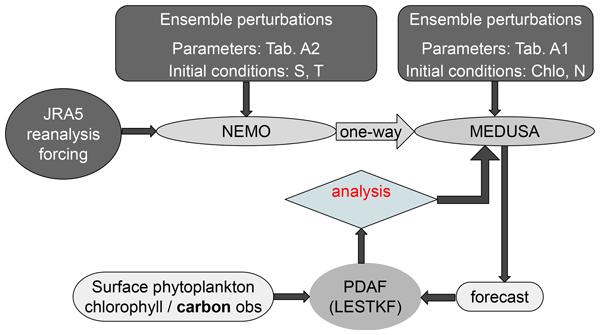
Figure 1: The boxes and circles should be made larger, with larger text inside them. Several acronyms used in the figure : PDAF and LESTKF are not defined in the caption, forcing the reader to consult the main text. These should be spelled out in the caption so the figure is self-contained. Additionally, the phrase "resulting analysis" in the caption is ambiguous and should be clarified explicitly as referring to the reconstructed state used to reinitialise the following ensemble forecast.
-
Figure 2: The line width of all curves should be increased to improve visibility.
-
Figure 3: The x-axis date labels overlap and should be adjusted, for example by rotating them or reducing their frequency. The legend is too small and should be enlarged. The use of red for the right-hand axis is discouraged as it is not accessible to colour-blind readers and should be replaced with a colour-blind friendly alternative throughout.
-
Figure 4: The use of red and green is not accessible to colour-blind readers and should be replaced with a more inclusive colour palette. Font sizes for all labels should be increased. The caption should be simplified by structuring it as "First row… second row…" rather than the current format.
-
Figures 5, 6 and 7: The captions are unnecessarily long and repetitive. In particular, the sentence describing how differences are computed appears verbatim across all three figures.
Citation: https://doi.org/10.5194/egusphere-2025-5851-RC2 - AC2: 'Reply on RC2', Yumeng Chen, 24 Jun 2026
-
Peer review completion


Interactive discussion
Status: closed
-
RC1: 'Comment on egusphere-2025-5851', Emmanuel Boss, 07 Apr 2026
Dear authors,
I am not a biogeochemical modeler per-se (that is I understand the math behind them and their content but am not running any model on a regular basis). Hence some of my comments may seem out of scope and there are some aspect I cannot comment on.
My major comments are the following:
1. Carbon products and phytoplankton product derived from remote sensing have been derived and used for years. There is no novelty in that and I am surprised you chose to only look at one such product. For example, Behrenfeld et al., 2005, showed how additional information can be gleaned from using a backscattering based C_phyto. In particular, through many manuscript, we have been able to show how phytoplankton photo-acclimation is the major forcing on the chl/C_phyto ratio and how it can inform us, for example, on nutrient limitation (https://egusphere.copernicus.org/preprints/2025/egusphere-2025-4261/ <- it has been accepted). The point here is not to make you cite papers I contributed to but make you aware that the utility of estimate of C_phyto from space has been shown in many works and, in particular, in providing information content additional to Chl.
2. The first test of a good C_phyto product is whether its ratio to Chl is consistent with lab studies of photoacclimation, e.g. is 30<C_phyto/Chl <300 (unless you are dealing with domination by mixotrophy in which case it could go lower, but you don't resolve them in your model.
3. Field measurements of Fchl, as done with Argo floats, can have many biases (see Roesler et al., 2017). One has to be careful on how to use them.
4. Phytoplankton products under clouds are typically wrong as they interpolate Chl rather than carbon and phytoplankton photo-adapt under cloud (https://agupubs.onlinelibrary.wiley.com/doi/10.1029/2024GL112274). How they do it for the product you use could bias your model (~70% of the ocean is covered by clouds at any given time).
5. How do you define the 'effectiveness' of DA is key and need to be provided. Obviously DA will force the model to the data.
6. How are you converting C to N? The product is carbon and your model currency is N.
7. To evaluate the distribution of parameter (e.g. histogram of distributions, whether of [Chl] or [Cphyto]), you could compare your model distribution to those of estimate from satellite. The near log-normal distribution should arise in both.
I am attaching an annotated PDF with some more comments.
Dear authors, I am often wrong. If you feel my comments are 'off the mark' feel free to contact me and if I am convinced I will be more than happy to amend my review.
- AC1: 'Reply on RC1', Yumeng Chen, 24 Jun 2026
-
RC2: 'Comment on egusphere-2025-5851', Anonymous Referee #2, 14 May 2026
Effects of assimilating phytoplankton carbon in marine ecosystem modelling in NEMO4.0.4-MEDUSA2.0-PDAF2.0
The paper is overall very well written and the methodology well explained. Even though it is not a breakthrough paper, as the novelty lies more in the technical implementation than in the idea itself, I consider it worth publishing with some clarifications that are hereby expressed, as it represents a solid contribution to the ocean biogeochemical data assimilation community.
The study investigates the impact of assimilating a novel satellite-derived phytoplankton carbon product from the ESA BICEP project into a global marine ecosystem model, using an ensemble data assimilation framework built on NEMO-MEDUSA coupled with the Parallel Data Assimilation Framework (PDAF). The authors compare several assimilation strategies using chlorophyll alone, carbon alone, or both simultaneously and evaluate their effects not only on phytoplankton biomass estimates but also on downstream ecosystem variables such as zooplankton, surface pCO₂, and oxygen. The main finding is that simultaneously assimilating both chlorophyll and carbon products yields more balanced and accurate estimates of phytoplankton biomass than assimilating either product alone, and produces the strongest response in ocean carbon and oxygen cycles.
The paper is within the scope of GMD. The source code and experiment setup are made available via Zenodo, which is commended and meets GMD reproducibility standards. Once the major concerns are addressed, the results are in principle sufficient to support the conclusions, with the caveat that the two-year experiment window and absence of independent validation currently limit the strength of those conclusions.
In order to facilitate the authors' revision, the concerns to be addressed before publication are reported in detail below.
Major Concerns
1. Carbon observation-error model: not justified and not assessed
The carbon product does not provide its own error estimate, so the authors inflate the chlorophyll observation error by 10% as a proxy. The manuscript itself indicates this at line 518 as requiring further investigation but never returns to it. The choice of observation error directly controls the weight given to the carbon product in the DA update: an underestimated error leads to overconfident corrections; an overestimated error suppresses the carbon signal. Deferring this entirely to future work is not acceptable in a results paper. The authors should provide at minimum a sensitivity analysis or a qualitative bounding of how this assumption affects the conclusions. Additionally, the two products are not truly co-located, have different spatial resolutions, and share information from the same ocean-colour measurements, none of which is adequately accounted for the error model.
2. Systematic carbon bias and the fixed C:N stoichiometry
The negative mean misfit for carbon across all experiments indicates a systematic overestimation of phytoplankton carbon by the model relative to observations. This is a significant finding whose physical origin is not examined. In particular, MEDUSA assumes a fixed C:N stoichiometric ratio of 6.625:1, but phytoplankton C:N ratios vary considerably with nutrient availability, light conditions, and community composition. The manuscript mentions this fixed ratio only in the forward-looking sentence comparing MEDUSA with more complex models, never as a candidate explanation for the negative misfit already present in the results. The authors should explicitly discuss whether the fixed C:N assumption contributes to this systematic bias.
3. Statistical significance of RMSD differences and the two-year experiment window
RMSD reductions across experiments are reported without any assessment of statistical significance. The experiments cover only 2015 and 2016: a very short period for a global ocean biogeochemical study, and one that encompasses the tail of the strongest El Niño on record. This is never mentioned as a limitation despite the fact that anomalous phytoplankton dynamics in the eastern equatorial Pacific during this period are likely to influence several of the largest reported DA adjustments. The authors should provide confidence intervals or significance tests for the RMSD differences, or explicitly acknowledge the short experiment window and ENSO conditions as limitations.
4. Unexplained seasonal discrepancy with Pradhan et al.
The authors note that RMSD peaks in boreal autumn in their system, whereas Pradhan et al. (2019) found higher errors in boreal spring, but offer no explanation. Possible explanations such as differences in biogeochemical model formulation, grid resolution, ensemble size, or forcing data, should be explored, even if only qualitatively.
5. Ensemble reliability and its implications for DA validity
The reliability score of the Freerun is reported to be worse than in Popov et al. (2024), indicating that the global ensemble is considerably less reliable than regional configurations. The authors indicate this but do not discuss its consequences for the validity of the DA results. If the ensemble poorly represents true system uncertainty, LESTKF corrections may be suboptimal or misleading. The authors should discuss how ensemble unreliability affects the interpretation of their results and what steps could improve it. Santana-Falcón et al. 2020, ( Ocean Science: https://os.copernicus.org/articles/16/1297/2020/) showed that DA improvements depend strongly on prior ensemble reliability and is directly relevant to this discussion.
6. Surface-only constraint: subsurface structure is unconstrained
The DA system assimilates only surface satellite observations, leaving the subsurface phytoplankton structure entirely unconstrained. This is never explicitly justified or discussed as a limitation. Arteaga et al. 2022, (Global Biogeochemical Cycles: https://agupubs.onlinelibrary.wiley.com/doi/full/10.1029/2022GB007389) showed that surface-only retrievals systematically misrepresent subsurface productivity, particularly in the Southern Ocean. The manuscript should acknowledge surface-only assimilation as a known limitation.
7. Absence of independent validation
All evaluation metrics in the paper are computed against the same products that were assimilated chlorophyll and carbon from satellite, which means the reported RMSD reductions measure how well the system fits its training data, not whether the model state has become more realistic. This limitation is acknowledged only in the final sentence of the manuscript. It should be discussed in the conclusions, alongside identification of independent datasets that could be used in future work: BGC-Argo profiles for subsurface chlorophyll and carbon, and SOCAT for surface pCO₂ are examples of candidates. The observations section (Section 2.2) should also be restructured to clearly separate datasets used for assimilation and experiment setup sections from datasets used for validation.
8. Seasonality deterioration from chlorophyll-only assimilation
The finding that assimilating chlorophyll alone with post-processing can deteriorate the seasonality of modelled global phytoplankton is currently buried in the seasonality section. Given that most operational biogeochemical DA systems rely exclusively on chlorophyll assimilation, this negative result has direct practical implications for the community and should be elevated, or at least acknowledged, in both results and conclusions.
9. pCO₂ degradation in the Daily Chl experiment
The Daily Chl experiment, which most closely resembles current operational biogeochemical DA systems, produces increased pCO₂ growth relative to Freerun, attributed to strong phytoplankton reduction in the eastern equatorial Pacific and increased zooplankton respiration. This is a potentially important and worrying result suggesting that high-frequency chlorophyll-only assimilation, as currently practised operationally, may degrade the carbon cycle representation. This finding deserves deeper discussion, including a mechanistic explanation and an assessment of its implications for operational systems. Similarly, the mechanism behind the highest oxygen increase in the Monthly Chl & C experiment is not explained and should be addressed.
10. One-way coupling, reduced state vector, and post-processing redistribution
These are reasonable first-implementation choices but they limit how far improved skill can be attributed specifically to the information content of the carbon product rather than to the mapping and redistribution scheme. The manuscript does not discuss these structural limitations critically enough. In particular, the proportionality assumption underlying Equation 1 where DA increments are distributed to diatom and non-diatom PFTs in proportion to their forecast fractions assumes that all PFTs respond proportionally to a perturbation, which is not generally true. Pradhan et al. (2020), already cited in this manuscript, demonstrated that PFTs do not always change proportionally, and this limitation should be acknowledged clearly in the methods.
11. Cross-product inconsistency
The combined assimilation does not bring the averaged misfits closer to zero, and the chlorophyll:carbon ratio in observations differs from the model. The joint-assimilation result should be framed explicitly as a compromise under imperfect product consistency, not as a solution.
12. Speculative claims about complex models
Lines 503–506 assert that more complex models such as ERSEM or REcoM2 would likely produce more robust DA responses to perturbations in carbon or chlorophyll. This claim is unsupported by evidence or references and should be reframed as a hypothesis for future work. If the authors wish to maintain it, they should cite studies comparing DA performance across models of different complexity.
13. Model spinup
The coupled NEMO-MEDUSA model is spun up for only 15 years prior to the assimilation experiments. While this may be sufficient to equilibrate surface biogeochemical variables, it is generally considered inadequate for full equilibration of deeper ocean carbon cycle variables such as dissolved inorganic carbon and alkalinity, which can require centuries to millennia to reach steady state. The authors should acknowledge this as a limitation and discuss whether residual drift in the deeper carbon cycle variables could influence the surface pCO₂ and oxygen results presented in Section 5.4.
Minor Concerns
-
The abstract does not mention the two key negative results identified in this review: the deterioration of phytoplankton seasonality from chlorophyll-only assimilation, and the increased pCO₂ growth in the Daily Chl experiment. Given their practical implications for operational systems, at least a brief acknowledgement of these findings should be included in the abstract.
-
In line 90: the sentence "In MEDUSA, the primary currency of nitrogen drives the model evolution" is unclear. The authors should clarify what is meant and explain more transparently how chlorophyll is diagnosed from nitrogen via a space- and time-dependent scaling factor. As written, this passage is likely to confuse readers unfamiliar with the specific MEDUSA formulation.
-
The relationship between PDAF and LESTKF should be stated more explicitly. The authors should clarify that PDAF is the computational framework within which LESTKF operates as the specific ensemble DA algorithm.
-
The authors are encouraged to summarise the experimental design in a table, listing for each experiment: the assimilated variable(s), the model variables directly updated, whether post-processing is applied, and the temporal frequency of assimilation.
-
Section 5 states that pCO₂ and oxygen are evaluated "without available observations." Observational products for both variables exist for example SOCAT for surface pCO₂, and World Ocean Atlas or BGC-Argo for oxygen. The correct statement is that the authors chose not to validate against these datasets in the present study.
-
The citation of Falkowski, even if broadly still used should be updated with more recent ones. In this sense, the statement that phytoplankton ‘account for 40 % of global carbon uptake’ is broadly correct but ambiguous. The authors should rephrase to refer explicitly to global primary production or carbon fixation rather than carbon uptake and update the refrences.
-
Consider adding Skákala et al. 2024, (Progress in Oceanography: https://www.sciencedirect.com/science/article/pii/S0079661124000557) to the motivation, as they demonstrated that phytoplankton community composition is the most uncertain and least observable marine ecosystem indicator when inferred from surface chlorophyll alone, which supports the argument for assimilating additional ocean-colour products such as phytoplankton carbon.”
-
Add the suggested papers, if necesarry to the reference list
Other minor suggestions
-
The authors are encouraged to clarify the distinction between "marine ecosystem model" and "ocean biogeochemical model", which are used somewhat interchangeably throughout. While both refer to MEDUSA, they carry different conceptual emphases: the former typically refers to biological components such as phytoplankton, zooplankton, nutrients and detritus, whereas the latter emphasises chemical cycles including carbon, oxygen and alkalinity. Since MEDUSA encompasses both, the authors should acknowledge this explicitly and be consistent in their use of terminology thereafter.
-
The term "primary currency" (line 90) should be replaced with a clearer expression such as "master prognostic variable", or simply clarified that the model is nitrogen-based with all other biogeochemical variables derived from or scaled to nitrogen.
-
The authors should be more precise in their use of "chlorophyll" versus "chlorophyll-a". The OC-CCI product assimilated is specifically chlorophyll-a, and in the text the generic term "chlorophyll" is systematically used.
-
The word "analysis" is used in two distinct senses throughout: its DA meaning as the corrected model state after assimilation and its general scientific meaning, as in "data analysis". This dual use could confuse readers unfamiliar with DA terminology. The authors should disambiguate where necessary, adopting "DA analysis" or "analysed state"
-
The term "balancing scheme" is used repeatedly but never explicitly defined. The authors should provide a concise self-contained definition upon first use, clarifying that it refers to a method for redistributing DA increments from an observed variable into other unobserved model variables based on assumed stoichiometric relationships.
-
The term "benchmark" (line 120) is slightly misleading. The chlorophyll product is not merely a passive reference, it is itself an active assimilation product being tested and compared throughout the study. The authors should replace it with "reference experiment" or similar.
Figures
The authors are encouraged to revise all figures to improve readability and quality. Specific comments follow:
-
Figure 1: The boxes and circles should be made larger, with larger text inside them. Several acronyms used in the figure : PDAF and LESTKF are not defined in the caption, forcing the reader to consult the main text. These should be spelled out in the caption so the figure is self-contained. Additionally, the phrase "resulting analysis" in the caption is ambiguous and should be clarified explicitly as referring to the reconstructed state used to reinitialise the following ensemble forecast.
-
Figure 2: The line width of all curves should be increased to improve visibility.
-
Figure 3: The x-axis date labels overlap and should be adjusted, for example by rotating them or reducing their frequency. The legend is too small and should be enlarged. The use of red for the right-hand axis is discouraged as it is not accessible to colour-blind readers and should be replaced with a colour-blind friendly alternative throughout.
-
Figure 4: The use of red and green is not accessible to colour-blind readers and should be replaced with a more inclusive colour palette. Font sizes for all labels should be increased. The caption should be simplified by structuring it as "First row… second row…" rather than the current format.
-
Figures 5, 6 and 7: The captions are unnecessarily long and repetitive. In particular, the sentence describing how differences are computed appears verbatim across all three figures.
Citation: https://doi.org/10.5194/egusphere-2025-5851-RC2 - AC2: 'Reply on RC2', Yumeng Chen, 24 Jun 2026
-
Peer review completion
Journal article(s) based on this preprint
Viewed
| HTML | XML | Total | BibTeX | EndNote | |
|---|---|---|---|---|---|
| 798 | 372 | 94 | 1,264 | 81 | 105 |
- HTML: 798
- PDF: 372
- XML: 94
- Total: 1,264
- BibTeX: 81
- EndNote: 105
Viewed (geographical distribution)
| Country | # | Views | % |
|---|
| Total: | 0 |
| HTML: | 0 |
| PDF: | 0 |
| XML: | 0 |
- 1

Dale Partridge
Lars Nerger
The requested preprint has a corresponding peer-reviewed final revised paper. You are encouraged to refer to the final revised version.
- Preprint
(21496 KB) - Metadata XML
Dear authors,
I am not a biogeochemical modeler per-se (that is I understand the math behind them and their content but am not running any model on a regular basis). Hence some of my comments may seem out of scope and there are some aspect I cannot comment on.
My major comments are the following:
1. Carbon products and phytoplankton product derived from remote sensing have been derived and used for years. There is no novelty in that and I am surprised you chose to only look at one such product. For example, Behrenfeld et al., 2005, showed how additional information can be gleaned from using a backscattering based C_phyto. In particular, through many manuscript, we have been able to show how phytoplankton photo-acclimation is the major forcing on the chl/C_phyto ratio and how it can inform us, for example, on nutrient limitation (https://egusphere.copernicus.org/preprints/2025/egusphere-2025-4261/ <- it has been accepted). The point here is not to make you cite papers I contributed to but make you aware that the utility of estimate of C_phyto from space has been shown in many works and, in particular, in providing information content additional to Chl.
2. The first test of a good C_phyto product is whether its ratio to Chl is consistent with lab studies of photoacclimation, e.g. is 30<C_phyto/Chl <300 (unless you are dealing with domination by mixotrophy in which case it could go lower, but you don't resolve them in your model.
3. Field measurements of Fchl, as done with Argo floats, can have many biases (see Roesler et al., 2017). One has to be careful on how to use them.
4. Phytoplankton products under clouds are typically wrong as they interpolate Chl rather than carbon and phytoplankton photo-adapt under cloud (https://agupubs.onlinelibrary.wiley.com/doi/10.1029/2024GL112274). How they do it for the product you use could bias your model (~70% of the ocean is covered by clouds at any given time).
5. How do you define the 'effectiveness' of DA is key and need to be provided. Obviously DA will force the model to the data.
6. How are you converting C to N? The product is carbon and your model currency is N.
7. To evaluate the distribution of parameter (e.g. histogram of distributions, whether of [Chl] or [Cphyto]), you could compare your model distribution to those of estimate from satellite. The near log-normal distribution should arise in both.
I am attaching an annotated PDF with some more comments.
Dear authors, I am often wrong. If you feel my comments are 'off the mark' feel free to contact me and if I am convinced I will be more than happy to amend my review.