
the Creative Commons Attribution 4.0 License.
the Creative Commons Attribution 4.0 License.
 | 12 Feb 2026
Improved NO2 spectral fits for TROPOMI and OMI by removing wavelengths around 430 nm
Abstract. The Fraunhofer absorption feature at 430 nm influences the retrieval of nitrogen dioxide (NO2) from measurements by satellite-based instruments such as the Tropospheric Monitoring Instrument (TROPOMI) and Ozone Monitoring Instrument (OMI). The width and depth of the feature in the measured spectrum are affected by rotational Raman scattering (RRS) throughout the atmosphere and by vibrational Raman scattering (VRS) in open water bodies. RRS, or the Ring-effect, is accounted for in the Differential Optical Absorption Spectroscopy (DOAS) retrieval of the NO2 slant column density (SCD) by means of a scalable reference spectrum, which will not fully pick up the variation of the depth of the 430 nm feature with the solar activity cycle. It is not possible to account for VRS with a scalable reference spectrum, since VRS characteristics depend on several aspects, including the viewing geometry and the material dissolved in the water, such as chlorophyll. From detailed inspection of DOAS fit residuals, the difference between the measured and modelled spectra, it is clear that the 430 nm feature disturbs the NO2 SCD retrieval.
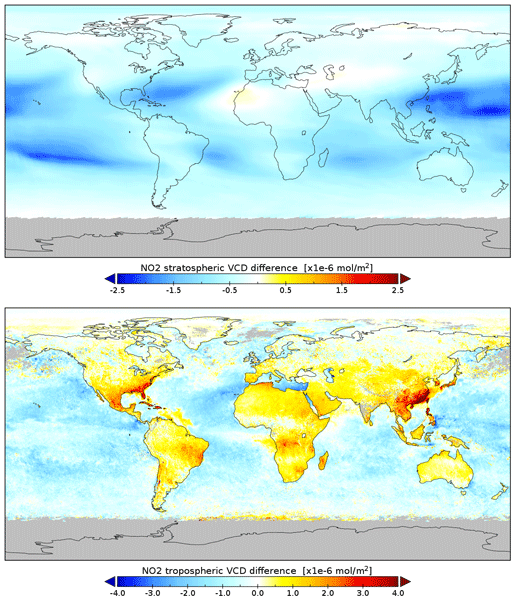
In this paper we investigate the benefits of removing the wavelength range 428–433 nm from the DOAS retrieval. This "NO2-gap approach" reduces the SCD error and the RMS error of the fit over water bodies by 10–20 % and the fit residual for the remaining parts of the window improves. Over some land scenes, where the residual outside the 428–433 nm range looks very good, the SCD error and RMS error are reduced by 5–10 %. For other areas the fit residual does not deteriorate by the NO2-gap approach. Over ocean waters the SCD is seen to decrease by a few percent, which leads to a decrease of the stratospheric NO2 column of on average up to -2 μmol m-2 in the tropics. Over land the change in SCD may be positive or negative by a few percent, which in combination with the change in the stratospheric column leads to changes in the tropospheric NO2 column of on average ±2 μmol m-2. These changes are too small to alter the general conclusions of the routine validation of TROPOMI data. Because of the improvement of the SCD error and systematic improvements over open water it has been decided to implement the NO2-gap approach in the forthcoming processor versions of TROPOMI and OMI.
-
Notice on discussion status
The requested preprint has a corresponding peer-reviewed final revised paper. You are encouraged to refer to the final revised version.
-
Preprint
(3934 KB)
-
The requested preprint has a corresponding peer-reviewed final revised paper. You are encouraged to refer to the final revised version.
- Preprint
(3934 KB) - Metadata XML
- BibTeX
- EndNote
- Final revised paper


Journal article(s) based on this preprint
Interactive discussion
Status: closed
-
RC1: 'Comment on egusphere-2025-5836', Anonymous Referee #1, 10 Apr 2026
- AC1: 'Reply on RC1', Jos van Geffen, 01 Jun 2026
-
RC2: 'Comment on egusphere-2025-5836', Anonymous Referee #2, 13 Apr 2026
General comments:
This manuscript presents a detailed investigation of the NO2 slant column fitting results from TROPOMI and OMI. Fitting residuals are carefully inspected showing that spectral misfits are systematically encountered around 430 nm, i.e. approximately in the middle of the retrieval range used for operational NO2 retrieval from both satellite sensors. These misfits are mostly observed above open water scenes (primarily Pacific, Atlantic and Indian oceans) and are attributed to the combined effect of inaccurate corrections for rotational Raman scattering (RRS) in air and vibrational Raman scattering (VRS) in water, the latter effect being ignored in the retrieval settings due to its complexity.
The authors present a convincing quantitative analysis of the dependency of the fit residuals on various parameters which clearly shows that the discrepancy is systematic and observed mainly above the water in a similar way for OMI and TROPOMI. This reinforces the interpretation of the nature of the problem. To solve the issue, they propose to introduce a 5-nm gap (428-433 nm) in the spectral range used for NO2 retrieval. The introduction of this gap is shown to reduce fitting RMS and SCD errors by about 10% while the NO2 SCD is seen to decrease by a few percent over oceans. Overall, the proposed algorithm adaptation only affects the retrieved NO2 columns by a few µmole/m2 (equivalent to a few 1014 molec/cm2) and is therefore essentially cosmetic.
The manuscript is well written and organized, and figures are all clear. The scientific approach to characterize fitting residuals and their variations is sound and appropriate. However, I remain unconvinced by the approach chosen to resolve the issue. In my view, especially considering the discussion in section 6.2, the intensity offset correction seems to provide an equally good correction while conserving the full spectral information. Another possible approach could have been to perform a PCA analysis of the spectral residuals over oceans and use it to generate an additional pseudo cross-section accounting for the misfit. Similar approaches have been recently exploited with success in correcting other misfit problems (e.g. the impact of scene inhomogeneities affecting the effective instrumental response function at the edge of bright scenes). In the end, the main benefit of the change in algorithm is to provide more realistic estimates of the random uncertainties in the retrieved slant columns. This aspect could be better stressed in the conclusions of the study.
That said, this article is of high quality and interesting in many respects, and it should certainly be published in AMT, once the comments below have been considered.
Detailed comments:
Pg. 1, line 8 and pg. 2, line 23: the authors repeatedly state that VRS cannot be corrected by way of a scalable reference spectrum, however it is not clear why it is so. References given for other VRS studies show that corrections can be implemented in some cases. Please make it clear in which way the correction that would be needed for NO2 is different from what has been successfully applied in other studies.
Pg. 3, line 17: as written, this sentence sounds a bit weird. I would suggest: “The Tropospheric Monitoring Instrument, sole payload aboard ESA’s Sentinel-5 Precursor (S5P) spacecraft, was launched on 13 October 2017 into an…”
Pg. 5, line 20: the Ring vector was calculated using the Dobber et al. atlas. Have you checked the potential impact of using another (more recent) solar reference spectrum for the calculation of the Ring cross-section (e.g. TSIS-1, or Chance and Kurucz)?
Pg. 11, line 19: Here, I would expect the RMS to be smaller over cloudy pixels, due to the increased S/N ratio over bright scenes (more photons being reflected to the satellite). Maybe the reason for the low RMS_430 ratio is simply that water is hidden by clouds. Please clarify.
Pg. 27, line 16: I follow the reasoning here, but the residual plot in Fig. 17 still does show an almost complete compensation. As mentioned later in the text, the broad-band structures visible in the fit residual themselves do not represent the missing reference spectrum, because the shape of the residual is the result of DOAS adjusting all fit parameters so as to minimise the residual. Therefore, although the peak at 430 nm is narrower than found in the residuals, it might well be that the IOC compensates well for the effect over the full interval.
Section 4.2, table 4: in my understanding, the main benefit of the NO2-gap is to improve residuals and therefore to bring the SCD errors closer to the statistical noise. It would be interesting to further discuss this point and maybe add values in table 4 showing how close the resulting SCD errors are to statistical errors.
Section 6.1: I understand that the spectral features over Tibetan lakes are related to a different mechanism, than those found more generally over oceans. Their impact on the NO2 SCDs is also more significant. It is not fully clear from the text whether the “NO2-gap” approach is able to reduce the observed bias on the NO2 SCDs. Please clarify.
Spelling, typos:
Pg. 3, line 3: remove the ‘s’ at the end of ‘shows’ in “Residuals may also shows broad-band..”
Pg. 7, line 7: replace ‘encounted’ by ‘encountered’
Pg. 19, line 8: replace “where” by “were”
Pg. 24, line 33: replace “deaper” by “deeper”
Citation: https://doi.org/10.5194/egusphere-2025-5836-RC2 - AC2: 'Reply on RC2', Jos van Geffen, 01 Jun 2026
Peer review completion


Interactive discussion
Status: closed
-
RC1: 'Comment on egusphere-2025-5836', Anonymous Referee #1, 10 Apr 2026
The paper “Improved NO2 spectral fits for TROPOMI and OMI by removing wavelengths around 430 nm” by van Geffen et al. describes the improvement of the DOAS retrieval algorithms for the TROPOMI and OMI instruments by disabling a part of the fit-window that reduces the impact of vibrational Raman scattering on the spectral fit quality. The study updates the TROPOMI NO2 retrieval algorithm described in van Geffen et al., 2020 and 2022. The “NO2-gap approach” is analysed for land- and water scenes and the impact on the stratospheric and tropospheric NO2 columns is discussed.
The topic of the manuscript is within the scope of AMT and it is of interest to the scientific community. It can be recommended for publication, if the authors make an effort to address the comments listed below, and improve the manuscript accordingly.
Specific comments:
Section 1
The authors explain that the remaining structures in the NO2 fit residual around 430 nm for retrievals over clear-sky dry land indicate that the accounting for RRS effects (by including a Ring spectrum in the DOAS fit) may not be fully accurate. The possible effects of the RRS (besides the effects of VRS over water) are shortly discussed in Section 3. Could these RRS effects be further investigated by applying the TROPOMI DOAS algorithm on simulated reflectances calculated with a radiative transfer model with RRS (e.g. for some specific scenarios)?
Section 2.1.1
Are there any other important algorithm improvements in the upcoming TROPOMI NO2 processor v2.9.1 (besides the “NO2-gap approach” described in this manuscript) that are of interest to the reader and could be shortly mentioned here?
Section 2.2
P4 Please include the definition of the geometric AMF used in this study.
Section 2.2.2
The statistical DOAS uncertainty is derived from the standard deviation on the slant columns in 2°x2° grid cells. Since the SCD also depends on the viewing geometry, it might be better to use geometrical corrected slant columns (GCD). The question is if there are significant differences between the statistical uncertainties based on the SCD or GCD.
Section 3
P9 Please include a global map of RD and RL
Section 3.1
A possible dependence of the RMS_430 ratio on the viewing/scattering geometry is not really discussed in the manuscript. It would be useful to include scatter plots of the RMS_430 ratio as a function of solar-, viewing or scattering angles for clear-sky pixels over the Atlantic Ocean.
Section 3.4
Fig.6 Why are the RMS_430 ratios only plotted in black (>2) and white (<2)? A color map would provide more information, e.g. about the RMS_430 ratios over different water scenes. Measurements with cloud radiance fractions > 0.5 could be marked as well.
Section 4.1
Is there also a significant impact of the NO2-gap fit on the statistical SCD uncertainty? This parameter could be included in Tables 2 and 3 as well.
Section 4.2
Fig.10 Please include a global map of the relative change in the NO2 SCD as well. The scatter plot on Fig. 11 show small changes in the SCD for most pixels but there seems to be a fairly large scatter in the SCD change as well.
Section 6
The authors discuss the unexpected large TROPOMI trop. NO2 columns over the Tibetian lakes that are likely due to unreliable DOAS retrievals and they also propose an (experimental) approach to improve the spectral fit over small areas like the lakes. I agree that such an approach to construct the missing reference spectrum might not be suitable for global retrievals and operational use. However, a case study for the Tibetian lakes would fit in the manuscript and enhance the scientific significance of the paper.
Citation: https://doi.org/10.5194/egusphere-2025-5836-RC1 - AC1: 'Reply on RC1', Jos van Geffen, 01 Jun 2026
-
RC2: 'Comment on egusphere-2025-5836', Anonymous Referee #2, 13 Apr 2026
General comments:
This manuscript presents a detailed investigation of the NO2 slant column fitting results from TROPOMI and OMI. Fitting residuals are carefully inspected showing that spectral misfits are systematically encountered around 430 nm, i.e. approximately in the middle of the retrieval range used for operational NO2 retrieval from both satellite sensors. These misfits are mostly observed above open water scenes (primarily Pacific, Atlantic and Indian oceans) and are attributed to the combined effect of inaccurate corrections for rotational Raman scattering (RRS) in air and vibrational Raman scattering (VRS) in water, the latter effect being ignored in the retrieval settings due to its complexity.
The authors present a convincing quantitative analysis of the dependency of the fit residuals on various parameters which clearly shows that the discrepancy is systematic and observed mainly above the water in a similar way for OMI and TROPOMI. This reinforces the interpretation of the nature of the problem. To solve the issue, they propose to introduce a 5-nm gap (428-433 nm) in the spectral range used for NO2 retrieval. The introduction of this gap is shown to reduce fitting RMS and SCD errors by about 10% while the NO2 SCD is seen to decrease by a few percent over oceans. Overall, the proposed algorithm adaptation only affects the retrieved NO2 columns by a few µmole/m2 (equivalent to a few 1014 molec/cm2) and is therefore essentially cosmetic.
The manuscript is well written and organized, and figures are all clear. The scientific approach to characterize fitting residuals and their variations is sound and appropriate. However, I remain unconvinced by the approach chosen to resolve the issue. In my view, especially considering the discussion in section 6.2, the intensity offset correction seems to provide an equally good correction while conserving the full spectral information. Another possible approach could have been to perform a PCA analysis of the spectral residuals over oceans and use it to generate an additional pseudo cross-section accounting for the misfit. Similar approaches have been recently exploited with success in correcting other misfit problems (e.g. the impact of scene inhomogeneities affecting the effective instrumental response function at the edge of bright scenes). In the end, the main benefit of the change in algorithm is to provide more realistic estimates of the random uncertainties in the retrieved slant columns. This aspect could be better stressed in the conclusions of the study.
That said, this article is of high quality and interesting in many respects, and it should certainly be published in AMT, once the comments below have been considered.
Detailed comments:
Pg. 1, line 8 and pg. 2, line 23: the authors repeatedly state that VRS cannot be corrected by way of a scalable reference spectrum, however it is not clear why it is so. References given for other VRS studies show that corrections can be implemented in some cases. Please make it clear in which way the correction that would be needed for NO2 is different from what has been successfully applied in other studies.
Pg. 3, line 17: as written, this sentence sounds a bit weird. I would suggest: “The Tropospheric Monitoring Instrument, sole payload aboard ESA’s Sentinel-5 Precursor (S5P) spacecraft, was launched on 13 October 2017 into an…”
Pg. 5, line 20: the Ring vector was calculated using the Dobber et al. atlas. Have you checked the potential impact of using another (more recent) solar reference spectrum for the calculation of the Ring cross-section (e.g. TSIS-1, or Chance and Kurucz)?
Pg. 11, line 19: Here, I would expect the RMS to be smaller over cloudy pixels, due to the increased S/N ratio over bright scenes (more photons being reflected to the satellite). Maybe the reason for the low RMS_430 ratio is simply that water is hidden by clouds. Please clarify.
Pg. 27, line 16: I follow the reasoning here, but the residual plot in Fig. 17 still does show an almost complete compensation. As mentioned later in the text, the broad-band structures visible in the fit residual themselves do not represent the missing reference spectrum, because the shape of the residual is the result of DOAS adjusting all fit parameters so as to minimise the residual. Therefore, although the peak at 430 nm is narrower than found in the residuals, it might well be that the IOC compensates well for the effect over the full interval.
Section 4.2, table 4: in my understanding, the main benefit of the NO2-gap is to improve residuals and therefore to bring the SCD errors closer to the statistical noise. It would be interesting to further discuss this point and maybe add values in table 4 showing how close the resulting SCD errors are to statistical errors.
Section 6.1: I understand that the spectral features over Tibetan lakes are related to a different mechanism, than those found more generally over oceans. Their impact on the NO2 SCDs is also more significant. It is not fully clear from the text whether the “NO2-gap” approach is able to reduce the observed bias on the NO2 SCDs. Please clarify.
Spelling, typos:
Pg. 3, line 3: remove the ‘s’ at the end of ‘shows’ in “Residuals may also shows broad-band..”
Pg. 7, line 7: replace ‘encounted’ by ‘encountered’
Pg. 19, line 8: replace “where” by “were”
Pg. 24, line 33: replace “deaper” by “deeper”
Citation: https://doi.org/10.5194/egusphere-2025-5836-RC2 - AC2: 'Reply on RC2', Jos van Geffen, 01 Jun 2026
Peer review completion
Journal article(s) based on this preprint
Viewed
| HTML | XML | Total | BibTeX | EndNote | |
|---|---|---|---|---|---|
| 1,024 | 667 | 94 | 1,785 | 192 | 233 |
- HTML: 1,024
- PDF: 667
- XML: 94
- Total: 1,785
- BibTeX: 192
- EndNote: 233
Viewed (geographical distribution)
| Country | # | Views | % |
|---|
| Total: | 0 |
| HTML: | 0 |
| PDF: | 0 |
| XML: | 0 |
- 1

Henk Eskes
Maarten Sneep
Mark ter Linden
Pepijn Veefkind
The requested preprint has a corresponding peer-reviewed final revised paper. You are encouraged to refer to the final revised version.
- Preprint
(3934 KB) - Metadata XML
The paper “Improved NO2 spectral fits for TROPOMI and OMI by removing wavelengths around 430 nm” by van Geffen et al. describes the improvement of the DOAS retrieval algorithms for the TROPOMI and OMI instruments by disabling a part of the fit-window that reduces the impact of vibrational Raman scattering on the spectral fit quality. The study updates the TROPOMI NO2 retrieval algorithm described in van Geffen et al., 2020 and 2022. The “NO2-gap approach” is analysed for land- and water scenes and the impact on the stratospheric and tropospheric NO2 columns is discussed.
The topic of the manuscript is within the scope of AMT and it is of interest to the scientific community. It can be recommended for publication, if the authors make an effort to address the comments listed below, and improve the manuscript accordingly.
Specific comments:
Section 1
The authors explain that the remaining structures in the NO2 fit residual around 430 nm for retrievals over clear-sky dry land indicate that the accounting for RRS effects (by including a Ring spectrum in the DOAS fit) may not be fully accurate. The possible effects of the RRS (besides the effects of VRS over water) are shortly discussed in Section 3. Could these RRS effects be further investigated by applying the TROPOMI DOAS algorithm on simulated reflectances calculated with a radiative transfer model with RRS (e.g. for some specific scenarios)?
Section 2.1.1
Are there any other important algorithm improvements in the upcoming TROPOMI NO2 processor v2.9.1 (besides the “NO2-gap approach” described in this manuscript) that are of interest to the reader and could be shortly mentioned here?
Section 2.2
P4 Please include the definition of the geometric AMF used in this study.
Section 2.2.2
The statistical DOAS uncertainty is derived from the standard deviation on the slant columns in 2°x2° grid cells. Since the SCD also depends on the viewing geometry, it might be better to use geometrical corrected slant columns (GCD). The question is if there are significant differences between the statistical uncertainties based on the SCD or GCD.
Section 3
P9 Please include a global map of RD and RL
Section 3.1
A possible dependence of the RMS_430 ratio on the viewing/scattering geometry is not really discussed in the manuscript. It would be useful to include scatter plots of the RMS_430 ratio as a function of solar-, viewing or scattering angles for clear-sky pixels over the Atlantic Ocean.
Section 3.4
Fig.6 Why are the RMS_430 ratios only plotted in black (>2) and white (<2)? A color map would provide more information, e.g. about the RMS_430 ratios over different water scenes. Measurements with cloud radiance fractions > 0.5 could be marked as well.
Section 4.1
Is there also a significant impact of the NO2-gap fit on the statistical SCD uncertainty? This parameter could be included in Tables 2 and 3 as well.
Section 4.2
Fig.10 Please include a global map of the relative change in the NO2 SCD as well. The scatter plot on Fig. 11 show small changes in the SCD for most pixels but there seems to be a fairly large scatter in the SCD change as well.
Section 6
The authors discuss the unexpected large TROPOMI trop. NO2 columns over the Tibetian lakes that are likely due to unreliable DOAS retrievals and they also propose an (experimental) approach to improve the spectral fit over small areas like the lakes. I agree that such an approach to construct the missing reference spectrum might not be suitable for global retrievals and operational use. However, a case study for the Tibetian lakes would fit in the manuscript and enhance the scientific significance of the paper.