
the Creative Commons Attribution 4.0 License.
the Creative Commons Attribution 4.0 License.
 | 13 Jan 2026
Synoptic and regional-scale meteorological controls of stratus altitude in the Namib Desert
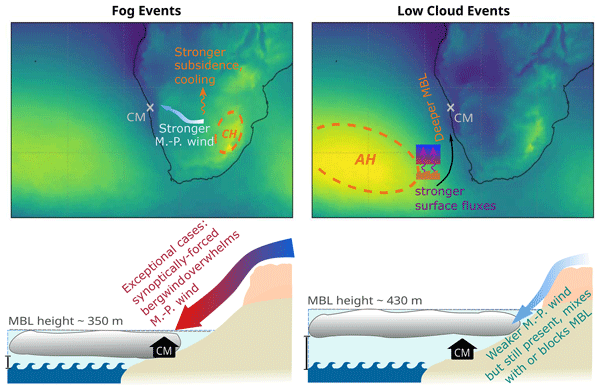
Abstract. In the Namib Desert, fog is an essential water source and occurs when and where advected marine stratus clouds intersect with the land surface. However, the meteorological controls of the cloud base height are still insufficiently understood. This study aims to develop a basic understanding of the relevant processes. We combine satellite and in situ observations with large-scale meteorological data from reanalysis data (ERA5) to compare fog events to lifted stratus at the coast (low-cloud events). In fog situations, the marine boundary layer is shallower along the entire coastline than in low-cloud situations. This is found to be related to the large-scale high-pressure systems. Fog situations exhibit a weaker Atlantic High but elevated continental pressure. The weaker Atlantic High is connected to less pronounced near-surface winds along the coastline, less cold advection, and heat fluxes upstream of the study region, leading to the shallower marine boundary layer. Increased continental pressure facilitates the development of regional mountain-plain winds that may reduce the height of the coastal inversion. These mechanisms are highlighted in a case study of an off-season fog event. To assess the predictive power of the two high-pressure systems and the regional pressure pattern, a logistic regression is trained with three corresponding features. The classification outperformed a climatological baseline by ≈ 10 %, suggesting that the features contain relevant process information. The results improve our understanding of the processes that determine the seasonal and day-to-day variability of fog versus elevated low-cloud occurrence in the Namib.
-
Notice on discussion status
The requested preprint has a corresponding peer-reviewed final revised paper. You are encouraged to refer to the final revised version.
-
Preprint
(14518 KB)
-
The requested preprint has a corresponding peer-reviewed final revised paper. You are encouraged to refer to the final revised version.
- Preprint
(14518 KB) - Metadata XML
- BibTeX
- EndNote
- Final revised paper


Journal article(s) based on this preprint
Interactive discussion
Status: closed
-
RC1: 'Comment on egusphere-2025-5816', Anonymous Referee #1, 25 Mar 2026
The comment was uploaded in the form of a supplement: https://egusphere.copernicus.org/preprints/2026/egusphere-2025-5816/egusphere-2025-5816-RC1-supplement.pdfCitation: https://doi.org/
10.5194/egusphere-2025-5816-RC1 -
RC2: 'Comment on egusphere-2025-5816', Anonymous Referee #2, 14 Apr 2026
This manuscript examines synoptic control on the formation of fog and low clouds over the western margin of the South African continent. The authors address this study by setting a spatial analysis to prove that the dipole high-pressure system between the Atlantic and the continent is the main mechanism controlling the land-to-sea wind circulation and boundary layer height. The manuscript is well written and well structured, with scientifically sound argumentation. The analysis, although descriptive, delves into synoptic causes of the difference between low stratus and land fog through a combination of reanalysis data and a case study. There are some minor comments in the supplement that need to be addressed before being considered for publication.
-
RC3: 'Comment on egusphere-2025-5816', Anonymous Referee #3, 20 Apr 2026
Review of ‘Synoptic and regional-scale meteorological controls of stratus
altitude in the Namib Desert’
The manuscript investigates the meteorological controls on stratus cloud base height in the Namib Desert, considering both large-scale circulation and regional-scale processes that influence boundary-layer structure and cloud altitude. Using synoptic analyses, vertical cross-sections, and ground-based observations, the authors examine how pressure patterns and wind fields interact with boundary-layer dynamics to control low-cloud altitude. Focusing on an atypical fog event, the study explores how variations in cloud base height govern the transition from stratus to surface-reaching fog. A logistic regression model is also used to assess the predictive skill of key meteorological variables for fog occurrence.
Overall, the manuscript provides valuable insights into the coupling between large-scale dynamics and boundary-layer processes in a region where fog is climatically important. The manuscript is well structured and clearly written. However, several aspects of the methodology, interpretation, and figure presentation and discussion require further clarification. The manuscript requires major revision before it can be considered for publication.
Specific comments.
Line 3: Please clarify what is meant by “the relevant processes.”
Line 11: Please specify which two pressure systems are being referred to.
Line 27: Above sea level (a.s.l.)
Line 68: change ‘the fog occurrence spatial patterns,’ to ‘the spatial patterns of fog occurrence’
Line 111-113: Please revise the sentence for clarity. ‘Both measure the standard meteorological variables at 1 min resolution…, and additionally measure fog water input…’
Line 113: ‘Juvik-type’
Line 122: A reference appears to be missing here.
Line 135-142: Could the authors clarify what threshold of fog precipitation was used to define ‘any’? For example, was a minimum measurable amount (e.g., instrument detection limit or a specific cutoff value) applied?
Figure 2: In the caption of Figure 2, please clarify the meaning of the dashed and solid lines, as well as the shaded regions. From my understanding, the solid lines and shaded regions appear to represent similar information.
Figure 3: In Figure 3, do the outlines indicate regions where the differences are consistent throughout the year (i.e., same sign, shown by black contours)? These are difficult to see in panels 3f and 3i. Additionally, line 195 states that the outlines are in blue. Please clarify this in the caption and consider using a brighter or more distinct color.
Line 275: In this sentence, ‘there contrasting’ appears to be a typographical error; it would be clearer as ‘thereby contrasting with’.
Line 276-277: Is this interpretation correct? I do not clearly see a southeasterly signal on the day before the event.
Line 303-304: The phrase “there due to limited range only observed after 10 UTC” is unclear. It may be clearer to write: “where it is only observed after 10 UTC due to limited range.”
Figure 9: Please clarify the ratio of training to testing data used in the analysis.
Additionally, provide a more detailed explanation of the figure, including the meaning of the F1-score and the representation of dots and lines (their frequencies).
Line 327-328: Is this ranking of importance statistically supported? For example, are there confidence intervals, significance tests, or standardized coefficients that demonstrate the relative importance of these predictors? I did not find any figure or quantitative analysis that clearly supports this statement. Please clarify how feature importance is assessed and consider providing additional evidence or visualization.
In Figure 9, the accuracy of the logistic regression appears to decrease toward the end of certain years (e.g., 2015, 2018, 2020). Could the authors comment on the potential reasons for this behavior?
Citation: https://doi.org/10.5194/egusphere-2025-5816-RC3 - AC1: 'Final Author Comment on egusphere-2025-5816', Viola Hipler, 11 Jun 2026
Peer review completion


Interactive discussion
Status: closed
-
RC1: 'Comment on egusphere-2025-5816', Anonymous Referee #1, 25 Mar 2026
The comment was uploaded in the form of a supplement: https://egusphere.copernicus.org/preprints/2026/egusphere-2025-5816/egusphere-2025-5816-RC1-supplement.pdf
-
RC2: 'Comment on egusphere-2025-5816', Anonymous Referee #2, 14 Apr 2026
This manuscript examines synoptic control on the formation of fog and low clouds over the western margin of the South African continent. The authors address this study by setting a spatial analysis to prove that the dipole high-pressure system between the Atlantic and the continent is the main mechanism controlling the land-to-sea wind circulation and boundary layer height. The manuscript is well written and well structured, with scientifically sound argumentation. The analysis, although descriptive, delves into synoptic causes of the difference between low stratus and land fog through a combination of reanalysis data and a case study. There are some minor comments in the supplement that need to be addressed before being considered for publication.
-
RC3: 'Comment on egusphere-2025-5816', Anonymous Referee #3, 20 Apr 2026
Review of ‘Synoptic and regional-scale meteorological controls of stratus
altitude in the Namib Desert’
The manuscript investigates the meteorological controls on stratus cloud base height in the Namib Desert, considering both large-scale circulation and regional-scale processes that influence boundary-layer structure and cloud altitude. Using synoptic analyses, vertical cross-sections, and ground-based observations, the authors examine how pressure patterns and wind fields interact with boundary-layer dynamics to control low-cloud altitude. Focusing on an atypical fog event, the study explores how variations in cloud base height govern the transition from stratus to surface-reaching fog. A logistic regression model is also used to assess the predictive skill of key meteorological variables for fog occurrence.
Overall, the manuscript provides valuable insights into the coupling between large-scale dynamics and boundary-layer processes in a region where fog is climatically important. The manuscript is well structured and clearly written. However, several aspects of the methodology, interpretation, and figure presentation and discussion require further clarification. The manuscript requires major revision before it can be considered for publication.
Specific comments.
Line 3: Please clarify what is meant by “the relevant processes.”
Line 11: Please specify which two pressure systems are being referred to.
Line 27: Above sea level (a.s.l.)
Line 68: change ‘the fog occurrence spatial patterns,’ to ‘the spatial patterns of fog occurrence’
Line 111-113: Please revise the sentence for clarity. ‘Both measure the standard meteorological variables at 1 min resolution…, and additionally measure fog water input…’
Line 113: ‘Juvik-type’
Line 122: A reference appears to be missing here.
Line 135-142: Could the authors clarify what threshold of fog precipitation was used to define ‘any’? For example, was a minimum measurable amount (e.g., instrument detection limit or a specific cutoff value) applied?
Figure 2: In the caption of Figure 2, please clarify the meaning of the dashed and solid lines, as well as the shaded regions. From my understanding, the solid lines and shaded regions appear to represent similar information.
Figure 3: In Figure 3, do the outlines indicate regions where the differences are consistent throughout the year (i.e., same sign, shown by black contours)? These are difficult to see in panels 3f and 3i. Additionally, line 195 states that the outlines are in blue. Please clarify this in the caption and consider using a brighter or more distinct color.
Line 275: In this sentence, ‘there contrasting’ appears to be a typographical error; it would be clearer as ‘thereby contrasting with’.
Line 276-277: Is this interpretation correct? I do not clearly see a southeasterly signal on the day before the event.
Line 303-304: The phrase “there due to limited range only observed after 10 UTC” is unclear. It may be clearer to write: “where it is only observed after 10 UTC due to limited range.”
Figure 9: Please clarify the ratio of training to testing data used in the analysis.
Additionally, provide a more detailed explanation of the figure, including the meaning of the F1-score and the representation of dots and lines (their frequencies).
Line 327-328: Is this ranking of importance statistically supported? For example, are there confidence intervals, significance tests, or standardized coefficients that demonstrate the relative importance of these predictors? I did not find any figure or quantitative analysis that clearly supports this statement. Please clarify how feature importance is assessed and consider providing additional evidence or visualization.
In Figure 9, the accuracy of the logistic regression appears to decrease toward the end of certain years (e.g., 2015, 2018, 2020). Could the authors comment on the potential reasons for this behavior?
Citation: https://doi.org/10.5194/egusphere-2025-5816-RC3 - AC1: 'Final Author Comment on egusphere-2025-5816', Viola Hipler, 11 Jun 2026
Peer review completion
Journal article(s) based on this preprint
Viewed
| HTML | XML | Total | BibTeX | EndNote | |
|---|---|---|---|---|---|
| 1,227 | 931 | 136 | 2,294 | 199 | 198 |
- HTML: 1,227
- PDF: 931
- XML: 136
- Total: 2,294
- BibTeX: 199
- EndNote: 198
Viewed (geographical distribution)
| Country | # | Views | % |
|---|
| Total: | 0 |
| HTML: | 0 |
| PDF: | 0 |
| XML: | 0 |
- 1
Cited


Viola Hipler
Hendrik Andersen

Robert Spirig
Roland Vogt
Stuart Piketh
Bianca Adler
Jan Cermak
The requested preprint has a corresponding peer-reviewed final revised paper. You are encouraged to refer to the final revised version.
- Preprint
(14518 KB) - Metadata XML