
the Creative Commons Attribution 4.0 License.
the Creative Commons Attribution 4.0 License.
 | 23 Feb 2026
Evidence of Vertical Soil Hydraulic Heterogeneity Regulating Hydrothermal Simulations in Qinghai–Tibetan Plateau Wetlands
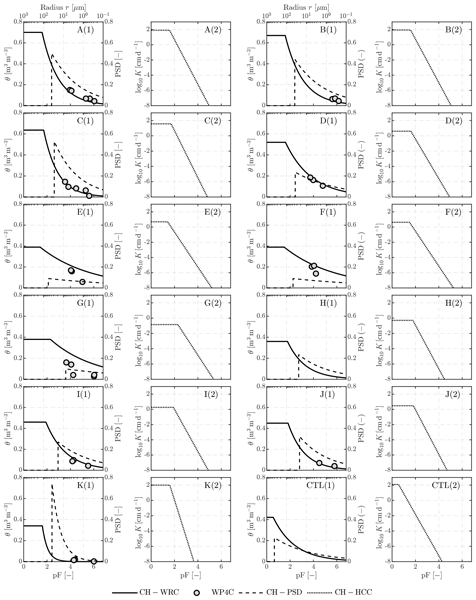
Abstract. Alpine wetlands on the Qinghai-Tibetan Plateau host vertically structured and highly contrasting pore systems that fundamentally shape land and atmosphere exchanges, yet their hydraulic expressions and process implications remain poorly quantified. This study provides the first process based and depth resolved characterization of these layered pore structures using soil physical analyses and laboratory evaporation experiments. The derived Clapp–Hornberger parameters reveal coherent hydraulic contrasts, with surface layers dominated by macropore connectivity and showing high θs and Ks and low b that promote rapid drainage and evaporation, mid layer domains with lower θs and Ks and larger b that enhance retention in finer pores, and deeper layers that act as stable and persistent storage reservoirs. These properties together generate a vertical regime of rapid near surface drainage, delayed mid layer release, and long lasting deep moisture storage. When implemented in Noah-MP, this hydraulic stratification systematically altered water and energy partitioning during wet and dry periods and showed that vertical hydraulic heterogeneity rather than a single layer parameterization governs the timing and magnitude of evaporation and heat fluxes. These findings provide the first quantitative evidence that pore scale structure regulates profile scale hydrothermal responses in Qinghai-Tibetan Plateau wetlands and establish a physically grounded basis for representing vertically heterogeneous hydraulic processes in land surface models.
-
Notice on discussion status
The requested preprint has a corresponding peer-reviewed final revised paper. You are encouraged to refer to the final revised version.
-
Preprint
(2480 KB)
-
The requested preprint has a corresponding peer-reviewed final revised paper. You are encouraged to refer to the final revised version.
- Preprint
(2480 KB) - Metadata XML
- BibTeX
- EndNote
- Final revised paper


Journal article(s) based on this preprint
Interactive discussion
Status: closed
-
RC1: 'Comment on egusphere-2025-5814', Anonymous Referee #1, 25 Mar 2026
-
AC1: 'Reply on RC1', Rong Liu, 08 Apr 2026
The comment was uploaded in the form of a supplement: https://egusphere.copernicus.org/preprints/2026/egusphere-2025-5814/egusphere-2025-5814-AC1-supplement.pdf
-
AC1: 'Reply on RC1', Rong Liu, 08 Apr 2026
-
RC2: 'Comment on egusphere-2025-5814', Gil Bohrer, 24 Apr 2026
The manuscript describes a very elegant sensitivity analysis of an often ignored but important issue of the vertical variation of soil hydraulic parameters. The lab work and the numerical experiment design are rather convincing.
My most critical comment is that “Data will be provided upon request” is absolutely not an appropriate data availability statement and violates the data policy of HESS https://www.hydrology-and-earth-system-sciences.net/policies/data_policy.html . I am a bit surprised that the editor let this manuscript proceed to review without disclosing any data, or model codes.
It is absolutely critical that ALL the eddy covariance flux data including LHF and SHF and all other site level meteorology, and soil hydrology observations will be made available. Similarly, all the laboratory measurements. Also needed are the exact variant of the NOAH-MP model code that was used, with the data for forcing, initialization and simulation setup for EACH of the simulation cases, and ALL the simulation output. These should all be published with a DOI in a FAIR repository. Make sure there is sufficient metadata to know what each variable in each data file is, and what are the units of reported values. Make sure a sufficient explanation exist as to how to run the model to recapture the simulation cases that were conducted here.
Another major comment is that there is no mention of sample sizes and variability throughout the manuscript.
How many cores did you extract? Of these, how many were used for the evaporation experiment, and how many to sample bulk density? What was the variability among cores? How representative were the few cores used for the evaporation experiment of the whole site? How did you scale the parameters you found across the whole region, and across different soil types (as shown in Fig 1a)? I may have missed it (in which case, highlight it more prominently) anywhere in the methods. Also, there is no mention of sample size anywhere throughout the results section.
Similarly, in section 3.2, I assume the parameter values are not the result of a single measurements, but either the mean of multiple measurements, in which case provide the std and range of observed parameter values, or are derived from fitting the model curve over multiple observations, in which case, provide some goodness of fit metric (preferably r^2).
Figure 7 – here two, are the lines represent single measurement, or are the mean of something? Provide some range of uncertainty around the lines.
Fig 11 – same, you did not simulate only one day. There should be some variation around the lines.
Minor comments:
Please provide the references to Brooks Corey (BC), Clapp–Hornberger (CH), van Genuchten (VG), and Kosugi (L47-48) upon first mention and not later. And please provide a reference to Mualem’s model, Savitzky–Golay filtering, and perhaps few other formulations which you mention and use, but not reference at all.
I personally do not like texts that divulge to alphabet soups, and find sentences like: “CH describes the WRC and HCC with power laws …” confusing. For the ease of the reader, will it be possible, here and most other places, to use the full terms? I.e., CH describes the water retention and hydraulic conductivity curves with power laws … (it only added 2 words)
L126 “Observation Station (denoted by the red dots in…” - There is only one dot. Is the plural "dots" a typo, or should there be more than one station? Also, a red color in Fig 1a is also used for one of the soil type. Slightly confusing. Consider a different color for the dot station marker.
For sections 2.4 – 2.7 I am missing a table similar to table 2, clarifying what is measured (direct observation), what is calculated from which equation and what is a fitted parameter.
In table 2, last column, it will make sense to mention which equation the parameter comes from.
Citation: https://doi.org/10.5194/egusphere-2025-5814-RC2 -
AC2: 'Reply on RC2', Rong Liu, 10 May 2026
The comment was uploaded in the form of a supplement: https://egusphere.copernicus.org/preprints/2026/egusphere-2025-5814/egusphere-2025-5814-AC2-supplement.pdf
-
AC2: 'Reply on RC2', Rong Liu, 10 May 2026
Peer review completion


Interactive discussion
Status: closed
-
RC1: 'Comment on egusphere-2025-5814', Anonymous Referee #1, 25 Mar 2026
This manuscript investigates the vertical heterogeneity of soil hydraulic properties in a typical alpine wetland on the Qinghai–Tibet Plateau and its impact on land-surface hydrothermal simulations. The authors combine CT imaging, HYPROP-WP4C evaporation experiments, CH curve fitting, and Noah-MP modeling to conduct a comprehensive analysis. This integrated approach is commendable, and the findings are meaningful for land-surface simulations, especially for alpine wetlands on the Qinghai–Tibet Plateau. However, several concerns need to be addressed before the manuscript can be recommended for publication.
Recommendation: Moderate Revision
Comments:
1. The authors focus on a single site in the Sanjiangyuan region, and the model evaluation is based primarily on data from 2023. While these data are adequate for offline Noah-MP simulations, the manuscript claims that the findings provide a verifiable pathway for alpine wetlands on the Qinghai–Tibet Plateau and similar complex ecosystems. It is therefore important to clarify how representative this site is of wetlands across the Qinghai–Tibet Plateau. In addition, was 2023 a climatologically normal year for this region? The authors are encouraged to expand Section 2.1 to include this information.
2. In Section 2.5, the authors combined data from two instruments (HYPROP-2 and WP4C) to obtain continuous water-retention curves (WRCs) and hydraulic-conductivity curves (HCCs). However, it is unclear how discrepancies between the two datasets were handled in the transition zone—specifically, whether the overlapping region was directly spliced or whether smoothing and fitting procedures were applied.
3. The authors employed the SCE-UA algorithm to invert multiple CH parameters. However, it remains unclear whether multiple independent optimization runs were conducted and whether parameter non-uniqueness was observed.
4. In the model experiment design (Section 2.8), the OAT sensitivity approach was adopted. Although the authors included a control experiment using Noah-MP default values, this appears insufficient. An OAT design cannot capture the nonlinear interactions among the selected parameters. The authors are therefore encouraged to add further experiments to examine such nonlinear interactions.
5. In Section 3.3, Pearson correlation coefficients are reported; however, the manuscript does not clearly state the sample size, p-values, or confidence intervals associated with these analyses, making it difficult to assess the robustness of the reported relationships.Citation: https://doi.org/10.5194/egusphere-2025-5814-RC1 -
AC1: 'Reply on RC1', Rong Liu, 08 Apr 2026
The comment was uploaded in the form of a supplement: https://egusphere.copernicus.org/preprints/2026/egusphere-2025-5814/egusphere-2025-5814-AC1-supplement.pdf
-
AC1: 'Reply on RC1', Rong Liu, 08 Apr 2026
-
RC2: 'Comment on egusphere-2025-5814', Gil Bohrer, 24 Apr 2026
The manuscript describes a very elegant sensitivity analysis of an often ignored but important issue of the vertical variation of soil hydraulic parameters. The lab work and the numerical experiment design are rather convincing.
My most critical comment is that “Data will be provided upon request” is absolutely not an appropriate data availability statement and violates the data policy of HESS https://www.hydrology-and-earth-system-sciences.net/policies/data_policy.html . I am a bit surprised that the editor let this manuscript proceed to review without disclosing any data, or model codes.
It is absolutely critical that ALL the eddy covariance flux data including LHF and SHF and all other site level meteorology, and soil hydrology observations will be made available. Similarly, all the laboratory measurements. Also needed are the exact variant of the NOAH-MP model code that was used, with the data for forcing, initialization and simulation setup for EACH of the simulation cases, and ALL the simulation output. These should all be published with a DOI in a FAIR repository. Make sure there is sufficient metadata to know what each variable in each data file is, and what are the units of reported values. Make sure a sufficient explanation exist as to how to run the model to recapture the simulation cases that were conducted here.
Another major comment is that there is no mention of sample sizes and variability throughout the manuscript.
How many cores did you extract? Of these, how many were used for the evaporation experiment, and how many to sample bulk density? What was the variability among cores? How representative were the few cores used for the evaporation experiment of the whole site? How did you scale the parameters you found across the whole region, and across different soil types (as shown in Fig 1a)? I may have missed it (in which case, highlight it more prominently) anywhere in the methods. Also, there is no mention of sample size anywhere throughout the results section.
Similarly, in section 3.2, I assume the parameter values are not the result of a single measurements, but either the mean of multiple measurements, in which case provide the std and range of observed parameter values, or are derived from fitting the model curve over multiple observations, in which case, provide some goodness of fit metric (preferably r^2).
Figure 7 – here two, are the lines represent single measurement, or are the mean of something? Provide some range of uncertainty around the lines.
Fig 11 – same, you did not simulate only one day. There should be some variation around the lines.
Minor comments:
Please provide the references to Brooks Corey (BC), Clapp–Hornberger (CH), van Genuchten (VG), and Kosugi (L47-48) upon first mention and not later. And please provide a reference to Mualem’s model, Savitzky–Golay filtering, and perhaps few other formulations which you mention and use, but not reference at all.
I personally do not like texts that divulge to alphabet soups, and find sentences like: “CH describes the WRC and HCC with power laws …” confusing. For the ease of the reader, will it be possible, here and most other places, to use the full terms? I.e., CH describes the water retention and hydraulic conductivity curves with power laws … (it only added 2 words)
L126 “Observation Station (denoted by the red dots in…” - There is only one dot. Is the plural "dots" a typo, or should there be more than one station? Also, a red color in Fig 1a is also used for one of the soil type. Slightly confusing. Consider a different color for the dot station marker.
For sections 2.4 – 2.7 I am missing a table similar to table 2, clarifying what is measured (direct observation), what is calculated from which equation and what is a fitted parameter.
In table 2, last column, it will make sense to mention which equation the parameter comes from.
Citation: https://doi.org/10.5194/egusphere-2025-5814-RC2 -
AC2: 'Reply on RC2', Rong Liu, 10 May 2026
The comment was uploaded in the form of a supplement: https://egusphere.copernicus.org/preprints/2026/egusphere-2025-5814/egusphere-2025-5814-AC2-supplement.pdf
-
AC2: 'Reply on RC2', Rong Liu, 10 May 2026
Peer review completion
Journal article(s) based on this preprint
Viewed
| HTML | XML | Total | BibTeX | EndNote | |
|---|---|---|---|---|---|
| 678 | 377 | 111 | 1,166 | 64 | 81 |
- HTML: 678
- PDF: 377
- XML: 111
- Total: 1,166
- BibTeX: 64
- EndNote: 81
Viewed (geographical distribution)
| Country | # | Views | % |
|---|
| Total: | 0 |
| HTML: | 0 |
| PDF: | 0 |
| XML: | 0 |
- 1

Xin Wang
Zuoliang Wang
Yongjie Pan
Yan Song
The requested preprint has a corresponding peer-reviewed final revised paper. You are encouraged to refer to the final revised version.
- Preprint
(2480 KB) - Metadata XML
This manuscript investigates the vertical heterogeneity of soil hydraulic properties in a typical alpine wetland on the Qinghai–Tibet Plateau and its impact on land-surface hydrothermal simulations. The authors combine CT imaging, HYPROP-WP4C evaporation experiments, CH curve fitting, and Noah-MP modeling to conduct a comprehensive analysis. This integrated approach is commendable, and the findings are meaningful for land-surface simulations, especially for alpine wetlands on the Qinghai–Tibet Plateau. However, several concerns need to be addressed before the manuscript can be recommended for publication.
Recommendation: Moderate Revision
Comments:
1. The authors focus on a single site in the Sanjiangyuan region, and the model evaluation is based primarily on data from 2023. While these data are adequate for offline Noah-MP simulations, the manuscript claims that the findings provide a verifiable pathway for alpine wetlands on the Qinghai–Tibet Plateau and similar complex ecosystems. It is therefore important to clarify how representative this site is of wetlands across the Qinghai–Tibet Plateau. In addition, was 2023 a climatologically normal year for this region? The authors are encouraged to expand Section 2.1 to include this information.
2. In Section 2.5, the authors combined data from two instruments (HYPROP-2 and WP4C) to obtain continuous water-retention curves (WRCs) and hydraulic-conductivity curves (HCCs). However, it is unclear how discrepancies between the two datasets were handled in the transition zone—specifically, whether the overlapping region was directly spliced or whether smoothing and fitting procedures were applied.
3. The authors employed the SCE-UA algorithm to invert multiple CH parameters. However, it remains unclear whether multiple independent optimization runs were conducted and whether parameter non-uniqueness was observed.
4. In the model experiment design (Section 2.8), the OAT sensitivity approach was adopted. Although the authors included a control experiment using Noah-MP default values, this appears insufficient. An OAT design cannot capture the nonlinear interactions among the selected parameters. The authors are therefore encouraged to add further experiments to examine such nonlinear interactions.
5. In Section 3.3, Pearson correlation coefficients are reported; however, the manuscript does not clearly state the sample size, p-values, or confidence intervals associated with these analyses, making it difficult to assess the robustness of the reported relationships.