
the Creative Commons Attribution 4.0 License.
the Creative Commons Attribution 4.0 License.
 | 06 Jan 2026
A Novel Framework for Automatic Scanning Radar Pointing Calibration Using the Sun
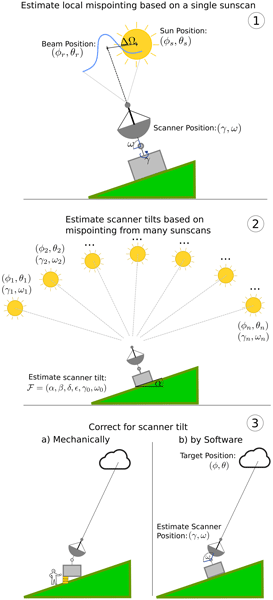
Abstract. A high accuracy of antenna beam pointing is essential for weather and cloud radars in order to precisely locate cloud and precipitation. It is also a critical requirement for estimating the horizontal wind field or to retrieve particle's vertical motions. We present a general framework for radar pointing calibration using the sun as a reference target. The workflow is structured into three steps: (i) measurement and analysis of individual Sun scans, (ii) estimation of scanner inaccuracies from a series of scans, and (iii) correction of these inaccuracies. Our approach is radar-agnostic and applicable to any instrument equipped with a two-axis pan-tilt scanner and a parabolic antenna. General recommendations for Sun scan implementation are given, and the full calibration process is demonstrated using a Mira-35 cloud radar. The method allows retrieval of a comprehensive set of parameters, including beamwidth in two orthogonal directions, pedestal tilt, axis misalignments, encoder offsets, gear backlash, and the receiver-scanner time offset. With this approach, absolute pointing accuracy better than 0.1° can be achieved, and relative changes as small as 0.01° can be detected. To facilitate the automatic application, we provide the open-source Python library SunscanPy for radar pointing calibration. This toolset is especially valuable for stationary radars and radar networks, where it enables automatic monitoring of long-term pointing stability. Finally, we introduce a novel automatic pointing correction scheme based on inverse kinematics. Once the scanner inaccuracies are estimated, the required motor positions can be computed to compensate for the inaccuracies, without mechanical adjustments. Such functionality is particularly advantageous for mobile radars, research campaigns, or remote deployments, where frequent mechanical leveling is necessary but often difficult to perform.
Competing interests: Mathias Bauer-Pfundstein is employed by Metek GmbH, the manufacturer of the Mira35 cloud radar.
Publisher's note: Copernicus Publications remains neutral with regard to jurisdictional claims made in the text, published maps, institutional affiliations, or any other geographical representation in this paper. While Copernicus Publications makes every effort to include appropriate place names, the final responsibility lies with the authors. Views expressed in the text are those of the authors and do not necessarily reflect the views of the publisher.-
Notice on discussion status
The requested preprint has a corresponding peer-reviewed final revised paper. You are encouraged to refer to the final revised version.
-
Preprint
(3355 KB)
-
The requested preprint has a corresponding peer-reviewed final revised paper. You are encouraged to refer to the final revised version.
- Preprint
(3355 KB) - Metadata XML
- BibTeX
- EndNote
- Final revised paper


Journal article(s) based on this preprint
Interactive discussion
Status: closed
-
RC1: 'Comment on egusphere-2025-5690', Anonymous Referee #1, 27 Jan 2026
- AC2: 'Reply on RC1', Paul Ockenfuss, 06 Mar 2026
-
RC2: 'Comment on egusphere-2025-5690', Anonymous Referee #3, 04 Feb 2026
The concept of inverse kinematics is mentioned several times but it is never explained. Please provide a brief explanation.
Lines 26 - 27: Please provide references for the velocity figures, including the precision of the velocity measurement.
Lines 60 - 61: It should be mentioned that the sun is also used as source for receiver noise calibration.
Lines 67 - 68: " Second, existing calibration workflows typically assume that mechanical correction of the scanner is required once biases are identified". This requires clarification. "mechanical correction" would mean that the sensor measuring the angle of the respective axis would have to be adjusted to a kind of "zero position". However the digital encoders of modern weather radars are only calibrated with digital offsets. A manual mechanical correction or adjustment would be to expensive. If "mechanical correction" refers to the alignment of the pedestal, like in Fig. 1/3 please refer to e.g. shipborne weather radar antennas, which have to compensate the movement of the ship permanently for pitch, roll and yaw. This is nowadays all done by software using a gyro as reference.
Lines 90 -95: The line numbering is incorrect. There are more than 5 lines.
" θ ∈ [0◦,90◦] " , " [0◦,180◦] ": Negative elevation angles are not unusual, in particular for shipborne radars. The method presented in this paper should take this into account.
With respect to the degree of accuracy which the authors intend to achieve: Is it necessary to consider the offset of the phase center of the antenna with respect to the Az and El rotation axis?Line 116: The backlash does not depend on the velocity but on the direction of rotation, as correctly addressed in line 214.
Line 170: The reference does not mention the Airy pattern. However Chapter 10-8 discusses patterns of large aperture antennas with uniform illumination which causes an Airy pattern. But parabolic reflector antennas are normally using a tapered illumination to keep the sidelobes low. The authors should explain why they use the Airy pattern and not the Gaussian pattern, which is normally applied, which resembles the tapered illumination better, and which is therefore also used in the derivation of the meteorological radar equation.
Line 177: Please explain this expression. Probably "bivalued" function is meant.
There are several publications discussing the center-to-limb variation of the microwave radiation of the sun, e.g. Shibasaki, K.:"Microwave Observations of the Quiet Sun", Solar Physics with Radio Observations, Proceedings of Nobeyama Symposium 1998, NRO Report 479. The authors should address the error caused by neglecting this effect.Line 211 - 212: How do you prevent the sun from being received by an antenna side lobe? Or is this not critical since you are only looking for a large difference?
Line 564 - 565: The reference is not clear. The international issue of the 3rd edition of the book was published in 2002, the US version in 2001. A reprint of this edition was published as paperback or softcover later, but the copyright is still 2002. Moreover, page 986 is the first page of Appendix B. Why do the authors refer to the appendix?
Citation: https://doi.org/10.5194/egusphere-2025-5690-RC2 - AC1: 'Reply on RC2', Paul Ockenfuss, 06 Mar 2026
-
RC3: 'Comment on egusphere-2025-5690', Anonymous Referee #2, 05 Feb 2026
The comment was uploaded in the form of a supplement: https://egusphere.copernicus.org/preprints/2026/egusphere-2025-5690/egusphere-2025-5690-RC3-supplement.pdf
- AC3: 'Reply on RC3', Paul Ockenfuss, 06 Mar 2026
Peer review completion


Interactive discussion
Status: closed
-
RC1: 'Comment on egusphere-2025-5690', Anonymous Referee #1, 27 Jan 2026
- AC2: 'Reply on RC1', Paul Ockenfuss, 06 Mar 2026
-
RC2: 'Comment on egusphere-2025-5690', Anonymous Referee #3, 04 Feb 2026
The concept of inverse kinematics is mentioned several times but it is never explained. Please provide a brief explanation.
Lines 26 - 27: Please provide references for the velocity figures, including the precision of the velocity measurement.
Lines 60 - 61: It should be mentioned that the sun is also used as source for receiver noise calibration.
Lines 67 - 68: " Second, existing calibration workflows typically assume that mechanical correction of the scanner is required once biases are identified". This requires clarification. "mechanical correction" would mean that the sensor measuring the angle of the respective axis would have to be adjusted to a kind of "zero position". However the digital encoders of modern weather radars are only calibrated with digital offsets. A manual mechanical correction or adjustment would be to expensive. If "mechanical correction" refers to the alignment of the pedestal, like in Fig. 1/3 please refer to e.g. shipborne weather radar antennas, which have to compensate the movement of the ship permanently for pitch, roll and yaw. This is nowadays all done by software using a gyro as reference.
Lines 90 -95: The line numbering is incorrect. There are more than 5 lines.
" θ ∈ [0◦,90◦] " , " [0◦,180◦] ": Negative elevation angles are not unusual, in particular for shipborne radars. The method presented in this paper should take this into account.
With respect to the degree of accuracy which the authors intend to achieve: Is it necessary to consider the offset of the phase center of the antenna with respect to the Az and El rotation axis?Line 116: The backlash does not depend on the velocity but on the direction of rotation, as correctly addressed in line 214.
Line 170: The reference does not mention the Airy pattern. However Chapter 10-8 discusses patterns of large aperture antennas with uniform illumination which causes an Airy pattern. But parabolic reflector antennas are normally using a tapered illumination to keep the sidelobes low. The authors should explain why they use the Airy pattern and not the Gaussian pattern, which is normally applied, which resembles the tapered illumination better, and which is therefore also used in the derivation of the meteorological radar equation.
Line 177: Please explain this expression. Probably "bivalued" function is meant.
There are several publications discussing the center-to-limb variation of the microwave radiation of the sun, e.g. Shibasaki, K.:"Microwave Observations of the Quiet Sun", Solar Physics with Radio Observations, Proceedings of Nobeyama Symposium 1998, NRO Report 479. The authors should address the error caused by neglecting this effect.Line 211 - 212: How do you prevent the sun from being received by an antenna side lobe? Or is this not critical since you are only looking for a large difference?
Line 564 - 565: The reference is not clear. The international issue of the 3rd edition of the book was published in 2002, the US version in 2001. A reprint of this edition was published as paperback or softcover later, but the copyright is still 2002. Moreover, page 986 is the first page of Appendix B. Why do the authors refer to the appendix?
Citation: https://doi.org/10.5194/egusphere-2025-5690-RC2 - AC1: 'Reply on RC2', Paul Ockenfuss, 06 Mar 2026
-
RC3: 'Comment on egusphere-2025-5690', Anonymous Referee #2, 05 Feb 2026
The comment was uploaded in the form of a supplement: https://egusphere.copernicus.org/preprints/2026/egusphere-2025-5690/egusphere-2025-5690-RC3-supplement.pdf
- AC3: 'Reply on RC3', Paul Ockenfuss, 06 Mar 2026
Peer review completion
Journal article(s) based on this preprint
Viewed
| HTML | XML | Total | BibTeX | EndNote | |
|---|---|---|---|---|---|
| 829 | 578 | 83 | 1,490 | 54 | 72 |
- HTML: 829
- PDF: 578
- XML: 83
- Total: 1,490
- BibTeX: 54
- EndNote: 72
Viewed (geographical distribution)
| Country | # | Views | % |
|---|
| Total: | 0 |
| HTML: | 0 |
| PDF: | 0 |
| XML: | 0 |
- 1
Paul Ockenfuß

Gregor Köcher
Matthias Bauer-Pfundstein
Stefan Kneifel
The requested preprint has a corresponding peer-reviewed final revised paper. You are encouraged to refer to the final revised version.
- Preprint
(3355 KB) - Metadata XML
Please find my comments attached.