
the Creative Commons Attribution 4.0 License.
the Creative Commons Attribution 4.0 License.
 | 14 Jan 2026
Long-term InSAR and streamflow recession analysis reveal accelerated permafrost degradation in the mining area of Qilian Mountain
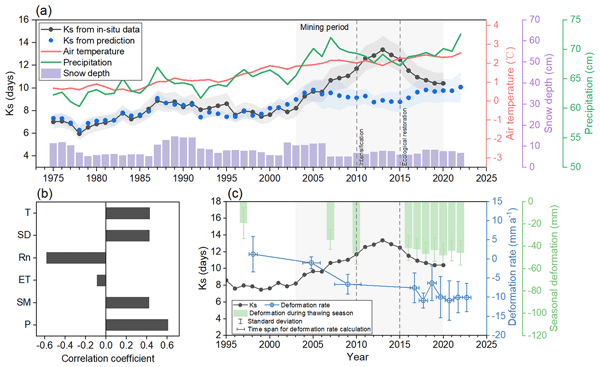
Abstract. Permafrost underlies about 40 % of the Qinghai-Tibet Plateau (QTP), where climate warming and human activities increasingly threaten fragile alpine ecosystems, necessitating long-term permafrost monitoring. Interferometric Synthetic Aperture Radar (InSAR) enables precise detection of thaw-induced surface deformation, while streamflow recession helps reveal subsurface hydrological changes with permafrost degradation. This study performed a first-time joint analysis of decades-long InSAR surface deformation and streamflow recession to assess the trajectory of permafrost degradation in the source region of the Datong River, an area located in the Qilian Mountains of the northeastern QTP and subject to intensive mining during the 2000s and early 2010s. A data-constrained Small Baseline Subset (SBAS) method was proposed to improve the Sentinel-1 C-band deformation retrievals through integrating a linear–periodic temporal constraint model and using concurrent ALOS-2 retrieved deformation rate as a reference. A consistent long-term (1997–2023) deformation dataset was then generated through combining multi-sensor C- and L-band SAR retrievals. The results reveal minimal surface deformation before the mining, followed by sustained ground subsidence (−15 to −5 mm a−1) and enhanced seasonal deformation (~20–60 mm) during and after mining, indicating accelerated permafrost degradation. This acceleration coincides with a marked slowdown in the post-mining streamflow recession rate derived from daily discharge data of the upper Datong River, likely driven by thaw-induced increases in basin subsurface water storage and flowpath connectivity. This study provides a first comprehensive assessment of permafrost degradation from both surface and subsurface perspectives, offering valuable insights for integrating remote sensing and hydrological observations to assess permafrost vulnerability.
Competing interests: At least one of the (co-)authors is a member of the editorial board of The Cryosphere. The peer-review process was guided by an independent editor, and the authors also have no other competing interests to declare.
Publisher's note: Copernicus Publications remains neutral with regard to jurisdictional claims made in the text, published maps, institutional affiliations, or any other geographical representation in this paper. While Copernicus Publications makes every effort to include appropriate place names, the final responsibility lies with the authors. Views expressed in the text are those of the authors and do not necessarily reflect the views of the publisher.-
Notice on discussion status
The requested preprint has a corresponding peer-reviewed final revised paper. You are encouraged to refer to the final revised version.
-
Preprint
(13204 KB)
-
Supplement
(14926 KB)
-
The requested preprint has a corresponding peer-reviewed final revised paper. You are encouraged to refer to the final revised version.
- Preprint
(13204 KB) - Metadata XML
-
Supplement
(14926 KB) - BibTeX
- EndNote
- Final revised paper


Journal article(s) based on this preprint
Interactive discussion
Status: closed
-
RC1: 'Comment on egusphere-2025-5611', Anonymous Referee #1, 29 Apr 2026
-
RC2: 'Reply on RC1', Neelarun Mukherjee, 06 Jun 2026
This manuscript integrates multi-decadal InSAR observations with streamflow recession analysis to investigate permafrost degradation in a mining-disturbed alpine basin. The topic is timely and the combination of surface deformation monitoring with a hydrological signal is novel. The long-term deformation dataset spanning five SAR sensors is a genuine contribution. I have a some comments:
1. Attribution of Ks changes to mining versus climate: The paper fits a multiple linear regression (MLR) using pre-mining data (1973–2002) and applies it to 2003–2022 to estimate climate-driven Ks changes. The authors do acknowledge uncertainty in attribution generally, but they do not quantify it.
2. he recession parameter b and the interpretation of Ks: The paper defines Ks = 1/a, where a is the coefficient of the power-law recession −dQ/dt = aQ^b (Kirchner, 2009). In this framework, a and b are estimated jointly: the magnitude of a depends on the value of b, and both parameters change when the shape of the recession curve changes. If b shifts systematically with permafrost degradation, which is physically plausible, since deeper active-layer drainage may alter the storage–discharge nonlinearity, then a time trend in Ks reflects a combination of changes in recession timescale and recession shape, not timescale alone. The analysis focuses exclusively on a/Ks and does not report b or its temporal variability. The authors should examine whether b shows a trend over the study period and discuss how any such trend affects the interpretation of Ks as a proxy for active-layer water storage.
3. Temporal constraint on the deformation onset (~2005): Section 4.1.2 states that significant permafrost degradation "likely initiated around 2005." The available SAR data between 2003 and 2007 consists of a single Envisat interferogram spanning 2003–2005, which shows minimal change. The next constraining observation is ALOS-1 from 2007 onward. The 2003–2007 gap means the onset could be anywhere from 2005 to 2007: a 2-year window, and the "~2005" date is effectively the midpoint of an unconstrained interval. The authors should frame this more carefully, acknowledging the unobserved gap and presenting the onset estimate as a range rather than a point date.Citation: https://doi.org/10.5194/egusphere-2025-5611-RC2 -
AC2: 'Reply on RC2', Yonghong Yi, 27 Jun 2026
We thank the reviewer for the positive assessment and constructive comments. In response, we have: (1) quantified the uncertainty in the climate-versus-mining attribution of Ks by calculating the climate-unexplained residual and its 95% uncertainty bounds; (2) examined the temporal variability of the recession parameter b and performed a fixed-b sensitivity analysis; and (3) discussed the unobserved temporal gap in the SAR record. Detailed responses to each comment are provided in the attached file.
-
AC2: 'Reply on RC2', Yonghong Yi, 27 Jun 2026
-
AC1: 'Reply on RC1', Yonghong Yi, 27 Jun 2026
We thank the reviewer for the positive assessment and constructive comments. In response, we have: (1) discussed the limitations of the linear–periodic temporal constraint and the ALOS-2 derived velocity reference and evaluated interannual Sentinel-1 interferograms and compared their performance with that of the ALOS-2 constrained NSBAS approach; (2) quantified the interannual stability of the thaw-season deformation scaling factors; (3) examined the temporal variability of the recession parameter b; and (4) applied Geodetector factor analysis to rank the explanatory power of environmental controls on seasonal deformation spatial variability. The relevant methods, results, discussion, figures, and supplementary materials have been revised accordingly. Detailed responses to each comment are provided in the attached file.
-
RC2: 'Reply on RC1', Neelarun Mukherjee, 06 Jun 2026
Peer review completion


Post-review adjustments


Interactive discussion
Status: closed
-
RC1: 'Comment on egusphere-2025-5611', Anonymous Referee #1, 29 Apr 2026
General comments:
This manuscript integrates multi-source InSAR observations with hydrological recession analysis to investigate permafrost-related surface deformation and its hydrological implications in a disturbed alpine river basin. The study addresses an important topic in cryosphere–hydrology interactions, and the development of a long-term deformation dataset is a valuable contribution to the community. The joint analysis of InSAR deformation and hydrology recession analysis is novel, and overall it is well done. I have some concerns on the methodology development and analysis that need to be clarified or discussed before the publication. Details are provided as below.1. InSAR processing
-The deformation analysis relies primarily on descending-orbit SAR acquisitions. While limited data availability may justify this choice for earlier sensors, Sentinel-1 provides systematic coverage in both ascending and descending tracks over most land areas. The authors should clarify the rationale for restricting the Sentinel-1 analysis to descending data.
The SAR datasets used in this study also differ in temporal coverage and observation periods. The potential impact of these inconsistencies on the long-term deformation estimates, as well as the associated uncertainties, need to be more explicitly discussed.-The study addresses the poor quality of C-band interferograms during winter, likely caused by snow cover and freeze–thaw-related decorrelation, by applying a linear–periodic temporal constraint within the NSBAS-InSAR framework and by calibrating the Sentinel-1 time series using ALOS-2-derived deformation rates. The NSBAS time-series inversion is constrained using long-term deformation rates derived from ALOS-2 data. While this approach is practical, the imposed constraints and simplified temporal model may not fully capture complex or transient deformation signals. A discussion of the limitations of this methodology, and how they may influence the reconstructed long-term deformation time series, would help clarify the strength and advantages of the method. In addition, previous studies have attempted to mitigate winter decorrelation in C-band InSAR over permafrost regions by using long-temporal-baseline interferograms acquired during summer-to-summer periods, which can avoid snow-contaminated winter acquisitions and has been shown to perform well in Alaska (Guan, S.; Wang, C.; Tang, Y.; Zou, L.; Yu, P.; Li, T.; Zhang, H. (2024). North American Circum-Arctic Permafrost Degradation Observation Using Sentinel-1 InSAR Data. Remote Sensing, 16(15), 2809. DOI: 10.3390/rs16152809). It would be useful for the authors to discuss this alternative strategy and compare its advantages and limitations with the ALOS-2-constrained approach used in this study. Such a discussion would better clarify the methodological applicability, and potential limitations of the proposed approach.
2. Uncertainty of the thaw-season deformation scaling
The thaw-season deformation scaling approach assumes that the relative proportions of deformation across different sub-periods remain stable across years. While practical, this assumption may be influenced by interannual variability in the climate conditions. Assessing the variability of the scaling factor across Sentinel-1 observational period, and providing an estimate of the associated uncertainty, would help evaluate the robustness of this approach.3. Recession analysis
The streamflow recession analysis provides some interesting insights. It is based on the power-law recession curve (Eq. 5), while the analysis focuses primarily on the recession rate (a). The other recession parameter (i.e. b) is also a key parameter controlling the nonlinearity of catchment drainage process. The authors may consider examining b, assessing its variability, and discussing its potential implications alongside with changes in a.4. Quantitative attribution of environmental controls on deformation variability
The manuscript includes several environmental variables to interpret deformation patterns; however, their relative contributions are not well quantitatively assessed. It would be helpful if the authors could further clarify the relative importance of these factors, for example, by providing a ranking of explanatory power or applying a feature importance analysis.Specific comments:
1. Section 3.1.1: It is unclear whether a consistent reference point is used across different InSAR data processing, which may affect the comparability of deformation estimates.
2. Line 255: Please clarify the temporal coverage of the datasets used in this analysis.
3. Figure 9c: There is a spelling error in the labels.
4. Figure 14: Is the statistical analysis of environmental factors and deformation limited to the study area? How do the authors explain why the northeastern part (outside the study area) shows low albedo values but does not exhibit strong subsidence signals (e.g. as shown in Fig. 13)?Citation: https://doi.org/10.5194/egusphere-2025-5611-RC1 -
RC2: 'Reply on RC1', Neelarun Mukherjee, 06 Jun 2026
This manuscript integrates multi-decadal InSAR observations with streamflow recession analysis to investigate permafrost degradation in a mining-disturbed alpine basin. The topic is timely and the combination of surface deformation monitoring with a hydrological signal is novel. The long-term deformation dataset spanning five SAR sensors is a genuine contribution. I have a some comments:
1. Attribution of Ks changes to mining versus climate: The paper fits a multiple linear regression (MLR) using pre-mining data (1973–2002) and applies it to 2003–2022 to estimate climate-driven Ks changes. The authors do acknowledge uncertainty in attribution generally, but they do not quantify it.
2. he recession parameter b and the interpretation of Ks: The paper defines Ks = 1/a, where a is the coefficient of the power-law recession −dQ/dt = aQ^b (Kirchner, 2009). In this framework, a and b are estimated jointly: the magnitude of a depends on the value of b, and both parameters change when the shape of the recession curve changes. If b shifts systematically with permafrost degradation, which is physically plausible, since deeper active-layer drainage may alter the storage–discharge nonlinearity, then a time trend in Ks reflects a combination of changes in recession timescale and recession shape, not timescale alone. The analysis focuses exclusively on a/Ks and does not report b or its temporal variability. The authors should examine whether b shows a trend over the study period and discuss how any such trend affects the interpretation of Ks as a proxy for active-layer water storage.
3. Temporal constraint on the deformation onset (~2005): Section 4.1.2 states that significant permafrost degradation "likely initiated around 2005." The available SAR data between 2003 and 2007 consists of a single Envisat interferogram spanning 2003–2005, which shows minimal change. The next constraining observation is ALOS-1 from 2007 onward. The 2003–2007 gap means the onset could be anywhere from 2005 to 2007: a 2-year window, and the "~2005" date is effectively the midpoint of an unconstrained interval. The authors should frame this more carefully, acknowledging the unobserved gap and presenting the onset estimate as a range rather than a point date.Citation: https://doi.org/10.5194/egusphere-2025-5611-RC2 -
AC2: 'Reply on RC2', Yonghong Yi, 27 Jun 2026
We thank the reviewer for the positive assessment and constructive comments. In response, we have: (1) quantified the uncertainty in the climate-versus-mining attribution of Ks by calculating the climate-unexplained residual and its 95% uncertainty bounds; (2) examined the temporal variability of the recession parameter b and performed a fixed-b sensitivity analysis; and (3) discussed the unobserved temporal gap in the SAR record. Detailed responses to each comment are provided in the attached file.
-
AC2: 'Reply on RC2', Yonghong Yi, 27 Jun 2026
-
AC1: 'Reply on RC1', Yonghong Yi, 27 Jun 2026
We thank the reviewer for the positive assessment and constructive comments. In response, we have: (1) discussed the limitations of the linear–periodic temporal constraint and the ALOS-2 derived velocity reference and evaluated interannual Sentinel-1 interferograms and compared their performance with that of the ALOS-2 constrained NSBAS approach; (2) quantified the interannual stability of the thaw-season deformation scaling factors; (3) examined the temporal variability of the recession parameter b; and (4) applied Geodetector factor analysis to rank the explanatory power of environmental controls on seasonal deformation spatial variability. The relevant methods, results, discussion, figures, and supplementary materials have been revised accordingly. Detailed responses to each comment are provided in the attached file.
-
RC2: 'Reply on RC1', Neelarun Mukherjee, 06 Jun 2026
Peer review completion
Post-review adjustments
Journal article(s) based on this preprint
Viewed
| HTML | XML | Total | Supplement | BibTeX | EndNote | |
|---|---|---|---|---|---|---|
| 1,538 | 1,037 | 114 | 2,689 | 280 | 100 | 122 |
- HTML: 1,538
- PDF: 1,037
- XML: 114
- Total: 2,689
- Supplement: 280
- BibTeX: 100
- EndNote: 122
Viewed (geographical distribution)
| Country | # | Views | % |
|---|
| Total: | 0 |
| HTML: | 0 |
| PDF: | 0 |
| XML: | 0 |
- 1
Tian Chang
Yonghong Yi

Masato Furuya
Huiru Jiang
Youhua Ran
Rongxing Li
The requested preprint has a corresponding peer-reviewed final revised paper. You are encouraged to refer to the final revised version.
- Preprint
(13204 KB) - Metadata XML
-
Supplement
(14926 KB) - BibTeX
- EndNote
- Final revised paper
General comments:
This manuscript integrates multi-source InSAR observations with hydrological recession analysis to investigate permafrost-related surface deformation and its hydrological implications in a disturbed alpine river basin. The study addresses an important topic in cryosphere–hydrology interactions, and the development of a long-term deformation dataset is a valuable contribution to the community. The joint analysis of InSAR deformation and hydrology recession analysis is novel, and overall it is well done. I have some concerns on the methodology development and analysis that need to be clarified or discussed before the publication. Details are provided as below.
1. InSAR processing
-The deformation analysis relies primarily on descending-orbit SAR acquisitions. While limited data availability may justify this choice for earlier sensors, Sentinel-1 provides systematic coverage in both ascending and descending tracks over most land areas. The authors should clarify the rationale for restricting the Sentinel-1 analysis to descending data.
The SAR datasets used in this study also differ in temporal coverage and observation periods. The potential impact of these inconsistencies on the long-term deformation estimates, as well as the associated uncertainties, need to be more explicitly discussed.
-The study addresses the poor quality of C-band interferograms during winter, likely caused by snow cover and freeze–thaw-related decorrelation, by applying a linear–periodic temporal constraint within the NSBAS-InSAR framework and by calibrating the Sentinel-1 time series using ALOS-2-derived deformation rates. The NSBAS time-series inversion is constrained using long-term deformation rates derived from ALOS-2 data. While this approach is practical, the imposed constraints and simplified temporal model may not fully capture complex or transient deformation signals. A discussion of the limitations of this methodology, and how they may influence the reconstructed long-term deformation time series, would help clarify the strength and advantages of the method. In addition, previous studies have attempted to mitigate winter decorrelation in C-band InSAR over permafrost regions by using long-temporal-baseline interferograms acquired during summer-to-summer periods, which can avoid snow-contaminated winter acquisitions and has been shown to perform well in Alaska (Guan, S.; Wang, C.; Tang, Y.; Zou, L.; Yu, P.; Li, T.; Zhang, H. (2024). North American Circum-Arctic Permafrost Degradation Observation Using Sentinel-1 InSAR Data. Remote Sensing, 16(15), 2809. DOI: 10.3390/rs16152809). It would be useful for the authors to discuss this alternative strategy and compare its advantages and limitations with the ALOS-2-constrained approach used in this study. Such a discussion would better clarify the methodological applicability, and potential limitations of the proposed approach.
2. Uncertainty of the thaw-season deformation scaling
The thaw-season deformation scaling approach assumes that the relative proportions of deformation across different sub-periods remain stable across years. While practical, this assumption may be influenced by interannual variability in the climate conditions. Assessing the variability of the scaling factor across Sentinel-1 observational period, and providing an estimate of the associated uncertainty, would help evaluate the robustness of this approach.
3. Recession analysis
The streamflow recession analysis provides some interesting insights. It is based on the power-law recession curve (Eq. 5), while the analysis focuses primarily on the recession rate (a). The other recession parameter (i.e. b) is also a key parameter controlling the nonlinearity of catchment drainage process. The authors may consider examining b, assessing its variability, and discussing its potential implications alongside with changes in a.
4. Quantitative attribution of environmental controls on deformation variability
The manuscript includes several environmental variables to interpret deformation patterns; however, their relative contributions are not well quantitatively assessed. It would be helpful if the authors could further clarify the relative importance of these factors, for example, by providing a ranking of explanatory power or applying a feature importance analysis.
Specific comments:
1. Section 3.1.1: It is unclear whether a consistent reference point is used across different InSAR data processing, which may affect the comparability of deformation estimates.
2. Line 255: Please clarify the temporal coverage of the datasets used in this analysis.
3. Figure 9c: There is a spelling error in the labels.
4. Figure 14: Is the statistical analysis of environmental factors and deformation limited to the study area? How do the authors explain why the northeastern part (outside the study area) shows low albedo values but does not exhibit strong subsidence signals (e.g. as shown in Fig. 13)?